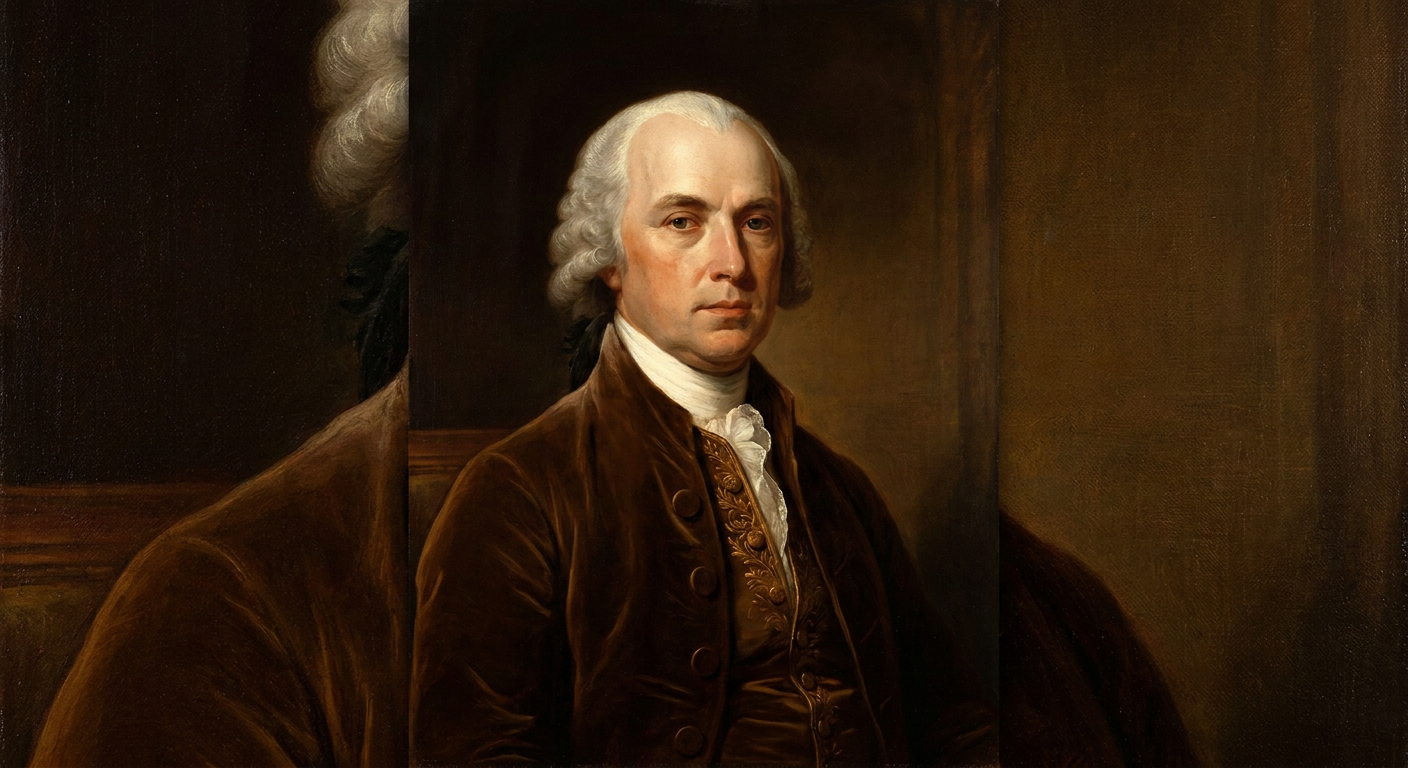
Quick Facts
- Years
- 1751 – 1836
- Category
- World Leaders & Revolutionaries
- Nationality
- American
- Occupation
- Statesman, political theorist, planter, and fourth U.S. president
James Madison
1751 – 1836 · American · Statesman, political theorist, planter, and fourth U.S. president
Recommended Audiobooks
Listen next from Marcus Alden

Life Lessons from Simon Bolivar
Marcus Alden · 55 min

Life Lessons from George Washington
Marcus Alden · 54 min
James Madison helped design the political machinery of the United States, then spent much of his career discovering how difficult that machinery could be to operate. A small, scholarly Virginian with a quiet manner, he became a leading architect of the Constitution, an author of the Federalist Papers, a founder of the Democratic-Republican Party, secretary of state, and the fourth president of the United States.
Madison is often called the “Father of the Constitution,” although the document was the work of many delegates and emerged through negotiation rather than from one mind. His preparation, proposals, speeches, and detailed convention notes nevertheless made him central to its creation. He also helped secure the Bill of Rights, transforming amendments he had initially regarded as unnecessary into enduring protections for civil liberty.
His record contains profound contradictions. Madison defended religious freedom and representative government while enslaving people throughout his life. He warned against concentrated power but expanded federal authority in practice. As president, he led the country into the War of 1812, a conflict marked by military disasters as well as a renewed sense of national confidence.
Madison remains worth studying because he understood that free government depends neither on perfect leaders nor simple formulas. It requires institutions capable of controlling power, informed citizens, compromise, and continual revision—lessons that remain central to constitutional democracy.
Quick Facts
| Field | Information |
|---|---|
| Full Name | James Madison Jr. |
| Common Name(s) | James Madison; “Father of the Constitution” |
| Born | March 16, 1751 |
| Died | June 28, 1836 |
| Age at Death | 85 |
| Birthplace | Belle Grove plantation, near Port Conway, Virginia Colony |
| Nationality | American |
| Occupation | Statesman, political theorist, planter, congressman, secretary of state, president |
| Historical Era | American Revolution and Early Republic |
| Famous For | Shaping the Constitution, writing the Federalist Papers, supporting the Bill of Rights, and serving as fourth president |
| Political Affiliation | Democratic-Republican; earlier associated with the Anti-Administration faction |
| Religion | Raised Anglican; championed religious liberty, while his private theology remains debated |
| Education | College of New Jersey, now Princeton University |
| Parents | James Madison Sr. and Eleanor Rose Conway Madison |
| Spouse(s) | Dolley Payne Todd Madison, married 1794 |
| Children | No biological children; stepfather to John Payne Todd, and briefly to William Temple Todd before the child’s death |
| Major Works | Virginia Plan; 29 essays in The Federalist; Memorial and Remonstrance Against Religious Assessments; Notes of Debates in the Federal Convention |
| Major Achievements | Constitution, Bill of Rights, religious-freedom reforms, Louisiana Purchase diplomacy, and presidential leadership during the War of 1812 |
Early Life
Madison was born into Virginia’s plantation elite on March 16, 1751. Although his birthplace was his maternal grandparents’ home near Port Conway, he grew up at Montpelier in Orange County. His father was a wealthy planter and local public official; his mother came from another established Virginia family. The plantation’s prosperity depended upon enslaved labor, a reality that shaped Madison’s opportunities and later became the central moral contradiction of his life.
He was the eldest of twelve children, seven of whom survived infancy. Often described as physically slight, Madison experienced recurring illnesses and episodes that he called a tendency to “sudden attacks, somewhat resembling epilepsy.” Modern retrospective diagnoses are uncertain. His health contributed to periods of anxiety but did not prevent a long public career.
Madison received private instruction before studying with the Reverend Thomas Martin. In 1769 he entered the College of New Jersey, chosen partly because of its reputation for religious and intellectual openness. He completed the usual four-year course in roughly two years, then remained for further study under college president John Witherspoon.
Witherspoon, a Scottish-born minister and later signer of the Declaration of Independence, exposed Madison to moral philosophy, history, rhetoric, Hebrew, and Enlightenment political thought. Madison learned to analyze government through both classical history and recent experience. Religious persecution in Virginia also affected him deeply. In 1774 he condemned the imprisonment of Baptist preachers, an early sign of his commitment to freedom of conscience.
Rise to Prominence
Madison entered public life during the American Revolution. In 1776 he served in the Virginia constitutional convention and helped revise George Mason’s proposed declaration on religion. Madison’s wording favored the “free exercise of religion,” a broader principle than mere toleration by government.
After losing a 1777 election—partly, according to the traditional account, because he refused the customary practice of supplying voters with food and drink—he joined Virginia’s Council of State. There he worked with Governor Thomas Jefferson, beginning one of the most consequential political friendships in American history.
From 1780 to 1783 Madison represented Virginia in the Continental Congress. He watched the national government struggle to raise revenue, regulate trade, and enforce decisions under the Articles of Confederation. The experience convinced him that independence might collapse unless the union gained effective authority.
Returning to the Virginia legislature, he opposed state-supported religion. His 1785 Memorial and Remonstrance Against Religious Assessments helped defeat Patrick Henry’s proposed tax for Christian teachers. Jefferson’s Virginia Statute for Religious Freedom then passed in 1786 with Madison’s guidance.
Madison also encouraged the 1786 Annapolis Convention, which called for a broader meeting in Philadelphia. Before that meeting, he studied ancient confederacies and modern governments, summarizing their failures in a memorandum known as “Vices of the Political System of the United States.” He arrived in Philadelphia better prepared than almost any other delegate.
Major Achievements
Shaping the Constitution
At the Constitutional Convention of 1787, Madison introduced ideas embodied in the Virginia Plan: a national government with separate legislative, executive, and judicial branches; a two-house legislature; and authority operating directly upon individuals rather than merely upon states.
He did not get everything he wanted. Madison opposed equal state representation in the Senate and favored a federal veto over state laws. Both proposals failed. Compromises—including the Three-Fifths Clause and protections for the Atlantic slave trade—bound the new system to slavery. Madison participated in these bargains, even while recognizing slavery as a source of division and injustice.
His influence lay not in dictating the final text but in framing its major problems and repeatedly defending a stronger union. His extensive notes, published after his death, became the fullest record of the convention, although scholars caution that they are not a verbatim transcript and were revised later.
Defending Ratification
With Alexander Hamilton and John Jay, Madison wrote The Federalist under the name “Publius.” Madison authored 29 of its 85 essays. In Federalist No. 10, he argued that a large republic could manage competing factions better than a small one. In Federalist No. 51, he explained how divided powers and institutional checks could restrain ambition.
At Virginia’s ratifying convention, Madison answered formidable opponents including Patrick Henry and George Mason. Virginia narrowly ratified the Constitution in June 1788, an essential victory for the new government.
Securing the Bill of Rights
Madison initially doubted that written guarantees would provide much protection, and he feared that listing rights might imply that unlisted rights did not exist. Yet he had promised amendments during ratification and understood their political importance.
As a member of the first House of Representatives, he introduced amendments drawn from state proposals. Congress approved twelve; the states ratified ten in 1791 as the Bill of Rights. Madison’s role connected constitutional structure with explicit protections for speech, religion, assembly, due process, and other liberties.
Building an Opposition Party
Madison initially cooperated with President George Washington’s administration but broke with Treasury Secretary Alexander Hamilton over finance and constitutional interpretation. Working with Jefferson, he organized opposition to Hamilton’s program and helped develop the Democratic-Republican Party.
This was historically important because the Constitution said nothing about parties, and many founders distrusted them. Nevertheless, organized opposition made electoral competition possible and established the legitimacy of criticizing an administration without rejecting the constitutional order.
Secretary of State and the Louisiana Purchase
As Jefferson’s secretary of state from 1801 to 1809, Madison supervised foreign affairs during the Louisiana Purchase. The 1803 acquisition from France doubled the nation’s territory and secured control of New Orleans. Jefferson took the leading presidential role, while diplomats Robert Livingston and James Monroe negotiated the agreement; Madison helped administer and defend it.
The purchase offered enormous opportunities for expansion but also accelerated Indigenous dispossession and the extension of slavery. Its constitutional basis was not explicit, exposing tension between the administration’s strict-construction rhetoric and practical statecraft.
Presidency and the War of 1812
Madison won the presidency in 1808 and took office in 1809. Britain and France were interfering with American trade during the Napoleonic Wars, while British forces impressed sailors from American vessels. Diplomatic and economic pressure repeatedly failed.
Congress declared war on Britain in June 1812 at Madison’s request. The war went badly at first. In 1814 British troops entered Washington and burned public buildings, including the President’s House and Capitol. American forces nevertheless defended Baltimore, and victories at Lake Erie and the Thames improved morale.
The Treaty of Ghent ended the war without resolving every stated maritime grievance, many of which had faded with Napoleon’s defeat. Andrew Jackson’s victory at New Orleans occurred after the treaty was signed but before news arrived. The conflict confirmed that the United States would remain independent, encouraged domestic manufacturing, and weakened Indigenous resistance east of the Mississippi—often through devastating loss of Native lands.
Leadership or Work
Madison led through preparation, writing, private persuasion, and coalition building. He was rarely a commanding public speaker. His strength was diagnosing institutional problems and converting abstract principles into workable proposals.
As a legislator, he mastered detail and maintained extensive correspondence. As a party strategist, however, he could be intensely partisan. The Virginia and Kentucky Resolutions, written secretly by Madison and Jefferson in response to the Alien and Sedition Acts, advanced strong claims about states resisting unconstitutional federal action. Madison later rejected interpretations that allowed a single state to nullify federal law.
His presidency exposed weaknesses in his style. Madison tolerated cabinet rivalries, relied on some ineffective officials, and entered war with inadequate military and financial preparation. Yet he respected elections, civilian authority, and dissent. He did not use wartime conditions to conduct a broad assault on opposition newspapers or imprison political critics.
Personal Life
Madison married Dolley Payne Todd, a young Quaker widow, in 1794. Aaron Burr helped introduce them. Dolley’s social skill complemented Madison’s reserved temperament. As a presidential hostess, she created gatherings where political opponents could meet informally, making sociability an instrument of government.
The couple had no children together. Madison became stepfather to Dolley’s surviving son, John Payne Todd, whose gambling, debts, and instability caused repeated family distress. Madison spent substantial sums rescuing him financially.
Madison enjoyed reading, conversation, agriculture, and political correspondence. At Montpelier he managed plantation affairs and lived among relatives, workers, and enslaved people. Accounts of his personal courtesy should not obscure the coercive system supporting his household.
His health was often fragile, yet he lived longer than any previous U.S. president. Dolley was present when he died at Montpelier on June 28, 1836.
Philosophy or Beliefs
Madison believed liberty was threatened both by oppressive rulers and by majorities willing to sacrifice minority rights. His solution was not to eliminate conflict—an impossible goal—but to distribute power among institutions and across a large republic.
He treated factions as unavoidable because people possess different beliefs, abilities, and property. Government should prevent any one faction from easily dominating. Separation of powers, federalism, elections, and an extended republic formed parts of this protective system.
Religious freedom was central to his thought. He argued that faith belonged to conscience and that government support could corrupt religion as well as endanger citizens. Scholars disagree over the details of his private theology. He was raised Anglican and used religious language, but he kept his personal beliefs guarded; confidently labeling him either an orthodox Christian or a deist goes beyond the evidence.
Madison’s universal language of rights clashed with slavery. He called slavery wrong and at times supported gradual colonization—the removal of free Black Americans to Africa—an approach now recognized as deeply paternalistic and opposed by many Black Americans. He neither freed the people he enslaved during his lifetime nor devised an effective emancipation plan.
Challenges and Controversies
Slavery
Madison enslaved more than 100 people at Montpelier at various times. His wealth, status, and public career depended partly upon their labor. Although he acknowledged slavery’s injustice, he prioritized property, family finances, racial assumptions, and political union over emancipation. This is not merely a modern criticism: abolitionists and free Black activists in his own era challenged slavery directly.
Constitutional compromises
The Constitution strengthened a union containing both free and slave states. Madison opposed some proslavery demands but accepted compromises that increased slaveholding states’ political power. Defenders emphasize the danger of the convention’s collapse; critics answer that stability was purchased at the expense of enslaved people.
Civil liberties and political opposition
Madison opposed the Alien and Sedition Acts as unconstitutional. Yet his Virginia Resolutions contributed language later invoked by nullification advocates. He insisted that the resolutions expressed collective protest by states, not a legal right for one state to invalidate national law, but the ambiguity had lasting consequences.
Embargo and war
As secretary of state, Madison supported Jefferson’s Embargo Act, which harmed American commerce without forcing Britain or France to respect neutral rights. As president, his administration underestimated the difficulty of conquering Canada and was poorly prepared for war. Critics called the War of 1812 unnecessary; supporters regarded resistance to British pressure as vital to national sovereignty.
Native American dispossession
Expansion under Jefferson and Madison increased pressure on Indigenous nations. The War of 1812 and conflicts involving Tecumseh’s confederacy ended with greater American control of Native lands. Describing this only as national growth overlooks broken autonomy, displacement, and violence.
Legacy
Madison’s greatest legacy is constitutional government designed around human imperfection. Courts, lawmakers, and citizens still quote his analysis of factions, checks and balances, religious liberty, and public knowledge. His arguments influence constitutional interpretation far beyond the United States.
The label “Father of the Constitution” recognizes his extraordinary work but can conceal the contributions of other delegates and the public debates that shaped ratification. It can also place heroic emphasis on a political order that excluded women, Indigenous peoples, and most Black Americans from meaningful power.
Montpelier is preserved as a historic site in Virginia. Its interpretation increasingly centers the enslaved community as well as the Madison family. James Madison University, Madison, Wisconsin, Madison Square, numerous counties, schools, and streets bear his name. His portrait appeared on the U.S. $5,000 bill, which is no longer issued.
His modern relevance lies in the questions he posed: How can majorities govern without becoming oppressive? How can institutions restrain officials? What happens when parties place victory above constitutional norms? Madison supplied no final answers, but he created a framework in which those questions continue to be contested.
Interesting Facts
- Madison was the shortest U.S. president, commonly reported at about 5 feet 4 inches.
- He was the first graduate of Princeton to become president.
- He studied Hebrew as part of his education.
- He arrived at the Constitutional Convention with extensive research on failed confederacies.
- He spoke frequently in Philadelphia but did not always prevail.
- He kept the most detailed surviving notes of the convention.
- His notes were published only after his death, as convention delegates had agreed to secrecy.
- He wrote 29 Federalist essays; Hamilton wrote most of the remainder.
- Madison was the only president to accompany troops toward an active battlefield while in office, during the British advance on Washington in 1814.
- Dolley Madison directed the removal of important objects from the President’s House before the British arrived.
- The original portrait of George Washington saved from the mansion was by Gilbert Stuart.
- Both of Madison’s vice presidents died in office.
- He was the last surviving major participant in the Constitutional Convention.
- His second inauguration was the first presidential inauguration followed by an organized inaugural ball.
- He opposed a national bank before later accepting the practical need for one.
- He served as rector of the University of Virginia after Jefferson’s death.
- He helped revise Virginia’s declaration of rights while only 25.
- He and Dolley had a 43-year marriage but no biological children together.
Famous Quotes
- “The latent causes of faction are thus sown in the nature of man.” — Federalist No. 10 (1787). Madison meant that political conflict arises from persistent differences among people and cannot simply be abolished.
- “If men were angels, no government would be necessary.” — Federalist No. 51 (1788). The line explains why institutions must account for human self-interest.
- “Ambition must be made to counteract ambition.” — Federalist No. 51. Madison defended checks that give officials motives to resist encroachment by other branches.
- “Justice is the end of government. It is the end of civil society.” — Federalist No. 51. Government’s ultimate purpose, he argued, is not power but justice.
- “Liberty is to faction what air is to fire.” — Federalist No. 10. Suppressing liberty to eliminate political division would destroy the cure along with the disease.
- “The accumulation of all powers, legislative, executive, and judiciary, in the same hands…may justly be pronounced the very definition of tyranny.” — Federalist No. 47 (1788). Madison summarized the case for separated powers.
- “Religion…must be left to the conviction and conscience of every man.” — Memorial and Remonstrance (1785). This expressed his opposition to state-supported religion.
- “A popular Government, without popular information…is but a Prologue to a Farce or a Tragedy.” — Letter to W. T. Barry (1822). Self-government, Madison warned, requires public knowledge.
- “Knowledge will forever govern ignorance.” — The same 1822 letter. Citizens seeking self-rule must equip themselves through education.
- “The advancement and diffusion of knowledge is the only guardian of true liberty.” — Commonly attributed to Madison, but no secure primary-source wording has been established; it should not be treated as authenticated.
Timeline
- 1751 — Born near Port Conway, Virginia.
- 1769 — Enters the College of New Jersey.
- 1771 — Completes his undergraduate degree.
- 1776 — Serves in Virginia’s revolutionary convention.
- 1780 — Joins the Continental Congress.
- 1784 — Returns to the Virginia legislature.
- 1785 — Writes the Memorial and Remonstrance.
- 1786 — Helps secure passage of the Virginia Statute for Religious Freedom and supports the Annapolis Convention.
- 1787 — Presents the Virginia Plan and participates in the Constitutional Convention.
- 1787–1788 — Writes 29 essays for The Federalist.
- 1788 — Helps win Virginia’s ratification.
- 1789 — Enters the House of Representatives and proposes constitutional amendments.
- 1791 — Bill of Rights is ratified.
- 1794 — Marries Dolley Payne Todd.
- 1798 — Drafts the Virginia Resolutions.
- 1801 — Becomes secretary of state.
- 1803 — Helps administer the Louisiana Purchase.
- 1808 — Elected president.
- 1809 — Begins first presidential term.
- 1812 — Wins reelection; United States declares war on Britain.
- 1814 — British forces burn Washington; Treaty of Ghent is signed.
- 1815 — Battle of New Orleans brings a dramatic American victory.
- 1816 — Approves the Second Bank of the United States.
- 1817 — Leaves office and retires to Montpelier.
- 1826 — Becomes rector of the University of Virginia.
- 1836 — Dies at Montpelier on June 28.
Frequently Asked Questions
1. Why is James Madison called the Father of the Constitution?
Madison prepared extensively for the convention, helped formulate the Virginia Plan, spoke frequently during debate, defended ratification, and preserved detailed notes. The title is useful shorthand but should not imply sole authorship. Gouverneur Morris drafted much of the final language, while George Washington, Benjamin Franklin, James Wilson, Roger Sherman, and many others shaped the compromises. The Constitution also gained legitimacy only through state ratifying conventions.
2. What did Madison contribute to the Federalist Papers?
He wrote 29 of the 85 essays, although authorship of a few was once disputed before scholarly analysis clarified the division. His best-known contributions include Nos. 10, 39, 47, 48, and 51. They examine factions, republican government, federalism, and separated powers. Courts often cite them as evidence about constitutional reasoning, though they are advocacy essays rather than legally binding text.
3. Did Madison write the Constitution?
No single person wrote the Constitution. Madison proposed a broad framework and influenced many provisions, but convention committees drafted and revised the document. His preferred federal veto over state laws failed, as did his opposition to equal representation for states in the Senate. The final Constitution was a negotiated product containing ideas Madison supported, compromises he disliked, and provisions tied to slavery.
4. What was Madison’s role in the Bill of Rights?
Madison introduced proposed amendments in the House in June 1789, organized suggestions from state ratifying conventions, and guided the project through Congress. He wanted some protections incorporated into the Constitution’s text, but Congress chose a supplementary list. Ten amendments were ratified in 1791. His advocacy was decisive, although the demands of Anti-Federalists and state conventions created the political pressure for action.
5. What was Madison’s position on religion?
He strongly supported freedom of conscience and opposed government funding or establishment of religion. His Memorial and Remonstrance argued that faith should not be directed by civil authority. Madison’s private theology is less certain because he rarely made personal declarations. Historians therefore distinguish his well-documented political defense of religious liberty from debated claims about whether he was conventionally Christian, rationalist, or deist.
6. Did James Madison own enslaved people?
Yes. Madison grew up in a slaveholding family and enslaved people at Montpelier throughout his adult life. More than 100 enslaved individuals lived there at various times. He recognized slavery as unjust and discussed colonization and gradual solutions, but he did not free the people he held during his lifetime. His conduct demonstrates the severe gap between his language of liberty and his dependence upon human bondage.
7. Why did the United States enter the War of 1812?
Madison cited British interference with American shipping, impressment of sailors, and threats to national sovereignty. Some western and southern legislators also hoped to defeat British-supported Indigenous resistance and possibly conquer Canada. Federalists argued that war was reckless and economically destructive. The causes therefore combined maritime rights, national honor, party politics, expansion, and frontier conflict rather than resting on one grievance.
8. Did the United States win the War of 1812?
The answer depends on the standard used. The Treaty of Ghent restored prewar boundaries and did not explicitly end impressment, so the United States achieved no clear territorial victory over Britain. Yet it survived war with a major power and emerged with increased national confidence. Britain secured Canada, while Indigenous nations suffered the most damaging strategic defeat because British support declined and American expansion accelerated.
9. Was Madison a strong president?
Assessments are mixed. He maintained constitutional government during war, adapted policies when experience demanded it, and presided over a durable peace. However, his administration entered the war poorly prepared, suffered command failures, and could not prevent Washington’s destruction. Many historians consider him more successful as a constitutional thinker and legislator than as an executive, though his restraint toward domestic dissent receives praise.
10. What was Madison’s relationship with Thomas Jefferson?
They were close friends, political partners, and prolific correspondents. Madison helped pass Jefferson’s religious-freedom statute, supported his presidential administration, and served as his secretary of state. Together they built the Democratic-Republican opposition to Federalist policies. Madison was often more attentive to institutional detail, while Jefferson supplied broader ideological language. Their partnership shaped American party politics for several decades.
11. Why did Madison oppose Hamilton?
Madison feared that Hamilton’s financial system favored creditors, concentrated influence, and interpreted federal power too broadly. He opposed the First Bank of the United States as lacking constitutional authorization. Hamilton believed public credit, manufacturing, and energetic national authority were essential. Their dispute helped create the first party system. As president, Madison later accepted a second national bank, illustrating how governing experience modified his earlier position.
12. What was the Virginia Plan?
The Virginia Plan was a proposal presented by Edmund Randolph but largely prepared by Madison and other Virginia delegates. It envisioned a substantially stronger national government with three branches and a bicameral legislature based on population or financial contribution. It became the convention’s starting point, not its final blueprint. Small states resisted its representation formula, producing the compromise that gave every state two senators.
13. What did Madison mean by “faction”?
He used “faction” for a group united by an interest or passion adverse to other citizens’ rights or the community’s lasting interests. Because liberty and human diversity inevitably generate groups, he rejected attempts to eliminate faction entirely. His proposed remedy was a large representative republic where numerous interests would compete, making durable oppression by one majority less likely. Modern political parties are related to, but not identical with, his concept.
14. What happened when Washington was burned?
In August 1814 British troops defeated American defenders at Bladensburg and entered the capital. Madison had observed the military preparations and narrowly avoided capture. British forces burned the Capitol, President’s House, and other government buildings. Dolley Madison had already left after directing that valuables and a Washington portrait be removed. The episode exposed severe American unpreparedness but did not end the war or destroy the government.
15. Did Dolley Madison save the Washington portrait herself?
Dolley Madison ordered that the portrait be saved as evacuation became urgent. Staff members and others physically removed it by breaking or unscrewing its frame. Thus, the familiar image of Dolley personally carrying the painting is misleading, but her decision and insistence were real. The rescued work was Gilbert Stuart’s full-length portrait of George Washington, now displayed in the White House.
16. Where is Madison buried?
He is buried in the Madison family cemetery at Montpelier in Orange County, Virginia. Montpelier preserves the mansion, landscape, archaeological sites, and evidence of the enslaved community. Modern interpretation there presents Madison’s constitutional achievements alongside the lives of people whose forced labor sustained the plantation, giving visitors a fuller understanding of both the nation’s ideals and its exclusions.
Lessons We Can Learn
- Prepare before negotiating. Madison’s comparative study gave him influence in Philadelphia; informed preparation still improves decision-making.
- Design institutions for imperfect people. His checks and balances assumed self-interest would persist, a historically grounded insight applicable to modern organizations.
- Compromise has moral costs. The Constitution endured, but its slavery compromises harmed millions; practicality does not erase responsibility.
- Protect dissent. Madison opposed the Sedition Act and tolerated wartime criticism, demonstrating that opposition can strengthen constitutional government.
- Revise views when evidence changes. His later acceptance of a national bank reflected experience, though critics may call it inconsistency.
- Political conflict cannot simply be wished away. Federalist No. 10 treated disagreement as normal and sought rules for managing it fairly.
- Rights need both principles and enforcement. Madison learned that structural safeguards and written guarantees could reinforce each other.
- Expertise does not guarantee executive success. His wartime difficulties show that theoretical knowledge and administrative command are different skills.
- Education supports self-government. His letters consistently linked public knowledge with republican survival; applying this today is a modern interpretation grounded in his writings.
- Judge ideals alongside conduct. Madison’s enslavement of people warns against evaluating leaders only by their finest words.
Related Historical Figures
- Thomas Jefferson — Madison’s closest political partner, mentor, president, and fellow founder of the Democratic-Republican movement.
- Alexander Hamilton — Coauthor of The Federalist and later Madison’s leading rival over finance and national power.
- George Washington — Presided over the Constitutional Convention and led the first administration in which Madison was initially influential.
- Dolley Madison — His wife, political partner, and a defining figure in Washington’s social culture.
- John Jay — The third author of The Federalist and an important diplomat and jurist.
- George Mason — Virginia delegate whose objections influenced demands for a bill of rights.
- Patrick Henry — Powerful opponent of ratification whom Madison confronted in Virginia.
- James Monroe — Fellow Virginian, diplomat, wartime cabinet member, and Madison’s presidential successor.
- John Adams — Federalist rival whose Alien and Sedition Acts prompted Madison’s Virginia Resolutions.
- Tecumseh — Shawnee leader whose resistance confederacy reveals the Indigenous consequences of expansion during Madison’s era.
Watch and Learn
“The Constitution, the Articles, and Federalism: Crash Course US History #8” — CrashCourse — approximately 13 minutes. This widely viewed educational overview clearly explains why the Articles of Confederation failed, how the Constitution changed national power, and where Madison’s ideas fit into the debate. Its brisk presentation is best used as an introduction alongside more detailed sources, especially for the Constitution’s compromises over slavery.
Watch and Learn
The Constitution, the Articles, and Federalism: Crash Course US History #8 · CrashCourse
Related Historical Figures