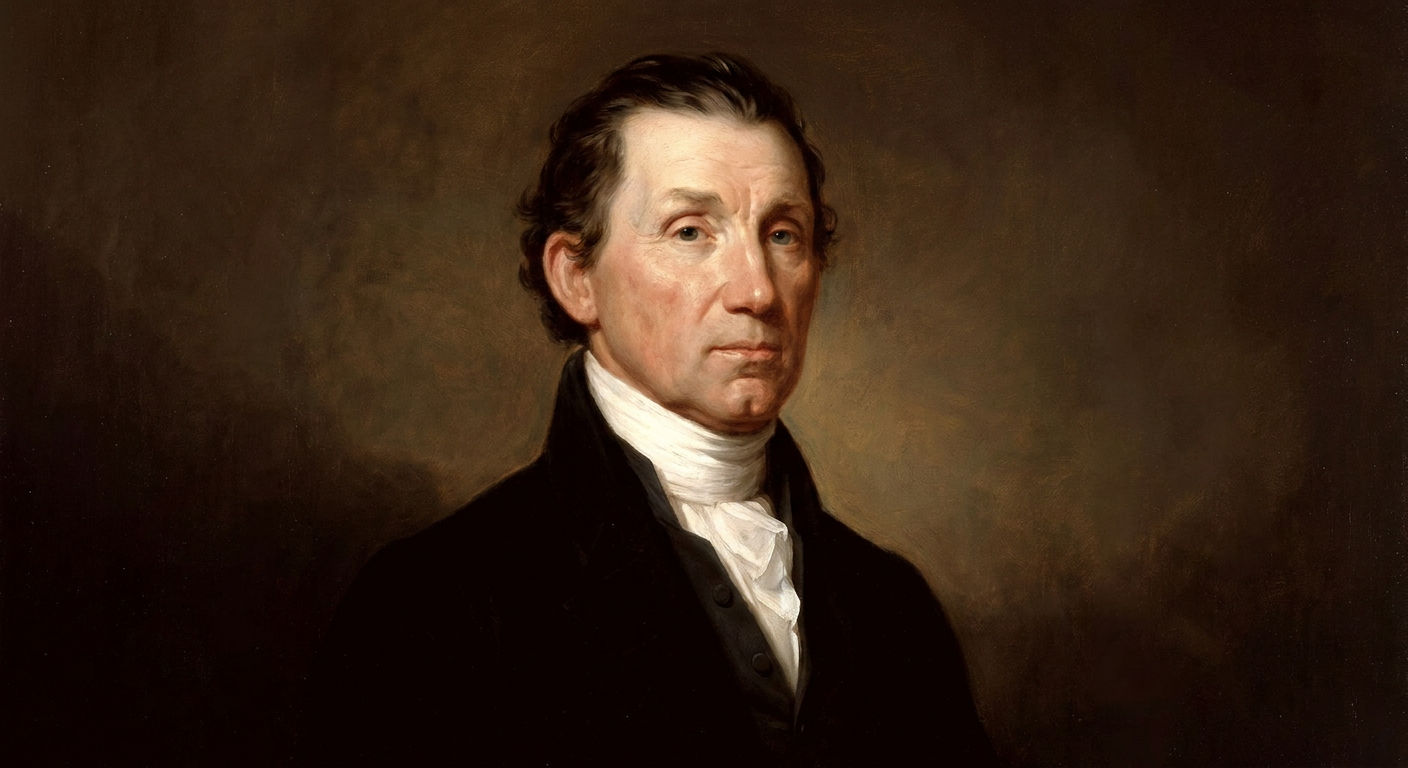
Quick Facts
- Years
- 1758 – 1831
- Category
- World Leaders & Revolutionaries
- Nationality
- American
- Occupation
- Statesman, diplomat, lawyer, soldier, and fifth president of the United States
James Monroe
1758 – 1831 · American · Statesman, diplomat, lawyer, soldier, and fifth president of the United States
Recommended Audiobooks
Listen next from Marcus Alden

Life Lessons from Simon Bolivar
Marcus Alden · 55 min

Life Lessons from George Washington
Marcus Alden · 54 min
James Monroe was the last American president to have fought in the Revolutionary War and the final chief executive associated closely with the generation that founded the United States. Soldier, lawyer, diplomat, governor, cabinet secretary, and president, he spent nearly five decades helping transform a fragile union of former colonies into an expanding republic with growing international influence.
Monroe’s presidency, from 1817 to 1825, became known as the Era of Good Feelings because organized party conflict briefly subsided. The label can be misleading: the nation still faced economic crisis, sectional conflict over slavery, disputes about federal power, and violence along its borders. Nevertheless, Monroe’s conciliatory public style helped restore confidence after the War of 1812.
His name remains most closely associated with the Monroe Doctrine, the 1823 declaration opposing further European colonization in the Americas. Although Secretary of State John Quincy Adams played the leading role in shaping its language, Monroe made it national policy and accepted responsibility for announcing it.
Monroe’s career also reveals the contradictions of the early republic. He defended representative government and national independence while enslaving people throughout his life. Students continue to examine him because his record connects the Revolution, territorial expansion, slavery, economic change, and the emergence of the United States as a power in the Western Hemisphere.
Quick Facts
| Field | Details |
|---|---|
| Full Name | James Monroe |
| Common Name(s) | James Monroe; sometimes called the Last Cocked Hat because he retained Revolutionary-era dress |
| Born | April 28, 1758 |
| Died | July 4, 1831 |
| Age at Death | 73 |
| Birthplace | Westmoreland County, Colony of Virginia, British America |
| Nationality | American |
| Occupation | Soldier, lawyer, diplomat, legislator, governor, cabinet secretary, and president |
| Historical Era | American Revolution and Early Republic |
| Famous For | Fifth U.S. president, the Monroe Doctrine, the Era of Good Feelings, and acquiring Florida |
| Political Affiliation | Democratic-Republican |
| Religion | Raised in Virginia’s Anglican tradition; his precise adult beliefs remain uncertain because he rarely discussed religion publicly |
| Education | College of William and Mary; studied law under Thomas Jefferson but did not earn a college degree |
| Parents | Spence Monroe and Elizabeth Jones Monroe |
| Spouse(s) | Elizabeth Kortright Monroe |
| Children | Eliza Kortright Monroe Hay, James Spence Monroe, and Maria Hester Monroe Gouverneur; James died in infancy |
| Major Works | Presidential messages, including the 1823 annual message containing the Monroe Doctrine; A View of the Conduct of the Executive |
| Major Achievements | Revolutionary War service, Louisiana Purchase diplomacy, Florida acquisition, postwar national reconciliation, and the Monroe Doctrine |
Early Life
James Monroe was born into Virginia’s planter society. His father, Spence Monroe, worked as a planter and carpenter, while his mother, Elizabeth Jones Monroe, came from a locally prominent family. Both parents died while James was young, leaving him and his siblings under the supervision of relatives. His maternal uncle, Joseph Jones, became particularly important in guiding his education and career.
Monroe attended Campbelltown Academy under the Reverend Archibald Campbell before entering the College of William and Mary in Williamsburg in 1774. Colonial politics soon disrupted his studies. Tensions with Britain were escalating, and Virginia’s capital had become a center of revolutionary activity.
In 1775 Monroe and other students participated in a raid on the Governor’s Palace arsenal, where patriots obtained weapons for the revolutionary cause. He left college without a degree and joined the Continental Army in 1776.
As an officer in the 3rd Virginia Regiment, Monroe crossed the Delaware with George Washington’s army and fought at Trenton on December 26, 1776. A musket ball struck his shoulder and severed an artery. Physician John Riker treated the wound, probably saving his life. Monroe later fought at Brandywine, Germantown, and Monmouth and served on the staff of General William Alexander, known as Lord Stirling.
The war gave Monroe practical lessons in endurance, administration, leadership, and national unity. It also placed him within the Revolutionary network that shaped his later career. After failing to obtain troops for a new command, he studied law under Virginia governor Thomas Jefferson. Jefferson became his mentor, political ally, and lifelong friend.
Rise to Prominence
Monroe entered the Virginia House of Delegates in 1782 and soon joined the Confederation Congress. There he became interested in western settlement, navigation rights on the Mississippi River, and the weaknesses of the government created by the Articles of Confederation.
He opposed ratification of the U.S. Constitution in 1788. Monroe did not reject union, but he feared that the proposed federal government possessed insufficient safeguards for individual liberty and state authority. Once the Constitution was adopted and a Bill of Rights proposed, he worked within the new system.
In 1790 Virginia sent him to the U.S. Senate. A Democratic-Republican ally of Jefferson and James Madison, Monroe criticized Alexander Hamilton’s financial program and the Washington administration’s increasingly pro-British foreign policy.
President Washington nevertheless appointed him minister to France in 1794. Monroe warmly embraced the French Republic and helped secure the release of Americans detained during the French Revolution, including Thomas Paine and Madame de Lafayette. His enthusiasm pleased France but troubled officials at home who expected stricter neutrality. Washington recalled him in 1796.
Monroe defended himself in the published work A View of the Conduct of the Executive. He later served as governor of Virginia from 1799 to 1802 and briefly returned in 1811.
His greatest diplomatic opportunity arrived in 1803. Jefferson sent him to France to assist Robert R. Livingston in seeking New Orleans and territory east of the Mississippi. Napoleon unexpectedly offered all of Louisiana. The resulting Louisiana Purchase doubled the nominal size of the United States for about $15 million and made Monroe nationally prominent.
Monroe then served as minister to Britain. He and William Pinkney negotiated the 1806 Monroe–Pinkney Treaty, but Jefferson refused to submit it to the Senate because it did not end British impressment of American sailors. The rejection strained Monroe’s relationship with Madison and Jefferson, although the breach was eventually repaired.
Major Achievements
Service in the Revolutionary War
Monroe’s combat record gave him unusual credibility in later public life. He had personally risked his life for independence and remained visibly connected to the founding generation. His service shaped his concern for military preparedness while also making him wary of unnecessary conflict.
The Louisiana Purchase
Monroe did not conceive the purchase alone, and Livingston conducted important negotiations before his arrival. Even so, Monroe had authority to act and joined Livingston in accepting Napoleon’s offer. The acquisition secured New Orleans, strengthened control of the Mississippi, and opened vast lands to U.S. expansion. That expansion also accelerated Indigenous dispossession and the political struggle over slavery.
Postwar Reconciliation
Elected president in 1816, Monroe toured the country in 1817 to inspect defenses and encourage national unity. A Boston newspaper described the atmosphere surrounding his visit as an “era of good feelings.” Monroe avoided aggressively partisan rhetoric and appointed officials from different regions, although almost all belonged to the Democratic-Republican coalition.
Acquisition of Florida
Spanish authority in Florida had weakened while cross-border conflict involved U.S. settlers, Seminoles, escaped enslaved people, and Spanish officials. General Andrew Jackson invaded Spanish Florida during the First Seminole War, exceeding or at least stretching his instructions—a question historians still debate.
Secretary of State John Quincy Adams used Spain’s vulnerability to negotiate the 1819 Adams–Onís Treaty. Spain ceded Florida, the United States assumed up to $5 million in American claims against Spain, and the countries established a continental boundary. The treaty took effect in 1821.
The Monroe Doctrine
In 1823 Monroe announced that the American continents were no longer open to European colonization. He warned European monarchies against extending their political systems into the Western Hemisphere while promising that the United States would generally avoid European wars and existing colonies.
Britain’s navy, rather than American military power, initially provided the practical barrier to European intervention. The doctrine therefore began as a declaration of principle, not an immediately enforceable command. Later governments expanded it far beyond Monroe’s original formulation, sometimes using it to justify intervention in Latin America.
National Development and Defense
Monroe supported coastal fortifications, a stronger navy, surveying, and carefully planned national development. He signed legislation admitting Mississippi, Illinois, Alabama, Maine, and Missouri, reflecting the republic’s rapid growth. He also promoted improved federal administration after weaknesses exposed by the War of 1812.
Leadership or Work
Monroe governed through patience, personal consultation, and attention to regional balance. He was less intellectually dazzling than Jefferson or Adams, but he possessed persistence, political experience, and an ability to recover from setbacks.
His cabinet included strong figures, especially John Quincy Adams at State, William H. Crawford at Treasury, John C. Calhoun at War, and William Wirt as attorney general. Monroe usually listened carefully before deciding, allowing vigorous internal debate. Adams’s diary shows that cabinet disagreements could be sharp even when the administration projected unity.
Monroe’s strengths included:
- Long experience in military, diplomatic, legislative, and executive office.
- Loyalty to colleagues and commitment to republican government.
- Sensitivity to regional opinion.
- Willingness to travel, inspect defenses, and gather information directly.
- A preference for consensus over public confrontation.
His weaknesses included uncertain financial management, excessive loyalty to some associates, and a tendency to underestimate the depth of sectional conflict. His effort to transcend party politics reduced open partisan warfare, but it also concealed rivalries that erupted during the election of 1824.
On internal improvements, Monroe took a complicated position. He favored roads and canals in principle but doubted that the Constitution authorized broad federal construction powers. In 1822 he vetoed a bill concerning toll collection on the Cumberland Road while arguing that a constitutional amendment could provide clearer authority.
Personal Life
Monroe married Elizabeth Kortright in New York in 1786. The daughter of merchant Laurence Kortright, Elizabeth was known for elegance and reserve. During the couple’s diplomatic service in France, she helped secure the release of Madame de Lafayette from imprisonment, earning admiration in French and American circles.
They had three children, although their son, James Spence Monroe, died in infancy. Eliza married George Hay, a lawyer who later prosecuted Aaron Burr. Maria married Samuel L. Gouverneur in the White House in 1820, generally recognized as the first child of a president to be married there.
Monroe enjoyed horseback riding and retained the formal manners and clothing of the Revolutionary generation. He could appear stiff in public but inspired durable loyalty among friends. Jefferson, Madison, and Monroe maintained an extraordinary Virginia political friendship, despite temporary disagreements.
Like many Virginia planters, Monroe lived beyond his income. Public service was expensive, agricultural returns were uncertain, and he spent years pursuing government reimbursement for diplomatic expenses. Financial pressure forced him to sell property. After leaving the presidency, he resided primarily at Oak Hill in Loudoun County, Virginia.
Elizabeth died in 1830. In poor health and burdened by debt, Monroe moved to New York City to live with his daughter Maria. He died there the following year.
Philosophy or Beliefs
Monroe believed that republican government depended on civic virtue, national independence, and a broad sense of common interest. He distrusted hereditary monarchy and European great-power politics, experiences reinforced by his service in Revolutionary France and Britain.
He began as a defender of states’ rights and a critic of concentrated federal authority. Experience changed him. The failures of the Articles of Confederation, foreign pressure, and the War of 1812 convinced him that the country required capable national institutions, armed forces, and reliable finances. Yet he continued to interpret federal constitutional powers cautiously.
His religious views are difficult to define. He was raised in an Anglican environment and used conventional references to Providence in public messages, but he left little personal theological writing. Claims that he was either conventionally devout or firmly deist go beyond the available evidence.
Monroe’s beliefs about liberty were also bounded by race and his social position. He enslaved people and did not embrace immediate abolition. As president of the American Colonization Society, he supported relocating free Black Americans to Africa. Supporters portrayed colonization as a gradual response to slavery and racism; many Black leaders condemned it for treating free Americans as outsiders and avoiding equal citizenship. Liberia’s capital, Monrovia, was named for him.
Challenges and Controversies
Slavery
The central moral contradiction in Monroe’s life was his ownership of enslaved people while championing liberty. Enslaved labor supported his households and plantations. His colonization work did not challenge slavery directly and offered no equal place for most Black Americans within the United States.
The Missouri Crisis
Missouri’s application for statehood threatened the political balance between free and slave states. The Missouri Compromise of 1820 admitted Maine as free and Missouri as slave while barring slavery north of latitude 36°30′ in most of the remaining Louisiana Territory.
Monroe signed the measures after consulting his cabinet about their constitutionality. The compromise prevented an immediate rupture but did not resolve slavery’s expansion. Later antislavery critics regarded it as an accommodation with injustice; others viewed it as a temporary measure that preserved the Union.
Panic of 1819
The country’s first major peacetime financial crisis brought bank failures, foreclosures, unemployment, and falling land prices. Causes included speculative lending, unstable international markets, and sharp credit contraction by the Second Bank of the United States. Monroe had limited tools under nineteenth-century assumptions about federal power, but suffering damaged confidence in his administration and fueled hostility toward banks and elites.
Andrew Jackson and Florida
Jackson’s invasion of Florida, execution of two British subjects, and punishment of Indigenous leaders created an international crisis. Some cabinet members wanted him censured. Adams defended the campaign’s strategic results and pressured Spain instead. Monroe ultimately retained Jackson, gaining Florida but helping establish a troubling precedent for commanders stretching civilian instructions.
Indigenous Dispossession
Expansion under Monroe increased pressure on Native nations. Treaties were frequently negotiated under unequal conditions, while settlers and officials sought Indigenous lands. The administration did not originate removal policy, but it contributed to the expansionist process that later culminated in forced removals.
Legacy
Monroe left office in 1825 after two terms and with widespread public respect. His presidency marked both the high point of post-Revolutionary political unity and the beginning of new sectional and personal rivalries.
The Monroe Doctrine became his most durable legacy. Presidents and policymakers repeatedly reinterpreted it. In the twentieth century, Theodore Roosevelt’s corollary claimed a U.S. right of intervention in parts of Latin America—an extension many Latin Americans regarded as imperialism. Monroe’s original declaration was narrower, but its language made later expansion possible.
His homes and memorials preserve different parts of his story. James Monroe’s Highland near Charlottesville interprets his plantation world, including the experiences of enslaved people. Oak Hill remains privately owned. His tomb stands in Hollywood Cemetery in Richmond. Monrovia, Liberia; Monroe County names across the United States; schools; streets; and the city of Monroe in several states reflect his public reputation.
Modern scholarship evaluates him more critically than older patriotic accounts did. Historians still recognize his diplomatic experience and successful presidency while emphasizing slavery, Indigenous dispossession, and the limits of the celebrated Era of Good Feelings.
Interesting Facts
- Monroe was the only U.S. president other than Washington to have been wounded in Revolutionary War combat.
- The bullet that struck him at Trenton remained in his body for the rest of his life.
- He left the College of William and Mary to join the Revolution and never completed a degree.
- Thomas Jefferson supervised his legal studies.
- Monroe helped free Thomas Paine from a French prison.
- He was both secretary of state and secretary of war during part of the War of 1812.
- He temporarily directed the War Department after British troops burned Washington.
- Monroe participated in negotiations for the Louisiana Purchase before becoming president.
- His 1817 national tour helped inspire the phrase Era of Good Feelings.
- He was the first president inaugurated outdoors in Washington, in 1817.
- His daughter Maria’s 1820 marriage was the first presidential child’s wedding held at the White House.
- Monroe ran virtually unopposed for reelection in 1820.
- Elector William Plumer cast the sole opposing presidential vote for John Quincy Adams, apparently because he preferred Adams—not, as legend claims, solely to preserve Washington’s unanimous distinction.
- Monroe was the first president to travel by steamboat.
- Liberia’s capital, Monrovia, was named in recognition of his colonization advocacy.
- He died on July 4, exactly five years after Jefferson and Adams died on that date.
- His body was moved from New York to Richmond in 1858, the centennial of his birth.
- He was the last president to wear knee breeches in the older Revolutionary style.
Famous Quotes
- “National honor is national property of the highest value.” — First inaugural address, 1817. Monroe linked international reputation to national security and republican confidence.
- “Discord does not belong to our system.” — First inaugural address. He argued that representative government should channel disagreement without destroying national unity.
- “The American continents ... are henceforth not to be considered as subjects for future colonization by any European powers.” — Annual message, 1823. This became the best-known principle of the Monroe Doctrine.
- “We owe it, therefore, to candor ... to declare that we should consider any attempt on their part to extend their system to any portion of this hemisphere as dangerous to our peace and safety.” — Annual message, 1823. Monroe warned European monarchies against political expansion in the Americas.
- “In the wars of the European powers ... we have never taken any part, nor does it comport with our policy so to do.” — Annual message, 1823. The doctrine paired hemispheric resistance with noninvolvement in European wars.
- “With the existing colonies or dependencies of any European power we have not interfered and shall not interfere.” — Annual message, 1823. Monroe carefully distinguished new colonization from existing possessions.
- “It is only when our rights are invaded or seriously menaced that we resent injuries or make preparation for our defense.” — Annual message, 1823. He presented American policy as defensive rather than expansionist.
- “Our country may be likened to a new house.” — Remarks associated with his 1817 tour. Monroe used the image to describe a nation still arranging and strengthening its institutions; versions of the longer quotation vary by source.
- “The best form of government is that which is most likely to prevent the greatest sum of evil.” — Commonly traced to Monroe’s political writings. It summarizes his practical rather than utopian approach to government.
Timeline
- 1758 — Born in Westmoreland County, Virginia.
- 1774 — Entered the College of William and Mary.
- 1775 — Participated in the seizure of arms from the Governor’s Palace.
- 1776 — Joined the Continental Army and was wounded at Trenton.
- 1777–1778 — Fought in major campaigns and endured the Valley Forge period with the army.
- 1780 — Began studying law under Thomas Jefferson.
- 1782 — Entered the Virginia House of Delegates.
- 1783–1786 — Served in the Confederation Congress.
- 1786 — Married Elizabeth Kortright.
- 1788 — Opposed the Constitution at Virginia’s ratifying convention.
- 1790 — Entered the U.S. Senate.
- 1794–1796 — Served as minister to France.
- 1799–1802 — Served as governor of Virginia.
- 1803 — Helped negotiate the Louisiana Purchase.
- 1803–1807 — Served as minister to Britain, with an additional diplomatic mission to Spain.
- 1811 — Briefly returned as governor, then became secretary of state.
- 1814–1815 — Served simultaneously as secretary of state and acting secretary of war.
- 1816 — Elected fifth president of the United States.
- 1817 — Inaugurated and began his national goodwill tour.
- 1819 — Adams–Onís Treaty signed; Panic of 1819 began.
- 1820 — Signed the Missouri Compromise and won reelection.
- 1821 — Florida formally transferred to the United States.
- 1823 — Announced the principles later called the Monroe Doctrine.
- 1825 — Left the presidency and retired to Virginia.
- 1830 — Elizabeth Monroe died.
- 1831 — Died in New York City on July 4.
- 1858 — Reinterred at Hollywood Cemetery in Richmond.
Frequently Asked Questions
1. What is James Monroe best known for?
Monroe is best known for the 1823 foreign-policy declaration later called the Monroe Doctrine. It opposed further European colonization in the Americas and warned against European political intervention in newly independent nations. He is also associated with the Era of Good Feelings, the acquisition of Florida, and the Missouri Compromise. His earlier service in the Revolution and Louisiana Purchase diplomacy gave him one of the broadest résumés of any American president.
2. Did Monroe personally write the Monroe Doctrine?
The doctrine appeared in Monroe’s annual message to Congress and therefore represented his administration’s policy. Secretary of State John Quincy Adams, however, was its principal intellectual architect and helped draft its wording. Monroe considered advice from Jefferson and Madison, who favored cooperation with Britain, but accepted Adams’s argument for an independent American declaration. It is most accurate to see the doctrine as a collective policy announced under Monroe’s constitutional authority.
3. Why was his presidency called the Era of Good Feelings?
The phrase originated during Monroe’s 1817 national tour, when public celebrations suggested that partisan conflict had eased after the War of 1812. The Federalist Party was collapsing, leaving Monroe’s Democratic-Republicans dominant. Yet the name exaggerates national harmony. The Panic of 1819, conflict over Missouri, disputes about internal improvements, and competition among Monroe’s prospective successors all revealed serious divisions beneath the surface.
4. Was James Monroe a Founding Father?
Definitions vary. Monroe was too young to sign the Declaration of Independence and played no role in drafting the Constitution. Nevertheless, he fought in the Revolution, served in the Confederation Congress, participated in Virginia’s ratifying convention, and worked closely with Washington, Jefferson, and Madison. For those reasons, he is often included among the broader founding generation and described as the last Founding Father to serve as president.
5. How was Monroe wounded at Trenton?
During the American attack on Trenton in December 1776, Lieutenant Monroe took part in an assault on Hessian artillery. A musket ball entered his shoulder and severed an artery. Dr. John Riker clamped or otherwise treated the damaged vessel, preventing fatal blood loss. Monroe recovered and returned to service, although the projectile reportedly remained in his body. The episode became an important part of his Revolutionary reputation.
6. What role did Monroe play in the Louisiana Purchase?
Jefferson sent Monroe to help Robert R. Livingston negotiate for New Orleans and nearby territory. Napoleon instead offered the whole Louisiana Territory. Livingston and Monroe accepted the opportunity and negotiated the purchase for approximately $15 million. Monroe was not its sole architect, but his authorization and willingness to act quickly were important. The purchase secured western commerce while opening immense areas to settlement, Native dispossession, and conflict over slavery.
7. Did Monroe support slavery?
Monroe enslaved people throughout his adult life and did not support immediate abolition. He regarded slavery as a serious problem but favored colonization: the removal of free Black Americans to Africa. Many African Americans rejected this approach because it denied their claim to citizenship in the country of their birth. His record therefore illustrates how some white leaders could acknowledge slavery’s dangers while continuing to benefit from and protect the system.
8. Why did Monroe sign the Missouri Compromise?
The compromise offered a way out of a dangerous sectional deadlock. It admitted Missouri as a slave state, Maine as a free state, and restricted slavery in much of the remaining Louisiana Purchase north of 36°30′. Monroe consulted his cabinet about whether Congress possessed the constitutional power to impose the restriction. He signed the legislation to preserve political balance and union, though the settlement postponed rather than solved the conflict over slavery.
9. What happened during the Panic of 1819?
A collapse in credit and commodity prices produced bank failures, unemployment, foreclosures, and widespread debt. Speculative land purchases and unstable lending had encouraged a boom, while contraction by banks—especially the Second Bank of the United States—intensified the downturn. Monroe believed federal intervention should remain limited. The crisis weakened faith in national financial institutions and helped shape the anti-bank politics associated with Andrew Jackson’s later rise.
10. Was Monroe elected unanimously in 1820?
Almost, but not entirely. Monroe received 231 electoral votes, while New Hampshire elector William Plumer voted for John Quincy Adams. A popular story claims Plumer wanted Washington to remain the only unanimously elected president. Plumer’s surviving comments indicate that he considered Monroe less qualified than Adams and objected to aspects of the administration. Thus, the Washington explanation is an enduring legend rather than the best-supported account.
11. How did Monroe obtain Florida?
Spain’s control of Florida had weakened, and raids across the border increased tensions. Andrew Jackson’s military incursion demonstrated that Spain could not effectively defend the territory. Secretary of State John Quincy Adams then negotiated the Adams–Onís Treaty, under which Spain ceded Florida and the United States assumed certain American claims. Monroe approved the strategy, though Jackson’s conduct raised serious questions about military obedience and international law.
12. What political party did Monroe belong to?
Monroe belonged to the Democratic-Republican Party founded around the leadership of Jefferson and Madison. The party emphasized republican government, agricultural interests, sympathy for France, and suspicion of concentrated financial power. By Monroe’s presidency, however, it had absorbed many policies once associated with the Federalists. Its dominance hid growing factions that eventually developed into the Democratic Party and the National Republican, later Whig, opposition.
13. What offices did Monroe hold before becoming president?
His career included service as a Virginia legislator, delegate to the Confederation Congress, U.S. senator, minister to France, governor of Virginia, special envoy for the Louisiana negotiations, minister to Britain, secretary of state, and secretary of war. Few presidents have entered office with comparable experience across every major branch of public service. That background helped him manage a strong cabinet and navigate both domestic and international problems.
14. What was Monroe’s relationship with Thomas Jefferson?
Jefferson was Monroe’s law teacher, political mentor, neighbor, and longtime friend. They shared Democratic-Republican principles and cooperated on the Louisiana Purchase. Their relationship was not free from tension: Jefferson’s rejection of the Monroe–Pinkney Treaty and Monroe’s possible presidential ambitions caused temporary distance. They eventually reconciled. Monroe’s home at Highland stood near Jefferson’s Monticello, symbolizing their close personal and political connection.
15. Why did Monroe die on July 4?
Monroe’s death on Independence Day was coincidence, though it acquired immediate symbolic importance. He died in New York on July 4, 1831, while living with his daughter after his wife’s death. Jefferson and John Adams had both died on July 4, 1826, exactly five years earlier. Monroe thus became the third of the first five presidents to die on the anniversary of American independence.
16. Was the Monroe Doctrine powerful when announced?
Its immediate military force was limited. The United States lacked the navy and army needed to exclude major European powers from the hemisphere. Britain, which wanted open trade with Latin America and opposed renewed Spanish control, possessed the naval strength that made recolonization unlikely. The doctrine’s importance grew over time as American power increased and later presidents invoked, revised, and sometimes expanded its meaning.
Lessons We Can Learn
- Experience across fields improves judgment. Monroe’s military, diplomatic, and legislative service prepared him for the presidency; modern readers can reasonably infer the value of varied experience.
- Coalitions require listening. His cabinet contained ambitious, forceful figures, yet consultation often produced durable policy.
- Unity should not conceal injustice. The Era of Good Feelings sounded harmonious while slavery and sectional conflict intensified.
- Strategic opportunities require timely action. Monroe and Livingston accepted Napoleon’s Louisiana offer even though it exceeded their original instructions.
- Declarations need power behind them. The Monroe Doctrine initially depended heavily on British naval strength, demonstrating the gap that can exist between policy and enforcement.
- Constitutional doubts deserve attention. Monroe explained his internal-improvements veto in detail rather than treating legal limits as inconvenient obstacles.
- Compromise may postpone a crisis rather than solve it. The Missouri settlement preserved short-term peace but left slavery’s central injustice untouched.
- Military success does not erase accountability concerns. Jackson’s Florida campaign produced diplomatic leverage while raising serious civil-military questions.
- Personal integrity includes confronting inherited systems. Monroe’s failure to break with slavery limits his example despite his commitment to political liberty.
- Historical reputations should be revised with evidence. Appreciating Monroe’s service does not require ignoring enslaved labor, Indigenous dispossession, or later abuses associated with his doctrine.
Related Historical Figures
- George Washington — Monroe served in Washington’s army and later received a diplomatic appointment from him.
- Thomas Jefferson — His legal mentor, political ally, neighbor, and the president who sent him to negotiate in France.
- James Madison — A fellow Virginian, party colleague, occasional rival, and the president under whom Monroe served in the cabinet.
- John Quincy Adams — Monroe’s secretary of state and the principal strategist behind the Monroe Doctrine and Florida treaty.
- Robert R. Livingston — Monroe’s diplomatic partner in negotiating the Louisiana Purchase.
- Andrew Jackson — General whose Florida campaign created opportunities and controversies for Monroe’s administration.
- Henry Clay — Congressional leader associated with the Missouri Compromise and internal improvements.
- John C. Calhoun — Monroe’s secretary of war and an influential advocate of national development before becoming a sectional theorist.
- William H. Crawford — Treasury secretary and presidential contender whose ambitions exposed divisions within Monroe’s coalition.
- Simón Bolívar — Latin American independence leader whose struggle formed part of the international setting for the Monroe Doctrine, although the two men did not work together directly.
Watch and Learn
The Monroe Doctrine — Khan Academy — approximately 10 minutes.
This accessible educational video explains the international circumstances behind Monroe’s 1823 message, including Latin American independence and European imperial politics. It is recommended as a concise companion to the biography because it distinguishes the doctrine’s original purpose from the broader meanings later attached to it.
Watch and Learn
The Monroe Doctrine · Khan Academy
Related Historical Figures