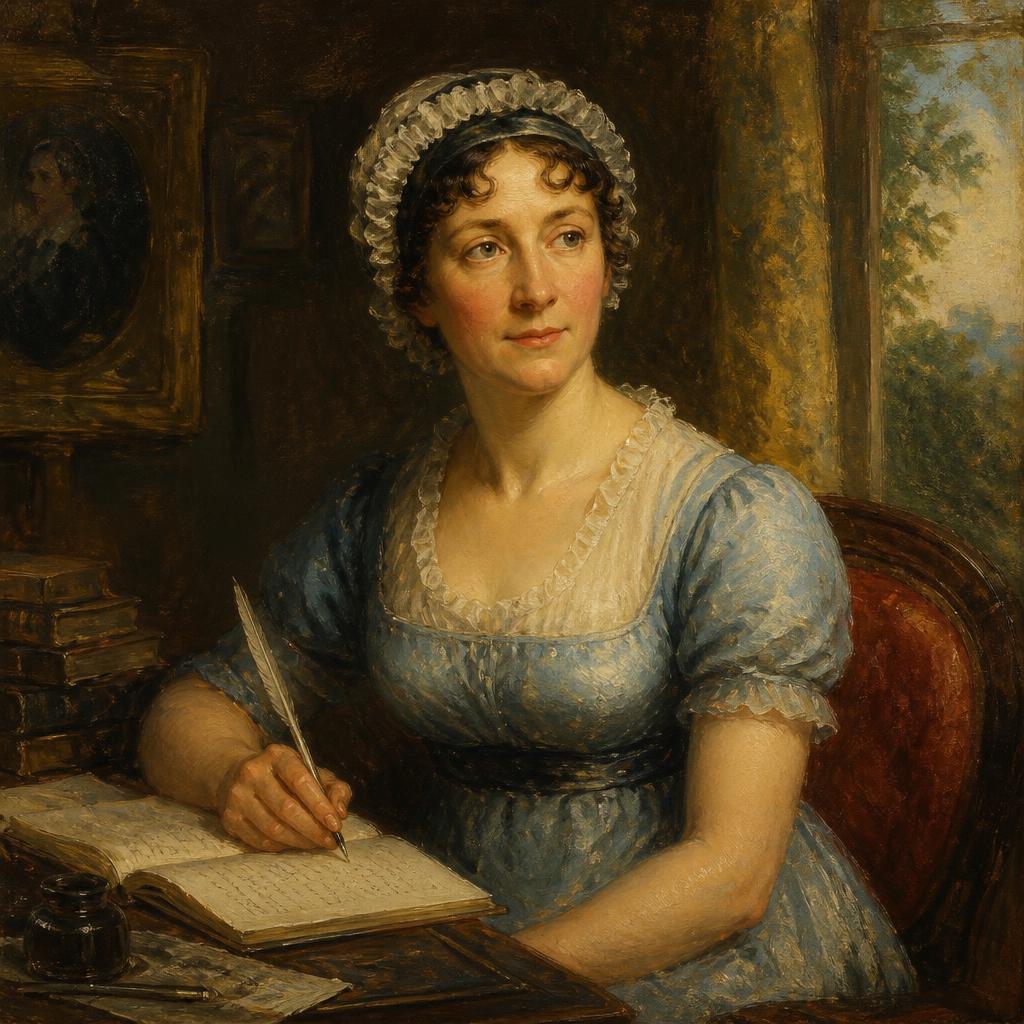
Quick Facts
- Years
- 1775 – 1817
- Category
- Writers & Poets
- Subcategory
- Novelists
- Nationality
- English
- Occupation
- Novelist
Jane Austen
1775 – 1817 · English · Novelist
Audiobook

Life Lessons from Jane Austen
Marcus Alden · 54 min
Jane Austen (1775–1817) was an English novelist whose six completed novels transformed ordinary social life into art of extraordinary precision. Writing about courtship, money, family, education, and rank, she exposed the pressures facing women in the landed gentry while creating memorable characters and tightly controlled comic plots. Her best-known works include Pride and Prejudice, Sense and Sensibility, Emma, and Persuasion.
Austen published anonymously during her lifetime: her title pages identified her only as “A Lady” or as the author of an earlier novel. Although contemporary readers generally received her books favorably, her fame grew dramatically after her death. Critics now recognize her command of irony, dialogue, narrative perspective, and free indirect discourse—the technique of blending a character’s thoughts with a third-person narrator’s voice.
Her achievement extended beyond elegant romantic comedy. Austen examined how property law, inheritance, social convention, and economic dependence shaped intimate decisions. Her heroines learn to judge themselves and others more accurately, but their personal growth occurs within a society offering women limited independence. Austen remains widely read because her stories unite emotional satisfaction with moral inquiry and sharp social observation. Scholars continue to debate her politics, religion, feminism, and relationship to empire, while adaptations have made her one of the most enduring novelists in world culture.
Quick Facts
| Field | Details |
|---|---|
| Full Name | Jane Austen |
| Common Name(s) | Jane Austen |
| Born | 16 December 1775 |
| Died | 18 July 1817 |
| Age at Death | 41 |
| Birthplace | Steventon, Hampshire, England |
| Nationality | English/British |
| Occupation | Novelist |
| Historical Era | Georgian era; Regency period |
| Famous For | Six completed novels of manners, including Pride and Prejudice and Emma |
| Political Affiliation | None recorded |
| Religion | Church of England |
| Education | Educated briefly at Oxford, Southampton, and Reading; chiefly educated at home |
| Parents | Reverend George Austen and Cassandra Leigh Austen |
| Spouse(s) | Never married |
| Children | None |
| Major Works | Sense and Sensibility; Pride and Prejudice; Mansfield Park; Emma; Northanger Abbey; Persuasion |
| Major Achievements | Established a lasting model of the novel of manners; advanced sophisticated ironic narration and characterization; became a central figure in the English literary canon |
Early Life
Jane Austen was born on 16 December 1775 at Steventon Rectory in rural Hampshire. She was the seventh of eight children and the second daughter of Reverend George Austen, an Anglican clergyman, and Cassandra Leigh Austen. Her siblings were James, George, Edward, Henry, Cassandra, Francis, and Charles. Her sister Cassandra became her closest lifelong companion.
The Austens belonged to the educated provincial gentry but were not wealthy. George Austen supplemented his clerical income by farming and tutoring boys. His library, intellectual interests, and encouragement of reading gave Jane unusual access to books. Her mother came from the prominent Leigh family and was remembered for wit and storytelling.
In 1783 Jane and Cassandra were sent away for instruction, first under the care of Ann Cawley at Oxford and then Southampton. After illness—probably an infectious fever—they returned home. From 1785 to 1786 they attended the Abbey House School in Reading. Formal schooling ended because of its cost, and Jane thereafter learned chiefly through extensive reading, family conversation, and private practice.
The household encouraged amateur theatricals and literary entertainment. Between approximately 1787 and 1793, Austen filled three manuscript notebooks with lively parodies, comic histories, plays, and stories now called her Juvenilia. These works reveal an early delight in satire and in overturning the conventions of sentimental fiction.
Steventon also supplied social material. Austen observed neighboring landowners, clergy, officers, tenants, and professional families through visits, assemblies, meals, and parish life. She came of age amid the American Revolution’s aftermath, the French Revolution, and the wars with Revolutionary and Napoleonic France. Her naval brothers Francis and Charles connected the family directly to wartime service and later helped inform the maritime world of Persuasion.
Rise to Prominence
Austen began drafting mature novels in her early twenties. An early version of Sense and Sensibility, probably titled Elinor and Marianne, was originally written in letters. She completed a draft of First Impressions, the basis of Pride and Prejudice, in 1796–1797. George Austen offered it to publisher Thomas Cadell, who rejected it unread.
Austen next revised Susan, later called Northanger Abbey. In 1803 Henry Austen arranged its sale to the publisher Benjamin Crosby & Son for £10. The firm advertised it but did not publish it. Years later, Austen recovered the copyright through Henry, without initially revealing that the author had since published successful books.
The family left Steventon in 1801 after George Austen retired and moved to Bath. Austen’s surviving literary output appears to have slowed during the unsettled years that followed. Her father died in 1805, leaving Jane, Cassandra, and their mother financially dependent on assistance from the Austen brothers. They lived temporarily in Southampton before Edward Austen Knight provided a cottage at Chawton in 1809.
Chawton gave Austen stability and a productive domestic routine. She revised old manuscripts and wrote new fiction while sharing household responsibilities. Thomas Egerton published Sense and Sensibility in 1811 on commission. The title page said only “By a Lady.” The edition sold out, and Austen earned a profit.
Pride and Prejudice followed in 1813 and became an immediate popular success. Mansfield Park appeared in 1814, and Emma in 1815, dated 1816. Austen’s authorship became known within literary and social circles, although her books remained formally anonymous. The Prince Regent admired her novels, and his librarian, James Stanier Clarke, conveyed that she had permission to dedicate Emma to him. Austen complied respectfully, despite privately disapproving of the prince’s conduct.
Her prominence during her lifetime was real but limited. She did not become a public celebrity in the modern sense. Her international canonical status emerged through later editions, biography, criticism, education, and adaptation.
Major Achievements
Creating Six Enduring Novels
Austen completed six novels, each distinct in tone and moral emphasis. Together they trace the development of a writer who could combine comic structure, psychological insight, and social analysis. Their survival in continuous cultural circulation is her most visible achievement.
The books matter because their marriage plots are also investigations of judgment, power, and economic survival. Austen made domestic choices carry intellectual and ethical weight. Later novelists inherited her attention to motive, conversation, and the morally significant details of ordinary life.
Transforming the Novel of Manners
Austen did not invent fiction about courtship or social rank, but she refined it with exceptional discipline. Balls, visits, proposals, letters, and meals become tests of perception. Characters reveal themselves through speech, silence, vanity, and misunderstanding.
This approach helped establish the domestic social novel as a major literary form. Writers from George Eliot and Henry James to modern comic novelists have been compared with Austen because of their close observation of society and consciousness.
Mastering Irony and Narrative Perspective
Austen’s narrators move subtly between detached commentary and a protagonist’s limited perceptions. In Emma, readers often share Emma Woodhouse’s errors without recognizing them immediately. In Pride and Prejudice, Elizabeth Bennet’s intelligence does not protect her from prejudice.
This flexible handling of viewpoint—often discussed as free indirect discourse—creates both intimacy and critical distance. Austen’s technical influence lies in showing how narrative style can reveal self-deception while preserving sympathy for the person deceived.
Depicting Women’s Economic Vulnerability
Austen dramatized legal and financial realities without writing treatises. The Bennet estate’s entail threatens the daughters in Pride and Prejudice. The Dashwood women lose security in Sense and Sensibility. Fanny Price’s dependence shapes her position in Mansfield Park.
These plots show that marriage could determine housing, status, and survival. Austen’s heroines seek affection, but they must calculate within unequal systems. This tension has made her central to scholarship on gender, property, and domestic authority.
Achieving Lasting Global Influence
Austen’s novels have been translated widely and repeatedly adapted for film, television, theater, radio, and the internet. Works such as Clueless and Bridget Jones’s Diary transplant or rework Austenian plots for new audiences.
Her global reception demonstrates that errors of judgment, family pressure, status anxiety, and negotiation between love and security remain recognizable across cultures. “Janeite” communities, academic societies, festivals, and reading groups sustain an unusually active literary afterlife.
Leadership and Work
Austen held no public leadership office, but she exercised disciplined artistic leadership within a restricted social world. Her working method combined private observation, repeated revision, family feedback, and careful dealings with publishers. Surviving manuscripts show substantial correction rather than effortless composition.
At Chawton, Austen reportedly wrote on small sheets and participated fully in household life. Family tradition describes her hiding pages when visitors entered, though claims about a famously creaking door serving as a warning come from later recollection and should not be treated as certain documentary fact.
She made practical publishing decisions. Sense and Sensibility was issued on commission, meaning Austen assumed financial risk but kept a larger share of potential profit. She later sold copyrights, including that of Pride and Prejudice, for fixed sums. These arrangements brought income but limited her participation in later profits.
Her strengths included structural control, attention to language, persistence after rejection, and a capacity to criticize beloved characters without cruelty. Her letters also show commercial awareness and pleasure in earnings. Limitations included a narrow geographical and social range, although that concentration was also a source of depth. She rarely represented laboring people from within their own perspectives, and much of Britain’s imperial and industrial reality remains peripheral or indirect.
Personal Life
Austen never married. In December 1802 she accepted a proposal from Harris Bigg-Wither, the younger brother of family friends, but withdrew her consent the next morning. The marriage would have offered financial security, yet no surviving explanation states precisely why she changed her mind.
Family tradition also recounts that Austen met an unnamed clergyman at the seaside and that mutual affection developed before his sudden death. The evidence is indirect, coming through later recollection, so historians cannot reconstruct the episode confidently. Claims that other youthful relationships inspired particular fictional heroes are speculative.
Her closest relationship was with Cassandra. The sisters lived together for most of their lives, shared friends and duties, and exchanged letters when apart. Cassandra later destroyed or cut portions from many of Jane’s letters, probably to protect private family matters. Roughly 160 letters survive, only a fraction of those Austen wrote.
Austen enjoyed reading, walking, dancing, music, conversation, and family games. She played the pianoforte and practiced in the morning. Her letters reveal humor, impatience, affection, shrewd financial interest, and occasionally sharp judgments. They should not be read as a complete self-portrait: private jokes and missing correspondence complicate interpretation.
Her health deteriorated in 1816. Symptoms included weakness and changes in complexion. Addison’s disease was long proposed as the cause, while later scholars have suggested Hodgkin lymphoma or other illnesses. No diagnosis can be proved. She moved to Winchester for medical care in May 1817 and died there on 18 July.
Philosophy and Beliefs
Austen was a practicing Anglican from a clerical family. Prayers attributed securely to her emphasize humility, self-examination, gratitude, and moral duty. Her novels likewise value conscience, responsible conduct, and the correction of selfishness.
Her politics are harder to define. She left no systematic political manifesto and belonged to no recorded party. Her family had connections commonly associated with Tory and establishment circles, but assigning her a simple partisan identity exceeds the evidence. Her fiction can respect social order while criticizing inherited privilege, irresponsible landowners, foolish clergy, and aristocratic vanity.
Ethically, Austen repeatedly contrasts appearance with character. Intelligence without self-knowledge is dangerous; charm without principle is unreliable; feeling without judgment can injure others. Moral growth requires honest reflection and willingness to revise first impressions.
Scholars debate whether Austen should be called feminist. She did not advocate a modern political program of equality in surviving writings. Yet she portrayed women’s constrained education, property rights, and economic choices with unusual force and granted female judgment full moral seriousness. Conservative, feminist, and historicist readings can each illuminate parts of her work, provided none erases its complexity.
Challenges and Controversies
Austen faced rejection, delayed publication, anonymity, and structural limits on women writers. Cadell’s dismissal of First Impressions and Crosby’s failure to publish Susan delayed her career. Financial dependence and repeated moves after 1801 also disrupted her work.
Her anonymity has sometimes been portrayed solely as forced concealment. Gender conventions certainly mattered, but anonymous publication was common in the period among male and female authors. Austen’s family connections and privacy concerns also influenced how she entered print.
Modern debate often centers on slavery and empire. In Mansfield Park, Sir Thomas Bertram’s wealth is linked to an Antiguan estate, and Fanny Price asks about the slave trade. Some critics interpret the novel as quietly challenging colonial exploitation; others argue that it leaves enslaved people largely outside the narrative and restores the estate without confronting its foundation. Both the critical hints and the profound silences are historically important.
Austen’s apparent admiration for abolitionist writer Thomas Clarkson, mentioned in a letter, is evidence of interest in abolition, but it does not settle every interpretive question. Her family also inhabited networks connected in varied ways to the British Empire.
Critics have accused Austen of social narrowness because her central characters usually come from the gentry and professional classes. Defenders respond that she deliberately restricted her canvas and subjected that world to rigorous criticism. Her wartime novels rarely depict battle directly, but naval service, militia presence, taxation, mobility, and economic uncertainty register the conflict’s effects.
Early family biographies softened Austen’s public image into that of a gentle, almost accidental author. Later scholarship has recovered a more ambitious professional writer. However, reacting by turning her into a modern revolutionary can be equally anachronistic. The strongest historical interpretations preserve tensions rather than forcing a single label.
Legacy
Austen was buried in Winchester Cathedral, an honor reflecting family and clerical connections rather than literary celebrity; her original memorial inscription did not mention her novels. A later brass plaque and memorial window emphasized her authorship.
Her brother Henry’s “Biographical Notice of the Author,” published with Northanger Abbey and Persuasion in 1817, publicly identified her. James Edward Austen-Leigh’s A Memoir of Jane Austen (1870) greatly expanded public interest, although its domestic portrait shaped—and sometimes constrained—later perceptions.
Today, Jane Austen’s House at Chawton preserves the cottage where she revised or wrote her mature works. Chawton House interprets the wider literary and family setting. The Jane Austen Centre in Bath explores her association with the city, while Winchester Cathedral remains a major memorial site.
Austen appears on the Bank of England £10 note introduced in 2017. Public statues stand in Basingstoke and near her former home in Winchester. Organizations including the Jane Austen Society of North America promote research and appreciation.
Her greatest monument remains the novels themselves. They influence literary fiction, romance, comedy, screenwriting, and popular speech. Their adaptability arises not from simple escapism but from an exact understanding of how private emotions are shaped by money, family, reputation, and power.
Interesting Facts
- Austen was born during a severe Hampshire winter in December 1775.
- She was one of eight children and had six brothers.
- Her sister Cassandra was nearly three years older and never married.
- Austen’s childhood writings survive in three manuscript volumes.
- She wrote a comic History of England illustrated by Cassandra.
- Her father unsuccessfully offered First Impressions to a publisher in 1797.
- Sense and Sensibility first appeared under the description “By a Lady.”
- She earned about £140 from the first edition of Sense and Sensibility.
- She sold the copyright of Pride and Prejudice for £110.
- The working title of Pride and Prejudice was First Impressions.
- Northanger Abbey was initially titled Susan.
- Austen accepted and then rejected Harris Bigg-Wither’s marriage proposal.
- Her naval brothers Francis and Charles both became admirals.
- The Prince Regent’s librarian suggested subjects for future novels; Austen politely declined through a comic “Plan of a Novel.”
- Emma was dedicated to the Prince Regent at his request.
- Austen’s surviving unfinished fiction includes The Watsons and Sanditon.
- Cassandra produced the only authenticated finished portrait of Jane from life.
- Austen was buried in Winchester Cathedral.
- Her authorship was formally announced only after her death.
- Her portrait has appeared on the Bank of England £10 note since 2017.
Famous Quotes
-
“It is a truth universally acknowledged, that a single man in possession of a good fortune, must be in want of a wife.” — Opening of Pride and Prejudice (1813). The sentence establishes the novel’s irony: families may be seeking wealthy husbands more urgently than wealthy men are seeking wives.
-
“The person, be it gentleman or lady, who has not pleasure in a good novel, must be intolerably stupid.” — Henry Tilney in Northanger Abbey. The comic declaration defends novels against contemporary disdain, though it is a character’s speech rather than a direct authorial statement.
-
“If I loved you less, I might be able to talk about it more.” — Mr. Knightley in Emma. His restrained proposal connects emotional sincerity with difficulty of expression.
-
“I must learn to be content with being happier than I deserve.” — Elizabeth Bennet in Pride and Prejudice. The line follows moral growth and reconciliation, mixing gratitude with Austen’s characteristic self-aware humor.
-
“I hate to hear you talk about all women as if they were fine ladies instead of rational creatures.” — Anne Elliot in Persuasion. Anne rejects stereotypes and insists upon women’s individuality and reason.
-
“You pierce my soul. I am half agony, half hope.” — Captain Wentworth’s letter in Persuasion. The declaration resolves years of silence and is among Austen’s most emotionally direct passages.
-
“There is no charm equal to tenderness of heart.” — Emma Woodhouse in Emma. Emma recognizes that moral warmth is more valuable than polished social performance.
-
“Selfishness must always be forgiven you know, because there is no hope of a cure.” — Mary Crawford in Mansfield Park. The witty line also reveals the speaker’s moral evasiveness.
-
“Pictures of perfection, as you know, make me sick and wicked.” — Austen’s letter to her niece Fanny Knight, 23 March 1817. Austen explains her preference for flawed, credible characters rather than idealized heroines.
-
“I do not want people to be very agreeable, as it saves me the trouble of liking them a great deal.” — Letter to Cassandra Austen, 24 December 1798. The private joke displays Austen’s social wit; it should not be treated as a complete statement of her ethics.
-
“The little bit (two Inches wide) of Ivory on which I work with so fine a Brush…” — Letter to James Edward Austen, 16–17 December 1816. Austen humorously characterizes the concentrated scale and precision of her fiction.
Timeline
- 1775 — Born at Steventon Rectory on 16 December.
- 1783 — Sent away with Cassandra for instruction; returns after illness.
- 1785–1786 — Attends Abbey House School in Reading.
- c. 1787–1793 — Produces most of the writings now known as the Juvenilia.
- 1795 — Writes Elinor and Marianne, an early form of Sense and Sensibility.
- 1796–1797 — Drafts First Impressions.
- 1797 — Thomas Cadell rejects George Austen’s offer of the manuscript.
- 1798–1799 — Writes or substantially develops Susan, later Northanger Abbey.
- 1801 — Moves with her parents and Cassandra from Steventon to Bath.
- 1802 — Briefly accepts, then rejects, Harris Bigg-Wither’s proposal.
- 1803 — Susan is sold to Crosby & Son but remains unpublished.
- 1804 — Begins The Watsons, which remains unfinished.
- 1805 — George Austen dies in Bath.
- 1806 — Austen women leave Bath; later settle with relatives in Southampton.
- 1809 — Moves to Chawton Cottage; recovers the copyright of Susan.
- 1811 — Sense and Sensibility is published.
- 1813 — Pride and Prejudice is published; second edition follows that year.
- 1814 — Mansfield Park is published.
- 1815 — Emma is published in December, dated 1816.
- 1816 — Health declines; completes revision of The Elliots, later Persuasion.
- 1817 — Begins Sanditon; stops writing in March; moves to Winchester in May; dies on 18 July; buried in Winchester Cathedral.
- 1817 — Northanger Abbey and Persuasion are issued together in December, dated 1818, with Henry Austen’s biographical notice.
- 1870 — Austen-Leigh’s Memoir stimulates wider public interest.
- 1940 — First major Hollywood adaptation of Pride and Prejudice appears.
- 1995 — Major screen adaptations help trigger renewed global popularity.
- 2017 — Austen appears on the Bank of England £10 note in the bicentenary year of her death.
Frequently Asked Questions
Why is Jane Austen famous?
Austen is famous for six completed novels combining romance, comedy, moral development, and acute social criticism. She transformed conversations, visits, dances, and marriage negotiations into sophisticated studies of judgment and power. Her controlled irony and flexible narrative viewpoint influenced the development of the modern novel. Pride and Prejudice is especially celebrated for Elizabeth Bennet, Mr. Darcy, and its movement from mutual misunderstanding to self-knowledge. Austen’s work remains popular because readers enjoy the plots while also recognizing enduring pressures involving money, family, reputation, and unequal opportunity.
What books did Jane Austen write?
Her six completed novels are Sense and Sensibility, Pride and Prejudice, Mansfield Park, Emma, Northanger Abbey, and Persuasion. The first four appeared during her lifetime; the last two were published together shortly after her death. Austen also left unfinished novels, principally The Watsons and Sanditon, as well as the epistolary novella Lady Susan. Her early notebooks contain parodies, plays, histories, and comic stories collectively called the Juvenilia. Continuations of her unfinished works by later writers are not Austen’s own compositions.
Did Jane Austen marry?
No. Austen never married and had no children. She accepted Harris Bigg-Wither’s proposal on 2 December 1802 but withdrew her acceptance the following morning. He was connected to close family friends and could have offered substantial security. Austen left no surviving explanation for reversing her decision, so accounts assigning a specific motive are conjectural. Family tradition records other possible attachments, but documentation is limited. Her unmarried life gave her direct knowledge of women’s financial dependence, although it would be simplistic to treat every fictional courtship as disguised autobiography.
Was Mr. Darcy based on a real person?
No convincing evidence identifies one historical model for Fitzwilliam Darcy. Austen knew men from the gentry, clergy, military, and professional classes and could combine observed traits with literary invention. Various candidates have been proposed, but the surviving letters and family records do not establish any of them. Darcy functions as part of the novel’s moral design: he must overcome pride and misuse of privilege while Elizabeth must confront her prejudiced judgment. Treating him as a direct portrait risks overlooking Austen’s craftsmanship and the conventions she reshaped.
Why did Jane Austen publish anonymously?
Her first title page described the author simply as “A Lady,” and later books referred to the author’s previous works. Publishing fiction could expose a genteel woman to unwanted publicity and criticism, so anonymity offered protection. Yet anonymous or pseudonymous publication was not unusual for men or women in Austen’s era. Her identity gradually became known among relatives, literary figures, and elite readers. Henry Austen publicly named her in the biographical notice issued after her death. Anonymity constrained public recognition but did not mean she lacked professional ambition.
How much money did Austen earn from writing?
Surviving evidence indicates that Austen earned several hundred pounds in total, a meaningful but not independent fortune. She made about £140 from the first edition of Sense and Sensibility. She sold Pride and Prejudice outright for £110, sacrificing future profits in exchange for certainty. Other works used varying arrangements, and exact lifetime totals differ depending on accounting. Her letters show close attention to sales and satisfaction in earning money. Writing improved her personal resources, but she continued to depend upon shared household arrangements and family support.
What is free indirect discourse?
Free indirect discourse is narration that presents a character’s thoughts or language within third-person prose without repeatedly adding phrases such as “she thought.” Austen did not invent the technique, but she used it with remarkable subtlety. In Emma, the narration often adopts Emma Woodhouse’s assumptions, encouraging readers to share her mistakes before recognizing them. The method allows Austen to remain close to a character while creating ironic distance. It became an important resource for later novelists exploring consciousness, self-deception, and the gap between perception and reality.
Was Jane Austen a feminist?
The answer depends on how “feminist” is defined. Austen did not leave a political program calling for modern legal equality, and placing a twenty-first-century label on her can be misleading. Nevertheless, her fiction exposes women’s restricted education, inheritance rights, employment choices, and dependence on marriage. Her heroines possess moral and intellectual authority, and they often resist pressure to marry without respect. Many scholars therefore find her work compatible with feminist analysis. Others emphasize her Anglican morality and acceptance of hierarchy. These positions need not be wholly exclusive.
What did Austen think about slavery?
The evidence is suggestive but incomplete. Mansfield Park connects the Bertram fortune to Antigua and includes Fanny’s question about the slave trade. Austen also wrote in 1813 that she was “in love with” abolitionist Thomas Clarkson, apparently meaning admiration for his work. Some scholars see a quiet critique of slavery and imperial wealth; others stress that enslaved people never receive direct representation and that the plantation system remains largely offstage. It is safest to recognize abolitionist sympathy while acknowledging the novel’s limitations and interpretive ambiguity.
What illness killed Jane Austen?
The cause remains uncertain. Austen’s letters describe progressive weakness and changes in skin color, but surviving medical information is insufficient for a definitive diagnosis. Addison’s disease was a widely accepted twentieth-century theory. More recent researchers have proposed Hodgkin lymphoma, other cancers, autoimmune disease, or infection. Arsenic poisoning has also appeared in public discussion, but low-level arsenic was present in period medicines and evidence for deliberate poisoning is absent. Responsible biographies identify the uncertainty rather than claiming that modern retrospective diagnosis has settled it.
Where did Jane Austen live?
Austen spent her first twenty-five years at Steventon in Hampshire. Her family moved to Bath in 1801, then after her father’s death experienced several unsettled years, including residence in Southampton. In 1809 Jane, Cassandra, their mother, and family friend Martha Lloyd settled in a cottage at Chawton provided by Edward Austen Knight. That stable home became the center of Austen’s mature publishing career. During her final illness she moved to Winchester for treatment. She also made extended family visits and seaside journeys, but never traveled outside Britain.
Is Pride and Prejudice autobiographical?
It draws upon Austen’s knowledge of family life, provincial society, courtship, and economic insecurity, but it is not a disguised autobiography. Elizabeth Bennet should not simply be equated with Austen, and the Bennet family does not map neatly onto her own. Novelists transform experience through invention, structure, and genre. Austen distributed aspects of intelligence, folly, affection, and prejudice among many characters. Biographical parallels can illuminate historical context, but claims that particular proposals, houses, or lovers directly generated the plot usually outrun the evidence.
Why was Bath important to Austen?
Bath was a fashionable spa and social center whose assemblies, lodging houses, streets, and rituals offered rich fictional material. Austen visited before moving there with her family in 1801 and lived in the city until after her father’s death. Bath features prominently in Northanger Abbey and Persuasion, where it can represent excitement, performance, social pressure, and loneliness. Earlier biographies sometimes claimed Austen hated Bath and stopped writing entirely there. Her letters show mixed reactions, while manuscript chronology remains incomplete; the simple “Bath silenced her” story is therefore too absolute.
What happened to Austen’s letters?
Only about 160 letters survive, most written to Cassandra. After Jane’s death, Cassandra destroyed many letters and cut passages from others. Her exact reasons are unknown, though family privacy and protection of reputations were probably important. Later relatives also dispersed correspondence. The surviving letters are invaluable for dating work, understanding publication, and hearing Austen’s humor. Yet they are an incomplete and selective record, often written for private amusement. Biographers must avoid treating every joke as a literal declaration or every silence as proof of a hidden event.
Did Jane Austen become famous during her lifetime?
Her novels sold respectably, received reviews, and attracted prominent readers, including the Prince Regent. Pride and Prejudice was particularly successful, and her authorship circulated privately. However, she published without her name and did not enjoy the mass celebrity achieved by figures such as Lord Byron or Walter Scott. Her broader reputation developed after Henry Austen identified her publicly, Victorian editions expanded readership, and Austen-Leigh’s Memoir created new interest. Twentieth-century scholarship, education, and screen adaptations transformed her into a global cultural figure.
Where is Jane Austen buried?
Austen is buried in the north aisle of Winchester Cathedral. She died in Winchester on 18 July 1817 after moving there for medical treatment. Her original gravestone praises her character and faith but does not identify her as a novelist, illustrating the limited public status of her authorship at death. In 1870 a brass tablet was added to recognize her writings, and a memorial window followed in 1900. The cathedral is now one of the most visited sites associated with her life.
Lessons We Can Learn
- Revise rather than romanticize talent. Austen repeatedly reworked early manuscripts before publication. Durable achievement usually depends on disciplined revision, not inspiration alone.
- Persist after rejection. First Impressions was rejected in 1797, yet its revised form became Pride and Prejudice. One gatekeeper’s refusal does not establish a work’s final value.
- Observe ordinary life closely. Austen found major drama in conversation and family routine. Careful attention can reveal structures of power hidden in familiar settings.
- Question first impressions. Elizabeth Bennet’s errors show that intelligence does not eliminate bias. Sound judgment requires testing assumptions against evidence.
- Balance feeling and reason. The Dashwood sisters represent different excesses in Sense and Sensibility. Healthy decisions require both emotional honesty and practical thought.
- Protect self-respect. Austen rejected a financially advantageous engagement. Although her precise motive is unknown, the episode demonstrates that security alone cannot guarantee a right decision.
- Understand economic context. Her marriage plots expose how money shapes choices. Modern ethical analysis also benefits from examining the material pressures behind behavior.
- Use humor critically. Austen’s irony corrects vanity without reducing every flawed person to a monster. Humor can expose problems while retaining human sympathy.
- Work within limits creatively. Restricted mobility and social expectations narrowed Austen’s opportunities, yet she turned a concentrated field into artistic strength.
- Remain open to self-correction. Austen’s strongest protagonists grow by recognizing their own failures. Accountability is more productive than defending an attractive self-image.
Related Historical Figures
- Cassandra Austen (1773–1845) — Jane’s sister, closest companion, correspondent, and guardian of much of her surviving personal record.
- Reverend George Austen (1731–1805) — Her father, whose library, education, and attempt to place First Impressions supported her development.
- Cassandra Leigh Austen (1739–1827) — Her mother, a witty storyteller from the Leigh family who shared Austen’s later households.
- Henry Thomas Austen (1771–1850) — Her brother and publishing intermediary; his posthumous biographical notice first publicly named her.
- Edward Austen Knight (1767–1852) — Her brother, adopted by wealthy relatives, who provided Chawton Cottage.
- Francis Austen (1774–1865) — Her naval brother, later Admiral of the Fleet, whose career reflects the maritime world important to Persuasion.
- Charles Austen (1779–1852) — Her younger naval brother, later a rear-admiral, who maintained close family ties.
- Sir Walter Scott (1771–1832) — Celebrated novelist who reviewed Emma perceptively and praised Austen’s skill in depicting ordinary life.
- Maria Edgeworth (1768–1849) — Prominent Anglo-Irish novelist and near-contemporary whose fiction also examined education, property, and society.
- Fanny Burney (1752–1840) — Earlier English novelist whose works about young women entering society formed part of the literary tradition Austen inherited and transformed.
Related Historical Figures