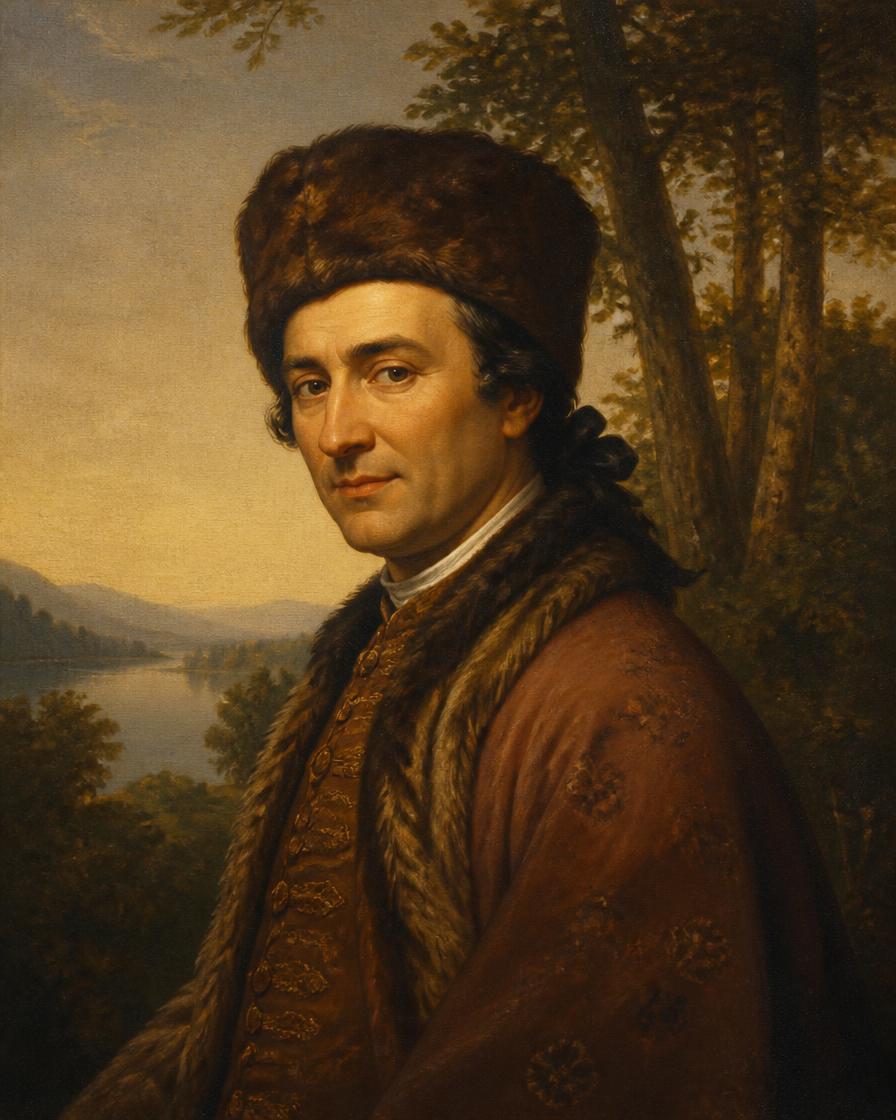
Quick Facts
- Years
- 1712 – 1778
- Category
- Philosophers & Thinkers
- Subcategory
- Enlightenment
- Nationality
- Genevan
- Occupation
- Philosopher & Composer
Jean-Jacques Rousseau
1712 – 1778 · Genevan · Philosopher & Composer
Audiobook

Life Lessons from Jean-Jacques Rousseau
Marcus Alden · 50 min
Jean-Jacques Rousseau (1712–1778) was a Genevan philosopher, novelist, autobiographer, educational theorist, and composer whose writings transformed European debates about freedom, inequality, citizenship, childhood, religion, and personal identity. Though associated with the Enlightenment, he challenged its confidence in civilization and intellectual progress. He argued that social development could corrupt human beings, while legitimate political authority had to rest on the freedom and collective consent of citizens.
Rousseau became famous after winning a Dijon Academy essay competition with his provocative claim that advances in the arts and sciences had not improved morality. He later produced works of extraordinary range: Discourse on Inequality, The Social Contract, Émile, Julie, or the New Heloise, and Confessions. He also composed music, wrote for the Encyclopédie, and helped stimulate a new appreciation of emotion, nature, and inward experience.
His ideas influenced democratic and revolutionary politics, Romantic literature, modern educational theory, and the development of autobiography. Yet his legacy is deeply contested. His ideal of popular sovereignty could support civic freedom, but critics have questioned the coercive possibilities of his “general will.” His celebration of childhood also sits uneasily beside his abandonment of his own infants. Rousseau remains important because he exposed enduring tensions between individual liberty and collective authority, authenticity and social approval, equality and property, civilization and nature.
Quick Facts
| Field | Details |
|---|---|
| Full Name | Jean-Jacques Rousseau |
| Common Name(s) | Jean-Jacques Rousseau; Rousseau |
| Born | 28 June 1712 |
| Died | 2 July 1778 |
| Age at Death | 66 |
| Birthplace | Geneva, Republic of Geneva |
| Nationality | Genevan by birth; later a subject of Savoy after conversion; regained Genevan citizenship in 1754 and renounced it in 1763 |
| Occupation | Philosopher, writer, political theorist, composer, music copyist |
| Historical Era | Enlightenment; eighteenth century |
| Famous For | The Social Contract, Émile, Confessions, theories of inequality, popular sovereignty, education, and authenticity |
| Political Affiliation if applicable | No modern party affiliation; republican political thinker |
| Religion if significant | Raised Calvinist; converted to Roman Catholicism in 1728; formally returned to Calvinism in 1754; later advocated a form of natural or civic religion |
| Education | Irregular schooling; largely self-educated through reading, employment, travel, and patronage |
| Parents | Isaac Rousseau and Suzanne Bernard Rousseau |
| Spouse(s) | Thérèse Levasseur; married in a civil ceremony in 1768 after a long partnership |
| Children | Rousseau reported five infants with Thérèse, all placed in the Paris foundling hospital; their later fates are unknown |
| Major Works | Discourse on the Sciences and Arts; Discourse on Inequality; Julie; The Social Contract; Émile; Confessions; Reveries of the Solitary Walker |
| Major Achievements | Major theorist of popular sovereignty; pioneer of modern educational and autobiographical writing; influential novelist and composer |
Early Life
Rousseau was born in the independent Calvinist Republic of Geneva. His mother, Suzanne Bernard, died from complications following his birth. His father, Isaac, was a watchmaker who shared with his son a love of reading, including classical history and romances. Rousseau later presented these early readings as both intellectually formative and emotionally intense.
In 1722 Isaac left Geneva after a quarrel that threatened legal consequences. Rousseau was placed under the care of relatives and briefly boarded with the Calvinist minister Jean-Jacques Lambercier at Bossey. His formal education remained fragmented. He later worked for a notary and was apprenticed to an engraver, Abel Ducommun. Rousseau remembered the apprenticeship as harsh and associated it with lying, theft, and resistance to humiliation.
In 1728, returning late to Geneva, he found the city gates closed and decided to leave. This impulsive departure changed his life. Catholic clergy directed him to Françoise-Louise de Warens, a convert employed in Savoyard Catholic conversion efforts. Rousseau called her “Maman.” She became his patron, educator, and eventually his lover.
Rousseau converted to Catholicism in Turin, thereby losing his Genevan citizenship under the city’s laws. During the following years he held unstable positions as a servant, music teacher, and secretary. At Warens’s household at Les Charmettes near Chambéry, he read extensively in philosophy, history, science, mathematics, and music. This largely self-directed education developed during a European age of expanding print culture, scientific inquiry, religious dispute, and criticism of inherited authority.
Rise to Prominence
Rousseau moved to Paris in 1742 hoping to win recognition for a new system of musical notation. The Academy of Sciences did not adopt it, although he later published a revised explanation. In Paris he met leading intellectuals, especially Denis Diderot, and contributed articles on music to Diderot and d’Alembert’s Encyclopédie.
From 1743 to 1744, Rousseau served as secretary to the French ambassador in Venice. His experience of inefficient administration, rank, and political dependence sharpened his interest in government. A dispute over pay and status helped end the appointment.
Back in Paris, he began his lifelong partnership with Thérèse Levasseur, a laundry servant. He also pursued music. His opera Le Devin du village (The Village Soothsayer) was performed before Louis XV’s court in 1752 and became a success.
The decisive intellectual turning point came in 1749. While traveling to visit the imprisoned Diderot at Vincennes, Rousseau read the Dijon Academy’s question asking whether the restoration of the arts and sciences had purified morals. He answered no. His winning Discourse on the Sciences and Arts appeared in 1750 and made him famous through its attack on polished civilization, luxury, and intellectual vanity.
Rousseau developed the argument in his Discourse on the Origin and Foundations of Inequality Among Mankind (1755). He contrasted natural differences with social inequality created through property, dependence, and institutions. Although the essay did not win the Dijon prize, it established him as one of Europe’s boldest critics of modern society.
Major Achievements
A Revolutionary Critique of Inequality
In the Discourse on Inequality, Rousseau used a hypothetical history rather than a conventional chronicle. He imagined relatively independent early human beings and traced how comparison, property, labor, and political institutions produced dependence and hierarchy.
The work mattered because it treated inequality as historically constructed rather than simply natural or divinely fixed. Its account was speculative, not modern anthropology, but it profoundly influenced later arguments about property, class, recognition, and alienation.
A Theory of Popular Sovereignty
The Social Contract (1762) opened with the famous observation that human beings are born free yet live “in chains.” Rousseau asked how political association could preserve freedom. His answer located sovereignty in the people collectively and expressed legitimate law through the “general will,” directed toward the common good.
This framework rejected the idea that rulers possessed legitimate authority merely through conquest, inheritance, or superior force. It influenced republicanism, democratic theory, and revolutionary language. Debate continues over whether Rousseau protects participatory freedom or leaves insufficient safeguards for dissent and minorities.
Transforming Educational Thought
Émile, or On Education (1762) presented a fictional pupil educated through carefully arranged experience. Rousseau argued that adults should respect developmental stages rather than treat children as miniature adults. Early education should protect curiosity, encourage practical learning, and delay abstract moralizing.
His prescribed education for Sophie, Émile’s future wife, reflected restrictive eighteenth-century assumptions about gender and has drawn sustained criticism. Nevertheless, the book helped reshape discussions of child development and influenced Johann Heinrich Pestalozzi, Friedrich Fröbel, and later progressive educators.
Redefining the Novel of Sentiment
Julie, or the New Heloise (1761), an epistolary novel about love, virtue, renunciation, and domestic life, became a publishing phenomenon. Readers responded intensely to its emotional directness and descriptions of landscape.
The novel helped elevate sensibility, inwardness, and nature within European literature. It contributed to cultural developments later associated with Romanticism and demonstrated that Rousseau’s influence extended far beyond formal philosophy.
Pioneering Modern Autobiography
In Confessions, drafted mainly during the 1760s and published posthumously, Rousseau attempted an unprecedentedly candid account of his inner life. He disclosed humiliations, desires, faults, resentments, and formative memories while asserting the uniqueness of his personality.
Earlier autobiographical traditions certainly existed, notably Augustine’s Confessions. Rousseau’s innovation lay in making individual psychology, subjective memory, and self-explanation central. His example influenced modern memoir, confessional literature, and psychological self-analysis.
Contributions to Music
Rousseau composed operas, songs, and motets and wrote extensively about musical notation and aesthetics. During the “Querelle des Bouffons,” he championed Italian opera’s melodic directness against what he regarded as the excessive complexity of French music.
His Dictionary of Music became an important reference work. Many of his technical judgments were disputed, but music was not a secondary pastime: it supplied income, public success, and a major arena for his arguments about nature, expression, and culture.
Leadership and Work
Rousseau never governed a state or led a political party. His leadership was intellectual and cultural. He influenced readers through paradox, moral urgency, personal testimony, and sharply framed questions. Rather than create a systematic philosophical institution, he wrote in many forms—essays, dialogues, novels, constitutional proposals, letters, autobiography, and music.
His working values included independence, sincerity, simplicity, civic equality, and resistance to fashionable opinion. He often rejected patronage that seemed likely to compromise his freedom. He earned money by copying music, a repetitive occupation he valued partly because it allowed intellectual independence.
Rousseau could form powerful friendships, as with Diderot, but he frequently interpreted disagreement as betrayal. His strengths included originality, psychological insight, literary force, and unusual sensitivity to hidden forms of dependence. His weaknesses included suspicion, emotional volatility, inconsistency, and difficulty sustaining collaboration. Consequently, his influence came less from organizational leadership than from changing the terms in which later generations discussed politics and selfhood.
Personal Life
Rousseau met Thérèse Levasseur in Paris around 1745. She remained his companion through poverty, exile, illness, and fame. They married in 1768 in a civil ceremony that may not have met all formal legal requirements. Rousseau sometimes portrayed her as loyal and practical, though his descriptions could also be condescending.
He stated that five children born to the couple were placed in the Enfants-Trouvés foundling hospital. No surviving institutional records conclusively identify them, but historians generally accept Rousseau’s own repeated admission. Mortality among abandoned infants was extremely high. His decision remains the starkest contradiction between his life and his educational writing.
His friendships included Diderot, Étienne Bonnot de Condillac, and Friedrich Melchior Grimm, but these relationships deteriorated. He was also close to aristocratic patrons, including Madame d’Épinay and the Maréchal and Maréchale de Luxembourg. Later he fell into bitter conflict with David Hume after accepting refuge in Britain.
Rousseau enjoyed solitary walking, botany, music, and rural landscapes. He suffered recurring urinary problems and periods of intense anxiety. In later life he became convinced that enemies were coordinating a broad campaign against him. Scholars debate how far this reflected genuine persecution—his books were indeed condemned and he was pursued by authorities—and how far it developed into pathological paranoia.
Philosophy and Beliefs
Rousseau did not simply claim that humans are innately virtuous or that everyone should return to prehistoric life. He argued more subtly that basic human impulses, including self-preservation and pity, were not inherently corrupt, while social comparison could generate vanity, rivalry, and domination. He distinguished natural self-concern (amour de soi) from status-conscious self-love (amour-propre).
Politically, he held that legitimate sovereignty belongs to the citizen body and cannot be alienated to a representative ruler. The general will is not merely majority preference; it is the collective will directed toward shared interests. Rousseau favored relatively small republics with active citizens, civic education, and limits on extreme wealth and poverty.
His ethical ideal emphasized freedom as obedience to laws one prescribes as a member of the sovereign people. This was not unrestricted individual choice. Citizens had duties to the community, creating a persistent tension between autonomy and coercion.
Religiously, Rousseau criticized dogmatic intolerance and clerical authority while defending belief in God, conscience, providence, and the soul. The “Profession of Faith of the Savoyard Vicar” in Émile advocated a natural religion grounded in feeling and reason. Both Catholic and Protestant authorities condemned the work. In The Social Contract, Rousseau also proposed a minimal “civil religion” to support civic unity—an idea admired as politically realistic and criticized as intolerant toward those considered antisocial.
Challenges and Controversies
Rousseau’s life included poverty, censorship, exile, broken friendships, and recurring illness. In 1762 French authorities ordered Émile burned and issued a warrant for his arrest. Geneva condemned both Émile and The Social Contract. He fled through Switzerland, faced local hostility, and eventually accepted Hume’s invitation to Britain before quarreling publicly with him.
The abandonment of his children generated criticism even during his lifetime, notably from Voltaire. Rousseau defended the decision by citing poverty, social convention, and his belief that he could not educate them properly. Those explanations do not remove the ethical contradiction, particularly given his later authority on education.
His treatment of women is another major controversy. Although his fiction gave female emotion unusual literary importance, Émile assigned women a dependent role oriented toward pleasing and supporting men. Mary Wollstonecraft later attacked these claims. Some scholars read Rousseau mainly as reinforcing patriarchy; others examine how his works also reveal the social construction and costs of gender roles.
Political interpretations remain divided. Admirers see a defender of equality, participation, and freedom from domination. Critics—from Benjamin Constant to later liberal theorists—warn that the general will can justify suppressing individuals in the name of collective unity. Claims that Rousseau directly caused revolutionary dictatorship are too simplistic, but revolutionary figures did selectively adopt his language.
His quarrels and persecution fears also require balance. Authorities genuinely banned his works, hostile pamphlets circulated, and former friends criticized him. Yet his increasingly expansive belief in coordinated plots damaged relationships and made reconciliation difficult.
Legacy
Rousseau influenced the French Revolution’s political vocabulary, although he died eleven years before 1789 and cannot be assigned responsibility for all revolutionary uses of his thought. Maximilien Robespierre admired him; republicans drew upon his concepts of virtue, sovereignty, and citizenship.
His literary celebration of feeling, authenticity, solitude, and landscape helped prepare European Romanticism. Goethe, Wordsworth, Chateaubriand, and many others worked within a cultural world Rousseau had helped alter. Educational reformers adopted his insistence that teaching should respond to childhood development and experience.
Modern political philosophy still debates his accounts of recognition, dependence, freedom, inequality, and democratic legitimacy. Thinkers across ideological traditions have claimed or challenged him, including Kant, Hegel, Marx, Tocqueville, and contemporary republican and communitarian theorists.
Rousseau died at Ermenonville and was buried on the Île des Peupliers. In 1794, revolutionary authorities transferred his remains to the Panthéon in Paris, opposite Voltaire. Geneva commemorates him through sites and collections, including the Maison Rousseau et Littérature at his birthplace. Statues, street names, schools, scholarly societies, and museum collections across Europe preserve his memory, while his contradictions keep that memory contested rather than ceremonial.
Interesting Facts
- Rousseau was born a citizen of the independent Republic of Geneva, not France.
- His mother died shortly after his birth.
- His father worked as a watchmaker.
- Rousseau left Geneva at fifteen after finding its gates closed.
- He converted from Calvinism to Catholicism in Turin in 1728.
- Françoise-Louise de Warens was successively his patron, educator, and lover.
- He proposed a numbered system of musical notation to the French Academy of Sciences.
- He served as secretary to the French ambassador in Venice.
- His first major fame came from winning an essay competition.
- He wrote music articles for the Encyclopédie.
- His opera The Village Soothsayer was performed at the French court.
- Rousseau regained Genevan citizenship in 1754 by returning formally to Calvinism.
- Julie was among the eighteenth century’s most widely read novels.
- Émile and The Social Contract were condemned in 1762.
- He earned income for years by copying musical scores.
- He developed a serious interest in botany late in life.
- David Hume arranged refuge for him in Britain, but they soon quarreled.
- Rousseau completed his final work, Reveries of the Solitary Walker, only in part.
- His remains were transferred to the Panthéon during the French Revolution.
- His opera remained in the repertory long after many contemporary philosophical controversies faded.
Famous Quotes
“Man is born free, and everywhere he is in chains.” — The Social Contract, Book I, chapter 1 (1762).
Rousseau introduces the problem of finding legitimate political authority without surrendering human freedom. “Man” follows traditional translations; the French l’homme can also mean humankind.
“The first man who, having enclosed a piece of ground, thought of saying ‘This is mine’ … was the true founder of civil society.” — Discourse on Inequality (1755).
This rhetorical passage identifies property claims as a decisive stage in the emergence of social inequality; it is not a documented historical event.
“The fruits of the earth belong to us all, and the earth itself to nobody.” — Discourse on Inequality (1755).
The sentence challenges absolute ownership by contrasting common human need with exclusive possession.
“To renounce liberty is to renounce being a man.” — The Social Contract, Book I, chapter 4 (1762).
Rousseau argues that freedom is inseparable from moral agency and cannot legitimately be surrendered through slavery.
“Obedience to a law which we prescribe to ourselves is liberty.” — The Social Contract, Book I, chapter 8 (1762).
The statement summarizes civic freedom: citizens remain free when collectively subject to laws they author.
“Everything is good as it leaves the hands of the Author of things; everything degenerates in the hands of man.” — Émile, Book I (1762).
This opening frames education as protection from corrupting social conventions, though Rousseau does not advocate a literal return to wilderness.
“There is no happiness without courage, nor virtue without struggle.” — Émile (1762).
Rousseau connects moral development with disciplined resistance to appetite, hardship, and dependence.
“I want to show my fellows a man in all the truth of nature; and this man shall be myself.” — Confessions, Book I.
The declaration announces his attempt to make candid self-examination the center of autobiography.
“I am made unlike anyone I have ever met.” — Confessions, Book I.
Rousseau presents individuality as a legitimate subject of literature, helping shape modern ideas of unique personal identity.
“The people of England regards itself as free; it is grossly mistaken.” — The Social Contract, Book III, chapter 15 (1762).
He criticizes representative government because citizens exercise sovereignty only during elections. Translations vary in wording.
Timeline
- 1712 — Born in Geneva on 28 June; his mother dies soon afterward.
- 1722 — His father leaves Geneva; Rousseau enters the care of relatives.
- 1725 — Apprenticed to the engraver Abel Ducommun.
- 1728 — Leaves Geneva, meets Madame de Warens, and converts to Catholicism in Turin.
- 1730s — Studies, teaches music, travels, and lives intermittently with Warens.
- 1742 — Moves to Paris and presents his musical notation system.
- 1743–1744 — Serves at the French embassy in Venice.
- 1745 — Begins his partnership with Thérèse Levasseur.
- 1749 — Encounters the Dijon Academy essay question while visiting Diderot.
- 1750 — Publishes the prizewinning Discourse on the Sciences and Arts.
- 1752 — The Village Soothsayer succeeds at court.
- 1754 — Returns to Calvinism and regains Genevan citizenship.
- 1755 — Publishes the Discourse on Inequality.
- 1756 — Moves to the Hermitage near Montmorency.
- 1758 — Publishes Letter to d’Alembert on the Theatre.
- 1761 — Publishes Julie, or the New Heloise.
- 1762 — Publishes The Social Contract and Émile; both are condemned, and he flees France.
- 1763 — Renounces Genevan citizenship.
- 1765 — Leaves the Île de Saint-Pierre after official pressure.
- 1766 — Travels to Britain with David Hume.
- 1767 — Returns secretly to France after quarreling with Hume.
- 1768 — Marries Thérèse in a civil ceremony.
- 1770 — Returns openly to Paris and resumes music copying.
- 1772–1776 — Writes the autobiographical dialogues later called Rousseau, Judge of Jean-Jacques.
- 1776–1778 — Writes Reveries of the Solitary Walker.
- 1778 — Dies at Ermenonville on 2 July.
- 1782 — First part of Confessions and Reveries appears posthumously.
- 1789 — Remaining books of Confessions are published.
- 1794 — His remains are transferred to the Panthéon in Paris.
Frequently Asked Questions
Who was Jean-Jacques Rousseau?
Rousseau was an eighteenth-century Genevan philosopher, author, political theorist, educational writer, and composer. He became famous for questioning whether civilization made people morally better and for investigating how social institutions produced inequality and dependence. His principal works include The Social Contract, Émile, Discourse on Inequality, Julie, and Confessions. His writing influenced democratic politics, Romantic literature, modern autobiography, and educational theory.
Was Rousseau French or Swiss?
He was born in the Republic of Geneva, then an independent Protestant city-state associated with the Swiss Confederacy but not a modern Swiss canton. Rousseau wrote in French and spent much of his career in France, so he is often placed within the French Enlightenment. “Genevan” is the most historically precise description of his birth citizenship. His legal status changed after religious conversions, and he renounced Genevan citizenship in 1763.
What is Rousseau best known for?
Rousseau is best known for his theory that legitimate political sovereignty belongs to the people and for his concept of the general will. He is also famous for arguing that social development can create corruption and inequality, for proposing child-centered principles in Émile, and for pioneering psychologically revealing autobiography in Confessions. His opening statement in The Social Contract—that people are born free yet everywhere live in chains—remains one of political philosophy’s most recognizable formulations.
What did Rousseau mean by the “state of nature”?
The state of nature was a thought experiment used to distinguish basic human tendencies from behaviors produced by society. Rousseau imagined early humans as largely solitary, compassionate, and concerned with survival, without modern property, status, or political institutions. He did not supply an empirically verified prehistoric account. Instead, the model helped him ask which inequalities were natural and which had arisen historically through comparison, ownership, labor, and dependence.
Did Rousseau believe people are naturally good?
The familiar summary is partly accurate but too simple. Rousseau believed humans possessed natural self-concern and pity and were not born morally corrupt. Full virtue, vice, and moral responsibility developed within social life. Civilization could expand knowledge and cooperation, but it also intensified comparison, vanity, competition, and domination. His argument was therefore less “everyone is naturally virtuous” than “many destructive motives are socially produced rather than unavoidable features of human nature.”
What is the general will?
The general will is the collective will directed toward the common good. Rousseau distinguished it from the sum of private preferences, which he called the “will of all.” Citizens express the general will when considering shared interests as members of the political community. The concept supports popular sovereignty and civic equality, but it raises difficult questions: who identifies the common good, how dissent is protected, and whether leaders can falsely claim to speak for the people.
Did Rousseau support democracy?
Rousseau supported popular sovereignty and active citizenship, but his position does not map neatly onto modern representative democracy. He believed sovereignty could not be transferred to elected representatives and favored small republics in which citizens directly made fundamental laws. He distinguished the sovereign people from the government that administered those laws. Modern democrats value his insistence on consent and equality, while often rejecting his distrust of representation as impractical for large states.
Did Rousseau influence the French Revolution?
Yes, but indirectly and unevenly. Rousseau died in 1778, before the Revolution began. Revolutionaries read his works and adopted language about popular sovereignty, civic virtue, equality, and the general will. Robespierre especially admired him. Nevertheless, the Revolution had many intellectual, economic, political, and social causes. It is historically misleading to make Rousseau the architect of revolutionary violence or assume that every faction interpreted him in the same way.
Why was Émile banned?
Authorities objected chiefly to the religious arguments in the “Profession of Faith of the Savoyard Vicar.” Rousseau criticized revealed dogma, ecclesiastical authority, and religious intolerance while defending a personal natural religion grounded in conscience. In 1762, the Parlement of Paris ordered the book burned and sought his arrest. Geneva’s authorities also condemned Émile, alongside The Social Contract. The suppression forced Rousseau into years of movement and exile.
What did Rousseau contribute to education?
Rousseau argued that education should respect stages of childhood and teach through experience rather than premature lectures or rote instruction. His fictional tutor protects Émile’s curiosity, arranges practical encounters, and delays abstract moral education. These ideas influenced later child-centered teaching. Yet Émile is not a classroom manual, and its education of Sophie reflects restrictive gender assumptions. Its importance lies in reframing childhood as a distinctive developmental condition worthy of serious study.
Was Rousseau a composer?
Yes. Rousseau composed operas, songs, and other music, devised a numerical notation system, copied scores professionally, and wrote influential articles and a Dictionary of Music. His one-act opera Le Devin du village achieved considerable success after its 1752 court performance. He also participated in the Querelle des Bouffons, supporting Italian melodic opera against the French tradition. Music was central to both his livelihood and intellectual identity.
Why did Rousseau abandon his children?
Rousseau admitted that he and Thérèse Levasseur placed five infants in Paris’s foundling hospital. He later cited poverty, unstable circumstances, social convention, and his belief that institutional upbringing might be preferable. Such defenses were criticized in his own lifetime and remain ethically troubling, especially because foundling mortality was high and Rousseau later wrote authoritatively about education. The children’s identities and fates are unknown, but most historians accept his admission.
Why did Rousseau quarrel with Voltaire?
The two represented contrasting Enlightenment temperaments. Voltaire championed cosmopolitan culture, theater, wit, and intellectual progress; Rousseau distrusted luxury, urban sophistication, and theater’s civic effects. They exchanged criticism over inequality, natural disaster, religion, and society. Voltaire also publicized Rousseau’s abandonment of his children. Their conflict should not be reduced to personal hostility: it exposed deep disagreements within the Enlightenment about progress, culture, and human nature.
What happened between Rousseau and David Hume?
Hume helped Rousseau travel to Britain in 1766 and arranged accommodation and royal financial support. Rousseau soon suspected Hume of participating in a campaign to ridicule and discredit him. Their private dispute became a public controversy across Europe. Hume regarded Rousseau’s accusations as irrational ingratitude; Rousseau saw concealed manipulation. Genuine satirical attacks against Rousseau complicated the episode, but most historians conclude that his suspicions of Hume were unfounded.
Did Rousseau advocate returning to nature?
Not literally. Rousseau did praise natural simplicity and criticize artificial needs, but he did not propose abolishing society and returning humanity to primitive isolation. He believed developed human capacities could not simply be reversed. His political and educational projects sought forms of social life that reduced dependence and corruption while preserving freedom. “Return to nature” is therefore a useful shorthand only if it does not replace his more complicated arguments.
How did Rousseau influence Romanticism?
Rousseau elevated emotion, sincerity, solitude, memory, landscape, and the unique self. Julie invited powerful emotional identification, while Confessions and Reveries treated inner experience and nature as serious literary subjects. These features helped prepare Romantic culture’s resistance to rigid rationalism and social convention. He was not himself simply a Romantic—the movement developed later—but writers across Europe inherited his language of authenticity, feeling, and communion with nature.
Where is Rousseau buried?
Rousseau was first buried on the Île des Peupliers at Ermenonville, where he had spent his final weeks under the hospitality of the Marquis de Girardin. In 1794, during the French Revolution, his remains were ceremonially transferred to the Panthéon in Paris. His tomb there faces that of Voltaire, turning two frequently opposed Enlightenment figures into national commemorative neighbors.
Lessons We Can Learn
- Question the meaning of progress. Rousseau’s first discourse asked whether technical and cultural achievement necessarily improves character. Today, innovation should be judged by social and ethical effects, not novelty alone.
- Examine hidden dependence. His inequality analysis showed how formal freedom can coexist with economic or psychological subordination. Modern institutions deserve scrutiny beyond their legal language.
- Protect the common good. The general will reminds citizens that politics cannot be only an exchange of private demands. Shared infrastructure, trust, and responsibility require collective thinking.
- Guard against coercive certainty. Rousseau’s political theory also demonstrates the danger of claiming exclusive authority to define the public interest. Democratic ideals need rights, accountability, and room for dissent.
- Respect stages of development. Émile challenged adults to adapt teaching to children’s capacities. Effective education still depends on readiness, curiosity, and experience.
- Learn through practice. Rousseau favored encounters with consequences and practical problems over empty verbal instruction. Applied learning can deepen understanding.
- Value emotional self-knowledge. His autobiographical works made motives, shame, and memory subjects of inquiry. Reflection can expose how social approval shapes behavior.
- Compare ideals with conduct. The contradiction between Émile and Rousseau’s abandoned children warns against judging thinkers only by their principles. Ethical credibility also depends on action.
- Preserve independence without rejecting cooperation. Rousseau’s resistance to patronage protected his voice, but suspicion destroyed friendships. Autonomy works best with evidence, trust, and openness to correction.
- Use nature as attention, not escape. His walks and botanical studies restored concentration during distress. Contact with nature can support reflection without solving political or personal problems by itself.
Related Historical Figures
- Denis Diderot — Friend, collaborator, and later opponent; Rousseau wrote music articles for Diderot’s Encyclopédie.
- Voltaire — Enlightenment rival whose defense of culture and progress sharply contrasted with Rousseau’s critique.
- David Hume — Scottish philosopher who sheltered Rousseau in Britain before their notorious quarrel.
- Françoise-Louise de Warens — Patron, teacher, and lover who supported Rousseau’s early education.
- Thérèse Levasseur — Rousseau’s longtime partner and eventual wife, as well as the mother of the infants they relinquished.
- John Locke — Earlier theorist of government and education whose positions provide important comparisons with Rousseau’s.
- Montesquieu — Political philosopher whose analysis of institutions influenced the eighteenth-century context of Rousseau’s republicanism.
- Immanuel Kant — German philosopher who admired Rousseau’s insistence on dignity, freedom, and moral equality.
- Mary Wollstonecraft — Early feminist thinker who criticized Rousseau’s gendered educational program for Sophie.
- Maximilien Robespierre — French revolutionary leader who revered Rousseau and adopted aspects of his civic and moral vocabulary.
Related Historical Figures