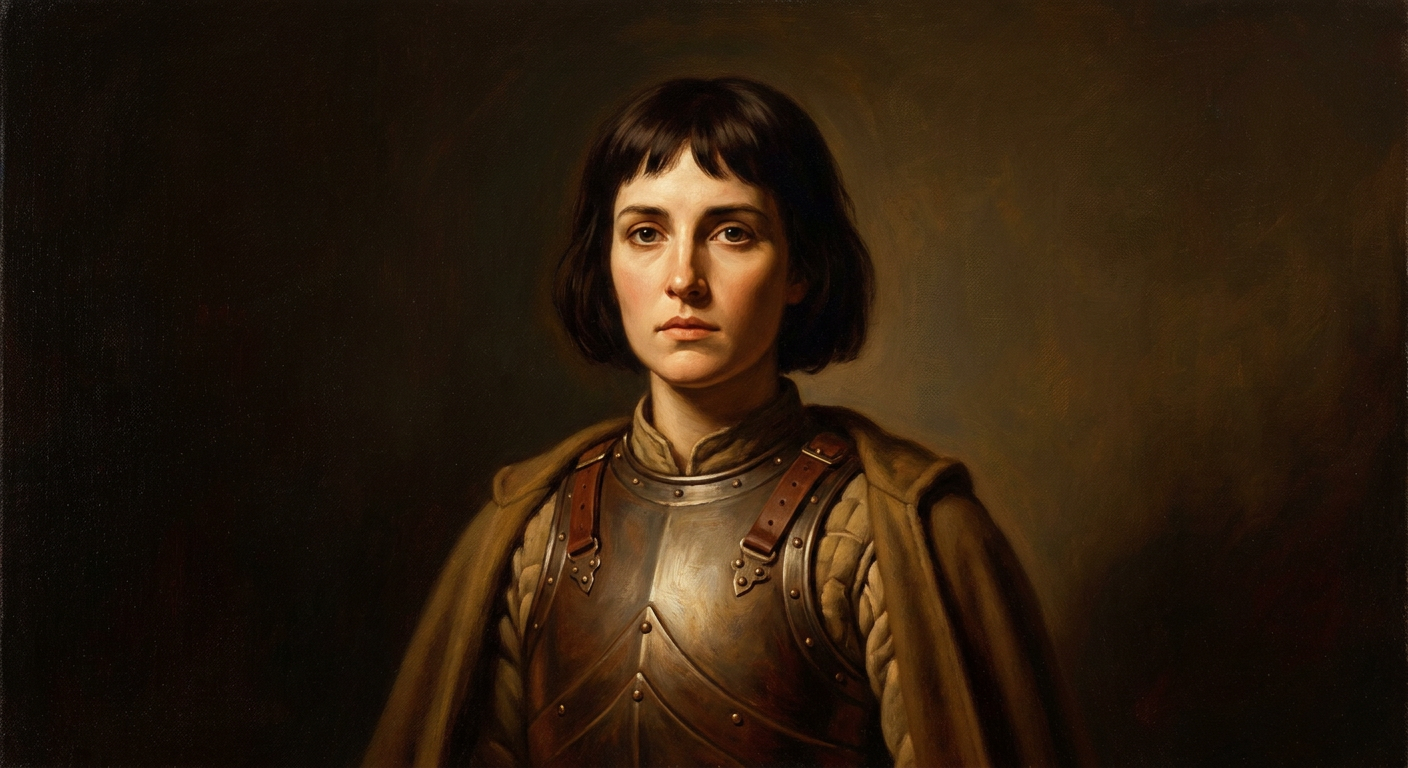
Quick Facts
- Years
- 1412 – 1431
- Category
- World Leaders & Revolutionaries
- Nationality
- French
- Occupation
- Military figure, religious visionary, and Roman Catholic saint
Joan of Arc
1412 – 1431 · French · Military figure, religious visionary, and Roman Catholic saint
Recommended Audiobooks
Listen next from Marcus Alden

Life Lessons from Simon Bolivar
Marcus Alden · 55 min

Life Lessons from George Washington
Marcus Alden · 54 min
Joan of Arc was a French peasant teenager who entered the violent politics of the Hundred Years’ War, helped transform a collapsing royal cause, and died at the stake before reaching her twentieth birthday. Born around 1412 in Domrémy, she said that heavenly voices had commanded her to assist Charles, the uncrowned Valois heir, and drive his enemies from France. Against extraordinary odds, she gained access to Charles’s court, joined the campaign that lifted the English siege of Orléans, and helped make possible his coronation as Charles VII at Reims in 1429.
Joan was neither the sole commander of the French army nor the simple national mascot imagined by later legend. She operated among experienced captains, clergy, nobles, and political advisers. Yet contemporary testimony shows that her courage, religious certainty, and symbolic authority had a remarkable effect on morale and royal legitimacy.
Captured in 1430, Joan was tried by a church court aligned with England and burned for heresy in Rouen in 1431. A later investigation overturned the judgment, and the Roman Catholic Church canonized her in 1920. Her story still matters because it joins military history, religion, politics, gender, law, memory, and myth. Students continue to study her not merely as a saint or heroine, but as a rare medieval individual whose own words survive in an extensive trial record.
Quick Facts
| Field | Details |
|---|---|
| Full Name | Jehanne or Jeanne; no fixed hereditary surname is securely established |
| Common Name(s) | Joan of Arc; Jeanne d’Arc; the Maid of Orléans |
| Born | Traditionally 6 January 1412, although the exact date is uncertain |
| Died | 30 May 1431 |
| Age at Death | About 19 |
| Birthplace | Domrémy, Duchy of Bar, on the frontier of the Kingdom of France; now Domrémy-la-Pucelle, France |
| Nationality | French, using the modern national label cautiously |
| Occupation | Military figure, religious visionary, and royal supporter |
| Historical Era | Late Middle Ages; Hundred Years’ War |
| Famous For | Relieving Orléans, supporting Charles VII’s coronation, and becoming a martyr and saint |
| Political Affiliation | Valois or Armagnac cause supporting Charles VII against the English-Burgundian alliance |
| Religion | Roman Catholic Christianity |
| Education | No formal schooling is documented; she could not read or write conventionally and dictated letters |
| Parents | Jacques d’Arc and Isabelle Romée |
| Spouse(s) | None |
| Children | None |
| Major Works | Dictated letters, proclamations, and testimony preserved in trial records |
| Major Achievements | Relief of Orléans; Loire campaign; journey to Reims; legitimization of Charles VII’s kingship; enduring religious and cultural influence |
Early Life
Joan grew up in Domrémy, a small agricultural settlement near the Meuse River. The region lay close to contested political boundaries and was exposed to raiding during the Hundred Years’ War. Her father, Jacques d’Arc, was a farmer with some standing in village affairs; her mother, Isabelle Romée, came from a devout Catholic background. Joan had several siblings and learned the domestic and agricultural tasks expected of a rural girl.
She later testified that she had not learned to read or write. This did not mean that she lacked intelligence or knowledge. Medieval rural culture relied heavily on memory, preaching, oral instruction, church ritual, and practical experience. Joan knew the central prayers of her faith and became known for attending Mass, giving alms, and showing unusual religious seriousness.
The political world around her was fractured. England’s Henry V had won a major victory at Agincourt in 1415. The Treaty of Troyes of 1420 recognized Henry and his heirs, rather than the Valois dauphin Charles, as successors to the French crown. After Henry V and Charles VI both died in 1422, the infant Henry VI was proclaimed king of France by the Anglo-Burgundian side, while Charles claimed the throne from territory south of the Loire.
Joan said that at about thirteen she first experienced a voice accompanied by light. She eventually identified her heavenly counselors as Saint Michael, Saint Catherine of Alexandria, and Saint Margaret of Antioch. Whether these experiences are understood as divine encounters, psychological phenomena, or something else depends on religious and scholarly interpretation. The historical fact is that Joan consistently reported them and organized her public mission around them.
Rise to Prominence
By 1428 Joan believed that she had been commanded to aid Charles and relieve Orléans, then under English siege. She approached Robert de Baudricourt, the royal captain at Vaucouleurs. He initially dismissed her. Joan persisted, gained local supporters, and correctly predicted—or at least reported news of—a French setback near Rouvray, known as the Battle of the Herrings. Baudricourt finally authorized her journey.
Dressed in male clothing for travel and protection, Joan crossed dangerous territory with a small escort and reached Charles’s court at Chinon in March 1429. Later stories claim that she instantly recognized Charles while he hid among courtiers. Contemporary evidence supports a significant meeting but not every dramatic detail added by later writers.
Charles’s advisers questioned Joan and sent her to Poitiers for examination by clergy. No formal record of that inquiry survives, although later sources indicate that the examiners found no reason to reject her. She was supplied with armor, attendants, a banner, and a place in the force going to Orléans.
Joan’s arrival at Orléans on 29 April 1429 electrified the defenders. Experienced commanders still controlled troops and strategy, but she pressed for aggressive action and participated near the front. During the assault on the English stronghold of Les Tourelles, she was wounded by an arrow but returned to encourage the attack. The English abandoned the siege on 8 May. The victory made the previously unknown teenager famous throughout Europe.
Major Achievements
Relief of Orléans
The siege had threatened one of the last major barriers protecting Charles’s southern territories. Joan’s presence coincided with a rapid sequence of French assaults that forced the English to withdraw.
The victory mattered both strategically and psychologically. English armies were not destroyed, but their reputation for near-inevitability was broken. Joan became a visible sign that the Valois cause might recover.
The Loire Campaign
In June 1429 French forces captured several English-held positions along the Loire, including Jargeau, Meung-sur-Loire, and Beaugency. At Patay on 18 June, French cavalry overwhelmed an English force before its longbowmen could prepare their usual defensive position.
Joan was not the only leader; the Duke of Alençon, La Hire, Jean de Dunois, and other commanders played essential roles. Her importance lay in urging momentum, accompanying operations, and investing the campaign with religious and political purpose.
The Coronation at Reims
Joan repeatedly argued that Charles should travel through contested territory to Reims, the traditional coronation city of French kings. Towns along the route submitted or opened their gates, and Charles was crowned on 17 July 1429.
The ceremony did not end the rival claim of Henry VI, but it strengthened Charles’s legitimacy. In medieval politics, sacred coronation carried enormous weight. Joan stood near the king with her banner, publicly linking her mission to the restoration of Valois rule.
Transformation of Royal Morale
Before 1429 Charles’s position was insecure, his finances weak, and his supporters divided. Joan did not solve all these problems, but she gave the royal party a compelling narrative of providential recovery.
Her impact illustrates how symbols can affect warfare. Armies depend not only on weapons and numbers but also on confidence, legitimacy, and willingness to act. Joan’s achievements were therefore psychological and political as well as military.
Survival Through the Historical Record
Joan left no autobiography, yet her dictated letters and trial testimony preserve an unusually direct medieval voice. The records reveal her intelligence, caution, humor, anger, and resistance under interrogation. Their survival has made her one of the best-documented non-royal women of the Middle Ages.
Leadership or Work
Joan led primarily through conviction, presence, and moral authority rather than formal rank. She rode with soldiers, carried a banner, encouraged attacks, and placed herself in danger. Witnesses later remembered that she opposed unnecessary swearing and tried to regulate the conduct of troops. Reports also associate her with efforts to protect civilians and prevent looting, although medieval armies could not be controlled perfectly.
Her working style was urgent. She favored decisive action when some courtiers and captains preferred negotiation or delay. That boldness helped at Orléans and during the Loire campaign, but it was less effective after the coronation, when royal policy became cautious.
Her main strengths included:
- extraordinary personal courage;
- an ability to inspire soldiers and civilians;
- persistence in gaining access to powerful institutions;
- clarity about her immediate objectives;
- skill in answering hostile questions.
Her weaknesses arose partly from the same qualities. Religious certainty could make compromise difficult, and she had limited influence over court politics, logistics, and diplomacy. She depended on nobles who controlled money, troops, and access to the king. Joan could urge policy, but she could not command the entire French state.
Personal Life
Joan never married and had no children. She testified that she had made a vow of virginity, an important part of her identity as “the Maid.” A young man from her region apparently brought a marriage claim against her; according to her testimony, she went before an ecclesiastical judge and successfully denied that any valid promise existed.
Her surviving words suggest a direct, self-possessed personality. She could be respectful to legitimate authority while sharply resisting questions she considered improper. Witnesses described her as devout, hardworking, modest, and courageous, though such testimony came largely from supporters during the later rehabilitation proceedings.
Male clothing was one of the most consequential features of her daily life. It was practical for horseback travel, armor, and life among soldiers. During imprisonment, tightly fastened male dress may also have made sexual assault more difficult. Her enemies treated the clothing as a religious offense, especially after she resumed wearing it following a brief recantation.
Joan was wounded more than once, including at Orléans and during the unsuccessful attack on Paris in September 1429. No chronic illness is securely documented. Her imprisonment, shackling, interrogation, and fear of execution placed her under severe physical and emotional pressure.
Philosophy or Beliefs
Joan’s worldview was thoroughly medieval and Catholic. She believed that God intervened in history, saints communicated with human beings, kingship possessed sacred meaning, and her mission had divine authorization. She did not present a systematic philosophy; her beliefs emerge from actions, letters, and testimony.
Politically, she supported Charles as the rightful king of France. Her language combined loyalty to the monarch with hostility toward English forces occupying French territory. Modern nationalism should be applied carefully: fifteenth-century identity was shaped by lordship, dynasty, locality, language, and religion, not by the modern nation-state alone.
Her ethics emphasized obedience to God, personal chastity, sacramental life, and courage. Yet a central conflict ran through her trial: how should a person respond when private revelation appears to conflict with church judges? Joan insisted that God came first while also affirming her loyalty to the Church. Her judges portrayed this as disobedience; later Catholic interpretation viewed her fidelity to conscience more sympathetically.
Challenges and Controversies
Joan’s campaign after Reims produced mixed results. The assault on Paris on 8 September 1429 failed, and she was wounded. Charles VII soon accepted a truce with Burgundy and reduced support for major operations. Historians debate whether Joan’s continued preference for attack was strategically realistic or whether royal hesitation squandered momentum.
On 23 May 1430, Burgundian troops captured her outside Compiègne. She was eventually transferred to English custody for a large payment. Charles VII made no successful effort to rescue or ransom her. The reasons remain debated: practical limitations, political caution, and her reduced usefulness may all have contributed.
Her trial at Rouen was conducted by Bishop Pierre Cauchon, a supporter of the Anglo-Burgundian cause. It followed ecclesiastical procedures, but its political setting, Joan’s confinement in an English-controlled secular prison, restricted access to assistance, and pressure on participants undermine claims of impartiality.
The court examined her visions, submission to church authority, predictions, and clothing. Under threat of immediate execution, Joan signed or marked an abjuration on 24 May 1431 and accepted female dress. The exact contents read to her and the extent of her understanding are disputed because surviving versions differ. Days later she resumed male clothing and reaffirmed her voices. Declared a relapsed heretic, she was burned on 30 May.
In 1455–1456, a new church inquiry authorized by Pope Callixtus III reviewed the case. It declared the original conviction invalid because of procedural injustice, coercion, and errors. This “nullification trial” was not simply a modern retrial, and it also served the interests of Joan’s family and Charles VII’s now-secure monarchy. Nevertheless, its testimony is indispensable historical evidence.
Claims that Joan secretly survived, was of royal birth, or was replaced at execution lack credible evidence. Scholars also disagree about medical explanations for her voices. Retrospective diagnoses cannot be established from medieval documents and should not be presented as fact.
Legacy
Joan’s immediate military career lasted little more than a year, but her image grew for centuries. By 1453 Charles VII’s forces had expelled the English from almost all their French territories, except Calais. Joan did not live to see that outcome, and France’s victory depended on institutional reform, artillery, diplomacy, and the weakening of the Anglo-Burgundian alliance. Even so, 1429 remained a decisive turning point.
She became a flexible symbol. Monarchists celebrated loyalty to the crown; republicans praised popular patriotism; Catholics honored faith and martyrdom; feminists examined her challenge to gender expectations; and political movements of both left and right attempted to claim her. These competing uses reveal as much about later societies as about Joan herself.
The Roman Catholic Church beatified her in 1909 and canonized her in 1920. Her feast day is 30 May. France observes a national celebration in her honor on the second Sunday in May, though it is not a general public holiday.
Important sites include her birthplace at Domrémy-la-Pucelle, the Basilica of Bois-Chenu nearby, Orléans, Reims Cathedral, and Rouen’s Historial Jeanne d’Arc. Statues stand in many cities, while literature, painting, opera, theater, and film have repeatedly reinterpreted her. Notable treatments include works by Friedrich Schiller, Giuseppe Verdi, Pyotr Tchaikovsky, Mark Twain, George Bernard Shaw, and filmmaker Carl Theodor Dreyer.
Her modern relevance lies partly in the questions her life raises: Who controls political legitimacy? How should courts handle vulnerable defendants? When does religious conviction inspire liberation, and when can certainty become dangerous? How are women who enter traditionally male spheres judged? Joan’s story offers no simple answer, but it makes those questions vivid.
Interesting Facts
- Joan generally called herself “Jeanne la Pucelle,” meaning Joan the Maid.
- The surname “d’Arc” had several medieval spellings and was not used by her as a modern family name.
- Her exact birthday is uncertain; 6 January 1412 is traditional rather than conclusively documented.
- She came from a relatively prosperous peasant household, not from destitution.
- She traveled roughly 500 kilometers through dangerous territory to reach Chinon.
- Her armor was funded by Charles VII’s government.
- She preferred to carry a banner and testified that she had never personally killed anyone.
- She dictated letters because she lacked conventional literacy.
- The sword associated with her was reportedly found at the church of Sainte-Catherine-de-Fierbois.
- She was wounded by an arrow at Orléans but returned to the fighting.
- Her public career from arrival at Chinon to capture lasted only about fifteen months.
- Burgundians, not English soldiers, captured her at Compiègne.
- She attempted to escape captivity, once leaping from a tower and surviving.
- Her trial record contains detailed answers delivered while she was about nineteen.
- She asked that her case be referred to the pope, but the request was not effectively granted.
- The executioner reportedly feared damnation after burning her.
- Her conviction was annulled twenty-five years after her death.
- She was canonized nearly five centuries later, in 1920.
Famous Quotes
Translations of Joan’s fifteenth-century French vary. The following statements come from trial testimony or contemporary documents unless noted otherwise.
- “If I am not, may God put me there; and if I am, may God so keep me.” Asked whether she was in God’s grace, Joan avoided a theological trap: church teaching held that no person could know this with certainty.
- “Before seven years are past, the English will lose a greater pledge than they did at Orléans.” During her trial, she predicted further English losses. The statement reflects confidence in eventual French recovery.
- “As for my work, I must do it; and as for this clothing, I must take it.” Her testimony linked male dress with the demands of her mission.
- “The voice is good and worthy, and I am not bound to answer you.” Joan resisted efforts to force disclosure of matters she considered divinely private.
- “I would rather die than do something which I know to be a sin.” Recorded in substance during questioning, this expresses the moral seriousness behind her resistance.
- “My banner had been in the suffering; it was right that it should share in the honor.” She explained why her banner stood prominently at Charles VII’s coronation.
- “I loved my sword, but I loved my banner forty times more.” Joan said she preferred the banner because she did not wish to kill anyone.
- “In God’s name, the soldiers will fight, and God will give the victory.” Preserved in contemporary testimony, this summarizes how she joined military action to providential belief.
- “Jesus, Jesus, Jesus.” Witnesses reported that she repeatedly invoked Jesus at the stake; the precise sequence cannot be reconstructed.
- “I am not afraid; I was born to do this.” Widely attributed to Joan in modern culture, but no reliable contemporary source records it. It should be treated as apocryphal.
Timeline
- c. 1412 — Joan is born in Domrémy to Jacques d’Arc and Isabelle Romée.
- c. 1425 — She later dates the beginning of her voices to around age thirteen.
- 1428 — Joan seeks help from Robert de Baudricourt at Vaucouleurs.
- February 1429 — Baudricourt permits her to travel to Charles’s court.
- March 1429 — Joan meets Charles at Chinon and is examined at Poitiers.
- 29 April 1429 — She enters besieged Orléans.
- 7 May 1429 — She is wounded during the assault on Les Tourelles.
- 8 May 1429 — The English lift the siege of Orléans.
- June 1429 — French forces win the Loire campaign.
- 18 June 1429 — The English are defeated at Patay.
- 17 July 1429 — Charles VII is crowned at Reims.
- 8 September 1429 — The French assault on Paris fails; Joan is wounded.
- 23 May 1430 — Burgundian forces capture Joan at Compiègne.
- Late 1430 — She is transferred to English custody and taken to Rouen.
- January–May 1431 — Bishop Pierre Cauchon’s court tries her for heresy.
- 24 May 1431 — Under threat of execution, Joan abjures.
- 28–29 May 1431 — She is judged a relapsed heretic.
- 30 May 1431 — Joan is burned at the stake in Rouen.
- 1455–1456 — A papally authorized inquiry reviews her case.
- 7 July 1456 — Her conviction is formally annulled.
- 1909 — The Catholic Church beatifies her.
- 1920 — Pope Benedict XV canonizes her.
- 1922 — She is declared a patron saint of France.
Frequently Asked Questions
1. Who was Joan of Arc?
Joan of Arc was a young woman from rural northeastern France who said that saints had commanded her to support Charles VII during the Hundred Years’ War. In 1429 she joined French forces, helped inspire the relief of Orléans, and promoted Charles’s coronation at Reims. Captured by Burgundian troops in 1430, she was transferred to English control and convicted of heresy by a politically compromised church court. She was executed in 1431, rehabilitated in 1456, and canonized in 1920.
2. Was Joan really born on 6 January 1412?
That date is traditional, but it is not certain. Medieval rural births were not documented with the standardized civil records familiar today. Joan herself did not provide an exact birth date during her trial; she estimated her age at about nineteen in 1431. Historians therefore commonly write that she was born around 1412. The traditional date remains useful for commemoration, but it should not be mistaken for a firmly verified fact.
3. Was Joan a military commander?
Yes, but the phrase requires qualification. Joan participated in councils, urged particular strategies, led or accompanied troops, and exercised powerful authority through her reputation. However, trained nobles and captains such as the Duke of Alençon and Jean de Dunois directed many tactical operations. She was not commander-in-chief of every French force. Her greatest contribution combined battlefield courage, advocacy for aggressive action, morale-building, and the religious legitimacy she gave the Valois campaign.
4. Did Joan fight with a sword?
Joan carried a sword, wore armor, and entered dangerous combat zones, but she testified that she had not killed anyone. She preferred her banner, explaining that it allowed her to avoid killing. It is impossible to reconstruct every moment of battle, yet no reliable evidence proves that she personally struck down an enemy. Her battlefield function was primarily to rally troops, communicate determination, and embody the sacred purpose she attributed to the campaign.
5. What voices did Joan say she heard?
Joan identified her principal voices as those of Saint Michael the Archangel, Saint Catherine of Alexandria, and Saint Margaret of Antioch. She said they offered spiritual guidance and instructed her to aid Charles. The trial judges pressed her for physical details, but she guarded parts of the experiences. Historians can establish that she reported these visions consistently; they cannot scientifically determine their supernatural origin. Religious believers and secular scholars therefore interpret them differently.
6. Why was Orléans so important?
Orléans guarded approaches into territory controlled by Charles VII and occupied a strategically important position on the Loire. Its fall could have opened the way for deeper English advances and further damaged Valois credibility. When the English siege ended in May 1429, the result reversed months of pressure and encouraged a French offensive. The victory did not decide the entire war, but it broke a dangerous military stalemate and transformed Joan into an international political figure.
7. Why did Charles VII need coronation at Reims?
French kings traditionally received sacred anointing and coronation at Reims Cathedral. Charles already claimed royal authority, but the ceremony gave that claim religious legitimacy and public visibility. Reaching Reims was risky because the route crossed contested territory. Joan argued strongly for the journey, and the coronation on 17 July 1429 weakened the English portrayal of Charles as an illegitimate rival. It did not eliminate Henry VI’s claim, but it gave Charles a major symbolic advantage.
8. Why did Joan wear men’s clothing?
Male clothing was practical for riding, wearing armor, traveling with soldiers, and securing garments while imprisoned among male guards. Joan also connected the clothing to instructions received through her voices. Her judges treated cross-dressing as a religious violation, citing biblical prohibitions, but medieval theology allowed context to matter, including necessity and safety. Her resumption of male clothing in prison became the immediate basis for declaring her a relapsed heretic, making dress central to her conviction.
9. How was Joan captured?
On 23 May 1430 Joan joined defenders outside Compiègne against a Burgundian attack. During the retreat, she was cut off and captured by troops serving the Burgundian faction. She passed through several places of confinement before being transferred to the English for a substantial payment. The English wanted to discredit the person who had helped validate Charles VII, but they pursued that goal through an ecclesiastical trial rather than treating her simply as a prisoner of war.
10. Why did Charles VII not rescue her?
No surviving document gives a complete answer. A rescue would have been difficult, and Joan was held in fortified places controlled by Charles’s enemies. Ransom negotiations depended on rank, money, political interest, and opportunity. Charles’s government may also have considered her less essential after the coronation and the failure at Paris. Historians often criticize his apparent inaction, but claims that he deliberately arranged her capture or wanted her executed go beyond the available evidence.
11. Was Joan’s trial fair?
By modern standards, no. Even under medieval canon law, serious problems existed. Bishop Pierre Cauchon was politically connected to the English cause; Joan was held in a secular prison guarded by English soldiers; she lacked a normal legal advocate; and requests involving papal judgment were not effectively honored. The proceedings nonetheless used recognizable church legal forms and extensive questioning. The later nullification court concluded that fraud, coercion, procedural abuse, and hostility had invalidated the conviction.
12. Why was she executed after recanting?
On 24 May 1431, threatened with immediate burning, Joan accepted an abjuration whose exact wording and explanation remain disputed. She temporarily wore female clothes. Within days she resumed male clothing and reaffirmed the divine origin of her voices. The judges classified this as relapse into heresy. Under the legal assumptions of the time, a relapsed heretic could be handed to secular authorities for execution. The speed and circumstances of the reversal remain among the trial’s most controversial features.
13. How did Joan die?
Joan was burned at the stake in Rouen’s marketplace on 30 May 1431. Witnesses reported that she asked for a cross and repeatedly invoked Jesus. Her remains were burned further, and the ashes were thrown into the Seine, preventing the creation of a burial shrine or verified relics. Later stories about her escape or substitution have no credible documentary support. The weight of contemporary evidence establishes that she died in Rouen that day.
14. Was Joan declared innocent?
A papally authorized nullification proceeding reviewed the original trial in 1455–1456. It gathered testimony from relatives, villagers, soldiers, clergy, and others who had known her. In July 1456 the court annulled the 1431 judgment, declaring it legally defective and unjust. This restored Joan’s reputation and removed the stain of heresy from her family and Charles VII’s cause. It was not identical to a modern declaration of factual innocence, but it decisively invalidated her conviction.
15. Why did the Catholic Church make her a saint?
Joan’s canonization followed a lengthy church process examining her life, faith, reputation, and reported miracles. She was beatified in 1909 and canonized by Pope Benedict XV in 1920. The Church honors her for fidelity to her perceived divine mission, courage, chastity, prayer, and perseverance through suffering. Canonization did not endorse every tactical decision or later nationalist interpretation. It recognized her as a model of Christian holiness within Catholic teaching.
16. Did Joan single-handedly save France?
No. That popular claim simplifies a long and complicated war. Joan helped produce a dramatic turning point in 1429, but the eventual French victory also depended on commanders, administrators, artillery development, financial recovery, diplomacy with Burgundy, and English political weakness. Her achievements remain extraordinary without exaggeration. She restored confidence, helped relieve Orléans, and promoted the coronation that strengthened Charles VII, but France’s reconquest continued for more than two decades after her death.
17. Why is Joan still controversial?
Joan stands at the intersection of religion, war, nationalism, gender, and political power. Catholics may emphasize sainthood, secular historians the documentary record, and gender historians her navigation of male clothing and military authority. Political groups have repeatedly adapted her to conflicting causes. Debate also surrounds interpretations of her voices and the extent of her command. The controversy persists because the evidence is unusually rich while her inner experiences remain impossible to verify independently.
Lessons We Can Learn
- Moral authority can change events. Joan lacked wealth or rank, yet her conviction influenced soldiers and a king. Modern readers may interpret this as a lesson in credibility, not proof that conviction alone guarantees truth.
- Persistence can open guarded institutions. Baudricourt initially rejected her, but she returned and built support. The evidence shows persistence; applying it to modern goals requires judgment about whether the goal itself is sound.
- Symbols matter in leadership. Her banner, armor, and presence created shared purpose. Modern leaders likewise use symbols, though symbols must be supported by effective policy.
- Courage is not the same as invulnerability. Joan accepted danger and suffered wounds, capture, and defeat. Bravery can inspire action but does not remove strategic risk.
- Success is usually collective. Orléans depended on Joan, captains, soldiers, residents, supplies, and prior planning. Heroic narratives should not erase teamwork.
- Legitimacy can be as important as force. The Reims coronation changed perceptions without destroying an army. Institutions and public confidence still influence political power.
- Question biased legal systems. Joan’s trial used legal procedures within a politically controlled setting. Formal process does not ensure justice when defendants lack independence and protection.
- Context matters when judging behavior. Her clothing was practical and protective, yet prosecutors treated it abstractly as disobedience. Rules should be interpreted with attention to circumstances.
- Momentum must be balanced with strategy. Joan’s urgency succeeded in the Loire campaign but failed at Paris. The modern lesson is interpretive: decisive action and careful planning must work together.
- Historical memory is continually reshaped. Saints, nationalists, artists, and activists created different Joans. Studying those versions teaches critical evaluation of how societies use the past.
Related Historical Figures
- Charles VII of France — The claimant Joan supported and escorted to his coronation; his restored monarchy was central to her mission.
- Henry VI of England — The child king proclaimed ruler of both England and France by the Anglo-Burgundian alliance.
- John, Duke of Bedford — English regent in France and a principal defender of Henry VI’s French claim.
- Philip the Good, Duke of Burgundy — Leader of the Burgundian state whose troops captured Joan and whose alliance shaped the war.
- Pierre Cauchon — Bishop of Beauvais who presided over Joan’s condemnation trial in Rouen.
- Jean de Dunois — Experienced French commander who fought at Orléans and later testified about Joan.
- John II, Duke of Alençon — French noble and commander who campaigned beside Joan during the Loire victories.
- Étienne de Vignolles, called La Hire — Soldier associated with Joan’s campaigns and the recovery of the Valois cause.
- Gilles de Rais — Nobleman and military commander who fought in Charles VII’s army; his later criminal case is separate from Joan’s story.
- Pope Callixtus III — The pope who authorized the investigation leading to annulment of Joan’s conviction.
Watch and Learn
“The myth of Joan of Arc” — TED-Ed — approximately 5 minutes. This animated lesson, written by educator Alex Gendler, provides a clear introduction to Joan’s mission, military role, trial, and posthumous reputation. It is recommended as an accessible overview, though viewers should use longer scholarly resources for the legal and political complexities of her career.
Watch and Learn
The myth of Joan of Arc · TED-Ed
Related Historical Figures