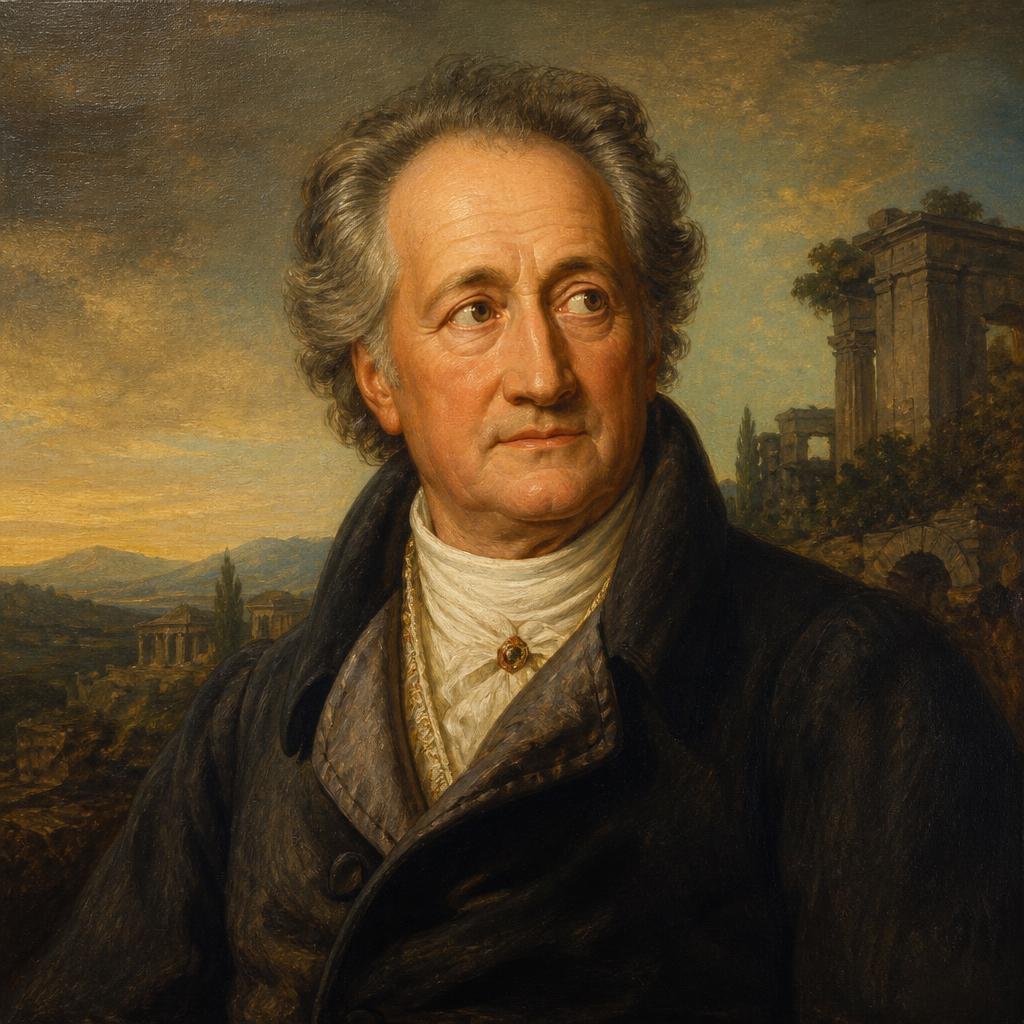
Quick Facts
- Years
- 1749 – 1832
- Category
- Writers & Poets
- Subcategory
- Poets
- Nationality
- German
- Occupation
- Poet & Playwright
Johann Wolfgang von Goethe
1749 – 1832 · German · Poet & Playwright
Audiobook

Life Lessons from Johann Wolfgang von Goethe
Marcus Alden · 54 min
Johann Wolfgang von Goethe (1749–1832) was a German poet, playwright, novelist, critic, scientist, and statesman whose career spanned the Enlightenment, the French Revolution, the Napoleonic era, and the beginnings of European Romanticism. Few writers worked across so many fields with comparable influence. His drama Faust, novel The Sorrows of Young Werther, lyric poetry, and autobiographical writings helped reshape European literature, while his work with Friedrich Schiller became central to Weimar Classicism.
Goethe was not merely an author. At the court of Saxe-Weimar-Eisenach, he supervised mines, roads, finances, military affairs, and cultural institutions. He also investigated plant form, anatomy, color, geology, and meteorology. Some scientific claims proved more durable than others, but his effort to understand nature through attentive observation remains historically significant.
His greatest achievement, Faust, occupied him for much of his adult life and transformed an old legend into a vast drama about knowledge, desire, responsibility, power, and redemption. Goethe is still studied because his work confronts enduring tensions: reason and emotion, individuality and society, art and politics, ambition and moral consequence. His openness to world literature and intercultural exchange also gives his thought continuing relevance.
Quick Facts
| Field | Details |
|---|---|
| Full Name | Johann Wolfgang Goethe; ennobled in 1782 as Johann Wolfgang von Goethe |
| Common Name(s) | Goethe; Johann Wolfgang von Goethe |
| Born | 28 August 1749 |
| Died | 22 March 1832 |
| Age at Death | 82 |
| Birthplace | Frankfurt am Main, Free Imperial City of Frankfurt, Holy Roman Empire |
| Nationality | German |
| Occupation | Poet, playwright, novelist, critic, scientist, administrator, statesman |
| Historical Era | Enlightenment, Sturm und Drang, Weimar Classicism, Romantic era |
| Famous For | Faust, The Sorrows of Young Werther, lyric poetry, Weimar Classicism, scientific writings |
| Political Affiliation if applicable | Court official in Saxe-Weimar-Eisenach; no modern party affiliation |
| Religion if significant | Baptized and raised Lutheran; later religious views were highly individual and difficult to classify |
| Education | Private education; law at Leipzig University and the University of Strasbourg |
| Parents | Johann Caspar Goethe and Catharina Elisabeth Goethe, née Textor |
| Spouse(s) | Christiane Vulpius, married 1806 after a long partnership |
| Children | Five children with Christiane; only August von Goethe survived infancy |
| Major Works | The Sorrows of Young Werther, Götz von Berlichingen, Iphigenia in Tauris, Egmont, Wilhelm Meister’s Apprenticeship, Elective Affinities, West-Eastern Divan, Faust Parts I and II |
| Major Achievements | Leading figure of German literature; major architect of Weimar Classicism; influential concept of world literature; service in Weimar government; contributions to morphology and color theory |
Early Life
Goethe was born into a prosperous household in Frankfurt am Main. His father, Johann Caspar Goethe, was a legally trained imperial councillor who lived as a private gentleman and supervised his son’s education closely. His mother, Catharina Elisabeth, came from the prominent Textor family and was remembered for her wit and storytelling. Of their children, Goethe and his sister Cornelia survived to adulthood.
Tutors taught him languages, literature, religion, drawing, music, riding, and fencing. The family library and Frankfurt’s civic culture exposed him to classical authors, the Bible, contemporary literature, and visual art. The French occupation of Frankfurt during the Seven Years’ War brought French theater and culture into his immediate environment.
In 1765 Goethe went to Leipzig to study law, as his father wished. He was more attracted to literature, art, and fashionable society. He studied drawing with Adam Friedrich Oeser and encountered classical aesthetics. Illness forced him home in 1768. During his recovery, he read religious, alchemical, and mystical writings through contacts associated with Susanna Katharina von Klettenberg.
He resumed legal study at Strasbourg in 1770 and earned a licentiate in law in 1771. Strasbourg proved decisive. Johann Gottfried Herder encouraged him to value Shakespeare, Homer, folk poetry, and culturally rooted language rather than rigid French neoclassical rules. Goethe also fell in love with Friederike Brion, daughter of a pastor at Sessenheim. Their relationship inspired important poems, although his departure caused her pain.
The fragmented Holy Roman Empire formed the political background of his youth. German-speaking lands lacked a unified national capital, and writers often depended on courts, universities, publishers, or private means. Goethe’s combination of wealth, education, and court patronage gave him unusual freedom, though it also connected him to elite institutions.
Rise to Prominence
After Strasbourg, Goethe practiced law in Frankfurt without great enthusiasm. His drama Götz von Berlichingen, published in revised form in 1773, broke theatrical conventions through rapid scene changes, forceful prose, and admiration for an independent sixteenth-century knight. It became a landmark of Sturm und Drang, the movement associated with emotional intensity, rebellion, and creative individuality.
In 1772 he worked at the Imperial Chamber Court in Wetzlar. There he became attached to Charlotte Buff, who was engaged to Johann Christian Kestner. Goethe combined this experience with elements from the suicide of the jurist Karl Wilhelm Jerusalem to create The Sorrows of Young Werther (1774). The epistolary novel made him famous across Europe. Its portrayal of frustrated love and suicide provoked admiration, imitation, and moral alarm.
The young Duke Carl August invited Goethe to Weimar in 1775. Goethe soon became a trusted adviser and, in 1776, a member of the duke’s Privy Council. Administrative work gave him status and practical experience but reduced his literary output. He handled mining, finance, military, and infrastructure responsibilities while developing an intense intellectual friendship with Charlotte von Stein.
By 1786 he felt constrained and creatively depleted. He left for Italy, initially without publicly announcing his plans. The Italian journey renewed his engagement with classical art, architecture, and landscape. After returning to Weimar in 1788, he reduced his administrative burden, began living with Christiane Vulpius, and concentrated more fully on literature, science, and cultural management.
Major Achievements
Transforming European Fiction with Werther
The Sorrows of Young Werther turned personal and contemporary materials into a tightly structured novel of letters. Its emotional immediacy made readers feel close to Werther’s consciousness, but the editorial framework also allowed critical distance from his self-absorption.
The book mattered because it demonstrated the international power of German literature at a time when French and English writing dominated European prestige. It became a cultural phenomenon and established Goethe at twenty-five. Its long-term impact can be seen in confessional fiction, Romantic ideas of the alienated individual, and continuing debates about literature’s effects on vulnerable readers.
Creating Faust
Goethe worked on versions of Faust from the 1770s until shortly before his death. Part I appeared in 1808; Part II was published posthumously in 1832. The drama follows the scholar Faust, whose dissatisfaction leads to an agreement with Mephistopheles. The tragedy of Gretchen anchors Part I, while Part II ranges through classical mythology, politics, economics, empire, and modern development.
Its importance lies in its extraordinary scale and moral ambiguity. Faust’s restless striving produces discovery but also exploitation and suffering. The work became a defining text of modernity and inspired music, philosophy, theater, visual art, and criticism around the world.
Shaping Weimar Classicism
Goethe’s collaboration with Friedrich Schiller, especially from 1794 until Schiller’s death in 1805, generated essays, poems, ballads, correspondence, and major dramas. They sought forms capable of reconciling freedom and discipline, emotion and reason, the individual and society.
Their partnership helped make Weimar a symbolic center of German culture. Although the label “Weimar Classicism” was systematized later, it describes a durable educational ideal based on aesthetic cultivation and humane self-formation.
Advancing the Idea of World Literature
In the 1820s Goethe spoke of Weltliteratur, or world literature, while reading works from China, Persia, Serbia, France, England, and elsewhere. He did not leave a single complete theory, but he urged writers and readers to look beyond national isolation.
This mattered because European nationalism was intensifying. His vision anticipated comparative literature and modern debates about translation and intercultural circulation. Scholars also note its limitations: Goethe approached other traditions from the position of an elite European reader and through available translations.
Contributing to Science and Morphology
Goethe pursued anatomy, botany, optics, geology, and meteorology. In the 1780s he promoted recognition of the human intermaxillary bone, known in other mammals, as evidence of structural continuity. His Metamorphosis of Plants (1790) explored transformations among plant organs and became influential in morphology.
His Theory of Colours (1810) rejected important aspects of Newtonian optics. Its physical theory did not replace Newton’s account and is not accepted as modern optical science. Nevertheless, its detailed attention to visual perception, physiological afterimages, and the experiential qualities of color influenced artists, philosophers, and historians of perception.
Serving Weimar as Administrator and Cultural Leader
Goethe’s government work included mining reform, taxation, roads, military organization, and oversight of institutions. Results were mixed; the effort to revive the Ilmenau silver and copper mines was costly and commercially unsuccessful. Yet the work immersed him in technology, labor, bureaucracy, and political compromise.
As director of the Weimar Court Theatre from 1791 to 1817, he promoted disciplined ensemble performance and a demanding repertory. He helped shape Weimar’s lasting reputation as a cultural center.
Leadership and Work
Goethe led through sustained observation, personal authority, and control of detail. In government and theater, he preferred orderly procedures, trained personnel, and gradual improvement. His administrative memoranda show a practical concern with resources and implementation rather than abstract declarations alone.
His creative method was similarly cumulative. He revised works over decades, absorbed new knowledge, and allowed projects such as Faust and Wilhelm Meister to evolve. Conversation, travel, art collecting, correspondence, and empirical study all entered his writing.
His strengths included range, discipline, curiosity, and an ability to connect specialized fields. He cultivated relationships with rulers, writers, actors, scientists, musicians, and artists. Schiller was his most important literary collaborator; their differences became productive rather than destructive.
His weaknesses included social distance and a willingness to exercise hierarchical authority. As a court official, he accepted structures that later democratic critics considered paternalistic. Theater personnel could find his standards severe. His response to disagreement was sometimes controlling, and his privileged position protected him from consequences faced by less powerful people.
Personal Life
Goethe’s emotional life strongly influenced his writing. Early attachments included Käthchen Schönkopf, Friederike Brion, Charlotte Buff, and Lili Schönemann. His decade-long relationship with Charlotte von Stein in Weimar was intellectually formative; its exact physical character remains debated because the surviving evidence does not settle the question.
In 1788 Goethe began living with Christiane Vulpius, a woman from a less privileged background. Weimar society often treated her condescendingly. They married in 1806, after French soldiers threatened their home and Christiane helped protect the household. Five children were born to them, but only their son August survived infancy. Christiane died in 1816, and August died in Rome in 1830.
Goethe formed important friendships with Herder, Schiller, Carl Friedrich Zelter, the Duke Carl August, and many others. His later conversations were recorded by Johann Peter Eckermann, though they should be read as mediated recollections rather than verbatim transcripts.
He enjoyed drawing, collecting art and minerals, gardening, travel, theater, music, and conversation. He worked regularly and preserved manuscripts with an eye toward posterity. Periods of illness marked his life, including the serious sickness that ended his Leipzig studies. In old age he remained productive despite bereavement and declining health.
Philosophy and Beliefs
Goethe resisted closed philosophical systems. He valued experience, development, form, and the interaction of opposites. Nature, in his view, was dynamic and interconnected rather than merely mechanical. This outlook shaped both his morphology and his literary portrayals of growth.
Religiously, he drew on Christianity, classical pagan traditions, Spinoza, mysticism, and Islamic and Persian poetry. He criticized narrow dogmatism but did not simply reject religion. Faust uses Christian language of sin and redemption while refusing an uncomplicated doctrinal scheme.
Politically, Goethe favored reform under enlightened rulers more than popular revolution. He disliked the violence and disruption associated with the French Revolution, although he understood its historical significance. His conservatism was institutional rather than narrowly ideological: he valued order, education, administrative competence, and cultural development.
Ethically, his works emphasize self-cultivation, responsible action, and openness to experience. Yet they also expose the danger of limitless striving. Faust’s ambition is creative and destructive, making Goethe’s ethics a field of tension rather than a list of fixed commandments.
Challenges and Controversies
The sensation surrounding Werther brought claims that it glamorized suicide. Some authorities restricted the book. Goethe later distanced himself from literal identification with Werther, and the novel itself contains warning signs about the protagonist’s judgments. Scholars continue to debate whether it primarily invites sympathy, criticism, or both.
His role at court has also drawn scrutiny. Admirers see an artist accepting civic responsibility; critics see accommodation to aristocratic power. His participation in the 1792 campaign against revolutionary France reinforced his skepticism toward mass revolution, but it did not make him a simple propagandist.
The Ilmenau mining program was a practical failure despite years of attention and substantial expenditure. It illustrates how intellectual energy and administrative persistence do not guarantee technical or economic success.
His color theory became another major dispute. Goethe believed Newtonian physics abstracted too far from lived visual phenomena. Modern physics supports Newton’s core account of light, so Goethe’s alternative physical claims cannot be treated as equivalent science. Historians nevertheless recognize the value of his perceptual observations.
Goethe’s relationship with Christiane exposed class prejudice, but his own treatment of women has also been questioned. Many relationships enriched his art while leaving women with fewer choices and reputational protections. Interpretations range from admiration for his emotional receptivity to criticism of unequal power.
Modern scholars further examine the Eurocentric limits of his cosmopolitanism and the social costs represented in Faust Part II. Such criticism does not erase his achievement; it reveals why his work remains open to serious argument.
Legacy
Goethe became a foundational figure in German-language culture and a central author in world literature. His lyric poems influenced composers including Schubert, Schumann, Brahms, Wolf, and Mahler. Faust inspired works by Berlioz, Gounod, Liszt, Wagner, Thomas Mann, and countless later artists.
His concept of world literature helped establish comparative approaches to texts across languages. His reflections on artistic formation shaped educational thought, while his scientific writings remain important to the history of morphology, perception, and critiques of reductionism.
Weimar preserves major sites associated with him. Goethe’s house on the Frauenplan and his garden house are part of the Klassik Stiftung Weimar. The Goethe and Schiller Monument stands before the German National Theatre. Frankfurt’s Goethe House commemorates his birthplace, although the original building was destroyed during the Second World War and reconstructed.
The Goethe-Institut, founded in 1951, promotes German-language learning and international cultural exchange. Universities, streets, schools, prizes, museums, and societies around the world bear his name. His modern relevance rests not in universal agreement with him, but in the richness with which he examined aspiration, culture, nature, power, and consequence.
Interesting Facts
- Goethe was born at noon on 28 August 1749, according to his autobiography.
- He studied law because his father intended him for a legal career.
- He practiced law briefly before literary fame transformed his prospects.
- Werther made him internationally famous at twenty-five.
- Napoleon met Goethe at Erfurt in 1808 and discussed Werther with him.
- Goethe was ennobled by Duke Carl August in 1782, adding “von” to his name.
- He lived in Weimar for most of the period from 1775 until his death.
- His Italian journey lasted from 1786 to 1788.
- He helped direct the Weimar Court Theatre for more than two decades.
- Only one of his five children with Christiane Vulpius survived infancy.
- He collected thousands of minerals and works of art.
- He regarded his studies of color as among his most important achievements.
- He worked on the Faust material for roughly six decades.
- Faust Part II was published only after his death.
- His correspondence with Schiller is a major record of literary collaboration.
- He wrote poetry inspired by the Persian poet Hafez.
- He coined or popularized discussions of Weltliteratur, “world literature.”
- His reported final words, “More light,” are famous but their exact wording and meaning are uncertain.
Famous Quotes
-
“Two souls, alas, are dwelling in my breast.” — Faust Part I, “Before the Gate.” Faust describes inner division between worldly desire and higher aspiration. Translations vary.
-
“What you have inherited from your fathers, acquire it in order to possess it.” — Faust Part I, “Night.” The line argues that tradition becomes meaningful only through active appropriation.
-
“Gray, dear friend, is all theory, and green the golden tree of life.” — Mephistopheles in Faust Part I, “Study.” Often quoted as Goethe’s own maxim, it is spoken by a deceptive character and should be interpreted in context.
-
“Here I am human; here I may be so.” — Faust Part I, “Before the Gate.” Faust experiences release among ordinary people during an Easter walk.
-
“The eternal feminine draws us upward.” — Final lines of Faust Part II. The disputed phrase has generated religious, philosophical, feminist, and psychological interpretations.
-
“One sees only what one knows.” — From Goethe’s writings and observations on art, commonly rendered from “Man sieht nur, was man weiß.” It summarizes the role of prior understanding in perception.
-
“National literature is now rather an unmeaning term; the epoch of world literature is at hand.” — Reported by Eckermann from a conversation of 31 January 1827. Because Eckermann published reconstructed conversations, the wording is mediated.
-
“Whoever knows himself and others will recognize that East and West cannot be separated.” — From the West-Eastern Divan. It expresses Goethe’s ideal of cultural relationship; English translations differ.
-
“In the beginning was the deed!” — Faust’s translation of the opening of John’s Gospel in Faust Part I. It places action at the center of his restless worldview.
-
“More light!” — Traditionally reported as Goethe’s last words. The attribution is famous but not securely documented in a form that settles whether it was symbolic or simply a request to open a shutter.
Timeline
- 1749 — Born in Frankfurt am Main on 28 August.
- 1765 — Begins legal studies at Leipzig University.
- 1768 — Returns home after serious illness.
- 1770 — Resumes legal education in Strasbourg and meets Herder.
- 1771 — Completes legal qualification and returns to Frankfurt.
- 1772 — Works at the Imperial Chamber Court in Wetzlar; meets Charlotte Buff.
- 1773 — Publishes the revised Götz von Berlichingen.
- 1774 — Publishes The Sorrows of Young Werther.
- 1775 — Moves to Weimar at Duke Carl August’s invitation.
- 1776 — Joins the Privy Council.
- 1782 — Is ennobled and becomes “von Goethe.”
- 1786 — Leaves Weimar for Italy.
- 1788 — Returns from Italy; begins partnership with Christiane Vulpius.
- 1789 — Son August is born.
- 1790 — Publishes Metamorphosis of Plants.
- 1791 — Assumes leadership of the Weimar Court Theatre.
- 1792 — Accompanies the duke during the campaign in France.
- 1794 — Begins close collaboration with Friedrich Schiller.
- 1795–1796 — Publishes Wilhelm Meister’s Apprenticeship.
- 1805 — Schiller dies.
- 1806 — Marries Christiane Vulpius.
- 1808 — Publishes Faust Part I and meets Napoleon.
- 1809 — Publishes Elective Affinities.
- 1810 — Publishes Theory of Colours.
- 1811–1833 — Volumes of his autobiography, Poetry and Truth, appear.
- 1816 — Christiane dies.
- 1819 — Publishes the expanded West-Eastern Divan.
- 1827 — Discusses the emerging age of world literature with Eckermann.
- 1829 — Publishes the completed Wilhelm Meister’s Journeyman Years.
- 1830 — His son August dies in Rome.
- 1831 — Completes Faust Part II.
- 1832 — Dies in Weimar on 22 March; Faust Part II appears posthumously.
Frequently Asked Questions
Who was Johann Wolfgang von Goethe?
Goethe was a German writer, scientist, administrator, and cultural leader. He wrote poetry, drama, fiction, autobiography, criticism, and scientific studies. His career connected Sturm und Drang, Weimar Classicism, and European Romanticism, though no single label encompasses him. He spent most of his mature life in Weimar, where he served Duke Carl August and helped manage cultural institutions. His best-known works are The Sorrows of Young Werther and Faust.
Why is Goethe so important?
Goethe expanded the possibilities of German and European literature across almost every major genre. Werther became an early international literary sensation, while Faust offered a profound account of modern striving and its costs. His collaboration with Schiller shaped Weimar Classicism. He also encouraged reading beyond national borders through the idea of world literature. His scientific studies and administrative work make him significant beyond literary history.
What is Faust about?
Faust concerns a learned man who is dissatisfied with the limits of knowledge and experience. He enters an agreement with Mephistopheles, whose assistance enables new pleasures and projects but contributes to suffering, especially Gretchen’s tragedy. Part II broadens the story into mythology, imperial politics, finance, war, and development. The drama asks whether ceaseless striving can be redeemed and what moral price is paid when ambition treats other people as instruments.
Did Goethe sell his soul to the devil?
No. Goethe was a historical person, and there is no factual basis for that claim. His fictional character Faust makes an agreement with Mephistopheles. Even within the drama, it is more complicated than the familiar phrase “selling one’s soul”: Faust wagers that he will never be satisfied enough to ask a passing moment to remain. Confusing author and character obscures Goethe’s critical exploration of temptation, ambition, and responsibility.
What made The Sorrows of Young Werther famous?
The novel’s letters gave readers unusually direct access to Werther’s feelings, frustrated love, social resentment, and despair. Its accessible style and emotional intensity resonated across Europe. Clothing associated with Werther was imitated, and the novel generated adaptations and controversies. Claims about a large, direct wave of copycat suicides are difficult to quantify, but contemporary authorities genuinely worried that the book could encourage imitation.
Was Goethe a Romantic writer?
Partly, but the label is inadequate. His early Sturm und Drang works helped prepare Romanticism through their emphasis on emotion, nature, and individual genius. Later, however, Goethe often criticized Romantic excess and pursued classical balance, formal discipline, and organic development. German literary history usually places his mature collaboration with Schiller under Weimar Classicism. His long life allowed him to influence Romantic writers while remaining independent of their movement.
What was Weimar Classicism?
Weimar Classicism was a cultural movement associated chiefly with Goethe and Schiller, with Herder and Wieland also important to Weimar’s intellectual environment. It sought to harmonize reason and feeling, freedom and form, often drawing on Greek antiquity. Rather than copying ancient models mechanically, its writers used them to pursue humane self-development. The dates and membership are debated, but Goethe and Schiller’s collaboration from 1794 to 1805 forms its central phase.
What did Goethe do in government?
Goethe served the Duke of Saxe-Weimar-Eisenach in senior administrative roles. His responsibilities included mining, roads, taxation, military matters, finances, and cultural institutions. He joined the Privy Council in 1776 and was ennobled in 1782. His work was not uniformly successful: the Ilmenau mining enterprise failed economically. Nevertheless, government service gave him practical knowledge of institutions, technology, labor, and political compromise that later informed his writing.
What were Goethe’s scientific contributions?
Goethe investigated comparative anatomy, botany, color, geology, and weather. His botanical work treated plant organs as transformations within an underlying pattern, contributing to morphology. He also supported recognition of the intermaxillary bone in humans. His color theory challenged Newton and failed as a replacement for modern physical optics, but its emphasis on perception, contrast, and visual experience remained influential in art and the humanities.
Who was Christiane Vulpius?
Christiane Vulpius was Goethe’s long-term partner and later his wife. They met in 1788 and lived together despite class prejudice within Weimar society. They had five children, only one of whom, August, survived infancy. In 1806, during the French occupation of Weimar, Christiane helped defend their household; Goethe married her that year. Her role in his domestic life was substantial, although earlier biographical traditions often treated her dismissively.
What was Goethe’s relationship with Schiller?
Goethe and Friedrich Schiller were initially cautious toward one another, but from 1794 they developed an exceptionally productive friendship. They exchanged detailed criticism, planned journals, wrote ballads, debated aesthetics, and encouraged each other’s major works. Schiller’s analytical energy helped revive Goethe’s literary production, including work on Faust. Goethe offered Schiller intellectual partnership and institutional support. Schiller’s death in 1805 was a profound personal and cultural loss for Goethe.
Did Goethe support the French Revolution?
Goethe did not support revolutionary violence or radical democratic transformation. As a court official, he valued order, gradual reform, and cultivated leadership. He witnessed military events connected with revolutionary France and recognized that the period marked a historic break. His literary responses are more complex than simple opposition: he examined social instability and political illusion while remaining skeptical that abstract ideals justified bloodshed or institutional collapse.
What did Goethe mean by “world literature”?
Goethe used “world literature” to describe increasing exchanges among national and linguistic traditions. Reading Chinese fiction, Persian poetry, Serbian songs, and contemporary European authors convinced him that literature was entering a more interconnected age. He did not mean that national traditions would disappear. Rather, translation and comparison could expose prejudice and enlarge understanding. The concept became foundational for comparative literature, although scholars debate its Eurocentric assumptions and modern institutional uses.
Was Goethe religious?
Goethe was raised Lutheran, knew the Bible deeply, and used Christian themes throughout his work. Yet he resisted doctrinal confinement and drew on Spinoza, classical mythology, mysticism, Islam, and Persian poetry. He sometimes criticized churches and dogmatism while affirming reverence for nature and a divine order. Scholars therefore describe him variously as pantheistic, humanistic, heterodox Christian, or religiously plural. No single label fully captures his changing views.
Why did Goethe travel to Italy?
By 1786 Goethe felt burdened by administrative duties and dissatisfied with unfinished artistic projects. Italy offered direct contact with classical sculpture, Renaissance art, architecture, geology, and Mediterranean landscapes. He traveled largely incognito and spent extended periods in Rome. The journey encouraged a clearer, more disciplined style and helped him revise works such as Iphigenia in Tauris. His later Italian Journey reshaped letters and notes into a literary account.
How did Goethe die?
Goethe died in Weimar on 22 March 1832 at the age of eighty-two, after a final illness generally described as involving respiratory or cardiac distress. He was buried in Weimar’s Ducal Vault near Schiller. The words “More light!” are traditionally reported as his last statement, but their exact form and symbolic interpretation are uncertain. His death came shortly after he had completed Faust Part II for posthumous publication.
Lessons We Can Learn
- Develop work over time. Goethe revised Faust for decades. Important projects may require repeated transformation rather than hurried completion.
- Learn outside your specialty. Literature, anatomy, botany, art, and administration informed one another in his work. Cross-disciplinary knowledge can reveal unexpected patterns.
- Seek rigorous collaborators. His partnership with Schiller sharpened both writers. Productive friendship includes honest criticism, not merely praise.
- Use travel as education. Italy changed Goethe’s artistic practice because he observed carefully rather than treating travel as consumption.
- Test ideas against experience. His best scientific work grew from sustained observation. Today, curiosity still needs evidence and correction.
- Accept that persistence can fail. The Ilmenau mines did not prosper. Commitment does not remove the need to evaluate results and change course.
- Read beyond national boundaries. Goethe’s world-literature ideal encourages comparison across languages while respecting historical difference.
- Balance freedom with form. Weimar Classicism treated discipline as a means of developing creative freedom, not simply restricting it.
- Examine ambition’s costs. Faust shows that achievement becomes dangerous when other people are reduced to obstacles or tools.
- Preserve complexity. Goethe resisted simple systems. Modern public debate also benefits from acknowledging tensions without abandoning judgment.
Related Historical Figures
- Friedrich Schiller (1759–1805) — Goethe’s closest mature literary collaborator and the other central figure of Weimar Classicism.
- Johann Gottfried Herder (1744–1803) — Mentor in Strasbourg who introduced Goethe to folk poetry, Shakespeare, and historically rooted culture.
- Christoph Martin Wieland (1733–1813) — Major Weimar writer whose presence helped establish the court’s literary importance.
- Duke Carl August (1757–1828) — Ruler of Saxe-Weimar-Eisenach, Goethe’s patron, employer, and long-term associate.
- Charlotte von Stein (1742–1827) — Weimar court figure whose intimate intellectual relationship with Goethe influenced his personal and artistic development.
- Christiane Vulpius (1765–1816) — Goethe’s partner from 1788 and wife from 1806, central to his household and family life.
- Friedrich Hölderlin (1770–1843) — German poet shaped by classical ideals and the literary world in which Goethe and Schiller held authority.
- Lord Byron (1788–1824) — British Romantic poet admired by Goethe and important to his international conception of literature.
- Napoleon Bonaparte (1769–1821) — French emperor who admired Werther and met Goethe at Erfurt in 1808.
- Johann Peter Eckermann (1792–1854) — Goethe’s assistant and interlocutor, whose published conversations became a major source for Goethe’s later thought.
Related Historical Figures