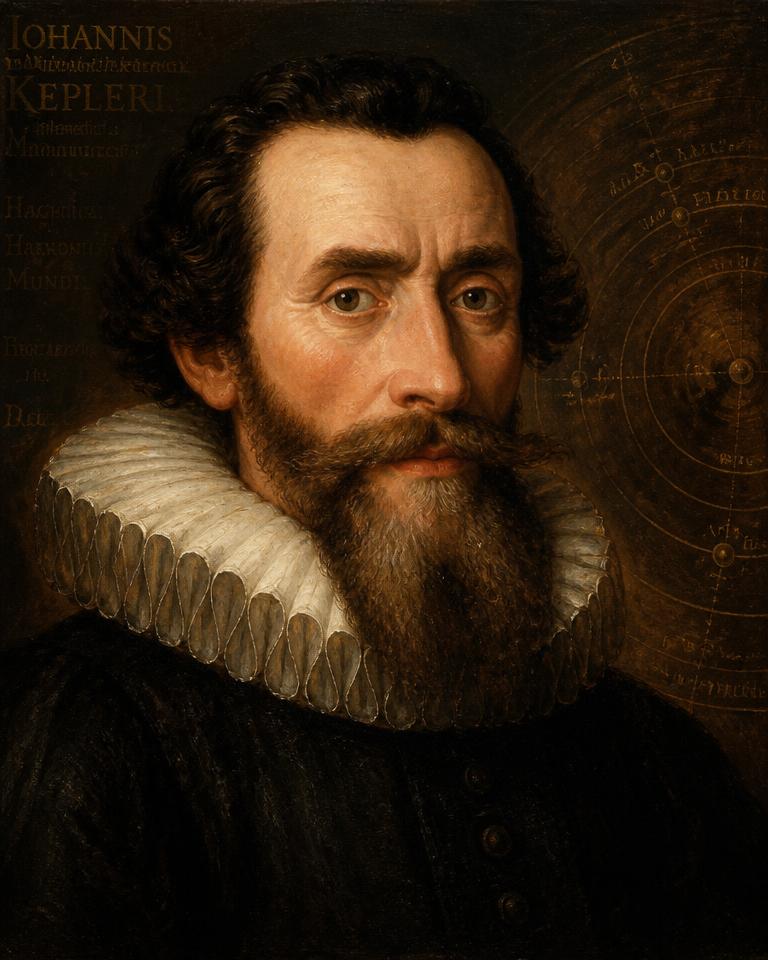
Quick Facts
- Years
- 1571 – 1630
- Category
- Scientists & Inventors
- Subcategory
- Astronomy
- Nationality
- German
- Occupation
- Astronomer & Mathematician
Johannes Kepler
1571 – 1630 · German · Astronomer & Mathematician
Audiobook

Life Lessons from Johannes Kepler
Marcus Alden · 42 min
Johannes Kepler (1571–1630) was a German astronomer, mathematician, natural philosopher, and committed Lutheran whose discoveries transformed humanity’s understanding of planetary motion. Working during the Scientific Revolution, he replaced the ancient assumption that planets must travel in perfect circles with three mathematical laws describing elliptical orbits, changing speeds, and the relationship between orbital periods and distance from the Sun.
Kepler’s achievements emerged from an unusual combination of precise observation, mathematical persistence, physical speculation, and religious conviction. Using Tycho Brahe’s exceptionally accurate measurements—especially observations of Mars—he showed that a heliocentric universe could be described with far greater precision than earlier models allowed. His Astronomia nova presented the first two laws of planetary motion; Harmonices mundi introduced the third; and the Rudolphine Tables gave astronomers and navigators highly effective planetary calculations.
His career was repeatedly disrupted by war, confessional conflict, poverty, family deaths, and the prosecution of his mother for witchcraft. Yet he continued producing foundational work in optics, geometry, astronomy, and computation. Isaac Newton later explained Kepler’s empirical laws through universal gravitation. Modern celestial mechanics, satellite navigation, and the search for exoplanets still rely on Keplerian principles, making Kepler one of the essential architects of modern science.
Quick Facts
| Field | Details |
|---|---|
| Full Name | Johannes Kepler |
| Common Name(s) | Johannes Kepler; Johann Kepler |
| Born | 27 December 1571 |
| Died | 15 November 1630 |
| Age at Death | 58 |
| Birthplace | Weil der Stadt, Duchy of Württemberg, Holy Roman Empire |
| Nationality | German |
| Occupation | Astronomer, mathematician, astrologer, natural philosopher, teacher |
| Historical Era | Scientific Revolution; late Renaissance; early modern Europe |
| Famous For | Three laws of planetary motion, Astronomia nova, Rudolphine Tables, contributions to optics |
| Political Affiliation | Not applicable; served several rulers within the Holy Roman Empire |
| Religion | Lutheran Christian, although excluded from communion because of doctrinal disagreements |
| Education | Monastic schools at Adelberg and Maulbronn; University of Tübingen |
| Parents | Heinrich Kepler and Katharina Guldenmann Kepler |
| Spouse(s) | Barbara Müller (married 1597–1611); Susanna Reuttinger (married 1613–1630) |
| Children | Eleven are generally recorded across both marriages; several died in infancy or childhood |
| Major Works | Mysterium Cosmographicum, Astronomiae Pars Optica, Astronomia nova, Dioptrice, Harmonices mundi, Epitome Astronomiae Copernicanae, Rudolphine Tables, Somnium |
| Major Achievements | Formulated the three laws of planetary motion; advanced geometrical optics; developed improved planetary tables; helped establish physical astronomy |
Early Life
Kepler was born on 27 December 1571 in Weil der Stadt, a small imperial town in southwestern Germany. His family had once enjoyed local standing but was declining economically. His father, Heinrich, worked intermittently as a mercenary and was often absent. His mother, Katharina, was the daughter of an innkeeper and had knowledge of herbal remedies. Kepler later described family life with unusual frankness, portraying it as unstable and contentious.
He was a sickly child. Smallpox impaired his eyesight and weakened his hands, limitations that made observational astronomy difficult but did not prevent mathematical work. Two childhood celestial events left strong impressions: the Great Comet of 1577 and a lunar eclipse in 1580. These experiences occurred in a culture where astronomy and astrology remained closely connected.
Württemberg’s Lutheran educational system gave talented boys of limited means a route into scholarship and ministry. Kepler attended schools at Leonberg, Adelberg, and Maulbronn before entering the University of Tübingen in 1589. He studied theology, philosophy, Greek, Hebrew, mathematics, and astronomy.
His mathematics teacher, Michael Maestlin, introduced him privately to Nicolaus Copernicus’s heliocentric model. University instruction still commonly presented Ptolemaic astronomy, but Kepler became persuaded that placing the Sun near the center offered both mathematical and theological coherence. He intended to become a Lutheran pastor. Before completing that path, however, he accepted a position teaching mathematics at the Protestant school in Graz in 1594.
Rise to Prominence
At Graz, Kepler taught mathematics and prepared calendars containing astrological forecasts. Some predictions appeared successful, enhancing his local reputation, although he later criticized much popular astrology. He also served as district mathematician.
In 1595 he believed he had discovered a geometrical explanation for the number and spacing of the six then-known planets. His model nested the five regular Platonic solids between planetary spheres. Published as Mysterium Cosmographicum in 1596, it was wrong as a physical account, but it made Kepler one of the first astronomers to defend Copernicanism openly in a substantial printed book. It also revealed his lifelong ambition: not merely to calculate celestial positions, but to discover the mathematical causes of the universe’s structure.
Religious persecution disrupted his work. The Catholic Habsburg authorities expelled Protestant teachers and ministers from Graz in 1598. Kepler returned temporarily, then had to leave permanently in 1600 after refusing conversion.
That year he joined Tycho Brahe near Prague. Tycho possessed the finest pre-telescopic observations in Europe but guarded them carefully. Their relationship was productive and tense: Kepler needed the data, while Tycho needed Kepler’s mathematical skill. Following Tycho’s death in 1601, Emperor Rudolf II appointed Kepler imperial mathematician.
Kepler’s analysis of Mars became the decisive turning point. After years of calculations, he found that a circular orbit failed to match Tycho’s observations by eight arcminutes. Rather than dismiss the discrepancy, he treated it as evidence against the model. This persistence led to the first two laws of planetary motion, published in Astronomia nova in 1609, and secured his enduring fame.
Major Achievements
The First Law: Elliptical Planetary Orbits
Kepler established that planets move around the Sun in ellipses, with the Sun at one focus. This result overturned a tradition extending from ancient Greek astronomy through Copernicus, all of whom had treated uniform circular motion as celestial perfection.
The breakthrough emerged from Mars, whose orbital eccentricity makes deviations from a circle easier to detect. Ellipses provided a simpler and more accurate account of Tycho’s data. The first law gave astronomy a geometry grounded in observation rather than inherited philosophical preference. It remains fundamental to orbital mechanics.
The Second Law: Equal Areas in Equal Times
Kepler found that a line joining a planet to the Sun sweeps out equal areas during equal intervals of time. A planet therefore moves faster near perihelion, when closest to the Sun, and slower near aphelion.
This rejected uniform planetary speed and suggested that the Sun exerted a physical influence. Kepler’s proposed mechanism—partly magnetic and partly animistic in its changing formulations—was incorrect, but his search for a cause helped transform astronomy from geometrical prediction into physical science. Newton later derived the area law from the conservation of angular momentum under a central force.
The Third Law: The Harmony of Orbital Periods
In Harmonices mundi (1619), Kepler announced that the square of a planet’s orbital period is proportional to the cube of its average distance from the Sun. In modern notation, P² ∝ a³.
This law united all planetary orbits in a single quantitative relationship. It showed that the solar system was not merely a collection of separate paths but an ordered system governed by a common rule. Newton used this relationship in developing gravitational theory. Today it allows astronomers to calculate masses, distances, and orbital periods in systems ranging from moons and satellites to exoplanets.
Founding Contributions to Physical Astronomy
Earlier mathematical astronomers often aimed to “save the appearances”—to construct models that reproduced observed positions without claiming that the models described real physical causes. Kepler insisted that astronomical hypotheses should correspond to actual celestial arrangements and forces.
Although he retained ideas later abandoned, including celestial harmonies and a finite Sun-centered cosmos, his effort to connect mathematics, observation, and causal explanation was revolutionary. The Sun became an active physical center rather than merely a convenient reference point.
Advances in Optics
Kepler’s Astronomiae Pars Optica (1604) explained that vision occurs when light forms an inverted image on the retina. He investigated refraction, shadows, pinhole images, and atmospheric optical effects. His account improved on older theories that imagined rays issuing from the eye.
In Dioptrice (1611), he described the optical principles of telescopes, including the design now called the Keplerian telescope, which uses two convex lenses. Its inverted image was inconvenient for terrestrial viewing, but its wider field and potential for magnification made it important for astronomy.
The Rudolphine Tables
The Rudolphine Tables, published in 1627 and named for Rudolf II, combined Tycho’s measurements with Kepler’s laws. They provided planetary positions more accurately than earlier tables and incorporated logarithms to ease calculation.
Their successful prediction of astronomical events, including the transits of Mercury and Venus in 1631, demonstrated the practical superiority of Keplerian astronomy. Pierre Gassendi observed the Mercury transit; the Venus transit was not observed in Europe because of timing and location.
Mathematics, Measurement, and Computation
In Nova stereometria doliorum vinariorum (1615), prompted partly by questions about measuring wine barrels, Kepler studied volumes of solids generated by rotation. His use of infinitesimal-style reasoning anticipated later integral calculus, though it was not calculus in the Newtonian or Leibnizian sense.
He also investigated logarithms, polyhedra, conic sections, and sphere packing. The “Kepler conjecture” proposed that the densest packing of equal spheres is the familiar arrangement used by grocers stacking oranges. Thomas Hales’s proof was completed with computer assistance centuries later and formally verified in the twenty-first century.
Leadership and Work
Kepler did not lead a major institution or command a large research school. His influence came through intellectual leadership: he challenged assumptions, published methods and evidence, corresponded across confessional boundaries, and accepted the consequences of results that contradicted his expectations.
His working method combined:
- close attention to high-quality observations;
- extensive hand calculation;
- repeated testing of alternative models;
- geometrical visualization;
- willingness to publish unsuccessful approaches;
- pursuit of physical and theological meaning.
He was tenacious rather than administratively powerful. Astronomia nova exposes much of his difficult path, including discarded hypotheses. That transparency allows readers to see science as correction rather than effortless discovery.
His strengths included mathematical imagination, honesty toward evidence, and extraordinary endurance. His weaknesses included speculative overreach, cumbersome exposition, and confidence in cosmic patterns that did not always survive testing. Relations with patrons could be strained by unpaid salaries and political instability. With Tycho, collaboration was mixed with mistrust; nevertheless, their complementary strengths—Tycho’s observational precision and Kepler’s analysis—proved decisive.
Personal Life
Kepler married Barbara Müller, a twice-widowed woman, in 1597. The marriage brought property but was burdened by illness, religious exile, and the deaths of children. Barbara died in 1611, shortly after the death of their son Friedrich and amid upheaval in Prague.
In 1613 Kepler married Susanna Reuttinger after considering several prospective spouses in a characteristically analytical fashion. Surviving documents suggest that this second marriage was affectionate and stable. Across both marriages, eleven children are generally recorded, though many died young. The high mortality was typical of early modern Europe but personally devastating.
Kepler maintained friendships and correspondence with scholars including Michael Maestlin and Galileo Galilei, although Galileo did not fully engage with Kepler’s elliptical astronomy. Kepler enjoyed music, geometry, poetry, and theological interpretation. His writing could be emotional, humorous, defensive, and intensely personal.
Poor eyesight and recurrent illness affected him from childhood. Financial insecurity remained chronic because imperial salaries were often paid late or not at all. He died after becoming ill while traveling to Regensburg to pursue money owed to him.
Philosophy and Beliefs
Kepler regarded the universe as a rational creation whose mathematical order reflected God’s mind. For him, astronomy was a religious vocation: studying nature meant tracing an intelligible divine design. This belief encouraged his confidence that planetary motions could be expressed by unified mathematical laws.
He was a Lutheran, but an independent and sometimes difficult one. He disagreed with strict Lutheran formulations concerning Christ’s presence in the Eucharist and resisted signing the Formula of Concord without qualification. Church authorities consequently excluded him from communion. He also rejected Catholic conversion despite the career protection it might have provided.
Politically, Kepler was not a modern partisan. He depended on princes and imperial patrons while navigating the fragmented jurisdictions of the Holy Roman Empire. His experience encouraged religious moderation and distaste for confessional coercion.
His astrology was nuanced. He believed celestial configurations could influence earthly conditions, especially weather and human temperaments, but rejected simplistic fortune-telling. Modern readers should neither conceal his astrology nor treat it as equivalent to present-day newspaper horoscopes; it belonged to an early modern intellectual framework in which astronomy, medicine, meteorology, and astrology overlapped.
Challenges and Controversies
Kepler’s life unfolded amid the Counter-Reformation and the opening phase of the Thirty Years’ War. Expulsion from Graz, instability in Prague, and later pressure in Linz repeatedly displaced him. Religious authorities on both Catholic and Lutheran sides viewed him with suspicion.
His dependence on astrology has generated debate. Some accounts portray horoscope work as an unwanted means of earning money. Others emphasize that he accepted a limited natural astrology while criticizing its abuses. The surviving evidence supports the more complex interpretation: necessity and genuine belief both mattered.
His first cosmological model, based on Platonic solids, failed. Even after discovering ellipses, he continued searching for musical and geometrical harmonies that modern science does not accept as causal principles. These were productive errors insofar as they generated questions, but they also show that revolutionary scientists remain shaped by their era.
The most painful controversy involved his mother, Katharina, who was accused of witchcraft in Württemberg in 1615. Kepler took an active role in her legal defense, studying records and challenging procedural weaknesses. She was imprisoned and threatened with torture but was released in 1621; she died the following year. Historians debate aspects of local hostility and family conflict, but there is no credible evidence that she practiced witchcraft.
Kepler also disputed priority and interpretation with other scholars. He criticized Robert Fludd’s mystical harmonies as insufficiently mathematical and clashed with Tycho’s heirs over access to observations and publication rights. His use of Tycho’s data was authorized through his imperial office but remained entangled in ownership disputes.
Legacy
Kepler’s laws became indispensable to Isaac Newton, who showed in the Principia that elliptical orbits follow from laws of motion and an inverse-square gravitational force. Through Newton, Kepler’s empirical discoveries entered the foundation of classical physics.
Modern astronomy still uses “Keplerian orbit” and “Kepler’s equation.” Space agencies calculate satellite and spacecraft trajectories with principles derived from his work, supplemented by perturbation theory and relativity. NASA’s Kepler Space Telescope, launched in 2009, discovered thousands of exoplanet candidates and confirmed planets by measuring periodic dips in starlight—an apt tribute to a scientist who found unity in orbital periods.
The Kepler-Gesellschaft maintains the Kepler Museum in his birthplace at Weil der Stadt. His former residence in Graz is associated with his early work, and memorials stand in cities including Weil der Stadt and Regensburg. The Johannes Kepler University Linz bears his name, as do craters on the Moon and Mars, an asteroid, and the Kepler supernova remnant.
Kepler remains important not because every belief he held was correct, but because he demonstrated how exact evidence can overturn beautiful assumptions. His career joins imaginative theory with disciplined correction—a central ideal of scientific practice.
Interesting Facts
- Kepler was born on 27 December 1571 under the Julian calendar then used locally.
- Childhood smallpox damaged his vision and hands.
- He saw the Great Comet of 1577 when he was six.
- He originally trained for the Lutheran ministry.
- Michael Maestlin introduced him to Copernican astronomy.
- His first major model used the five Platonic solids to explain six planetary orbits.
- He became imperial mathematician after Tycho Brahe’s death.
- An eight-arcminute mismatch helped convince him that circular orbits failed.
- The first two planetary laws appeared in 1609; the third followed in 1619.
- He provided an early scientific explanation of retinal image formation.
- The Keplerian telescope uses two convex lenses and produces an inverted image.
- He observed the supernova of 1604, now called Kepler’s Supernova.
- He defended his mother during a six-year witchcraft prosecution.
- He wrote Somnium, a fictional journey to the Moon used to explore astronomy.
- His work on wine barrels contributed to the prehistory of integral calculus.
- He proposed the densest equal-sphere packing arrangement in 1611.
- His Rudolphine Tables predicted the 1631 transits of Mercury and Venus.
- He died while seeking payment of overdue salary.
- His grave in Regensburg was destroyed during the Thirty Years’ War.
- NASA named its pioneering planet-hunting telescope after him.
Famous Quotes
Translations vary because Kepler wrote mainly in Latin and German.
- “I much prefer the sharpest criticism of a single intelligent man to the thoughtless approval of the masses.” — From the dedication of Mysterium Cosmographicum (1596). It expresses his preference for informed scrutiny over popularity.
- “If you forgive me, I shall rejoice; if you are angry, I shall bear it.” — Astronomia nova (1609), addressing readers as he leads them through difficult reasoning. It conveys his candid, sometimes playful style.
- “My book is written. It will be read either by my contemporaries or by posterity—I care not which.” — Common translation from Harmonices mundi (1619). Kepler expected delayed recognition.
- “Nature loves simplicity and unity.” — A recurring Keplerian principle, commonly translated from his works. It summarizes his search for common mathematical causes.
- “The heavenly motions are nothing but a continuous song for several voices.” — Harmonices mundi. The metaphor links orbital ratios to musical harmony.
- “The ways by which men arrive at knowledge of celestial things are hardly less wonderful than the nature of these things themselves.” — Associated with Astronomia nova. It emphasizes discovery as a subject worthy of explanation.
- “The die is cast, and I am writing the book—whether to be read by the present age or by posterity.” — Harmonices mundi. This fuller version underlines his confidence in the third law’s importance.
- “Without proper experiments, I conclude nothing.” — Commonly rendered from Kepler’s optical discussions; wording differs among translations. It reflects his increasing insistence on empirical tests.
- “Where there is matter, there is geometry.” — Frequently translated from Epitome Astronomiae Copernicanae. It captures his view that physical creation has mathematical structure.
- “I am stealing the golden vessels of the Egyptians to build a tabernacle for my God.” — Harmonices mundi, adapting a Christian metaphor for using ancient pagan mathematics in a Christian understanding of nature.
The popular sentence “Thinking God’s thoughts after Him” is often attached to Kepler, but this exact wording is not securely documented in his writings and should be treated as a later paraphrase of his theology.
Timeline
- 1571 — Born in Weil der Stadt on 27 December.
- 1577 — Observes the Great Comet as a child.
- 1580 — Observes a lunar eclipse.
- 1589 — Enters the University of Tübingen.
- 1594 — Becomes mathematics teacher and district mathematician in Graz.
- 1596 — Publishes Mysterium Cosmographicum.
- 1597 — Marries Barbara Müller.
- 1598 — Expelled from Graz during anti-Protestant measures, then briefly permitted to return.
- 1600 — Leaves Graz permanently and begins working with Tycho Brahe near Prague.
- 1601 — Succeeds Tycho as imperial mathematician to Rudolf II.
- 1604 — Observes the new star later called Kepler’s Supernova; publishes major work on optics.
- 1606 — Publishes De Stella Nova on the 1604 star.
- 1609 — Publishes Astronomia nova with the first two planetary laws.
- 1611 — Publishes Dioptrice; son Friedrich and wife Barbara die.
- 1612 — Moves to Linz as district mathematician.
- 1613 — Marries Susanna Reuttinger.
- 1615 — Publishes work on barrel volumes; his mother’s witchcraft case begins.
- 1618–1621 — Publishes volumes of the Epitome of Copernican Astronomy.
- 1619 — Publishes Harmonices mundi and the third planetary law.
- 1620–1621 — Katharina Kepler is imprisoned; Kepler assists her defense and secures her release.
- 1626 — Leaves Linz amid religious and military pressures.
- 1627 — Publishes the Rudolphine Tables at Ulm.
- 1628 — Enters the service of Albrecht von Wallenstein at Sagan.
- 1630 — Dies in Regensburg on 15 November.
- 1634 — Somnium is published posthumously.
Frequently Asked Questions
Who was Johannes Kepler?
Johannes Kepler was a German astronomer and mathematician of the Scientific Revolution. He is best known for formulating three laws of planetary motion, which describe elliptical orbits, changing orbital speed, and the relationship between a planet’s period and distance from the Sun. He also made major contributions to optics, telescope theory, geometry, and astronomical tables. Kepler worked in Graz, Prague, Linz, Ulm, and Sagan while navigating religious persecution and political upheaval in the Holy Roman Empire.
What are Kepler’s three laws of planetary motion?
The first law says each planet follows an ellipse with the Sun at one focus. The second says a line from the Sun to a planet sweeps out equal areas in equal times, meaning orbital speed varies. The third states that the square of a planet’s orbital period is proportional to the cube of its orbit’s semimajor axis. Together, these laws replaced circular planetary models with a precise mathematical description later explained by Newtonian gravity.
Did Kepler discover that Earth moves around the Sun?
No. Aristarchus had proposed a Sun-centered system in antiquity, and Nicolaus Copernicus developed a detailed heliocentric model before Kepler’s birth. Kepler’s crucial achievement was to improve heliocentrism by showing that planets move in ellipses and at varying speeds. Copernicus retained circular motions and epicycles. Kepler therefore did not originate heliocentrism, but he gave it a far more accurate mathematical and physical form.
How did Tycho Brahe help Kepler?
Tycho supplied the exceptionally precise naked-eye observations necessary to test planetary models. Mars data were particularly important because the planet’s noticeably eccentric orbit exposed weaknesses in circular theories. Tycho and Kepler had a difficult relationship, and access to the observations was initially restricted. After Tycho died, Kepler used the data as imperial mathematician. Their combined contributions—measurement from Tycho and mathematical interpretation from Kepler—became a landmark collaboration of the Scientific Revolution.
Why was the eight-arcminute error important?
Kepler found that a model based on circular motion differed from Tycho’s Mars observations by about eight arcminutes, roughly one-quarter of the Moon’s apparent width divided by four. Earlier astronomers might have treated such a discrepancy as observational noise. Kepler trusted Tycho’s precision and concluded that the theory, not the evidence, had failed. This decision eventually led him to elliptical orbits and illustrates the scientific importance of taking small but reliable anomalies seriously.
Was Kepler an astrologer?
Yes, but the answer requires historical context. Kepler cast horoscopes and prepared prognostic calendars, partly because such work was expected of court and district mathematicians and provided income. He also believed that celestial configurations could influence weather and human dispositions. However, he mocked crude prediction and denied that the stars mechanically determined individual choices. His qualified natural astrology differed from both modern astronomy and simplified popular horoscopes.
What was Kepler’s role in optics?
Kepler explained that the eye’s lens focuses an inverted image on the retina, helping establish the modern geometrical understanding of vision. He analyzed reflection, refraction, pinhole images, atmospheric effects, and lenses. In Dioptrice, he described a telescope using two convex lenses. This Keplerian design produced an inverted image but offered advantages for astronomical observation and became the foundation for later refracting telescopes fitted with additional optical elements.
What was Kepler’s Supernova?
In October 1604, observers saw a brilliant “new star” in the constellation Ophiuchus. Kepler observed and studied it extensively, publishing De Stella Nova in 1606. Modern astronomy identifies the event as a supernova, the explosion of a star, although Kepler could not know its physical cause. Its appearance challenged the Aristotelian doctrine that the realm of fixed stars was eternal and unchanging. It was the last supernova known to have been plainly visible in the Milky Way to unaided observers.
Why was Kepler’s mother accused of witchcraft?
Katharina Kepler became entangled in accusations arising from local disputes, suspicions about herbal practices, and the witch-hunting culture of early seventeenth-century Württemberg. A woman claimed Katharina had caused her illness through a magical potion. Johannes Kepler examined legal documents, challenged inconsistencies, and helped direct the defense. Katharina was imprisoned and shown instruments of torture but did not confess. She was released in 1621. Historians find no sound evidence that she practiced witchcraft.
What was Mysterium Cosmographicum?
Published in 1596, Mysterium Cosmographicum was Kepler’s first major book and an early public defense of Copernican astronomy. It proposed that the spaces between the six known planetary spheres corresponded to the five regular Platonic solids. The model was inaccurate, but it mattered because Kepler sought a mathematical reason for the number and arrangement of planets. Its failure did not end his inquiry; instead, comparison with observations eventually helped move him toward better orbital theories.
What is Astronomia nova?
Astronomia nova, published in 1609, is Kepler’s account of his investigation of Mars. It introduced the first two laws of planetary motion and argued that the Sun physically influenced planetary movement. The book is unusual because it recounts errors, abandoned models, and intermediate calculations rather than presenting only a polished conclusion. Historians regard it as a foundational work of physical astronomy and an exceptional record of scientific reasoning in action.
Why did Kepler believe in cosmic harmony?
Kepler inherited the Pythagorean and Platonic idea that nature possesses mathematical harmony, and he interpreted that harmony through Christian theology. He sought meaningful ratios among planetary speeds and related them to musical intervals in Harmonices mundi. Modern science does not accept his theological harmonics as planetary causes, yet the search produced the third law of planetary motion. His case shows how historically specific metaphysical beliefs can motivate discoveries that remain valid independently of those beliefs.
Did Kepler invent the telescope?
No. The telescope appeared in the Netherlands in 1608, and Galileo quickly adapted it for astronomy. Kepler did not build the first telescope, but he explained telescope optics and proposed an influential design using two convex lenses. The Keplerian telescope inverted the image, making it less convenient for ordinary terrestrial use, but it allowed a wider field and high magnification. Later astronomical refractors developed from this optical arrangement.
How did Kepler influence Isaac Newton?
Kepler provided the precise mathematical regularities that Newton’s theory needed to explain. Newton showed that a body moving under an inverse-square central force follows a conic-section orbit and that Kepler’s area law follows from central-force motion. Kepler’s third law also connected orbital scale with period and helped reveal the universal character of gravitation. In simplified terms, Kepler described how planets move; Newton explained why they move that way.
What were the Rudolphine Tables used for?
The tables allowed users to calculate positions of the Sun, Moon, and planets with unprecedented accuracy. They were useful for astronomers, astrologers, calendar makers, and navigators. Kepler based them on Tycho’s observations and his own planetary laws and used logarithms to reduce computational labor. Their successful predictions, notably the 1631 Mercury transit, helped convince European astronomers that Keplerian models outperformed older Ptolemaic and Copernican tables.
What did Kepler contribute to mathematics?
Kepler investigated conic sections, polyhedra, logarithms, sphere packing, and the measurement of volumes. His study of wine barrels approximated curved solids by summing thin sections, anticipating methods later formalized in integral calculus. He also proposed the densest arrangement of equal spheres, now known as the Kepler conjecture. Although mathematics was often a tool for his astronomy, several of his mathematical questions developed independent importance.
How did Johannes Kepler die?
Kepler became ill during a journey to Regensburg in 1630, reportedly while attempting to collect salary arrears and address employment matters. He died there on 15 November at age 58. He was buried in a Protestant cemetery outside the city. The grave was destroyed during later military operations in the Thirty Years’ War, so his exact burial place no longer survives.
Why is Kepler still relevant today?
Kepler’s laws govern the first approximation of orbital motion throughout astronomy and spaceflight. Scientists use them to study planets, binary stars, exoplanets, moons, comets, and artificial satellites. His insistence on testing elegant models against precise data also remains a model of scientific practice. The NASA Kepler mission extended his legacy by finding planets around other stars, revealing that planetary systems are common across the galaxy.
Lessons We Can Learn
- Respect precise evidence. Kepler refused to ignore the eight-arcminute discrepancy in Mars’s orbit. Today, reliable anomalies can expose flaws in accepted models.
- Abandon beautiful ideas when necessary. His Platonic-solid cosmos was elegant but inaccurate. Intellectual honesty requires revising cherished theories.
- Show the path, not only the result. Astronomia nova records failed attempts. Transparent reasoning helps others evaluate and improve work.
- Combine complementary skills. Tycho’s observations and Kepler’s mathematics achieved more together than either could alone. Modern research likewise depends on collaboration.
- Seek underlying relationships. The third law connected every known planet through one rule. Looking for common structure can turn isolated facts into understanding.
- Work across disciplines. Kepler linked astronomy, optics, music, geometry, and theology. Cross-disciplinary questions often generate unexpected insights.
- Persevere through instability. Exile, unpaid wages, bereavement, and war repeatedly interrupted him, yet he completed major works. Resilience can sustain long projects.
- Challenge institutional pressure conscientiously. He resisted forced conversion and defended theological independence. Integrity may carry professional costs.
- Use expertise in defense of others. Kepler applied close reasoning to his mother’s witchcraft case. Technical skill has ethical value when used against injustice.
- Separate durable results from motivating beliefs. His cosmic theology inspired valid laws even though many associated ideas were discarded. Knowledge can outlast the framework that first produced it.
Related Historical Figures
- Nicolaus Copernicus — Developed the heliocentric model that Kepler adopted and substantially revised.
- Tycho Brahe — Supplied the precise planetary observations from which Kepler derived his orbital laws.
- Michael Maestlin — Kepler’s Tübingen teacher and early guide to Copernican astronomy.
- Galileo Galilei — Contemporary supporter of heliocentrism and telescopic astronomy; corresponded with Kepler but did not adopt his ellipses promptly.
- Isaac Newton — Explained Kepler’s laws through motion and universal gravitation.
- Emperor Rudolf II — Employed Kepler as imperial mathematician and gave his name to the Rudolphine Tables.
- Albrecht von Wallenstein — Military commander and patron who employed Kepler during his final years.
- Robert Fludd — English physician and mystical cosmologist who debated Kepler over the proper meaning of universal harmony.
- Pierre Gassendi — Observed the 1631 transit of Mercury predicted from Kepler’s tables.
- Edmond Halley — Later applied Newtonian and Keplerian principles to cometary motion, extending the science Kepler helped establish.
Related Historical Figures