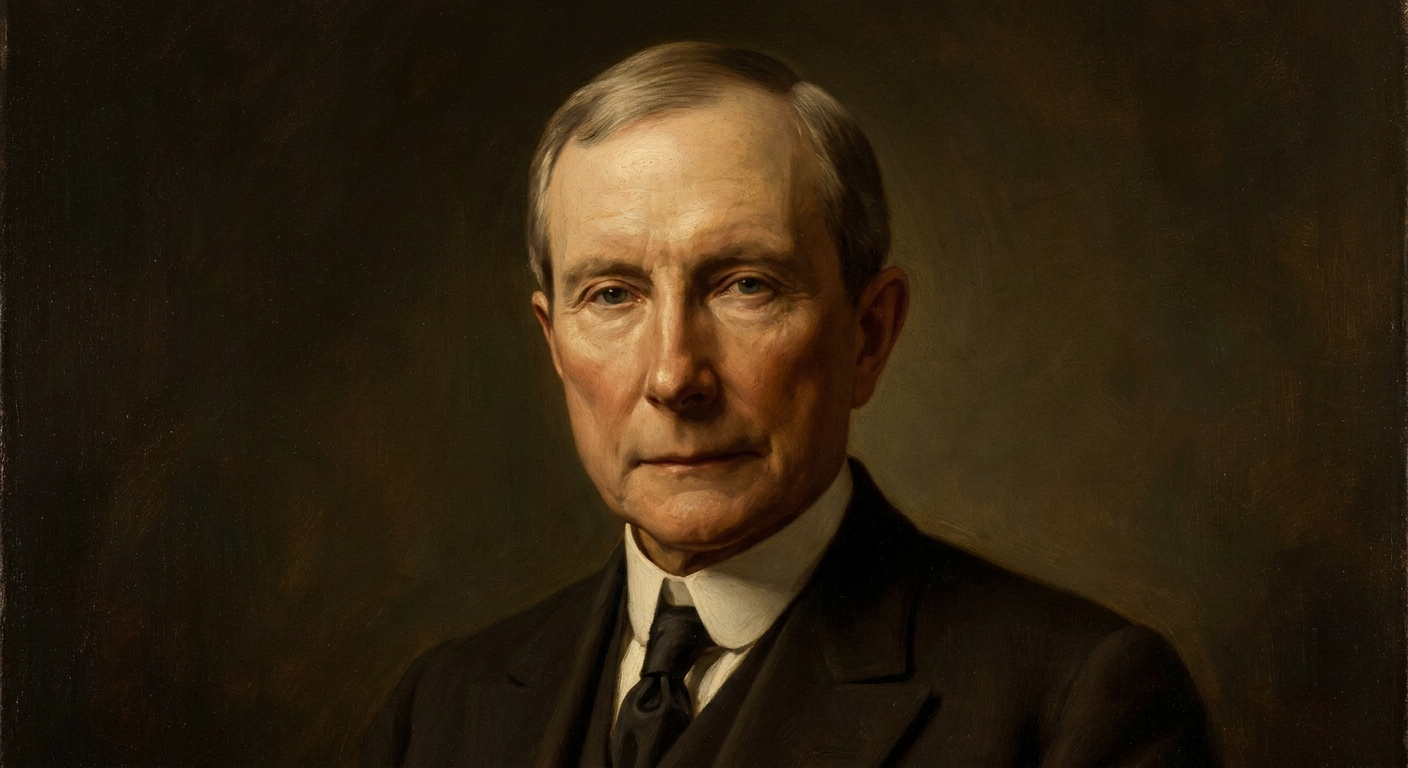
Quick Facts
- Years
- 1839 – 1937
- Category
- Social Reformers & Humanitarians
- Nationality
- American
- Occupation
- Industrialist and philanthropist
John D. Rockefeller
1839 – 1937 · American · Industrialist and philanthropist
Recommended Audiobooks
Listen next from Marcus Alden

Life Lessons from Harriet Beecher Stowe
Marcus Alden · 53 min

Life Lessons from Florence Nightingale
Marcus Alden · 48 min
John D. Rockefeller helped create both the modern corporation and the modern philanthropic foundation. Born into a financially unstable household in rural New York, he became the dominant figure in the nineteenth-century American petroleum industry and, by common estimates, the richest American of his age. His Standard Oil organization brought unprecedented coordination to oil refining, transportation and distribution. It lowered costs and made kerosene widely available, but it also used railroad rebates, acquisitions and aggressive competitive tactics that provoked lasting arguments about monopoly power.
Rockefeller’s importance extends far beyond business. After withdrawing from daily management, he directed hundreds of millions of dollars toward universities, medical research, public health and education. Institutions associated with his giving helped establish laboratory-based medicine in the United States, supported the University of Chicago and fought diseases such as hookworm and yellow fever.
Yet Rockefeller remains a divided symbol. Admirers see an exceptionally disciplined organizer who converted private wealth into enduring public institutions. Critics see a monopolist whose methods exposed the dangers of concentrated corporate power. Both views contain important evidence. His life therefore offers more than a story of extraordinary wealth: it illuminates industrialization, inequality, regulation, religion and the difficult question of what responsibilities accompany great fortune.
Quick Facts
| Field | Details |
|---|---|
| Full Name | John Davison Rockefeller Sr. |
| Common Name(s) | John D. Rockefeller; JDR |
| Born | July 8, 1839 |
| Died | May 23, 1937 |
| Age at Death | 97 |
| Birthplace | Richford, New York, United States |
| Nationality | American |
| Occupation | Bookkeeper, merchant, oil refiner, industrialist and philanthropist |
| Historical Era | Gilded Age and Progressive Era |
| Famous For | Building Standard Oil and creating major philanthropic institutions |
| Political Affiliation | Generally supported the Republican Party, although he avoided elected office |
| Religion | Northern Baptist; religious faith strongly influenced his giving |
| Education | Cleveland Central High School; bookkeeping course at Folsom’s Mercantile College; no university degree |
| Parents | William Avery Rockefeller and Eliza Davison Rockefeller |
| Spouse(s) | Laura Celestia “Cettie” Spelman, married 1864–1915 |
| Children | Elizabeth, Alice, Alta, Edith and John D. Rockefeller Jr. |
| Major Works | Standard Oil, University of Chicago support, Rockefeller Institute for Medical Research, General Education Board, Rockefeller Foundation |
| Major Achievements | Consolidated the oil-refining industry; pioneered large-scale corporate organization; gave more than $500 million to philanthropic causes |
Early Life
John Davison Rockefeller was born in Richford, New York, the second of six children. His mother, Eliza, was devout, thrifty and orderly. His father, William Avery Rockefeller, was an itinerant salesman who spent long periods away and sometimes presented himself as a doctor. William’s irregular income and secret second household made family life unstable, although John did not publicly dwell on these matters.
The family moved several times before settling near Cleveland, Ohio, in 1853. John learned to keep careful accounts, raise small sums through work and lending, and contribute to his Baptist congregation. He later recalled that he had been trained early to work, save and give. Such recollections were partly autobiographical self-presentation, but surviving financial ledgers confirm his unusually systematic habits.
Rockefeller attended Cleveland Central High School but left before graduating. He completed a short bookkeeping course at Folsom’s Mercantile College, where he studied commercial arithmetic, banking practices and double-entry accounting. At sixteen he began searching for office work, later commemorating September 26—the day he obtained his first position—as “Job Day.”
In 1855 he became an assistant bookkeeper at Hewitt & Tuttle, produce merchants and commission agents. The job taught him freight rates, credit, commodity prices and negotiation. Cleveland was then becoming a transportation center linking farms, railways, canals and the Great Lakes. Rockefeller entered business just as an expanding national market was creating opportunities for people able to organize goods and capital efficiently.
Rise to Prominence
In 1859 Rockefeller and Maurice B. Clark established a produce commission partnership. Rockefeller borrowed money, cultivated bankers and became known for exact accounts and reliable payment. The Civil War increased demand for food and supplies, helping the firm prosper, although Rockefeller did not serve in the army; as permitted by law, he paid for a substitute.
The decisive opportunity came from petroleum. Edwin Drake’s 1859 well in Pennsylvania encouraged an oil boom, while Cleveland offered rail and water connections, skilled labor and proximity to producing regions. In 1863 Rockefeller, the Clark brothers and chemist Samuel Andrews invested in a refinery. Refining seemed less speculative than drilling because it turned crude oil into marketable products, especially illuminating kerosene.
Disagreements with the Clarks led to an auction in 1865. Rockefeller bought the refining concern for $72,500, a major risk that gave him control. He and Andrews then expanded, and the arrival of Henry M. Flagler brought new capital and negotiating skill. Rockefeller, Andrews & Flagler became one of Cleveland’s strongest refiners.
Standard Oil of Ohio was incorporated in 1870 with capital of $1 million. Rockefeller pursued scale relentlessly. He reinvested profits, negotiated favorable freight terms, improved quality, built storage and transportation facilities, and found uses for by-products that competitors discarded. During the rapid Cleveland acquisitions of 1872—later called the “Cleveland Massacre”—Standard absorbed or displaced many local refiners.
By the late 1870s, Standard Oil controlled roughly 90 percent of American refining capacity. Rockefeller had become nationally famous, although increasingly as a symbol of monopoly rather than merely successful enterprise.
Major Achievements
Building an integrated petroleum system
Standard Oil coordinated refining, pipelines, tank cars, storage, barrels, exports and sales. This integration reduced waste and made output more predictable. Consumers benefited from cheaper, more standardized kerosene, but the same network made it extremely difficult for independent firms to compete.
Creating a new corporate structure
Because corporations were then chartered by individual states, operating a nationwide enterprise was legally awkward. In 1882 Standard’s owners placed shares in multiple companies under trustees, creating the Standard Oil Trust. The trust became a model for large-scale coordination—and a warning to those who feared private economic government.
Advancing scientific philanthropy
Rockefeller’s philanthropy emphasized expert investigation and long-term institutions rather than scattered relief. He provided crucial support to the University of Chicago, founded in 1890, while declining to place his name on it. In 1901 he established the Rockefeller Institute for Medical Research, now Rockefeller University. Its laboratories contributed to major advances in biomedical science.
Supporting education and public health
The General Education Board, chartered in 1903, supported schools, teacher training and higher education, particularly in the American South. The Rockefeller Sanitary Commission launched a major campaign against hookworm in 1909. The Rockefeller Foundation, chartered in 1913, later supported global public health, medical education and disease control.
These programs had lasting value, though historians also examine their paternalism: wealthy donors and experts often decided what communities needed without granting those communities equal authority.
Leadership or Work
Rockefeller led through information, financial control and carefully chosen associates. He read reports closely, compared costs across refineries and expected managers to justify expenditures. He usually spoke calmly and preferred consensus inside the organization, but his strategic goals were uncompromising.
His principal strengths included:
- disciplined reinvestment rather than extravagant consumption;
- mastery of accounting and transportation costs;
- selection of talented partners such as Flagler and Andrews;
- willingness to plan over decades;
- attention to quality, efficiency and by-products.
His weaknesses arose from the same drive for control. Standard Oil treated competition as a system to be managed or absorbed, not as a permanent public good. Rockefeller delegated aggressive negotiations while benefiting from their results, allowing him to maintain personal distance from conduct that damaged his reputation.
He withdrew from regular office work during the 1890s and considered himself retired by 1897, though his wealth and influence remained tied to Standard Oil. His later philanthropic staff, especially adviser Frederick T. Gates, applied similarly systematic methods to giving.
Personal Life
Rockefeller married Laura Celestia Spelman in 1864. She was educated, deeply religious and committed to abolitionism and temperance. Four of their five children survived to adulthood; Alice died in infancy. Their only son, John D. Rockefeller Jr., eventually managed much of the family’s philanthropy and public responsibilities.
Despite his wealth, Rockefeller cultivated an image of domestic restraint. He enjoyed church, gardening, golf and family life. He kept detailed personal accounts and gave children small allowances intended to teach saving and charity. His residences included homes in Cleveland, New York City, Pocantico Hills in New York and Ormond Beach, Florida.
Rockefeller could be reserved in public but playful with relatives and visitors. In old age he became known for giving children shiny dimes. The gesture was friendly but also symbolic: he enjoyed presenting thrift as a moral lesson.
During the 1890s he suffered digestive trouble, stress and alopecia, which caused the loss of much of his hair. Retirement and a regulated routine improved his condition. Laura died in 1915, a loss he felt deeply. Rockefeller lived another twenty-two years and died in Florida in 1937.
Philosophy or Beliefs
Rockefeller’s Northern Baptist faith shaped his understanding of wealth. He attended worship, supported missionary activity, abstained from alcohol and regarded disciplined work as a religious duty. From his earliest wages, he recorded donations to churches and charities.
He came to believe that the ability to accumulate money created an obligation to administer it productively. This resembled the “Gospel of Wealth” associated with Andrew Carnegie, although Rockefeller’s beliefs arose from his own Baptist upbringing and experience. He favored projects that attacked underlying causes rather than simply relieving immediate suffering.
Politically, Rockefeller generally supported Republicans, sound money and a business-friendly national order. He was not a political theorist or officeholder. His conduct reveals a tension between his stated respect for service and the immense private power his corporation exercised.
Supporters argue that he believed efficiency benefited the public through lower prices and reliable products. Critics answer that beneficial results did not justify secret rebates or the suppression of independent competitors. That moral conflict is central to understanding him.
Challenges and Controversies
Railroad rebates and the South Improvement Company
Large shippers commonly received railroad discounts, but Standard obtained especially favorable rebates and, at times, information or payments connected to competitors’ shipments. In 1872 Rockefeller joined the South Improvement Company, a proposed alliance between railroads and major refiners. Public resistance forced its collapse before the full arrangement operated, but the episode revealed Standard’s methods and ambitions.
Monopoly and acquisitions
Standard purchased many competitors, sometimes offering them shares that later became immensely valuable. Some owners sold willingly because Rockefeller’s organization was efficient and financially secure. Others believed they faced discriminatory freight rates, price pressure or ruin if they refused. The record therefore does not fit either a simple story of voluntary cooperation or one of universal coercion.
Ida Tarbell and public opinion
Journalist Ida M. Tarbell’s 1902–1904 investigation documented Standard’s secretive tactics and personalized its power through Rockefeller. Her work helped shape Progressive Era demands for regulation. Standard’s defenders accused her of hostility—her father had been an independent oil producer—but historians generally regard her research as substantial even where later scholarship has added context.
Antitrust dissolution
In 1911 the US Supreme Court ruled that Standard Oil had violated the Sherman Antitrust Act and ordered it divided into separate companies. The judgment did not erase Rockefeller’s fortune. Because he held shares in the resulting firms, their subsequent growth increased his wealth.
Ludlow and family responsibility
In 1914 Colorado National Guard troops and mine guards attacked a striking miners’ camp at Ludlow, leading to deaths, including women and children. The Rockefeller family held a major interest in Colorado Fuel & Iron. John D. Rockefeller Jr. was more directly involved than his retired father, but the family name became associated with the disaster. The episode demonstrated how absentee ownership could carry moral responsibility even without direct operational command.
Legacy
Rockefeller transformed the scale of American enterprise. Descendants of Standard Oil include companies that became Exxon, Mobil, Chevron and others. Modern antitrust debates about technology platforms, healthcare and energy still echo questions raised by his empire: when does efficiency become domination, and how should society control private power?
His philanthropic legacy is equally extensive. Rockefeller University remains a major biomedical research center. The University of Chicago became a leading research university. The Rockefeller Foundation has supported public health, agriculture and education worldwide, while the family’s institutions helped professionalize philanthropy through expert staff, research and measurable programs.
Sites connected to him include Kykuit, the Rockefeller family estate at Pocantico Hills, now preserved as a historic property. His name also remains attached to Rockefeller Center, developed principally by his son, and numerous foundations and programs.
His reputation has shifted repeatedly—from feared monopolist to benevolent elder statesman and then to a more complicated figure combining both identities. He is best understood neither as a flawless benefactor nor as a one-dimensional villain, but as a central architect of modern concentrated wealth and organized giving.
Interesting Facts
- Rockefeller began his first permanent bookkeeping job at age sixteen.
- He celebrated the anniversary of that job as “Job Day.”
- His earliest surviving account books recorded both earnings and charitable gifts.
- He entered oil refining rather than the riskier business of drilling wells.
- He bought control of his first refinery at an 1865 auction.
- Standard Oil was incorporated in Ohio in 1870.
- The company once controlled about nine-tenths of US oil refining.
- Standard reused petroleum by-products to make lubricants, wax and other goods.
- Rockefeller never attended university.
- He helped finance the University of Chicago but resisted naming it after himself.
- He began reducing his business role before the great public campaign against him peaked.
- The 1911 breakup of Standard Oil ultimately increased the value of many of his holdings.
- He lived long enough to witness the rise of automobiles and aviation.
- His wealth peaked at roughly 2 percent of the US economy, though historical comparisons vary.
- He gave away more than $500 million during his lifetime.
- He regularly played golf well into old age.
- He distributed dimes to children and visitors as lessons in saving.
- He died less than two months before his ninety-eighth birthday.
Famous Quotes
Quotations are drawn chiefly from Rockefeller’s Random Reminiscences of Men and Events and public statements; wording sometimes varies among editions.
- “The only question with wealth is, what do you do with it?” In his memoir, Rockefeller framed fortune as a responsibility rather than an end in itself.
- “I had no ambition to make a fortune. Mere money-making has never been my goal.” This retrospective claim expressed his preferred self-image, though critics note that his career displayed intense accumulation.
- “I was trained from the beginning to work and to save.” His memoir connected adult habits to childhood discipline.
- “A friendship founded on business is better than a business founded on friendship.” Rockefeller used this observation to emphasize professional judgment over sentiment.
- “We must ever remember we are refining oil for the poor man, and he must have it cheap and good.” Reported from Standard Oil deliberations, it summarizes his efficiency argument for consolidation.
- “Every right implies a responsibility; every opportunity, an obligation; every possession, a duty.” Widely published as part of Rockefeller’s personal credo, it captures his philosophy of stewardship.
- “The best philanthropy is constantly in search of the finalities—a search for a cause, an attempt to cure evils at their source.” This explained his preference for research and institutions.
- “Competition is a sin.” Frequently attributed to Rockefeller, but no secure primary source proves he used this exact phrase. It should not be quoted as certain fact.
- “God gave me my money.” Newspapers associated this wording with a religious address, but the compressed quotation lacks its fuller theological context and its exact form is disputed.
Timeline
- 1839 — Born in Richford, New York.
- 1853 — Family settles near Cleveland, Ohio.
- 1855 — Begins work at Hewitt & Tuttle.
- 1859 — Forms a produce commission partnership with Maurice Clark.
- 1863 — Invests in a Cleveland oil refinery.
- 1864 — Marries Laura Celestia Spelman.
- 1865 — Buys the Clark interests in the refinery for $72,500.
- 1867 — Henry Flagler joins the expanding refining partnership.
- 1870 — Standard Oil Company of Ohio is incorporated.
- 1872 — South Improvement Company controversy and rapid Cleveland acquisitions.
- 1882 — Standard Oil Trust is organized.
- 1890 — Sherman Antitrust Act becomes law; University of Chicago is founded with Rockefeller support.
- 1897 — Rockefeller largely retires from active business.
- 1901 — Rockefeller Institute for Medical Research is founded.
- 1902–1904 — Ida Tarbell publishes her Standard Oil investigation.
- 1903 — General Education Board receives its federal charter.
- 1909 — Rockefeller Sanitary Commission begins its hookworm campaign.
- 1911 — Supreme Court orders Standard Oil dissolved.
- 1913 — Rockefeller Foundation is chartered.
- 1914 — Ludlow Massacre intensifies criticism of Rockefeller family interests.
- 1915 — Laura Rockefeller dies.
- 1937 — Rockefeller dies at Ormond Beach, Florida.
Frequently Asked Questions
1. How did John D. Rockefeller become rich?
Rockefeller became rich by building an oil-refining organization that controlled costs, transportation and distribution on an unprecedented scale. He reinvested profits, negotiated railroad discounts, purchased competing refineries and integrated pipelines, storage and sales. Standard Oil’s efficiency made petroleum products cheaper and more consistent, but its preferential rates and market power also weakened competitors. His fortune grew further after Standard’s 1911 breakup because he retained shares in the resulting companies.
2. Was Rockefeller the richest person in history?
He is often described that way, but comparisons across centuries are inherently uncertain. At his financial peak, his fortune may have equaled roughly 2 percent of the United States economy. By that measure, he was extraordinarily wealthy relative to his society. Converting his assets into modern dollars produces dramatically different totals depending on the method used, so precise claims that he possessed a specific present-day sum should be treated cautiously.
3. What was Standard Oil?
Standard Oil was an oil-refining and distribution enterprise incorporated in Ohio in 1870. It developed into a nationwide network of related companies coordinating refineries, pipelines, rail shipments, storage facilities and sales. In 1882 its owners used a trust arrangement to centralize control across state boundaries. Standard became famous for efficiency and low costs, but notorious for secret rebates, aggressive acquisitions and overwhelming market power.
4. Did Rockefeller discover oil?
No. Commercial petroleum development in the United States was already underway after Edwin Drake’s Pennsylvania well in 1859. Rockefeller neither discovered petroleum nor invented refining. His achievement was organizational: he recognized that refining and distributing oil could become a stable, large-scale business. He coordinated capital, transport, production and marketing more effectively than most competitors and built the dominant company in the industry.
5. Why was Standard Oil considered a monopoly?
By the late 1870s, Standard controlled roughly 90 percent of American refining. Its size allowed it to demand transportation advantages, influence prices and make entry difficult for independent firms. Market share later declined, but its network remained powerful. In 1911 the Supreme Court concluded that Standard had unlawfully restrained trade under the Sherman Antitrust Act. Historians still debate how much of its dominance came from efficiency and how much from exclusionary conduct.
6. Did Rockefeller make oil cheaper?
The price of refined kerosene fell substantially during Standard Oil’s rise, and product quality became more consistent. Standard’s scale, technical improvements, reduced waste and transportation system contributed to that trend. However, broader forces—including expanding crude production, technological change and competition—also lowered prices. Cheaper products therefore form a genuine part of Rockefeller’s record, but they do not by themselves settle whether Standard’s methods were fair or lawful.
7. Why was Standard Oil broken up?
The federal government argued that Standard Oil had combined companies and restricted competition in violation of the Sherman Antitrust Act. In 1911 the Supreme Court agreed and ordered the enterprise divided into separate corporations. The decision established an important precedent for applying federal antitrust law to dominant businesses. Companies descending from the breakup eventually included Exxon, Mobil, Chevron and other major petroleum firms.
8. Was Rockefeller a robber baron or a captain of industry?
Both labels oversimplify him. “Captain of industry” highlights his organizational skill, lower production costs and creation of a reliable national market. “Robber baron” emphasizes railroad favors, secrecy and pressure on competitors. Historical evidence supports elements of each interpretation. A balanced judgment recognizes that Rockefeller improved industrial efficiency while also accumulating a degree of private power that helped provoke modern antitrust regulation.
9. How much money did Rockefeller donate?
He distributed more than $500 million during his lifetime; estimates often place the total near $540 million. Exact comparisons with modern money vary. His gifts supported churches, universities, medical research, education and public health. Much of the funding passed through permanent organizations rather than direct personal charity. This institutional approach magnified its long-term reach but also concentrated decision-making in private foundations controlled by wealthy donors and professional experts.
10. What institutions did he create?
Rockefeller’s major initiatives included the Rockefeller Institute for Medical Research, the General Education Board, the Rockefeller Sanitary Commission and the Rockefeller Foundation. He was also the essential early financial supporter of the University of Chicago. These bodies promoted scientific medicine, public health, teacher education and research. Not every program was solely his creation; advisers such as Frederick T. Gates and many scientists, educators and community workers shaped their actual work.
11. What role did religion play in his life?
Religion was central to Rockefeller’s identity. Raised by a devout Baptist mother, he attended church, supported congregations and missions, taught Sunday school and gave from his earliest earnings. He interpreted wealth through the idea of stewardship: money brought obligations to God and society. Critics viewed that outlook as a moral justification for fortune, while supporters saw consistent evidence that faith genuinely motivated his disciplined giving.
12. Did Rockefeller treat workers well?
There is no simple answer because Standard Oil employed many people across numerous operations and decades. The company could offer stable work and systematic management, but labor relations occurred within an unequal corporate hierarchy. Rockefeller’s personal image as a calm, paternal employer did not guarantee worker influence. The Ludlow crisis involved a separate family-controlled mining company rather than Standard Oil, yet it exposed the human costs that could accompany distant ownership.
13. What was Rockefeller’s connection to Ludlow?
The Rockefeller family held a major interest in Colorado Fuel & Iron during the bitter 1913–1914 coal strike. Violence at Ludlow killed miners’ family members and others, creating national outrage. Rockefeller had retired, and his son John Jr. handled the investment more directly, so the elder Rockefeller did not command the troops or mine guards. Nevertheless, critics held the family’s wealth and absentee control morally accountable for conditions surrounding the conflict.
14. Why did Ida Tarbell oppose Standard Oil?
Tarbell investigated Standard’s history for McClure’s Magazine, documenting rebates, acquisitions and pressure against independent refiners. Her father’s business had been affected by the Pennsylvania oil conflicts, giving her personal knowledge and possible bias. Yet her work relied heavily on documents, interviews and court records. Most historians treat it as pioneering investigative journalism while supplementing it with later economic research and perspectives unavailable to her.
15. How did Rockefeller spend his later years?
After leaving daily business, Rockefeller concentrated on philanthropy, family, church, golf and management of his estates. Advisers evaluated potential gifts and designed large programs in medicine and education. He also worked to soften his severe public image, meeting journalists and distributing dimes to visitors. His carefully regulated routine helped him recover from stress-related illness, and he remained active into advanced age before dying at ninety-seven.
16. Are any Standard Oil companies still operating?
The original trust and unified corporation no longer exist, but several modern energy companies descend from entities created by the 1911 division. Standard Oil of New Jersey became Exxon, while Standard Oil of New York became Mobil; they merged as ExxonMobil in 1999. Standard Oil of California became Chevron. Corporate mergers and name changes make the genealogy complicated, but Standard Oil’s institutional descendants remain important in the global energy industry.
Lessons We Can Learn
- Master the numbers. Rockefeller’s bookkeeping knowledge guided investment and cost control. Modern interpretation: financial literacy strengthens decision-making in any organization.
- Reinvest for the long term. He repeatedly put profits into capacity and infrastructure. The lesson is growth through patience, not a guarantee that expansion is always desirable.
- Use waste creatively. Standard turned refining by-products into valuable goods. Resource efficiency remains economically and environmentally relevant.
- Choose capable partners. Andrews supplied technical knowledge and Flagler financial skill. Rockefeller’s rise was collaborative, not a solitary achievement.
- Reputation has material consequences. Secrecy and rebates damaged public trust even when Standard delivered cheap products.
- Efficiency does not excuse unfairness. Standard demonstrates that beneficial outcomes and questionable methods can coexist.
- Private power needs accountability. The 1911 decision shows why successful organizations may still require legal oversight.
- Address causes, not only symptoms. Rockefeller philanthropy funded medical investigation and disease prevention. That evidence supports strategic giving, though communities should share authority.
- Wealth creates obligations. Rockefeller explicitly treated possessions as duties. Applying that belief today is a moral interpretation, not an economic law.
- Accept complexity in historical judgment. His career combined innovation, coercive power, generosity and paternalism. Responsible learning resists both hero worship and caricature.
Related Historical Figures
- Henry M. Flagler — Standard Oil partner whose capital and transportation strategy aided its expansion.
- Samuel Andrews — Chemist and early refining partner who contributed technical expertise.
- Ida M. Tarbell — Journalist whose investigation transformed Rockefeller’s public reputation.
- Andrew Carnegie — Fellow industrialist and philanthropist associated with the Gospel of Wealth.
- Cornelius Vanderbilt — Railroad magnate whose industry shaped Standard’s transportation negotiations.
- Theodore Roosevelt — Progressive president identified with federal action against corporate trusts.
- William Howard Taft — President during the government’s successful Standard Oil antitrust case.
- Frederick T. Gates — Baptist minister and adviser who organized Rockefeller’s scientific philanthropy.
- John D. Rockefeller Jr. — His son, successor in family philanthropy and manager of major investments.
- Edwin Drake — Early commercial oil driller whose Pennsylvania well helped launch the petroleum age.
Watch and Learn
The Industrial Economy: Crash Course US History #23 — CrashCourse — approximately 14 minutes.
This widely viewed educational overview places Rockefeller and Standard Oil within the broader transformation of the Gilded Age economy. It is recommended for its clear explanation of industrial consolidation, labor and the rise of large corporations, although viewers should use it as an introduction rather than a complete biography.
Watch and Learn
The Industrial Economy: Crash Course US History #23 · CrashCourse
Related Historical Figures