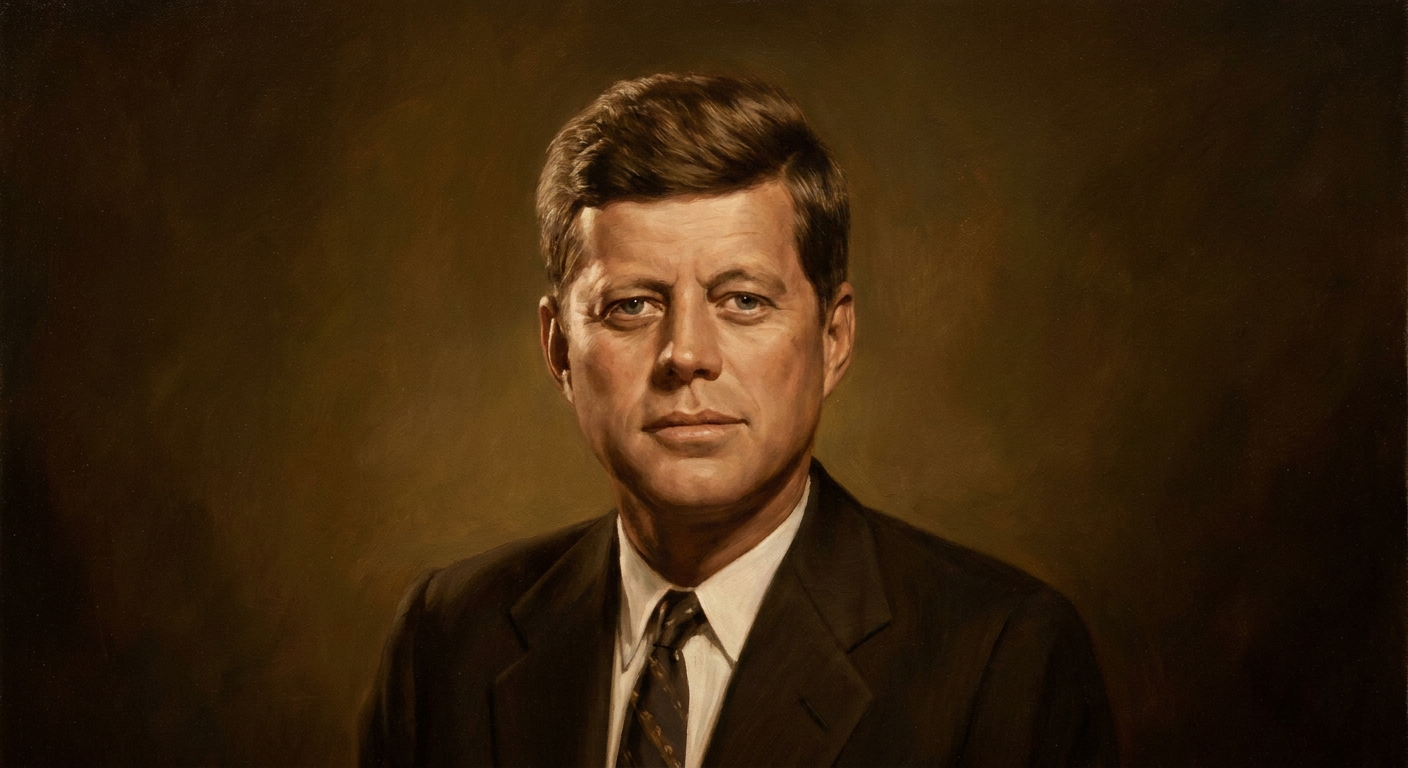
Quick Facts
- Years
- 1917 – 1963
- Category
- World Leaders & Revolutionaries
- Nationality
- American
- Occupation
- Politician, naval officer, author, and 35th president of the United States
John F. Kennedy
1917 – 1963 · American · Politician, naval officer, author, and 35th president of the United States
Recommended Audiobooks
Listen next from Marcus Alden

Life Lessons from Simon Bolivar
Marcus Alden · 55 min

Life Lessons from George Washington
Marcus Alden · 54 min
John Fitzgerald Kennedy was the 35th president of the United States and one of the defining political figures of the twentieth century. Elected in 1960 at age 43, he became the youngest person elected to the presidency and the first Roman Catholic to hold the office. His administration lasted less than three years, yet it encompassed the Bay of Pigs disaster, the building of the Berlin Wall, the Cuban Missile Crisis, the acceleration of the American space program, and an increasingly forceful federal commitment to civil rights.
Kennedy combined eloquent public language with pragmatic, sometimes cautious decision-making. His call to public service helped inspire the Peace Corps, while his pledge to land an American on the Moon gave the space program a clear national objective. During the Cuban Missile Crisis, he resisted demands for an immediate attack and helped prevent a confrontation between nuclear superpowers from becoming a war.
His assassination in Dallas on November 22, 1963, transformed a controversial working president into a symbol of interrupted promise. Admiration for his leadership exists alongside serious criticism of the Bay of Pigs, covert operations, Vietnam policy, concealed illnesses, and private conduct. Kennedy remains important not because his record was flawless, but because his life illuminates the possibilities, pressures, and dangers of leadership during the Cold War.
Quick Facts
| Fact | Details |
|---|---|
| Full Name | John Fitzgerald Kennedy |
| Common Name(s) | John F. Kennedy, JFK, Jack Kennedy |
| Born | May 29, 1917 |
| Died | November 22, 1963 |
| Age at Death | 46 |
| Birthplace | Brookline, Massachusetts, United States |
| Nationality | American |
| Occupation | Naval officer, journalist, author, congressman, senator, president |
| Historical Era | Cold War and postwar United States |
| Famous For | The Cuban Missile Crisis, the Moon program, the Peace Corps, civil rights initiatives, and his assassination |
| Political Affiliation | Democratic Party |
| Religion | Roman Catholic |
| Education | Choate School; Harvard College, AB in government, 1940 |
| Parents | Joseph P. Kennedy Sr. and Rose Fitzgerald Kennedy |
| Spouse(s) | Jacqueline Lee Bouvier Kennedy |
| Children | Arabella, Caroline, John Jr., and Patrick; Arabella was stillborn and Patrick died in infancy |
| Major Works | Why England Slept; Profiles in Courage; presidential speeches |
| Major Achievements | Peace Corps, Alliance for Progress, Cuban Missile Crisis settlement, Partial Nuclear Test Ban Treaty, Moon-landing commitment, and a major civil rights bill proposal |
Early Life
John Kennedy was born into a wealthy and politically ambitious Irish American family. His father, Joseph P. Kennedy Sr., built a fortune through finance and business before serving in government, including as ambassador to Britain. His mother, Rose, was the daughter of Boston mayor John F. Fitzgerald. John was the second of nine children in a competitive family that stressed achievement, loyalty, and public prominence.
Although later photographs projected youth and vigor, Kennedy experienced severe health problems from childhood. He suffered repeated illnesses, digestive trouble, chronic back pain, and eventually Addison’s disease, an adrenal disorder. His medical history was largely concealed during his political career.
Kennedy attended several schools before entering Choate in Connecticut. In 1936 he enrolled at Harvard, where travel in Europe deepened his interest in international affairs. His senior thesis examined why Britain had been slow to rearm before the Second World War. Revised with help from others, it appeared in 1940 as Why England Slept.
His older brother, Joseph Kennedy Jr., was initially expected to carry the family’s political hopes. John appeared less disciplined and more intellectually curious, with interests in history, current affairs, sailing, and literature. The Second World War changed his direction and ultimately placed him at the center of the family’s ambitions.
Rise to Prominence
Kennedy joined the United States Naval Reserve in 1941. In the Pacific, he commanded patrol torpedo boat PT-109. On August 2, 1943, a Japanese destroyer struck and destroyed the vessel. Kennedy helped lead the surviving crew to safety, at one point towing an injured sailor by gripping the man’s life-jacket strap between his teeth. He received the Navy and Marine Corps Medal and a Purple Heart.
The rescue was genuine, though the Kennedy family and political advisers later publicized it effectively. After Joseph Jr. died during a hazardous wartime aviation mission in 1944, expectations increasingly shifted toward John.
Following brief work as a journalist, Kennedy ran for the House of Representatives in 1946. Family money, energetic campaigning, veteran status, and his own personal appeal helped him win a Boston-area seat. He served three terms before defeating Republican Henry Cabot Lodge Jr. for the Senate in 1952.
In 1953 Kennedy married Jacqueline Bouvier. Her intelligence, style, and command of languages later contributed substantially to the administration’s cultural image. Kennedy underwent dangerous back operations during his Senate years and at one point received Catholic last rites.
His national profile rose after Profiles in Courage won the 1957 Pulitzer Prize for biography. Kennedy was credited as its author, but his aide Theodore Sorensen performed extensive research and drafting. Scholars differ over how authorship should be apportioned; the evidence clearly shows collaboration more substantial than the public initially understood.
Kennedy unsuccessfully sought the Democratic vice-presidential nomination in 1956. The defeat proved useful by giving him national exposure without tying him to a losing ticket. Four years later, he defeated Vice President Richard Nixon in an extraordinarily close presidential election. Televised debates helped establish Kennedy as a composed national figure, though historians caution against treating television as the sole reason for his victory.
Major Achievements
Managing the Cuban Missile Crisis
In October 1962, American reconnaissance revealed Soviet nuclear missile sites under construction in Cuba. Military advisers urged air strikes or invasion, but Kennedy chose a naval quarantine while secretly exploring a settlement.
The Soviet Union removed the missiles after Kennedy publicly promised not to invade Cuba and privately agreed that American Jupiter missiles would later be withdrawn from Turkey. The compromise was initially hidden, allowing both sides to protect their credibility. Kennedy’s restraint helped avert nuclear war and encouraged later efforts to improve superpower communication.
Advancing the Space Program
On May 25, 1961, Kennedy asked Congress to commit the nation to landing a person on the Moon and returning him safely before the decade ended. The goal responded partly to Soviet space successes and Cold War competition.
Kennedy did not live to see Apollo 11 land in 1969, but his deadline mobilized political support, scientific expertise, industrial capacity, and federal funding. The program accelerated advances in engineering and computing while becoming a powerful symbol of national ambition.
Creating the Peace Corps
Kennedy established the Peace Corps by executive order in March 1961, and Congress later gave it statutory authority. The program sent American volunteers abroad to work in education, agriculture, health, and community development.
Its record has included criticism concerning paternalism and uneven effectiveness, but it offered an enduring model of civilian international service. It also embodied Kennedy’s belief that Cold War influence could be exercised through assistance rather than military power alone.
Supporting Arms Control
The Cuban crisis gave both Washington and Moscow reason to reduce the chance of accidental conflict. Kennedy and Soviet leader Nikita Khrushchev established a direct communications link commonly called the hotline.
In 1963 the United States, Soviet Union, and Britain signed the Partial Nuclear Test Ban Treaty, prohibiting nuclear tests in the atmosphere, outer space, and underwater. It did not end the arms race, but it reduced radioactive fallout and demonstrated that limited cooperation was possible.
Moving Toward Federal Civil Rights Action
Kennedy entered office cautious about civil rights legislation, partly because he needed support from white southern Democrats. Activists, court battles, Freedom Rides, demonstrations, and violent resistance made caution increasingly untenable.
His administration used federal authority in university desegregation disputes and protected James Meredith’s enrollment at the University of Mississippi. In June 1963 Kennedy described civil rights as a moral issue and proposed broad legislation. Congress passed a stronger Civil Rights Act in 1964 under Lyndon B. Johnson, after Kennedy’s death.
Alliance for Progress
Kennedy launched the Alliance for Progress to promote development and reform in Latin America. It provided aid and encouraged education, housing, health programs, and land reform. Results were mixed: local elites resisted change, governments often failed to meet goals, and Washington sometimes prioritized anti-communism over democracy. Nevertheless, the initiative represented an ambitious attempt to address conditions that could fuel revolution.
Leadership or Work
Kennedy’s leadership evolved under pressure. The Bay of Pigs invasion in April 1961, inherited in planning from the Eisenhower administration but approved by Kennedy, ended in humiliation when Cuban exiles failed to overthrow Fidel Castro. Kennedy accepted public responsibility and afterward questioned military and intelligence advice more rigorously.
During the missile crisis, he encouraged debate within a special advisory group and avoided forcing an immediate consensus. He separated public demands from private bargaining and allowed Khrushchev a face-saving route out of the confrontation. This was flexible leadership, though it also depended on secrecy.
Kennedy valued speed, intelligence, wit, and personal loyalty. He favored a compact White House organization over a rigid chain of command. That style generated creative discussion but sometimes produced confusion, competing assignments, and insufficient oversight—especially in covert policy.
His strengths included persuasive communication, intellectual curiosity, calm under extreme pressure, and an ability to revise his assumptions. His weaknesses included excessive secrecy, tolerance of risky clandestine operations, delayed action on civil rights, and a tendency to rely on a close circle of highly credentialed advisers.
Personal Life
Kennedy married Jacqueline Bouvier on September 12, 1953. They became the parents of four children, but endured considerable loss. Arabella was stillborn in 1956, and Patrick died shortly after premature birth in 1963. Caroline and John Jr. survived into adulthood.
The Kennedys presented a glamorous public image, encouraging interest in art, fashion, literature, and historic preservation. Jacqueline led a celebrated restoration of the White House and promoted American culture during diplomatic events.
Privately, the marriage was strained by Kennedy’s repeated extramarital relationships, which are supported by substantial testimony and documentary research, although details of particular allegations vary in reliability. His behavior raises ethical questions and, in some cases, possible security concerns.
Kennedy read rapidly, enjoyed sailing and swimming, followed newspapers closely, and appreciated political gossip and humor. Behind the appearance of athletic vitality, he endured constant pain and took numerous medications. Historians continue to debate how much his treatment affected particular moments, but the broad fact of serious concealed illness is well established.
Philosophy or Beliefs
Kennedy was a Cold War liberal rather than a political radical. He believed in containing Soviet power, maintaining a strong defense, stimulating economic growth, and using government to expand opportunity. He was often more pragmatic than ideological and adjusted policy when circumstances changed.
As a Catholic candidate, he faced fears that church authorities would control him. In a 1960 address to Protestant ministers in Houston, he defended church-state separation and declared that presidential decisions should serve the national interest rather than religious command. His faith remained personally important, but he did not advocate a sectarian government.
His public philosophy emphasized citizenship, sacrifice, and national purpose. It could be idealistic, as in the Peace Corps and Moon program, yet his administration also authorized covert action and supported anti-communist governments with poor democratic records. The tension between democratic ideals and Cold War strategy was central to his presidency.
Challenges and Controversies
The Bay of Pigs was Kennedy’s clearest early failure. He approved a flawed CIA-backed invasion while limiting direct American support, producing an operation strong enough to implicate the United States but too weak to succeed.
Afterward, Operation Mongoose pursued covert efforts to destabilize Castro’s government. Proposed or attempted schemes included sabotage and assassination planning. The exact degree of Kennedy’s knowledge regarding specific plots remains disputed, but such operations occurred under his administration.
Kennedy also increased the number of American military advisers in South Vietnam from roughly 900 when he entered office to more than 16,000 by late 1963. His administration supported policies that contributed to the overthrow of President Ngo Dinh Diem, who was then killed by South Vietnamese officers. Whether Kennedy would have withdrawn from Vietnam or escalated further is unknowable; historians use conflicting evidence, and confident claims about this counterfactual go beyond the record.
On civil rights, critics argue that Kennedy acted too slowly and often responded only after activists forced crises into public view. Defenders note the difficult congressional landscape and his administration’s eventual shift toward comprehensive legislation. Both points are supported by the chronology.
His family’s wealth and organization gave him exceptional political advantages. Questions also surrounded voting in Illinois and Texas in 1960, but allegations that fraud decisively changed the national result have never been conclusively demonstrated.
Kennedy’s health was deliberately misrepresented, limiting voters’ ability to judge his fitness. His private relationships likewise conflicted with his carefully managed family image.
Finally, the assassination generated enduring controversy. The Warren Commission concluded that Lee Harvey Oswald acted alone. In 1979, the House Select Committee on Assassinations said Kennedy was probably killed as the result of a conspiracy, relying partly on acoustic evidence that later scientific reviews challenged. No alternative conspiracy has been conclusively proved.
Legacy
Kennedy’s death created a powerful sense of unfinished possibility. Lyndon Johnson invoked his memory while advancing the Civil Rights Act of 1964, the tax reduction Kennedy had supported, and other measures. Some achievements commonly associated with Kennedy were therefore completed by his successor.
His language of public service influenced volunteers, politicians, diplomats, astronauts, and civil rights advocates. The Peace Corps continues to operate, while the Apollo program fulfilled his lunar goal. Crisis-management scholars still examine his handling of October 1962 as a study in avoiding escalation, although they also warn that earlier American actions helped create the confrontation.
The John F. Kennedy Presidential Library and Museum in Boston preserves his papers and interprets his administration. The Kennedy Center in Washington, D.C., serves as a national cultural institution and memorial. Numerous schools, roads, public buildings, and New York’s John F. Kennedy International Airport carry his name. His grave at Arlington National Cemetery is marked by an eternal flame.
Modern scholarship has made the portrait less romantic but more instructive. Kennedy can be understood simultaneously as an inspiring communicator, a cautious politician, a capable crisis leader, and a president responsible for serious errors. His short tenure remains a window into nuclear danger, media politics, civil rights, public service, and the gap between democratic ideals and governmental practice.
Interesting Facts
- Kennedy was the first U.S. president born in the twentieth century.
- He remains the youngest person elected president; Theodore Roosevelt was younger when he succeeded to the office.
- He was the first Roman Catholic president of the United States.
- His Harvard thesis became the book Why England Slept.
- He commanded PT-109 in the Solomon Islands.
- He carved a rescue message into a coconut after PT-109 sank.
- The preserved coconut later appeared in the Oval Office.
- He received the Navy and Marine Corps Medal and a Purple Heart.
- He worked briefly as a newspaper correspondent after the war.
- He received last rites more than once because of severe illness.
- He was the first president to conduct a live televised press conference.
- He recorded many White House conversations without most participants knowing.
- His rocking chair helped ease his chronic back pain.
- Robert Frost recited a poem at his inauguration.
- Kennedy donated his presidential salary to charitable causes.
- He won a Pulitzer Prize for Profiles in Courage, whose production involved extensive assistance from Theodore Sorensen.
- He was the first sitting U.S. president to visit Ireland after it became a republic.
- His remark “Ich bin ein Berliner” did not mistakenly mean “I am a jelly doughnut”; that popular story is a myth.
Famous Quotes
- “Ask not what your country can do for you—ask what you can do for your country.” — Inaugural Address, January 20, 1961. It summarized Kennedy’s appeal to civic duty.
- “The torch has been passed to a new generation of Americans.” — Inaugural Address, 1961. Kennedy presented his administration as a generational transition.
- “Let us never negotiate out of fear. But let us never fear to negotiate.” — Inaugural Address, 1961. The line joined military resolve with diplomacy.
- “We choose to go to the Moon.” — Rice University speech, September 12, 1962. Kennedy defended an expensive and difficult national objective.
- “Mankind must put an end to war—or war will put an end to mankind.” — Address to the United Nations, September 25, 1961. It expressed the existential danger of nuclear conflict.
- “Our most basic common link is that we all inhabit this small planet.” — American University commencement, June 10, 1963. Kennedy urged a more humane view of the Soviet people.
- “This nation, for all its hopes and all its boasts, will not be fully free until all its citizens are free.” — Civil rights address, June 11, 1963. It framed equality as a national moral obligation.
- “Ich bin ein Berliner.” — West Berlin speech, June 26, 1963. Kennedy declared solidarity with a divided city facing communist pressure.
- “A man may die, nations may rise and fall, but an idea lives on.” — Speech at the University of California, Berkeley, March 23, 1962. Kennedy emphasized the durability of political ideals.
- “We all breathe the same air. We all cherish our children’s future.” — American University, 1963. The words supported coexistence without denying political conflict.
Timeline
- 1917 — Born in Brookline, Massachusetts, on May 29.
- 1936 — Entered Harvard College.
- 1940 — Graduated from Harvard; published Why England Slept.
- 1941 — Joined the United States Naval Reserve.
- 1943 — Survived the destruction of PT-109 and helped rescue crew members.
- 1944 — His older brother Joseph Jr. died during a wartime mission.
- 1946 — Elected to the House of Representatives.
- 1952 — Elected to the U.S. Senate.
- 1953 — Married Jacqueline Bouvier.
- 1956 — Nearly won the Democratic vice-presidential nomination.
- 1957 — Received the Pulitzer Prize for Profiles in Courage.
- 1960 — Defeated Richard Nixon in the presidential election.
- 1961 — Inaugurated; created the Peace Corps; accepted responsibility for the Bay of Pigs; proposed a Moon landing.
- 1962 — Confronted the Soviet Union during the Cuban Missile Crisis.
- 1963 — Proposed major civil rights legislation; delivered peace and Berlin speeches; signed the Partial Nuclear Test Ban Treaty.
- 1963 — Assassinated in Dallas on November 22; buried at Arlington National Cemetery.
Frequently Asked Questions
1. Why is John F. Kennedy historically important?
Kennedy led the United States during an especially dangerous stage of the Cold War. His presidency included the Cuban Missile Crisis, the creation of the Peace Corps, the commitment to reach the Moon, and a major turn toward federal civil rights legislation. His assassination intensified his symbolic importance. Historians also study him because his successes coexisted with covert operations, policy failures, and unresolved questions about Vietnam.
2. Was Kennedy the youngest U.S. president?
He was the youngest person elected president, taking office at 43. Theodore Roosevelt was younger—42—when he became president following William McKinley’s assassination, but Roosevelt had not yet been elected to the office. Kennedy’s youth reinforced the administration’s image of energy and generational change, even though serious illnesses made that public image incomplete.
3. How did Kennedy win the 1960 election?
Kennedy combined strong organization, family resources, effective campaigning, labor and urban support, and a disciplined television presence. He also addressed religious prejudice directly by defending church-state separation. The popular vote against Richard Nixon was extremely close, and allegations of irregularities remain controversial. No evidence has conclusively established that fraud altered the overall outcome.
4. What happened to PT-109?
In August 1943, a Japanese destroyer rammed Kennedy’s patrol torpedo boat in the Solomon Islands. Two crewmen died. Kennedy and the other survivors swam to islands, and Kennedy helped an injured sailor despite his own back problems. Local islanders carried a message he had carved into a coconut, leading to rescue. The episode became both a legitimate act of courage and a valuable political story.
5. Why did the Bay of Pigs invasion fail?
The invasion relied on Cuban exiles to trigger an uprising against Fidel Castro, but planners underestimated Castro’s strength and popular control. Kennedy limited overt American military involvement to preserve deniability, leaving the invasion force without sufficient protection. Poor intelligence, unrealistic assumptions, and confused decision-making produced defeat. Kennedy accepted public responsibility, though planning had begun under Dwight Eisenhower.
6. How did Kennedy resolve the Cuban Missile Crisis?
Kennedy imposed a naval quarantine rather than immediately bombing Cuba. He combined public pressure with confidential negotiation. Khrushchev agreed to remove Soviet missiles in return for a public American pledge not to invade Cuba. Kennedy also privately promised the later removal of obsolete U.S. missiles from Turkey. This hidden concession was important, making the outcome a negotiated compromise rather than a simple Soviet surrender.
7. What did Kennedy do for civil rights?
His administration brought voting-rights cases, intervened in desegregation crises, and eventually proposed comprehensive civil rights legislation. Yet Kennedy initially moved cautiously and sometimes prioritized political management over urgent reform. Activists—including Freedom Riders and Birmingham demonstrators—forced the federal government to confront racial violence. His June 1963 civil rights speech marked a major moral and legislative commitment, completed after his death.
8. Did Kennedy start the Vietnam War?
No single president “started” the long conflict, which arose from Vietnamese colonial history, civil war, and Cold War intervention. Kennedy substantially deepened American involvement by increasing advisers, equipment, and support for South Vietnam. He did not deploy conventional combat forces on the scale Lyndon Johnson later did. Claims that Kennedy certainly would have withdrawn—or certainly would have escalated—remain disputed counterfactual arguments.
9. What was Kennedy’s role in the Moon landing?
Kennedy gave the space program a clear deadline and political purpose by proposing a crewed lunar landing before 1970. Congress supplied the funding, while hundreds of thousands of engineers, scientists, technicians, contractors, and astronauts carried out the work. Apollo 11 achieved the goal in July 1969. Kennedy deserves credit for mobilizing the commitment, not for accomplishing the vast technical project alone.
10. Did Kennedy write Profiles in Courage?
Kennedy was credited as the author and helped shape the project, but Theodore Sorensen and others performed extensive research and drafting. The book won the Pulitzer Prize in 1957. Earlier publicity minimized the assistance, creating an authorship controversy. Most historians now treat it as a heavily collaborative political-literary work rather than either wholly Kennedy’s independent writing or a book with no meaningful Kennedy involvement.
11. How serious were Kennedy’s health problems?
They were severe. Kennedy experienced chronic back pain, gastrointestinal illness, osteoporosis, and Addison’s disease. He underwent repeated treatment and used several medications. His advisers publicly denied or minimized these conditions, helping preserve an image of vigor. Scholars debate the effect of particular drugs or illnesses on specific decisions, but there is no serious dispute that his health was much worse than voters knew.
12. Who assassinated John F. Kennedy?
Lee Harvey Oswald was arrested after the shooting but was killed by Jack Ruby before trial. The Warren Commission concluded that Oswald fired the shots and acted alone. A later congressional committee judged that a conspiracy was probable, partly because of acoustic evidence subsequently challenged by scientific analysis. Despite many theories, no alternative plot has been established by conclusive evidence, and debate continues.
13. What was Kennedy’s relationship with Robert Kennedy?
Robert F. Kennedy was his brother, campaign manager, attorney general, and one of his closest advisers. The appointment drew criticism for nepotism, but Robert became influential in organized-crime prosecutions, civil rights enforcement, Cuba policy, and crisis deliberations. Their trust allowed candid discussion, though it also concentrated power within the family and blurred conventional institutional boundaries.
14. Why is Kennedy’s presidency called “Camelot”?
The label came from Jacqueline Kennedy’s comments after the assassination, invoking the musical Camelot and its image of a brief, shining moment. Journalists and admirers used it to describe the administration’s youth, culture, and promise. Historians regard the image as emotionally powerful but incomplete because it can obscure policy failures, secrecy, private misconduct, and the unfinished nature of Kennedy’s domestic program.
15. What is Kennedy’s most important legacy?
There is no single answer. His crisis management helped prevent nuclear war, his Moon pledge reshaped space exploration, and his public language elevated service and citizenship. His civil rights proposal contributed to landmark legislation, though activists and Johnson were essential to its passage. His legacy also includes warnings about covert action, managed public images, and how assassination can transform historical memory.
Lessons We Can Learn
- Question expert consensus. After the Bay of Pigs, Kennedy encouraged broader debate during the missile crisis. Leaders benefit when advisers can challenge assumptions.
- Leave opponents a way to retreat. The Cuban settlement allowed Khrushchev to remove missiles without total humiliation, reducing pressure for escalation.
- Accept responsibility for failure. Kennedy publicly accepted blame for the Bay of Pigs, helping restore trust even though accountability within government remained incomplete.
- Set clear, measurable goals. The lunar deadline converted a broad ambition into a defined mission that institutions could organize around.
- Communication can mobilize service. Kennedy’s speeches helped attract volunteers and public support, showing that language matters when linked to programs.
- Image should not replace transparency. Concealment of his health demonstrates the democratic cost of excessive control over personal information relevant to office.
- Political caution carries moral consequences. Kennedy’s delayed civil rights response shows how incremental strategy can leave vulnerable people exposed.
- Learn from mistakes. His missile-crisis methods were more careful than the decision process used at the Bay of Pigs.
- Ideals must be tested against conduct. Support for democracy coexisted with covert intervention, illustrating the need to compare rhetoric with policy.
- Avoid certainty about unwritten history. Arguments over what Kennedy would have done in Vietnam remind us to distinguish documented evidence from modern speculation.
Related Historical Figures
- Jacqueline Kennedy Onassis — Kennedy’s wife, cultural partner, and a central figure in preserving his public memory.
- Robert F. Kennedy — His brother, campaign manager, attorney general, and closest political adviser.
- Joseph P. Kennedy Sr. — His father, whose wealth, ambition, and connections shaped the family’s political rise.
- Lyndon B. Johnson — His vice president and successor, who completed major civil rights and tax legislation.
- Richard Nixon — His Republican opponent in the extremely close 1960 election.
- Nikita Khrushchev — Soviet leader and Kennedy’s principal counterpart during the Cuban Missile Crisis.
- Fidel Castro — Cuban revolutionary leader targeted by the Bay of Pigs invasion and covert American operations.
- Martin Luther King Jr. — Civil rights leader whose movement pressured Kennedy’s administration toward stronger action.
- Dwight D. Eisenhower — Kennedy’s predecessor, who handed him an established Cold War strategy and the Bay of Pigs plan.
- Lee Harvey Oswald — The accused assassin whose actions and murder before trial fueled continuing controversy.
Watch and Learn
“The history of the Cuban Missile Crisis - Matthew A. Jordan” — TED-Ed — approximately 5 minutes. This concise animated lesson clearly explains the nuclear confrontation that became Kennedy’s greatest presidential test. It is recommended as an accessible introduction to the choices, risks, and compromise involved, though viewers should supplement it with broader material on Kennedy’s full life and presidency.
Watch and Learn
The history of the Cuban Missile Crisis - Matthew A. Jordan · TED-Ed
Related Historical Figures