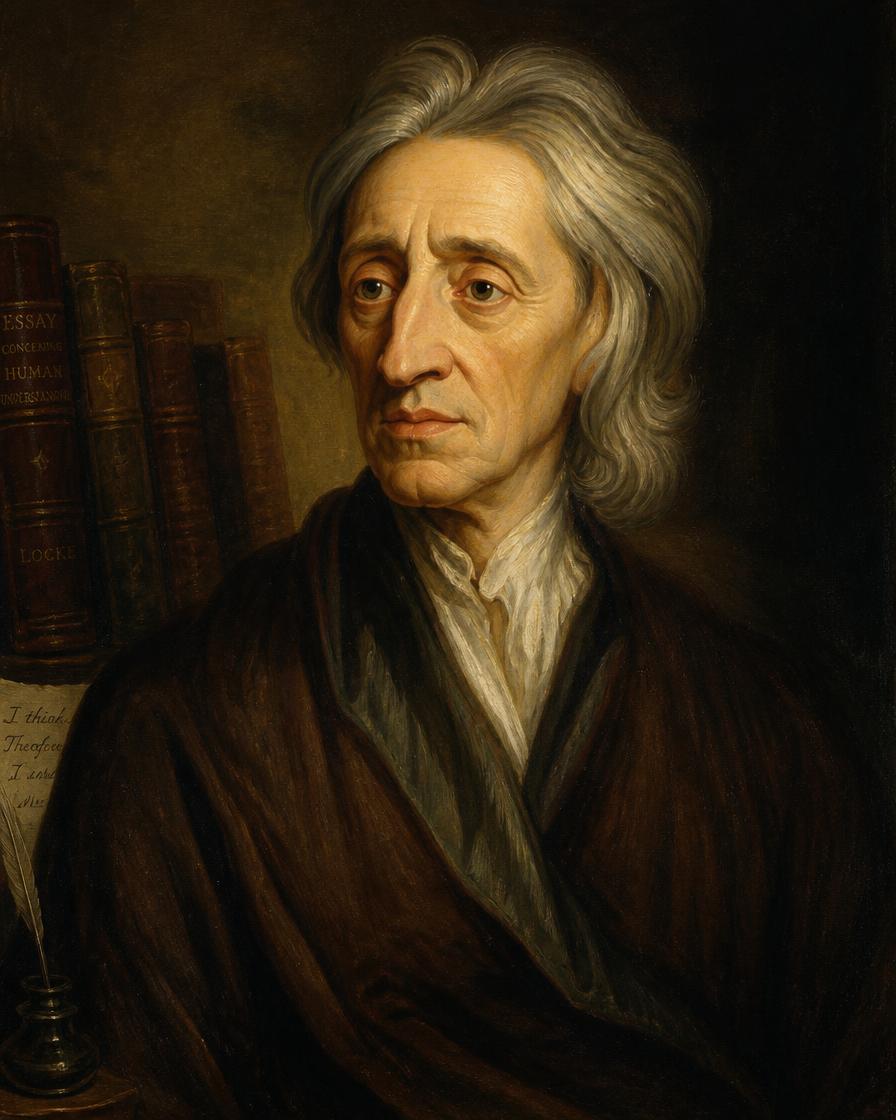
Quick Facts
- Years
- 1632 – 1704
- Category
- Philosophers & Thinkers
- Subcategory
- Enlightenment
- Nationality
- English
- Occupation
- Philosopher & Physician
John Locke
1632 – 1704 · English · Philosopher & Physician
Audiobook

Life Lessons from John Locke
Marcus Alden · 50 min
John Locke (1632–1704) was an English philosopher, physician, political theorist, and public official whose writings helped shape modern ideas about knowledge, government, religious toleration, education, and individual rights. A leading figure of the early Enlightenment, he argued that human understanding depends largely on experience rather than innate ideas. His account of the mind as initially lacking innate principles became central to British empiricism.
Locke was equally influential in politics. In the Two Treatises of Government, he described people as naturally free and equal, possessing rights to life, liberty, and property. Legitimate government, he maintained, rests on consent and exists to protect those rights. When rulers violate their trust, the people may alter or remove them. These arguments influenced later constitutional thought, particularly in Britain, the United States, France, and liberal political traditions worldwide.
His Letter Concerning Toleration defended broad religious toleration, while Some Thoughts Concerning Education emphasized character, practical judgment, and learning suited to the child. Yet Locke’s record also contains tensions: his toleration had limits, his political connections implicated him in colonial administration, and scholars debate his relationship to slavery and empire. He remains important precisely because his work combines enduring arguments for freedom with contradictions that illuminate the seventeenth-century world from which liberalism emerged.
Quick Facts
| Field | Details |
|---|---|
| Full Name | John Locke |
| Common Name(s) | John Locke |
| Born | 29 August 1632 |
| Died | 28 October 1704 |
| Age at Death | 72 |
| Birthplace | Wrington, Somerset, England |
| Nationality | English |
| Occupation | Philosopher, physician, political theorist, public official |
| Historical Era | Seventeenth century; Scientific Revolution; early Enlightenment |
| Famous For | Empiricism, natural rights, government by consent, religious toleration |
| Political Affiliation | Associated with the Whig opposition and the circle of the 1st Earl of Shaftesbury |
| Religion | Anglican background; broadly Protestant Christianity, with views that some contemporaries suspected were heterodox |
| Education | Westminster School; Christ Church, Oxford; Bachelor of Medicine, Oxford |
| Parents | John Locke Sr. and Agnes Keene Locke |
| Spouse(s) | Never married |
| Children | None recorded |
| Major Works | An Essay Concerning Human Understanding; Two Treatises of Government; A Letter Concerning Toleration; Some Thoughts Concerning Education; The Reasonableness of Christianity |
| Major Achievements | Founded a major empiricist tradition; formulated an influential theory of natural rights and consent; defended toleration; advanced educational thought |
Early Life
John Locke was born on 29 August 1632 in Wrington, Somerset, and raised principally near Pensford. His father, John Locke Sr., was a lawyer and minor landowner who served as a cavalry captain on Parliament’s side during the English Civil War. His mother, Agnes Keene, came from a local family; little is securely recorded about her influence. Locke had a younger brother, Thomas.
His childhood unfolded amid conflict over monarchy, Parliament, and religion. Civil war began when Locke was nine. The execution of Charles I in 1649, republican government, and the restoration of Charles II in 1660 taught his generation that political authority was neither simple nor secure.
Through a family connection, Locke entered Westminster School in 1647. The school’s demanding classical curriculum gave him strong Latin and Greek, although he later criticized education based too heavily on rote learning and corporal punishment.
In 1652 he entered Christ Church, Oxford. He received a bachelor’s degree in 1656 and a master’s in 1658, later holding academic posts there. Locke found much of Oxford’s traditional Aristotelian curriculum unsatisfying. He became increasingly interested in medicine and the experimental sciences associated with Robert Boyle, Thomas Willis, Richard Lower, and the intellectual network that helped produce the Royal Society.
Locke studied medicine rather than following a purely clerical or scholastic career. He earned the degree of Bachelor of Medicine in 1675. His medical training encouraged habits that shaped his philosophy: careful observation, suspicion of unsupported systems, and attention to the limits of certainty. René Descartes also influenced him, though Locke rejected Cartesian innate ideas.
Rise to Prominence
Locke’s decisive turning point came in 1666, when he met Anthony Ashley Cooper, later the 1st Earl of Shaftesbury. Ashley was impressed by Locke and invited him into his household. In 1667 Locke moved to London as physician, adviser, and administrator within Ashley’s circle.
Locke’s medical reputation benefited from his role during Ashley’s serious liver illness. Working with surgeon Thomas Sydenham and others, Locke helped supervise a risky operation in 1668 that inserted a drainage tube into an abscess. Ashley survived for many years afterward. Locke did not perform the operation himself, but his medical judgment and supervision strengthened their relationship.
The household exposed Locke to high politics, trade, colonial policy, and religious disputes. He served as secretary to bodies connected with commerce and the colonies, including the Lords Proprietors of Carolina and later the Council of Trade and Plantations. This administrative experience informed his political and economic thought.
Around 1671, discussions with friends prompted Locke to examine the limits of human understanding. This project eventually became An Essay Concerning Human Understanding. Ill health, particularly respiratory trouble, led him to France from 1675 to 1679, where he studied, traveled, and met intellectuals.
After Shaftesbury’s political fortunes collapsed during the Exclusion Crisis, Locke came under suspicion. He left England for the Dutch Republic in 1683. Although no conclusive evidence proves that he participated in the Rye House Plot against Charles II and James, Duke of York, his opposition connections made exile prudent. In the Netherlands he completed major works and moved among Protestant dissidents and scholars.
The Glorious Revolution of 1688–1689 enabled his return. His principal books appeared shortly afterward, many initially anonymously. Their intellectual power, political relevance, and controversy made him one of Europe’s best-known thinkers.
Major Achievements
Establishing an Empiricist Theory of Knowledge
In An Essay Concerning Human Understanding (1689, dated 1690), Locke asked what human beings can know and how they acquire ideas. He rejected innate speculative and moral principles, arguing that ideas arise through sensation and reflection upon the mind’s own operations.
This mattered because it redirected philosophy toward experience, language, and the boundaries of understanding. Locke distinguished primary qualities, such as shape and motion, from secondary qualities, such as color and taste, which depend on how objects affect perceivers. His account contained difficulties, but it became a foundation for British empiricism and influenced George Berkeley, David Hume, and later psychology.
Articulating Natural Rights and Consent
The Two Treatises of Government, published anonymously in 1689 and dated 1690, rejected patriarchal and absolute monarchy. Locke argued that human beings are naturally free and equal under a moral law of nature. They possess rights commonly summarized as life, liberty, and property.
Political society arises through consent, and government receives limited powers as a trust. When rulers systematically destroy the purposes for which government exists, the people retain a right of resistance. These ideas provided a vocabulary for constitutionalism and revolution. Their influence is visible in eighteenth-century American political thought, although scholars caution against treating Locke as the sole source of the Declaration of Independence.
Defending Religious Toleration
Locke’s first Letter Concerning Toleration was written in Latin during exile and published anonymously in 1689. It argued that civil government should protect worldly interests rather than compel religious belief. Faith produced by force, he reasoned, cannot save souls.
The argument supported a broader separation between civil authority and religious institutions. It became a landmark in the history of toleration. Yet Locke excluded atheists from full toleration and expressed major reservations about Roman Catholics whose allegiance, he feared, might belong to a foreign power. His toleration was therefore pioneering but not universal by modern standards.
Transforming Educational Thought
Some Thoughts Concerning Education (1693) grew from advice to his friend Edward Clarke. Locke emphasized health, self-command, habit, practical learning, and respectful treatment rather than constant punishment. He wanted education to form sound judgment and virtuous character, not merely display classical learning.
The work primarily addressed the upbringing of a gentleman rather than universal schooling, but its child-centered observations influenced later educators, including Jean-Jacques Rousseau. Its lasting importance lies in treating education as the gradual formation of habits, reason, and independence.
Contributing to Religious and Economic Debate
In The Reasonableness of Christianity (1695), Locke presented Christianity as intelligible and centered on acknowledging Jesus as the Messiah, while retaining the importance of moral conduct. Critics accused him of weakening orthodox doctrine, and he defended himself against charges of Socinianism.
Locke also wrote on money, interest, and coinage. During England’s currency crisis, he opposed devaluation and supported recoining silver at its established standard. His economic writings influenced policy discussions, though later economists disputed aspects of his monetary analysis.
Leadership and Work
Locke was not a mass political leader. His influence came through counsel, administration, scholarship, and carefully constructed arguments. He tended to work within networks: Shaftesbury’s household, scientific circles, Dutch exile communities, and the home of Sir Francis and Lady Damaris Masham.
His method was analytical and incremental. He frequently revised manuscripts over many years, distinguished degrees of certainty, and tested broad claims against experience. That caution was a strength, especially in epistemology. It could also produce complexity and apparent inconsistencies.
As an administrator, Locke dealt with trade, colonial affairs, and government appointments. After 1696 he served as a commissioner of the Board of Trade, despite chronic illness. He attended conscientiously when health allowed and contributed to discussions of commerce and colonies.
Locke valued liberty, rational inquiry, civility, and useful knowledge. His relationships reveal loyalty: he remained attached to Shaftesbury despite political danger and maintained long friendships with figures such as Edward Clarke and Damaris Masham. Nevertheless, he could be forceful in controversy. His exchanges with Edward Stillingfleet over the Essay became detailed and defensive.
His greatest professional strength was his ability to connect practical experience with philosophical reflection. His weaknesses included limits imposed by his social position and era. His theory spoke of equality while his administrative world remained hierarchical, colonial, and economically connected to coerced labor.
Personal Life
Locke never married and had no recorded children. His closest relationships were intellectual friendships and patronage ties. Shaftesbury gave him access to political life; Robert Boyle and Thomas Sydenham shaped his scientific and medical interests; Philipp van Limborch and other Dutch associates supported him during exile.
Damaris Cudworth Masham, herself a philosopher and daughter of Cambridge Platonist Ralph Cudworth, became one of his most important later friends. In 1691 Locke joined the Masham household at Oates in Essex. He participated in family life there and helped educate Damaris’s son, Francis Cudworth Masham.
Locke suffered from chronic respiratory illness, probably asthma or a related pulmonary condition. He sought cleaner air and spent periods in France partly for his health. His physical limitations contributed to his preference for quieter intellectual work and eventually forced him to resign from the Board of Trade in 1700.
Accounts from friends portray him as courteous, disciplined, conversational, and interested in medicine, gardening, education, theology, and public affairs. He kept notebooks and commonplace books and maintained extensive correspondence. He died at Oates on 28 October 1704, reportedly after Lady Masham read to him from the Psalms. He was buried in the churchyard of All Saints’ Church, High Laver, Essex.
Philosophy and Beliefs
Locke’s epistemology began with intellectual modesty. Human beings, he argued, should investigate the origins and limits of their ideas before claiming certainty. Experience supplies the materials of thought through sensation and reflection. The mind combines, compares, and abstracts from these materials.
His theory of personal identity located identity over time in continuity of consciousness rather than simply in the same body or immaterial substance. The famous prince-and-cobbler thought experiment illustrates that if consciousness, including memory, were transferred, personal identity would follow consciousness. Philosophers continue to debate whether memory can bear the role Locke assigned it.
Politically, Locke rejected the divine-right absolutism defended by Sir Robert Filmer. Individuals are equal in moral jurisdiction, and no one naturally possesses authority over another. Property begins when labor is joined to natural resources, subject initially to limits against waste and to leaving “enough, and as good” for others. Money and consent permit greater accumulation, creating tensions later critics explored.
Locke’s Christianity shaped his natural law, ethics, and politics. He believed humanity to be God’s workmanship and therefore denied that people could arbitrarily destroy themselves or others. He defended reasoned faith and scriptural study. Scholars debate the exact boundaries of his theology, especially his views of the Trinity and his proximity to Socinian ideas; he did not publicly identify as a Socinian.
Ethically, Locke emphasized responsibility, self-government, and accountability. Freedom was not mere impulsiveness but action under law and reason. His mature thought sought a society where inquiry could proceed without persecution and political power remained answerable to its purposes.
Challenges and Controversies
Locke faced censorship, exile, illness, and religious accusation. The Two Treatises and toleration writings initially appeared anonymously because their arguments remained politically dangerous. Oxford authorities deprived him of his studentship at Christ Church in 1684 under royal pressure.
His relation to slavery is the most serious modern controversy. Locke invested in the Royal African Company, which participated in the transatlantic slave trade, and held administrative roles linked to colonial government. He was also associated with the Fundamental Constitutions of Carolina, a document that protected slaveholders’ authority. The extent of his personal authorship is disputed: the constitutions emerged from Shaftesbury’s circle, and scholars disagree about which clauses Locke composed or merely copied and administered.
Some interpreters argue that Locke’s natural-rights theory fundamentally condemns slavery except as punishment following a just war. Others stress that his practical involvement with colonial systems and investment in slave trading reveal a profound contradiction, perhaps one partly accommodated by categories within his political theory. The evidence supports neither absolution nor the simplistic claim that he alone designed Carolina’s slave system.
Locke’s toleration also had boundaries. He denied toleration to atheists because he believed promises and oaths could not bind those who rejected divine judgment. He distrusted Catholics when their political obedience appeared directed toward foreign authority. Defenders note the security fears of seventeenth-century England; critics answer that these exceptions violated his own arguments for freedom of conscience.
His account of property has been praised for linking ownership with labor and criticized for rationalizing unequal accumulation and colonial appropriation. Scholars debate whether the “enough and as good” condition seriously limits acquisition or becomes weakened after the introduction of money.
In philosophy, critics challenged the coherence of his primary-secondary quality distinction, his account of substance, and his memory-based theory of identity. These objections did not erase his influence; they helped set the agenda for later philosophy.
Legacy
Locke became a principal source of Enlightenment liberalism. His language of natural rights, consent, limited government, and resistance influenced British Whigs, American revolutionaries, French reformers, and subsequent constitutional thinkers. Thomas Jefferson’s formulation of unalienable rights resembles Locke’s framework, though it also drew from wider English, Scottish, classical, and colonial traditions.
In philosophy, Locke helped establish empiricism as a major rival to rationalism. Berkeley and Hume developed his premises in directions he would not always have accepted. His discussions of consciousness and identity remain central to philosophy of mind, while his analysis of language anticipated later concerns about meaning and conceptual confusion.
His educational theories contributed to a movement away from purely punitive and memorization-centered instruction. His toleration arguments helped define the modern distinction between civil interests and religious conviction, even as his exclusions demonstrate how incomplete early toleration could be.
Locke has no single national museum devoted exclusively to him, but manuscripts and objects connected with him are held by institutions including Oxford’s Bodleian Library and Christ Church. His grave and memorial at All Saints’ Church, High Laver, remain important sites. Statues and portraits appear at institutions such as University College London and Oxford, and his name is used by schools, academic societies, lecture series, and research centers.
Modern scholarship increasingly studies both Locke’s emancipatory arguments and his entanglement with commerce, colonialism, and slavery. This fuller legacy makes him neither a flawless founder nor merely a hypocrite, but a thinker whose principles transformed politics while emerging from a deeply unequal imperial world.
Interesting Facts
- Locke was born in the same year as the philosopher Baruch Spinoza.
- His father fought for Parliament during the English Civil War.
- Locke attended Westminster School before entering Christ Church, Oxford.
- He trained as a physician but did not build a conventional full-time medical practice.
- He helped oversee the treatment that prolonged Shaftesbury’s life after liver surgery.
- He was elected a Fellow of the Royal Society in 1668.
- A conversation among friends in 1671 inspired the project that became the Essay.
- He spent several years in France for study and health.
- Political danger drove him into Dutch exile in 1683.
- His major political and toleration works were first published anonymously.
- The Two Treatises was written substantially before the Glorious Revolution, though its exact composition history is debated.
- Locke returned to England in 1689 aboard the same ship convoy that carried Princess Mary.
- He never married and had no known children.
- He coined no simple phrase equivalent to “blank slate”; he used the image of “white paper.”
- He distinguished real and nominal essences in his philosophy of classification.
- He treated consciousness as crucial to personal identity.
- He wrote practical advice about exercise, clothing, diet, and childhood habits.
- Chronic respiratory illness affected his travel and public service.
- He spent his final years in Damaris Masham’s household.
- He was buried at High Laver, Essex, rather than in Westminster Abbey.
Famous Quotes
- “No man’s knowledge here can go beyond his experience.” — An Essay Concerning Human Understanding, Book II. Locke summarizes the empirical limit on ideas and knowledge.
- “Let us then suppose the mind to be, as we say, white paper, void of all characters.” — Essay, Book II. The passage rejects innate ideas; “blank slate” is a later shorthand.
- “New opinions are always suspected, and usually opposed, without any other reason but because they are not already common.” — Essay, dedicatory epistle. Locke comments on resistance to intellectual change.
- “Where there is no law, there is no freedom.” — Second Treatise of Government, section 57. Proper law protects rather than simply restricts liberty.
- “The end of law is not to abolish or restrain, but to preserve and enlarge freedom.” — Second Treatise, section 57. Legitimate rules secure a sphere for free action.
- “Men being, as has been said, by nature, all free, equal, and independent...” — Second Treatise, section 95. Political society requires individual consent.
- “The great and chief end... of men’s uniting into commonwealths... is the preservation of their property.” — Second Treatise, section 124. Here “property” can encompass lives, liberties, and estates.
- “The care of souls is not committed to the civil magistrate.” — A Letter Concerning Toleration. Government lacks authority and capacity to compel saving belief.
- “Neither Pagan, nor Mahometan, nor Jew, ought to be excluded from the civil rights of the commonwealth because of his religion.” — Letter Concerning Toleration. The statement was unusually broad for its era, despite Locke’s other exclusions.
- “Reading furnishes the mind only with materials of knowledge; it is thinking that makes what we read ours.” — Of the Conduct of the Understanding, published posthumously. Locke distinguishes information from reflective understanding.
- “All mankind... being all equal and independent, no one ought to harm another in his life, health, liberty, or possessions.” — Second Treatise, section 6. This expresses the moral law governing Locke’s state of nature.
Timeline
- 1632 — Born at Wrington, Somerset, on 29 August.
- 1647 — Entered Westminster School.
- 1652 — Entered Christ Church, Oxford.
- 1656 — Received his bachelor’s degree.
- 1658 — Received his master’s degree.
- 1660 — Became a lecturer in Greek at Christ Church.
- 1666 — Met Anthony Ashley Cooper.
- 1667 — Joined Ashley’s London household.
- 1668 — Helped supervise Ashley’s liver operation; elected Fellow of the Royal Society.
- 1671 — Began drafting ideas that became the Essay.
- 1672–1674 — Held administrative offices connected with Shaftesbury and trade.
- 1675 — Received the Bachelor of Medicine degree; traveled to France.
- 1679 — Returned to England as Shaftesbury regained influence.
- 1683 — Fled to the Dutch Republic amid political repression.
- 1684 — Removed from his Christ Church studentship by royal order.
- 1688 — Completed the Latin toleration letter; Glorious Revolution began.
- 1689 — Returned to England; Letter Concerning Toleration and Two Treatises published.
- 1690 — Essay Concerning Human Understanding appeared with the date 1690.
- 1691 — Moved to the Masham household at Oates.
- 1693 — Published Some Thoughts Concerning Education.
- 1695 — Published The Reasonableness of Christianity.
- 1696 — Appointed commissioner of the Board of Trade.
- 1700 — Resigned from the Board of Trade because of poor health.
- 1704 — Died at Oates on 28 October and was buried at High Laver.
Frequently Asked Questions
Who was John Locke?
John Locke was a seventeenth-century English philosopher, physician, and public official. He is best known for developing an empiricist account of knowledge and an influential political theory grounded in natural rights, consent, limited government, and resistance to tyranny. He also wrote major works on religious toleration, education, Christianity, money, and personal identity. His ideas became important to Enlightenment philosophy and later constitutional government.
Why is John Locke called the father of liberalism?
The label reflects Locke’s defense of individual rights, legal equality, religious toleration, private property, and government based on consent. He treated political authority as a limited trust rather than an unlimited possession of rulers. However, “father of liberalism” is retrospective: modern liberalism developed from many sources and later took forms Locke could not have anticipated. His exclusions and colonial connections also complicate celebratory uses of the title.
What did Locke mean by natural rights?
Locke believed people possess moral claims before the creation of government. In the state of nature, everyone is free and equal under natural law, which forbids harming others in their life, health, liberty, or possessions. Governments do not create these basic rights; they are established to protect them more reliably. If a government persistently attacks them, it violates its trust and may justifiably face resistance.
Did Locke write “life, liberty, and the pursuit of happiness”?
No. That phrase appears in the 1776 United States Declaration of Independence, chiefly drafted by Thomas Jefferson. Locke commonly wrote of life, liberty, and property, though his concept of “property” sometimes included lives and liberties as well as material possessions. Jefferson and other founders knew Locke’s political tradition, but the Declaration also drew on many English, Scottish, classical, legal, and colonial sources.
What is Locke’s blank-slate theory?
Locke did not use the exact English phrase “blank slate.” He asked readers to suppose the mind is like “white paper” without innate characters. Experience then supplies ideas through sensation and reflection. This does not mean people have no natural capacities, temperaments, or mental powers. Locke’s target was principally the claim that human beings are born already possessing particular principles or ideas.
Was Locke a physician?
Yes. Locke pursued medical studies at Oxford and received a Bachelor of Medicine degree in 1675. He associated with prominent researchers and physicians, particularly Thomas Sydenham, and practiced within Shaftesbury’s household. His best-known medical role was helping diagnose and supervise treatment for Shaftesbury’s liver condition. Medicine influenced his observational method, although philosophy and administration became his principal historical contributions.
What did Locke believe about government?
Locke held that legitimate government rests on consent and serves defined purposes: preserving people’s lives, liberties, and possessions and providing impartial law. Legislative power is supreme within the constitution but remains limited by natural law and public trust. Executive discretion may be necessary, yet it is not absolute. A sustained attempt to subvert rights or representative institutions places rulers in a state of war with the people.
Did Locke support revolution?
Locke defended a right of resistance, not constant rebellion. He argued that people generally endure serious abuses before overturning established institutions. Resistance becomes justified when rulers systematically violate their trust, destroy lawful government, or use force without right. Scholars debate how directly the Two Treatises was written to justify the Glorious Revolution because substantial portions were composed before 1688.
What was Locke’s view of religion?
Locke was a Protestant Christian who believed revelation and reason should be interpreted consistently. He regarded Jesus as the Messiah and stressed Christianity’s moral intelligibility. His precise doctrinal position remains debated because critics suspected Socinian tendencies, especially concerning the Trinity. Locke denied that label. Religion underpinned his natural-law theory, but he also sought to limit coercive ecclesiastical and governmental power.
Did Locke favor complete religious freedom?
No. His toleration was broad by seventeenth-century standards but incomplete. He argued that civil authorities should not compel faith and explicitly extended civil rights to several non-Christian groups. Yet he excluded atheists and distrusted Catholics whose obedience might be controlled by a foreign power. Modern readers often see these exclusions as contradictions; historically, they also reflect contemporary fears about oaths and international religious politics.
How did Locke influence the American Revolution?
American colonists and founders encountered Lockean ideas through his writings and the wider Whig tradition. Natural rights, government by consent, political trust, and resistance to tyranny all became prominent revolutionary themes. Jefferson’s language bears a family resemblance to Locke’s. Nonetheless, historians avoid reducing the Revolution to one thinker: classical republicanism, English law, Protestant traditions, colonial experience, and Scottish philosophy were also important.
What did Locke say about personal identity?
Locke distinguished being the same person from merely having the same body or substance. Personal identity extends as far as consciousness can reach backward to past thoughts and actions. His examples suggest that consciousness, especially memory, connects the person across time and grounds responsibility. Critics point out circularity and failures of memory, but the theory inaugurated debates that remain central in philosophy and cognitive science.
Was John Locke involved with slavery?
Yes, in troubling ways. He invested in the slave-trading Royal African Company and worked in colonial administration. He was connected to the Fundamental Constitutions of Carolina, which protected slaveholders, although scholars dispute how much of that document he personally authored. His political theory permits slavery only under narrow just-war conditions, creating a serious gap between universal language and colonial practice. Historians debate how that contradiction should shape interpretation.
What did Locke believe about property?
Locke argued that people gain claims over natural resources by mixing their labor with them. Initial acquisition was limited by duties not to waste and to leave enough and equally good resources for others. The development of money, accepted by consent, allowed durable accumulation and inequality. Supporters see a defense of productive independence; critics see intellectual support for capitalism, unequal ownership, or colonial dispossession.
Who influenced Locke?
His influences included René Descartes, whose philosophy he criticized as well as learned from; Robert Boyle and experimental science; physician Thomas Sydenham; natural-law writers such as Hugo Grotius and Samuel Pufendorf; and Shaftesbury’s political circle. English religious conflict and civil war were equally formative. Locke’s thought emerged from these overlapping scientific, theological, legal, and political settings rather than from one school.
Who did Locke influence?
Locke strongly influenced Berkeley, Hume, Voltaire, Rousseau, and many eighteenth-century constitutional thinkers. His political arguments shaped Whig and liberal traditions and contributed to American and French revolutionary discourse. His educational proposals influenced debates about childhood and pedagogy. Contemporary philosophers still engage his theories of knowledge, language, property, toleration, consciousness, and identity, even when rejecting his conclusions.
Where is John Locke buried?
Locke is buried in the churchyard of All Saints’ Church in High Laver, Essex. He died nearby at Oates, the Masham family home where he had lived during his later years. His epitaph, composed in Latin, presents him with characteristic modesty and directs readers to his writings for a fuller account. The grave remains a destination for scholars and visitors interested in his life.
Lessons We Can Learn
- Test claims against evidence. Locke’s medical and scientific background encouraged observation over inherited authority. Today, evidence-based judgment remains essential in public policy and personal decisions.
- Recognize the limits of knowledge. The Essay mapped what the mind can and cannot securely know. Intellectual humility reduces dogmatism without requiring skepticism about everything.
- Treat power as a trust. Locke judged government by whether it protected the public. Modern institutions also require accountability, transparency, and defined authority.
- Protect disagreement. His toleration writings showed that coercion cannot produce sincere conviction. Plural societies benefit when peaceful differences are protected.
- Examine exceptions to principles. Locke defended toleration but excluded some groups. Testing who is left outside a principle exposes hidden prejudice and inconsistency.
- Build habits, not just knowledge. Some Thoughts Concerning Education emphasized practice and character. Durable learning depends on repeated behavior, not information alone.
- Revise ideas patiently. Locke developed the Essay over nearly two decades. Important work often improves through long reflection and repeated revision.
- Connect theory with experience. His service in medicine and government gave practical contexts to philosophical questions. Ideas become stronger when tested against institutions and consequences.
- Confront compromised legacies honestly. Locke’s colonial and financial connections complicate his rights theory. Learning from a thinker does not require ignoring harmful involvement.
- Value lawful freedom. Locke argued that well-designed law enlarges liberty by protecting people from arbitrary power. Freedom depends on fair institutions, not simply the absence of rules.
Related Historical Figures
- Anthony Ashley Cooper, 1st Earl of Shaftesbury — Locke’s patron, patient, and political associate; his household brought Locke into national and colonial affairs.
- Robert Boyle — Experimental scientist whose methods and Oxford circle influenced Locke’s empirical outlook.
- Thomas Sydenham — Physician and collaborator whose observational approach to medicine paralleled Locke’s philosophical method.
- Damaris Cudworth Masham — Philosopher, friend, and host during Locke’s final years; she discussed theology, reason, and education with him.
- René Descartes — Rationalist philosopher who influenced Locke’s agenda, despite Locke’s rejection of innate ideas.
- Sir Robert Filmer — Defender of patriarchal monarchy whose arguments Locke attacked in the First Treatise.
- William III — Monarch installed after the Glorious Revolution, the political settlement that allowed Locke to return from exile.
- George Berkeley — Irish philosopher who developed and criticized Locke’s account of ideas and material substance.
- David Hume — Scottish philosopher who carried empiricist analysis into more skeptical conclusions.
- Thomas Jefferson — American statesman whose language of rights and consent reflects Locke’s influence within a broader revolutionary tradition.
Watch and Learn
POLITICAL THEORY - John Locke · The School of Life
Related Historical Figures