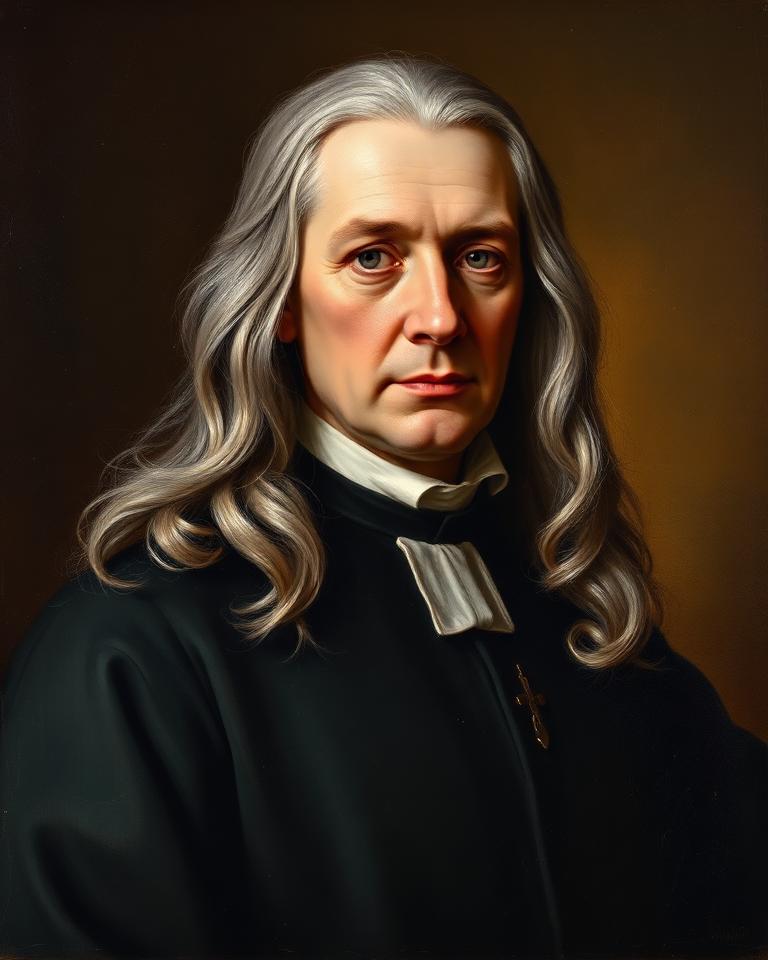
Quick Facts
- Years
- 1703 – 1791
- Category
- Social Reformers & Humanitarians
- Subcategory
- Religious Reform
- Nationality
- British
- Occupation
- Theologian and Cleric
John Wesley
1703 – 1791 · British · Theologian and Cleric
Audiobook

Life Lessons from John Wesley
Marcus Alden · 52 min
John Wesley (1703–1791) was an English Anglican cleric, theologian, preacher, and principal founder of the Methodist movement. Working alongside his brother Charles Wesley and the evangelist George Whitefield, he helped reshape eighteenth-century British Protestantism through open-air preaching, disciplined religious societies, extensive travel, and a practical theology centered on grace and holy living.
Wesley did not initially intend to establish a separate denomination. He remained a priest of the Church of England until his death and described Methodism as a reforming movement within it. Yet the societies, classes, circuits, lay preachers, conferences, and charitable projects he organized eventually formed the institutional foundations of worldwide Methodism.
His achievements were both theological and organizational. Wesley taught that divine grace reaches people before conversion, that salvation is received through faith, and that Christian maturity involves growth in love of God and neighbor. He preached more than 40,000 sermons, traveled enormous distances—usually on horseback—and published sermons, journals, hymnal collections, theological works, and inexpensive educational material.
Wesley remains important because his movement united personal conversion with disciplined community and social responsibility. His ideas continue to shape Methodist, Wesleyan, Holiness, and some Pentecostal traditions. Historians also study him as a major figure in the Evangelical Revival and in the social and religious history of modern Britain.
Quick Facts
| Field | Information |
|---|---|
| Full Name | John Wesley |
| Common Name(s) | John Wesley |
| Born | 17 June 1703, Old Style; 28 June under the modern Gregorian calendar |
| Died | 2 March 1791 |
| Age at Death | 87 |
| Birthplace | Epworth, Lincolnshire, England |
| Nationality | English |
| Occupation | Anglican cleric, theologian, evangelist, author, organizer |
| Historical Era | Georgian Britain; Evangelical Revival |
| Famous For | Founding and organizing Methodism; open-air preaching; Wesleyan theology |
| Political Affiliation | No formal party affiliation; generally conservative and monarchist |
| Religion | Anglican Christianity; leader of the Methodist movement |
| Education | Charterhouse School; Christ Church, Oxford; M.A. from Oxford |
| Parents | Samuel Wesley and Susanna Wesley, née Annesley |
| Spouse(s) | Mary Wesley, née Vazeille, married 1751; separated without formal divorce |
| Children | None |
| Major Works | A Collection of Hymns for the Use of the People Called Methodists; Explanatory Notes upon the New Testament; A Plain Account of Christian Perfection; The Journal of the Rev. John Wesley; Primitive Physick |
| Major Achievements | Co-founded Methodism; organized societies and circuits; trained lay preachers; promoted missions, education, charity, and opposition to slavery |
Early Life
John Wesley was born at the rectory in Epworth, Lincolnshire, the fifteenth of Samuel and Susanna Wesley's nineteen children, although only ten survived infancy. His father was the Anglican rector of Epworth. His mother, a highly educated and disciplined woman, directed much of the children's early instruction and exercised a lasting influence on John's devotional habits.
The household combined Anglican ministry, serious scholarship, financial insecurity, and strong convictions. Both parents came from families connected with Protestant Nonconformity before entering the Church of England. Their son therefore grew up aware of both established religion and dissent.
On 9 February 1709, a fire destroyed the Epworth rectory. Six-year-old John was rescued through an upper window shortly before the roof collapsed. Susanna later interpreted his survival through the biblical phrase “a brand plucked out of the burning.” Wesley accepted the event as evidence of providential preservation, although later legends sometimes embellished its details.
He entered Charterhouse School in London in 1714. In 1720 he matriculated at Christ Church, Oxford. Wesley studied classics, logic, theology, and biblical languages. Influential devotional writers included Thomas à Kempis, Jeremy Taylor, and William Law, whose works stressed inward holiness and disciplined obedience.
Wesley was ordained deacon in 1725 and elected a fellow of Lincoln College, Oxford, in 1726. He received his M.A. in 1727 and was ordained priest in 1728. After briefly assisting his father at Epworth, he returned to Oxford in 1729.
There he joined a small devotional group begun by his brother Charles. Its members prayed, studied the Greek New Testament, fasted, received Communion frequently, visited prisoners, and assisted poor families. Critics mockingly called them the “Holy Club” and “Methodists” because of their regular methods. The label eventually became the movement's name.
Rise to Prominence
Wesley's first major missionary undertaking was initially a failure. In 1735 he sailed to the new colony of Georgia as a missionary under the Society for the Propagation of the Gospel. He hoped to minister to settlers and convert Indigenous peoples, but accomplished little toward the latter goal.
During an Atlantic storm, Wesley was impressed by the calm faith of Moravian Christians aboard ship. In Georgia he imposed strict religious discipline and became involved in a painful dispute with Sophia Hopkey, a woman he had courted but did not marry. After she married another man, Wesley excluded her from Communion on grounds he described as religious. Civil proceedings followed, and he left Georgia in December 1737 under a cloud of controversy.
Back in England, Wesley experienced profound spiritual uncertainty. The Moravian Peter Böhler encouraged him to preach faith until he possessed assurance of it himself. On 24 May 1738, Wesley attended a meeting in Aldersgate Street, London. While someone read from Martin Luther's preface to Romans, Wesley recorded that he felt his heart “strangely warmed” and trusted Christ for salvation.
Aldersgate became a defining Methodist memory, though scholars debate whether it should be called Wesley's conversion. He had long been a serious Christian and ordained priest; the experience is more precisely understood as a new assurance of justifying faith.
In 1739 George Whitefield invited Wesley to preach outdoors near Bristol. Wesley initially considered field preaching irregular, but soon addressed miners and large crowds excluded from or unlikely to enter parish churches. His preaching brought recognition, hostility, and opportunities that ordinary church structures could not contain.
Wesley organized converts into societies for mutual discipline. Smaller “classes” met for spiritual accountability and financial contributions; “bands” offered more intimate confession and counsel. He increasingly appointed lay preachers, established circuits, and traveled between them. These innovations transformed a revival into a durable movement.
Major Achievements
Building the Methodist Connection
Wesley created a linked network, commonly called the Connexion, rather than isolated congregations. Societies remained divided into classes, leaders reported on members, itinerant preachers followed circuits, and annual conferences coordinated doctrine and appointments.
This mattered because religious enthusiasm often faded after a revival. Wesley supplied regular meetings, pastoral supervision, financial support, and rules of conduct. The system became a model for Methodist denominations throughout the world.
Taking Preaching Beyond Church Walls
Beginning in 1739, Wesley preached in fields, marketplaces, streets, meetinghouses, and private homes. He spoke at dawn, during journeys, and wherever crowds gathered. Contemporary estimates in his journals are not always independently verifiable, but his audiences sometimes numbered in the thousands.
Field preaching brought evangelical religion to miners, laborers, artisans, prisoners, and others poorly served by existing parish arrangements. It also challenged assumptions that preaching belonged only inside consecrated buildings. Outdoor evangelism became a defining practice of later revival movements.
Developing Wesleyan Theology
Wesley was a practical and synthesizing theologian rather than the creator of a closed philosophical system. His standard sermons and biblical notes emphasized universal grace, repentance, justification by faith, assurance, the new birth, and sanctification.
His doctrine of Christian perfection did not mean intellectual or moral infallibility. It described mature love in which the believer's governing intention is love of God and neighbor. The teaching inspired Holiness traditions, while also provoking persistent debate over whether such maturity is possible in this life.
Empowering Lay Leadership
A shortage of ordained clergy willing to support the revival led Wesley to authorize capable laypeople to preach and supervise societies. Lay leadership allowed Methodism to expand rapidly and gave ordinary members significant responsibility.
Women also served as class leaders and spiritual advisers. Wesley cautiously accepted some women's preaching when he judged it to involve an “extraordinary call,” notably in the cases of Sarah Crosby and Mary Bosanquet Fletcher. His position was not modern equality, but it opened space wider than that available in many contemporary churches.
Publishing for a Broad Public
Wesley used print on a remarkable scale. He abridged older works, issued inexpensive tracts, edited hymn collections, wrote sermons and notes on Scripture, and published his journals. A Christian Library made devotional writings more accessible, while Primitive Physick offered household medical advice—some sensible for its time, some ineffective or unsafe by modern standards.
His publishing program standardized Methodist teaching and supported literacy and self-education. Charles Wesley's hymns, selected and edited within this culture, gave the movement a memorable sung theology.
Joining Religion to Social Action
Methodist societies collected money for poor relief, visited prisoners and sick people, supported schools, and experimented with small lending funds. Wesley promoted plain living partly so that resources could be shared. His maxim was effectively to earn, save, and give as much as one responsibly could.
Late in life, he became a prominent opponent of the slave trade. His Thoughts upon Slavery (1774) condemned the institution, and his final known letter encouraged abolitionist William Wilberforce. Methodist involvement in abolition drew lasting energy from this stance, although Wesley had earlier accepted a missionary role within colonial structures.
Securing Methodism's Future
In 1784 Wesley executed the Deed of Declaration, legally defining the Conference of one hundred preachers that would govern Methodist property and organization after his death. That year he also ordained ministers for the newly independent United States and appointed Thomas Coke as superintendent, acting with assistance from other clergy.
These steps were controversial because Anglican order normally reserved ordination to bishops. Wesley defended his action through his understanding of the early church and necessity. It enabled American Methodism to become an independent Episcopal denomination and hastened the eventual separation of British Methodism from the Church of England.
Leadership and Work
Wesley's leadership was disciplined, mobile, centralized, and relentlessly practical. He rose early, preached frequently, read while traveling, kept extensive journals, examined local societies, and expected regular reports. His ability to combine spiritual purpose with administration was among his greatest strengths.
He made decisions experimentally. If a practice produced what he considered scriptural fruit, he was willing to retain it despite convention. Field preaching and lay ministry emerged in this way. Yet he also issued detailed rules and reserved broad authority over preachers, appointments, and property.
His values included personal holiness, stewardship, punctuality, simplicity, education, and care for the poor. He could be warm and encouraging, but also controlling and abrupt. Relationships with colleagues suffered when theological disagreement or institutional independence threatened unity.
Wesley separated from George Whitefield organizationally over predestination, though they later regained mutual respect. His relationship with Charles was affectionate but strained by decisions about ordination and succession. With the Moravians, early gratitude gave way to disagreement over quietism and assurance.
His great weakness as a leader was often the reverse of his strength: certainty and energy could become inflexibility. Nevertheless, his structures survived because they distributed daily responsibility among class leaders and itinerants rather than depending entirely on his personal presence.
Personal Life
Wesley's closest early relationships were within his large family, especially with Susanna and Charles. He admired his mother's intelligence and sought her counsel. His correspondence reveals numerous friendships with preachers, patrons, converts, and religious women.
In 1751 he married Mary Vazeille, a widowed mother of four commonly called Molly. The marriage was unhappy. Wesley's constant travel, extensive correspondence with women, poor communication, and Mary's jealousy all contributed. She sometimes examined or removed his papers and published extracts from private letters. They separated repeatedly and finally ceased living together. Wesley did not attend her burial in 1781, reportedly learning of her death afterward. They had no children.
Wesley maintained a demanding routine into old age. He commonly rose around four in the morning, traveled thousands of miles each year, preached several times a day, and read widely. He enjoyed music and believed congregational singing to be a powerful means of teaching.
His health was generally resilient, though he endured recurrent illness, exhaustion, falls from horses, and declining strength. He was interested in medicine and electricity as therapy, reflecting eighteenth-century curiosity rather than modern clinical science.
Descriptions by contemporaries portray him as short, neat, energetic, courteous, and commanding. His journals show humor and curiosity as well as strong judgments. Frugal habits supported his charitable giving, although his organizations and publications handled substantial sums.
Philosophy and Beliefs
Wesley's theology began with the conviction that salvation is entirely grounded in God's grace. Prevenient grace, in his understanding, acts before conscious faith and enables human response. He rejected both salvation by meritorious works and strict predestination that limited saving grace to an elect few.
Justification meant forgiveness and acceptance through faith. The new birth referred to inward renewal. Sanctification was the continuing work by which believers grow in holiness. Wesley insisted that authentic faith produces works of mercy and obedience, not as the price of salvation but as its fruit.
He described Christianity as “social” in the sense that holiness must be practiced in relationships and community. Methodist rules grouped duties under doing no harm, doing good, and attending the ordinances of God. Care for bodies, education, economic conduct, and public justice therefore belonged to religious discipleship.
Wesley valued Scripture as the primary authority while drawing on Christian tradition, reason, and experience. The later term “Wesleyan Quadrilateral” is a twentieth-century scholarly formulation, not a phrase Wesley himself used.
Politically, Wesley was usually conservative. He supported monarchy, opposed radical agitation, and criticized the American Revolution. His pamphlet A Calm Address to Our American Colonies borrowed heavily from Samuel Johnson's arguments, prompting accusations of plagiarism and political subservience. Yet his conservatism coexisted with criticism of luxury, exploitation, and slavery.
Challenges and Controversies
Wesley's Georgia mission damaged his reputation. His handling of Sophia Hopkey mixed pastoral authority with unresolved personal emotion, even though he claimed sacramental grounds for his action. Admirers have emphasized procedural and ecclesiastical complexities; critics see poor judgment and misuse of clerical power.
Established clergy often accused Methodists of enthusiasm, disorder, emotional manipulation, and intrusion into parishes. Mobs disrupted meetings, assaulted preachers, and damaged property. Wesley defended extraordinary methods as necessary to reach neglected populations, but critics feared that itinerancy weakened parish order.
The Calvinist controversy divided revival leaders. Whitefield and others affirmed election in a Reformed sense, whereas Wesley preached grace available to all. Wesley's 1770 conference minutes appeared to some Calvinists to compromise justification by faith. A fierce pamphlet dispute followed, involving Augustus Toplady and others.
His teaching on perfection was frequently misunderstood. Critics believed it encouraged spiritual pride or claims of sinlessness. Wesley denied freedom from ignorance, mistakes, temptation, or involuntary weakness, yet his terminology remained controversial even among Methodists.
His governance could be paternalistic. He appointed preachers, moved them between circuits, enforced membership rules, and sometimes managed dissent personally. Supporters viewed this as necessary discipline; critics regarded it as authoritarian.
Wesley's ordinations for America raised legal and ecclesiastical objections. He remained an Anglican priest while taking actions usually associated with bishops. Historians differ over how far he intended institutional separation, but his decisions plainly made separation more likely.
Some popular claims about Wesley exceed the evidence. The assertion that Methodism prevented an English revolution, often associated with later historical arguments, cannot be demonstrated. Methodism may have encouraged discipline and social solidarity, but Britain's political trajectory had many causes.
Legacy
Wesley died at his London home on 2 March 1791 and was buried behind his chapel in City Road. By then the British Methodist societies included tens of thousands of members, while Methodism had also taken institutional root in the United States.
After his death, British Methodism separated formally and gradually from Anglican structures. Today the wider Methodist family numbers tens of millions worldwide. Wesley's theology also shaped the Holiness movement, the Salvation Army, Nazarene churches, and important strands of Pentecostalism.
His organizational legacy is visible in conferences, circuits, itinerant ministry, small-group accountability, and strong lay participation. His integration of evangelism with education and social service influenced schools, colleges, missions, hospitals, and charities.
Important sites include Wesley's Chapel and his house in London, now preserved for visitors; the New Room in Bristol, the oldest surviving Methodist building; Epworth Old Rectory; and the World Methodist Museum at Lake Junaluska, North Carolina. Statues and memorials stand at several Methodist institutions and historic sites, including Wesley's Chapel.
Wesley remains relevant to debates about religious experience, institutional innovation, economic ethics, social holiness, and the relationship between inherited tradition and reform. His record is neither free of failure nor reducible to private devotion: he was a movement builder whose choices changed global Christianity.
Interesting Facts
- Wesley was one of nineteen children, ten of whom survived infancy.
- He escaped the burning Epworth rectory at age five under the calendar then used in England.
- “Methodist” began as a term of ridicule at Oxford.
- He was a fellow of Lincoln College, Oxford.
- His Georgia mission lasted from 1735 to 1737.
- Moravian Christians strongly influenced his understanding of assurance.
- His Aldersgate experience occurred on 24 May 1738.
- Methodists commemorate 24 May as Wesley Day or Aldersgate Day.
- George Whitefield persuaded him to try open-air preaching.
- Wesley often preached early in the morning to working people.
- He traveled approximately 250,000 miles during his ministry according to traditional estimates.
- Traditional estimates credit him with more than 40,000 sermons.
- He used lay preachers despite initial hesitation.
- Wesley published a widely read household medical guide, Primitive Physick.
- He experimented with electricity for therapeutic purposes.
- He opposed alcoholic spirits but did not demand total abstinence from every alcoholic drink.
- He strongly condemned the transatlantic slave trade.
- His final known letter was addressed to William Wilberforce.
- He remained an Anglican priest until his death.
- His last reported words were, “The best of all is, God is with us.”
Famous Quotes
- “I felt my heart strangely warmed.” — Journal entry for 24 May 1738. It describes Wesley's Aldersgate assurance of trust in Christ, not necessarily his first Christian belief.
- “The world is my parish.” — Journal, 11 June 1739. Wesley used the phrase while defending his duty to preach beyond one geographically assigned parish.
- “I look upon all the world as my parish.” — The fuller documented wording from the same journal passage; it expresses missionary scope rather than contempt for local churches.
- “There is no holiness but social holiness.” — Preface to Hymns and Sacred Poems (1739). In context, Wesley meant that Christian holiness is lived in fellowship, not that holiness is merely political activism.
- “Gain all you can, save all you can, give all you can.” — Summary of the argument of his sermon “The Use of Money.” The familiar compressed form accurately reflects its three headings.
- “Earn all you can” — Often substituted for “gain” in modern versions. This wording is a popular adaptation rather than the original heading.
- “In essentials, unity; in non-essentials, liberty; and in all things, charity.” — Frequently attributed to Wesley, but the attribution is disputed; the saying predates him and is associated with earlier European theologians.
- “Do all the good you can, by all the means you can…” — The longer “Do all the good” maxim is widely attributed to Wesley, but no secure occurrence has been found in his authenticated writings; attribution is disputed.
- “I am not afraid that the people called Methodists should ever cease to exist… But I am afraid, lest they should only exist as a dead sect, having the form of religion without the power.” — From “Thoughts upon Methodism” (1786). It warns that institutions can survive after spiritual purpose disappears.
- “The best of all is, God is with us.” — Reported as Wesley's final words in accounts of his death. The statement summarizes his confidence in divine presence.
Timeline
- 1703 — Born at Epworth, Lincolnshire, on 17 June Old Style.
- 1709 — Rescued from the Epworth rectory fire.
- 1714 — Entered Charterhouse School, London.
- 1720 — Began studies at Christ Church, Oxford.
- 1725 — Ordained deacon.
- 1726 — Elected fellow of Lincoln College.
- 1727 — Received his M.A.; assisted his father in Lincolnshire.
- 1728 — Ordained priest in the Church of England.
- 1729 — Returned to Oxford and joined the devotional group later called the Holy Club.
- 1735 — Sailed for Georgia as a missionary.
- 1737 — Left Georgia after pastoral and legal controversy.
- 1738 — Experienced assurance at Aldersgate on 24 May; visited the Moravian community at Herrnhut.
- 1739 — Began open-air preaching; organized the first Methodist societies in the emerging revival.
- 1740 — Broke with the Fetter Lane Moravian society and differed publicly with Whitefield over predestination.
- 1742 — Developed the class-meeting system in Bristol.
- 1744 — Convened the first Methodist Conference.
- 1751 — Married Mary Vazeille.
- 1755 — Published Explanatory Notes upon the New Testament.
- 1766 — Sarah Crosby's ministry helped force consideration of women's preaching.
- 1769 — Sent Methodist preachers to support work in America.
- 1770 — Conference minutes triggered the Calvinist controversy.
- 1774 — Published Thoughts upon Slavery.
- 1775 — Published A Calm Address to Our American Colonies.
- 1778 — Opened the City Road Chapel, now Wesley's Chapel.
- 1780 — Published A Collection of Hymns for the Use of the People Called Methodists.
- 1781 — Mary Wesley died.
- 1784 — Established the legal Conference by Deed of Declaration and ordained ministers for America.
- 1786 — Published “Thoughts upon Methodism.”
- 1791 — Wrote to William Wilberforce on 24 February; died on 2 March in London.
Frequently Asked Questions
Who was John Wesley?
John Wesley was an eighteenth-century English Anglican priest, evangelist, theologian, and organizer. He was the leading architect of Methodism, working closely with Charles Wesley, George Whitefield, lay preachers, and local leaders. His importance lies not only in his sermons but in the durable network he built: societies, classes, circuits, conferences, publishing operations, and charitable ministries. Although Methodism became a separate family of churches, Wesley himself remained an Anglican priest throughout his life.
When and where was John Wesley born?
Wesley was born at Epworth rectory in Lincolnshire. The parish register and contemporary English calendar give the date as 17 June 1703. Because England still used the Julian calendar, this corresponds to 28 June in the Gregorian calendar used today. Both dates therefore appear in responsible biographies. His father, Samuel, was rector of Epworth, and his mother, Susanna, supervised the children's demanding early education.
Why was he called a Methodist?
Oxford critics used “Methodist” to mock Wesley, his brother Charles, and their associates for following a highly structured religious routine. They prayed, fasted, studied Scripture, received Communion regularly, visited prisoners, and gave aid to poor people. The nickname suggested excessive method and discipline. Wesley eventually accepted it, and it came to identify the revival societies under his direction and, after institutional separation, a worldwide denominational tradition.
What happened at Aldersgate?
On 24 May 1738, Wesley attended a religious meeting in Aldersgate Street, London. During a reading from Luther's preface to the Epistle to the Romans, he felt his heart “strangely warmed” and gained assurance that Christ had forgiven his sins. Methodists often call this his conversion, but historians use more careful language because Wesley had long practiced Christianity and was already ordained. It was chiefly a turning point in his experience of assurance and justification by faith.
Did John Wesley found Methodism by himself?
No. Wesley was its principal organizer and theologian, but Methodism emerged through collaboration. Charles Wesley helped begin the Oxford group and supplied thousands of hymns. George Whitefield pioneered mass open-air evangelism and invited John into field preaching. Women and men serving as class leaders, hosts, patrons, local preachers, and itinerants sustained the societies. Wesley's distinctive contribution was to connect these efforts within a disciplined, centrally coordinated movement.
Why did Wesley preach outdoors?
Many parish pulpits were closed to revival preachers, while large numbers of laborers rarely attended church. At Whitefield's invitation, Wesley preached outdoors near Bristol in 1739. He initially considered the practice irregular because Anglican ministry centered on parish churches. Its effectiveness persuaded him that necessity justified it. Outdoor preaching enabled him to reach miners, artisans, and urban crowds, but it also provoked clergy who believed he was intruding into their parishes.
What did Wesley teach about salvation?
Wesley taught that God's grace precedes human response, awakens repentance, and makes faith possible. People are justified—forgiven and accepted—through faith rather than by earning salvation. The new birth renews the person inwardly, while sanctification is lifelong growth in holy love. He rejected strict predestination and held that saving grace was offered to all. Good works were necessary fruits of living faith and means of growth, not payments that purchased divine favor.
What is Christian perfection in Wesley's theology?
Christian perfection, or entire sanctification, meant mature love of God and neighbor governing the believer's intentions. Wesley did not claim that perfected Christians become omniscient, incapable of mistakes, free from temptation, or immune to bodily weakness. Critics feared the teaching encouraged pride or unrealistic claims. Wesley regarded it as a promise that grace could transform the heart deeply in this life, while continued vigilance and growth remained necessary.
Did Wesley leave the Church of England?
No. Wesley remained an Anglican priest and died within the Church of England. He repeatedly stated that he did not wish Methodists to become a separate church. Nevertheless, his use of lay preachers, independent chapels, legal Conference, and especially his ordinations for America created structures capable of denominational independence. British separation developed progressively after his death, while American Methodism formed its own church in 1784.
Why were his American ordinations controversial?
After the American Revolution, Methodists in the United States lacked ordained clergy to administer sacraments. In 1784 Wesley ordained Thomas Coke and others to provide ministry there, relying on his reading of early church order and practical necessity. Anglican critics held that a priest could not perform episcopal ordinations. Wesley's action solved an urgent pastoral problem but exceeded conventional Anglican authority, contributing directly to the Methodist Episcopal Church's formation.
Was Wesley opposed to slavery?
Yes, especially in his later public work. Thoughts upon Slavery (1774) denounced slave trading and slaveholding as cruel and incompatible with Christianity. He encouraged abolitionist activism and wrote his final known letter to William Wilberforce, urging perseverance against the “execrable villainy.” His stance became influential in Methodist abolitionism. It should still be situated within a life that included earlier participation in the British colonial missionary system.
What was Wesley's political outlook?
Wesley was generally monarchist, conservative, and suspicious of revolutionary politics. He opposed American independence and radical agitation, believing social order valuable. His Calm Address repeated arguments from Samuel Johnson and drew criticism for its borrowing and politics. Yet Wesley's conservatism did not prevent forceful attacks on slavery, economic selfishness, and neglect of the poor. His outlook joined institutional loyalty with moral criticism rather than fitting neatly into modern party categories.
Was John Wesley married?
He married Mary Vazeille, a wealthy widow with four children, in 1751. Their relationship was deeply unhappy. Wesley's near-constant travel and correspondence, including letters to women followers, intensified Mary's suspicion, while her examination and publication of private papers damaged trust. They separated without divorce and had no children together. The marriage is often cited as an area in which Wesley's pastoral and organizational discipline did not translate into domestic wisdom.
How far did Wesley travel and how often did he preach?
Traditional Methodist estimates state that Wesley traveled about 250,000 miles and preached more than 40,000 sermons, much of the travel being on horseback. Exact totals cannot be independently reconstructed, but his surviving journals confirm extraordinary mobility over more than five decades. He crossed Britain repeatedly, visited Ireland many times, preached at early hours, and continued traveling in advanced age. Mobility allowed him to supervise societies personally and preserve their sense of connection.
Did Wesley allow women to preach?
Wesley did not advocate full modern gender equality in ministry, and he initially distinguished women's testimony from formal preaching. Yet women already led classes and exercised significant pastoral influence. When Sarah Crosby and later Mary Bosanquet Fletcher drew large gatherings, Wesley accepted that some women could possess an extraordinary divine call to preach. His cautious authorization created a precedent, though women's ministerial status remained contested within Methodism for generations.
What books did Wesley write?
His major publications include collections of sermons, Explanatory Notes upon the New Testament, A Plain Account of Christian Perfection, edited hymnals, journal installments, and Primitive Physick. He also compiled the multi-volume Christian Library and produced many pamphlets and abridgments. Wesley wrote for practical formation more than academic originality. His sermons and New Testament notes later became important doctrinal standards in several Methodist churches.
How did John Wesley die?
Wesley declined after his final preaching journeys and died at his home beside the City Road chapel in London on 2 March 1791, aged 87. Friends and followers surrounded him. Contemporary accounts report that among his last words were, “The best of all is, God is with us.” He was buried behind the chapel, now known as Wesley's Chapel. His death transferred responsibility to structures he had spent decades preparing.
Why is Wesley still important today?
Wesley's influence extends through Methodist, Wesleyan, Holiness, Salvation Army, and some Pentecostal communities. His small-group model remains relevant to congregational organization, while his connection of evangelism, education, health, relief, and justice informs Christian social ministry. Scholars examine his theology of grace, his innovative use of media and lay leadership, and his tensions with Anglican authority. His failures also offer material for studying power, marriage, colonial missions, and institutional reform.
Lessons We Can Learn
- Build structures around inspiration. Wesley turned revival enthusiasm into classes, circuits, and conferences. Lasting reform requires systems that continue after emotional momentum fades.
- Adapt methods without abandoning purpose. He reluctantly accepted field preaching when church pulpits could not reach many people. Modern leaders can change delivery while keeping core principles clear.
- Share responsibility. Lay preachers and class leaders allowed Methodism to grow beyond one personality. Distributed leadership increases reach and resilience.
- Combine belief with service. Wesley linked preaching to visiting prisoners, educating children, and relieving poverty. Values become credible when expressed through action.
- Use communication strategically. Cheap tracts, journals, sermons, and hymns created a common culture. Accessible media can carry serious ideas to broad audiences.
- Treat failure as instruction. The Georgia disaster exposed Wesley's limitations but preceded major spiritual and vocational change. Honest reflection can redirect a failed project.
- Remain open to unexpected leaders. His gradual recognition of lay and female preaching challenged his assumptions. Institutions grow when they recognize demonstrated ability.
- Beware of overcontrol. Wesley's centralized authority preserved unity but generated conflict. Clear standards should be balanced with accountability and local judgment.
- Do not neglect private relationships. His successful public ministry contrasted sharply with his failed marriage. Achievement cannot substitute for communication and care at home.
- Prepare for succession. The legal Conference and trained itinerants helped Methodism survive him. Responsible leadership builds institutions that do not depend on a founder forever.
Related Historical Figures
- Charles Wesley (1707–1788) — John's younger brother, fellow Methodist founder, and prolific hymn writer whose poetry supplied the movement's sung theology.
- Susanna Wesley (1669–1742) — His mother and early educator; her discipline, intellect, and devotional practices profoundly influenced both John and Charles.
- Samuel Wesley (1662–1735) — His father, Anglican rector of Epworth, who shaped John's clerical identity and educational ambitions.
- George Whitefield (1714–1770) — Evangelist who introduced Wesley to field preaching; their disagreement over predestination produced separate branches of the revival.
- Peter Böhler (1712–1775) — Moravian missionary who counseled Wesley during his crisis over faith and assurance before Aldersgate.
- Nikolaus von Zinzendorf (1700–1760) — Moravian leader connected with Wesley's early evangelical development, though theological and organizational differences later separated them.
- Francis Asbury (1745–1816) — English-born itinerant who became the dominant organizer of American Methodism and extended Wesley's circuit model across the United States.
- Thomas Coke (1747–1814) — Anglican cleric ordained by Wesley as superintendent for America; a key missionary strategist and early Methodist bishop.
- Mary Bosanquet Fletcher (1739–1815) — Methodist preacher, writer, and charitable leader whose ministry helped establish a precedent for women preaching.
- William Wilberforce (1759–1833) — Parliamentary abolitionist who received Wesley's final known letter encouraging the campaign against the slave trade.
Related Historical Figures