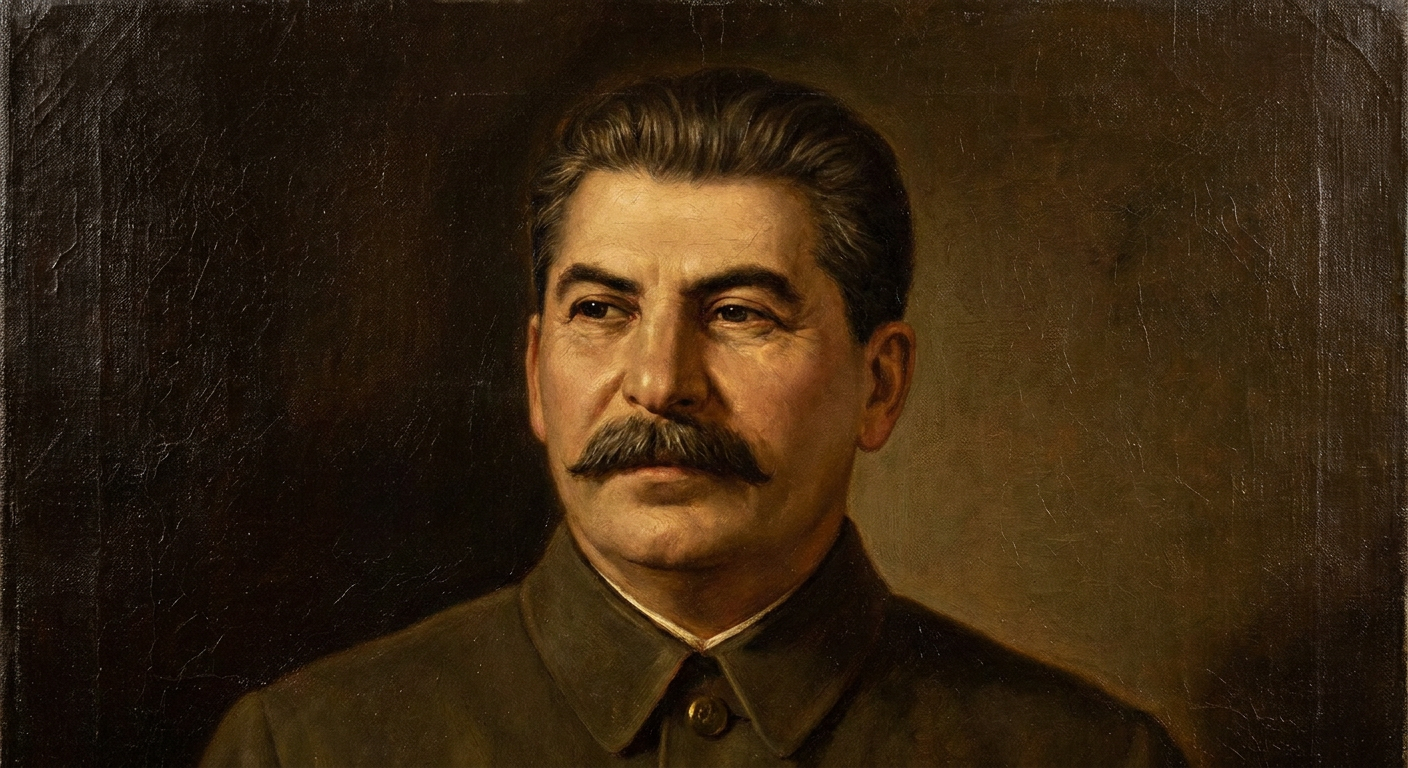
Quick Facts
- Years
- 1878 – 1953
- Category
- World Leaders & Revolutionaries
- Nationality
- Georgian-born Soviet
- Occupation
- Revolutionary, politician, dictator, and leader of the Soviet Union
Joseph Stalin
1878 – 1953 · Georgian-born Soviet · Revolutionary, politician, dictator, and leader of the Soviet Union
Recommended Audiobooks
Listen next from Marcus Alden

Life Lessons from Simon Bolivar
Marcus Alden · 55 min

Life Lessons from George Washington
Marcus Alden · 54 min
Joseph Stalin ruled the Soviet Union for nearly three decades and became one of the most powerful—and destructive—leaders of the twentieth century. Born into poverty in Russian-ruled Georgia, he entered revolutionary politics as a young man, survived arrest and exile, and rose through the Bolshevik Party after the Russian Revolution. By the late 1920s, he had defeated his political rivals and established a personal dictatorship.
Under Stalin, the Soviet Union changed at extraordinary speed. Forced industrialization helped turn a predominantly agricultural country into a major industrial and military power. The USSR played the central role in defeating Nazi Germany in Europe and emerged from the Second World War as a superpower. Soviet education, science, heavy industry, and state capacity expanded dramatically.
These achievements came at an immense human cost. Forced collectivization contributed to catastrophic famine; political purges imprisoned or executed hundreds of thousands; millions passed through the Gulag labor-camp system; and entire ethnic communities were deported. Stalin's decisions also worsened Soviet military vulnerability before Germany invaded in 1941.
Stalin remains essential to the study of dictatorship, propaganda, modernization, war, and political violence. His career demonstrates both the power of state-directed transformation and the devastating consequences of concentrating authority in a leader who tolerated no meaningful restraint.
1. Quick Facts
| Field | Details |
|---|---|
| Full Name | Ioseb Besarionis dze Jughashvili; Russian form: Iosif Vissarionovich Dzhugashvili |
| Common Name(s) | Joseph Stalin; Koba; Soso |
| Born | 18 December 1878, according to surviving birth and church records; Stalin later officially used 21 December 1879 |
| Died | 5 March 1953 |
| Age at Death | 74 |
| Birthplace | Gori, Tiflis Governorate, Russian Empire; now Georgia |
| Nationality | Georgian-born Soviet |
| Occupation | Revolutionary, Communist Party official, Soviet leader, dictator |
| Historical Era | Russian Revolution, interwar period, Second World War, early Cold War |
| Famous For | Ruling the USSR, forced industrialization, collectivization, the Great Terror, wartime leadership, and expansion of Soviet power |
| Political Affiliation | Russian Social Democratic Labour Party; Bolshevik Party; Communist Party of the Soviet Union |
| Religion | Raised Georgian Orthodox; became an atheist Marxist revolutionary |
| Education | Gori Church School; Tiflis Theological Seminary, not graduated |
| Parents | Besarion Jughashvili and Ekaterine Geladze |
| Spouse(s) | Ekaterine Svanidze; Nadezhda Alliluyeva |
| Children | Yakov Dzhugashvili, Vasily Stalin, Svetlana Alliluyeva; he also adopted or helped raise Artyom Sergeyev |
| Major Works | The Foundations of Leninism, Problems of Leninism, Marxism and Problems of Linguistics; close oversight of the party's Short Course history |
| Major Achievements | Consolidation of Soviet rule, rapid industrial growth, victory over Nazi Germany, superpower status, and expansion of Soviet influence |
2. Early Life
Stalin was born in Gori, a small Georgian town within the Russian Empire. His father, Besarion, was a cobbler whose business declined; his mother, Ekaterine, worked as a washerwoman and hoped that her surviving son would become a priest. The family experienced poverty and instability. Accounts of severe paternal violence come from relatives and later testimony, although some details remain difficult to verify.
Known as Soso in childhood, he survived smallpox, which scarred his face, and an injury that left his left arm permanently impaired. He performed well at the Gori Church School and won a place at the Orthodox theological seminary in Tiflis, now Tbilisi, in 1894.
The seminary imposed rigid discipline in a region where Georgian nationalism and opposition to Russian imperial authority were growing. Jughashvili read prohibited literature, including Marxist writings, and joined underground discussion groups. He also wrote poetry in Georgian; several poems were published in a respected literary journal.
He left the seminary in 1899. Seminary authorities said he failed to attend examinations, while Stalin later presented his departure as expulsion for revolutionary activity. Historians agree that his increasing commitment to Marxism made a clerical career impossible, but the precise administrative circumstances remain debated.
3. Rise to Prominence
Jughashvili became a professional revolutionary, organizing workers, writing propaganda, and helping arrange strikes in the Caucasus. He adopted the nickname Koba, after a defiant hero from Georgian literature. Following the split in Russian Marxism, he sided with Vladimir Lenin's Bolsheviks.
His underground career included arrests, imprisonment, Siberian exile, escapes, and involvement in illegal fundraising. Bolsheviks in the Caucasus conducted armed robberies known as “expropriations.” Stalin was connected to the local organization behind the bloody 1907 Tiflis bank robbery, although scholars debate exactly how directly he planned the attack.
By 1912 Lenin had brought him onto the Bolshevik Central Committee. Around this period he increasingly used “Stalin,” derived from the Russian word for steel. His 1913 essay Marxism and the National Question strengthened his reputation as a party specialist on nationalities. He then spent several years in remote Siberian exile.
After the February Revolution of 1917 overthrew the tsar, Stalin returned to Petrograd. He initially supported a cautious line toward the provisional government, then followed Lenin's demand for socialist revolution. His role in the October seizure of power was important but less prominent than those of Lenin or Leon Trotsky.
During the Russian Civil War, Stalin served as a political and military representative on several fronts. His conduct showed traits that later defined his rule: suspicion of specialists, harsh discipline, personal intervention, and readiness to use coercion. He also developed a lasting rivalry with Trotsky.
In 1922 Stalin became general secretary of the Communist Party. The position initially appeared administrative, but it gave him influence over appointments and access to organizational information. After Lenin's death in 1924, Stalin built shifting alliances to isolate Trotsky, Grigory Zinoviev, Lev Kamenev, and eventually Nikolai Bukharin. By the end of the 1920s, no rival could effectively challenge him.
4. Major Achievements
Industrial transformation
Beginning with the First Five-Year Plan in 1928, the state directed investment toward steel, coal, electricity, machinery, armaments, and vast industrial projects. New centers such as Magnitogorsk symbolized the transformation. Output statistics were often exaggerated and consumer needs were neglected, but industrial capacity genuinely expanded.
This mattered greatly in the war against Nazi Germany. Factories, railways, technical education, and weapons production helped the USSR replace enormous losses. Nevertheless, calling industrialization an achievement must not obscure its methods: forced labor, severe workplace discipline, low living standards, and violent extraction of resources from the countryside.
Expansion of education and technical expertise
The Stalin era saw rising literacy, mass schooling, and the training of engineers, scientists, military officers, and administrators. Social advancement became possible for many workers and peasants who entered new institutions.
The state also imposed ideological controls. Scholars and artists faced censorship, while politically favored but scientifically damaging doctrines—most famously Trofim Lysenko's rejection of modern genetics—received official support.
Victory over Nazi Germany
The Soviet Union bore the largest share of the European land war after Germany invaded in June 1941. Stalin remained in Moscow, became supreme commander, and gradually learned to rely more effectively on professional generals. Victories at Moscow, Stalingrad, Kursk, and during Operation Bagration destroyed much of Hitler's military power.
Victory made Stalin's USSR a global superpower, but approximately 27 million Soviet citizens died. Stalin's prewar purges, failure to act fully on invasion warnings, and early operational interference contributed to the 1941 catastrophe. His later leadership was more effective, but it cannot be separated from the sacrifices of Soviet soldiers and civilians.
Creation of a Soviet sphere in Eastern Europe
At wartime conferences with Franklin D. Roosevelt and Winston Churchill, Stalin negotiated from the position created by Red Army advances. After 1945, Communist governments dominated Poland, Hungary, Romania, Bulgaria, Czechoslovakia, and East Germany.
This provided the USSR with strategic depth and superpower influence. For many Eastern Europeans, however, it meant political repression, controlled elections, and subordination to Moscow. The resulting division of Europe became a foundation of the Cold War.
5. Leadership or Work
Stalin governed through the Communist Party, secret police, economic ministries, and a personal secretariat. He read large quantities of reports, edited documents closely, telephoned officials late at night, and used appointments to create dependency. He was capable of mastering administrative detail and asking precise questions.
His leadership relied equally on fear. Officials were encouraged to compete, report on one another, and anticipate his preferences. Stalin often avoided giving a clear written command for the most sensitive actions, although extensive signed orders, execution lists, and correspondence directly connect him to mass repression.
His strengths included persistence, political calculation, memory, and an ability to present himself as a practical centrist while opponents became isolated. His weaknesses were catastrophic: extreme suspicion, vindictiveness, intolerance of criticism, and confidence that coercion could solve economic and political problems.
The personality cult portrayed him as Lenin's wisest disciple, a military genius, and the caring “father of peoples.” This image concealed collective work, erased rivals, and made honest advice dangerous.
6. Personal Life
Stalin married Ekaterine Svanidze in 1906. She died of illness in 1907, leaving their son Yakov. Stalin later married Nadezhda Alliluyeva, with whom he had Vasily and Svetlana. Nadezhda died by suicide in 1932 after a Kremlin gathering. Soviet authorities concealed the cause, publicly describing her death as the result of illness.
His family life was troubled. Yakov became a German prisoner during the Second World War and died at Sachsenhausen concentration camp in 1943. Vasily became an air-force officer but suffered from alcoholism. Svetlana defected to the United States in 1967 and published revealing memoirs.
Stalin enjoyed literature, films, gardening, and extended dinners at which senior officials drank, watched movies, and endured his testing humor. These gatherings mixed sociability with intimidation. He usually worked late and expected subordinates to follow his schedule.
He could show charm and affection, especially toward Svetlana when she was young, yet he was emotionally harsh and capable of sacrificing associates and relatives to political suspicion. In later years he suffered from hypertension and probable cardiovascular disease. His paranoia also intensified, most visibly during the anti-Semitic “Doctors' Plot.”
7. Philosophy or Beliefs
Stalin identified himself as a Marxist-Leninist. He believed history was driven by class conflict, capitalism would ultimately fail, and a disciplined Communist Party could transform society. His doctrine of “socialism in one country” argued that the USSR could build socialism without waiting for successful revolutions elsewhere.
In practice, his worldview combined ideology with Russian imperial state traditions, security concerns, and personal power. He treated rapid industrialization as essential because the Soviet Union was economically and militarily behind its rivals. This diagnosis contained genuine strategic insight; his chosen methods involved extraordinary violence.
Stalin viewed independent institutions, political pluralism, and organized religion as potential threats. The state persecuted religious communities, though during the German invasion he allowed a limited revival of the Russian Orthodox Church to strengthen national unity.
His ethical reasoning subordinated individuals to supposedly historical goals. Categories such as “kulak,” “saboteur,” and “enemy of the people” turned diverse human beings into presumed obstacles. This made collective punishment appear politically legitimate within the regime.
8. Challenges and Controversies
Collectivization and famine
From 1929, the regime forced peasant households into collective farms and attacked better-off peasants classified as kulaks. Resistance was met with confiscation, deportation, imprisonment, and execution. Agricultural disruption and aggressive grain procurement helped produce famine across several Soviet regions in 1932–33.
Ukraine suffered the Holodomor, while Kazakhstan, the North Caucasus, and parts of Russia also experienced mass death. Scholars agree that Stalin's policies were decisive and that authorities continued extraction while restricting movement and suppressing information. Debate continues over whether the Ukrainian famine should be defined as genocide specifically intended to destroy Ukrainians. Many governments and scholars say yes; others emphasize a broader, brutally class-based Soviet campaign without denying its exceptional severity in Ukraine.
The Great Terror
Between 1936 and 1938, show trials destroyed former Bolshevik leaders, while secret-police operations targeted officials, officers, intellectuals, workers, peasants, foreigners, and ethnic minorities. Roughly 700,000 people were executed during the peak terror, and many more were imprisoned.
Older interpretations sometimes portrayed Stalin as reacting to uncontrolled local officials. Archival evidence instead shows that he approved quotas, signed execution lists, directed major cases, and encouraged escalation, even though subordinates also pursued their own interests.
The Gulag
The forced-labor camp system expanded enormously under Stalin. Prisoners mined resources, cut timber, built canals, and worked in remote industrial projects. Some were convicted criminals; many were imprisoned for political offenses, alleged disloyalty, minor violations, or under sweeping security campaigns. Hunger, exposure, disease, and overwork caused high mortality, especially during wartime.
Foreign policy and war
The 1939 Nazi-Soviet Pact delayed direct war with Germany but included secret protocols dividing parts of Eastern Europe into spheres of influence. The USSR occupied eastern Poland, annexed the Baltic states, seized Romanian territory, and fought Finland. Soviet security forces murdered thousands of Polish officers and prisoners in the 1940 Katyn massacre.
Stalin misjudged Hitler's intentions and discounted numerous warnings before Operation Barbarossa. Once war began, he recovered from the initial shock and developed into a more capable coalition and military leader, but the early losses were staggering.
Deportations and postwar repression
Entire peoples—including Chechens, Ingush, Crimean Tatars, Kalmyks, and Volga Germans—were deported on allegations of collective disloyalty. Many died during transport or exile. Collective punishment ignored individual guilt and is widely recognized as a grave state crime.
After the war, censorship and arrests continued. Campaigns against “rootless cosmopolitans” disproportionately targeted Jews. The Doctors' Plot of 1952–53 accused mostly Jewish physicians of conspiracy; it ended after Stalin's death.
9. Legacy
Stalin left a Soviet Union that was industrialized, victorious, nuclear-armed, and dominant across much of Eastern Europe. He also left traumatized communities, distorted institutions, chronic fear, and an economy overly concentrated on heavy industry and military production.
Nikita Khrushchev denounced Stalin's personality cult and some of his crimes in the 1956 “Secret Speech.” Prisoners were released, victims rehabilitated, and Stalin's body was removed from Lenin's Mausoleum in 1961. Yet the Soviet system remained authoritarian, and public discussion of repression stayed limited.
After the Soviet collapse, archives transformed scholarship by documenting central responsibility for terror. Memorial, an organization devoted to victims of repression, assembled invaluable records before Russian courts ordered its principal branches dissolved in 2021–22.
Stalin's image remains contested. Georgia maintains museums and surviving monuments connected to him, particularly in Gori, while statues removed elsewhere have sometimes reappeared in Russia. Admirers emphasize order, industrialization, and wartime victory; critics note that these narratives minimize avoidable deaths and state crimes.
His modern relevance extends beyond Soviet history. Stalin's rule is studied as a warning about unchecked executive power, manipulated information, forced economic transformation, dehumanizing political categories, and the replacement of institutions by personal loyalty.
10. Interesting Facts
- Stalin's documented birth date differs from the official date celebrated during his rule.
- His birth name was Georgian, not Russian.
- He published Georgian poetry before becoming a professional revolutionary.
- “Koba” came from a heroic character in a Georgian novel.
- “Stalin” means approximately “man of steel.”
- Smallpox left visible facial scars often softened in official portraits.
- A childhood injury impaired his left arm.
- He trained at a theological seminary but never became a priest.
- He spent multiple periods in Siberian exile and escaped several times.
- General secretary initially appeared less powerful than more public party offices.
- He maintained an extensive personal library and marked books in the margins.
- He was an enthusiastic film viewer and intervened in Soviet cinema.
- His second wife's suicide was concealed from the Soviet public.
- His son Yakov died in German captivity.
- Stalin was nominated for the Nobel Peace Prize in 1945 and 1948 but did not win.
- He was named Time magazine's Person of the Year twice, reflecting influence rather than moral approval.
- He did not leave Moscow when German armies approached in 1941.
- His body lay beside Lenin's from 1953 until 1961.
11. Famous Quotes
- “We are fifty or a hundred years behind the advanced countries.” In a 1931 speech to industrial managers, Stalin used Soviet backwardness to justify extreme acceleration. He added that the gap had to be closed in ten years—a grimly prescient period before the German invasion.
- “Either we do it, or we shall be crushed.” From the same speech, this expressed his belief that industrialization was a matter of national survival. It did not, by itself, justify the coercive methods selected.
- “Cadres decide everything.” Spoken in 1935, this emphasized the importance of trained personnel. The phrase became especially ironic as the purges soon destroyed experienced cadres.
- “Life has become better, comrades. Life has become more joyous.” Stalin told Stakhanovite workers this in 1935. Propaganda celebrated improving conditions while famine, scarcity, and repression remained recent realities.
- “Not one step back!” The defining phrase of Order No. 227 in July 1942 demanded resistance during the German advance. It symbolized determination but was enforced through severe disciplinary measures.
- “Brothers and sisters, I turn to you, my friends.” Stalin's radio address of 3 July 1941 used unusually personal language to rally citizens after Germany invaded.
- “Hitlers come and go, but the German people and the German state remain.” In a 1942 order, Stalin distinguished the Nazi leadership from the German population while defining Soviet war aims.
- “Dizzy with success.” This was the title phrase of Stalin's 1930 article blaming local officials for collectivization abuses, despite central pressure driving the campaign.
- “The death of one man is a tragedy; the death of millions is a statistic.” Frequently attributed to Stalin, but no reliable primary source establishes that he said it. It should be treated as apocryphal.
- “It is enough that the people know there was an election.” Versions claiming vote counters determine everything are widely attributed to Stalin, but the documentary basis is weak and attribution disputed.
12. Timeline
- 1878 — Born in Gori, Georgia, within the Russian Empire.
- 1894 — Entered the Tiflis Theological Seminary.
- 1899 — Left the seminary and entered revolutionary underground life.
- 1903 — Aligned with the Bolshevik faction.
- 1906 — Married Ekaterine Svanidze.
- 1907 — Ekaterine died; the Tiflis bank robbery occurred.
- 1912 — Joined the Bolshevik Central Committee and adopted the name Stalin more consistently.
- 1913 — Published Marxism and the National Question; exiled to Siberia.
- 1917 — Returned after the February Revolution and participated in the Bolshevik seizure of power.
- 1918–21 — Served in senior political and military roles during the Civil War.
- 1922 — Became general secretary of the Communist Party.
- 1924 — Lenin died; struggle for succession intensified.
- 1927 — Trotsky and other opposition leaders were expelled from the party.
- 1928 — First Five-Year Plan began.
- 1929 — Forced collectivization and the campaign against kulaks accelerated.
- 1932–33 — Catastrophic famine struck Ukraine, Kazakhstan, Russia, and other regions; Nadezhda Alliluyeva died.
- 1934 — Sergei Kirov was assassinated, followed by expanding repression.
- 1936–38 — Great Terror and Moscow show trials.
- 1939 — Nazi-Soviet Pact signed; Soviet forces entered eastern Poland.
- 1940 — Katyn massacre; Baltic states annexed.
- 1941 — Germany invaded the USSR; Stalin became supreme commander.
- 1942–43 — Soviet victory at Stalingrad transformed the war.
- 1945 — Germany defeated; Soviet influence expanded across Eastern Europe.
- 1949 — USSR tested its first atomic bomb.
- 1952 — Stalin's final party congress and escalation of the Doctors' Plot.
- 1953 — Suffered a stroke and died on 5 March.
- 1956 — Khrushchev publicly denounced major aspects of his rule.
- 1961 — Stalin's body was removed from Lenin's Mausoleum.
13. Frequently Asked Questions
1. When was Joseph Stalin born?
Surviving birth and church records indicate that Stalin was born on 18 December 1878 in Gori. During his political career, however, official Soviet biographies gave 21 December 1879. The reason for the alteration is uncertain. Revolutionaries sometimes changed personal details for underground purposes, and Stalin may simply have preferred the later date. Modern historians generally use 1878 because it rests on contemporary documentation.
2. Was Stalin Russian or Georgian?
Stalin was ethnically Georgian and grew up speaking Georgian in Gori, then part of the Russian Empire. He learned Russian through school and eventually conducted most political business in that language, retaining a Georgian accent. As ruler, he promoted a centralized Soviet state increasingly influenced by Russian institutions and patriotic symbolism. Describing him as a Soviet leader is accurate; calling him ethnically Russian is not.
3. How did Stalin gain power?
He gained power through organizational control rather than a single coup. As general secretary, Stalin influenced appointments throughout the Communist Party. He formed temporary alliances, first isolating Trotsky and then turning against Zinoviev, Kamenev, and Bukharin. He presented his positions as the party's practical center while weakening opponents. By controlling personnel, doctrine, and disciplinary institutions, he had become dominant by the late 1920s.
4. Did Lenin want Stalin to succeed him?
No evidence shows that Lenin selected Stalin as successor. In notes written in late 1922 and early 1923, often called Lenin's Testament, Lenin criticized several senior Bolsheviks and warned that Stalin had accumulated enormous power. He suggested considering Stalin's removal as general secretary because of his rudeness. The document was circulated only in a restricted manner, and Stalin's allies prevented it from ending his career.
5. What was collectivization?
Collectivization was the forced consolidation of individual farms into collective or state-run agricultural units. The government hoped to control grain supplies, finance industry, and transform rural society. Many peasants resisted by hiding produce, slaughtering livestock, or fleeing. Authorities confiscated property and deported alleged kulaks. Production collapsed in important areas, and state procurement demands contributed to the famine of 1932–33.
6. How many people died because of Stalin's rule?
There is no single universally accepted total because categories overlap and demographic evidence is incomplete. Deaths include famine victims, executions, Gulag mortality, deportation deaths, and losses linked to specific state policies. Scholarly estimates vary by definition, but they reach many millions. Claims at either extreme should be checked carefully. Archival research confirms roughly 700,000 executions during the Great Terror alone, while famine caused several million deaths.
7. Was the Holodomor a genocide?
Ukraine and numerous governments officially recognize the Holodomor as genocide, and many historians argue that Stalin's leadership used starvation and movement restrictions to break Ukrainian resistance and national aspirations. Other scholars classify it as part of a wider Soviet famine generated by collectivization, requisitions, and class warfare, noting severe mortality beyond Ukraine. The disagreement concerns intention and legal classification, not whether state policy caused a preventable catastrophe.
8. Why did Stalin carry out the Great Terror?
The terror reflected several forces: Stalin's determination to eliminate possible rivals, fear of war and internal conspiracy, ideological hostility toward supposed class enemies, and bureaucratic incentives that rewarded accusations. Public trials targeted famous Bolsheviks, while secret mass operations struck ordinary people and ethnic minorities. Local officials sometimes intensified repression, but archival documents demonstrate that Stalin and the central leadership authorized quotas and repeatedly approved executions.
9. What was the Gulag?
The Gulag was the Soviet agency administering a vast network of prisons, labor camps, and colonies. It existed before Stalin but expanded enormously during his rule. Prisoners worked in mining, forestry, construction, and industry, often in severe climates. Conditions varied across time and place, but malnutrition, disease, violence, and overwork were widespread. The system served punishment, political control, population removal, and economic development.
10. Did Stalin help defeat Hitler?
Yes, Stalin was the leader and supreme commander of the state whose forces did most to destroy Nazi Germany's army. He coordinated resources, worked with Allied leaders, and eventually gave capable generals greater operational freedom. Yet he also bears responsibility for weakening the officer corps through purges and for failing to respond adequately to invasion warnings. His wartime record therefore combines significant strategic leadership with grave prewar and early-war errors.
11. Why did Stalin sign a pact with Hitler?
Stalin sought time to rearm, distrusted Britain and France, and wanted to avoid facing Germany alone. The August 1939 nonaggression pact also offered territorial gains through secret protocols dividing Eastern Europe into spheres. It postponed German-Soviet war for nearly two years but assisted Hitler's attack on Poland and facilitated Soviet expansion. Stalin then miscalculated by assuming Germany would not invade as early as June 1941.
12. Was Stalin personally involved in executions?
Yes. Although he did not decide every case, surviving documents directly demonstrate his involvement. Stalin signed or initialed hundreds of lists containing names of people proposed for severe punishment, usually execution. He approved mass-operation quotas, commented on interrogations, and pressed security chiefs for results. The scale of repression required a large bureaucracy, but the archival record makes it untenable to portray him as uninformed or powerless.
13. Why was Stalin called a dictator?
Stalin eliminated meaningful political competition, subordinated courts and security agencies to party authority, controlled media, and made opposition potentially fatal. Elections offered no genuine choice. Even members of the ruling party could not safely challenge him. Although decrees were formally issued through Soviet institutions, decisions increasingly depended on Stalin's preferences and approval. This concentration of coercive, political, and ideological power meets the standard historical definition of dictatorship.
14. What happened when Stalin died?
Stalin suffered a stroke at his Kuntsevo residence and died on 5 March 1953. Delayed medical attention has inspired murder theories, especially concerning security chief Lavrentiy Beria, but decisive evidence of assassination has not emerged. A collective leadership took power, Beria was arrested and executed, and political repression eased. In 1956 Khrushchev denounced Stalin's cult and crimes, beginning the process known as de-Stalinization.
15. Is Stalin still admired today?
Some people continue to admire Stalin for industrialization, state power, order, and victory in the Second World War. Positive views often rise when wartime achievement and national strength dominate public memory. Critics argue that this selective remembrance suppresses famine, executions, deportations, and forced labor. Polling and commemoration vary by country and period. Historical evaluation requires acknowledging both Soviet transformation and the human beings destroyed by its coercive methods.
14. Lessons We Can Learn
- Unchecked power invites abuse. Stalin neutralized party rivals and independent institutions; without accountability, policy errors became crimes on a massive scale.
- Bad information can become a national-security threat. Officials feared reporting unwelcome facts, contributing to Stalin's misreading of Germany in 1941.
- Economic progress must be judged by its human cost. Soviet industry expanded, but forced labor, famine, and deprivation were not incidental details.
- Dehumanizing labels enable violence. Terms such as “kulak” and “enemy of the people” made collective punishment easier to present as necessary.
- Expertise requires intellectual freedom. Soviet technical training advanced, while political interference such as Lysenkoism damaged science.
- Political loyalty is not the same as competence. Purging experienced officers and officials weakened the institutions Stalin wanted to strengthen.
- Propaganda can reshape memory without changing facts. The personality cult erased rivals and credited one leader with collective accomplishments.
- Temporary strategic bargains can carry lasting consequences. The Nazi-Soviet Pact bought time but enabled aggression and did not prevent invasion.
- States need channels for correcting mistakes. Policies such as collectivization continued because open criticism was treated as disloyalty.
- Historical achievements do not erase victims. Modern readers may recognize industrial and military change while still holding leaders responsible for avoidable suffering; this is interpretation grounded in documented outcomes, not a claim that history offers simple formulas.
15. Related Historical Figures
- Vladimir Lenin — Bolshevik founder who promoted Stalin but later warned about his power and conduct.
- Leon Trotsky — Revolutionary, Red Army organizer, and Stalin's leading rival; murdered in exile by a Soviet agent.
- Nikolai Bukharin — Former ally who opposed forced collectivization and was executed after a show trial.
- Sergei Kirov — Popular party leader whose 1934 assassination became a pretext for escalating repression.
- Lavrentiy Beria — Secret-police chief who administered repression, deportations, and the atomic project.
- Nikita Khrushchev — Stalin-era official who later denounced the personality cult and initiated de-Stalinization.
- Georgy Zhukov — Leading Soviet commander in the defeat of Nazi Germany, alternately valued and distrusted by Stalin.
- Adolf Hitler — Nazi dictator whose pact with Stalin preceded Germany's devastating invasion of the USSR.
- Winston Churchill — British prime minister and wartime ally who later warned of Soviet domination in Eastern Europe.
- Franklin D. Roosevelt — American president who negotiated with Stalin over wartime strategy and the postwar international order.
16. Watch and Learn
Recommended video: History vs. Joseph Stalin by TED-Ed (approximately six minutes).
This animated lesson introduces the central historical dispute over Stalin's record by weighing industrialization and victory over Nazi Germany against famine, purges, forced labor, and dictatorship. Its debate format is concise and accessible, making it a useful starting point, although viewers should follow it with longer works based on archival scholarship.
Watch and Learn
History vs. Joseph Stalin · TED-Ed
Related Historical Figures