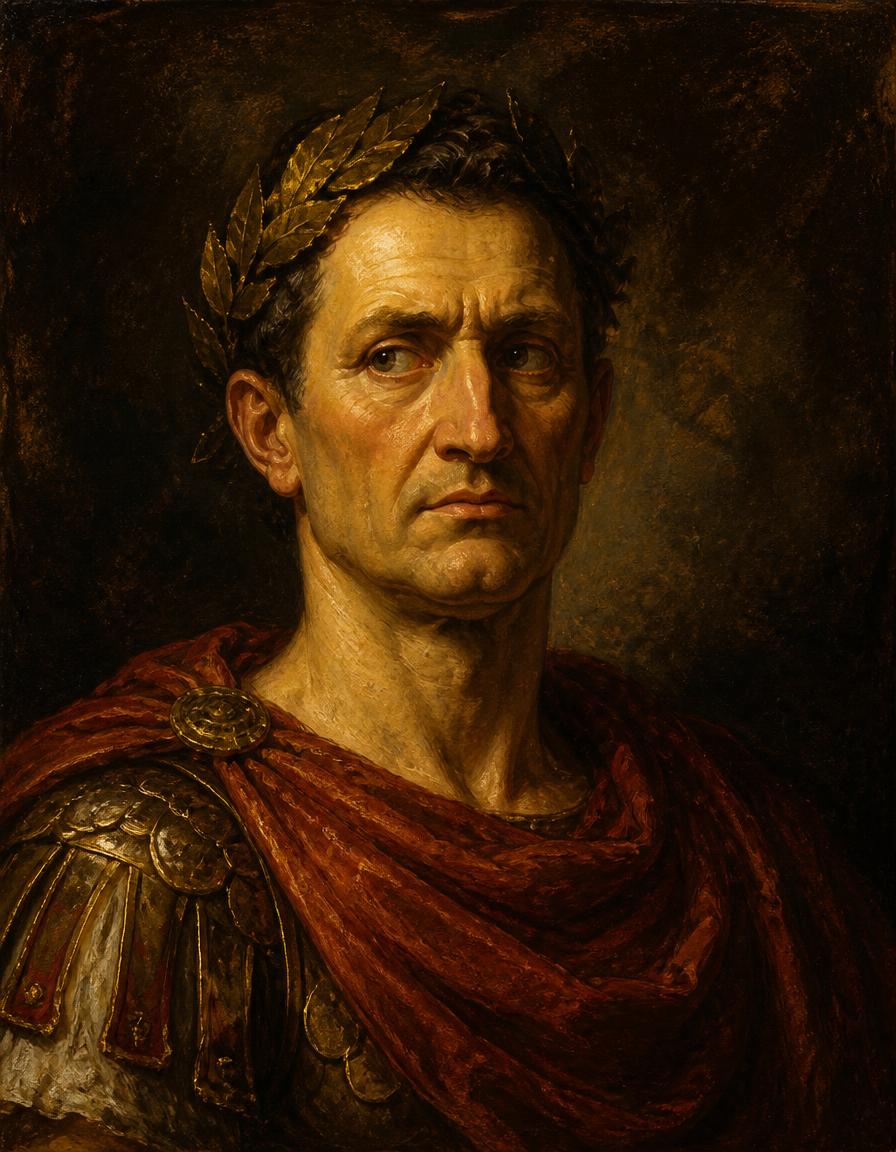
Quick Facts
- Years
- 100 BC – 44 BC
- Category
- World Leaders & Revolutionaries
- Nationality
- Roman
- Occupation
- General & Statesman
Julius Caesar
100 BC – 44 BC · Roman · General & Statesman
Audiobook

Life Lessons from Julius Caesar
Marcus Alden · 52 min
Gaius Julius Caesar was a Roman general, politician, orator, and author whose career transformed the Mediterranean world and helped end the Roman Republic. Born into an old patrician family but rising through popular politics, Caesar combined military brilliance, calculated generosity, literary talent, and an extraordinary appetite for power. His conquest of Gaul enlarged Rome’s dominion, enriched his followers, and gave him an army personally loyal to him. His crossing of the Rubicon in 49 BCE began a civil war that made him Rome’s dominant ruler.
As dictator, Caesar introduced a more accurate calendar, expanded citizenship, settled veterans, reformed provincial administration, and enlarged the Senate. Yet his concentration of authority alarmed senators who believed that monarchy was returning under another name. On 15 March 44 BCE—the Ides of March—conspirators led by Brutus and Cassius assassinated him in the Senate meeting hall at Pompey’s theater.
Caesar remains important not only as a conqueror but as a central figure in debates about republican government, political violence, populism, and personal rule. His writings are major sources for Roman warfare, although they present events from his perspective. His name became a title used by emperors, while his life inspired works by Shakespeare, historians, filmmakers, and political theorists. He is still studied because his achievements, ambition, reforms, and destruction of constitutional norms cannot easily be separated.
Quick Facts
| Field | Information |
|---|---|
| Full Name | Gaius Julius Caesar |
| Common Name(s) | Julius Caesar; Caesar |
| Born | 12 or 13 July 100 BCE (traditional date; year disputed by some scholars) |
| Died | 15 March 44 BCE |
| Age at Death | About 55 or 56 |
| Birthplace | Rome, Roman Republic |
| Nationality | Roman |
| Occupation | General, statesman, dictator, orator, author, priest |
| Historical Era | Late Roman Republic |
| Famous For | Conquest of Gaul, crossing the Rubicon, civil war victory, dictatorship, calendar reform |
| Political Affiliation | Associated with the populares tradition; member of the First Triumvirate |
| Religion | Traditional Roman religion; pontifex maximus from 63 BCE |
| Education | Elite Roman education in rhetoric, literature, law, and Greek culture; studied rhetoric under Apollonius Molon on Rhodes |
| Parents | Gaius Julius Caesar and Aurelia Cotta |
| Spouse(s) | Cornelia; Pompeia; Calpurnia |
| Children | Julia; Caesarion was acknowledged by Cleopatra as Caesar’s son, but Caesar’s paternity remains disputed |
| Major Works | Commentaries on the Gallic War; Commentaries on the Civil War; other writings largely lost |
| Major Achievements | Conquest of Gaul; victory in the civil war; Julian calendar; citizenship, colonization, debt, and administrative reforms |
Early Life
Caesar was born in Rome on 12 or 13 July, traditionally in 100 BCE. Some modern scholars have argued for 102 BCE because of inconsistencies involving the legal ages for offices, but 100 BCE remains the conventional date. His family, the Julii Caesares, was patrician and claimed descent from Iulus, son of the Trojan hero Aeneas, and therefore from the goddess Venus. The lineage was prestigious, though Caesar’s immediate household was not among Rome’s richest or most politically dominant.
His father, also Gaius Julius Caesar, served as praetor and governed the province of Asia. His mother, Aurelia Cotta, came from a politically influential family and acquired a reputation in ancient sources for intelligence and discipline. Caesar’s aunt Julia married Gaius Marius, the celebrated general and leader associated with the populares. That connection placed the young Caesar near the violent struggle between Marius and the conservative commander Lucius Cornelius Sulla.
Caesar received the education expected of a Roman aristocrat: Latin and Greek literature, public speaking, law, history, and physical training. Marcus Antonius Gnipho, a noted grammarian, is sometimes identified as one of his teachers. Roman education prepared ambitious nobles for courtroom advocacy, military command, and competitive public office rather than for an academic profession.
Around 84 BCE Caesar married Cornelia, daughter of Lucius Cornelius Cinna, an ally of Marius. When Sulla became dictator, he ordered Caesar to divorce her. Caesar refused, losing property and priestly status and temporarily going into hiding. Relatives and influential supporters secured a pardon. According to Suetonius, Sulla warned that Caesar contained “many Mariuses,” although the exact wording may reflect later storytelling.
Caesar then served militarily in Asia and Cilicia. At the siege of Mytilene he earned the civic crown for valor. On a diplomatic mission to Bithynia he stayed at the court of King Nicomedes IV, generating hostile rumors about a sexual relationship that opponents repeated throughout his career. The allegations cannot be verified.
After Sulla’s death in 78 BCE, Caesar returned to Rome, pursued corruption cases against former governors, and developed his reputation as an advocate. He later traveled to Rhodes to study rhetoric under Apollonius Molon. Pirates captured him en route. Ancient accounts say that, after his ransom, he raised a force, captured them, and had them crucified—an episode illustrating both his self-confidence and Roman aristocratic severity.
Rise to Prominence
Caesar advanced through the Roman cursus honorum, the customary sequence of public offices. He served as military tribune, quaestor in 69 or 68 BCE, and quaestor in Hispania. After Cornelia’s death, he married Pompeia, a granddaughter of Sulla. In 65 BCE, as curule aedile, he staged lavish games and public works, accumulating heavy debts while gaining popular recognition.
He also promoted the memory of Marius. At his aunt Julia’s funeral, Caesar publicly displayed ancestral images connected to Marius, symbols suppressed during Sulla’s regime. The act positioned him as a politician willing to challenge the Sullan settlement and appeal to popular constituencies.
In 63 BCE Caesar won election as pontifex maximus, Rome’s chief priest, despite formidable opponents. He reportedly borrowed heavily to finance his campaign. During the Catilinarian conspiracy that year, Caesar opposed executing Roman citizens without trial. His position was constitutional and politically risky; critics suspected sympathy with the conspirators, but no evidence proves his participation.
Elected praetor for 62 BCE, Caesar divorced Pompeia after Publius Clodius allegedly entered the women-only rites of the Bona Dea held in Caesar’s house. Caesar said he knew nothing against her but maintained that his household should be above suspicion. He then governed Further Spain, where successful campaigning allowed him to clear debts and seek a triumph.
In 60 BCE Caesar faced a choice: remain outside Rome awaiting a triumph or enter the city to stand for consul. He abandoned the triumph and won the consulship for 59 BCE. He formed an informal political alliance with Pompey and Marcus Licinius Crassus, commonly called the First Triumvirate. Caesar secured land for Pompey’s veterans, ratification of Pompey’s eastern arrangements, and financial concessions desired by Crassus’s associates. He married his daughter Julia to Pompey and himself married Calpurnia.
His consulship was forceful and divisive. When his colleague Bibulus obstructed business, Caesar bypassed or intimidated opposition. Afterward, he received a multi-year command in Cisalpine Gaul, Illyricum, and later Transalpine Gaul. This command supplied the troops, victories, wealth, and fame that elevated him beyond ordinary senatorial politics.
Major Achievements
The Conquest of Gaul
From 58 to 50 BCE Caesar campaigned across Gaul, roughly encompassing modern France, Belgium, and neighboring regions. He defeated the migrating Helvetii, the Germanic king Ariovistus, the Belgae, and numerous Gallic coalitions. He twice bridged the Rhine and twice invaded Britain, although the British expeditions produced no lasting conquest.
The most dangerous revolt came in 52 BCE under Vercingetorix. After a setback at Gergovia, Caesar trapped the Gallic army at Alesia. Roman troops constructed inward- and outward-facing fortifications, defeating both the besieged army and a relief force. Vercingetorix surrendered.
The campaigns brought vast territories and tax revenues under Roman control and accelerated Gaul’s incorporation into a Roman political and cultural sphere. They also involved mass killing, enslavement, and destruction. Caesar’s casualty figures are often regarded as exaggerated, but the human cost was unquestionably severe.
Military and Political Communication
Caesar’s Commentaries on the Gallic War circulated accounts of his campaigns in clear, controlled Latin. Writing about himself in the third person, he emphasized speed, necessity, discipline, and defensive justification. The work informed Roman audiences, shaped Caesar’s public image, and became a model of Latin prose.
His narratives remain invaluable but cannot be treated as neutral reports. Omissions, strategic framing, and self-justification served his political objectives. Their long-term importance lies partly in demonstrating how military leadership and public communication can reinforce one another.
Victory in the Civil War
When Caesar’s command neared its end, opponents sought to make him surrender his army before seeking another consulship, exposing him to prosecution. Negotiations collapsed. On 10 or 11 January 49 BCE, Caesar crossed the Rubicon River with troops, violating the boundary of his province and beginning civil war.
Pompey and many senators withdrew to Greece. Caesar secured Italy, defeated Pompeian forces in Spain, and overcame Pompey at Pharsalus in 48 BCE. Pompey fled to Egypt, where royal officials murdered him. Caesar later defeated remaining opponents in Africa at Thapsus in 46 BCE and in Spain at Munda in 45 BCE.
His victories ended organized resistance and placed unprecedented authority in his hands. They also demonstrated that military power could decide Roman politics, creating a precedent inherited by later commanders.
Government and Social Reform
Caesar attempted to govern a state strained by civil war and rapid expansion. He granted clemency to many former enemies, reorganized municipal administration, established colonies for veterans and poorer citizens, and widened Roman citizenship. He revised tax collection in some provinces and took measures against extortion.
His debt reforms rejected both wholesale cancellation and rigid collection at inflated wartime values. Property was assessed at prewar prices, and interest already paid could count toward principal. The compromise eased pressure without eliminating creditors’ claims.
Caesar enlarged the Senate from roughly 600 to about 900 members, admitting Italians and provincials as well as supporters. This broadened representation but diluted the institution’s prestige and filled it with men indebted to him.
The Julian Calendar
The Roman calendar had drifted badly out of alignment with the solar year. With assistance from astronomical experts, traditionally including Sosigenes of Alexandria, Caesar introduced a 365-day calendar with an extra day every fourth year. The reform took effect in 45 BCE after an extended transitional year.
The Julian calendar brought administrative order across Roman territories. Its small annual error was corrected by the Gregorian reform of 1582, but the Julian system remains foundational to the modern civil calendar. The month Quintilis was renamed Julius—July—in Caesar’s honor after his death.
Leadership and Work
Caesar led through speed, personal presence, and close knowledge of soldiers. He shared campaign hardships, addressed troops directly, rewarded courage, and cultivated loyalty. He was willing to take calculated risks, as shown by rapid marches, winter operations, complex siegeworks, and his pursuit of enemies across multiple theaters.
His decision-making was flexible. He could retreat after failure, as at Gergovia, then recover strategically. He employed engineers, intelligence networks, diplomatic bargaining, and local allies alongside battlefield force. His ability to coordinate logistics over long distances was essential to his success.
Politically, Caesar built coalitions through patronage, legislation, marriage alliances, and public generosity. His relationship with Pompey began as cooperation and ended in civil war. Crassus’s death at Carrhae in 53 BCE and Julia’s death in 54 BCE removed bonds stabilizing the triumviral alliance.
Clemency became both a value and a strategy. Caesar pardoned prominent enemies, hoping to reconcile elites and contrast himself with Sulla’s proscriptions. Yet pardoned opponents could view mercy as humiliating dependence, and several later joined the assassination plot.
His strengths included energy, persuasion, strategic imagination, memory, and the capacity to handle several tasks at once. His weaknesses included heavy reliance on personal authority, impatience with obstruction, acceptance of extravagant honors, and failure to restore trusted constitutional government. His leadership solved immediate problems while deepening Rome’s dependence on one man.
Personal Life
Caesar married three times. Cornelia, his first wife, was the mother of his only undisputed biological child, Julia. His refusal to divorce Cornelia under Sulla became an early example of defiance. His second marriage, to Pompeia, ended after the Bona Dea scandal. His third wife, Calpurnia, survived him and reportedly attempted to warn him after ominous dreams before his assassination.
Julia’s marriage to Pompey reinforced Caesar’s political alliance with him. Her death in childbirth weakened their personal bond. In Egypt, Caesar formed a relationship with Queen Cleopatra VII. She named her son Ptolemy XV Caesar, commonly called Caesarion, implying that Caesar was the father. Ancient opinion was divided, and Caesar did not make Caesarion his legal heir. His will adopted his great-nephew Gaius Octavius, the future Augustus.
Mark Antony was an important lieutenant, though their relationship experienced tensions. Caesar also maintained associations with intellectuals and politicians such as Gaius Oppius and Aulus Hirtius. Cicero admired Caesar’s intellect and style while fearing his political dominance.
Ancient writers portray Caesar as attentive to dress and personal appearance, embarrassed by thinning hair, and pleased by permission to wear a laurel wreath. Suetonius records numerous affairs, including with Servilia, mother of Marcus Brutus. Some claims may be true; others originated in Roman political invective.
Sources report episodes resembling epilepsy, fainting, or another neurological condition, especially late in life. Retrospective diagnosis is uncertain. Accounts also mention physical endurance, moderate eating and drinking, skilled horsemanship, and a habit of dictating correspondence while traveling.
Philosophy and Beliefs
Caesar left no systematic philosophical treatise. His worldview must be reconstructed from speeches, actions, and partisan literary works. He valued dignitas—status and public worth—along with honor, achievement, loyalty, and service to the state. These Roman aristocratic values could motivate both civic accomplishment and destructive competition.
Politically, he favored wider participation for Italian and provincial elites, relief for debtors, land distribution, and constraints on senatorial oligarchy. Calling him a modern democrat would be misleading. The populares were not a political party, and Caesar’s popular measures coexisted with aristocratic privilege and personal ambition.
As pontifex maximus, Caesar supervised Roman religious institutions and observed public ritual. He also used his family’s claimed descent from Venus for political symbolism. His writings sometimes express skepticism about reports of supernatural belief among other peoples, but they do not prove atheism.
His policy of clemency suggests pragmatism and a wish to avoid Sulla-style terror. Nevertheless, he accepted warfare, enslavement, and coercion as normal instruments of Roman power. His ethics were those of an elite Roman commander, not modern humanitarian principles.
Challenges and Controversies
The Gallic conquest is Caesar’s greatest military achievement and one of the largest controversies of his career. Caesar presented intervention as necessary for Roman security and allied interests. Critics, including Cato, regarded aspects of the war as aggressive and unlawful. Modern historians debate figures and motives, but generally recognize conquest, prestige, and wealth alongside security concerns.
His consulship of 59 BCE strained republican procedure. Caesar used popular assemblies to overcome senatorial resistance, while intimidation hindered opponents. Supporters could argue that an obstructionist elite made reform impossible; critics saw deliberate erosion of legal convention.
Crossing the Rubicon was an armed rebellion against lawful authorities, even if Caesar believed his enemies had denied him legitimate political protections. The Senate’s emergency decree and Pompeian mobilization also escalated the crisis. Responsibility for the collapse was shared, but Caesar made the decisive choice to invade Italy.
His relationship with Cleopatra became politically explosive. Her presence in Rome and Caesar’s honors raised fears of eastern kingship, although there is no reliable proof that he planned to move the capital to Alexandria or marry her under Roman law.
By 44 BCE Caesar held the dictatorship for life and accumulated powers, offices, and ceremonial distinctions. His image appeared on coins during his lifetime, and he occupied a conspicuous golden chair. Some honors were granted by an obsequious Senate, but his acceptance of them fostered suspicion that he sought kingship.
At the Lupercalia festival, Mark Antony offered Caesar a diadem. Caesar refused it publicly. Interpretations differ: the episode may show genuine rejection of monarchy, a staged test of opinion, or political theater not fully coordinated. Rome’s hatred of the title rex made the symbolism dangerous.
His assassination was defended by conspirators as tyrannicide in defense of liberty. Yet the killing lacked a workable political settlement. The conspirators removed Caesar without controlling his troops, supporters, or reforms. Renewed civil wars followed, and the Republic was not restored.
Legacy
Caesar’s death reshaped rather than reversed Rome’s political transformation. His adopted heir Octavian joined Antony and Lepidus in the Second Triumvirate, defeated Caesar’s assassins, and eventually became Augustus. Augustus preserved republican forms while establishing enduring one-man rule.
The family name Caesar became an imperial title. It eventually contributed to the words “Kaiser” and “Tsar.” Caesar’s calendar regulated European timekeeping for more than sixteen centuries and still underlies the modern calendar.
His writings became core texts in Latin education. Military thinkers have examined Alesia, his rapid maneuvers, and his integration of engineering with command. Political thinkers use his career to explore how inequality, institutional paralysis, ambition, and emergency powers can destroy republican systems.
His cultural afterlife is immense. Shakespeare’s Julius Caesar, based largely on Plutarch, shaped modern perceptions of Brutus, Antony, and the assassination. Caesar appears in paintings, operas, novels, films, television, games, and the Asterix comics.
Important sites associated with him include the Roman Forum’s Temple of Caesar, where ancient tradition located his cremation; the Curia of Pompey archaeological area near Largo di Torre Argentina; Alesia in France; and museums throughout Europe displaying late republican coins, inscriptions, and military artifacts. Statues stand in Rome and many former Roman territories, although ancient portraits continue to generate scholarly debate over identification and likeness.
Interesting Facts
- Caesar normally wrote about himself in the third person in his campaign commentaries.
- He earned the civic crown, a major Roman military decoration, as a young soldier.
- Pirates captured him while he was traveling to Rhodes.
- He became pontifex maximus in 63 BCE.
- He had only one universally accepted biological child, Julia.
- Cleopatra’s son Caesarion may have been his son, but paternity is unresolved.
- Caesar built two famous temporary bridges across the Rhine.
- He invaded Britain in 55 and 54 BCE but did not annex it.
- His siegeworks at Alesia faced both inward and outward.
- The Rubicon’s exact ancient crossing point remains debated, though the river is conventionally identified with the modern Fiumicino.
- He was the first living Roman to appear on Roman state coinage in a sustained, official way.
- The year 46 BCE was extended to realign the calendar and is sometimes called the “year of confusion.”
- The Julian calendar began operating in 45 BCE.
- Caesar pardoned many opponents who had fought against him.
- He was stabbed 23 times, according to the physician Antistius as reported by Suetonius.
- He died at the Curia of Pompey, not in the main Senate house in the Forum.
- His will adopted Octavian and made him principal heir.
- July was named after him.
- “Caesar” later became an imperial title rather than merely a family name.
- Many writings attributed to or known from Caesar’s career have been lost.
Famous Quotes
- “The die is cast.” Suetonius reports the Latin iacta alea est at the Rubicon; Plutarch gives a Greek form meaning “let the die be cast.” The precise wording is disputed, but it symbolizes an irreversible decision.
- “I came, I saw, I conquered.” Veni, vidi, vici was associated with Caesar’s swift victory over Pharnaces II at Zela in 47 BCE. Its compressed form expresses speed and completeness.
- “All Gaul is divided into three parts.” The opening of The Gallic War introduces Caesar’s geographical and ethnographic framing of the conquest.
- “Of all these, the Belgae are the bravest.” In The Gallic War, Caesar links their reputed courage to distance from Roman luxury and frequent warfare.
- “Men willingly believe what they wish.” A close rendering of Caesar’s observation in The Gallic War about wishful thinking during the campaign against Vercingetorix.
- “Experience is the teacher of all things.” From The Civil War, emphasizing how practice and circumstances shape military judgment.
- “If you must break the law, do it to seize power; in all other cases observe it.” Suetonius says Caesar often quoted this line from Euripides. It was not Caesar’s original composition and survives through hostile political context.
- “I would rather be first here than second at Rome.” Plutarch attributes this sentiment to Caesar when passing a small settlement. The anecdote is ancient but its exact words are uncertain.
- “Caesar’s wife must be above suspicion.” This is a conventional paraphrase of Plutarch’s account of Caesar explaining his divorce from Pompeia; wording varies by translation.
- “You too, child?” Suetonius reports a tradition that Caesar said the Greek kai su, teknon when attacked, possibly to Brutus. Whether he spoke at all is disputed.
- “Et tu, Brute?” Famous from Shakespeare, not a securely documented historical utterance. Ancient sources offer different accounts, and some say Caesar died silently.
Timeline
- 100 BCE — Traditional year of Caesar’s birth in Rome.
- 84 BCE — Marries Cornelia and is designated to a priesthood associated with Jupiter.
- 82–81 BCE — Refuses Sulla’s order to divorce Cornelia and temporarily goes into hiding.
- 81–78 BCE — Serves in Asia Minor; wins the civic crown at Mytilene.
- 75 BCE — Captured by pirates while traveling to Rhodes; later captures and executes them.
- 69/68 BCE — Serves as quaestor in Hispania; Cornelia dies around this period.
- 67 BCE — Marries Pompeia.
- 65 BCE — Serves as curule aedile and stages expensive public entertainments.
- 63 BCE — Elected pontifex maximus; opposes summary execution of Catilinarian conspirators.
- 62 BCE — Serves as praetor; divorces Pompeia after the Bona Dea scandal.
- 61–60 BCE — Governs Further Spain and campaigns successfully.
- 60 BCE — Forms alliance with Pompey and Crassus.
- 59 BCE — Serves as consul; marries Calpurnia; Julia marries Pompey.
- 58–50 BCE — Conducts the Gallic Wars.
- 55 and 54 BCE — Leads expeditions to Britain.
- 54 BCE — Julia dies.
- 53 BCE — Crassus dies at Carrhae.
- 52 BCE — Defeats Vercingetorix at Alesia.
- 49 BCE — Crosses the Rubicon; civil war begins.
- 48 BCE — Defeats Pompey at Pharsalus; arrives in Egypt after Pompey’s murder.
- 48–47 BCE — Involved in the Alexandrian War and relationship with Cleopatra.
- 47 BCE — Defeats Pharnaces II at Zela.
- 46 BCE — Defeats Pompeian forces at Thapsus; holds triumphs; reforms calendar.
- 45 BCE — Defeats final major resistance at Munda; Julian calendar takes effect.
- 44 BCE — Appointed dictator perpetually; assassinated on 15 March.
- 42 BCE — Formally deified by the Roman state as Divus Julius.
Frequently Asked Questions
Who was Julius Caesar?
Julius Caesar was a Roman aristocrat, general, author, priest, and politician of the first century BCE. He conquered Gaul, defeated Pompey and other rivals in civil wars, and became Rome’s dominant ruler. His reforms addressed the calendar, citizenship, colonization, debt, and administration. Because he concentrated power in the dictatorship, a group of senators assassinated him in 44 BCE. The resulting wars produced the imperial system under his adopted heir Augustus.
When and where was Julius Caesar born?
Caesar was born in Rome on 12 or 13 July, conventionally in 100 BCE. Ancient evidence does not settle every detail, and some scholars have proposed 102 BCE because the traditional date appears difficult to reconcile with age requirements for certain offices. Most modern reference works retain 100 BCE. He belonged to the patrician Julian clan, an ancient but not then exceptionally powerful family.
Was Julius Caesar an emperor?
Not in the later constitutional sense. Caesar was dictator—eventually dictator for life—and accumulated extraordinary powers, but Rome did not yet have the imperial settlement created by Augustus. Ancient Romans later regarded Caesar as a decisive predecessor of the emperors, and his name became an imperial title. Calling him “emperor” can therefore be convenient in popular speech but risks obscuring the offices and political language of his lifetime.
Why did Caesar conquer Gaul?
Caesar publicly justified intervention through threats to Roman provinces and allies, beginning with the migration of the Helvetii and conflict involving Ariovistus. Security concerns were real, but conquest also supplied military glory, wealth, political leverage, and loyal soldiers. Ancient critics questioned the legality and necessity of parts of the war. Historians generally treat Caesar’s motives as a combination of strategic concerns and personal ambition rather than a single cause.
What happened at Alesia?
In 52 BCE Caesar besieged Vercingetorix’s forces at Alesia. His troops built fortifications around the stronghold and a second defensive perimeter facing outward. When a large Gallic relief army attacked, the Romans fought on both fronts. Caesar’s forces prevailed, and Vercingetorix surrendered. The victory broke the strongest coordinated Gallic revolt, although resistance continued. Alesia is especially studied for engineering, logistics, and command under pressure.
Why did Caesar cross the Rubicon?
Caesar’s provincial command protected him from prosecution and allowed him to retain military influence. Opponents demanded that he disband his army before seeking another consulship, while Caesar sought permission to stand without returning privately to Rome. After negotiations failed and the Senate backed emergency measures, he crossed from his province into Italy with troops in January 49 BCE. This illegal military action made compromise nearly impossible and began civil war.
Did Caesar say “The die is cast”?
Ancient authors associate a phrase about casting dice with Caesar’s Rubicon crossing. Suetonius gives iacta alea est, usually translated “the die is cast,” while Plutarch reports a Greek expression closer to “let the die be cast.” The episode was recorded decades later, so the exact wording cannot be confirmed. It remains an apt summary of Caesar’s recognition that crossing the boundary committed him to a dangerous, irreversible course.
Did Caesar say “Et tu, Brute?”
There is no reliable evidence that Caesar spoke Shakespeare’s Latin phrase. Suetonius says some accounts reported the Greek words kai su, teknon—“you too, child?”—but also indicates that Caesar may have said nothing after an initial groan. Plutarch describes him ceasing resistance when he saw Brutus but gives no famous line. “Et tu, Brute?” belongs principally to literary tradition rather than verified history.
Why was Caesar assassinated?
The conspirators feared that Caesar’s dictatorship, honors, and dominance had destroyed republican liberty and might culminate in kingship. Personal grievances, competition for office, and resentment of dependence on his favor also influenced individuals. They killed him during a Senate meeting on 15 March 44 BCE. Although they invoked liberty, they had no effective program for stabilizing Rome afterward, and their act triggered further civil war.
Who killed Julius Caesar?
A group of roughly 60 conspirators participated in the plot, though not all struck him. The leading organizers included Gaius Cassius Longinus, Marcus Junius Brutus, and Decimus Junius Brutus Albinus. Ancient sources name several additional attackers, including Casca. Caesar suffered numerous wounds; Suetonius reports that a physician judged only one fatal. Responsibility was collective, and reducing the assassination to Brutus alone reflects later dramatic tradition.
Was Brutus Caesar’s son?
No credible evidence establishes that Marcus Junius Brutus was Caesar’s biological son. Caesar had an affair with Brutus’s mother, Servilia, but Brutus was born in 85 BCE, when Caesar was about 15, making the theory chronologically improbable. Caesar’s affection or clemency toward Brutus may reflect political and family connections, but ancient gossip and later literature magnified the relationship. Brutus was the son of Marcus Junius Brutus the Elder.
Did Caesar have a child with Cleopatra?
Cleopatra presented Ptolemy XV Caesar, known as Caesarion, as Caesar’s son. Caesar’s opponents and supporters disagreed about the claim, and the available evidence cannot prove paternity. Caesar permitted Cleopatra and the child to visit Rome but did not name Caesarion in his will or make him a Roman heir. Instead, he adopted Octavian. Historians therefore describe Caesar’s paternity as possible but unresolved.
What did Julius Caesar write?
Caesar’s surviving core works are the seven books of Commentaries on the Gallic War attributed directly to him and three books of Commentaries on the Civil War. An eighth Gallic book was written by Aulus Hirtius. Other campaign works in the Caesarian corpus were composed by unidentified associates. Caesar also wrote speeches, poems, an anti-Cato work, and a study of language, but these survive only in fragments or reports.
How accurate are Caesar’s commentaries?
They are indispensable eyewitness-level sources written by the commander at the center of events, but they are also political narratives. Caesar selects information, explains aggression as necessity, highlights his judgment, and sometimes uses numbers historians consider implausible. Archaeology and other texts confirm many broad events while complicating details. The best approach is to read the commentaries critically: neither dismiss them as fiction nor accept them as impartial reporting.
What reforms did Caesar introduce?
His best-known reform was the Julian calendar. He also founded colonies, settled veterans and civilians, widened citizenship, revised debt arrangements, reorganized elements of provincial taxation, regulated municipal government, and expanded the Senate. Some planned projects were unfinished at his death. The reforms addressed real administrative pressures, but their dependence on Caesar’s authority reinforced the perception that normal republican institutions had become subordinate to him.
Was Caesar a tyrant or a reformer?
He was both a reforming ruler and an autocrat, depending on the question being asked. His measures improved administration and broadened integration across Roman territory. He also took power through civil war, controlled elections and offices, and accepted dictatorship for life. Ancient and modern judgments differ because useful reforms do not erase coercive methods, while unconstitutional power does not make every policy ineffective. A balanced interpretation must preserve that tension.
How did Caesar’s death lead to the Roman Empire?
The assassination created a power vacuum rather than restoring stable republican competition. Mark Antony, Octavian, and Lepidus formed the Second Triumvirate and defeated Brutus and Cassius at Philippi. Antony and Octavian later fought each other, with Octavian winning at Actium. As Augustus, Octavian created a durable monarchy disguised through republican titles and institutions. Caesar’s career had shown that armies and personal authority could override senatorial government.
Where was Julius Caesar buried?
Caesar’s body was cremated in the Roman Forum after a volatile public funeral. A temple dedicated to the deified Caesar was later built near the cremation location traditionally identified by Romans. The Temple of Divus Julius remains visible in the Forum, and visitors commonly leave flowers there. It is not a conventional tomb containing an intact burial; cremation and later monumental commemoration shaped the site’s significance.
Lessons We Can Learn
- Institutions require restraint. Caesar and his opponents repeatedly exploited legal forms while abandoning compromise; rules survive only when leaders accept limits.
- Communication shapes power. His commentaries turned campaigns into persuasive public narratives, showing why audiences should evaluate leaders’ accounts critically.
- Speed can create advantage. Rapid movement in Gaul and Italy often disrupted stronger opponents; timely action remains valuable when paired with preparation.
- Engineering supports strategy. Rhine bridges and Alesia’s fortifications show that technical capacity can determine outcomes beyond battlefield courage.
- Adapt after setbacks. Caesar recovered from Gergovia rather than allowing one defeat to end the campaign; resilient leaders learn and reposition.
- Personal loyalty can weaken public systems. Soldiers’ attachment to commanders helped turn political disputes into civil wars; institutions should not depend on individuals.
- Mercy needs reconciliation. Caesar pardoned enemies but did not create shared trust; forgiveness without a durable settlement may leave conflict unresolved.
- Useful reforms do not justify unlimited power. The Julian calendar was successful, yet administrative competence did not answer constitutional objections.
- Symbolism matters. Diadems, titles, coins, and ceremonial honors intensified fears of monarchy; leaders must understand how gestures affect legitimacy.
- Victory is not the same as stability. Caesar defeated every major military rival but failed to create a broadly accepted succession or political order.
Related Historical Figures
- Gaius Marius — Caesar’s uncle by marriage; his popular political legacy influenced Caesar’s early alignment.
- Lucius Cornelius Sulla — Dictator who persecuted Caesar and demonstrated how armies could seize political power.
- Pompey the Great — Caesar’s ally, son-in-law, and eventual principal rival in civil war.
- Marcus Licinius Crassus — Wealthy triumvir whose alliance with Caesar and Pompey helped dominate Roman politics.
- Cleopatra VII — Egyptian queen, political partner, and lover of Caesar; mother of Caesarion.
- Mark Antony — Caesar’s officer and political supporter who became a leading figure after the assassination.
- Marcus Junius Brutus — Pardoned opponent who became one of the most famous conspirators against Caesar.
- Gaius Cassius Longinus — Experienced soldier and principal organizer of the assassination plot.
- Cicero — Orator and republican statesman who admired Caesar’s talents but opposed autocratic rule.
- Augustus — Caesar’s adopted son and heir, who defeated his rivals and established the Roman Principate.
Watch and Learn
The great conspiracy against Julius Caesar · TED-Ed
Related Historical Figures