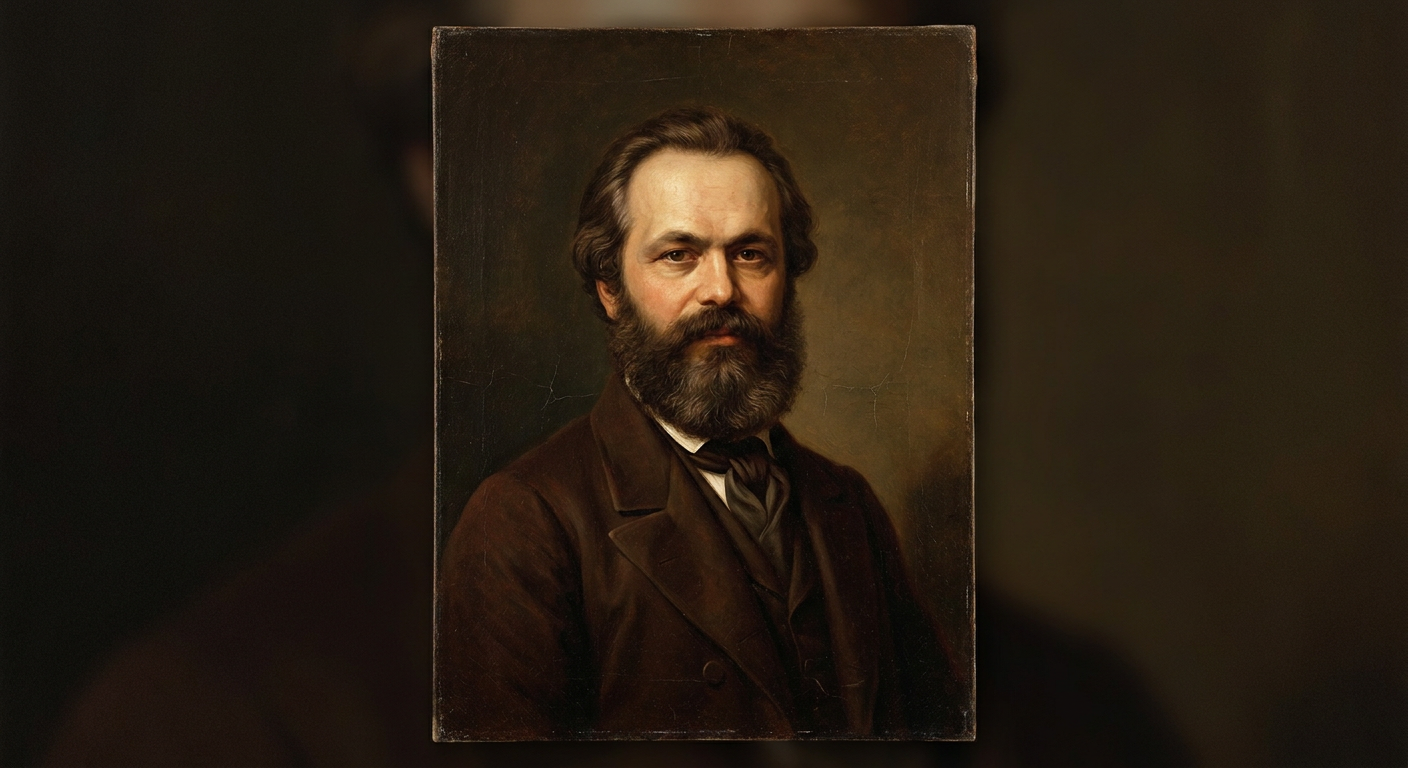
Quick Facts
- Years
- 1818 – 1883
- Category
- Philosophers & Thinkers
- Nationality
- German
- Occupation
- Philosopher, economist, historian, journalist, and revolutionary socialist
Karl Marx
1818 – 1883 · German · Philosopher, economist, historian, journalist, and revolutionary socialist
Recommended Audiobooks
Listen next from Marcus Alden

Life Lessons from Aristotle
Marcus Alden · 51 min

Life Lessons from Plato
Marcus Alden · 46 min
Karl Marx was a German philosopher, economist, historian, journalist, and revolutionary socialist whose ideas transformed modern political thought. Born in Prussia in 1818, he spent much of his adult life in exile, studying capitalism while enduring censorship, poverty, illness, and political defeat. With his lifelong collaborator Friedrich Engels, Marx wrote The Communist Manifesto, one of history’s most influential political texts. His unfinished economic project, Capital, offered a sweeping analysis of commodities, wages, profit, industrial development, and class power.
Marx argued that human societies are shaped not only by laws and ideals but also by material production: who owns resources, who performs labor, and how wealth is distributed. He believed capitalism had created extraordinary productive power while simultaneously producing exploitation, instability, and alienation. His expectation that class struggle would eventually lead beyond capitalism inspired labor movements, socialist parties, revolutions, and governments across the world.
Marx remains deeply controversial. Admirers regard him as a penetrating critic of inequality and economic power. Critics connect Marxism with authoritarian regimes, failed economic experiments, and political violence, although scholars debate how directly those outcomes followed from Marx’s own writings. Studying him therefore means examining both a nineteenth-century thinker and the enormous, conflicting history created in his name.
Quick Facts
| Field | Details |
|---|---|
| Full Name | Karl Heinrich Marx |
| Common Name(s) | Karl Marx |
| Born | 5 May 1818 |
| Died | 14 March 1883 |
| Age at Death | 64 |
| Birthplace | Trier, Kingdom of Prussia, German Confederation |
| Nationality | Prussian-born German; later stateless |
| Occupation | Philosopher, economist, historian, journalist, political organizer |
| Historical Era | Industrial Revolution; nineteenth-century Europe |
| Famous For | Marxism, historical materialism, The Communist Manifesto, Capital |
| Political Affiliation | Communist League; International Working Men’s Association |
| Religion | Baptized Lutheran; became an atheist and critic of religion |
| Education | Universities of Bonn, Berlin, and Jena; doctorate from Jena |
| Parents | Heinrich Marx and Henriette Pressburg Marx |
| Spouse(s) | Jenny von Westphalen |
| Children | Seven; only Jenny Caroline, Jenny Laura, and Eleanor survived to adulthood |
| Major Works | The Communist Manifesto, The Eighteenth Brumaire of Louis Bonaparte, A Contribution to the Critique of Political Economy, Capital |
| Major Achievements | Developed an influential critique of capitalism; helped shape international socialism and modern social theory |
Early Life
Karl Marx was born in Trier, a Rhineland city that had passed from French to Prussian rule after the Napoleonic Wars. His family had Jewish roots on both sides. His father, Heinrich, was a lawyer who converted to Protestant Christianity before Karl’s birth, largely because Prussian restrictions prevented Jews from continuing in certain professions. Karl was baptized in 1824.
The Marx household was educated and relatively comfortable, although not aristocratic. Heinrich admired Enlightenment rationalism and constitutional government. Family friend Ludwig von Westphalen introduced the young Marx to literature and philosophy; Marx later married his daughter, Jenny.
After attending the Trier Gymnasium, Marx entered the University of Bonn in 1835. His first year included poetry, social clubs, debt, and a brief duel-related incident. Concerned about his progress, Heinrich transferred him to the more demanding University of Berlin.
In Berlin, Marx encountered the philosophy of Georg Wilhelm Friedrich Hegel. Hegel presented history as a dynamic process driven by contradictions and change. Marx joined the Young Hegelians, radical intellectuals who used Hegelian criticism against religion and Prussian conservatism. He completed a doctoral dissertation comparing the ancient philosophies of Democritus and Epicurus. The University of Jena awarded his doctorate in 1841.
An academic career was effectively closed to him because Prussian authorities were suppressing radical scholars. This obstacle redirected Marx toward journalism, politics, and eventually economics.
Rise to Prominence
In 1842 Marx began writing for the liberal Rheinische Zeitung in Cologne and soon became its editor. Debates over censorship, poverty, forest-use laws, and landowners’ interests pushed him beyond abstract philosophy. Government pressure forced the newspaper to close in 1843.
Marx married Jenny von Westphalen that June, and the couple moved to Paris. There he studied French socialism and British political economy and met Friedrich Engels in 1844. Engels, the son of a textile manufacturer, had observed industrial conditions in Manchester. Their friendship became one of intellectual history’s most productive partnerships.
Expelled from France at Prussia’s request, Marx moved to Brussels. He and Engels developed their materialist conception of history, criticized rival socialists, and joined the Communist League. Commissioned by the league, they published The Manifesto of the Communist Party in February 1848, just as revolutions spread across Europe.
Marx returned to Cologne and edited the Neue Rheinische Zeitung. After the revolutions failed, he was expelled again. In 1849 he settled permanently in London, where he became internationally known through political writing, organizing, and economic research.
Major Achievements
Reframing history through material conditions
Marx argued that societies cannot be understood through rulers and ideas alone. Systems of production, property relations, technology, and class conflict also shape political institutions and beliefs. Later writers called this approach historical materialism. It profoundly influenced history, sociology, political science, anthropology, and cultural criticism.
Writing The Communist Manifesto
Written with Engels, the 1848 manifesto presented history as a history of class struggles and described capitalism as both revolutionary and exploitative. Its immediate political effect was limited, but it later became a defining statement of international communism. Its compact language helped spread socialist ideas far beyond academic circles.
Producing Capital
Volume I of Capital appeared in 1867. Marx analyzed commodities, money, machinery, wages, working time, and the accumulation of wealth. His concept of surplus value sought to explain how profit arose from labor performed beyond what workers received in wages. Engels edited Volumes II and III from Marx’s manuscripts after his death.
Building an international movement
Marx played a central role in the International Working Men’s Association, founded in 1864. He drafted important addresses and tried to unite trade unionists, socialists, and other radicals. Internal conflict—especially with the anarchist Mikhail Bakunin—and political repression weakened the organization, but it established a model for international labor coordination.
Interpreting revolution and political power
In works such as The Class Struggles in France and The Eighteenth Brumaire of Louis Bonaparte, Marx combined journalism with historical analysis. He showed that class coalitions, state institutions, political symbols, and leadership could complicate simple economic divisions.
Leadership or Work
Marx was more theorist and organizer than mass political leader. He worked through newspapers, correspondence, committees, and intensive research. In London, he spent years reading government reports, economic treatises, and statistical publications in the British Museum Reading Room.
His method was relentless but often inefficient. He revised repeatedly, opened new lines of investigation, and struggled to declare projects finished. This thoroughness strengthened Capital but left much of the larger plan incomplete.
Within organizations Marx could be strategic, persuasive, and intellectually commanding. He could also be harsh toward opponents. His disputes with Pierre-Joseph Proudhon, Ferdinand Lassalle, and Bakunin mixed substantive disagreements with personal attacks. Supporters valued his analytical power; critics regarded him as domineering and intolerant of rival doctrines.
Engels was indispensable. He provided intellectual criticism, knowledge of industry, editorial assistance, and substantial financial support. Marx nevertheless remained responsible for his own central arguments, and historians avoid treating Engels merely as a patron or Marx merely as an isolated genius.
Personal Life
Marx and Jenny von Westphalen shared a devoted but difficult marriage. Jenny copied manuscripts, managed correspondence, endured repeated moves, and supported his political work. Their London years were marked by debt, pawning household goods, and the deaths of several children. Three daughters—Jenny Caroline, Laura, and Eleanor—reached adulthood and became involved in socialist politics.
The family’s housekeeper, Helene Demuth, was a trusted member of the household. She gave birth in 1851 to Frederick Demuth. Many biographers conclude that Marx was probably the father, although the surviving documentary evidence is indirect and Engels formally accepted paternity. The matter should therefore be described as probable rather than definitively proved.
Marx enjoyed literature, jokes, chess, family outings, and smoking cigars. His nickname within the family was “Moor,” apparently referring to his dark hair and complexion. Friends described him as affectionate in private but formidable in argument.
His health deteriorated under stress and overwork. He experienced liver trouble, insomnia, painful skin eruptions, and respiratory illness. Jenny died in 1881; their eldest daughter died in January 1883. Marx died in London two months later.
Philosophy or Beliefs
Marx’s worldview combined German philosophy, British political economy, French socialism, and close observation of industrial society. He rejected the idea that history follows a simple moral plan. Instead, he emphasized changing material conditions and conflicts among social groups.
Several concepts are central to his thought:
- Class struggle: Classes arise from different relationships to productive property. Under capitalism, Marx emphasized conflict between the bourgeoisie, who own capital, and the proletariat, who sell their labor.
- Alienation: In early writings, Marx argued that workers can become separated from the products they make, the activity of work, other people, and their human creative capacities.
- Surplus value: Workers create value during production, while owners retain part of that value as profit. Marx treated this as a structural relationship, not simply individual dishonesty.
- Ideology: Dominant ideas can make historically created social arrangements appear natural or inevitable.
- Revolutionary change: Marx believed capitalism created both immense productive power and recurring contradictions that could enable workers to transform society.
Marx was an atheist and saw religious belief partly as a response to suffering. His famous description of religion as the “opium of the people” was not simply mockery: the surrounding passage calls religion both an expression of distress and a protest against it.
He offered no detailed blueprint for a future communist society. His writings suggest common control of production, the end of class domination, and expanded human freedom, but scholars disagree about the institutions he expected during and after a transition from capitalism.
Challenges and Controversies
Marx’s career included conspicuous failures. The revolutions of 1848 were defeated, the Communist League dissolved, and the First International fractured. Predictions associated with his work did not unfold uniformly: advanced capitalist countries did not all experience proletarian revolution, and capitalism proved more adaptable than many nineteenth-century socialists expected.
Critics dispute Marx’s labor theory of value and argue that centrally directed economies inspired by Marxism produced shortages, coercion, and weak incentives. Marxist and sympathetic scholars answer that Marx primarily analyzed capitalism rather than designing twentieth-century command economies. Economists continue to debate which elements of his account remain useful.
Governments claiming Marx’s legacy—including the Soviet Union, Maoist China, and others—committed repression and mass violence. Marx did advocate revolutionary transformation and sometimes used uncompromising language. Yet he did not design those later states, and he acknowledged in some contexts that peaceful political advances might be possible. The relationship between his ideas and later dictatorship remains a major scholarly and moral debate.
Some writings contain insulting ethnic or racial language, including antisemitic stereotypes in private correspondence. His essay “On the Jewish Question” criticizes antisemitic restrictions and supports Jewish political emancipation, but it also uses troubling associations between Judaism and money. Interpretations range from contextual defenses to strong criticism; the language itself should not be minimized.
Marx’s treatment of colonialism was also uneven. At times he described imperial disruption as historically transformative in language now recognized as Eurocentric. In later writings he paid greater attention to colonial violence, non-European societies, and the possibility of different historical paths.
Legacy
Marx’s influence expanded dramatically after his death. Socialist parties, labor unions, anticolonial activists, and revolutionary movements adopted or revised his ideas. Leninism, social democracy, Western Marxism, Maoism, and other traditions interpreted him in sharply different ways.
His concepts influenced thinkers including Vladimir Lenin, Rosa Luxemburg, Antonio Gramsci, W. E. B. Du Bois, and the Frankfurt School. Even scholars who reject Marxism use questions he helped popularize about class, power, work, crisis, and ownership.
Marx is buried in Highgate Cemetery in London. His present monument, unveiled in 1956, bears the lines “Workers of All Lands Unite” and “The philosophers have only interpreted the world in various ways; the point, however, is to change it.” His birthplace in Trier is now the Karl Marx House museum.
Modern debates over automation, global supply chains, insecure employment, corporate concentration, and inequality repeatedly revive interest in Marx. His legacy remains neither a settled triumph nor a closed failure, but an ongoing argument about modern society.
Interesting Facts
- Marx was born only three years after Trier became part of Prussia.
- He wrote poetry and attempted fiction as a young man.
- His doctoral dissertation concerned ancient Greek philosophy, not economics.
- He was expelled from France, Belgium, and Prussia.
- Prussia revoked his citizenship in 1845; he remained stateless.
- He met Engels in Paris in 1844 after a less significant earlier encounter.
- The Communist Manifesto initially appeared anonymously in London.
- Marx supported himself partly by writing for the New-York Daily Tribune.
- He closely followed the American Civil War and opposed slavery.
- He wrote to Abraham Lincoln on behalf of the First International after Lincoln’s reelection.
- Only Volume I of Capital appeared during Marx’s lifetime.
- Engels organized later volumes from difficult, incomplete manuscripts.
- Marx learned Russian late in life to study Russian economic and social conditions.
- He filled extensive notebooks with excerpts from books and official reports.
- He was buried near Jenny in Highgate Cemetery.
- Only a small group attended his funeral.
- Engels delivered the best-known graveside speech.
- Marx once remarked that he was not a “Marxist,” rejecting dogmatic uses of his ideas.
Famous Quotes
- “The history of all hitherto existing society is the history of class struggles.” — The Communist Manifesto (1848). This states the manifesto’s central historical claim, although Engels later qualified its scope regarding pre-class societies.
- “Workers of all countries, unite!” — Closing appeal of The Communist Manifesto. Translations vary between “workers” and “proletarians.”
- “The philosophers have only interpreted the world, in various ways; the point, however, is to change it.” — “Theses on Feuerbach” (1845). Marx presented philosophy as inseparable from transformative practice.
- “Religion is the opium of the people.” — Introduction to the critique of Hegel’s philosophy of right (1844). The larger passage describes religion as comfort, protest, and a symptom of suffering.
- “The tradition of all dead generations weighs like a nightmare on the brains of the living.” — The Eighteenth Brumaire (1852). Marx meant that inherited symbols constrain political action.
- “Men make their own history, but they do not make it as they please.” — The Eighteenth Brumaire. Human agency operates within conditions inherited from the past.
- “From each according to his ability, to each according to his needs!” — Critique of the Gotha Programme (1875). Marx used this older socialist formula to describe a higher phase of communist society.
- “Accumulate, accumulate! That is Moses and the prophets!” — Capital, Volume I (1867). The ironic phrase summarizes capitalism’s pressure toward continual reinvestment.
- “Capital is dead labour, that, vampire-like, only lives by sucking living labour.” — Capital, Volume I. The metaphor dramatizes Marx’s theory of exploitation.
- “I am not a Marxist.” — Common rendering of a remark reported by Engels concerning French followers. The wording is secondhand, but the attribution is generally treated as credible rather than a verbatim documented statement by Marx.
Timeline
- 1818 — Born in Trier on 5 May.
- 1835 — Enters the University of Bonn.
- 1836 — Transfers to Berlin; becomes engaged to Jenny von Westphalen.
- 1841 — Receives doctorate from the University of Jena.
- 1842 — Joins and later edits the Rheinische Zeitung.
- 1843 — Marries Jenny; moves to Paris.
- 1844 — Begins close collaboration with Engels.
- 1845 — Expelled from France; moves to Brussels.
- 1847 — Joins the Communist League.
- 1848 — Publishes The Communist Manifesto with Engels; returns to Cologne.
- 1849 — Settles in London after renewed expulsion.
- 1852 — Publishes The Eighteenth Brumaire of Louis Bonaparte.
- 1859 — Publishes A Contribution to the Critique of Political Economy.
- 1864 — Helps lead the International Working Men’s Association.
- 1867 — Publishes Volume I of Capital.
- 1871 — Writes The Civil War in France about the Paris Commune.
- 1875 — Writes Critique of the Gotha Programme.
- 1881 — Jenny Marx dies.
- 1883 — Marx dies on 14 March and is buried at Highgate Cemetery.
- 1885 — Engels publishes Capital, Volume II.
- 1894 — Engels publishes Capital, Volume III.
Frequently Asked Questions
1. Who was Karl Marx?
Karl Marx was a nineteenth-century German philosopher, economist, journalist, and socialist organizer. He investigated how capitalism developed, how wage labor generated profit, and how ownership divided society into classes with competing interests. With Friedrich Engels, he wrote The Communist Manifesto. His most substantial economic work was Capital. Marx held no government office and never led a successful revolution, but his ideas later influenced political parties, labor movements, academic disciplines, and revolutionary governments around the world.
2. What is Marxism?
Marxism is the broad tradition derived from Marx’s and Engels’s writings. It analyzes society through material production, class relations, and historical change, while generally seeking an end to class exploitation. It is not one uniform doctrine. Social democrats, Leninists, democratic socialists, Maoists, Western Marxists, and independent scholars have interpreted Marx differently. Consequently, policies adopted by one Marxist movement should not automatically be treated as positions explicitly stated by Marx himself.
3. What did Marx mean by class struggle?
Marx believed that classes form when groups occupy different positions within systems of production. In capitalism, owners control productive assets, while workers generally must sell their capacity to work. Their interests can conflict over wages, working hours, control, and profit. Marx did not claim every event had a single economic cause. His historical writings examined governments, traditions, and alliances, but he considered class conflict a recurring force behind major social and political transformations.
4. Did Marx invent communism?
No. Ideas about common property and egalitarian communities existed long before Marx, and communist movements already operated in Europe when he entered politics. Marx and Engels gave communism a distinctive historical and economic framework. They argued that it could emerge from contradictions within industrial capitalism rather than simply from moral persuasion or an ideal community plan. Their writings became so influential that later communism was frequently identified with Marx, despite substantial differences among communist traditions.
5. What is The Communist Manifesto about?
The manifesto explains history through class conflict, describes the global expansion of capitalist markets, and calls for working-class political organization. Marx and Engels praised capitalism’s enormous productive and disruptive energy while arguing that it concentrated property and generated exploitation. The text was a political pamphlet commissioned by the Communist League, not a full guide to economics or government. Readers should therefore distinguish its urgent revolutionary rhetoric from Marx’s more detailed, later research in Capital.
6. What was Marx’s main argument in Capital?
Capital examines capitalism as a system governed by commodity exchange, competition, wage labor, and accumulation. Marx argued that workers create more value during production than they receive back as wages; owners appropriate the difference in the form of surplus value. He also explored machinery, working time, economic crisis, and the concentration of capital. Economists dispute parts of his value theory, but the work remains influential as a study of power and social relations within markets.
7. Was Karl Marx poor?
Marx experienced serious and recurring financial hardship, especially during his early London years. Creditors pursued the family, possessions were pawned, and inadequate living conditions worsened its suffering. Yet “poor” requires qualification: Marx had middle-class origins, received inheritances, earned journalism income, and was repeatedly supported by Engels. The household’s circumstances improved later. His poverty was real but uneven, and it differed from the factory labor and extreme deprivation experienced by many workers he studied.
8. Why was Marx repeatedly exiled?
European governments regarded Marx’s journalism and revolutionary organizing as threats. Prussian censorship closed newspapers associated with him, France expelled him under diplomatic pressure, and Belgian authorities removed him during the upheavals of 1848. After returning to Cologne, he faced prosecution and another expulsion. Britain offered comparatively broad asylum, allowing him to remain in London from 1849 until his death. Exile isolated Marx politically but placed him near British industry, libraries, official reports, and international networks.
9. What was Marx’s relationship with Friedrich Engels?
Engels was Marx’s closest collaborator, political ally, editor, and financial supporter. Their partnership began in earnest in Paris in 1844 and continued through meetings and an enormous correspondence. Engels’s experience of Manchester industry informed their early analysis, while his income helped sustain the Marx household. They coauthored several works, though Marx wrote Capital himself. After Marx’s death, Engels deciphered and arranged unfinished manuscripts for Volumes II and III, shaping how later generations encountered Marx’s economics.
10. Did Marx support democracy?
Marx supported universal suffrage, working-class political organization, and resistance to authoritarian monarchy. He also believed existing states generally protected dominant property relations and that profound change might require revolution. In later statements, he acknowledged that workers might achieve power peacefully in countries with suitable institutions, while warning that resistance could still become violent. Scholars therefore debate whether Marx should be classified as a radical democrat, revolutionary authoritarian, or thinker whose unfinished political theory contains elements supporting different interpretations.
11. Did Marx predict the collapse of capitalism?
Marx believed capitalism contained tensions involving competition, crisis, accumulation, and class conflict, but he did not provide one simple date or automatic mechanism for collapse. Some followers presented history as an inevitable sequence, whereas Marx’s own writings include contingency, political struggle, and uneven development. Capitalism survived by changing through regulation, welfare systems, technology, unions, and global expansion. Whether these adaptations disprove Marx or illustrate capitalism’s dynamism remains a subject of scholarly disagreement.
12. Was Marx responsible for communist dictatorships?
Marx profoundly influenced leaders who created one-party states, and his advocacy of class revolution supplied language later used to justify coercion. That intellectual connection cannot be ignored. However, he died before those regimes arose and left no detailed design for their institutions. Later leaders adapted Marx to different countries, wars, and political traditions. Historical responsibility is therefore indirect and contested: Marx shaped their ideological vocabulary, but he did not personally order or administer twentieth-century repression.
13. What did Marx think about religion?
Marx treated religion as a human response to an unjust social world rather than as revealed truth. His “opium” comparison meant that religion could relieve pain while also discouraging people from confronting its earthly causes. He believed criticism of religion should lead toward criticism of political and economic conditions. Although descended from Jewish families and baptized Lutheran, he became an atheist. Some of his language about Judaism is offensive and remains the subject of serious historical debate.
14. How did Marx die?
Marx died at his London home on 14 March 1883, aged 64, after years of declining health. Bronchitis and pleurisy were among his final illnesses, while earlier problems had included painful skin disease, liver complaints, and insomnia. His wife Jenny had died in 1881, and the death of their eldest daughter shortly before his own was another severe blow. He was buried at Highgate Cemetery on 17 March before a small gathering of relatives and associates.
15. Why is Marx still relevant?
Marx remains relevant because he asked enduring questions about who controls work, how profit is produced, why wealth concentrates, and how economic power affects politics and culture. Global production networks, automation, insecure employment, housing inequality, and corporate concentration keep these questions current. Relevance does not prove that all his conclusions were correct. Rather, his work offers a powerful framework that can be tested, criticized, revised, or rejected through evidence and comparison with later developments.
Lessons We Can Learn
- Study systems, not only individuals. Marx connected personal hardship to institutions and ownership; modern readers can examine structures without denying individual responsibility.
- Read primary evidence closely. His use of factory reports shows the value of grounding large arguments in documented conditions.
- Collaboration can transform work. Engels’s criticism, expertise, and support were essential to Marx’s career.
- Clear writing broadens influence. The manifesto reached audiences that a dense economic treatise could not.
- Ideas change across contexts. Later movements adapted Marx in ways he could not control, warning authors that reception differs from intention.
- Criticism should include self-criticism. Marx exposed others’ assumptions but sometimes used prejudiced language and treated rivals unfairly.
- Economic innovation has human costs. His factory studies encourage scrutiny of who benefits from technological change.
- Predictions require revision. Capitalism’s adaptability shows why theories must be reassessed against later evidence.
- Political means shape political ends. The history of regimes invoking Marx illustrates the danger of excusing coercion for promised future liberation.
- Complex thinkers resist slogans. Evidence supports reading Marx’s varied works rather than reducing him either to a flawless prophet or the sole cause of later disasters.
Related Historical Figures
- Friedrich Engels — Marx’s closest collaborator, coauthor, editor, and financial supporter.
- Jenny von Westphalen Marx — His wife, intellectual companion, manuscript copyist, and political partner.
- Georg Wilhelm Friedrich Hegel — The philosopher whose dialectical account of change deeply influenced Marx.
- Ludwig Feuerbach — A Young Hegelian whose materialist criticism of religion shaped Marx’s early development.
- Adam Smith — A foundational political economist whose analysis of labor and markets Marx studied critically.
- David Ricardo — His theories of value, wages, and profit provided important starting points for Marx.
- Pierre-Joseph Proudhon — French socialist criticized by Marx in The Poverty of Philosophy.
- Mikhail Bakunin — Anarchist rival whose conflict with Marx divided the First International.
- Vladimir Lenin — Revolutionary who adapted Marxism to Russian conditions and built a new political doctrine.
- Rosa Luxemburg — Marxist theorist who developed his economics while criticizing authoritarian tendencies in socialism.
Watch and Learn
“POLITICAL THEORY - Karl Marx” — The School of Life — approximately 9 minutes. This concise educational introduction clearly explains Marx’s ideas about capitalism, labor, alienation, and inequality through accessible narration and animation. It is useful as an overview, although viewers should supplement its simplified presentation with Marx’s writings and scholarly historical studies.
Watch and Learn
POLITICAL THEORY - Karl Marx · The School of Life
Related Historical Figures