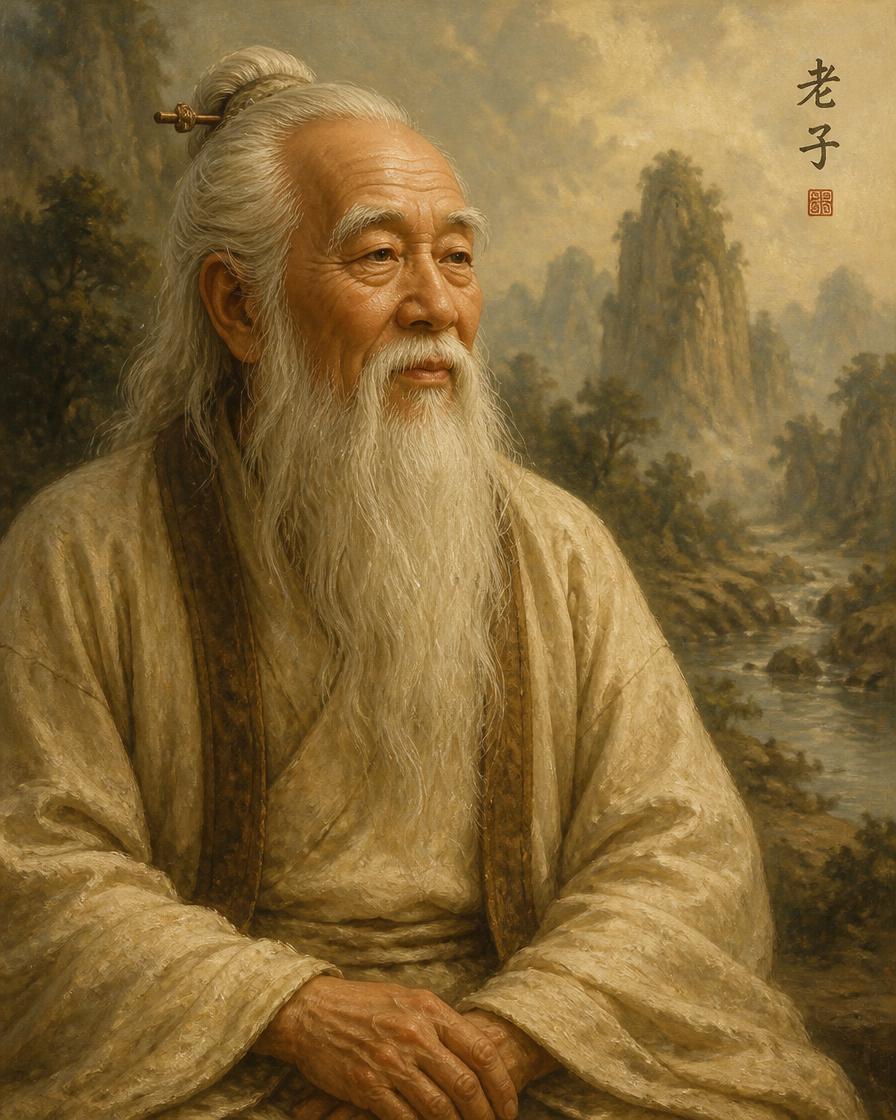
Quick Facts
- Years
- 601 BC – 531 BC
- Category
- Philosophers & Thinkers
- Subcategory
- Eastern Philosophy
- Nationality
- Chinese
- Occupation
- Philosopher & Author of the Tao Te Ching
Laozi
601 BC – 531 BC · Chinese · Philosopher & Author of the Tao Te Ching
Audiobook

Life Lessons from Laozi
Marcus Alden · 38 min
Laozi—also written Lao Tzu or Lao-tse—is the name traditionally given to the ancient Chinese thinker associated with the Tao Te Ching (Daodejing), one of the most influential works in world philosophy. Traditional chronology places him in the sixth century BCE, sometimes around 601–531 BCE, but neither those dates nor a single, identifiable historical author can be confirmed. Some scholars interpret “Laozi,” meaning “Old Master,” as an honorific, and many regard the received text as the product of several authors or editorial stages during the late Warring States period.
The Tao Te Ching examines the Dao—the underlying “Way” of reality—and de, its power, efficacy, or virtue. Through compact, paradoxical verses, it advocates humility, simplicity, restraint, compassion, and wuwei: action that does not force events against their natural course. Its political teachings favor rulers who interfere sparingly and avoid war, ostentation, and excessive demands.
Laozi’s importance reaches far beyond the uncertain details of his life. His attributed work became foundational to philosophical and religious Daoism, shaped Chinese government, poetry, painting, medicine, and spiritual practice, and entered global debates about ethics, ecology, leadership, and contemplative life. He remains studied because his questions—how to exercise power responsibly, live without needless striving, and align human conduct with a larger order—remain enduringly relevant.
Quick Facts
| Field | Details |
|---|---|
| Full Name | Unknown; traditionally Li Er, courtesy name Dan |
| Common Name(s) | Laozi, Lao Tzu, Lao-tse, Old Master |
| Born | Traditionally c. 601 BCE; unverified |
| Died | Traditionally c. 531 BCE; unverified |
| Age at Death | Traditionally about 70; unknown historically |
| Birthplace | Traditionally Quren, Chu—often associated with present-day Luyi, Henan; disputed |
| Nationality | Ancient Chinese; traditionally a subject of Zhou or Chu |
| Occupation | Philosopher and author; traditionally a Zhou archival official |
| Historical Era | Traditionally Eastern Zhou, Spring and Autumn period; text likely took shape in the Warring States period |
| Famous For | The Tao Te Ching and teachings on Dao, de, simplicity, and wuwei |
| Political Affiliation | None recorded |
| Religion | Later revered in Daoism; his own religious identity is unknown |
| Education | Not recorded |
| Parents | Not reliably recorded |
| Spouse(s) | Not reliably recorded |
| Children | Later traditions name a son, Zong; historically unverified |
| Major Works | Tao Te Ching (Daodejing), traditionally attributed |
| Major Achievements | Foundational influence on Daoist philosophy and religion; major impact on Chinese and global thought |
Early Life
Nearly everything said about Laozi’s beginnings comes from traditions recorded centuries after the period in which he supposedly lived. The most influential early biography appears in Sima Qian’s Records of the Grand Historian, composed around the late second and early first centuries BCE. Sima Qian identified Laozi with Li Er, whose courtesy name was Dan, and placed his origin in the state of Chu.
Later accounts supplied increasingly elaborate details, including miraculous conception and birth legends. Such stories belong to religious hagiography rather than verifiable biography. No contemporary inscription, manuscript, or administrative record securely documents Laozi’s parents, childhood, schooling, or mentors.
According to Sima Qian, Laozi served as a keeper of archival records at the Zhou royal court. If true, the position could have given him access to ritual texts, histories, and political precedents. Yet scholars cannot independently confirm that appointment. The description may have explained the wisdom and antiquity later readers perceived in the Tao Te Ching.
The traditional sixth-century setting was an age of weakening Zhou authority and growing rivalry among regional states. Ritual ideals remained influential, but warfare and political fragmentation intensified. The received Tao Te Ching, however, reflects concerns often associated with the fourth and third centuries BCE: aggressive state-building, heavy taxation, military competition, and disputes among rival philosophical schools.
No reliable evidence identifies Laozi’s formal education. His attributed text demonstrates familiarity with political rule, warfare, ritual, language, and traditional wisdom, but these features cannot prove the experiences of one author. Its repeated praise of water, valleys, infants, uncarved wood, and feminine receptivity suggests sustained observation of nature and deliberate resistance to conventional ideals of status and strength.
Rise to Prominence
In the traditional story, Laozi became respected for his learning while working at the Zhou court. Sima Qian reports that Confucius consulted him about ritual. The narrative portrays Laozi as an elder critic of pride and ambition. Whether such a meeting occurred is uncertain; its literary purpose was partly to establish a relationship between the two great traditions.
Laozi’s decisive turning point supposedly came when Zhou power declined. He left civilization and traveled west. At a frontier pass, the guard Yin Xi asked him to record his wisdom before departing. Laozi then wrote a work of roughly five thousand Chinese characters in two parts, dealing with Dao and de, and disappeared. This is the traditional origin story of the Tao Te Ching, not a contemporaneously documented event.
Historically, Laozi’s prominence is more securely connected to the circulation of the text bearing his name. Excavated manuscripts show that sayings now found in the Tao Te Ching circulated in varying arrangements. Bamboo manuscripts discovered at Guodian and dated to around 300 BCE contain portions of the work. Silk manuscripts from Mawangdui, buried in 168 BCE, preserve fuller versions in which the De section precedes the Dao section.
These discoveries suggest textual development rather than a single, fixed composition written at one moment. By the early imperial era, however, “Laozi” named both an authoritative book and a revered sage. Commentators, rulers, seekers, and religious communities expanded that authority, transforming an enigmatic ancient teacher into a central figure of Chinese civilization.
Major Achievements
Association with the Tao Te Ching
Laozi’s foremost achievement is his traditional association with the Tao Te Ching, a compact collection of 81 chapters in its standard form. The work asks how beings arise, how opposites depend upon one another, and how people can live without destructive excess.
Its importance lies partly in its unusual method. Rather than building a systematic argument, it uses paradox, repetition, metaphor, and strategically ambiguous language. This form invites interpretation rather than closing debate. The book became one of the most translated works of Chinese literature, although translations differ greatly because key terms resist exact equivalents.
Articulation of Dao and Wuwei
The text gave enduring philosophical expression to Dao and wuwei. Dao can mean road, way, method, or the ineffable process through which the world unfolds. Wuwei literally suggests “non-action,” but in context usually means action without coercive or self-defeating interference.
This mattered because it offered an alternative to domination. Effective action could be adaptive, quiet, and responsive—like water, which is yielding yet transformative. The idea subsequently shaped Daoist spirituality, theories of government, martial practice, aesthetics, and modern discussions of leadership.
A Critique of Coercive Government
The Tao Te Ching repeatedly warns rulers against warfare, overregulation, punitive display, high taxation, and the glorification of conquest. It praises leaders whose presence is scarcely felt and whose people believe they have accomplished things themselves.
The work was not a democratic manifesto in the modern sense. It addressed monarchic government, sometimes imagining a small and simple society. Nevertheless, its suspicion of force provided Chinese political thought with a durable language of restraint and offered later rulers and critics a standard by which oppressive government could be judged.
Foundation for Daoist Traditions
Laozi’s teachings became one major source of philosophical Daoism alongside the Zhuangzi. From the late Han period onward, organized Daoist movements also revered Laozi as a divine or transcendent figure, often calling him Lord Lao or the Most High Lord Lao.
The historical philosopher should not be automatically equated with every later religious representation. Even so, his attributed text furnished vocabulary, authority, and imagery for meditation, ritual, cosmology, ethics, and self-cultivation across many Daoist schools.
Global Intellectual Influence
Translations introduced Laozi to audiences throughout Asia, Europe, and the Americas. Writers, philosophers, psychologists, environmental thinkers, and leadership theorists have all engaged with the text.
This influence broadened comparative philosophy, but it also created risks. Popular versions sometimes detach selected lines from their linguistic, political, and historical settings. Laozi’s global achievement is therefore double-edged: extraordinary accessibility accompanied by frequent simplification.
Leadership and Work
Laozi held no securely documented command, school, or political office. Discussion of his leadership must therefore focus on the model presented in the Tao Te Ching, not on a demonstrable personal administration.
That model emphasizes:
- Minimal coercion: Good rulers avoid multiplying commands and punishments.
- Humility: Leaders do not constantly advertise their achievements.
- Adaptability: Like water, wise action responds to circumstances rather than imposing rigid form.
- Restraint: Military victory, wealth, and expansion are treated cautiously.
- Trust in emergence: Order can arise when rulers stop disrupting ordinary life.
Decision-making in this framework begins with quiet observation. The leader reduces personal desire, recognizes limits, and avoids acting merely to display power. The method resembles indirect guidance: establishing conditions in which people can function without constant intervention.
Its strength is the recognition that force often produces resistance and unintended consequences. Its weakness is practical ambiguity. “Non-action” can become an excuse for passivity, and the text gives few institutional safeguards against a ruler who claims wisdom while remaining unaccountable. Some chapters also appear paternalistic, imagining that the sage keeps people simple rather than politically informed.
Relationships are presented less as personal bonds than as patterns of non-contention. The sage competes with no one, occupies the low place, and assists without possessing. This ideal challenges status-seeking, but it does not supply a detailed account of law, bureaucracy, or civic participation.
Personal Life
No dependable evidence establishes Laozi’s marriage, household, friendships, appearance, habits, health, or death. Later traditions sometimes identify a son named Zong who became a military commander. Sima Qian also mentioned descendants, but the genealogical claims cannot be independently verified.
The alleged encounter with Confucius is Laozi’s best-known personal relationship. In different versions, Confucius asks about ritual and leaves impressed by Laozi’s unfathomable wisdom, comparing him to a dragon. Historians generally approach these accounts cautiously because they appear in texts compiled long after the supposed meeting and serve symbolic purposes.
One may infer a literary personality from the Tao Te Ching: skeptical of fame, attentive to nature, opposed to aggressive striving, and fond of paradox. Such inference must not be mistaken for biography. A composite text can possess a coherent voice without preserving one author’s private character.
Religious legends later made Laozi’s personal life miraculous. Some stories claimed that his mother carried him for decades and gave birth to an old man, explaining the title “Old Master.” These narratives express sacred status; they are not historical evidence.
Philosophy and Beliefs
The opening chapter states that a Dao that can be spoken is not the constant Dao. This does not make language useless; rather, it warns that concepts never exhaust reality. Naming divides the world into manageable categories, while the source and pattern of existence exceed those divisions.
The text links Dao with de, the particular power or integrity through which beings become what they are. Human flourishing depends less on imposing abstract plans than on allowing each thing to develop according to its nature.
Wuwei is central. It does not normally demand literal inactivity. The sage acts without strain, possessiveness, or compulsive control. A skilled response may require effort, but it avoids forcing conditions beyond what they can sustain.
Ethically, the work praises compassion, frugality, humility, softness, and contentment. Hardness appears powerful but breaks; softness bends and survives. Water benefits all things while seeking low places. The infant symbolizes vitality not yet distorted by artificial ambition.
Politically, Laozi’s attributed teachings favor limited intervention, modest taxation, peace, and suspicion of luxury. Weapons are treated as unfortunate tools, never objects of celebration. Yet some passages envision rulers managing people through simplicity and reduced desire, which modern readers may regard as paternalistic.
Religiously, the early text does not present Dao as a creator god who issues commands. Dao is unnamed, generative, and impartial. Later Daoist traditions developed rich pantheons, rituals, revelations, and methods of attaining longevity or transcendence, while interpreting Laozi himself as a cosmic deity. Those developments should be distinguished from what can be confidently read in the early text.
The philosophy also unsettles rigid opposites. Beauty implies ugliness; being and nonbeing generate one another; difficult and easy are mutually defining. Wisdom recognizes these relationships and avoids treating temporary distinctions as absolute.
Challenges and Controversies
The central controversy is whether Laozi was a historical individual. Sima Qian reported several possibilities and acknowledged uncertainty. Besides Li Er, he mentioned Lao Laizi and a Zhou astrologer named Dan. This suggests that competing identities already circulated in antiquity.
A traditional view accepts an elder contemporary of Confucius who authored the text near the end of the sixth century BCE. A common modern view dates much of the Tao Te Ching later and sees it as an anthology that reached recognizable form during the Warring States period. Intermediate positions allow an early teacher or core collection followed by substantial editing.
Authorship is similarly disputed. The uneven vocabulary, repeated passages, variant manuscripts, and differing arrangements support cumulative composition. Yet compilation does not make the work philosophically insignificant. Ancient texts often developed through oral transmission, discipleship, and editorial revision.
The conventional dates 601–531 BCE remain popular but are not historically established. They should be presented as traditional rather than factual. Even the title “Laozi” may originally have meant “Old Master” rather than a personal name.
Interpretation creates further controversy. Some readers understand wuwei as contemplative noninterference; others emphasize strategic, effective action. Some view the politics as anti-authoritarian, while others see techniques through which a monarch governs efficiently and invisibly.
Modern appropriation also attracts criticism. Business manuals sometimes turn wuwei into productivity advice, while inspirational collections attribute recent sayings to Laozi without textual evidence. Such uses can obscure the work’s criticism of accumulation, competition, and political violence.
Finally, the label “Taoism” can blur distinctions among early philosophical texts, organized religious communities, local practices, and modern spiritual movements. Scholars increasingly treat Daoism as a diverse historical family rather than one doctrine created fully formed by a single founder.
Legacy
Laozi’s legacy first rests on the Tao Te Ching. Major commentators helped define its reception. The Heshang Gong commentary interpreted it in political and self-cultivation terms, while Wang Bi’s third-century CE commentary developed a subtle metaphysics of being and nonbeing. These readings influenced later philosophy for centuries.
Daoist religious communities elevated Laozi beyond authorship. The Celestial Masters movement, emerging in the second century CE, revered the deified Lord Lao as a revealer of sacred authority. Temples, liturgies, and visual art portrayed him as an ancient sage or divine elder.
His influence also entered Chinese Buddhism, especially as translators and thinkers used familiar Daoist language to approach unfamiliar Indian concepts. Chan Buddhism developed within a broader intellectual environment already shaped by Daoist critiques of rigid language and artificial striving, although Chan cannot simply be reduced to Daoism.
Chinese poets and painters drew upon ideals of emptiness, spontaneity, naturalness, and withdrawal from corrupt public life. Political thinkers repeatedly revisited the text during periods of disorder or overgovernment. Its antiwar passages gave conquest a language of mourning rather than triumph.
Today, sites associated with Laozi include Taiqing Palace near Luyi in Henan, traditionally identified with his birthplace, and Louguantai in Shaanxi, linked to the western-pass legend. Temples and statues exist across China and in overseas Daoist communities. These are important places of memory and devotion, not proof of disputed biographical claims.
Universities, translation projects, Daoist associations, museums, and cultural institutes continue to study or commemorate him. Modern environmental thinkers value the text’s attention to interdependence and limits, while leadership readers explore its preference for unobtrusive authority. Responsible study, however, keeps the strangeness of the ancient work intact rather than reducing it to slogans.
Interesting Facts
- “Laozi” literally means “Old Master” or “Old Master(s).”
- “Tao Te Ching” follows an older romanization; “Daodejing” is standard Pinyin.
- The standard received text contains 81 short chapters.
- Early versions did not always divide or order the chapters identically.
- The work is traditionally described as approximately 5,000 Chinese characters long.
- Guodian bamboo manuscripts preserve portions of the text from around 300 BCE.
- The Mawangdui silk manuscripts place the De section before the Dao section.
- Sima Qian recorded more than one possible identity for Laozi.
- The famous meeting with Confucius cannot be historically verified.
- Yin Xi is the legendary gatekeeper who requested Laozi’s book.
- Water is one of the text’s most important models of strength through yielding.
- The work condemns the celebration of military victory.
- Wuwei generally means non-forcing action, not simply doing nothing.
- Wang Bi died young but wrote one of the most influential Laozi commentaries.
- Laozi became a deity in several religious Daoist traditions.
- Many popular internet quotations credited to Laozi are paraphrases or misattributions.
- There is no universally definitive English translation of the Tao Te Ching.
- The conventional lifespan 601–531 BCE is traditional, not securely documented.
Famous Quotes
Translations vary by edition; chapter numbers provide the most reliable context.
- “The way that can be spoken of is not the constant way.” — Chapter 1. The opening warns that language cannot completely contain Dao. Wording varies among translations.
- “The highest good is like water.” — Chapter 8. Water benefits life without contending and occupies places others reject, making it an image of humble effectiveness.
- “He who knows others is wise; he who knows himself is enlightened.” — Chapter 33. The verse contrasts external knowledge with the deeper discipline of self-understanding.
- “A journey of a thousand miles begins beneath one’s feet.” — Chapter 64. Often rendered “with a single step,” it teaches that great undertakings develop from small beginnings.
- “Those who know do not speak; those who speak do not know.” — Chapter 56. This paradox cautions against mistaking verbal display for deep understanding; it is not a blanket ban on teaching.
- “Governing a large state is like cooking a small fish.” — Chapter 60. Too much handling ruins both fish and government; the image advocates restraint.
- “The soft and weak overcome the hard and strong.” — Chapter 36. The line expresses the text’s reversal of ordinary assumptions about power.
- “The sage does not accumulate.” — Chapter 81. Wisdom gives to others rather than hoarding, connecting generosity with abundance.
- “To know that one does not know is best.” — Chapter 71. Intellectual humility is presented as protection against error.
- “When the work is done and the task accomplished, the people all say, ‘We did it ourselves.’” — Chapter 17. Translation varies; the passage defines unobtrusive leadership.
Frequently attributed sayings such as “Life is a series of natural and spontaneous changes” are not reliable verbatim translations of the ancient text and should be treated as disputed modern paraphrases.
Timeline
- c. 601 BCE — Traditional birth date; not historically verified.
- Sixth century BCE — Tradition places Laozi at the Zhou court as an archival official.
- Sixth–fifth centuries BCE — Alleged meeting with Confucius; historicity disputed.
- c. 531 BCE — Traditional death date; unverified.
- Fourth–third centuries BCE — Many scholars date major stages in the formation of the Tao Te Ching to this period.
- c. 300 BCE — Guodian bamboo texts preserve early selections corresponding to the received work.
- Late third century BCE — The text likely approached recognizable form, although dating remains debated.
- 168 BCE — Tomb containing the two Mawangdui silk versions is sealed.
- c. 145–86 BCE — Lifetime traditionally assigned to Sima Qian, author of Laozi’s earliest substantial surviving biography.
- Second century CE — Celestial Masters and related Daoist communities revere a divine Lord Lao.
- 226–249 CE — Wang Bi lives and produces his influential commentary.
- Seventh–eighth centuries CE — Tang emperors honor Laozi and claim kinship through the surname Li.
- Nineteenth century — European translations expand Laozi’s international readership.
- 1993 — Guodian bamboo manuscripts are excavated in Hubei.
- Twenty-first century — Laozi remains influential in philosophy, religion, environmental ethics, literature, and leadership studies.
Frequently Asked Questions
Who was Laozi?
Laozi was the ancient Chinese sage traditionally credited with the Tao Te Ching. Traditional accounts identify him as Li Er or Li Dan, an archivist at the Zhou court and an older contemporary of Confucius. Historians cannot verify those details. “Laozi” may have been an honorific meaning “Old Master,” and the text associated with him probably developed through multiple stages. It is therefore safest to describe Laozi as a traditional author and foundational cultural figure whose exact historical identity remains uncertain.
When was Laozi born?
The date 601 BCE is often given, with 531 BCE supplied as his death date, but neither is supported by contemporary evidence. Early sources do not provide a securely verifiable chronology. The sixth-century dating reflects the tradition that Laozi met Confucius. Many modern scholars believe the Tao Te Ching assumed much of its form in the fourth or third century BCE. A biography should consequently label 601 BCE as a traditional date, not an established fact.
Did Laozi really write the Tao Te Ching?
Tradition says he composed it at a western frontier pass before disappearing. Manuscript discoveries and textual analysis complicate that story. Early copies differ in order, wording, and contents, while the received work contains repetitions and layers suggesting collection and editing. Laozi may represent an individual teacher, a lineage, an editorial persona, or the authority attached to accumulated sayings. Scholars disagree, but few treat the traditional composition scene as straightforward documentary history.
What does “Laozi” mean?
The name is usually translated as “Old Master.” Depending on how the Chinese characters are understood, it can function as an honorific rather than an ordinary personal name. Ancient tradition gave Laozi the surname Li and personal name Er, with Dan as a courtesy or posthumous designation, but those identifications remain uncertain. The title itself helped create the image of an elder sage possessing wisdom deeper than conventional scholarship.
What is the Dao?
Dao means “way,” “path,” or “course,” but the Tao Te Ching uses it for the ineffable source and pattern of reality. Dao gives rise to beings without ruling them like a personal monarch. It cannot be captured completely by names or doctrines. To follow Dao is not merely to obey a set of commandments; it is to act in responsive alignment with how life and circumstances unfold, avoiding needless force and excess.
What is wuwei?
Wuwei literally means “not acting” or “non-action,” yet “effortless action” or “non-forcing” often conveys the intended sense better. It describes conduct that does not interfere compulsively or struggle against the grain of circumstances. A ruler practicing wuwei governs without oppressive micromanagement; an individual acts without ego-driven strain. It is not necessarily laziness. Appropriate action may be energetic, but it remains proportionate, responsive, and free from needless coercion.
Was Laozi a religious founder?
Not in the simple sense that one person deliberately established all of Daoism. The early Tao Te Ching is philosophical, ethical, political, and cosmological, but organized Daoist movements appeared centuries later. Those traditions adopted Laozi as an authoritative revealer and sometimes worshiped him as Lord Lao. He became foundational to religious Daoism, yet the religion developed through many communities, texts, rituals, deities, and historical transformations rather than from one documented founding event.
Did Laozi meet Confucius?
Ancient narratives say Confucius consulted Laozi about ritual and was amazed by him. The story dramatizes a relationship between Confucian and Daoist orientations: ritual cultivation on one side, criticism of pride and artificiality on the other. No contemporary evidence confirms the encounter, and the relevant accounts were recorded long afterward. Historians therefore regard it as possible only in a broad traditional chronology, but unverified and probably shaped for philosophical or literary purposes.
Why did Laozi leave the Zhou court?
According to legend, Laozi perceived the decline of Zhou civilization and traveled west. At the pass, Yin Xi persuaded him to write down his teaching. After producing the Tao Te Ching, Laozi departed and vanished from history. This narrative embodies the ideal of withdrawing from corruption and abandoning fame. It should not be treated as a documented itinerary; it is an origin story explaining how the text was supposedly created and preserved.
What did Laozi teach about government?
The Tao Te Ching recommends restrained government, low demands, modest leadership, and avoidance of war. A wise ruler creates conditions for ordinary life rather than constantly issuing commands or seeking glory. The text criticizes excessive taxation, luxury, weapons, and proliferating prohibitions. It remains monarchic and can be paternalistic, however. Its politics are better described as a critique of coercive rule than as a complete modern theory of constitutional or democratic government.
Was Laozi a pacifist?
The text strongly distrusts warfare and says military victory should be approached with mourning rather than celebration. Weapons are ominous instruments to be used only when unavoidable. This supports a deeply antiwar reading. Nevertheless, the work does not formulate an absolute prohibition against every use of force. It addresses rulers who inhabit a violent world and emphasizes reluctance, necessity, and restraint. “Pacifist” is useful only if qualified by this ancient political context.
How is Laozi different from Zhuangzi?
Laozi is associated with a terse collection focused heavily on Dao, governance, humility, and reversal. Zhuangzi, a fourth-century BCE thinker or textual persona, is linked to a larger work full of stories, humor, fantasy, and arguments about perspective and spontaneity. Both resist rigid distinctions and coercive striving, but their voices differ. Later tradition grouped them together as central Daoist classics, sometimes calling their philosophy “Lao-Zhuang” thought.
What do the Guodian manuscripts reveal?
The Guodian bamboo slips, excavated in 1993 from a tomb dated around 300 BCE, contain portions parallel to the Tao Te Ching. Their selections and organization differ from the received 81-chapter text. They show that Laozi material circulated relatively early but had not necessarily reached one universally fixed form. The manuscripts strengthened scholarly arguments for textual development while also confirming the antiquity of many core teachings.
Why are translations so different?
Classical Chinese is concise and often omits subjects, tense markers, and explicit grammatical connections. Key words such as Dao, de, wuwei, and ziran possess ranges of meaning that no single English term captures. Manuscripts also differ. Translators must choose among philosophical possibilities, producing versions that can sound mystical, political, poetic, or practical. Comparing several scholarly translations is usually more informative than treating one English rendering as final.
Is Tao the same word as Dao?
Yes. “Tao” reflects the Wade–Giles romanization system, while “Dao” reflects Hanyu Pinyin, now the standard in mainland China and much modern scholarship. Both represent the Chinese character 道. Likewise, “Lao Tzu” and “Tao Te Ching” correspond to “Laozi” and “Daodejing.” The pronunciation is closer to the Pinyin forms than English speakers may assume from the older spelling.
Where is Laozi buried?
No authenticated tomb of Laozi is known. Several places are associated with his life through local or religious tradition, but the underlying biography is too uncertain to identify a verified burial site. Temples and memorial landscapes can reveal how communities remembered and revered him; they do not by themselves establish where a historical individual lived or died. Claims about a definitive grave should therefore be approached cautiously.
Lessons We Can Learn
- Lead without constant display. Chapter 17 praises leaders whose people feel ownership of success. Modern managers can create autonomy rather than claiming every achievement.
- Use force sparingly. The text treats weapons as regrettable. Governments and individuals alike should consider escalation’s long-term costs.
- Begin with small actions. Chapter 64 links enormous journeys and trees to tiny beginnings. Sustainable progress often depends on modest, repeated steps.
- Practice intellectual humility. Chapter 71 values knowing the limits of knowledge. This matters in research, policy, and daily judgment.
- Adapt like water. Water changes shape without losing its nature. Flexible strategies often survive conditions that defeat rigid plans.
- Avoid excess. Laozi criticizes accumulation, luxury, and overreach. Restraint can protect finances, institutions, health, and ecosystems.
- Do not confuse busyness with effectiveness. Wuwei asks whether action fits the situation. Eliminating unnecessary intervention may improve results.
- Recognize interdependence. The text pairs being with nonbeing and difficult with easy. Opposing categories frequently define and sustain one another.
- Value overlooked positions. Valleys and low places receive water. Listening, service, and humility can generate forms of influence unavailable to domination.
- Question inherited stories responsibly. Laozi’s uncertain biography shows why tradition and evidence must be distinguished without dismissing either. Historical literacy requires both respect and scrutiny.
Related Historical Figures
- Confucius (551–479 BCE): Traditionally met Laozi; his ritual and ethical teachings became a major comparative counterpart to Daoism.
- Zhuangzi (c. 369–286 BCE): Expanded related themes of Dao, spontaneity, perspective, and freedom through stories and philosophical argument.
- Sima Qian (c. 145–86 BCE): Preserved the earliest substantial surviving biographical traditions about Laozi.
- Yin Xi: Legendary frontier guardian said to have requested the composition of the Tao Te Ching.
- Wang Bi (226–249 CE): Produced a philosophically influential commentary emphasizing nonbeing and underlying unity.
- Heshang Gong: Mysterious early commentator whose interpretation linked government with bodily and spiritual cultivation.
- Emperor Gaozu of Han (256/247–195 BCE): Ruled during an era when restrained, “Huang-Lao” political thought influenced early Han governance.
- Emperor Xuanzong of Tang (685–762 CE): Honored Laozi, promoted Daoism, and wrote a commentary on the Daodejing.
- Han Feizi (c. 280–233 BCE): Legalist thinker whose work includes early commentaries on Laozi and adapts some ideas to statecraft.
- Bodhidharma (traditionally fifth–sixth century CE): Later associated with Chan Buddhism, a tradition often compared with Daoist spontaneity, though direct connections are complex and disputed.
Watch and Learn
The Philosophy of Lao Tzu · Einzelgänger
Related Historical Figures