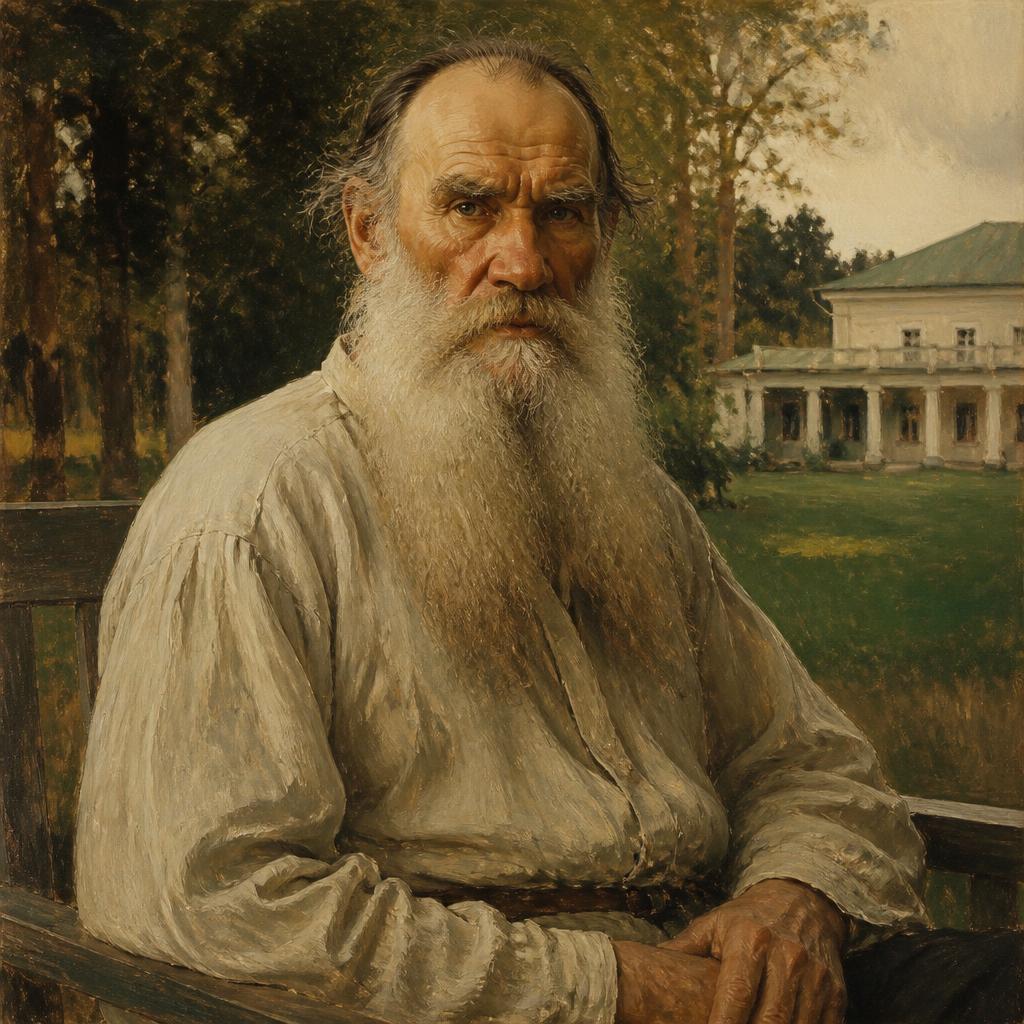
Quick Facts
- Years
- 1828 – 1910
- Category
- Writers & Poets
- Subcategory
- Novelists
- Nationality
- Russian
- Occupation
- Novelist
Leo Tolstoy
1828 – 1910 · Russian · Novelist
Audiobook

Life Lessons from Leo Tolstoy
Marcus Alden · 54 min
Leo Tolstoy was a Russian novelist, moral philosopher, social critic, and religious thinker whose fiction transformed world literature. Born into the aristocracy in 1828, he drew on military service, family life, historical research, and spiritual crisis to explore how human beings confront love, war, death, responsibility, and social injustice. His monumental novels War and Peace and Anna Karenina are celebrated for their psychological depth, social range, and innovative treatment of history and everyday life.
Tolstoy first became known through autobiographical fiction and realistic accounts of the Crimean War. After achieving literary fame, he underwent a profound crisis of meaning. He rejected institutional Christianity, aristocratic privilege, private violence, and many conventions of modern society, developing an ethical doctrine centered on nonviolence, simplicity, chastity, manual labor, and resistance to evil without force. His ideas influenced reformers including Mahatma Gandhi and Martin Luther King Jr., although both adapted Tolstoy rather than simply following him.
His later life was marked by humanitarian work, conflict with the Russian Orthodox Church, disputes over property and copyright, and painful tensions within his marriage. Tolstoy remains studied not only as a master novelist but also as an unsettling critic of power, wealth, organized religion, and the gap between moral ideals and daily conduct.
Quick Facts
| Field | Details |
|---|---|
| Full Name | Lev Nikolayevich Tolstoy |
| Common Name(s) | Leo Tolstoy; Lev Tolstoy; Count Tolstoy |
| Born | 9 September 1828 (28 August, Old Style) |
| Died | 20 November 1910 (7 November, Old Style) |
| Age at Death | 82 |
| Birthplace | Yasnaya Polyana, Tula Governorate, Russian Empire |
| Nationality | Russian |
| Occupation | Novelist, short-story writer, essayist, educator, religious thinker, landowner, former army officer |
| Historical Era | Imperial Russia; nineteenth and early twentieth centuries |
| Famous For | War and Peace, Anna Karenina, The Death of Ivan Ilyich, Christian nonviolence |
| Political Affiliation if applicable | No political party; Christian anarchist and anti-statist ideas are often attributed to him |
| Religion if significant | Raised Russian Orthodox; later developed an unorthodox Christian faith and was formally excluded from church communion in 1901 |
| Education | Kazan University, 1844–1847; left without a degree |
| Parents | Count Nikolai Ilyich Tolstoy and Princess Mariya Nikolayevna Volkonskaya |
| Spouse(s) | Sophia Andreyevna Behrs, married 1862 |
| Children | 13, of whom 8 survived childhood |
| Major Works | Childhood, Sevastopol Sketches, The Cossacks, War and Peace, Anna Karenina, A Confession, The Death of Ivan Ilyich, The Kreutzer Sonata, Resurrection, Hadji Murat |
| Major Achievements | Created landmark works of realist fiction; advanced nonviolent Christian ethics; promoted popular education; influenced global peace and reform movements |
Early Life
Tolstoy was born at Yasnaya Polyana, the Tolstoy family estate roughly 200 kilometers south of Moscow. He belonged to an old aristocratic family. His mother died before he was two, and his father died when he was nine. Relatives, including aunts, assumed responsibility for Tolstoy and his siblings. Early experiences of bereavement, family memory, and estate life later shaped his fiction.
His childhood unfolded within the hierarchical world of imperial Russia, where noble privilege depended heavily on serf labor. Tolstoy later became acutely critical of this arrangement, although his relationship with peasants remained complicated by his position as a wealthy landowner.
Educated first by tutors, he entered Kazan University in 1844. He initially studied Oriental languages and later law, but his academic performance was uneven. He left in 1847 without completing a degree. His notebooks reveal ambitious programs of self-improvement alongside gambling, debt, sexual activity, and frustration at his lack of discipline.
Returning to Yasnaya Polyana, Tolstoy tried to improve conditions for his serfs and reorganize the estate. These efforts achieved little, partly because of mutual distrust and his inexperience. He then moved between Moscow and St. Petersburg, living an unsettled aristocratic life.
Writers including Jean-Jacques Rousseau strongly influenced him. Rousseau's criticism of artificial society and emphasis on conscience helped shape Tolstoy's lifelong suspicion of civilization, convention, and inequality. His brother Nikolai also mattered greatly, drawing him toward the Caucasus and military service.
Rise to Prominence
In 1851 Tolstoy traveled to the Caucasus, where Nikolai served in the army. The landscape, Cossack communities, military danger, and encounters across cultural boundaries supplied material for stories such as The Raid and the later novella The Cossacks. Tolstoy joined the army and began writing seriously.
His first published work, Childhood, appeared in the journal The Contemporary in 1852 under initials rather than his full name. Its sensitive treatment of memory and consciousness attracted praise. Boyhood and Youth continued the partly autobiographical sequence, although they should not be read as literal memoirs.
During the Crimean War, Tolstoy served at Sevastopol, where Russian forces endured a prolonged Anglo-French-Ottoman siege. His Sevastopol Sketches described bravery without romanticizing warfare. He emphasized confusion, vanity, suffering, and death, earning national attention for a realism grounded in direct experience.
After leaving the army in 1856, Tolstoy entered St. Petersburg literary society. He associated with writers such as Ivan Turgenev but disliked literary factions and eventually quarreled with several contemporaries. European travel in 1857 and 1860–1861 deepened his doubts about industrial civilization. Witnessing a public execution in Paris horrified him.
Tolstoy established schools for peasant children at Yasnaya Polyana and experimented with noncoercive education. He married Sophia Behrs in 1862. Supported by her management, copying, and editorial work, he entered his most productive period. War and Peace, serialized from 1865 to 1869, established his international stature; Anna Karenina, serialized from 1875 to 1877, confirmed it.
Major Achievements
Revolutionizing the Historical Novel
War and Peace follows several Russian aristocratic families through the Napoleonic era, especially the invasion of 1812. Tolstoy combined domestic life, battlefield experience, philosophical argument, and historical figures on an unprecedented scale.
The novel mattered because it challenged explanations of history centered on supposedly great individuals. Tolstoy portrayed events as the outcome of innumerable choices and conditions that no commander could fully control. Its shifting viewpoints and attention to ordinary perception influenced modern narrative technique and the historical novel worldwide.
Creating a Masterpiece of Psychological Realism
Anna Karenina intertwines Anna's adulterous relationship with Count Vronsky and Konstantin Levin's search for meaningful family and work. Rather than reducing characters to moral examples, Tolstoy presents changing motives, self-deception, social pressure, desire, and conscience from multiple perspectives.
Its importance lies in its fusion of intimate psychology with a broad portrait of Russian society after the emancipation of the serfs. Novelists continue to study its transitions between minds, physical detail, social scenes, and moral ambiguity.
Transforming Personal Crisis into Ethical Inquiry
After his greatest literary successes, Tolstoy experienced severe spiritual despair. In A Confession, written mainly in the late 1870s and published abroad in the 1880s, he described fearing that life had no meaning despite fame, family, and wealth.
He turned toward the teachings of Jesus, especially the Sermon on the Mount, while rejecting miracles, church authority, and many doctrines. Works such as What I Believe and The Kingdom of God Is Within You argued for nonresistance to evil by violence. These writings helped make Tolstoy a global moral figure.
Advancing Nonviolent Resistance
Tolstoy condemned war, military service, capital punishment, and coercive government. He urged people to withdraw personal cooperation from systems sustained by violence rather than seize power through revolution.
His correspondence with Mohandas Gandhi, particularly after Tolstoy's “A Letter to a Hindu,” contributed to an international conversation about nonviolent resistance. Gandhi named a South African cooperative Tolstoy Farm. Tolstoy's influence was substantial, though Gandhi combined it with Indian religious traditions and his own political practice.
Supporting Education and Humanitarian Relief
Tolstoy opened schools and published the educational journal Yasnaya Polyana. He opposed rigid curricula and physical punishment, arguing that learning should respect children's freedom. His methods were experimental rather than a complete modern educational system, but they anticipated aspects of learner-centered education.
During the famines of 1891–1892, Tolstoy and his family helped organize relief kitchens and gather aid. His articles criticized social structures and government failures contributing to hunger. The campaign demonstrated his capacity to convert fame into practical humanitarian action.
Producing Powerful Later Fiction
Tolstoy's shorter works—including The Death of Ivan Ilyich, Master and Man, and Hadji Murat—compressed his moral and psychological concerns into exceptionally focused narratives. Resurrection attacked prisons, courts, property, and respectable hypocrisy. Its royalties assisted the persecuted Doukhobors' migration to Canada.
These works mattered because Tolstoy did not abandon artistic complexity after his religious transformation. Although he sometimes distrusted art that served pleasure alone, his later fiction remained vivid, ironic, and emotionally demanding.
Leadership and Work
Tolstoy exercised influence without holding political office. His authority came from literary reputation, moral argument, correspondence, and the example—sometimes inconsistent—of his daily life. Admirers gathered around him, but he resisted turning his teaching into a formal church or party.
His working method was intensely revisionary. He rewrote major works repeatedly, while Sophia copied drafts, deciphered corrections, managed correspondence, and negotiated with publishers. Tolstoy observed gestures, speech, landscapes, family interactions, and physical sensations with unusual precision. Historical research supported War and Peace, but he reshaped evidence according to his philosophical argument.
As an estate owner, he promoted manual work, simple clothing, vegetarianism, and reduced consumption. He made shoes, worked in fields, and taught children. Yet servants, property, and family wealth continued to sustain his household. This contradiction weakened his authority for some critics.
His strengths included intellectual fearlessness, disciplined observation, empathy across social boundaries, and willingness to criticize his own class. His weaknesses included moral absolutism, impatience, and a tendency to impose severe ideals on intimate relationships. Followers often treated his pronouncements reverently, while family members experienced the costs of his public mission.
Personal Life
Tolstoy married Sophia Behrs, usually known as Sonya or Sofia, when he was 34 and she was 18. Before the wedding, he gave her diaries describing his earlier sexual life, a disclosure that contributed to enduring pain. Their marriage produced 13 children; five died in childhood.
The partnership was intellectually and practically significant. Sophia copied War and Peace through multiple drafts, managed publishing and finances, photographed family life, and kept extensive diaries. Their early marriage included affection and productive collaboration. Over time, disagreements about sex, money, property, copyright, religion, and Tolstoy's disciples caused bitter conflict.
Tolstoy formed important friendships with the poet Afanasy Fet and the critic Nikolai Strakhov. His relationship with Ivan Turgenev included a serious quarrel and eventual reconciliation. In later years Vladimir Chertkov became his closest disciple and editorial collaborator, intensifying Sophia's fears that control of Tolstoy's manuscripts and legacy was being taken from the family.
Tolstoy was physically energetic for much of his life. He rode horses, walked long distances, cycled in old age, and practiced agricultural labor. His habits could also be extreme: youthful gambling and sensuality gave way to rigorous self-scrutiny, vegetarianism, and attempts at chastity.
In October 1910, amid family strain, Tolstoy secretly left Yasnaya Polyana with his doctor. He became ill during the journey and stopped at Astapovo railway station. He died there of pneumonia on 20 November 1910, surrounded by international press attention.
Philosophy and Beliefs
Tolstoy's mature worldview began with the claim that Jesus' ethical teachings should govern everyday life. He emphasized love of enemies, forgiveness, truthfulness, sexual restraint, rejection of oaths, and refusal to kill. He interpreted “resist not evil” as a prohibition on violent retaliation.
This position led him to condemn states because they relied on taxation, armies, police, prisons, and executions. Scholars often classify him as a Christian anarchist, although Tolstoy did not embrace every movement bearing the anarchist label. He rejected revolutionary terrorism and did not advocate replacing one coercive government with another.
He criticized private property, especially land ownership, and admired Henry George's land-reform ideas. He sought to surrender copyrights to some later works, creating conflict over his family's financial security. His critique of wealth was powerful but compromised by his continued residence on a family estate legally managed within the household.
Tolstoy opposed the Russian Orthodox Church's doctrines, sacraments, hierarchy, and alliance with the state. He produced his own harmonized interpretation of the Gospels and rejected Christ's divinity and bodily resurrection. In 1901 the Holy Synod declared that he had separated himself from the Church; this is commonly called excommunication, though the official wording described exclusion from communion unless he repented.
His moral theory also shaped his aesthetics. In What Is Art? he argued that genuine art communicates sincere feeling and helps unite humanity. He criticized much elite art—including some of his own earlier work—as inaccessible or morally empty. Critics have found this standard too narrow, but it remains a major challenge to purely aesthetic accounts of culture.
Challenges and Controversies
Tolstoy's marriage is central to debates over his moral legacy. Some biographies once depicted Sophia chiefly as an obstacle to a saintly husband. Her diaries and modern scholarship reveal a more complicated picture: she protected the family, enabled his work, suffered repeated pregnancies, and faced uncertainty over property. Tolstoy, for his part, felt trapped between obligations to his family and his desire to renounce privilege.
His sexual ethics became increasingly strict. The Kreutzer Sonata associates desire with jealousy, domination, and violence, provoking censorship and public controversy. Some readers see a courageous critique of marital inequality; others consider its treatment of sexuality misogynistic or psychologically damaging. Tolstoy's own marriage did not consistently embody the celibate ideal he praised.
His portrayals of peasants combine respect with idealization. He learned from rural believers and criticized elite arrogance, yet sometimes treated “the people” as sources of moral purity rather than diverse individuals. Likewise, his Caucasian fiction is unusually critical of imperial violence for its period but still emerged from an imperial officer's viewpoint.
Tolstoy's doctrine of nonresistance was criticized by revolutionaries and liberals who believed force might be necessary against tyranny. Some argued that refusing institutional political action left oppression intact. Admirers countered that his insistence on personal noncooperation exposed the moral foundations of state violence and opened new methods of resistance.
The Orthodox Church condemned his reinterpretation of Christianity. Conservatives saw him as a dangerous heretic; radicals sometimes dismissed his religion as impractical. His relationship with followers created another dispute. Chertkov helped preserve and publish Tolstoy's writings, but his influence over copyright arrangements and access to Tolstoy deepened family conflict.
Tolstoy never received the Nobel Prize despite repeated nominations and international stature. Explanations involve the Swedish Academy's early conservatism and concern about his radical religious and political views. Claims that he simply “refused the Nobel Prize” are misleading: he expressed relief when he did not receive it, but no prize was formally awarded to him for rejection.
Legacy
Tolstoy's novels remain foundational to world literature. Writers as different as Virginia Woolf, Thomas Mann, James Joyce, Ernest Hemingway, and contemporary novelists have engaged with his realism, scale, and representation of consciousness. Film, television, theater, opera, and ballet repeatedly adapt his work.
His religious and political writings contributed to modern nonviolent thought. Gandhi corresponded with him, and later advocates of civil resistance encountered Tolstoy through Gandhian traditions. Martin Luther King Jr.'s philosophy drew more directly on Jesus, Gandhi, and American Black church traditions, but Tolstoy belongs to the wider intellectual genealogy of nonviolence.
Yasnaya Polyana is now a museum-estate preserving his home, library, landscape, and grave. The former Astapovo station, renamed Lev Tolstoy, also became a memorial site. Museums in Moscow and elsewhere preserve manuscripts and personal objects. Statues, streets, schools, and cultural institutions around the world bear his name.
Tolstoy remains modern because he asks questions that resist easy answers: Can a privileged person reject privilege without harming dependents? Can political evil be opposed without reproducing violence? What makes art socially valuable? His achievement lies not in resolving every contradiction but in rendering moral life with unmatched urgency.
Interesting Facts
- Tolstoy's first name, Lev, means “lion” in Russian; “Leo” is its common English form.
- He inherited Yasnaya Polyana, where he was born, wrote much of his work, and was buried.
- He left Kazan University without earning a degree.
- He served as an artillery officer during the Crimean War.
- His reporting from besieged Sevastopol made his literary reputation.
- He witnessed a public execution in Paris in 1857 and became a determined opponent of capital punishment.
- Sophia Tolstoy repeatedly prepared clean manuscript copies of War and Peace.
- War and Peace contains French dialogue because French was widely used among Russian aristocrats.
- Tolstoy learned Greek in adulthood to study early Christian texts.
- He founded an experimental school for peasant children.
- He became a vegetarian during his later moral transformation.
- He learned to make shoes and practiced manual labor.
- He took up bicycling in his sixties and received a bicycle from the Moscow Society of Velocipede-Lovers.
- He corresponded with Gandhi near the end of his life.
- Royalties from Resurrection supported Doukhobor emigration to Canada.
- The Holy Synod publicly declared him outside Orthodox communion in 1901.
- He was photographed and recorded on early sound equipment.
- He was nominated repeatedly for Nobel honors but never won.
- His grave at Yasnaya Polyana has no conventional monumental tombstone.
- He died at a railway station after leaving home during his final journey.
Famous Quotes
- “All happy families are alike; each unhappy family is unhappy in its own way.” — Opening of Anna Karenina. It announces the novel's investigation of marriage and family disorder.
- “Everything was in confusion in the Oblonskys' house.” — Anna Karenina. The line immediately converts the abstract opening into a concrete domestic crisis.
- “The strongest of all warriors are these two—Time and Patience.” — War and Peace, in common English translation. Spoken in the context of Kutuzov's strategy, it emphasizes limits on deliberate control.
- “The subject of history is the life of peoples and of humanity.” — War and Peace. Tolstoy uses this proposition to challenge history written mainly around rulers.
- “The sole meaning of life is to serve humanity.” — From Tolstoy's diary, often translated with slight variation. It summarizes his mature ethical emphasis on service rather than status.
- “The Kingdom of God is within you.” — Biblical phrase used as the title of Tolstoy's 1894 treatise. For Tolstoy, moral authority resided in conscience rather than coercive institutions.
- “Everyone thinks of changing the world, but no one thinks of changing himself.” — Widely attributed to Tolstoy and associated with his emphasis on personal moral reform; exact wording and source vary, so the attribution should be treated cautiously.
- “Art is a human activity consisting in this, that one man consciously, by means of certain external signs, hands on to others feelings he has lived through.” — What Is Art?, in translation. It defines art as communication and shared feeling.
- “Ivan Ilyich's life had been most simple and most ordinary and therefore most terrible.” — The Death of Ivan Ilyich. The sentence exposes the spiritual emptiness hidden inside respectable conformity.
- “There is no greatness where there is not simplicity, goodness, and truth.” — War and Peace, in translation. It expresses Tolstoy's rejection of heroic grandeur detached from morality.
Translations differ among editions, so wording may vary. Popular sayings such as “If you want to be happy, be” are frequently credited to Tolstoy without secure primary-source documentation.
Timeline
- 1828 — Born at Yasnaya Polyana.
- 1830 — His mother dies.
- 1837 — His father dies.
- 1844 — Enters Kazan University.
- 1847 — Leaves university without a degree and returns to Yasnaya Polyana.
- 1851 — Travels to the Caucasus with his brother Nikolai.
- 1852 — Publishes Childhood and enters military service.
- 1854 — Transfers to the Danube front and then Sevastopol during the Crimean War.
- 1855–1856 — Publishes the Sevastopol Sketches.
- 1856 — Leaves the army.
- 1857 — Travels in Western Europe and witnesses an execution in Paris.
- 1860–1861 — Makes a second European journey and studies educational methods.
- 1861 — Expands educational experiments at Yasnaya Polyana.
- 1862 — Marries Sophia Behrs.
- 1863 — Publishes The Cossacks.
- 1865–1869 — War and Peace appears in serial and book forms.
- 1875–1877 — Anna Karenina is serialized.
- Late 1870s — Experiences a major spiritual crisis.
- 1882 — Completes the central form of A Confession; publication in Russia is obstructed.
- 1884 — What I Believe articulates his unorthodox Christianity.
- 1886 — Publishes The Death of Ivan Ilyich.
- 1889 — The Kreutzer Sonata circulates and provokes censorship.
- 1891–1892 — Organizes famine relief.
- 1894 — The Kingdom of God Is Within You appears.
- 1897 — Publishes What Is Art?.
- 1899 — Publishes Resurrection.
- 1901 — The Holy Synod declares him outside Orthodox communion.
- 1908 — Writes “A Letter to a Hindu.”
- 1909–1910 — Corresponds with Gandhi.
- 1910 — Leaves Yasnaya Polyana, falls ill, and dies at Astapovo on 20 November.
- 1912 — Hadji Murat is published posthumously.
Frequently Asked Questions
Who was Leo Tolstoy?
Leo Tolstoy was a Russian novelist, essayist, educator, and religious thinker born into an aristocratic family in 1828. His best-known novels, War and Peace and Anna Karenina, combine social observation with psychological insight and philosophical inquiry. After a spiritual crisis, he became a prominent critic of institutional religion, state violence, private wealth, and social inequality. His Christian doctrine of nonviolence influenced reformers internationally. Tolstoy died in 1910 after leaving his family estate during a final personal crisis.
Why is Tolstoy considered one of the greatest novelists?
Tolstoy represented individual consciousness while also portraying families, classes, armies, and historical events on an enormous scale. His characters rarely fit simple categories of virtue and vice; their motives change through subtle interactions between body, memory, society, and circumstance. He was equally skilled at battle scenes, drawing rooms, childbirth, farming, illness, and spiritual revelation. His narrative techniques influenced modern fiction, while his questions about freedom, history, death, and responsibility continue to invite interpretation.
What is War and Peace about?
War and Peace follows the Rostov, Bolkonsky, Bezukhov, and related families during Russia's wars against Napoleon from 1805 through the invasion of 1812 and its aftermath. Pierre Bezukhov, Andrei Bolkonsky, and Natasha Rostova are among its central characters. The book blends fiction, history, domestic drama, and essays about causation. Tolstoy disputes the idea that rulers alone direct events, arguing that history arises from countless human actions. It is a novel rather than an objective historical account.
Is War and Peace historically accurate?
Tolstoy researched memoirs, official materials, histories, and the geography of battlefields, but he wrote historical fiction shaped by a distinctive theory of history. Major events and many historical figures are real, while central families and private episodes are fictional. Scholars have challenged his portrayals of commanders, especially his contrast between Napoleon and Kutuzov. The work is valuable for understanding nineteenth-century Russian historical imagination, but it should not replace specialist histories of the Napoleonic Wars.
What is Anna Karenina about?
The novel centers on Anna's relationship with the officer Alexei Vronsky and the social consequences of leaving her husband, Alexei Karenin. A parallel narrative follows Konstantin Levin and Kitty Shcherbatskaya as they build a marriage and search for ethical purpose. Through these intersecting stories, Tolstoy examines love, adultery, gender, parenthood, agriculture, faith, and social judgment. Anna's tragedy is neither merely punishment nor simple liberation; the novel shows emotional isolation and unequal social standards with painful complexity.
Did Tolstoy fight in a war?
Yes. Tolstoy served as an artillery officer, first in the Caucasus and later during the Crimean War. At besieged Sevastopol he observed bombardment, courage, fear, bureaucracy, and death firsthand. These experiences informed the Sevastopol Sketches and later battle scenes in War and Peace. Military service did not initially make him an absolute pacifist, but his later religious philosophy led him to reject warfare and compulsory service as incompatible with Christ's command to love one's enemies.
What caused Tolstoy's spiritual crisis?
During the 1870s, despite literary fame, wealth, and family life, Tolstoy became preoccupied with mortality and the apparent meaninglessness of existence. Philosophy and conventional religion initially failed to satisfy him. He found renewed purpose in the faith and endurance he associated with ordinary working people and in his interpretation of Jesus' ethical teaching. A Confession narrates this transformation, though it is a crafted retrospective account rather than a neutral clinical record of his mental state.
Was Tolstoy excommunicated?
In 1901 the Russian Orthodox Holy Synod issued a declaration stating that Tolstoy had consciously broken with the Church and could not participate in its communion unless he repented. It is routinely described as an excommunication, although the document's exact canonical status and wording were unusual. Tolstoy rejected doctrines including the Trinity, Christ's divinity, resurrection, sacraments, and church authority. He nevertheless regarded himself as a follower of Jesus' moral teaching and did not return to Orthodox doctrine.
Was Tolstoy an anarchist?
Many scholars call him a Christian anarchist because he denied the moral legitimacy of states based on force and opposed armies, prisons, executions, and coercive taxation. Tolstoy himself did not promote a political party or violent overthrow. He believed social transformation should come through personal conversion and refusal to cooperate with violence. His position differs from secular revolutionary anarchism, and labels can obscure the specifically Christian basis of his thought, but “Christian anarchist” remains a useful qualified description.
How did Tolstoy influence Gandhi?
Gandhi read The Kingdom of God Is Within You and found support in Tolstoy's critique of violence and emphasis on love. In 1909 Gandhi contacted Tolstoy concerning “A Letter to a Hindu,” and they exchanged letters until Tolstoy's death. Gandhi named his cooperative community near Johannesburg Tolstoy Farm. The influence was important but not exclusive: Gandhi's satyagraha also arose from Hindu, Jain, Christian, and other sources, as well as political experiments in South Africa.
How many children did Tolstoy have?
Leo and Sophia Tolstoy had 13 children, eight of whom survived childhood. Pregnancy, childcare, illness, and death profoundly shaped family life. Their descendants became involved in preserving Tolstoy's legacy and spread across several countries following revolution and emigration. The demands of such a large household also form an essential context for disputes about Tolstoy's wish to surrender property and copyright: Sophia feared that his ideals could undermine his responsibilities to dependents.
What role did Sophia Tolstoy play in his career?
Sophia was far more than a passive spouse. She copied and recopied manuscripts, managed household finances and publishing business, corresponded with editors, raised their children, and documented family life through diaries and photography. Her labor materially supported the creation and distribution of Tolstoy's major works. Their relationship later deteriorated over sexuality, religious ideals, property, copyright, and Vladimir Chertkov's influence. Modern scholarship generally treats both partners with greater nuance than older saint-versus-obstacle narratives did.
Why did Tolstoy leave home before his death?
In October 1910 Tolstoy left Yasnaya Polyana with his physician, seeking distance from escalating household conflict and a life more consistent with his ideal of simplicity. His precise long-term plan remains uncertain. During the journey he developed pneumonia and was taken off the train at Astapovo. The stationmaster provided rooms, but reporters soon arrived and transformed the private crisis into a worldwide news event. Tolstoy died there at age 82.
Did Tolstoy win the Nobel Prize?
No. He was repeatedly nominated for the Nobel Prize in Literature and for the Nobel Peace Prize, but never received either. Early Nobel institutions were cautious about his radical attacks on church, state, patriotism, and established culture. Tolstoy indicated that he was relieved not to win because prize money would create difficulties. Nevertheless, saying he formally refused a Nobel Prize is inaccurate: the committee never awarded him one to accept or reject.
What did Tolstoy believe about art?
In What Is Art?, Tolstoy argued that art communicates feelings from one person to others and should contribute to human unity. He attacked elite art that required specialized education or served luxury, sensuality, and vanity. His judgments were deliberately provocative, even toward canonical artists and some of his own earlier fiction. Critics argue that his moral test undervalues ambiguity, formal innovation, and artistic autonomy. Supporters see it as a powerful demand that culture justify its social consequences.
What is the best Tolstoy book for beginners?
Readers seeking a short introduction often begin with The Death of Ivan Ilyich, a concise and accessible examination of mortality and self-deception. Hadji Murat offers action, imperial politics, and moral complexity, while “How Much Land Does a Man Need?” presents his later ethical storytelling plainly. Those ready for a major novel might choose Anna Karenina before War and Peace. Translation matters, so readers should compare editions and select one with helpful notes and readable prose.
Lessons We Can Learn
- Observe before judging. Tolstoy's fiction reveals motives gradually rather than assigning instant labels. Modern decisions improve when we investigate context before condemning people.
- Question heroic explanations. War and Peace shows that major events have many causes. Leaders today should recognize systems, chance, and collective action rather than claiming sole credit.
- Success cannot supply meaning by itself. Tolstoy's crisis followed extraordinary fame. Achievement matters, but it does not replace ethical purpose, relationships, or reflection.
- Revise serious work. Tolstoy repeatedly rewrote his manuscripts. Careful iteration remains essential in writing, research, policy, and design.
- Test ideas in practice. His schools and famine relief moved beyond essays. Convictions gain credibility when translated into responsible action.
- Examine personal complicity. Tolstoy criticized privilege while benefiting from it. His contradiction teaches that reform begins with honest scrutiny of one's own advantages.
- Reject dehumanizing language about enemies. His wartime experience led him to oppose patriotic glorification of killing. This remains vital during political polarization and conflict.
- Value overlooked labor. Sophia's manuscript and household work helped make Tolstoy's career possible. Historical achievement is often collaborative even when credit concentrates on one name.
- Beware moral absolutism in relationships. Tolstoy's severe ideals intensified family conflict. Principles require humility, consent, and attention to obligations toward others.
- Let contradictions provoke inquiry. Tolstoy did not perfectly embody his teachings. Rather than dismissing every imperfect thinker, readers can test valuable ideas while acknowledging failures.
Related Historical Figures
- Sophia Tolstoy — His wife, manuscript copyist, business manager, diarist, and central partner in his family and literary life.
- Nikolai Tolstoy — His older brother, whose military service drew Leo to the Caucasus.
- Ivan Turgenev — Major Russian novelist, literary acquaintance, adversary, and later reconciled friend.
- Fyodor Dostoevsky — Fellow giant of Russian literature; although they did not meet, their contrasting moral and religious visions are frequently compared.
- Alexander Pushkin — Foundational Russian writer whose language and narrative achievements helped create the tradition Tolstoy inherited.
- Jean-Jacques Rousseau — European philosopher whose critique of civilization and emphasis on conscience deeply influenced Tolstoy.
- Vladimir Chertkov — Tolstoy's closest later disciple, editor, and organizer, whose influence contributed to conflict with Sophia.
- Mahatma Gandhi — Anti-colonial leader who corresponded with Tolstoy and adapted ideas of love and nonviolence.
- Henry George — American political economist whose proposals concerning land taxation appealed strongly to Tolstoy.
- Anton Chekhov — Younger Russian writer who visited Tolstoy, admired his art, and sometimes resisted his moral doctrines.
Related Historical Figures