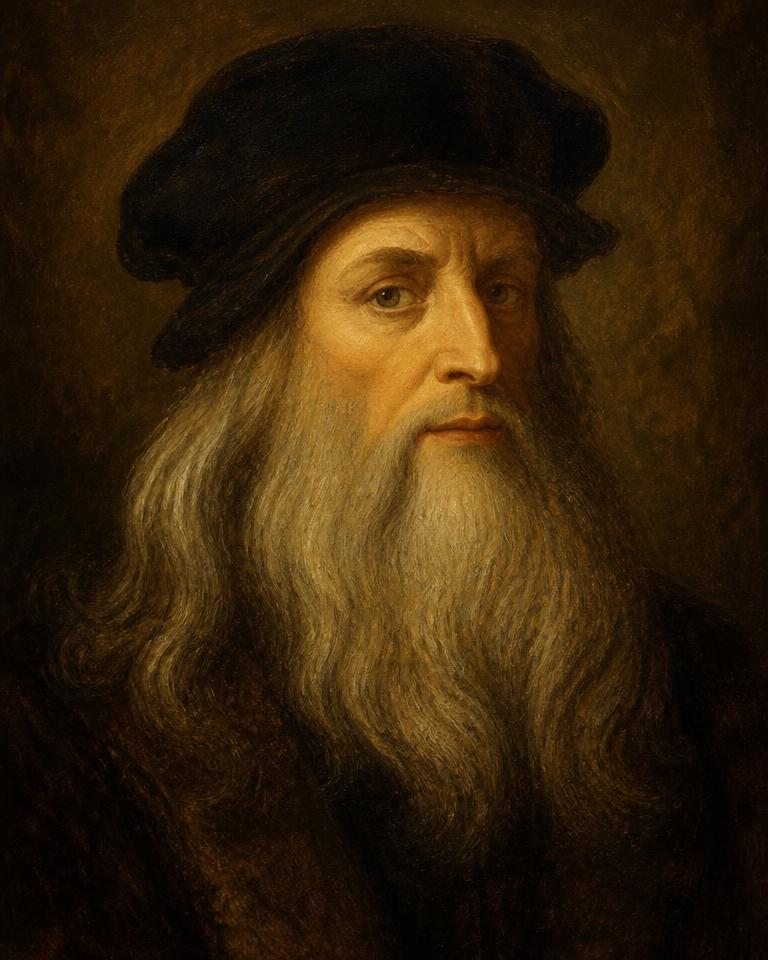
Quick Facts
- Years
- 1452 – 1519
- Category
- Scientists & Inventors
- Subcategory
- Renaissance Science
- Nationality
- Italian
- Occupation
- Polymath & Inventor
Leonardo da Vinci
1452 – 1519 · Italian · Polymath & Inventor
Audiobook

Life Lessons from Leonardo da Vinci
Marcus Alden · 1 hr
Leonardo da Vinci was an Italian artist, engineer, anatomist, and investigator of nature whose notebooks reveal one of history’s most wide-ranging intellects. Born near Vinci in 1452, he trained in Andrea del Verrocchio’s Florentine workshop before serving patrons in Florence, Milan, Rome, and France. Although relatively few paintings can be securely attributed to him, works such as The Last Supper, the Mona Lisa, and the Virgin of the Rocks transformed Western art through psychological subtlety, unified composition, and innovative handling of light and atmosphere.
Leonardo also studied anatomy, water, flight, optics, geology, mechanics, architecture, and military engineering. His drawings include precise anatomical studies and designs for machines, but modern claims that he “invented” every device he sketched often exaggerate what was built or original. His deeper achievement was methodological: he joined observation, experiment, drawing, and mechanical reasoning in an unusually systematic search for causes.
His career included abandoned commissions, technical failures, and thousands of notebook pages left unpublished. Yet that combination of achievement and incompletion makes him especially revealing. Leonardo remains important not merely as a symbol of “genius,” but as a historically situated Renaissance practitioner who crossed boundaries between art and natural knowledge. His works continue to shape museums, scholarship, engineering imagination, visual culture, and debates about creativity itself.
Quick Facts
| Field | Information |
|---|---|
| Full Name | Leonardo di ser Piero da Vinci |
| Common Name(s) | Leonardo da Vinci; Leonardo |
| Born | 15 April 1452 |
| Died | 2 May 1519 |
| Age at Death | 67 |
| Birthplace | Anchiano or Vinci, Republic of Florence (exact location debated) |
| Nationality | Florentine/Italian; “Italian” is the modern cultural designation |
| Occupation | Painter, draftsman, engineer, anatomist, architect, sculptural designer, natural philosopher |
| Historical Era | Italian Renaissance |
| Famous For | Mona Lisa, The Last Supper, Virgin of the Rocks, Vitruvian Man, notebooks, anatomical and engineering studies |
| Political Affiliation if applicable | No formal party affiliation; served successive Florentine, Milanese, papal, and French patrons |
| Religion if significant | Baptized and culturally Christian; precise personal beliefs remain debated |
| Education | Workshop apprenticeship under Andrea del Verrocchio; no university education recorded |
| Parents | Ser Piero da Vinci and Caterina, whose precise identity remains debated |
| Spouse(s) | Never married |
| Children | None recorded |
| Major Works | The Annunciation, Adoration of the Magi, Virgin of the Rocks, Lady with an Ermine, The Last Supper, Mona Lisa, Saint John the Baptist, Vitruvian Man |
| Major Achievements | Major innovations in Renaissance painting; extensive anatomical, mechanical, hydraulic, optical, and flight studies; influential integration of art and empirical inquiry |
Early Life
Leonardo was born on 15 April 1452, the illegitimate son of Ser Piero, a Florentine notary, and Caterina. Scholars have proposed different identities and social origins for Caterina, but surviving evidence has not produced universal agreement. Leonardo grew up within his father’s extended household around Vinci, in Tuscan territory governed by Florence.
Illegitimacy limited access to the conventional professional path of a notary and probably helped direct him toward an artistic trade. He received practical instruction in reading, writing, and arithmetic, but no university training and little formal Latin in youth. He later worked to improve his Latin and called himself an omo sanza lettere—a “man without letters”—contrasting experience with bookish authority.
The countryside around Vinci exposed him to streams, rock formations, plants, animals, and changing atmospheric effects. His mature notebooks suggest that these early surroundings nourished a lasting attention to natural processes, although specific childhood anecdotes are difficult to verify.
By the late 1460s, Leonardo entered the Florence workshop of Andrea del Verrocchio, one of the city’s leading artists. Such workshops trained apprentices collaboratively in drawing, painting, sculpture, metalwork, mechanics, and preparation for public spectacles. Leonardo learned within a culture shaped by classical revival, commercial wealth, Medici patronage, and intense artistic competition. By 1472 he had joined Florence’s painters’ guild, the Compagnia di San Luca, while apparently continuing to work with Verrocchio.
Rise to Prominence
Leonardo’s early paintings already displayed extraordinary sensitivity to landscape, light, gesture, and texture. He is generally credited with parts of Verrocchio’s Baptism of Christ, although the traditional story that Verrocchio abandoned painting after seeing Leonardo’s angel comes from Giorgio Vasari and is not reliable as literal fact.
Independent commissions followed. The unfinished Adoration of the Magi, ordered in 1481 for San Donato a Scopeto, shows Leonardo constructing a complex drama through movement and facial response. He left it incomplete when he departed for Milan around 1482.
Leonardo presented himself to Ludovico Sforza, Milan’s ruler, as an engineer able to design bridges, fortifications, weapons, and public works; painting appeared near the end of the famous résumé preserved in the Codex Atlanticus. At the Sforza court he created portraits, designed entertainments, advised on architecture and engineering, and planned a colossal equestrian monument to Francesco Sforza.
His Milanese reputation culminated in The Last Supper, painted for Santa Maria delle Grazie in the 1490s. Its dramatic treatment of Christ’s announcement of betrayal brought immediate admiration. Yet Leonardo’s experimental wall technique deteriorated rapidly. When French forces conquered Milan in 1499, the Sforza regime fell, the equestrian monument remained unrealized, and Leonardo began years of travel and changing patronage.
Major Achievements
Transforming Renaissance Painting
Leonardo replaced rigid outlines with subtle tonal transitions, especially the smoky effect later called sfumato. He coordinated figures through glances, gestures, and shared psychological action. In The Last Supper, the apostles react in varied groups while perspective directs attention toward Christ. In the Mona Lisa, atmospheric landscape, controlled modeling, and an ambiguous expression produce an unusually living presence.
These methods mattered because they made inner life appear through visible form. Raphael, Correggio, and many later artists absorbed aspects of Leonardo’s compositional and tonal language. His small surviving painted oeuvre became disproportionately influential.
Anatomical Investigation
Leonardo studied the human body over decades and participated in dissections, especially in Milan, Florence, and later Rome. His sheets analyze skeletons, muscles, organs, pregnancy, facial structure, and the heart. Work conducted with Marcantonio della Torre around 1510–1511 may have been intended for a treatise that was never completed.
His drawings combined multiple views, cutaways, notes, and sequential diagrams. He correctly investigated the heart’s valves and the mechanics of movement, though he also retained inherited errors and analogies. Because the studies remained unpublished, they had little direct impact on sixteenth-century medicine. Their modern importance lies in their visual precision and evidence of sustained empirical research.
Engineering and Mechanics
Leonardo designed gears, bearings, cranes, pumps, locks, bridges, military devices, and mechanisms for theatrical productions. Some forms had medieval or ancient precedents; others were adaptations rather than wholly new inventions. Many existed only as sketches and could not have operated with the materials or power sources then available.
Even so, his analysis of friction, force, motion, and machine components was remarkable. By treating machines as combinations of elementary mechanisms, he anticipated an important engineering habit: understanding systems through transferable parts and principles.
Studies of Flight
Bird flight fascinated Leonardo. He examined wings, air resistance, balance, and the movement of the body’s center of gravity. His notebooks contain ornithopters, a parachute-like device, and the celebrated helical aerial screw.
He did not build a functioning airplane or helicopter. The lasting significance of these studies is analytical rather than technological: he moved from imitation of flapping birds toward inquiry into airflow, gliding, control, and mechanical constraints.
Hydraulics, Geology, and the Earth
Leonardo studied eddies, waves, erosion, canals, river diversion, and flood control. He observed marine fossils in mountain rocks and rejected simplistic explanations that they had been carried there by a single biblical flood. His geological conclusions were incomplete, but they relied strikingly on sediment, water action, and deep natural change.
As an engineer, he proposed canal and river projects for Milan and Florence. Not all were practical or executed, yet they linked close observation of water with civic and military planning.
Drawing as a Tool of Knowledge
The Vitruvian Man, made around 1490, examines ideal human proportions derived from the Roman architect Vitruvius while revising them through observation. Across thousands of surviving sheets, Leonardo used drawing not merely to illustrate conclusions but to think.
This fusion of text and image allowed him to compare forms, test mechanisms, and display structures invisible from one viewpoint. Scientific illustration, design practice, and anatomical communication still rely on this fundamental visual method.
Leadership and Work
Leonardo led workshops and coordinated assistants, pupils, craftsmen, and court specialists, but he was not an institutional leader in the modern sense. His practice depended on patronage and collaboration. Bernardino Luini, Giovanni Antonio Boltraffio, Marco d’Oggiono, and Francesco Melzi were among artists connected with his Milanese circle, though attribution within the workshop remains contested.
His decision-making was exploratory. He generated alternatives, revised repeatedly, and sought underlying principles before accepting a solution. Observation, analogy, measurement, and drawing formed his central methods. He valued experience and criticized authorities whose claims were unsupported by demonstration.
His strengths included visual memory, interdisciplinary thinking, technical imagination, and the ability to connect form with function. His weaknesses were equally consequential: he often overextended projects, experimented with unstable materials, missed deadlines, and left works unfinished. Patrons could admire his brilliance while becoming frustrated by slow completion.
Relationships were pragmatic but sometimes warm. He adapted successfully to republican, ducal, papal, and royal courts. In his final years, French king Francis I gave him status and security. Leonardo’s notebooks also reveal a solitary intellectual discipline, even though his career was sustained by teams, servants, patrons, and skilled collaborators.
Personal Life
Leonardo never married and had no recorded children. In 1476 he and several other young men were anonymously accused in Florence of sodomy, then a criminal offense. The charge was dismissed, apparently for lack of admissible evidence. It does not establish the details of his sexual life. Scholars have debated his sexuality, but the surviving record permits no certain reconstruction.
His closest later companion was Francesco Melzi, a well-born Milanese pupil who inherited most of Leonardo’s papers. Another longtime associate, Gian Giacomo Caprotti—known as Salaì—entered his household as a boy in 1490 and remained connected to him for decades. Leonardo’s notes portray Salaì as troublesome, though he also became a pupil and beneficiary.
Contemporaries and early biographers described Leonardo as attractive, socially accomplished, musically talented, and fond of elegant dress. Such testimony should be read with awareness that Renaissance biographies often shaped exemplary personalities. His notebooks, however, confirm broad interests in music, riddles, jokes, animals, costume, and festival design.
He appears to have been left-handed and commonly wrote in mirror script from right to left, probably because it was comfortable and reduced smudging rather than because he sought secrecy. Late in life he suffered impaired movement in his right arm or hand, described by a visitor in 1517. The exact diagnosis is unknown.
Philosophy and Beliefs
Leonardo’s intellectual outlook centered on experience, sensory evidence, mathematics, and causal explanation. “Wisdom is the daughter of experience,” he wrote in a notebook. Yet he was not a modern scientist operating with today’s institutions or methods. His thought combined experiment with analogy, classical sources, artistic theory, and Renaissance natural philosophy.
Politically, he was flexible rather than doctrinaire. He worked for the Medici environment, the Sforzas, Cesare Borgia, the Florentine Republic, papal circles, and the French monarchy. This adaptability reflected the realities of patronage in a divided and frequently warring Italy.
His religious position is harder to define. He produced major Christian images, received ecclesiastical commissions, and was buried with church rites. Some later writers portray him as skeptical or heterodox, while others emphasize his spiritual engagement with nature and sacred art. The evidence does not justify confidently labeling him atheist, orthodox theologian, or esoteric initiate.
Ethically, his notes sometimes condemn cruelty and war, yet he offered military engineering services and worked for rulers engaged in violent conflict. This tension reflects both personal contradiction and the dependence of Renaissance specialists on powerful patrons.
Challenges and Controversies
Incompletion was Leonardo’s most persistent professional problem. The Adoration of the Magi, Saint Jerome, and Battle of Anghiari remained unfinished. The Sforza horse never reached bronze, partly because metal was diverted for war and Milan’s political order collapsed.
Technical experimentation also failed. The Last Supper was painted on a dry wall with an experimental layered method rather than durable true fresco, and deterioration began within decades. The Battle of Anghiari mural was abandoned after difficulties traditionally associated with its painting process, although details remain debated.
Attribution presents another controversy. Specialists disagree over the degree of Leonardo’s participation in works such as Salvator Mundi, La Belle Ferronnière, and some workshop paintings. The 2017 auction of Salvator Mundi for a record price intensified debate over authorship, condition, restoration, and the art market.
Popular culture frequently turns his sketches into claims that he invented the helicopter, tank, bicycle, robot, or diving suit. Some designs resemble later technologies, but historical assessment must distinguish conceptual drawings from tested inventions and acknowledge earlier precedents.
His service to Cesare Borgia as military architect and engineer in 1502 has also prompted ethical scrutiny. One view emphasizes professional survival and technical employment; another stresses complicity in coercive warfare. The record does not reveal a complete personal justification.
Finally, narratives of a solitary, universally knowledgeable genius can obscure collaborators, workshop practices, predecessors, and the limits of his knowledge. Recognizing those contexts does not diminish Leonardo; it makes his achievements historically intelligible.
Legacy
Leonardo’s immediate artistic influence spread through Lombardy and central Italy. His compositions circulated through pupils, copies, drawings, and prints. Raphael studied his Florentine work, while later artists adopted his atmospheric modeling and psychological interaction.
His manuscripts had a more fragmented history. Melzi tried to organize them, but after his death the papers dispersed. Some material informed the posthumous Treatise on Painting, while much remained inaccessible for centuries. The nineteenth and twentieth centuries brought facsimiles, transcription, and systematic scholarship, helping construct the modern image of Leonardo as the universal Renaissance genius.
Major holdings are preserved in the Royal Collection at Windsor Castle, the Biblioteca Ambrosiana in Milan, the Institut de France in Paris, the British Library, the Biblioteca Nacional de España, and other institutions. The Louvre houses the Mona Lisa; Santa Maria delle Grazie preserves The Last Supper; the Gallerie dell’Accademia in Venice holds the Vitruvian Man.
Museums and institutions bearing his name include Milan’s Museo Nazionale Scienza e Tecnologia Leonardo da Vinci and the Museo Leonardiano in Vinci. Leonardo da Vinci–Fiumicino Airport, public monuments, schools, prizes, exhibitions, novels, and films reflect his global cultural status.
His modern relevance lies less in prophetic gadgets than in his habit of crossing disciplines. Artists study his composition; anatomists admire his visualization; engineers analyze his mechanisms; historians examine his patronage networks and manuscripts. He remains a model of curiosity—provided admiration does not replace evidence.
Interesting Facts
- Leonardo was born on 15 April 1452, according to a notation by his grandfather.
- “Da Vinci” means “from Vinci”; it was not a modern hereditary surname.
- He joined Florence’s painters’ guild by 1472.
- He wrote much of his private notation from right to left.
- More than 7,000 notebook pages survive, though many others are lost.
- He played music and was associated with the lira da braccio.
- He designed court festivals and theatrical machinery in Milan.
- The planned Sforza horse was intended to be monumental but was never cast in bronze.
- The Last Supper began deteriorating unusually soon after completion.
- The Mona Lisa remained with Leonardo rather than its presumed commissioner.
- He mapped the Tuscan town of Imola for Cesare Borgia.
- His anatomical drawings included a fetus in the uterus.
- He studied vortices in both water and air.
- The Codex Leicester is largely concerned with water and the Earth.
- Bill Gates purchased the Codex Leicester in 1994.
- Leonardo spent his final years near Amboise under Francis I’s patronage.
- The romantic story that Leonardo died in Francis I’s arms is not supported by contemporary evidence.
- His original grave was disrupted during the French Revolution; remains later attributed to him cannot be identified with absolute certainty.
Famous Quotes
Quotations are translated from Leonardo’s Italian manuscripts, so wording varies by edition.
- “Wisdom is the daughter of experience.” In a notebook critique of empty authority, Leonardo presents experience as the basis of reliable knowledge.
- “Those who fall in love with practice without science are like a sailor who enters a ship without rudder or compass.” From his notes on method; it argues that action needs governing principles.
- “The eye, which is called the window of the soul, is the chief means whereby the understanding may most fully and abundantly appreciate the infinite works of nature.” From writings on painting; it explains the intellectual status he granted vision.
- “Painting is poetry that is seen rather than felt, and poetry is painting that is felt rather than seen.” From the tradition preserved in the Treatise on Painting; it participates in the Renaissance comparison of the arts.
- “The noblest pleasure is the joy of understanding.” Recorded among his maxims; it captures his association of inquiry with delight.
- “Nature never breaks her own laws.” From notebook observations; it expresses confidence that natural events have consistent causes.
- “Every action needs to be prompted by a motive.” A notebook maxim emphasizing causation and purposeful action.
- “Learning never exhausts the mind.” Widely translated from a Leonardo maxim, though exact English wording varies; it celebrates sustained study.
- “Simplicity is the ultimate sophistication.” Disputed attribution. Frequently credited to Leonardo, but no secure primary-source basis is known.
- “Art is never finished, only abandoned.” Disputed attribution. It aptly evokes his revisions but is not securely documented in this familiar form.
Timeline
- 1452 — Born near Vinci on 15 April.
- Late 1460s — Enters Andrea del Verrocchio’s Florentine workshop.
- 1472 — Recorded as a member of Florence’s painters’ guild.
- 1473 — Dates an early landscape drawing.
- 1476 — Sodomy accusation is dismissed.
- c. 1470s — Contributes to works associated with Verrocchio’s workshop.
- 1481 — Receives commission for the unfinished Adoration of the Magi.
- c. 1482 — Moves to Milan and offers his services to Ludovico Sforza.
- 1483 — Contracts for the first version of Virgin of the Rocks.
- c. 1489–1490 — Paints Lady with an Ermine and intensifies anatomical studies.
- c. 1490 — Creates the Vitruvian Man.
- 1490s — Develops plans for the Sforza equestrian monument.
- c. 1495–1498 — Paints The Last Supper.
- 1499 — Leaves Milan after the French conquest.
- 1500 — Returns to Florence after traveling through Mantua and Venice.
- 1502–1503 — Serves Cesare Borgia as military architect and engineer.
- 1503 — Begins work associated with the Mona Lisa and receives the Battle of Anghiari commission.
- 1506 — Returns to Milan under French rule.
- c. 1510–1511 — Conducts advanced anatomical research with Marcantonio della Torre.
- 1513 — Moves to Rome under Giuliano de’ Medici’s patronage.
- 1516 — Enters the service of Francis I and relocates to France.
- 1517 — Receives a visit from Cardinal Luigi of Aragon’s secretary, who records his condition and works.
- 1519 — Dies at Cloux, now Clos Lucé, on 2 May.
Frequently Asked Questions
Why is Leonardo da Vinci considered a polymath?
Leonardo worked across painting, drawing, anatomy, mechanics, hydraulics, optics, architecture, music, stage design, and natural philosophy. “Polymath” is appropriate because his surviving manuscripts demonstrate sustained inquiry, not merely casual interest, in many fields. Nevertheless, his knowledge had Renaissance limits, and many projects remained speculative or incomplete. The label is most useful when it describes his ability to connect disciplines—for example, using anatomy to improve figure drawing or studying water through both engineering and visual analysis—rather than treating him as an all-knowing modern scientist.
Where and when was Leonardo born?
Leonardo was born on 15 April 1452 in the territory of Vinci, a Tuscan community within the Republic of Florence. His grandfather recorded the birth and baptism. Tradition identifies a house in nearby Anchiano as his birthplace, but scholars cannot establish the precise building with certainty. He was born outside marriage to Ser Piero, a notary, and Caterina. Modern descriptions often call him Italian, which is culturally sensible, although political Italy did not become a unified nation-state until the nineteenth century.
What does “da Vinci” mean?
“Da Vinci” means “from Vinci.” Leonardo’s fuller historical name, Leonardo di ser Piero da Vinci, identifies him as Leonardo, son of Ser Piero, from Vinci. It was not a hereditary surname in the modern sense. For that reason, historians generally call him “Leonardo” rather than “da Vinci” when using a shortened name. The familiar English usage remains widely understood, but the original form reflects Renaissance naming customs and Leonardo’s connection to his birthplace.
Who taught Leonardo to paint?
Leonardo trained in Andrea del Verrocchio’s workshop in Florence, probably beginning in the late 1460s. Verrocchio was a painter, sculptor, and metalworker whose establishment offered broad practical training. Apprentices learned drawing, pigments, panel preparation, modeling, metalwork, and collaborative production. Leonardo’s environment also brought him into contact with the competitive artistic culture of Florence. Although Vasari tells a dramatic story about Leonardo surpassing his master, modern scholarship treats that anecdote cautiously. Verrocchio’s workshop, rather than one isolated lesson, provided Leonardo’s essential education.
What are Leonardo’s most famous artworks?
His best-known paintings are the Mona Lisa in the Louvre and The Last Supper at Santa Maria delle Grazie in Milan. Other major works include two versions of the Virgin of the Rocks, Lady with an Ermine, The Annunciation, Saint John the Baptist, and the unfinished Adoration of the Magi and Saint Jerome. The Vitruvian Man is a drawing rather than a painting. Attribution is difficult because Leonardo collaborated with assistants, revised works over long periods, and left a small surviving body of paintings.
Who is the woman in the Mona Lisa?
The leading identification is Lisa Gherardini, wife of the Florentine merchant Francesco del Giocondo. This explains the Italian title La Gioconda and is supported by early documentary evidence, including a note discovered in a book once owned by Agostino Vespucci. Some scholars have proposed alternative sitters or a more idealized conception, and the painting may have evolved beyond a conventional portrait commission. Leonardo retained it and continued refining it, which helps explain why its commissioning history and final purpose remain partly uncertain.
Why is the Mona Lisa so famous?
Its fame results from artistic quality, historical reputation, museum display, reproduction, and modern publicity. Leonardo used subtle tonal transitions, atmospheric depth, and carefully balanced pose and gaze to create a compelling psychological presence. The painting was already admired before 1911, but its theft from the Louvre that year generated international headlines. Its recovery in 1913, subsequent travel, mass reproduction, parody, and prominent Louvre placement made it a global icon. Its celebrity therefore combines Renaissance innovation with a much later history of media and cultural circulation.
Did Leonardo invent the helicopter?
No, not in the modern engineering sense. He drew a helical aerial screw that visually resembles a helicopter rotor, but there is no evidence that he built or flew it. The design lacked an adequate lightweight power source and did not solve all the aerodynamic problems of controlled vertical flight. It remains historically important because it shows Leonardo thinking about air as a material capable of resistance and lift. Calling it a helicopter can be a useful analogy, but saying he invented the operational helicopter overstates the evidence.
Did Leonardo invent the tank and parachute?
Leonardo sketched an armored vehicle with weapons and a pyramidal parachute-like device. Both belong to a long history of mechanical and military ideas, and neither became an operational technology under his direction. Modern reconstructions can sometimes be made to work after choices or modifications that Leonardo never tested. His importance lies in conceptual visualization, mechanical analysis, and the communication of designs through drawings. Historians therefore distinguish between imagining or adapting a device and inventing a tested, practical machine that influences later development.
Was Leonardo a scientist?
He can reasonably be described as a scientific investigator, provided the term is used historically. He observed, measured, dissected, compared, and sometimes experimented. His studies of anatomy, optics, water, geology, and mechanics sought natural causes rather than relying solely on inherited authority. However, he lived before modern scientific professions, peer-reviewed journals, and standardized experimental institutions. He also used analogies that later proved wrong and published almost none of his findings. “Natural philosopher” and “artist-engineer” capture his period more precisely, while “scientist” conveys recognizable aspects of his method.
Why did Leonardo write backward?
Leonardo commonly wrote Italian notes in mirror script, moving from right to left. Because he was left-handed, this direction was probably comfortable and helped prevent his hand from smearing wet ink. The notion that he used mirror writing primarily to hide secret discoveries is unsupported; the script is not difficult to decode, and he sometimes wrote conventionally for other readers. His notebooks were working documents filled with revisions, diagrams, lists, and reminders. Their unusual appearance reflects personal practice more than deliberate encryption.
How many notebooks survive?
More than 7,000 pages or sheets associated with Leonardo survive, depending on how pages, folios, and fragments are counted. They are dispersed among collections and organized into codices such as the Codex Atlanticus, Codex Leicester, Codex Arundel, and the manuscripts of the Institut de France. Many pages were lost, separated, trimmed, or rebound after his death. The surviving material spans decades and includes polished diagrams, rough calculations, literary notes, shopping lists, jokes, engineering schemes, and observations of nature.
Was Leonardo gay?
Leonardo’s sexual orientation cannot be established with certainty from surviving evidence. In 1476 he and other young men were accused anonymously of sodomy, but the case was dismissed. He never married, had no recorded children, and formed close relationships with male pupils and companions. Some modern scholars interpret these facts as suggesting that he was homosexual; others emphasize the limits of applying modern identity categories to incomplete Renaissance evidence. Responsible biography can discuss the evidence and its context without turning an unproven interpretation into fact.
Why did Leonardo leave so many works unfinished?
Several causes contributed. Leonardo revised extensively, pursued difficult technical effects, shifted between disciplines, and sometimes lost interest after solving a conceptual problem. Political upheaval interrupted the Sforza monument and displaced him from Milan. Patronage changes and technical failures affected other projects. His experimental temperament could conflict with deadlines and durable execution. Yet incompletion should not be reduced to laziness: preparatory studies show intense labor, and some Renaissance commissions changed for reasons beyond an artist’s control. His unfinished works reveal both extraordinary ambition and chronic difficulty bringing projects to closure.
What happened to The Last Supper?
Leonardo painted The Last Supper on a refectory wall at Santa Maria delle Grazie in Milan, probably between about 1495 and 1498. Seeking the detail and revision possible in panel painting, he used an experimental dry-wall technique rather than true fresco. Moisture and unstable materials caused rapid deterioration. War, environmental damage, repainting, and earlier restorations worsened its condition. A major modern conservation campaign completed in 1999 removed later additions where possible and stabilized surviving material. What visitors see is fragile, but enough remains to convey the revolutionary composition.
Did Leonardo and Michelangelo dislike each other?
Sources indicate rivalry and tension, though later storytelling may exaggerate personal hostility. They differed in age, temperament, artistic ideals, and public reputation. In Florence, both received commissions for enormous battle scenes in the Palazzo Vecchio—Leonardo’s Battle of Anghiari and Michelangelo’s Battle of Cascina—creating a celebrated competitive setting. Neither mural was completed, but their preparatory designs influenced other artists. Reports of sharp exchanges are plausible but come through sources with literary agendas. Their relationship is best understood as competitive rather than reduced to a simple feud.
How did Leonardo die?
Leonardo died on 2 May 1519 at Cloux, now Clos Lucé, near Amboise in France. He was 67. A contemporary visitor had noted impairment of his right hand or arm in 1517, and some modern writers suggest stroke, but the precise cause of death is not recorded. Vasari’s moving account of Leonardo dying in the arms of King Francis I became famous in art, yet the king was probably elsewhere. Leonardo was buried at the church of Saint-Florentin in Amboise, later destroyed.
Where can Leonardo’s work be seen today?
The Louvre displays the Mona Lisa, Virgin and Child with Saint Anne, and Saint John the Baptist. The Last Supper remains in Milan, and the Vitruvian Man belongs to Venice’s Gallerie dell’Accademia, where it is shown only under controlled conditions. Major drawings are held by the Royal Collection at Windsor Castle. Manuscripts are preserved in Milan’s Biblioteca Ambrosiana, the British Library, the Institut de France, and other collections. Because the works are fragile, access and display schedules vary, while high-quality digital facsimiles broaden scholarly and public study.
Lessons We Can Learn
- Observe before concluding. Leonardo repeatedly studied water, muscles, and light from life. Careful evidence remains the best defense against confident error.
- Connect disciplines. Anatomy improved his painting, while drawing strengthened his investigation. Modern innovation often occurs where fields meet.
- Use sketches to think. His diagrams tested ideas rather than merely decorating them. Externalizing a problem can reveal structures that words alone miss.
- Question authority constructively. Leonardo compared received claims with experience. Today, healthy skepticism should be paired with evidence, not reflexive distrust.
- Study causes, not just appearances. He sought the mechanics behind motion and form. Understanding systems produces more durable solutions than treating symptoms.
- Balance imagination with feasibility. His flying and military designs were bold, but many were unbuildable. Creative concepts need materials, testing, and constraints.
- Finish strategically. Leonardo’s incomplete commissions show the cost of endless revision. Define completion criteria and deliver before perfection becomes paralysis.
- Document the process. His notebooks preserve questions, alternatives, and failures. Good records make work reviewable and transferable.
- Adapt without losing curiosity. Political upheaval forced him among cities and patrons, yet he continued investigating. Adaptability can sustain long-term purpose.
- Avoid the lone-genius myth. Workshops, patrons, texts, craftsmen, and pupils supported his work. Achievement is individual and collaborative at once.
Related Historical Figures
- Andrea del Verrocchio — Leonardo’s Florentine master, whose multidisciplinary workshop shaped his artistic and technical formation.
- Ludovico Sforza — Duke of Milan and major patron who employed Leonardo as artist, engineer, and court designer.
- Cecilia Gallerani — Sforza court intellectual and probable sitter for Lady with an Ermine.
- Francesco Melzi — Devoted pupil and heir who preserved Leonardo’s manuscripts.
- Salaì — Longtime assistant, pupil, companion, and beneficiary in Leonardo’s household.
- Michelangelo Buonarroti — Florentine rival whose art and Palazzo Vecchio commission formed a defining competitive contrast.
- Raphael — Younger Renaissance master who studied and adapted Leonardo’s compositions and figure relationships.
- Cesare Borgia — Military ruler who employed Leonardo as architect and engineer in 1502–1503.
- Niccolò Machiavelli — Florentine official connected to the political setting of Leonardo’s river-diversion and Battle of Anghiari projects.
- Francis I of France — King who welcomed Leonardo to France and supported him during his final years.
Related Historical Figures