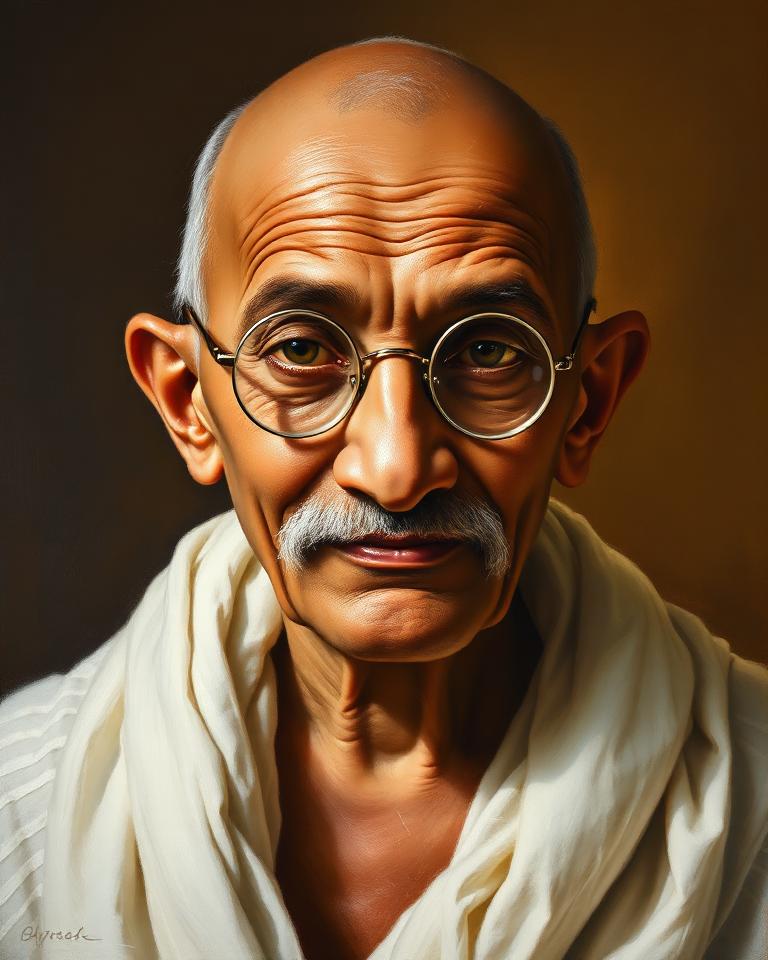
Quick Facts
- Years
- 1869 – 1948
- Category
- Social Reformers & Humanitarians
- Subcategory
- Social Reformers & Humanitarians
- Nationality
- Indian
- Occupation
- Lawyer and Anti-Colonial Nationalist
Mahatma Gandhi
1869 – 1948 · Indian · Lawyer and Anti-Colonial Nationalist
Audiobook

Life Lessons from Mahatma Gandhi
Marcus Alden · 56 min
Mohandas Karamchand Gandhi (1869–1948), widely called Mahatma Gandhi, was an Indian lawyer, anti-colonial nationalist, social reformer, and moral philosopher. He transformed satyagraha—the disciplined pursuit of truth through nonviolent resistance—into a powerful method of mass politics. After developing his ideas while resisting racial discrimination in South Africa, Gandhi returned to India in 1915 and became a central leader of the struggle against British rule.
His campaigns connected national independence with everyday grievances: oppressive taxation, salt laws, rural poverty, labor disputes, religious division, and the exclusion of communities then labeled “untouchable.” The Non-Cooperation Movement, Salt March, and Quit India Movement challenged imperial authority while inspiring later advocates of civil resistance, including Martin Luther King Jr. and Nelson Mandela.
Gandhi did not hold government office after independence, and his record remains contested. Historians debate his political strategy, ideas about caste and race, economic program, religious language, and controversial personal experiments. His efforts could unite millions, but his movements also encountered violence and sometimes ended without immediate victory.
Assassinated in New Delhi on 30 January 1948, Gandhi remains one of the most studied figures of the twentieth century because his life raises enduring questions about ethical leadership, political means, social justice, and the possibilities—and limits—of nonviolent action.
Quick Facts
| Field | Details |
|---|---|
| Full Name | Mohandas Karamchand Gandhi |
| Common Name(s) | Mahatma Gandhi; Gandhi; Bapu |
| Born | 2 October 1869 |
| Died | 30 January 1948 |
| Age at Death | 78 |
| Birthplace | Porbandar, Kathiawar, British India; now Gujarat, India |
| Nationality | Indian |
| Occupation | Lawyer, anti-colonial nationalist, political leader, writer, social reformer |
| Historical Era | British Raj; Indian independence movement; early twentieth century |
| Famous For | Satyagraha, nonviolent resistance, the Salt March, and leadership in India’s independence struggle |
| Political Affiliation | Indian National Congress, chiefly 1915–1934; never consistently defined by formal office |
| Religion | Hinduism, interpreted inclusively and influenced by Jain, Christian, Islamic, and other traditions |
| Education | Samaldas College briefly; Inner Temple, London; called to the English bar in 1891 |
| Parents | Karamchand Uttamchand Gandhi and Putlibai Gandhi |
| Spouse | Kasturba Gandhi (married 1883–1944, her death) |
| Children | Harilal, Manilal, Ramdas, and Devdas Gandhi; an earlier infant died shortly after birth |
| Major Works | Hind Swaraj; Satyagraha in South Africa; The Story of My Experiments with Truth; editorials in Indian Opinion, Young India, Navajivan, and Harijan |
| Major Achievements | Developed satyagraha; led major anti-colonial campaigns; advanced communal reconciliation and campaigns against untouchability; influenced global civil-resistance movements |
Early Life
Gandhi was born in the coastal principality of Porbandar. His father, Karamchand Gandhi, served as a chief minister in several small Kathiawar states. His mother, Putlibai, was deeply religious and observed demanding vows and fasts. Their household belonged to the Vaishya caste and followed the Vaishnava tradition, while the religiously diverse culture of western India exposed Gandhi to Jain teachings about non-harm and self-discipline.
As a child, Gandhi described himself as shy and unexceptional at school. Stories about the truthful King Harishchandra and the devoted son Shravana made a lasting impression on him. These memories come largely from his later autobiography and therefore reflect his mature effort to interpret his childhood morally.
In 1883, at age thirteen, he married Kasturba Makhanji in an arranged child marriage. Gandhi later criticized child marriage and wrote candidly about his youthful jealousy and possessiveness. The couple eventually had four surviving sons.
Gandhi traveled to London in 1888 to study law, after promising his mother that he would avoid meat, alcohol, and sexual misconduct. At the Inner Temple, he qualified as a barrister. London also broadened his intellectual world. Through the Vegetarian Society and Theosophical acquaintances, he read the Bhagavad Gita, the Bible—especially the Sermon on the Mount—and works on religion and ethics.
Called to the bar in 1891, Gandhi returned to India, where his mother had died during his absence. His first legal efforts in Bombay were unsuccessful: he struggled with public speaking and courtroom procedure. A commercial assignment to South Africa in 1893 unexpectedly redirected his career.
Rise to Prominence
South Africa was Gandhi’s political apprenticeship. Soon after arriving, he encountered racial discrimination, most famously when railway officials removed him from a first-class compartment at Pietermaritzburg despite his ticket. The precise meaning he later gave this episode evolved in retrospect, but it became emblematic of the racial order confronting Indians.
Gandhi remained in South Africa for about twenty-one years, with visits abroad. He founded the Natal Indian Congress in 1894, petitioned authorities, organized merchants and workers, and established the newspaper Indian Opinion. At first he sought equality for Indians within the British Empire rather than universal racial equality. His early writings sometimes repeated derogatory assumptions about Black Africans, language that has generated justified modern criticism. His attitudes changed in some respects, but scholars disagree over the degree and completeness of that change.
During the South African War and the Zulu rebellion, Gandhi organized Indian ambulance or stretcher-bearer units for British forces. He hoped loyal service would strengthen Indian claims to civic rights—a strategy that yielded disappointing results.
In 1906, resistance to compulsory registration laws in the Transvaal led Gandhi toward satyagraha, a term meaning roughly “holding firmly to truth.” Protesters accepted arrest and punishment while refusing compliance. The campaign involved imprisonment, negotiation, setbacks, strikes, and a major 1913 march by Indian workers. A 1914 settlement removed several grievances, though it did not dismantle South Africa’s racial system.
Gandhi returned permanently to India in 1915. His political mentor, Gopal Krishna Gokhale, advised him to travel and understand the country before leading national campaigns. Gandhi’s interventions at Champaran, Ahmedabad, and Kheda between 1917 and 1918 established him as a national figure who could connect elite politics with peasants and workers.
Major Achievements
Creating Satyagraha as a Political Method
Gandhi did not invent nonviolence, but he combined older religious and ethical traditions with organized civil resistance. Satyagraha required truthfulness, nonviolence, willingness to suffer legal penalties, and an effort to convert rather than humiliate opponents.
This mattered because it offered people excluded from armed or parliamentary power a disciplined means of resistance. Its long-term impact can be seen in civil-rights, anti-colonial, democratic, and human-rights campaigns worldwide, although successful movements adapted it to their own circumstances.
Champaran, Ahmedabad, and Kheda
In Champaran in 1917, Gandhi investigated indigo cultivators’ grievances and defied an order to leave. An official inquiry helped secure reforms. In 1918, he supported textile workers in Ahmedabad and peasants seeking tax relief after crop failure in Kheda.
These campaigns were not complete victories, and local organizers—including Raj Kumar Shukla, Vallabhbhai Patel, Mahadev Desai, and others—were essential. Nevertheless, they demonstrated Gandhi’s ability to combine fact-finding, negotiation, public discipline, and resistance.
Non-Cooperation and Mass Nationalism
Following the 1919 Rowlatt Acts and the Amritsar massacre, Gandhi’s faith in imperial justice collapsed. He allied with leaders of the Khilafat movement and launched Non-Cooperation in 1920. Indians were urged to surrender honors, boycott government institutions and foreign cloth, and build indigenous alternatives.
The campaign made the Indian National Congress a mass organization. Gandhi suspended it after protesters killed police officers at Chauri Chaura in 1922, prioritizing nonviolence over immediate momentum. Critics considered the withdrawal abrupt; supporters saw it as essential to the movement’s moral discipline.
The Salt March and Civil Disobedience
In 1930, Gandhi walked approximately 240 miles from Sabarmati Ashram to Dandi with selected companions, reaching the coast on 6 April and breaking the colonial salt law. Because salt was universally used and government-controlled, the issue made imperial power tangible.
Civil disobedience spread across India, involving women, students, peasants, merchants, and workers. Repression was severe. The campaign did not immediately win independence, but it damaged Britain’s moral authority, attracted worldwide attention, and demonstrated the reach of Indian nationalism.
Campaign Against Untouchability
Gandhi denounced untouchability as a grave moral wrong, promoted temple entry, sanitation work, and education, and lived with members of oppressed communities in his ashrams. He used the term “Harijan,” meaning “children of God,” which many Dalits later rejected as patronizing.
His disagreement with B. R. Ambedkar over separate electorates culminated in Gandhi’s 1932 prison fast and the Poona Pact. Gandhi’s supporters emphasize his role in moving caste exclusion to the center of public debate. Critics argue that he defended an idealized varna order for too long and constrained independent Dalit political power.
Quit India and the End of Empire
In August 1942, amid the Second World War, Gandhi called for British withdrawal and urged Indians to “Do or Die.” Colonial authorities immediately detained Congress leaders. Leaderless resistance included strikes and demonstrations, but also sabotage and violence that Gandhi did not authorize.
Quit India was crushed militarily, yet it revealed that Britain could no longer govern India with stable consent. Independence in 1947 resulted from many forces: decades of nationalism, mass mobilization, wartime exhaustion, international change, constitutional negotiations, labor and military unrest, and campaigns by numerous organizations—not Gandhi alone.
Work for Communal Peace
As Hindu-Muslim violence accompanied partition, Gandhi walked through riot-affected regions, met victims, defended minorities, and fasted for peace in Calcutta and Delhi. His presence helped calm some outbreaks, though it could not prevent partition or the mass displacement and killing around it.
His final fast in January 1948 pressed Delhi’s communities toward assurances of safety and reconciliation. This work illustrated his insistence that independence without interreligious justice was morally incomplete.
Leadership and Work
Gandhi led through personal example, symbols, persuasion, organization, and moral pressure. He simplified complex grievances into accessible actions: spinning cloth, making salt, boycotting institutions, marching, fasting, or accepting arrest. His newspapers and extensive correspondence allowed him to explain strategy and respond to critics.
He often consulted colleagues, but he could make sudden decisions based on conscience, particularly when violence occurred. Jawaharlal Nehru admired him while disputing his village-centered economics; Vallabhbhai Patel was a close organizer with a more pragmatic administrative outlook; Subhas Chandra Bose opposed his gradualism and nonviolence; Ambedkar challenged his caste politics; Muhammad Ali Jinnah increasingly rejected Congress claims to represent all Indians.
Gandhi’s strengths included courage, political imagination, communication, austerity, and an unusual capacity to mobilize diverse groups. His weaknesses included paternalism, overconfidence in personal moral authority, inconsistent judgments, and expectations of self-denial that others could find intrusive. Fasts could awaken conscience but also place intense pressure on allies and opponents.
His ashrams functioned as communities of discipline and training. Residents practiced communal labor, sanitation, hand-spinning, prayer, dietary restraint, and vows. These institutions embodied his belief that political transformation began with daily conduct, although authority within them remained strongly centered on Gandhi.
Personal Life
Gandhi and Kasturba’s marriage changed from a child marriage marked by his jealousy into a long, politically active partnership. Kasturba resisted some of his demands, participated in campaigns, and endured repeated imprisonment. She died in detention at the Aga Khan Palace in 1944.
Their family life was often strained. Gandhi devoted himself to public work and communal living, while expecting substantial sacrifices from relatives. His relationship with his eldest son, Harilal, was particularly troubled. Harilal resisted his father’s authority, struggled with finances and alcohol, and died months after Gandhi.
In 1906 Gandhi took a vow of brahmacharya, or celibacy, without a conventionally equal process of consultation with Kasturba. Late in life he conducted highly controversial “experiments” in celibacy that included sleeping beside young women, including his grandniece Manu, while claiming to test self-control. Many associates objected. Modern scholars widely regard these practices as ethically troubling because of power imbalances, regardless of Gandhi’s stated purpose.
Gandhi followed strict vegetarian diets, experimented with foods, practiced fasting, spun cotton, walked extensively, and maintained demanding schedules. He was interested in health, sanitation, education, rural crafts, and nature cure, though some medical opinions he expressed were unscientific. Friends and associates included Hermann Kallenbach, Henry and Millie Polak, C. F. Andrews, Mirabehn, Mahadev Desai, and Pyarelal.
Philosophy and Beliefs
Gandhi’s central concepts were satya (truth) and ahimsa (nonviolence). He eventually wrote that “Truth is God,” emphasizing a truth larger than any individual’s possession. Because people understand truth imperfectly, he believed opponents should not be destroyed and one must remain open to correction.
Satyagraha differed from passive submission. It involved active noncooperation with injustice while refusing hatred and retaliatory violence. Voluntary suffering was intended to expose wrongdoing, discipline the protester, and invite moral reconsideration.
His political ideal, swaraj, meant more than replacing British rulers with Indian ones. It included self-government, personal self-rule, decentralized villages, local production, and restraint of wants. In Hind Swaraj (1909), he criticized modern industrial civilization, centralized states, railways, doctors, and lawyers in sweeping terms. Even many admirers considered parts of this critique unrealistic.
Gandhi favored swadeshi, or reliance on local production, symbolized by the spinning wheel and khadi cloth. He proposed “trusteeship,” under which wealthy people would hold property for social benefit rather than face violent expropriation. Critics saw this as insufficiently structural; Gandhi considered it a nonviolent route toward economic justice.
Religiously, he remained Hindu while drawing from the Gita, Jain ethics, Jesus’ teachings, Islamic traditions, Tolstoy, Ruskin, and Thoreau. He defended interfaith respect and rejected conversion based on denigrating another faith. Yet his use of Hindu vocabulary sometimes alienated Muslims, secularists, and anti-caste thinkers.
Challenges and Controversies
Gandhi’s reputation should not obscure major disputes:
- Race in South Africa: Early writings used insulting racial language and often demanded Indian advancement without challenging the whole racial hierarchy. Defenders point to later universalist commitments; critics stress that his early activism was limited and prejudiced.
- Caste: Gandhi forcefully opposed untouchability but initially defended hereditary varna in modified form. His position evolved toward rejecting caste distinctions, yet Ambedkar and later Dalit thinkers considered his reformism inadequate.
- The Poona Pact: Gandhi opposed separate electorates for the “Depressed Classes,” fearing permanent division within Hindu society. Ambedkar believed distinct political safeguards were needed against caste domination. Their conflict remains central to interpretations of Indian democracy.
- Withdrawal after Chauri Chaura: Some nationalists believed Gandhi squandered revolutionary momentum in 1922. Gandhi argued that a movement incapable of nonviolent discipline was unready for civil disobedience.
- Economic thought: His preference for villages, hand production, and limited consumption challenged exploitative industrialization but offered no straightforward program for a large modern economy.
- Gender and sexuality: Gandhi encouraged women’s political participation, yet often idealized female suffering and purity. His celibacy experiments raise serious questions about consent and authority.
- Partition: Gandhi opposed partition and tried to restore communal trust, but he could not reconcile Congress and Muslim League positions. Responsibility for partition remains debated and cannot reasonably be assigned to one person.
- Nonviolence in extreme conditions: Critics questioned whether his method could confront genocidal regimes. Some of his comments about Jews under Nazism are widely criticized as morally earnest but gravely inadequate to the circumstances.
Legacy
Gandhi’s greatest international legacy is the demonstration that organized nonviolent resistance can weaken entrenched power. Martin Luther King Jr. studied Gandhian methods during the U.S. civil-rights movement. Nelson Mandela and other South African leaders engaged with his legacy while adopting strategies suited to apartheid. César Chávez, Václav Havel, and many civil-resistance organizers also drew lessons from him.
In India, Gandhi is officially honored as a foundational national leader, though “Father of the Nation” is an affectionate title rather than a constitutional designation. His birthday, 2 October, is Gandhi Jayanti and the United Nations’ International Day of Non-Violence. His image appears on Indian currency.
Major memorials include Raj Ghat in New Delhi, where his cremation site is marked; Gandhi Smriti, the location of his assassination; Sabarmati Ashram in Ahmedabad; Mani Bhavan in Mumbai; the National Gandhi Museum in New Delhi; and museums and monuments in South Africa and elsewhere. Statues stand in numerous countries, although some have prompted debate because of his early racial views.
Gandhi remains relevant not because every proposal is accepted, but because he linked political ends to ethical means. Environmentalists revisit his critique of limitless consumption; activists study his movement-building; critics use caste, feminist, and postcolonial analysis to expose his limitations. His legacy is therefore both influential and contested.
Interesting Facts
- “Mahatma,” meaning “great soul,” was an honorific, not part of Gandhi’s birth name.
- He qualified as a barrister at London’s Inner Temple in 1891.
- He lived and worked in South Africa for roughly two decades.
- The term satyagraha emerged from his South African campaigns.
- He established Phoenix Settlement in 1904 and Tolstoy Farm in 1910.
- He corresponded with Russian writer Leo Tolstoy.
- His 1909 book Hind Swaraj was written largely during a sea voyage.
- Gandhi returned to India permanently on 9 January 1915, now commemorated as Pravasi Bharatiya Divas.
- He wore increasingly simple Indian clothing as a political and ethical statement.
- He was arrested and imprisoned multiple times in South Africa and India.
- The 1930 Salt March covered approximately 240 miles.
- Time magazine named him its Man of the Year for 1930.
- He attended the 1931 Round Table Conference in London as the Congress representative.
- He met Charlie Chaplin in London in 1931 and discussed machinery.
- He never received the Nobel Peace Prize, despite multiple nominations.
- He wrote extensively by hand and maintained an enormous correspondence.
- He was in Calcutta, not Delhi, when India became independent on 15 August 1947.
- He was assassinated while walking to an evening prayer meeting.
- His final words are uncertain; reports that he said “Hey Ram” cannot be conclusively verified.
- The United Nations designated 2 October as the International Day of Non-Violence in 2007.
Famous Quotes
- “My life is my message.” Gandhi gave this concise reply to a journalist in 1946, emphasizing practice over slogans.
- “Truth is God.” Used repeatedly in his later thought, this reversed the more conventional phrase “God is Truth” and stressed truth as the shared basis of faith.
- “Non-violence is the greatest force at the disposal of mankind.” Published in Young India in 1920, it expressed his belief that disciplined nonviolence was active power.
- “Civil disobedience becomes a sacred duty when the State becomes lawless or corrupt.” In Young India in 1920, Gandhi argued that obedience has moral limits.
- “I want world sympathy in this battle of Right against Might.” Written to the viceroy before the Salt March in 1930, it framed civil disobedience as a moral appeal.
- “Do or Die.” Delivered in his Quit India speech on 8 August 1942, it demanded determined struggle without authorizing violence.
- “I do not want my house to be walled in on all sides and my windows to be stuffed.” Published in 1921, this metaphor defended openness to other cultures without cultural subordination.
- “Recall the face of the poorest and the weakest man… and ask yourself if this step you contemplate is going to be of any use to him.” The “talisman,” recorded in 1947, offered a test for public decisions.
- “An eye for an eye makes the whole world blind.” Commonly attributed to Gandhi, but no secure primary-source wording has been established; treat it as disputed.
- “Be the change you wish to see in the world.” This exact wording is not documented in Gandhi’s works. It is a modern paraphrase of ideas he expressed about personal and social transformation.
Timeline
- 1869 — Born in Porbandar on 2 October.
- 1883 — Married Kasturba Makhanji.
- 1888 — Traveled to London to study law.
- 1891 — Called to the bar and returned to India.
- 1893 — Went to South Africa for legal work.
- 1894 — Helped establish the Natal Indian Congress.
- 1903 — Began publishing Indian Opinion.
- 1904 — Established Phoenix Settlement.
- 1906 — Took a celibacy vow and began organized resistance to Transvaal registration laws.
- 1908 — Imprisoned during the South African satyagraha.
- 1909 — Wrote Hind Swaraj.
- 1910 — Tolstoy Farm was established near Johannesburg.
- 1913 — Helped lead a major workers’ march in South Africa.
- 1914 — South African campaign concluded with a partial settlement; departed for Britain.
- 1915 — Returned permanently to India and founded an ashram near Ahmedabad.
- 1917 — Led the Champaran campaign.
- 1918 — Intervened in the Ahmedabad labor dispute and Kheda tax campaign.
- 1919 — Opposed the Rowlatt Acts; violence and the Amritsar massacre transformed Indian politics.
- 1920 — Launched Non-Cooperation with Congress and Khilafat allies.
- 1922 — Suspended the campaign after Chauri Chaura; arrested and sentenced to prison.
- 1924 — Released after an appendicitis operation; served as Congress president at Belgaum.
- 1930 — Led the Salt March and Civil Disobedience Movement.
- 1931 — Signed the Gandhi-Irwin Pact and attended the Second Round Table Conference.
- 1932 — Fasted against separate electorates; Poona Pact concluded with Ambedkar and other leaders.
- 1934 — Withdrew from formal Congress membership and emphasized village reconstruction.
- 1942 — Launched Quit India; imprisoned at the Aga Khan Palace.
- 1944 — Kasturba died in detention; Gandhi was released on health grounds.
- 1946 — Worked for peace amid communal violence, including in Noakhali.
- 1947 — India became independent and was partitioned; Gandhi pursued reconciliation in Bengal and Delhi.
- 1948 — Assassinated by Nathuram Godse in New Delhi on 30 January.
Frequently Asked Questions
What was Mahatma Gandhi’s real name?
His full birth name was Mohandas Karamchand Gandhi. “Mahatma” is a Sanskrit-derived honorific generally translated as “great soul.” It became widely associated with him during his public career, although the exact story of who first applied it to him is disputed. Gandhi himself sometimes expressed discomfort with such reverence. “Bapu,” meaning father, was another affectionate name. Neither title was an official government position, and “Father of the Nation” remains a popular honorific rather than a title established by India’s Constitution.
Why is Gandhi important?
Gandhi helped turn the Indian independence struggle into a broad mass movement and developed satyagraha into a systematic strategy of political resistance. He showed how boycotts, marches, civil disobedience, strikes, and voluntary acceptance of punishment could challenge an empire. His importance also lies in linking political freedom with ethical conduct, rural poverty, caste exclusion, sanitation, and religious coexistence. He did not achieve these goals alone, and some of his positions were deeply flawed, but his influence on twentieth-century politics and global nonviolent movements was exceptional.
Was Gandhi a lawyer?
Yes. Gandhi studied at the Inner Temple in London and was called to the English bar in 1891. His early attempt to practice in Bombay went poorly because he lacked confidence in courtroom speaking. In South Africa, however, legal work introduced him to the discrimination facing Indian communities. He drafted petitions, negotiated disputes, interpreted legislation, and organized political associations. Legal habits—careful documentation, argument, and negotiation—remained visible in his later campaigns even after he became better known as a nationalist leader.
What happened to Gandhi on the Pietermaritzburg train?
In June 1893, while traveling in South Africa with a first-class ticket, Gandhi was ordered to move from a compartment reserved in practice for white passengers. When he refused, railway personnel removed him at Pietermaritzburg. Gandhi later described the cold night at the station as a turning point in his resolve to oppose racial injustice. The incident was not his only experience of discrimination, and historians caution against treating one moment as the complete origin of his political awakening. Nevertheless, it became a powerful symbol of South Africa’s racial order.
What does satyagraha mean?
Satyagraha can be translated as “truth-force” or “holding firmly to truth.” Gandhi coined the term in South Africa to distinguish his method from “passive resistance.” Participants openly refused unjust rules, remained nonviolent, accepted arrest or punishment, and sought to transform the conflict rather than destroy the opponent. It required training and self-discipline, not mere avoidance of violence. Critics note that it works differently depending on political conditions and may impose heavy costs on vulnerable participants, but it became one of history’s most influential theories of civil resistance.
Did Gandhi invent nonviolence?
No. Traditions of non-harm and peaceful resistance existed long before Gandhi in Jainism, Buddhism, Hindu thought, Christianity, and many other cultures. Gandhi’s distinctive contribution was to combine religious ethics, political organization, civil disobedience, publicity, negotiation, and mass participation into satyagraha. He learned from the Bhagavad Gita, Jain influences, Jesus’ Sermon on the Mount, Leo Tolstoy, John Ruskin, and Henry David Thoreau, among others. He adapted these influences rather than creating nonviolence from nothing.
What was the Salt March?
The Salt March was Gandhi’s 1930 journey from Sabarmati Ashram to Dandi on the Arabian Sea. Beginning with 78 selected marchers, he walked about 240 miles and broke the colonial salt law on 6 April by making or collecting salt. The tax and monopoly affected nearly everyone, making salt an effective symbol of foreign rule. Civil disobedience then spread throughout India. Although Britain did not immediately grant independence, the campaign mobilized diverse participants and attracted international attention to the legitimacy crisis of British rule.
Why did Gandhi stop the Non-Cooperation Movement?
Gandhi suspended mass civil disobedience after an angry crowd killed more than twenty police personnel by burning a police station at Chauri Chaura in February 1922. He believed nonviolence was the campaign’s foundation and that participants lacked sufficient discipline to continue. Many nationalists were frustrated because the movement had generated extraordinary momentum. The decision reveals a defining tension in his leadership: he treated ethical means as inseparable from political ends, even when enforcing that principle risked strategic defeat.
What was Gandhi’s relationship with Jawaharlal Nehru?
Gandhi and Nehru shared commitment to independence and developed a close political and emotional bond, but they disagreed substantially. Nehru favored industrial development, scientific planning, socialism, and a secular state, while Gandhi emphasized village economies, hand production, spiritualized politics, and restrained consumption. Gandhi nevertheless increasingly treated Nehru as his principal political heir. Their ability to cooperate despite disagreements helped hold Congress together, although independent India ultimately followed a more centralized and industrial path than Gandhi preferred.
Why did Gandhi disagree with B. R. Ambedkar?
Ambedkar, a Dalit jurist and political leader, argued that caste oppression required independent representation and enforceable political safeguards. Gandhi opposed untouchability but feared separate electorates for the oppressed castes would permanently divide Hindu society. When the British Communal Award proposed such electorates in 1932, Gandhi fasted in prison. The resulting Poona Pact provided reserved seats within joint electorates. Admirers see Gandhi’s campaign as moral opposition to untouchability; critics argue that it pressured Ambedkar and weakened autonomous Dalit political power.
Did Gandhi support the caste system?
His views changed over time and cannot be summarized by a simple yes or no. Gandhi always condemned untouchability, but for many years he defended an idealized version of varna, a hereditary division of social function that he claimed did not imply superiority. Ambedkar and other anti-caste thinkers argued that caste and untouchability were inseparable. Gandhi later moved toward stronger rejection of caste barriers and endorsed inter-caste marriage, but critics maintain that this evolution came too slowly and never matched Ambedkar’s structural critique.
Was Gandhi racist?
Gandhi’s early South African writings sometimes used offensive terms for Black Africans and reflected assumptions of Indian cultural superiority. His initial campaigns primarily sought improved status for Indians, not equal rights for all racial groups. These facts deserve direct acknowledgment. Some scholars stress that his outlook broadened and that his mature philosophy opposed human degradation; others argue that later universalism does not erase or fully resolve his earlier prejudice. The most accurate answer recognizes both development and limitation rather than either idealizing or dismissing him.
Did Gandhi cause India’s partition?
No single individual caused partition. Gandhi opposed dividing India and continued advocating Hindu-Muslim unity. Partition emerged from British colonial policies, competing nationalisms, the Congress–Muslim League conflict, failed constitutional negotiations, provincial politics, wartime changes, and escalating communal violence. Gandhi’s critics argue that his religious political language and Congress’s choices did not always reassure Muslims. Yet he lacked the power to impose a settlement and spent his final months protecting threatened minorities. Historians continue to debate relative responsibility among institutions and leaders.
Why did Gandhi fast?
Gandhi used fasting for self-discipline, purification, protest, and attempts to stop violence or change conduct. Notable fasts addressed labor conflict, communal bloodshed, untouchability, and failures of nonviolent discipline. He believed fasting should appeal to people with whom one shared a moral relationship rather than coerce enemies. Even close associates sometimes disagreed. Because his health and prestige created intense public pressure, critics regard some fasts as coercive. Their ethical meaning therefore depends on context, purpose, and unequal power relationships.
Did Gandhi help women enter politics?
Gandhi encouraged large numbers of women to join boycotts, picketing, spinning campaigns, salt protests, and civil disobedience. This widened women’s participation in nationalist public life, and leaders such as Sarojini Naidu exercised prominent roles. However, his thinking often associated women with sacrifice, purity, patience, and moral superiority rather than fully challenging patriarchal roles. His personal celibacy experiments also create serious ethical concerns. His impact was thus enabling in important ways but constrained by paternalistic assumptions.
Why was Gandhi assassinated?
Nathuram Vinayak Godse, a Hindu extremist and former member of the Rashtriya Swayamsevak Sangh who was active in Hindu nationalist circles, shot Gandhi at a prayer meeting in New Delhi on 30 January 1948. Godse opposed Gandhi’s efforts toward Hindu-Muslim reconciliation and accused him of favoring Muslims and Pakistan. He was convicted and executed in 1949. Gandhi’s assassination followed previous threats and a failed bombing attempt, reflecting the intense communal and ideological conflict surrounding partition.
What were Gandhi’s last words?
Popular tradition holds that Gandhi said “Hey Ram,” an invocation often translated as “O God,” after being shot. Eyewitness accounts are inconsistent, however, and some close observers reported no clearly audible words. Historians therefore cannot verify the phrase with certainty. “Hey Ram” became part of his memorial image because devotion to Rama featured in his prayers, but it should be presented as a disputed report rather than an established fact.
Did Gandhi win the Nobel Peace Prize?
No. Gandhi was nominated several times but never received the Nobel Peace Prize. The Norwegian Nobel Committee later acknowledged that his omission was notable. He was assassinated before the 1948 prize decision, and that year no award was made on the stated ground that there was “no suitable living candidate.” Claims that the committee officially withheld the prize solely because Gandhi had died oversimplify its rules and deliberations. His global standing does not depend on having received the award.
Lessons We Can Learn
- Match means to ends. Gandhi suspended Non-Cooperation after Chauri Chaura because violence contradicted his goal. Today, organizations should ensure tactics reflect their stated values.
- Choose symbols people understand. Salt turned an abstract critique of empire into an everyday grievance. Effective leadership connects large issues to ordinary experience.
- Investigate before acting. At Champaran, Gandhi gathered testimony before pressing demands. Evidence strengthens advocacy and prevents slogans from replacing facts.
- Build disciplined organizations. Satyagraha required training, communication, and agreed rules. Moral enthusiasm without preparation can collapse under pressure.
- Accept correction. Gandhi described his life as experiments and repeatedly revised positions. Leaders should acknowledge error rather than protect an image of infallibility.
- Include marginalized voices—and recognize when you fail. Gandhi addressed untouchability, but Ambedkar exposed the limits of reform without independent representation. Inclusion requires sharing power.
- Use simple living to question consumption. Khadi and ashram labor challenged dependency and status. Modern sustainability likewise connects private habits with public systems.
- Keep dialogue open. Gandhi negotiated with political opponents while resisting their policies. Communication need not mean surrender.
- Beware personal moral authority. His fasts and celibacy experiments show that revered leaders can exert coercive pressure. Accountability matters even when motives are sincere.
- Protect human dignity during victory. Gandhi worked for minority safety after independence. Political success is incomplete if it licenses revenge or abandons vulnerable people.
Related Historical Figures
- Kasturba Gandhi — Gandhi’s wife and a political participant who endured imprisonment and challenged him within their long marriage.
- Gopal Krishna Gokhale — Moderate nationalist whom Gandhi regarded as his political mentor after returning to India.
- Jawaharlal Nehru — Congress colleague and eventual first prime minister of India; an ally who differed sharply on economics and modernity.
- Vallabhbhai Patel — Organizer in Kheda and senior Congress leader whose administrative realism complemented and sometimes diverged from Gandhi.
- B. R. Ambedkar — Dalit leader and constitutional architect who challenged Gandhi over caste, representation, and the Poona Pact.
- Muhammad Ali Jinnah — Muslim League leader and founder of Pakistan; his political conflict with Congress shaped the road to partition.
- Rabindranath Tagore — Poet and intellectual who admired Gandhi but debated nationalism, noncooperation, reason, and social reform with him.
- Subhas Chandra Bose — Militant nationalist who respected Gandhi personally but rejected his strategy and pursued armed struggle.
- Leo Tolstoy — Russian writer whose Christian anarchism and critique of violence influenced Gandhi; the two corresponded.
- Martin Luther King Jr. — U.S. civil-rights leader who adapted Gandhian nonviolent resistance to campaigns against racial segregation.
Related Historical Figures