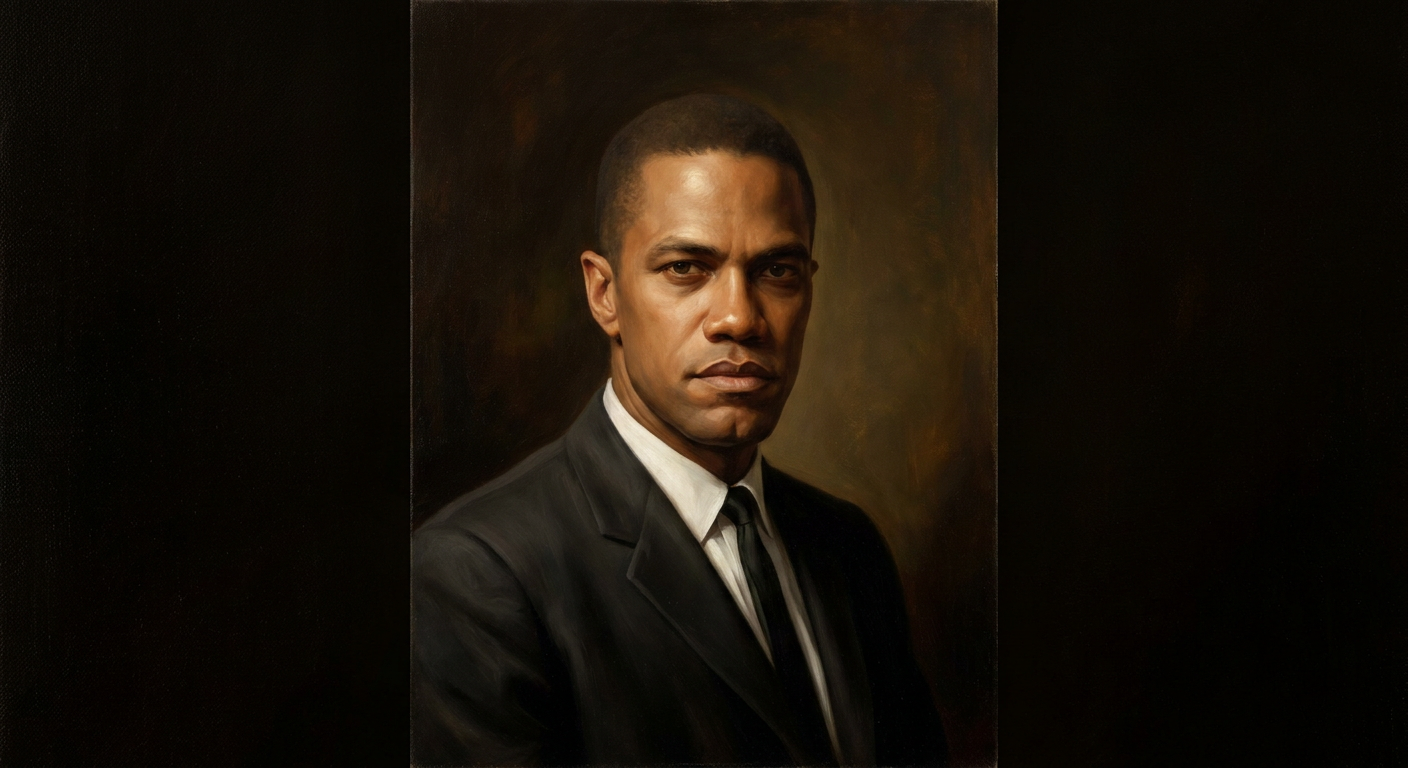
Quick Facts
- Years
- 1925 – 1965
- Category
- Social Reformers & Humanitarians
- Nationality
- American
- Occupation
- Minister, civil rights activist, public speaker and writer
Malcolm X
1925 – 1965 · American · Minister, civil rights activist, public speaker and writer
Recommended Audiobooks
Listen next from Marcus Alden

Life Lessons from Harriet Beecher Stowe
Marcus Alden · 53 min

Life Lessons from Florence Nightingale
Marcus Alden · 48 min
Malcolm X was one of the most compelling—and most debated—voices of the twentieth-century struggle for Black freedom. A minister, organizer and electrifying public speaker, he condemned racism in language that was direct, urgent and impossible to ignore. Where many civil-rights leaders emphasized integration and nonviolence, Malcolm initially championed Black nationalism, self-defense and separation from white society. He forced Americans to confront not only discriminatory laws but also the anger, poverty and psychological injuries produced by generations of racial oppression.
His life was also a remarkable story of transformation. Born Malcolm Little in 1925, he endured family tragedy, foster care, crime and imprisonment before educating himself and joining the Nation of Islam. He became the movement's best-known national spokesman, then broke with it in 1964. A pilgrimage to Mecca and travels through Africa broadened his religious and political outlook. During his final year, he increasingly framed the African American struggle as an international human-rights cause while remaining committed to Black political power.
Malcolm was assassinated in New York in 1965, at only 39. His speeches and posthumously published autobiography influenced the Black Power movement, anticolonial activists, writers, musicians and generations of students. He remains important because his career demonstrates how human beings can change—and because his questions about race, power, dignity, policing and economic justice remain unsettled.
Quick Facts
| Field | Details |
|---|---|
| Full Name | Malcolm Little; later El-Hajj Malik El-Shabazz |
| Common Name(s) | Malcolm X, Malik Shabazz |
| Born | May 19, 1925 |
| Died | February 21, 1965 |
| Age at Death | 39 |
| Birthplace | Omaha, Nebraska, United States |
| Nationality | American |
| Occupation | Minister, activist, organizer, public speaker and writer |
| Historical Era | Civil Rights era; Cold War; African decolonization |
| Famous For | Black nationalism, Muslim ministry, human-rights advocacy and powerful speeches |
| Political Affiliation | No major-party affiliation; founded the Organization of Afro-American Unity |
| Religion | Nation of Islam, followed later by Sunni Islam |
| Education | Formal schooling through eighth grade; extensive self-education in prison |
| Parents | Earl Little and Louise Helen Norton Little |
| Spouse(s) | Betty X Shabazz, married 1958 |
| Children | Attallah, Qubilah, Ilyasah, Gamilah Lumumba, Malaak and Malikah |
| Major Works | The Autobiography of Malcolm X; “The Ballot or the Bullet”; speeches and interviews |
| Major Achievements | Expanded the Nation of Islam; internationalized Black freedom claims; founded Muslim Mosque, Inc. and the OAAU |
Early Life
Malcolm Little was born in Omaha into a family already shaped by Black political activism. His father, Earl Little, was a Baptist minister and organizer influenced by Marcus Garvey's movement, which promoted Black pride, economic independence and connections with Africa. His mother, Louise, was born in Grenada and contributed to Garveyite publications.
White supremacists threatened the family. Their Omaha home was attacked, and the Littles moved first to Milwaukee and then to Lansing, Michigan. In 1929 their Lansing-area house burned. The family believed racists were responsible, although official conclusions did not confirm that claim.
Earl Little died in 1931 after being struck by a streetcar. Authorities ruled the death accidental. Malcolm and other family members believed he had been murdered, but surviving evidence has not established this conclusively. The loss deprived the family of income during the Great Depression.
Louise struggled to support eight children while facing poverty and intrusive welfare authorities. After suffering a mental-health crisis, she was committed to a state hospital in 1939. Her children were separated among foster homes and institutions. Modern accounts often emphasize the racial and economic pressures surrounding her hospitalization, though diagnosing her condition retrospectively is difficult.
Malcolm performed well at school. He later recalled that a white teacher discouraged his ambition to become a lawyer and suggested carpentry instead. Whether every word of the remembered conversation is exact cannot be independently verified, but it clearly represented for Malcolm the limited expectations imposed on Black children.
He left school after eighth grade and moved to Boston, where his half-sister Ella Little-Collins provided a base. He later worked on railroads and lived in Harlem. During the 1940s he adopted fashionable clothes, danced, gambled, sold drugs and participated in burglary. In 1946 he received an eight-to-ten-year prison sentence.
Prison became the decisive turning point. Encouraged by fellow inmate John Bembry and letters from his siblings, Malcolm read history, religion, philosophy and dictionaries with extraordinary intensity. He joined the Nation of Islam, whose teachings combined Black self-reliance, strict moral discipline and a theology sharply different from orthodox Islam. When paroled in 1952, he replaced “Little” with “X,” symbolizing an African family name erased by slavery.
Rise to Prominence
Malcolm's intelligence, discipline and speaking ability quickly impressed Nation of Islam leader Elijah Muhammad. He became an assistant minister in Detroit and then established or led temples in Boston, Philadelphia and Harlem. As minister of New York's Temple No. 7, he recruited in streets, prisons, barber shops and working-class neighborhoods often neglected by established institutions.
National attention followed the 1957 police beating of Nation member Hinton Johnson. Malcolm organized a disciplined crowd outside a Harlem police station and helped secure medical treatment for Johnson. His ability to mobilize supporters made city officials—and the press—take notice.
Television accelerated his fame. The 1959 documentary The Hate That Hate Produced introduced the Nation of Islam to a large audience. Its sensational framing alarmed many viewers, but it also gave Malcolm a national platform. He appeared in debates, interviews and university forums, combining sharp criticism, humor and memorable comparisons.
Under Elijah Muhammad, Malcolm taught that white society was fundamentally corrupt, integration was inadequate and Black people should build independent institutions. He criticized civil-rights leaders who worked with white liberals, sometimes using dismissive language that deepened tensions. Yet his appeal grew because he voiced the frustration of people unconvinced that gradual reform would protect them.
By the early 1960s, Malcolm was the Nation's most recognizable representative. His prominence created internal jealousy, while his discovery of Elijah Muhammad's extramarital relationships damaged his faith in the leader. The break widened after Malcolm described President John F. Kennedy's assassination as a case of “the chickens coming home to roost.” Elijah Muhammad silenced him for 90 days. In March 1964 Malcolm announced his departure from the Nation.
Major Achievements
Building a national platform for Black self-determination
Malcolm helped transform the Nation of Islam from a relatively small religious movement into a nationally recognized organization. Exact membership figures are disputed, but its growth during his ministry is undeniable. He gave public expression to demands for dignity, community discipline, independent businesses and protection from racist violence.
Challenging the limits of mainstream debate
Malcolm shifted public discussion by asking why Black Americans should remain peaceful when the state failed to protect them. He did not generally advocate unprovoked violence; he argued for self-defense when attacked. His rhetoric made moderate proposals appear more acceptable to some white officials, while also giving voice to people who believed conventional civil-rights leadership underestimated Northern racism.
Founding independent organizations
After leaving the Nation, Malcolm founded Muslim Mosque, Inc. as a religious organization and the Organization of Afro-American Unity, or OAAU, as a secular political body. Inspired partly by the Organization of African Unity, the OAAU promoted Black unity, education, economic control and international alliances.
Neither organization had enough time to become stable before his death. Their importance lies mainly in the direction they indicated: locally rooted organization combined with global human-rights advocacy.
Internationalizing the freedom struggle
During 1964 Malcolm traveled through the Middle East and Africa, met political leaders and connected African American conditions to anticolonial movements. He hoped to bring accusations of American racism before the United Nations. Legal and diplomatic obstacles made that difficult, and he did not complete the campaign, but later activists adopted similar international frameworks.
Leaving a transformative autobiography
Journalist Alex Haley conducted extensive interviews with Malcolm and shaped them into The Autobiography of Malcolm X, published after the assassination. Scholars caution that an autobiography is a crafted narrative rather than a neutral transcript; Haley selected and organized the material, while Malcolm interpreted his earlier selves from a later perspective. Even so, the book became an influential account of crime, conversion, political awakening and personal change.
Leadership or Work
Malcolm led through speech, personal discipline and direct engagement. He studied his audiences, answered hostile questions rapidly and translated complex political ideas into concrete examples. Rather than soften disagreement, he often exposed it.
His principal strengths included:
- exceptional public speaking and debating ability;
- willingness to address racism outside the South;
- organizational discipline and a demanding work schedule;
- talent for connecting personal experience with political analysis;
- readiness to revise his views when evidence challenged them.
His approach also had weaknesses. Early speeches sometimes treated white people as a single hostile category and repeated the Nation of Islam's racial theology. His attacks on other Black leaders could be unnecessarily personal. After leaving the Nation, he created two organizations at once while traveling frequently, leaving limited time to build administration and funding.
Malcolm's relationship with Elijah Muhammad initially resembled that of a devoted student to a spiritual father. Its collapse was therefore both political and deeply personal. In his final year, Malcolm worked with a widening circle of Sunni Muslims, African diplomats, students and civil-rights activists, but he was still developing a durable coalition when he died.
Personal Life
Malcolm married Betty X, later known as Betty Shabazz, in 1958. She was a nurse and Nation of Islam member. Their marriage combined genuine partnership with the strict gender expectations taught by the Nation. Malcolm's travel and public duties frequently kept him away, while Betty managed the household under increasing financial and security pressure.
They had six daughters. Twins Malaak and Malikah were born months after their father's death. Betty later became an educator and prominent guardian of his legacy.
Friends and colleagues described Malcolm as disciplined, observant, witty and intensely hardworking. He neither drank nor smoked after his conversion and maintained the Nation's dietary restrictions. He read constantly, kept appointments carefully and prepared for interviews even when he appeared spontaneous.
His final months were marked by exhaustion and danger. He received repeated threats. On February 14, 1965, the family's Queens home was firebombed. No one was killed, and responsibility remains disputed. Malcolm publicly blamed the Nation of Islam; Nation representatives accused him of staging the attack, an allegation never proven.
Philosophy or Beliefs
Malcolm's worldview changed substantially, so reducing it to a single slogan is misleading.
Within the Nation of Islam, he taught Black separation, moral reform and economic independence. He rejected Christianity as it had often been used to justify slavery and submission. He also repeated the Nation's teaching that white people were inherently evil—a doctrine outside mainstream Islam and one he later abandoned.
After leaving the Nation, Malcolm embraced Sunni Islam. His 1964 pilgrimage to Mecca brought him into close contact with Muslims of many ethnic backgrounds. He wrote that this experience changed his understanding of race and showed that sincere brotherhood across racial lines was possible.
The shift did not mean that he abandoned Black nationalism or suddenly endorsed every integrationist strategy. He continued to support Black control of community politics and economics. Increasingly, however, he distinguished between white people committed to justice and those defending white supremacy.
He also reframed civil rights as human rights. Civil-rights claims appealed to American law; human-rights claims could be presented as international obligations. Malcolm believed this approach could connect African Americans with newly independent African and Asian nations.
Challenges and Controversies
Malcolm's critics reasonably objected to his early racial generalizations, separatism and harsh descriptions of civil-rights leaders. His characterization of the March on Washington as managed by white interests ignored the agency of many Black organizers. Supporters answer that his confrontational language exposed power imbalances and widened the range of acceptable debate.
His endorsement of armed self-defense remains controversial. Malcolm argued that people had a moral and legal right to protect themselves when government failed. Opponents feared that such rhetoric could encourage escalation. Evidence does not support the simple claim that he promoted random racial violence, but he deliberately used provocative language.
His evolving beliefs create interpretive disagreement. Some scholars emphasize a decisive transformation after Mecca toward interracial cooperation. Others warn against presenting him as moving neatly toward mainstream liberal integration. His final speeches still defended Black nationalism, revolution and self-defense, even as his religious universalism expanded.
The assassination remains surrounded by justified questions and unsupported theories. Three Nation of Islam members were convicted: Talmadge Hayer, later known as Mujahid Abdul Halim; Norman 3X Butler, later Muhammad Aziz; and Thomas 15X Johnson, later Khalil Islam. Halim admitted participating but said Aziz and Islam were innocent. In 2021 their convictions were vacated after an investigation found that important evidence had been withheld and the case was seriously flawed.
Scholars continue to examine Nation of Islam responsibility, police failures and government surveillance. The FBI and New York police monitored Malcolm and infiltrated political organizations. Those facts do not, by themselves, prove that government agencies organized the murder. The full division of responsibility has not been conclusively established.
Legacy
Malcolm's strongest immediate influence appeared in the Black Power era. Activists drew on his emphasis on racial pride, community control, self-defense and international solidarity. Figures in the Black Panther Party, student movements and Pan-African organizations treated him as an intellectual predecessor.
His influence extended beyond formal politics. Writers, filmmakers and musicians used his speeches to explore identity and resistance. Spike Lee's 1992 film Malcolm X, starring Denzel Washington, introduced his life to a new global audience. His autobiography remains widely taught, though educators increasingly pair it with speeches, archival records and scholarship that reveal the complexity of its construction.
Memorials include the Malcolm X and Dr. Betty Shabazz Memorial and Educational Center at the former Audubon Ballroom in Manhattan. Streets, schools and community institutions bear his name. His childhood home site in Omaha and related locations in Boston, Lansing and New York preserve aspects of his story.
Modern movements continue to invoke Malcolm when discussing police violence, political independence, cultural pride and the difference between legal equality and lived equality. His enduring value lies partly in his unfinished development: he modeled conviction without pretending that growth required never changing one's mind.
Interesting Facts
- Malcolm's parents were supporters of Marcus Garvey's international Black nationalist movement.
- He was known as “Detroit Red” because of the reddish color of his hair.
- He copied dictionary entries in prison as part of his self-education.
- He once hoped to become a lawyer but left formal school after eighth grade.
- He took “X” to represent a family name lost through slavery.
- The 1957 Hinton Johnson case established his reputation as an organizer in Harlem.
- He debated students at major universities in the United States and Britain.
- He met Fidel Castro in Harlem in 1960 when the Cuban delegation stayed at Hotel Theresa.
- Malcolm and Betty married in Lansing, Michigan, in 1958.
- He visited Mecca in 1964 and adopted the name El-Hajj Malik El-Shabazz.
- He met Ghanaian leader Kwame Nkrumah and other African political figures.
- His Oxford Union appearance occurred in December 1964.
- His Queens home was firebombed one week before his assassination.
- Two of the three men originally convicted of killing him were exonerated in 2021.
- The Autobiography of Malcolm X was published about eight months after his death.
- All six of his children were daughters.
- His funeral was held at Harlem's Faith Temple Church of God in Christ.
Famous Quotes
“It'll be the ballot, or it'll be the bullet.”
In his April 1964 “The Ballot or the Bullet” speech, Malcolm warned that continued political exclusion would produce deeper conflict. The phrase contrasted meaningful democratic participation with the consequences of denying it.
“We declare our right on this earth to be a human being, to be respected as a human being.”
Delivered at the OAAU's founding rally in June 1964, this statement placed dignity and protection within a universal human-rights framework.
“By any means necessary.”
Malcolm used this phrase at the same OAAU rally while discussing freedom and justice. It expressed strategic determination, not a detailed instruction to use violence in every situation.
“I don't see any American dream; I see an American nightmare.”
In a 1964 speech, he challenged optimistic national narratives by contrasting them with Black experiences of discrimination.
“You don't have a peaceful revolution. You don't have a turn-the-cheek revolution.”
In his 1963 “Message to the Grass Roots” speech, Malcolm compared Black liberation with revolutions that involved fundamental struggles for power.
“Who taught you to hate the texture of your hair? Who taught you to hate the color of your skin?”
In a 1962 speech, he examined how racism could shape self-image as well as laws and institutions.
“I am for truth, no matter who tells it. I am for justice, no matter who it is for or against.”
This line appears in The Autobiography of Malcolm X and captures the self-critical outlook Malcolm associated with his later development.
“You can't separate peace from freedom because no one can be at peace unless he has his freedom.”
Spoken in a 1965 interview, this linked social order to justice rather than mere absence of protest.
“Education is the passport to the future, for tomorrow belongs to those who prepare for it today.”
This is widely attributed to Malcolm, but researchers have not identified a secure primary-source recording or transcript. It should therefore be quoted with an attribution warning.
Timeline
- 1925 — Born in Omaha, Nebraska.
- 1929 — Family home near Lansing, Michigan, burns.
- 1931 — His father, Earl Little, dies.
- 1939 — His mother is institutionalized; the children are separated.
- 1941 — Moves to Boston and later spends time in Harlem.
- 1946 — Imprisoned for burglary.
- Late 1940s — Educates himself and joins the Nation of Islam.
- 1952 — Paroled and adopts the name Malcolm X.
- 1954 — Becomes minister of Temple No. 7 in Harlem.
- 1957 — Leads the response to the police beating of Hinton Johnson.
- 1958 — Marries Betty X.
- 1959 — Gains national attention through The Hate That Hate Produced.
- 1960 — Meets Fidel Castro in Harlem.
- 1963 — Delivers “Message to the Grass Roots”; suspended after comments on Kennedy's assassination.
- March 1964 — Leaves the Nation of Islam and forms Muslim Mosque, Inc.
- April 1964 — Delivers “The Ballot or the Bullet” and begins the pilgrimage to Mecca.
- June 1964 — Establishes the Organization of Afro-American Unity.
- 1964 — Travels extensively in Africa and the Middle East.
- December 1964 — Speaks at the Oxford Union.
- February 14, 1965 — His family home is firebombed.
- February 21, 1965 — Assassinated at the Audubon Ballroom.
- October 1965 — The Autobiography of Malcolm X is published.
- 2021 — Convictions of Muhammad Aziz and Khalil Islam are vacated.
Frequently Asked Questions
1. Why did Malcolm Little call himself Malcolm X?
He adopted “X” after joining the Nation of Islam because he believed “Little” was a name imposed on his ancestors by enslavers. The X represented the unknown African family name that slavery had erased. Nation members commonly replaced inherited surnames in this way. After embracing Sunni Islam and completing the pilgrimage to Mecca, he increasingly used El-Hajj Malik El-Shabazz, although Malcolm X remained his best-known public name.
2. Was Malcolm X part of the civil-rights movement?
Yes, although his place within it was distinctive. He criticized many mainstream organizations for relying on integration, courtroom action and nonviolent protest. He addressed Northern segregation, economic inequality, police brutality and psychological liberation. Historians now commonly treat him as part of the broad Black freedom struggle rather than defining that struggle only through Southern campaigns and organizations such as the Southern Christian Leadership Conference.
3. Did Malcolm X advocate violence?
He advocated self-defense, not indiscriminate attack. Malcolm argued that Black people should remain peaceful toward peaceful people but could defend themselves against violent assault. His language was intentionally forceful, and critics feared it could intensify conflict. Nevertheless, describing him simply as an advocate of violence erases the distinction he repeatedly made between aggression and defense. His organizations did not conduct a campaign of random attacks.
4. What did Malcolm X believe about Martin Luther King Jr.?
Malcolm initially criticized King harshly, especially his commitment to nonviolence and cooperation with white liberals. King rejected Malcolm's rhetoric as potentially destructive but acknowledged that anger arose from real injustice. They met only once, briefly, at the U.S. Capitol in March 1964. In his final year Malcolm became more willing to work alongside civil-rights campaigns, although major strategic differences remained.
5. Why did he leave the Nation of Islam?
Several conflicts converged. Malcolm became disillusioned after learning that Elijah Muhammad had fathered children with secretaries despite demanding strict sexual morality from followers. Nation officials also resented Malcolm's prominence and political interests. His comment about Kennedy's assassination led to suspension from public speaking. In March 1964 he left, later criticizing the Nation's leadership and rejecting important parts of its theology.
6. How did the pilgrimage to Mecca change him?
In Mecca, Malcolm worshiped with Muslims of many skin colors and nationalities. He concluded that white people were not inherently evil and that Islam could support genuine interracial brotherhood. The pilgrimage changed his racial theology, but it did not erase his concern with Black political independence. He continued to argue that African Americans needed control over their communities and protection against racist violence.
7. Was Malcolm X a Sunni Muslim?
During most of his public rise, Malcolm followed the Nation of Islam, whose theology differs significantly from orthodox Islam. After leaving in 1964, he formally embraced Sunni Islam, completed the Hajj and studied Islamic practice abroad. He founded Muslim Mosque, Inc. and sought guidance from international Muslim communities. His final religious identity was therefore Sunni, although his transition was still developing when he was killed.
8. What was “The Ballot or the Bullet” about?
The speech urged Black Americans to use voting power independently and hold politicians accountable. Malcolm argued that both major parties had benefited from Black votes without fully protecting Black rights. “The bullet” represented the danger of continued exclusion and frustration, while “the ballot” represented effective political action. The speech combined electoral pragmatism, Black nationalism, religious cooperation and warnings about social conflict.
9. What was the Organization of Afro-American Unity?
The OAAU was a secular political organization Malcolm founded in June 1964. Modeled partly on the Organization of African Unity, it proposed cultural education, economic self-reliance, political organization and international human-rights advocacy. It welcomed African Americans regardless of religion. The OAAU remained small and organizationally fragile because Malcolm traveled frequently and was assassinated less than eight months after its public founding.
10. Who wrote The Autobiography of Malcolm X?
Malcolm narrated his life through repeated interviews with journalist Alex Haley, who organized and wrote the final text. Malcolm reviewed portions before his death, but Haley completed the book afterward. Scholars therefore describe it as a collaboration. It is invaluable but should not be treated as a verbatim record: like all autobiographies, it selects events and shapes them into a meaningful story.
11. Who assassinated Malcolm X?
Gunmen killed Malcolm at the Audubon Ballroom on February 21, 1965. Mujahid Abdul Halim admitted participating and was convicted. Muhammad Aziz and Khalil Islam were also convicted but consistently maintained their innocence; their convictions were vacated in 2021 because of serious flaws and withheld evidence. Evidence points toward Nation of Islam members, but questions remain about the full group involved and failures by law enforcement.
12. Was the government involved in his death?
The FBI and New York police closely monitored Malcolm, the Nation of Islam and other Black organizations. Informants were present within activist circles, and officials possessed information not properly disclosed during the original prosecution. These established facts justify scrutiny. However, publicly available evidence has not conclusively proved that a government agency ordered or carried out the assassination. Claims beyond the evidence should be identified as theories.
13. How many children did Malcolm X have?
Malcolm and Betty Shabazz had six daughters: Attallah, Qubilah, Ilyasah, Gamilah Lumumba, Malaak and Malikah. The youngest two were twins born after Malcolm's death. Several daughters became educators, writers or public speakers associated with preserving their parents' history. Betty raised the family while pursuing higher education and a professional career, despite the trauma and financial strain caused by the assassination.
14. Did Malcolm X change his views near the end of his life?
Yes, but the change was complex. He rejected the Nation of Islam's racial theology, accepted the possibility of interracial brotherhood and became open to cooperation with white people who demonstrated a commitment to justice. At the same time, he retained Black nationalist ideas, support for self-defense and criticism of American capitalism and foreign policy. Scholars disagree mainly over which side of this evolving synthesis deserves greater emphasis.
15. Why is Malcolm X still important?
Malcolm connected racial justice with dignity, economic power, cultural identity and international human rights. He spoke especially to people who felt excluded from conventional politics. His willingness to admit change makes his life a powerful study in education and moral development. Current debates over policing, structural racism, political representation and global solidarity continue to draw on questions he posed, even when activists disagree with his answers.
Lessons We Can Learn
- Education can redirect a life. Malcolm's prison reading transformed his vocabulary and ambitions. The evidence supports the importance of disciplined learning, though his path should not romanticize incarceration.
- People can revise deep convictions. His break with racial essentialism after Mecca shows that changing one's mind can reflect strength rather than inconsistency.
- Dignity is politically important. Malcolm understood that injustice damages self-image as well as legal rights, a lesson still relevant to education and representation.
- Powerful speech requires preparation. His seemingly effortless interviews rested on sustained reading, observation and practice.
- Institutions matter more than charisma alone. His organizations struggled after his death, illustrating the need for durable leadership structures.
- Internal criticism can carry personal costs. Challenging Elijah Muhammad isolated Malcolm and endangered him, yet he considered honesty a moral duty.
- Local problems may have global dimensions. He connected American racism with colonialism and international human-rights law.
- Self-defense and restraint require careful distinction. His arguments remain relevant, but modern application demands attention to law, context and the risks of escalation.
- Coalitions need clear principles. Malcolm became open to cooperation without abandoning independent Black organization.
- Historical figures should be studied in motion. His beliefs changed rapidly. Treating one speech as his permanent position produces a misleading portrait.
Related Historical Figures
- Martin Luther King Jr. — A contemporary civil-rights leader whose nonviolent integrationism contrasted with Malcolm's early strategy.
- Elijah Muhammad — Nation of Islam leader, mentor and later adversary.
- Betty Shabazz — Malcolm's wife, educator and central protector of his legacy.
- Marcus Garvey — Black nationalist whose movement influenced Malcolm's parents and later political thought.
- Alex Haley — Journalist and collaborator on Malcolm's autobiography.
- James Baldwin — Writer who engaged Malcolm's ideas about race, religion and American identity.
- Muhammad Ali — Boxer whose conversion Malcolm encouraged before their painful political separation.
- Kwame Nkrumah — Ghanaian president and Pan-African leader whom Malcolm met during his African travels.
- John Lewis — Student civil-rights organizer whose nonviolent activism represented a contrasting strategy.
- Stokely Carmichael (Kwame Ture) — Black Power leader strongly influenced by Malcolm's nationalism and internationalism.
Watch and Learn
Video: Malcolm X at the Oxford Union Debate
Channel: OxfordUnion
Approximate duration: 20 minutes
This archival university recording allows viewers to encounter Malcolm directly rather than through later summaries. His December 1964 remarks reveal his humor, command of an audience and late-career effort to explain self-defense, extremism and racial inequality within an international setting.
Watch and Learn
Malcolm X at the Oxford Union Debate · OxfordUnion
Related Historical Figures