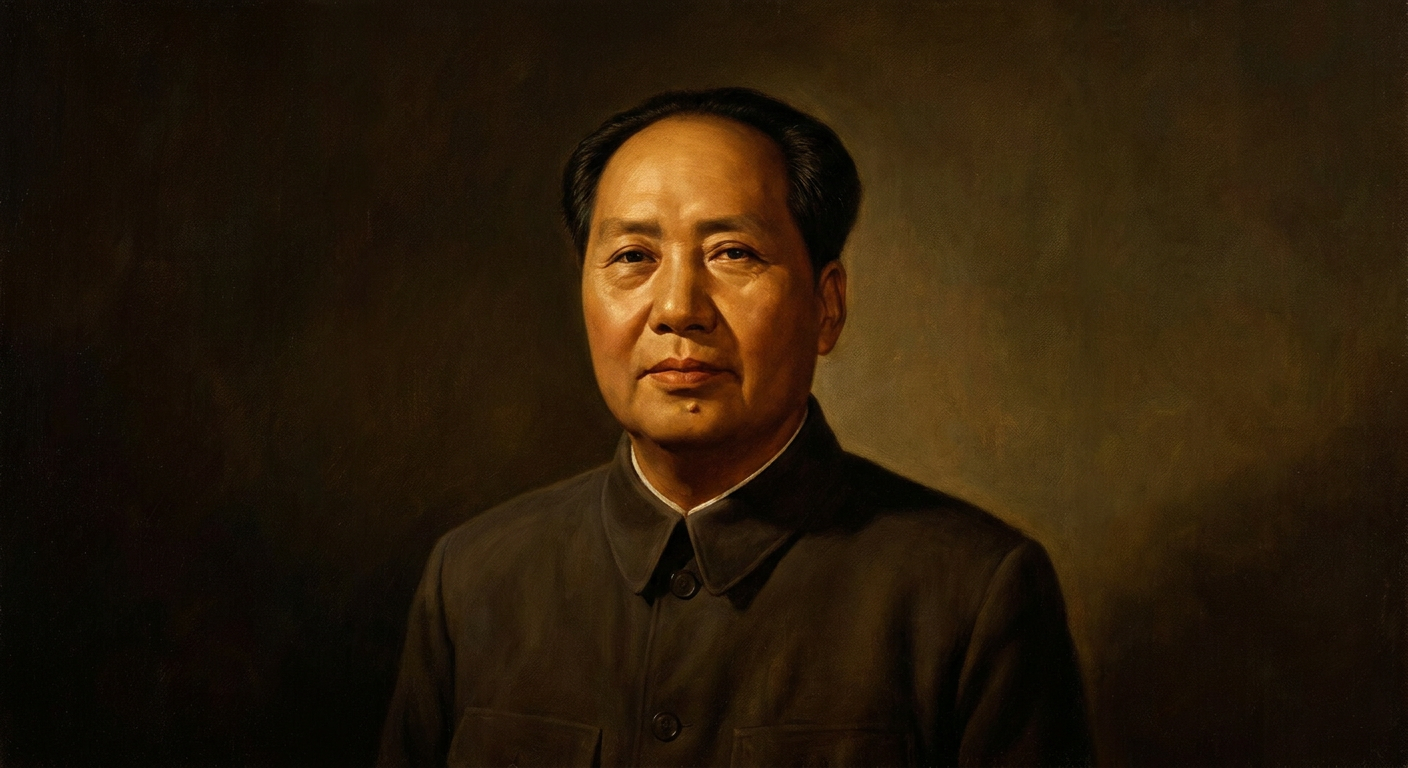
Quick Facts
- Years
- 1893 – 1976
- Category
- World Leaders & Revolutionaries
- Nationality
- Chinese
- Occupation
- Revolutionary leader, statesman and political theorist
Mao Zedong
1893 – 1976 · Chinese · Revolutionary leader, statesman and political theorist
Recommended Audiobooks
Listen next from Marcus Alden

Life Lessons from Simon Bolivar
Marcus Alden · 55 min

Life Lessons from George Washington
Marcus Alden · 54 min
Mao Zedong was the principal founder of the People’s Republic of China, the longtime leader of the Chinese Communist Party, and one of the most consequential—and controversial—figures of the twentieth century. Born to a farming family in 1893, he emerged from the collapse of China’s imperial order to become a revolutionary organizer, military strategist, political theorist, and ruler of the world’s most populous country.
Mao helped transform a vulnerable communist movement into the force that defeated its domestic rivals and established a unified central government in mainland China in 1949. Under his leadership, China expanded basic health care and literacy, pursued industrialization, challenged foreign domination, and became a nuclear power. His adaptation of Marxism to a predominantly rural society influenced revolutionary movements across Asia, Africa, and Latin America.
Those achievements came at an immense human cost. Land reform involved executions and coercion. The Great Leap Forward contributed to the deadliest famine in modern history, while the Cultural Revolution unleashed persecution, factional conflict, and widespread destruction. Scholars continue to debate precise death tolls and the balance between Mao’s responsibility, institutional pressures, local abuses, and environmental factors, but there is broad agreement that his major campaigns caused catastrophic suffering.
Mao is still studied because his life brings together revolution, nationalism, social transformation, personality cults, and the dangers of concentrated power. Modern China remains deeply shaped by the state he founded, even as it has abandoned many of his economic policies.
Quick Facts
| Field | Details |
|---|---|
| Full Name | Mao Zedong |
| Common Name(s) | Mao Tse-tung in older Wade–Giles spelling; Chairman Mao |
| Born | 26 December 1893 |
| Died | 9 September 1976 |
| Age at Death | 82 |
| Birthplace | Shaoshan, Hunan, Qing China |
| Nationality | Chinese |
| Occupation | Revolutionary, political leader, military strategist, poet and theorist |
| Historical Era | Republican China, Chinese Civil War and early People’s Republic |
| Famous For | Founding the People’s Republic of China and leading the Chinese Communist Party |
| Political Affiliation | Chinese Communist Party |
| Religion | Officially atheist and Marxist; raised amid Chinese folk and Buddhist traditions |
| Education | Local schools and the First Provincial Normal School of Hunan; no overseas university education |
| Parents | Mao Yichang and Wen Qimei |
| Spouse(s) | Luo Yixiu, Yang Kaihui, He Zizhen and Jiang Qing |
| Children | At least ten were born across his marriages; several died or disappeared during wartime |
| Major Works | Report on an Investigation of the Peasant Movement in Hunan, On Practice, On Contradiction, On Protracted War and Quotations from Chairman Mao Tse-tung |
| Major Achievements | Communist victory in 1949, establishment of the People’s Republic, national consolidation, social reforms and greater international power for China |
Early Life
Mao was born in Shaoshan, a village in Hunan province, near the end of the Qing dynasty. His father, Mao Yichang, had risen from poverty through farming and trading grain. He was disciplined and demanding. Mao’s mother, Wen Qimei, was a devout Buddhist remembered for her generosity. Mao later described conflict with his father as an early lesson in resistance to authority, although autobiographical recollections should not be treated as perfectly objective records.
He attended a village school where he studied Confucian classics but preferred popular tales of rebellion, warfare, and heroic adventure. As a teenager, he worked on the family farm and briefly entered an arranged marriage with Luo Yixiu. Mao did not recognize the union as a meaningful marriage, and the couple apparently did not live together for long. Luo died in 1910.
China was then undergoing profound crisis. Foreign powers enjoyed special privileges, the Qing government appeared unable to defend national sovereignty, and reformers debated how to modernize the country. The 1911 Revolution overthrew the dynasty while Mao was serving briefly in a revolutionary army in Hunan. The new republic, however, fragmented under military strongmen known as warlords.
Mao tried several educational and occupational paths before entering the First Provincial Normal School in Changsha. There he read Chinese history, Western political thought, nationalism, liberalism, anarchism, and socialism. The teacher Yang Changji became an important intellectual influence. Mao also cultivated habits of physical exercise, independent reading, and political discussion.
After graduating in 1918, Mao traveled to Beijing. Through Yang Changji, he obtained work as an assistant in the Peking University library under Li Dazhao, an early Chinese Marxist. Mao was not yet a leading intellectual, but he encountered the radical debates generated by the Russian Revolution and China’s anti-imperialist May Fourth Movement.
Rise to Prominence
Returning to Hunan, Mao became a teacher, journalist, and organizer. He supported student activism, labor unions, women’s rights, and resistance to warlord government. During these years he moved toward Marxism, concluding that social revolution offered a path to both national renewal and the destruction of entrenched inequality.
Mao participated in the Chinese Communist Party’s founding congress in Shanghai in 1921. The small party initially worked with Sun Yat-sen’s Nationalist Party, or Kuomintang, in an alliance encouraged by the Soviet Union. Communists organized workers and peasants while the Nationalists sought to reunify China.
Mao’s close observation of rural unrest became decisive. In his 1927 report on the peasant movement in Hunan, he argued that poor peasants could become a revolutionary force. This departed from orthodox Marxist expectations that urban industrial workers would lead revolution. It later became a defining feature of Maoism.
The alliance collapsed when Nationalist leader Chiang Kai-shek turned against the communists in 1927. Thousands were arrested or killed. Mao led the Autumn Harvest Uprising, which failed militarily, and retreated with survivors to the Jinggang Mountains. There he helped create a rural revolutionary base and combined guerrilla warfare, political education, land redistribution, and efforts—unevenly enforced—to discipline soldiers.
Internal party rivals repeatedly challenged him. Nationalist encirclement campaigns eventually forced the communists to abandon their southern base in 1934. During the Long March, a desperate retreat across thousands of kilometers, Mao gained greater authority at the Zunyi Conference of 1935. Communist accounts later turned the march into a heroic national epic, although it was also a devastating retreat in which most participants did not survive to reach the northwestern base at Yan’an.
From Yan’an, Mao refined his theories of guerrilla war and party leadership. The Japanese invasion of China created a new communist–Nationalist alliance in 1937, but both sides also prepared for their eventual struggle against each other. Communist forces expanded their rural influence through resistance, administration, taxation, propaganda, and land policies. By Japan’s defeat in 1945, Mao led a far larger movement than he had a decade earlier.
Civil war resumed, and communist armies defeated the Nationalists despite early disadvantages in equipment. Military leadership was shared with commanders including Zhu De, Peng Dehuai, and Lin Biao; victory cannot be credited to Mao alone. Nationalist corruption, inflation, strategic mistakes, communist rural organization, and captured Japanese weapons all contributed. On 1 October 1949, Mao proclaimed the People’s Republic of China in Beijing. Chiang Kai-shek’s government withdrew to Taiwan.
Major Achievements
Founding and consolidating the People’s Republic
The communist victory ended decades of large-scale civil conflict on mainland China and produced a stronger central state. The new government curbed warlordism, expanded administration, stabilized prices, and asserted sovereignty against foreign influence. It also imposed one-party rule, eliminated organized political opposition, and used campaigns, imprisonment, and executions to secure control.
Transforming rural society
Land reform broke the power of many landlords and redistributed property to peasants before agriculture was collectivized. For numerous rural families, the reform altered long-standing hierarchies. It also relied on public accusation meetings, class labels, confiscation, and killings. Estimates vary, but historians commonly place deaths associated with land reform and related repression in the hundreds of thousands to roughly two million.
Expanding education, health, and women’s legal rights
Literacy campaigns and basic public health programs reached communities that had previously possessed few services. Later initiatives trained rural health workers popularly called barefoot doctors. The 1950 Marriage Law opposed arranged marriage, child betrothal, and concubinage while establishing formal rights to divorce. Implementation differed by region, and patriarchal practices persisted, but the law represented a major legal shift.
Establishing China as an international power
China intervened in the Korean War in 1950, fighting United Nations forces led by the United States. The conflict was extraordinarily costly, yet preventing the complete defeat of North Korea strengthened the new government’s claim that China could resist major powers. China tested an atomic bomb in 1964 and a hydrogen bomb in 1967.
Mao also approved rapprochement with the United States as relations with the Soviet Union deteriorated. President Richard Nixon’s 1972 visit to China transformed Cold War diplomacy and helped prepare the way for broader international recognition of Beijing.
Developing a distinctive revolutionary doctrine
Mao adapted Marxism–Leninism to Chinese conditions by emphasizing peasants, guerrilla bases, prolonged warfare, ideological education, and continuous struggle. Maoism became influential well beyond China. Its international impact was significant even where revolutionary movements failed or produced authoritarian outcomes.
Leadership or Work
Mao combined strategic patience with a taste for dramatic political mobilization. In military affairs, he often favored flexibility, retreat when necessary, and the gradual isolation of a stronger opponent. His writing translated complex strategy into memorable formulas, helping build shared purpose among cadres and soldiers.
As a ruler, however, Mao increasingly distrusted bureaucracy, technical experts, and stable institutions. He believed revolutionary commitment could overcome material limitations. He frequently encouraged criticism or mass activism, then altered direction when the results threatened party control. Associates therefore had to interpret changing signals from the top.
His strengths included political intuition, determination, command of symbolic language, and an ability to connect nationalism with social revolution. He understood the political importance of China’s vast peasant majority more clearly than many early communist colleagues.
His weaknesses were equally consequential. He tolerated little lasting opposition, treated ideological struggle as a tool of government, and often discounted specialist evidence. Power became highly personalized. Officials could exaggerate successes because challenging Mao was dangerous, weakening the flow of accurate information during crises such as the Great Leap Forward.
Mao’s relationships with colleagues shifted repeatedly. Zhou Enlai remained an indispensable administrator while adapting to Mao’s authority. Liu Shaoqi and Deng Xiaoping helped restore the economy after the Great Leap but later became Cultural Revolution targets. Peng Dehuai was purged after criticizing the Leap. Lin Biao became Mao’s designated successor before dying in a mysterious 1971 plane crash after an alleged coup plot; important details remain disputed.
Personal Life
Mao’s private life was closely entangled with revolution. Yang Kaihui, the daughter of his former teacher, married Mao in the early 1920s and became a communist activist. Nationalist authorities executed her in 1930 after she refused to renounce him. Their son Mao Anying later died during the Korean War. Another son, Mao Anqing, lived into old age but experienced serious mental illness.
Mao’s relationship with He Zizhen began while Yang was still alive but separated from him by war, making the marital chronology politically and personally controversial. He Zizhen accompanied Mao during revolutionary warfare and the Long March. Several of their children died or were left with local families during retreats; the fate of some remains uncertain.
Mao married the actress Jiang Qing in Yan’an in 1938. Senior communists reportedly accepted the marriage on the understanding that she would initially avoid political involvement. She later became a major Cultural Revolution leader and, after Mao’s death, was arrested as part of the Gang of Four. Mao and Jiang had a daughter, Li Na; Mao and He Zizhen’s surviving daughter was Li Min.
Mao enjoyed swimming, poetry, calligraphy, history, and classical Chinese literature. His publicized swim in the Yangtze River in 1966 helped signal his political return before the Cultural Revolution. Accounts by physicians, staff, and political associates describe unconventional hygiene, irregular sleep, heavy smoking, and extramarital relationships, although some intimate claims—especially those from hostile or retrospective memoirs—remain contested.
His health declined sharply in the 1970s. He suffered from heart and lung problems, and many historians accept that he developed a neurological disorder, often identified as amyotrophic lateral sclerosis or a related condition, though public medical disclosure was limited.
Philosophy or Beliefs
Mao was a Marxist–Leninist who saw history as a struggle between social classes. Yet his thinking differed from Soviet orthodoxy. Because China had relatively few industrial workers, he placed peasants at the center of revolution and treated rural base areas as the foundation for surrounding and capturing cities.
Several concepts shaped his decisions:
- Mass line: Leaders should gather ideas from ordinary people, interpret them through party theory, and return them as policy. In practice, party control restricted genuine popular choice.
- Protracted people’s war: A weaker force could survive, gain rural support, and gradually defeat a stronger enemy.
- Contradiction: Social conflict was permanent and could generate change rather than simply representing disorder.
- Continuous revolution: Even after communist victory, Mao believed new elites could restore capitalism. This conviction helped inspire the Cultural Revolution.
- Voluntarism: Political will and mass enthusiasm could, in Mao’s view, accelerate material transformation. The Great Leap demonstrated the lethal danger of allowing ambition to override agricultural and technical realities.
Mao rejected institutional religion as part of a Marxist worldview, although his language and political symbolism drew upon Chinese historical traditions. His ethics prioritized collective revolution over individual rights. Supporters regarded this as commitment to equality and national independence; critics argue that it enabled coercion by treating people as instruments of an abstract historical mission.
Challenges and Controversies
Repression and one-party rule
Campaigns against alleged counterrevolutionaries consolidated the new state but produced executions, imprisonment, forced labor, and fear. Class labels could shape a family’s opportunities for generations. Defenders emphasized the violence and instability preceding 1949; critics answer that prior disorder cannot justify systematic political repression.
The Hundred Flowers and Anti-Rightist campaigns
In 1956–57 Mao encouraged intellectuals to criticize party failings under the slogan of letting a hundred flowers bloom. When criticism expanded, the Anti-Rightist Campaign punished hundreds of thousands through dismissal, imprisonment, labor assignments, and public humiliation. Scholars debate whether Mao intended a trap from the beginning. Evidence suggests that he initially welcomed some criticism but rapidly turned against its scale and political implications.
The Great Leap Forward
Launched in 1958, the Great Leap sought to propel China rapidly into communism through rural communes, ambitious production targets, mass labor, and backyard steel furnaces. Local officials inflated harvest figures, while the state procured grain on the basis of false reports. Labor diversion, coercive farming practices, reduced incentives, weather problems, and the disruption of Soviet assistance worsened the crisis.
From 1959 to 1961, famine killed tens of millions. Estimates differ because records are incomplete and scholars use different methods; a commonly cited range is roughly 15–45 million excess deaths. Mao did not intend famine, but his policies, pressure for impossible targets, suppression of criticism, and delay in reversing course make his responsibility central.
The Cultural Revolution
In 1966 Mao called on young people to attack supposedly bourgeois authorities and traditions. Red Guards humiliated teachers, officials, intellectuals, and alleged class enemies. Cultural sites were vandalized, schools disrupted, and factions fought violently. The army eventually restored order, but purges and political campaigns continued until Mao’s death.
Estimates of violent deaths range from several hundred thousand to around two million, while many millions experienced persecution, displacement, imprisonment, or forced labor. Supporters at the time claimed the movement challenged privilege and bureaucratic power. Most historians emphasize that it devastated education, culture, administration, and human lives while strengthening Mao’s personal authority.
Personality cult and historical memory
Portraits, badges, songs, loyalty rituals, and the mass circulation of the Little Red Book elevated Mao above ordinary political accountability. Today China’s government acknowledges serious errors while preserving him as a founding national figure. The official formulation that his achievements outweighed his mistakes serves political continuity, but it is not a neutral scholarly calculation.
Legacy
Mao left a dual legacy that resists simple judgment. He helped reunify mainland China under a durable state, expanded national independence, transformed property relations, and promoted social programs that contributed to improvements in literacy and life expectancy. He also constructed an authoritarian political system and initiated campaigns responsible for persecution, famine, and cultural devastation.
After 1978, Deng Xiaoping’s leadership dismantled collective agriculture, welcomed markets and foreign investment, and prioritized expertise and material incentives. Yet the Communist Party retained Mao’s political framework: centralized party rule, control of the military, and restrictions on organized opposition.
Mao’s portrait remains above Tiananmen Gate, his embalmed body lies in a memorial hall in Beijing, and his birthplace at Shaoshan is a major site of state-sponsored tourism. His image appears in official ceremonies, popular art, souvenirs, and occasional protests against inequality. There is no national holiday devoted solely to him, but National Day commemorates the state he proclaimed.
Internationally, Maoist ideas inspired insurgencies and political parties from Peru and India to Nepal and the Philippines. Their histories vary greatly, and their actions should not automatically be attributed to Mao personally. More broadly, his career remains a warning about utopian economic planning, manipulated information, political fanaticism, and leadership unchecked by institutions.
Interesting Facts
- Mao was born only seventeen years before the Qing dynasty collapsed.
- He briefly served in a revolutionary army during the 1911 Revolution.
- His job at Peking University was a junior library position, not a professorship.
- He helped found the Chinese Communist Party in 1921, when it had only a small membership.
- Mao’s revolutionary strategy gave peasants a role orthodox Marxism usually assigned to industrial workers.
- The Long March was not one continuous march but a series of retreats by different communist armies.
- Mao wrote poetry in traditional Chinese forms despite campaigning against parts of the old culture.
- He was an enthusiastic swimmer and used swimming as a symbol of vigor.
- Mao adopted the name Zedong, commonly interpreted as an aspiration to benefit or bring brightness to the east.
- His eldest surviving son, Mao Anying, was killed by an air strike in Korea in 1950.
- The expression Little Red Book was mainly a Western name for his pocket-sized quotations.
- Hundreds of millions of copies of Mao’s quotations circulated during the Cultural Revolution.
- Mao met Richard Nixon in 1972 despite decades of hostility toward the United States.
- China’s first atomic bomb test occurred during Mao’s rule in 1964.
- Mao never traveled outside Asia; his two major foreign visits were to the Soviet Union.
- The simplified Chinese writing program expanded under his government, though simplification had earlier roots.
- He stepped down as state chairman in 1959 but remained party chairman and China’s dominant leader.
- His embalmed body is displayed in the Chairman Mao Memorial Hall despite reports that he had preferred cremation.
Famous Quotes
Translations vary because Mao wrote and spoke in Chinese, and later editions sometimes standardized his wording.
- “Political power grows out of the barrel of a gun.” From Problems of War and Strategy (1938). Mao meant that control of armed force was decisive in revolutionary politics.
- “A revolution is not a dinner party.” From his 1927 Hunan peasant report. The line defended revolution as a forceful rupture, not a polite reform process.
- “A single spark can start a prairie fire.” From a 1930 letter later published as an essay. It expressed confidence that small rural bases could produce national revolution.
- “No investigation, no right to speak.” Associated with Mao’s 1930 essay opposing bookish decision-making. It stresses direct inquiry, though Mao’s later rule did not consistently protect truthful reporting.
- “Serve the people.” From a 1944 memorial speech for soldier Zhang Side. It became one of the party’s most enduring moral slogans.
- “The people, and the people alone, are the motive force in the making of world history.” From On Coalition Government (1945). It summarized Mao’s theory of mass historical agency.
- “All reactionaries are paper tigers.” Said in a 1946 interview with journalist Anna Louise Strong. Mao argued that apparently powerful opponents could prove strategically weak.
- “Let a hundred flowers bloom; let a hundred schools of thought contend.” Used during the Hundred Flowers period. Its later association with punishment makes it a symbol of the dangers faced by critics.
- “Women hold up half the sky.” Widely associated with Mao and communist gender policy. The slogan is well documented, but its precise first occasion and exact original formulation are uncertain.
- “We should despise all enemies strategically, but take them seriously tactically.” A formulation associated with Mao’s discussions of strategy. It distinguished long-term confidence from careful preparation.
Timeline
- 1893 — Born in Shaoshan, Hunan.
- 1910 — His first wife, Luo Yixiu, dies.
- 1911 — Serves briefly in a revolutionary army during the fall of the Qing.
- 1918 — Graduates from the First Provincial Normal School of Hunan and goes to Beijing.
- 1919 — Participates in the intellectual and political ferment surrounding the May Fourth Movement.
- 1921 — Attends the Chinese Communist Party’s founding congress.
- 1925–27 — Organizes in rural areas and develops his emphasis on peasant revolution.
- 1927 — Leads the failed Autumn Harvest Uprising and retreats to Jinggangshan.
- 1930 — Yang Kaihui is executed by Nationalist authorities.
- 1931 — Communist leaders establish the Chinese Soviet Republic in Jiangxi.
- 1934–35 — Takes part in the Long March and rises at the Zunyi Conference.
- 1937 — Full-scale war with Japan begins; communists and Nationalists form another alliance.
- 1938 — Marries Jiang Qing.
- 1942–44 — Yan’an Rectification Campaign strengthens Mao’s ideological authority.
- 1945 — Becomes undisputed senior leader of the party as civil war approaches.
- 1949 — Proclaims the People’s Republic of China on 1 October.
- 1950 — Marriage Law and land reform enacted; China enters the Korean War.
- 1953 — First Five-Year Plan begins with Soviet assistance.
- 1956 — Hundred Flowers initiative encourages criticism.
- 1957 — Anti-Rightist Campaign punishes critics.
- 1958 — Great Leap Forward and people’s communes launched.
- 1959 — Peng Dehuai is purged after criticizing the Great Leap; Mao leaves the state chairmanship.
- 1959–61 — China experiences catastrophic famine.
- 1964 — China tests its first atomic bomb.
- 1966 — Cultural Revolution begins.
- 1969 — Mao designates Lin Biao as successor amid the Cultural Revolution.
- 1971 — Lin dies in a plane crash after an alleged coup plot; China receives the UN seat held by Taiwan.
- 1972 — Mao meets US president Richard Nixon in Beijing.
- 1976 — Zhou Enlai and Zhu De die; Tangshan earthquake strikes; Mao dies on 9 September.
- 1981 — The Communist Party formally condemns the Cultural Revolution while preserving Mao’s status as a founding leader.
Frequently Asked Questions
1. Who was Mao Zedong?
Mao was a Chinese communist revolutionary who led the Chinese Communist Party to victory in the civil war and proclaimed the People’s Republic of China in 1949. He remained China’s dominant political figure until his death in 1976. His rule combined national consolidation and major social change with one-party dictatorship, political repression, catastrophic economic experimentation, and intense ideological campaigns.
2. How did Mao come to power?
Mao rose through decades of organization and warfare rather than a single coup. After the communists were violently suppressed in the cities, he built rural bases and promoted peasant mobilization and guerrilla tactics. His authority grew during the Long March and the war against Japan. Communist organization, Nationalist weaknesses, popular grievances, military leadership, and wartime conditions all contributed to victory in 1949.
3. What was Maoism?
Maoism was Mao’s adaptation of Marxism–Leninism to a largely rural society. It emphasized peasant revolution, disciplined party leadership, guerrilla war, mass mobilization, ideological struggle, and the possibility that class conflict would continue under socialism. International groups adopted different versions of these ideas. Maoism was never a single unchanging doctrine, and its application outside China produced widely varying movements.
4. Why did Mao focus on peasants?
Early twentieth-century China had a vast rural population and a comparatively small industrial working class. Mao observed that debt, rent, landlord power, and political exclusion generated rural anger. He concluded that organized peasants could sustain revolutionary armies and governments. This insight helped the communists survive, though later collectivization subjected rural people to severe state control.
5. What was the Long March?
The Long March was the communist retreat from southern bases in 1934–35 under pressure from Nationalist armies. Different communist forces followed different routes, suffering enormous casualties from combat, hunger, illness, and terrain. The survivors established a base in northwestern China. Later propaganda celebrated the march as heroic endurance, but it began as a military defeat and humanitarian ordeal.
6. Did Mao defeat Japan?
No single leader or faction defeated Japan. Nationalist armies fought many of the largest conventional battles and suffered enormous losses, while communist forces conducted guerrilla operations and expanded in occupied rural areas. Japan surrendered in 1945 after years of Chinese resistance, Allied warfare, Soviet entry into the conflict, and the US atomic bombings. Communist narratives sometimes overstated their exclusive role.
7. What caused the Great Leap Forward famine?
The famine resulted chiefly from policy failures interacting with coercion and difficult conditions. Communes disrupted production; officials reported imaginary surpluses; the state collected grain based on those reports; labor was diverted into poorly planned projects; and criticism was suppressed. Weather and the withdrawal of Soviet assistance aggravated problems but do not adequately explain the scale of mortality.
8. How many people died because of the Great Leap?
There is no universally accepted number. Restricted or incomplete records require historians to estimate excess mortality from demographic data. Published estimates commonly range from about 15 million to 45 million deaths, with many scholars placing the total around 30 million or more. The disagreement concerns scale and method, not whether the famine was enormous and substantially caused by government policy.
9. What was the Cultural Revolution?
The Cultural Revolution was a political upheaval launched by Mao in 1966 to attack supposed capitalist tendencies, revive revolutionary commitment, and defeat rivals. Red Guards targeted officials, educators, intellectuals, religious institutions, and cultural heritage. Factional violence spread before the army imposed greater control. Persecution continued in changing forms until Mao’s death in 1976.
10. Why did young people join the Red Guards?
Motivations included sincere revolutionary belief, loyalty to Mao, pressure from peers, resentment of school authorities, hopes for status, and fear of being labeled politically unreliable. Some youths saw an opportunity to challenge privilege; others participated in humiliations and violence. Red Guard groups eventually fought one another, demonstrating that mass mobilization did not create a unified movement.
11. Was Mao popular?
Mao possessed genuine support, especially because many people associated the communist victory with unity, sovereignty, land reform, and an end to earlier disorder. Propaganda, censorship, political education, and fear also shaped public behavior. Popularity changed across time and region. Displays of devotion during the Cultural Revolution cannot be interpreted simply as either entirely sincere or entirely coerced.
12. Did Mao improve women’s rights?
His government outlawed several oppressive marital practices, encouraged women’s employment, and promoted the principle of legal equality. These changes expanded opportunities for many women. Yet implementation was incomplete, women remained underrepresented in leadership, and state policies often expected them to combine paid labor with domestic responsibilities. Maoist gender policy was transformative but did not eliminate patriarchy.
13. Why did China and the Soviet Union split?
The split arose from ideological disagreement, national interests, border tensions, Soviet criticism of Stalin, and competition for leadership of the communist world. Mao considered Soviet coexistence with the West too cautious and resented Moscow’s pressure. By the 1960s, the former allies exchanged public accusations and eventually fought a brief border conflict in 1969.
14. Why did Mao meet Richard Nixon?
Both governments saw strategic advantage in improving relations. China faced serious tension with the Soviet Union, while the United States sought leverage in the Cold War and a path out of its diplomatic isolation from Beijing. Nixon’s 1972 visit did not erase ideological hostility, but it reshaped global diplomacy and prepared the ground for normalized relations in 1979.
15. How is Mao viewed in China today?
Officially, Mao is honored as the founding leader who made major contributions but committed serious later errors. His portrait remains a state symbol, while open discussion of famine and political violence can be restricted. Public attitudes range from reverence and nostalgia to private criticism. Some people invoke Mao to criticize corruption and inequality, even though contemporary economic policy differs sharply from his.
16. Was Mao solely responsible for every death under his rule?
No serious historical analysis treats every death as the result of one person’s direct order. Officials, institutions, local conflicts, war, disease, and environmental factors mattered. Nevertheless, Mao held supreme authority, initiated key campaigns, removed critics, and maintained systems that rewarded exaggeration and coercion. Distinguishing direct orders from political responsibility is essential, but it does not remove his central accountability.
Lessons We Can Learn
- Accurate information protects lives. Inflated harvest reports during the Great Leap produced disastrous procurement decisions. Modern organizations need channels through which bad news can travel safely.
- Ambition cannot replace expertise. Backyard furnaces and unsuitable farming methods show the danger of treating enthusiasm as a substitute for technical knowledge.
- Concentrated power magnifies mistakes. Mao’s dominance made correction difficult. The broader modern lesson is that institutions should permit oversight and peaceful disagreement.
- National recovery can coexist with repression. China’s consolidation after 1949 does not erase political persecution. Historical outcomes should be assessed across several dimensions rather than reduced to triumph or disaster.
- Local conditions matter. Mao’s focus on peasants helped his movement survive where imported revolutionary models failed. Adaptation remains important, though strategic effectiveness does not prove moral legitimacy.
- Mass participation can liberate or intimidate. Mobilization expanded literacy and organization but also enabled public humiliation and violence. Participation requires rights, safeguards, and accountability.
- Criticism must receive durable protection. The reversal from Hundred Flowers to Anti-Rightist punishment taught people that honesty was dangerous, damaging later policy feedback.
- Personality cults weaken institutions. Treating a leader as infallible discourages evidence-based correction. This is strongly supported by Cultural Revolution records, not merely a modern analogy.
- Social reform should be judged by implementation. Progressive marriage legislation mattered, yet unequal local enforcement limited its reach. Laws require practical support and cultural change.
- History demands moral and factual complexity. Mao was both a successful revolutionary state-builder and the leader responsible for ruinous campaigns. Understanding one side should not require suppressing the other.
Related Historical Figures
- Sun Yat-sen — Founder of the Chinese Republic whose Nationalist movement initially cooperated with the communists.
- Chiang Kai-shek — Mao’s principal rival in the Chinese Civil War and leader of the Nationalist government that retreated to Taiwan.
- Zhou Enlai — Premier of the People’s Republic and a crucial diplomat and administrator under Mao.
- Zhu De — Senior communist commander and foundational leader of the Red Army.
- Peng Dehuai — Korean War commander purged after criticizing the Great Leap Forward.
- Liu Shaoqi — State chairman and economic recovery leader persecuted to death during the Cultural Revolution.
- Deng Xiaoping — Purged twice under Mao before leading post-Mao market-oriented reforms.
- Jiang Qing — Mao’s fourth wife and a prominent Cultural Revolution radical associated with the Gang of Four.
- Joseph Stalin — Soviet leader whose government assisted Chinese communists while maintaining a complicated relationship with Mao.
- Richard Nixon — US president whose 1972 meeting with Mao transformed Cold War diplomacy.
Watch and Learn
Video: Communists, Nationalists, and China's Revolutions: Crash Course World History #37
Channel: CrashCourse
Approximate duration: 12 minutes
This widely viewed educational overview clearly introduces the fall of imperial rule, the rivalry between Nationalists and communists, the Long March, and Mao’s rise. Its brisk format cannot cover the full human consequences or scholarly debates surrounding Mao’s government, but it provides an accessible starting point when paired with the more detailed account above.
Watch and Learn
Communists, Nationalists, and China's Revolutions: Crash Course World History #37 · CrashCourse
Related Historical Figures