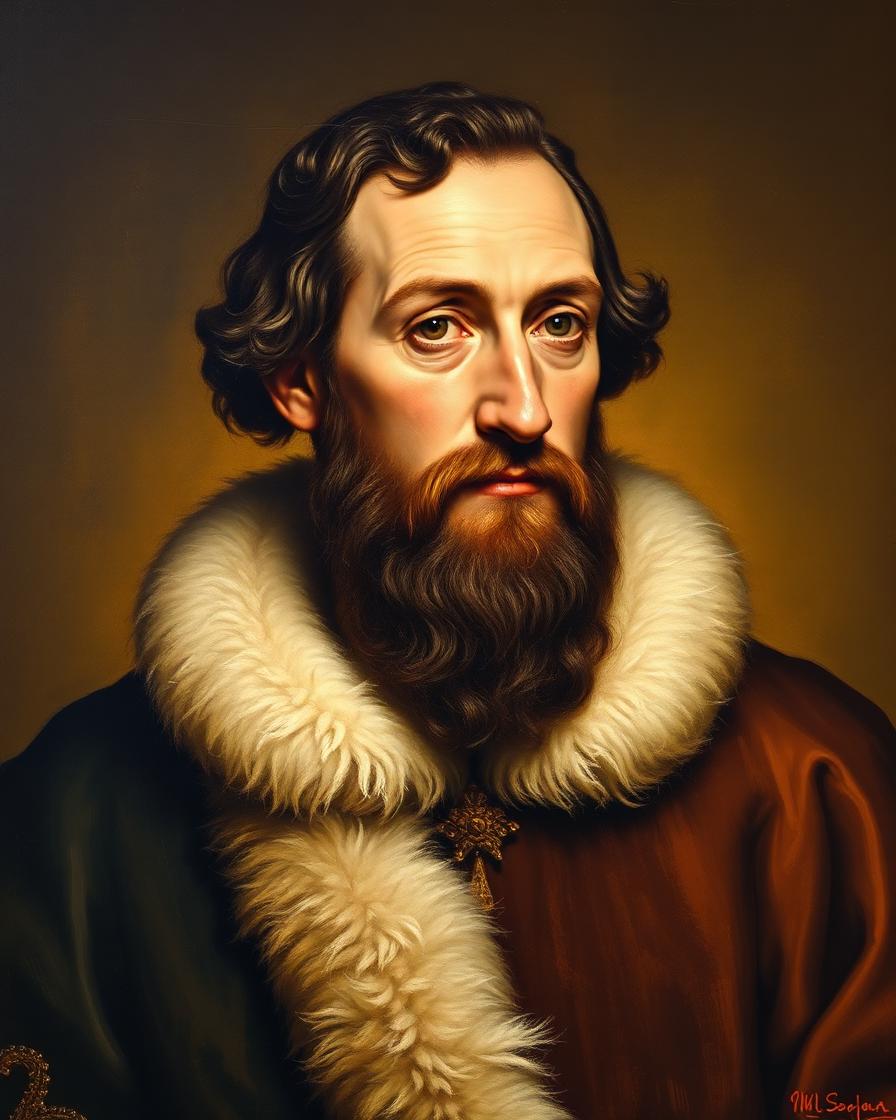
Quick Facts
- Years
- 1254 – 1324
- Category
- Explorers & Adventurers
- Nationality
- Venetian
- Occupation
- Merchant, Explorer & Travel Writer
Marco Polo
1254 – 1324 · Venetian · Merchant, Explorer & Travel Writer
Audiobook

Life Lessons from Marco Polo
Marcus Alden
Marco Polo (1254–1324) was a Venetian merchant, traveler, and writer whose account of Asia became one of medieval Europe’s most influential geographical works. According to his book, he left Venice as a teenager with his father, Niccolò, and uncle, Maffeo, crossed Central Asia, and spent years in territories governed by the Mongol emperor Kublai Khan. His descriptions introduced many European readers to the wealth, cities, trade networks, religions, and political institutions of lands from Persia to China.
Polo did not personally write a conventional diary during the journey. After returning to Venice, he was imprisoned during a war with Genoa and dictated his recollections to Rustichello of Pisa, an experienced author of romances. The resulting work—usually called The Travels of Marco Polo—survives in numerous, often conflicting manuscripts.
Historians debate details of Polo’s itinerary, court service, and authorship, but most accept that he traveled widely in Mongol-ruled Asia and drew upon genuine firsthand knowledge, supplemented at times by reports from others. His greatest achievement was not “discovering” places long inhabited and connected by trade, but transmitting an unusually extensive picture of Asia to Latin Europe. His book influenced cartography, commerce, exploration, and European ideas about the wider world, making him an enduring subject of historical study.
Quick Facts
| Field | Details |
|---|---|
| Full Name | Marco Polo |
| Common Name(s) | Marco Polo; Marco Milione in some Venetian traditions |
| Born | 1254 |
| Died | 8 January 1324 |
| Age at Death | About 69 |
| Birthplace | Traditionally Venice, Republic of Venice; exact birthplace is disputed |
| Nationality | Venetian |
| Occupation | Merchant, traveler, diplomatic agent or court servant, travel writer |
| Historical Era | High to Late Middle Ages; Mongol Empire and Yuan dynasty |
| Famous For | Traveling through Asia and providing the account known as The Travels of Marco Polo |
| Political Affiliation | Republic of Venice; served or traveled under Kublai Khan according to his account |
| Religion | Latin Christian, probably Roman Catholic |
| Education | Not formally recorded; likely practical mercantile education |
| Parents | Niccolò Polo and a mother whose name is not securely recorded |
| Spouse(s) | Donata Badoer |
| Children | Fantina, Bellela, and Moreta |
| Major Works | The Description of the World, commonly called The Travels of Marco Polo |
| Major Achievements | Crossed Eurasia; described Mongol Asia and Yuan China; influenced European geography, cartography, and exploration |
Early Life
Marco Polo was born in 1254 into a Venetian merchant family. Venice was then a maritime republic whose prosperity depended upon commerce across the Mediterranean and beyond. Venetian traders handled spices, silk, precious goods, and financial transactions through ports linked to Byzantium, the Black Sea, and Islamic markets.
Marco’s father, Niccolò, and uncle, Maffeo, were long-distance merchants. They left Venice before or around Marco’s birth and traded through Constantinople, the Crimean port of Soldaia, and Mongol-controlled territories. Their movements illustrate how the so-called Silk Roads were not one highway but overlapping land and sea networks.
Marco’s mother died while he was young, although the chronology and her identity remain unclear. He was probably raised by relatives. No school records survive. As the son of merchants, he likely learned arithmetic, currencies, weights, contracts, navigation, and commercial customs. His later narrative also suggests an ability to observe prices, products, transportation, and political administration.
Niccolò and Maffeo reached the court of Kublai Khan, grandson of Genghis Khan and ruler of much of East Asia. They returned west with a request, as Marco’s narrative presents it, that the pope send educated Christians and sacred oil from Jerusalem. When they reached Venice around 1269, Marco was approximately fifteen. His father’s return transformed his prospects: instead of entering a purely local career, he joined a journey across Eurasia.
The age favored mobility despite its dangers. The Mongol conquests had caused enormous destruction, yet the resulting imperial networks also facilitated diplomacy and trade across vast distances. Travelers with appropriate protection could move between interconnected Mongol realms more readily than in many earlier periods.
Rise to Prominence
In 1271, Marco departed with Niccolò and Maffeo. They traveled first through the eastern Mediterranean and obtained letters and gifts connected with the papacy. Two friars initially accompanied them but reportedly turned back amid regional warfare.
The Polos continued through Armenia, Persia, and Central Asia. Their precise route is difficult to reconstruct because surviving manuscripts differ and the account often organizes material geographically rather than as a day-by-day itinerary. Marco described deserts, mountain passages, trading towns, religious communities, and Mongol customs. The journey to Kublai’s court probably took about three and a half years.
They reached the khan’s domains around 1275. Marco’s book says Kublai favored the young Venetian and employed him on missions. It attributes to Marco travel across parts of China and perhaps neighboring regions. His exact official rank cannot be independently verified, and claims that he governed Yangzhou are especially doubtful. Nevertheless, the account contains detailed knowledge of Yuan communications, taxation, paper currency, salt production, and urban life.
The Polos remained in Asia for many years. They eventually received permission to leave while accompanying the Mongol princess Kökechin by sea to Persia, where she was to marry into the Ilkhanid ruling house. The voyage passed through Southeast Asian waters and the Indian Ocean and suffered major loss of life.
Marco returned to Venice in 1295. His fame emerged not immediately from public office but from war and imprisonment. Captured in the Venetian-Genoese conflict—traditionally after the Battle of Curzola in 1298, though details are debated—he met Rustichello of Pisa in a Genoese prison. Marco dictated or collaborated on his account in a Franco-Italian literary language. Copies circulated rapidly, transforming a merchant traveler into a celebrated, sometimes doubted, authority on Asia.
Major Achievements
Crossing Eurasia and Returning by Sea
Marco’s reported journey linked the Mediterranean, Middle East, Central Asia, China, Southeast Asia, and Indian Ocean. Such routes were already used by Asian, Muslim, Armenian, Jewish, and other merchants, but few Latin European travelers left comparably extensive accounts.
The achievement mattered because medieval travel was slow and hazardous. Political violence, disease, deserts, mountain climates, and shipwreck threatened travelers. Marco’s successful return allowed knowledge acquired in Asia to circulate in Europe.
Long-term, his route became a symbol of intercultural travel. It should not be described as a European “discovery” of Asia; rather, it was an exceptional act of observation and transmission within established networks.
Describing the Mongol and Yuan Worlds
The Travels presented Kublai Khan’s court, postal relays, armies, hunting expeditions, paper money, taxation, canals, cities, and religious diversity. Marco admired the khan’s wealth and administrative reach, although his portrait also reflects courtly literary conventions.
These passages mattered because European knowledge of East Asia was fragmentary. Polo’s account offered a broad, if imperfect, description of governance and economic organization under Mongol rule.
Its long-term value extends beyond geography. Historians compare the work with Persian, Chinese, Arabic, and archaeological evidence to study Yuan institutions and trans-Eurasian perceptions.
Recording Commercial and Material Knowledge
Polo paid close attention to commodities: silk, spices, salt, pearls, precious stones, porcelain-like ceramics, coal, and currencies. He repeatedly evaluated cities by markets, revenues, crafts, and transport.
This mercantile emphasis made the work practical as well as marvelous. His discussion of paper money was particularly striking to Europeans accustomed primarily to metallic currency. His description of combustible “black stones” is commonly understood as coal.
Later merchants and geographers used his information when imagining Asian wealth and trade. Even when inaccurate, his economic framework encouraged readers to view distant societies as organized commercial systems rather than merely as settings for legends.
Creating an Enduring Travel Narrative
The book’s original title is uncertain. It circulated as Devisement du monde (“Description of the World”), Il Milione, and eventually The Travels of Marco Polo. Rustichello’s participation gave the narrative a literary form shaped by romance traditions, while Marco supplied geographical and experiential material.
The work mattered because it combined observation, hearsay, wonder, ethnography, and commercial intelligence. More than 100 medieval manuscripts and fragments survive, demonstrating wide circulation, though their texts vary substantially.
Its long-term impact reached mapmakers, scholars, missionaries, and explorers. Christopher Columbus owned a Latin edition and annotated it heavily while seeking an ocean route to Asia.
Expanding Europe’s Geographical Imagination
Marco described places Europeans often knew only vaguely, including Cathay, Manzi, Tibet, Yunnan, Japan—called Cipangu—and islands of the Indian Ocean. He did not visit every place he discussed; some sections clearly depend on secondhand information.
Even so, the scope of the account expanded European mental maps. Information associated with Polo entered late-medieval cartography, including traditions represented by the Catalan Atlas and Fra Mauro’s world map.
His influence did not ensure accuracy, but it shifted discussion toward named cities, routes, distances, products, and political jurisdictions. That more concrete geographical imagination helped prepare the intellectual setting for later European maritime expansion.
Leadership and Work
Marco Polo was not primarily a political leader. His achievements depended on adaptability, observation, negotiation, and family cooperation rather than command of an army or state. The three Polos operated as a compact mercantile and diplomatic partnership.
His methods reflected a merchant’s priorities. He noticed profitable products, transport routes, currencies, populations, and revenues. He also recorded customs and religions, sometimes with curiosity and sometimes through medieval Christian assumptions.
If his account of service to Kublai is broadly accurate, Marco succeeded by becoming useful across cultures. He claims to have learned languages, carried messages, and reported on distant regions. The specific languages are not reliably listed, and there is no evidence that he read Chinese.
His strengths included endurance, attentiveness, memory, and willingness to navigate unfamiliar societies. His book shows admiration for administrative efficiency regardless of whether its practitioners were Christian. That comparative openness distinguished him from writers who treated non-European peoples only as enemies or abstractions.
His weaknesses were those of both his era and his literary project. He repeated marvels and hearsay, sometimes exaggerated quantities, and rarely explained sources clearly. The collaboration with Rustichello blurred the boundary between direct recollection and literary embellishment. Moreover, the surviving text underwent repeated copying, translation, abridgment, and expansion.
Personal Life
After returning to Venice, Marco reentered the life of a prosperous merchant household. He married Donata Badoer, a woman from a respected Venetian family. They had three daughters: Fantina, Bellela, and Moreta. No securely documented sons are known.
Legal and commercial records show Marco involved in property, investments, and disputes. These documents are important because they confirm his existence and social standing independently of the travel narrative. He lived in the parish of San Giovanni Crisostomo, in a family house traditionally associated with the Venetian court known as the Corte del Milion.
Marco maintained ties with relatives and business associates. One notable relationship was with the enslaved or formerly enslaved Tatar man Pietro, whom Marco’s will ordered to be freed and who received a bequest. The document illuminates both Marco’s personal household and the reality of slavery in medieval Mediterranean society.
Accounts of his personality are filtered through his book and later legend. He appears observant, commercially minded, proud of what he had witnessed, and fascinated by abundance and organization. The popular story that Venetians nicknamed the family “Milione” because Marco told millions of exaggerations is not securely established; the name may instead have derived from an older family designation.
Marco made his will on 9 January 1323 under the Venetian calendar, corresponding to 1324 in modern dating. He died soon afterward, on 8 January by some documentary interpretations of the calendar tradition; scholarly references commonly give 8 January 1324. He was buried at the church of San Lorenzo in Venice. His tomb did not survive later rebuilding.
Philosophy and Beliefs
Marco was a Latin Christian, and his narrative reflects medieval Christian categories. He took interest in relics, biblical traditions, missionaries, and Christian communities in Asia, including members of the Church of the East. Yet his account also recognized the coexistence of Buddhists, Muslims, Christians, and practitioners of local religions under Mongol rule.
He admired Kublai Khan despite the emperor’s non-Christian religious environment. This admiration was pragmatic rather than ideological: Marco praised order, wealth, tolerance, military power, and efficient administration. The khan appears as an exemplary universal ruler within the narrative.
Marco’s ethical outlook cannot be reconstructed systematically. He left no philosophical treatise. His values seem to have included family loyalty, commercial competence, fidelity to patrons, courage, and careful observation. At the same time, he shared assumptions typical of his society, including hierarchical views of peoples and participation in an economy that included slavery.
Politically, he belonged to republican Venice but wrote with fascination about centralized imperial authority. Rather than advocating a formal system, he compared institutions according to how effectively they generated stability, revenue, communication, and prosperity.
Challenges and Controversies
The greatest controversy concerns whether Marco Polo actually reached China. Skeptics have noted that surviving Chinese records do not clearly name him and that his book omits tea, Chinese writing, foot binding, and the Great Wall. They also argue that some claims—especially his supposed governorship of Yangzhou and involvement in the siege of Xiangyang—conflict with chronology or documentation.
Most specialists nevertheless reject the theory that he invented the entire journey. His account contains detailed and often accurate information about Yuan paper money, salt revenues, postal stations, official practices, place-names, and routes. Some details are better explained by experience within the Mongol world than by reliance on Persian merchants alone. Absence from Chinese chronicles is not decisive: foreign visitors of modest official rank were often unrecorded, and “Marco” might not appear under a recognizable form.
The omissions also have possible explanations. The Great Wall familiar today largely dates from the Ming period, after Marco’s journey; tea was not equally notable in every region; and his book was selective rather than encyclopedic. Still, such answers do not prove every claim.
Authorship presents another difficulty. Rustichello shaped the text, perhaps adding formulas and wonders drawn from romance literature. Because no autograph survives, scholars cannot always separate Marco’s testimony from editorial additions or copying errors.
Some episodes are demonstrably problematic. Chinese and Persian sources place the siege of Xiangyang before the Polos’ likely arrival, undermining versions suggesting that they designed siege engines there. Marco’s claimed association with Yangzhou is also more plausibly interpreted as temporary service or later textual inflation than as a three-year governorship.
Finally, his descriptions use medieval stereotypes and occasionally portray peoples as exotic curiosities. Modern readers should value the information while recognizing the unequal gaze, religious prejudices, and commercial priorities that shaped it.
Legacy
Marco Polo’s most important legacy is textual. The Travels became a foundational European account of Asia, copied in French, Franco-Italian, Latin, Tuscan, Venetian, and other languages. Because versions differ, modern editors reconstruct the text through comparison rather than treating any one manuscript as definitive.
His work influenced geographical thought for centuries. Cartographers drew upon Polo-related names and descriptions, while missionaries and merchants used the book to imagine routes and societies beyond the Islamic world. Columbus’s annotated copy demonstrates its role in the plans that led to sustained European Atlantic expansion—a later development with profound and often catastrophic consequences for Indigenous peoples.
Polo also became a cultural symbol detached from the historical man. His name has been applied to ships, airports, geographical features, hotels, commercial brands, an aquatic game, and the children’s calling game “Marco Polo.” These uses attest to fame, not necessarily to historical understanding.
Venice preserves associations with the Polo family at the Corte del Milion, although the original house does not survive intact. A statue of Marco Polo stands in Ulaanbaatar, Mongolia, reflecting his association with the Mongol world. The Marco Polo Museum in Korčula presents a local claim that he was born there, but the claim remains disputed and lacks conclusive contemporary evidence. Museums, exhibitions, manuscript libraries, and Silk Road research programs worldwide continue to interpret his journey.
Modern scholarship studies him less as a solitary heroic “discoverer” and more as one participant in extensive Eurasian networks. This approach places Asian hosts, Mongol institutions, interpreters, sailors, merchants, and preexisting routes at the center of the story. Marco remains relevant because his work shows both the possibilities and limitations of cross-cultural observation.
Interesting Facts
- Marco left Venice at about seventeen years of age.
- His outward journey probably lasted roughly three and a half years.
- He traveled with his father Niccolò and uncle Maffeo.
- The Polos journeyed during the period often called the Pax Mongolica.
- Marco described paper money with unusual detail for a medieval European audience.
- He reported the use of coal as fuel, calling it a kind of black stone.
- His book discusses Japan under the name Cipangu, largely from hearsay.
- He probably did not visit every region included in his narrative.
- Rustichello of Pisa helped compose the book while both men were prisoners in Genoa.
- No original manuscript written or dictated directly by Marco survives.
- More than 100 medieval manuscript witnesses and fragments are known.
- The familiar title The Travels of Marco Polo was not its only medieval title.
- Marco returned from Asia by an Indian Ocean route rather than retracing the entire land journey.
- He married Donata Badoer and had three daughters.
- His will freed a Tatar man named Pietro and left him money.
- Christopher Columbus owned and annotated a copy of Polo’s account.
- Marco’s alleged governorship of Yangzhou is not supported by secure Chinese evidence.
- The Great Wall he supposedly “failed” to mention was not yet the monumental Ming structure familiar today.
- He was buried at San Lorenzo in Venice, but his tomb was later lost.
- The Marco Polo sheep was named after him because his book described wild sheep of Central Asia.
Famous Quotes
Quotations vary by manuscript and translation; wording should not be treated as Marco’s exact spoken English.
-
“Emperors, kings, dukes, marquises, counts, knights, and burgesses … learn about the different races of mankind and the diversities of the various regions of the world.” — From the prologue in common English translations. It announces the book as a universal geographical survey.
-
“He who has not seen it could not believe it.” — A recurring translated formula attached to extraordinary wealth or scale. It expresses the narrative’s appeal to eyewitness authority.
-
“I did not tell half of what I saw, for I knew I would not be believed.” — Famous deathbed attribution. It appears in later tradition rather than secure contemporary documentation and should be considered disputed.
-
“I have only told the half of what I saw.” — A shorter version of the same disputed deathbed saying, often repeated to summarize Polo’s reputation for marvels.
-
“The Great Khan causes the bark of trees, made into something like paper, to pass for money over all his country.” — Translation and wording vary. The passage explains Yuan paper currency and its enforcement.
-
“Throughout the province of Cathay there is a sort of black stone, which is dug out of veins in the mountains, and burns like logs.” — From the account of coal. It conveyed an unfamiliar fuel to many European readers.
-
“The city is beyond dispute the finest and the noblest in the world.” — Applied in many translations to Quinsai, or Hangzhou. The superlative reflects Marco’s admiration for its size and prosperity.
-
“They have such a quantity of silk that it is marvelous.” — Representative wording from his commercial descriptions; exact phrasing differs across editions. Silk signified urban wealth and manufacturing capacity.
-
“The people are idolaters and subject to the Great Khan.” — A repeated medieval classification in translated texts. It reveals Marco’s Christian terminology as well as Mongol political reach.
-
“Cipangu is an island toward the east in the high seas.” — From his secondhand account of Japan. The description later helped shape European expectations of wealthy islands in Asia.
Timeline
- 1254 — Marco Polo is born, traditionally in Venice.
- c. 1260 — Niccolò and Maffeo Polo begin or continue their eastern commercial journey.
- 1260s — The brothers travel through Constantinople, Crimea, and Mongol territories.
- c. 1266 — Niccolò and Maffeo reach Kublai Khan’s court.
- 1269 — They return to Venice and reunite with the adolescent Marco.
- 1271 — Marco, Niccolò, and Maffeo leave Venice for Asia.
- 1271–1272 — They travel through the eastern Mediterranean and Middle East.
- 1270s — The party crosses Persia, Central Asian deserts, and mountain regions.
- c. 1275 — The Polos arrive in Kublai Khan’s domains.
- 1275–1291 — Marco reportedly travels and performs assignments within Mongol-ruled Asia.
- c. 1291 — The Polos depart China while accompanying Princess Kökechin.
- 1291–1293 — They sail through Southeast Asia and across the Indian Ocean.
- 1293–1294 — Kökechin is delivered to the Ilkhanid court in Persia.
- 1295 — Marco, Niccolò, and Maffeo return to Venice.
- 1296–1299 — Venice and Genoa are at war.
- 1298 — Marco is probably captured and imprisoned in Genoa; he collaborates with Rustichello.
- 1299 — Marco is released; early versions of his book circulate.
- c. 1300 — He marries Donata Badoer, approximately around this period.
- 1300s–1310s — Marco conducts business and participates in Venetian legal affairs.
- 1324 — Marco dies in Venice and is buried at San Lorenzo.
- 15th century — His work influences cartographers and explorers, including Columbus.
Frequently Asked Questions
Who was Marco Polo?
Marco Polo was a thirteenth-century Venetian merchant, long-distance traveler, and the principal source behind a celebrated account of Asia. He journeyed east with his father and uncle, probably reaching Kublai Khan’s realm around 1275. After returning to Venice in 1295, he collaborated in prison with the writer Rustichello of Pisa. Their book described Mongol government, Asian cities, trade, religions, and natural resources. Marco did not “discover” China, which possessed ancient civilizations and extensive international connections. His historical importance lies in communicating information about Asia to a large European readership.
When and where was Marco Polo born?
He was born in 1254. Venice is the traditional and most commonly accepted birthplace, though contemporary documentation does not settle the matter beyond doubt. Korčula, now in Croatia and then connected to the Venetian sphere, promotes an alternative claim, but firm medieval evidence for it is lacking. Because surviving records of Marco’s earliest years are sparse, responsible biographies acknowledge the uncertainty while identifying him socially and politically as Venetian. He grew up within a merchant family tied to the Republic of Venice’s far-reaching commercial world.
Why did Marco Polo travel to Asia?
Marco traveled because his father Niccolò and uncle Maffeo were merchants already experienced in Eurasian trade. After returning from Kublai Khan’s court, they planned another journey carrying communications and gifts associated with the khan and the papacy. Marco, about seventeen, accompanied them. Commercial opportunity, family enterprise, diplomacy, and curiosity all played roles. The trip was therefore not a modern expedition of individual exploration. It occurred within functioning trade and diplomatic networks linking Mediterranean markets with Mongol-controlled territories.
How long was Marco Polo away from Venice?
He was absent for approximately twenty-four years, from 1271 until 1295. The outward journey likely took about three and a half years. According to his narrative, the Polos then spent roughly seventeen years within Kublai Khan’s wider domains before leaving by sea. The return involved escorting the Mongol princess Kökechin toward Persia and traveling through Southeast Asia and the Indian Ocean. Exact dates differ slightly among reconstructions because the surviving manuscript versions are inconsistent and external records do not document every stage.
Did Marco Polo really go to China?
Most modern specialists believe he did, although some details remain disputed. Skeptics emphasize his absence from identifiable Chinese records and omissions such as tea, Chinese script, and foot binding. Supporters point to precise information about Yuan paper currency, salt production, postal systems, place-names, and administrative practices. No single item proves the journey, but the cumulative evidence strongly supports extensive travel in Mongol-ruled Asia. Historians are more cautious about accepting every office, route, and adventure exactly as the book presents them.
Did Marco Polo meet Kublai Khan?
Marco’s account says that he and his relatives reached Kublai Khan’s court and were received favorably. This is plausible given Niccolò and Maffeo’s earlier mission, Mongol openness to useful foreign specialists, and the book’s knowledge of court practices. However, no known Yuan document independently records Marco under an identifiable name. Historians therefore distinguish between the broadly credible encounter and specific claims about intimacy or high office. He may have served as an envoy or agent without holding the elevated status later popular culture sometimes assigns him.
Was Marco Polo the governor of Yangzhou?
The claim is doubtful. Some versions of The Travels state that Marco exercised authority at Yangzhou for three years, but Chinese administrative records do not identify him as governor. The original expression may have referred to temporary service, residence, or a lesser assignment, and later copying may have magnified it. Most historians avoid calling him governor as an established fact. The controversy illustrates why Polo’s book must be compared across manuscripts and with independent Yuan evidence rather than read as a straightforward modern autobiography.
What did Marco Polo discover?
He did not discover China, Central Asia, or the Silk Roads. These regions were inhabited, governed, mapped, and connected by sophisticated networks long before his birth. From a European historical perspective, his achievement was to bring unusually extensive descriptions of these places to Latin Christian readers. He reported cities, products, routes, institutions, and religious communities that many Europeans knew poorly. Calling him an observer and transmitter of geographical knowledge is more accurate than calling him a discoverer.
What is The Travels of Marco Polo?
It is a medieval description of Asian lands and routes based largely on Marco’s recollections, composed with Rustichello of Pisa around 1298. It is known by several titles, including The Description of the World and Il Milione. The work mixes reported experience, information from informants, commercial geography, courtly description, and marvel literature. No authorial manuscript survives. Instead, scholars work from many copies in different languages, containing additions, omissions, and altered wording. Consequently, quotations and interpretations depend upon the chosen edition.
Did Marco Polo write his book himself?
Not in the ordinary sense of sitting alone and producing a surviving manuscript. While imprisoned in Genoa, Marco dictated or recounted his experiences to Rustichello of Pisa, who had literary experience writing chivalric romances. Rustichello probably organized and styled the material in Franco-Italian prose. Marco was the central source, but the text was collaborative from its beginning and then changed through copying and translation. This helps explain its dramatic formulas, inconsistencies, and blend of firsthand observation with stories learned from others.
Why was Marco Polo imprisoned?
He was imprisoned during a war between the maritime republics of Venice and Genoa. Later tradition connects his capture with the Battle of Curzola in 1298 and sometimes portrays him commanding a galley, but the precise circumstances are not securely documented. In Genoese custody he encountered Rustichello of Pisa. The imprisonment became the turning point that converted his travel memories into a widely circulated book. He was probably released in 1299 following the peace settlement between the two republics.
Did Marco Polo bring pasta to Italy?
No reliable evidence supports this popular legend. Forms of pasta existed in the Mediterranean and Italy before Marco returned from Asia. Medieval documents refer to pasta-like foods, and Arab culinary influence had already contributed to dried noodle traditions in Sicily and elsewhere. Marco’s book does describe Asian foods, but it does not establish him as the person who introduced spaghetti. The story became popular much later, partly through commercial promotion and a tendency to attribute cultural exchange to a single famous traveler.
Why did Marco Polo not mention the Great Wall?
The monumental brick-and-stone Great Wall most visitors recognize today was mainly constructed or rebuilt under the Ming dynasty, which began after Marco’s lifetime. Earlier defensive walls existed, but many had deteriorated, lay outside his likely routes, or did not form one visually dominant structure. His omission is therefore not strong proof that he never reached China. It does, however, remind readers that the book is selective. Marco also focused particularly on features relevant to Mongol administration, commerce, and urban wealth.
What languages did Marco Polo speak?
No dependable source provides a complete list. His narrative says that he learned several languages and writing systems, but it does not identify them consistently. He may have used Persian, Turkic, or Mongolian varieties employed across Mongol networks, perhaps with interpreters. There is no convincing evidence that he read or wrote Chinese. His own book was initially composed with Rustichello in a Franco-Italian literary language rather than in standard modern Italian. Any exact claim about the number of languages he mastered is speculative.
How accurate was Marco Polo’s account?
Its accuracy varies. Many descriptions of routes, currency, salt, urban economies, and Mongol administration correspond well with independent evidence. Other passages rely on hearsay, exaggerate numerical scale, or repeat fabulous stories. Claims involving the siege of Xiangyang and Marco’s authority at Yangzhou are particularly problematic. Textual transmission creates an added challenge because scribes and translators altered the work. Historians therefore neither accept everything nor dismiss the whole book; they assess each passage against geography, chronology, archaeology, and Asian written sources.
How did Marco Polo influence Christopher Columbus?
Columbus owned a Latin edition of Polo’s book and filled its margins with notes. He was especially interested in descriptions of Asian wealth, gold, spices, and powerful rulers. Believing that Asia could be reached by sailing west across the Atlantic, Columbus interpreted new lands through expectations partly shaped by Polo and other geographical writers. Polo did not cause Columbus’s voyages by himself, but his account contributed to the intellectual and commercial imagination behind them. That influence links medieval Eurasian travel literature with later European oceanic expansion.
How did Marco Polo die?
No reliable source records a dramatic cause of death. He probably died from illness or age-related causes in Venice in January 1324, at about sixty-nine. His will, prepared near the end of his life, distributed property among family members, made religious bequests, and ordered the freedom of Pietro, a Tatar man in his household. Later tradition claims that friends urged Marco to retract his stories and that he refused, saying he had told only half of what he saw. That deathbed exchange is not securely documented.
Where is Marco Polo buried?
Marco requested burial at the church of San Lorenzo in Venice and was interred there. The church was subsequently rebuilt, and his tomb was lost. As a result, visitors cannot see a securely identified surviving grave. Venice nevertheless preserves several sites connected with Polo memory, especially the Corte del Milion near San Giovanni Crisostomo, traditionally associated with his family’s residence. The modern physical memorial landscape is therefore more commemorative than archaeologically intact.
Lessons We Can Learn
- Curiosity expands knowledge. Marco paid attention to unfamiliar currencies, fuels, customs, and cities. Today, disciplined curiosity remains essential for learning across cultures.
- Observe practical details. His strongest passages concern measurable systems such as trade, taxation, and transport. Concrete evidence produces more durable understanding than vague impressions.
- Adapt across cultures. The Polos survived by operating within Armenian, Persian, Turkic, Mongol, Chinese, and maritime worlds. Modern international work likewise requires flexibility and respect.
- Use existing networks. Marco’s journey relied on merchants, courts, postal relays, ports, and guides. Major accomplishments are rarely solitary.
- Separate experience from hearsay. Some of his weakest claims concern places he knew indirectly. Modern communicators should label secondhand information clearly.
- Collaboration can amplify ideas. Rustichello’s literary skill helped turn recollections into a famous book. Expertise often becomes influential through effective partnership.
- Successful systems deserve study wherever found. Marco admired Yuan paper money and communications despite religious difference. Useful ideas need not come from familiar societies.
- Texts require source criticism. Conflicting manuscripts make simple quotation risky. Today’s readers should ask who created, edited, translated, and transmitted information.
- Avoid the “lone discoverer” myth. Marco moved along routes maintained by countless Asian and Middle Eastern travelers. Recognizing infrastructure and local knowledge produces fairer history.
- Endurance must be paired with humility. His decades of travel were extraordinary, but not every claim is verifiable. Achievement does not remove the need for critical evaluation.
Related Historical Figures
- Niccolò Polo — Marco’s father, merchant partner, and guide on the journey to Kublai Khan’s realm.
- Maffeo Polo — Marco’s uncle, who traveled with Niccolò before Marco joined their second Asian expedition.
- Kublai Khan — Mongol emperor and founder of China’s Yuan dynasty; the central ruler in Marco’s narrative.
- Rustichello of Pisa — Romance writer who collaborated with Marco in Genoese captivity to compose The Travels.
- Kökechin — Mongol princess whom the Polos reportedly escorted by sea from East Asia toward Persia.
- Genghis Khan — Kublai’s grandfather and founder of the Mongol Empire whose conquests created the political setting for Polo’s journey.
- Pope Gregory X — Pope elected shortly before the Polos’ departure; supplied letters and clerical representatives for their mission.
- Rabban Bar Sauma — A Church of the East monk and diplomat who traveled from China to Europe, providing a reverse-direction parallel to Polo.
- Ibn Battuta — Fourteenth-century Moroccan traveler whose extensive account offers a later, Muslim perspective on interconnected Afro-Eurasia.
- Christopher Columbus — Genoese navigator whose annotated copy of Polo’s book influenced his expectations about reaching Asia by sailing west.
Related Historical Figures