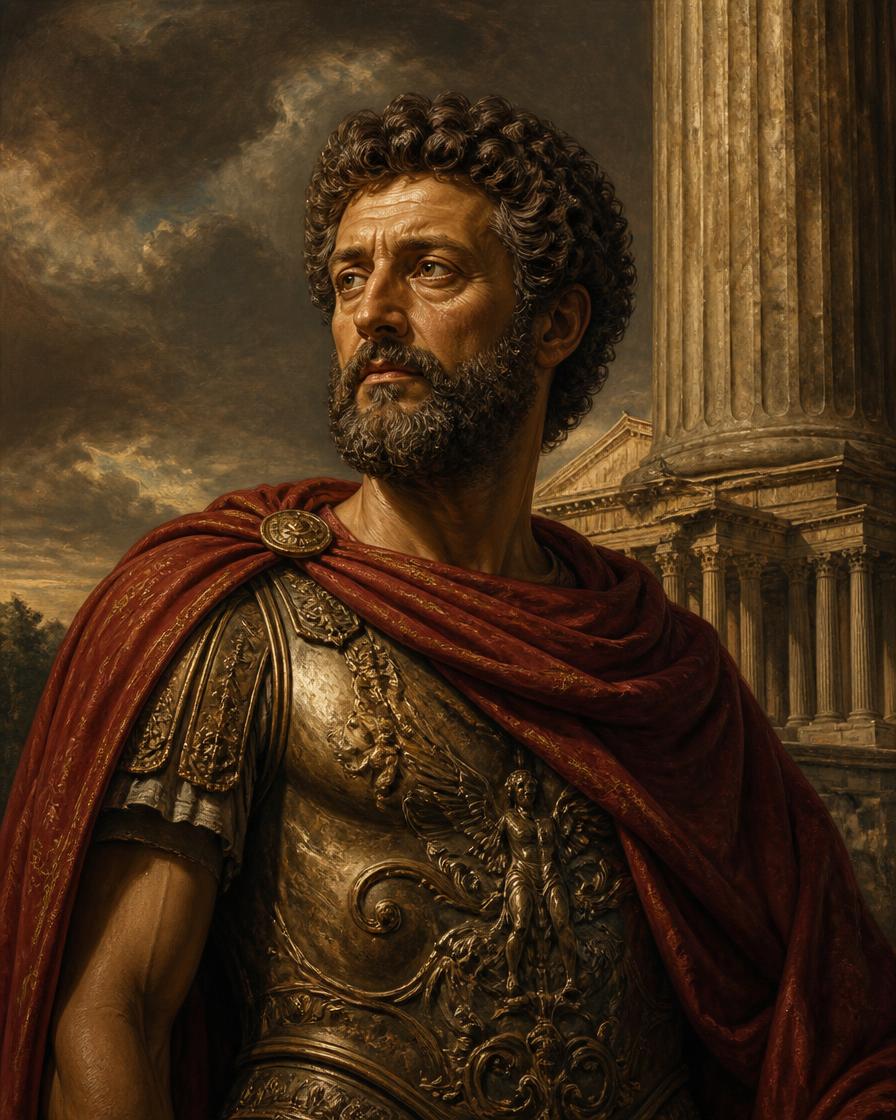
Quick Facts
- Years
- 121 – 180
- Category
- Philosophers & Thinkers
- Subcategory
- Stoicism
- Nationality
- Roman
- Occupation
- Roman Emperor & Stoic Philosopher
Marcus Aurelius
121 – 180 · Roman · Roman Emperor & Stoic Philosopher
Audiobook

Life Lessons from Marcus Aurelius
Marcus Alden · 46 min
Marcus Aurelius Antoninus (121–180) was Roman emperor from 161 to 180 and the last ruler traditionally grouped among the “Five Good Emperors.” He is equally famous as the author of the Meditations, private philosophical reflections that became one of Stoicism’s most influential surviving texts.
Born into Rome’s senatorial aristocracy, Marcus was adopted into the imperial succession arranged by Emperor Hadrian. After years of administrative and rhetorical training, he inherited power alongside Lucius Verus. Their reign confronted war with Parthia, a devastating epidemic—usually called the Antonine Plague—and prolonged fighting along the Danube frontier. Marcus spent much of his later life directing armies rather than enjoying the security of Rome.
His government combined serious attention to law and administration with the coercion and inequality characteristic of Roman imperial rule. His reputation as a humane philosopher-emperor must therefore be balanced against warfare, slavery, harsh measures during crises, and the persecution of some Christians under provincial authorities.
Marcus remains important because his life tests whether ethical reflection can guide political power. The tension between his Stoic ideals, his public responsibilities, and the imperfect results of his decisions continues to interest historians, philosophers, leaders, and general readers.
Quick Facts
| Field | Details |
|---|---|
| Full Name | Marcus Annius Verus; later Marcus Aurelius Antoninus Augustus |
| Common Name(s) | Marcus Aurelius; “the philosopher-emperor” |
| Born | 26 April 121 CE |
| Died | 17 March 180 CE |
| Age at Death | 58 |
| Birthplace | Rome, Roman Empire |
| Nationality | Roman |
| Occupation | Emperor, statesman, military commander, Stoic philosopher |
| Historical Era | Roman Empire; Antonine dynasty |
| Famous For | Reigning as emperor, frontier wars, and writing the Meditations |
| Political Affiliation | Roman imperial government; no modern party affiliation |
| Religion | Traditional Roman religion, interpreted through Stoic philosophy |
| Education | Privately educated in Latin and Greek rhetoric, law, literature, and philosophy |
| Parents | Marcus Annius Verus and Domitia Lucilla |
| Spouse(s) | Faustina the Younger |
| Children | Ancient evidence indicates at least 13 children; only some survived childhood, including Commodus and Lucilla |
| Major Works | Meditations (Greek title commonly rendered To Himself) |
| Major Achievements | Co-emperorship with Lucius Verus; administration and legal activity; defense of the Danube frontier; enduring contribution to Stoic thought |
Early Life
Marcus was born in Rome on 26 April 121 into a wealthy family of Spanish provincial ancestry established in the senatorial elite. His father, Marcus Annius Verus, died while Marcus was young. His mother, Domitia Lucilla, belonged to a prosperous family whose brickworks benefited from Rome’s construction economy. Marcus was raised partly under the supervision of his paternal grandfather, also named Marcus Annius Verus.
The child attracted the attention of Emperor Hadrian, who reportedly nicknamed him “Verissimus,” a play on the family name Verus and the Latin word for “most truthful.” The anecdote comes through later literary tradition and should not be treated as a verbatim record, but it reflects Marcus’s early reputation for seriousness.
His education was appropriate for a future Roman aristocrat. Tutors taught him Greek and Latin literature, rhetoric, law, music, geometry, and public speaking. Among his important teachers were the rhetoricians Marcus Cornelius Fronto and Herodes Atticus. Surviving letters between Marcus and Fronto reveal affection, intellectual exchange, concern over health, and occasional disagreement about the relative value of rhetoric and philosophy.
Marcus increasingly preferred philosophy. He credited the Stoic teacher Junius Rusticus with introducing him to the teachings of Epictetus and with encouraging intellectual discipline. Other influences included Apollonius of Chalcedon, Sextus of Chaeronea, and Claudius Maximus. These relationships later appeared in the first book of the Meditations, where Marcus catalogued virtues learned from relatives and teachers.
His youth unfolded during the comparatively stable reigns of Hadrian and Antoninus Pius. Yet Roman succession was not hereditary in any fixed constitutional sense. In 138, the ailing Hadrian adopted Antoninus Pius on condition that Antoninus adopt both Marcus and Lucius Verus, son of Hadrian’s earlier designated heir. This arrangement placed Marcus firmly in the line of succession.
Rise to Prominence
After his adoption by Antoninus Pius, Marcus became Marcus Aelius Aurelius Verus Caesar. His marriage plans changed accordingly. A proposed union with Ceionia Fabia was cancelled, and he was betrothed to Antoninus’s daughter Faustina the Younger. They married in 145.
Marcus served as consul in 140, 145, and 161. Antoninus gradually gave him tribunician power and other marks of imperial authority, while involving him in administration and meetings of the imperial council. This long apprenticeship—nearly twenty-three years—gave Marcus unusual preparation for rule.
The arrangement was not without personal strain. Marcus’s correspondence suggests recurring illness and anxiety over public responsibilities. He also had to reconcile his philosophical preference for simplicity with the ceremony and competition of court life. Nevertheless, he accepted the Stoic premise that social duty required him to perform the role assigned by circumstances.
Antoninus Pius died on 7 March 161. The Senate offered imperial power to Marcus. He insisted that Lucius Verus receive equal rank, creating Rome’s first formally acknowledged co-emperorship. Marcus was probably the senior partner in prestige and experience, but official documents and public monuments presented both men as Augusti.
The new rulers quickly faced military danger. Parthian forces intervened in Armenia and defeated Roman armies. Lucius traveled east while experienced generals, including Avidius Cassius, conducted operations. Victory enhanced the prestige of both emperors, but returning troops may have helped spread the epidemic later known as the Antonine Plague.
Major Achievements
Establishing a Durable Co-Emperorship
Marcus’s decision to share supreme rank with Lucius Verus honored Hadrian’s succession plan and avoided a potentially destabilizing rivalry. Although earlier emperors had delegated extensive authority, the formal equality of two Augusti was a significant institutional development.
The partnership mattered because the empire’s scale demanded divided attention. Lucius represented imperial authority in the East while Marcus remained closer to Rome. Later Roman governments repeatedly used multiple emperors, especially when simultaneous frontier crises became common.
Governing Through Law and Administration
Marcus devoted substantial attention to petitions, judicial hearings, appointments, and senatorial consultation. Legal sources preserve decisions associated with his reign on guardianship, inheritance, the treatment of slaves, and the status of vulnerable persons.
Some measures offered limited protections—for example, restraining certain forms of cruelty toward slaves or improving procedures affecting minors. These reforms did not challenge slavery or Roman hierarchy. Their significance lies in incremental regulation, not modern equality.
Marcus cultivated an image of conscientious accessibility. Cassius Dio, a senator writing later, praised his diligence and willingness to hear cases. Even allowing for idealization, the volume of legal activity indicates sustained engagement with government.
Managing the Parthian War
The Roman-Parthian War of 161–166 began badly, but Roman forces recovered under commanders such as Statius Priscus and Avidius Cassius. They reasserted influence in Armenia, entered Mesopotamia, and captured Seleucia and Ctesiphon.
The settlement restored Roman prestige in the East and gave Lucius and Marcus victory titles. It also exposed the limits of conquest: Rome did not permanently absorb all occupied territories. Moreover, the returning army was associated in ancient accounts with the spread of epidemic disease, though the plague’s precise route and pathogen remain debated.
Defending the Danube Frontier
From the later 160s, groups including the Marcomanni, Quadi, and Sarmatian Iazyges crossed or threatened Rome’s northern borders. Pressures probably included population movements, competition, and instability beyond the frontier. The conflict reached northern Italy, creating an unusually direct threat.
Marcus raised troops, mobilized resources, and spent years near the Danube. Roman armies eventually recovered territory, imposed settlements, and recruited or relocated some defeated peoples. The Column of Marcus Aurelius in Rome later depicted these campaigns in dramatic relief.
The wars prevented a lasting collapse of the frontier during Marcus’s lifetime. They also consumed money and lives, required severe measures, and remained unfinished when he died.
Writing the Meditations
Marcus composed much of the Meditations in Greek, probably during the 170s, including periods of military campaigning. The work consists of twelve books of notes rather than a polished treatise. It may never have been intended for publication.
He reminded himself to distinguish what depended on his judgment from what did not, to fulfill social duties, to resist anger, and to contemplate mortality. The text matters because it records philosophical practice under extraordinary pressure. Its influence has extended far beyond ancient Stoicism into ethics, psychology, leadership literature, and popular culture.
Leadership and Work
Marcus’s leadership rested on diligence, self-command, consultation, and devotion to duty. He worked closely with senators, jurists, secretaries, provincial governors, and generals. Unlike emperors remembered primarily for personal display, he fashioned—or acquired—the reputation of a ruler burdened by responsibility.
His decision-making was pragmatic. During emergencies, the government recruited gladiators and others into military service, auctioned imperial valuables, and accepted settlements that moved outsiders into imperial territory. Such measures show flexibility, but also the severity of Rome’s manpower and financial difficulties.
Marcus valued loyalty, competence, and philosophical restraint. His relationship with Lucius Verus demonstrates a willingness to share honors, even though ancient authors contrasted Marcus’s seriousness with Lucius’s alleged love of luxury. Those portraits may exaggerate moral differences to praise Marcus.
His strengths included patience, administrative experience, personal endurance, and an ability to retain capable commanders. He did not abandon the frontier when conditions became difficult. His surviving reflections show continued scrutiny of his motives.
Weaknesses are clearest in succession and crisis management. He could not permanently resolve the northern conflicts, and choosing Commodus as heir had disastrous consequences. Yet rejecting his biological son would itself have risked civil war. Marcus also remained an autocrat presiding over an exploitative imperial system; philosophical moderation did not make his government democratic or pacifist.
Personal Life
Marcus married Faustina the Younger in 145. Their marriage lasted until her death in 175. Ancient evidence indicates that they had at least thirteen children, many of whom died young. Surviving children included Lucilla, who married Lucius Verus, and Commodus, who became emperor.
Later gossip accused Faustina of adultery, often in sensational stories preserved by hostile or unreliable sources. Firm evidence is lacking. Marcus publicly honored her, had her deified after death, and established commemorative honors associated with her name.
His letters to Fronto reveal a warmer personality than the austere marble portraits might suggest. He expressed affection for family members, worried about illness, discussed sleep and digestion, and took pleasure in correspondence. Chronic health complaints appear repeatedly, although retrospective diagnosis is impossible.
Marcus enjoyed philosophy and literature, but his later years offered little leisure. He spent long periods at military headquarters in places such as Carnuntum and Sirmium. The Meditations suggest habits of daily self-examination, reading, and mentally rehearsing responses to adversity.
He could be emotionally reserved, but he was not indifferent. His writings repeatedly address grief, irritation, reputation, and death—subjects that mattered because he struggled with them. Stoic practice aimed not at emotional numbness but at preventing destructive passions from overruling reason and social responsibility.
Philosophy and Beliefs
Marcus followed Stoicism, a school founded in Hellenistic Athens and developed by thinkers including Zeno, Chrysippus, Seneca, Musonius Rufus, and Epictetus. Stoics taught that virtue is the only true good and that external conditions such as wealth, pain, status, and death do not determine moral worth.
Three themes dominate Marcus’s thought:
- Control of judgment: Events affect the mind partly through the interpretations assigned to them.
- Duty to others: Human beings are rational and social, so cooperation serves both nature and justice.
- Acceptance of change: Everything material passes away; fame and power are temporary.
Marcus believed the cosmos was ordered by providence or, at minimum, by an intelligible natural process. At times he frames the alternatives as “providence or atoms”: either way, panic and selfishness remain unreasonable. His religion was not secular in the modern sense. He participated in Roman cults, sacrifices, vows, and ceremonies while interpreting the divine through philosophical ideas about universal reason.
His philosophy shaped his ideal of emperorship. He urged himself to avoid becoming “Caesarified”—corrupted by power—and to act justly without craving praise. Yet the relationship between thought and policy is not always demonstrable. The Meditations rarely discuss specific decrees, campaigns, or individuals in enough detail to prove direct causal links.
Challenges and Controversies
The Antonine Plague
A severe epidemic struck the empire from the mid-160s and recurred for years. Galen described symptoms, but scholars disagree about the pathogen; smallpox is often proposed, though certainty is impossible. Claims that it killed a fixed percentage of the empire are modern estimates, not secure ancient statistics.
The plague damaged military recruitment, commerce, and public morale. Marcus responded through religious rites, fiscal measures, and emergency mobilization. Ancient medicine could not control the disease effectively.
Persecution of Christians
Christians suffered local persecutions during Marcus’s reign, most famously at Lyon and Vienne in 177. Some later Christian traditions portrayed him as a direct persecutor. Surviving evidence, however, does not establish a new empire-wide anti-Christian edict issued personally by Marcus.
Roman officials regarded refusal to honor the gods and imperial cult as socially disruptive. Marcus’s government did not create religious toleration, and he bears ultimate responsibility as emperor for the system under which punishments occurred. Historians nevertheless distinguish that responsibility from claims that he personally designed every local prosecution.
Warfare and Imperial Violence
The Meditations emphasize human kinship, yet Marcus commanded destructive wars. Roman monuments celebrate defeated and sometimes executed enemies. Supporters argue that the northern campaigns were defensive responses to invasions; critics note that Roman strategy also pursued domination, deportation, and possible annexation.
Both points can be true: Rome faced genuine attacks while responding through the violent logic of empire.
The Revolt of Avidius Cassius
In 175, the eastern commander Avidius Cassius was proclaimed emperor, reportedly after a false report that Marcus had died. The causes and Faustina’s alleged involvement remain disputed. Cassius was killed by his own officers before Marcus reached the East.
Marcus reportedly sought clemency for the rebel’s family and supporters. Ancient writers used the episode to illustrate his mercy, though their accounts may polish his philosophical image.
The Succession of Commodus
Marcus named Commodus Caesar in 166 and co-emperor in 177. After Marcus’s death, Commodus abandoned the northern offensive and developed a reputation for erratic, autocratic rule.
The succession is Marcus’s most famous political criticism. Earlier emperors had adopted capable adult heirs, but they often lacked surviving sons. Marcus was operating within expectations favoring dynastic continuity. Choosing another heir could have provoked conflict, yet Commodus’s elevation remains a consequential failure of judgment.
Legacy
Marcus’s immediate legacy was overshadowed by Commodus, whose reign ended with assassination in 192 and renewed civil war. Later authors therefore cast Marcus’s death as the end of a golden age. The neat contrast is morally powerful but historically simplified: serious military, demographic, and fiscal pressures had already emerged.
The Meditations became his most durable achievement. Preserved through Byzantine manuscripts, it circulated in print from the sixteenth century and gained readers across religious and political traditions. Modern admirers include soldiers, public officials, athletes, therapists, and readers seeking practical approaches to adversity.
His equestrian bronze statue survived the Middle Ages largely because it was mistakenly believed to represent the Christian emperor Constantine. The original is conserved in Rome’s Capitoline Museums, while a replica stands in the Piazza del Campidoglio. The Column of Marcus Aurelius remains in Piazza Colonna.
Museums across Europe and North America display coins, portraits, inscriptions, and casts associated with him. Archaeological sites along the Danube—including Carnuntum in Austria—interpret the frontier world in which he campaigned and wrote.
Modern scholarship resists treating Marcus either as a flawless sage or a hypocrite. His importance lies in the difficult conjunction of reflection and power. He left an unusually candid record of a ruler trying, not always successfully, to live according to universal ethical principles within a violent imperial order.
Interesting Facts
- Marcus was born on 26 April 121 in Rome.
- Hadrian reportedly called him “Verissimus,” meaning “most truthful.”
- He was adopted by Antoninus Pius as part of Hadrian’s succession plan.
- He served three consulships before becoming emperor.
- Marcus and Lucius Verus became co-emperors in 161.
- Their arrangement was Rome’s first formal joint rule by two Augusti.
- Marcus wrote the Meditations in Greek, not Latin.
- The work’s ancient title is commonly rendered To Himself.
- Several entries were written during campaigns near the Danube.
- His correspondence with Fronto survives in substantial fragments.
- He had at least thirteen children with Faustina the Younger.
- His daughter Lucilla married his co-emperor, Lucius Verus.
- Commodus became co-emperor three years before Marcus died.
- Marcus auctioned palace valuables during wartime financial pressure.
- The pathogen responsible for the Antonine Plague remains uncertain.
- His bronze equestrian statue survived partly through mistaken identification as Constantine.
- A scene once interpreted as a miraculous rain appears on the Column of Marcus Aurelius.
- He died while campaigning on the northern frontier, probably at Vindobona, although Sirmium has also been proposed.
- The Meditations do not present a systematic autobiography.
- “Marcus Aurelius” was only one form among the several names he bore during his life.
Famous Quotes
Translations vary because Marcus wrote in Greek. Book and section numbers provide the historical context.
- “The universe is change; our life is what our thoughts make it.” — Meditations 4.3, in a traditional translation. Marcus was reflecting on impermanence and the mind’s role in shaping experience.
- “You have power over your mind—not outside events. Realize this, and you will find strength.” — Often quoted from Meditations 12.36, but this wording is a modern paraphrase rather than a literal translation. It summarizes Stoic control of judgment.
- “The best revenge is not to be like your enemy.” — Meditations 6.6. The point is that retaliation must not corrupt one’s character.
- “What is not good for the hive is not good for the bee.” — Meditations 6.54. Individual welfare is inseparable from the community.
- “Waste no more time arguing about what a good man should be. Be one.” — Meditations 10.16. Philosophy should produce action, not endless debate.
- “The impediment to action advances action. What stands in the way becomes the way.” — Meditations 5.20, in a widely used modern translation. Obstacles become material for virtuous action.
- “When you arise in the morning, think of what a privilege it is to be alive, to think, to enjoy, to love.” — Popularly attributed to Marcus, but this exact wording is not securely found in standard texts; treat it as disputed.
- “Soon you will have forgotten all things; soon all things will have forgotten you.” — Meditations 7.21. Marcus uses mortality to reduce vanity and resentment.
- “If it is not right, do not do it; if it is not true, do not say it.” — Meditations 12.17. Ethical conduct requires truthful speech and just action.
- “Men exist for the sake of one another. Teach them then or bear with them.” — Meditations 8.59. Social duty calls for instruction or patience rather than hatred.
Timeline
- 121 — Born in Rome on 26 April.
- 124 — His father probably died while Marcus was still very young; the exact year is uncertain.
- 128 — Enrolled by Hadrian among the Salian priests.
- 136 — Hadrian first designated Lucius Aelius Caesar as heir.
- 138 — Antoninus Pius adopted Marcus and Lucius Verus under Hadrian’s succession settlement.
- 139 — Marcus received the title Caesar.
- 140 — Served his first consulship.
- 145 — Served a second consulship and married Faustina the Younger.
- 147 — Received tribunician power, marking him as Antoninus’s principal successor.
- 161 — Became emperor with Lucius Verus; served a third consulship.
- 161–166 — Roman-Parthian War.
- 165/166 — Major epidemic began spreading through imperial territories.
- 166 — Commodus and his twin brother Annius Verus were named Caesars.
- 166–167 — Northern frontier crisis intensified.
- 168 — Marcus and Lucius traveled north to direct military operations.
- 169 — Lucius Verus died; Marcus became sole emperor.
- 170s — Marcus composed much of the Meditations during the Danube campaigns.
- 172–175 — Roman counteroffensives against the Marcomanni, Quadi, and Iazyges.
- 175 — Avidius Cassius revolted and was killed; Faustina died later that year.
- 176 — Marcus celebrated a triumph with Commodus.
- 177 — Commodus became co-emperor; Christians were executed at Lyon and Vienne.
- 178 — Marcus and Commodus returned to the northern war.
- 180 — Marcus died on 17 March, probably at Vindobona; Commodus succeeded him.
Frequently Asked Questions
Who was Marcus Aurelius?
Marcus Aurelius was Roman emperor from 161 to 180 and a practitioner of Stoic philosophy. He initially ruled with Lucius Verus and later governed alone, before elevating Commodus as co-emperor. His reign was dominated by war, epidemic disease, legal administration, and frontier defense. He is now best known for the Meditations, a collection of private notes on ethics, duty, mortality, and self-discipline. Calling him a “philosopher-king” is understandable, but he remained an autocratic Roman ruler whose government relied on military force and social hierarchy.
When and where was Marcus Aurelius born?
He was born in Rome on 26 April 121 CE. His family belonged to the senatorial aristocracy and had roots in Roman Spain. His mother’s wealth and his paternal grandfather’s status gave him access to elite private education and court connections. Rome was then governed by Hadrian, under whom the empire experienced relative internal stability but still depended on carefully managed succession. Marcus’s birthplace and family background placed him close to political power long before he became formally connected to the imperial household.
How did Marcus Aurelius become emperor?
Marcus entered the succession through adoption. In 138, Hadrian adopted Antoninus Pius on condition that Antoninus adopt Marcus and Lucius Verus. Marcus then spent more than two decades learning government, holding consulships, and receiving imperial powers. When Antoninus died in 161, the Senate recognized Marcus as emperor. Marcus insisted that Lucius share the rank of Augustus. The transition was therefore dynastic and constitutional by Roman standards, rather than the result of military rebellion or conquest.
Why is Marcus Aurelius called a Stoic philosopher?
Marcus studied Stoic teachers and repeatedly practiced Stoic exercises in the Meditations. He emphasized rational judgment, virtue, acceptance of events outside one’s control, service to the human community, and awareness of mortality. He was not primarily an original theoretical philosopher. His importance comes from applying an established tradition to daily conduct under political and military pressure. The notes show philosophy functioning as training: Marcus corrects his anger, fear, vanity, and reluctance to perform difficult duties.
What are the Meditations?
The Meditations are twelve books of philosophical notes written in Greek. They are neither a conventional memoir nor an official account of Marcus’s reign. Many passages are reminders addressed to himself, drawing on Stoic ideas and quotations from earlier thinkers. The date and location of every entry cannot be determined, but references to the Quadi and to Carnuntum connect portions with the Danube campaigns. Their survival is remarkable because Marcus probably did not prepare them as a polished publication.
Did Marcus Aurelius write the Meditations during war?
At least part of the work was associated with military settings. One book bears a heading referring to the land of the Quadi, and another mentions Carnuntum, a major Roman base on the Danube. This does not prove that every passage was written in a battlefield tent, as popular imagery sometimes implies. The text probably accumulated over time. Its campaign context nevertheless helps explain the recurring attention to death, fatigue, difficult colleagues, duty, and the transience of political fame.
Was Marcus Aurelius a good emperor?
Ancient senatorial writers generally judged him favorably, emphasizing diligence, justice, and restraint. He defended threatened frontiers, respected administrative procedure, and avoided some forms of courtly excess. Yet “good” depends on criteria. His government waged brutal wars, preserved slavery, and did not prevent local persecution of Christians. His choice of Commodus also had grave consequences. Historians usually regard him as capable and conscientious, while rejecting the idealized picture of a faultless ruler.
Who ruled with Marcus Aurelius?
Lucius Verus ruled as co-emperor from 161 until his death in 169. Marcus appears to have held greater moral authority and administrative experience, but Lucius had equal imperial title and received credit for eastern victories. In 177, Marcus elevated his son Commodus to co-emperor. These arrangements illustrate an increasingly important Roman solution to governing a vast empire: distributing supreme authority among multiple rulers while trying to preserve unity.
What was the Antonine Plague?
The Antonine Plague was a major epidemic that appeared during the 160s and recurred into the following decades. The physician Galen observed it and described symptoms. Smallpox is a common modern diagnosis, but the evidence is insufficient for certainty. Ancient claims and modern demographic models suggest serious mortality, yet exact empire-wide death totals are unknown. The outbreak weakened recruitment, disrupted economic life, and intensified the pressures facing Marcus’s government during simultaneous frontier wars.
Did Marcus Aurelius persecute Christians?
Christians were prosecuted and executed during his reign, notably at Lyon and Vienne in 177. There is no conclusive evidence that Marcus issued a new general edict ordering empire-wide persecution. Most enforcement depended on governors, local accusations, and existing Roman expectations concerning sacrifice and public religion. Marcus therefore should not be detached from the coercive system he headed, but neither should every local action be presented as his personal initiative. The evidence supports a nuanced judgment rather than complete exoneration or a simple image of centrally directed persecution.
Who was Faustina the Younger?
Faustina was the daughter of Antoninus Pius and Faustina the Elder. She married Marcus in 145 and became Augusta, the principal imperial woman of his reign. She accompanied Marcus during part of his travels and was given the title Mater Castrorum, “Mother of the Camps.” Ancient gossip about her alleged affairs is difficult to verify and often reflects hostile conventions about powerful women. After her death in 175, Marcus had her deified and commemorated publicly.
How many children did Marcus Aurelius have?
Marcus and Faustina had at least thirteen children, although ancient and modern reconstructions differ in counting infants and names. Childhood mortality was high, even within the imperial family. Several children died young. Those who survived longer included Lucilla, who married Lucius Verus, and Commodus, the future emperor. The repeated bereavements form an important background to Marcus’s reflections on loss, impermanence, and accepting nature’s course.
Why did Marcus choose Commodus as successor?
Commodus was Marcus’s surviving son and had been publicly prepared for succession from childhood. Roman political culture strongly favored dynastic continuity when a legitimate male heir existed. Bypassing him might have encouraged rebellion or placed Commodus at mortal risk. Critics rightly observe that Commodus proved a destructive ruler, but Marcus did not possess certain knowledge of that future. His choice was understandable within Roman monarchy while still being one of his reign’s most damaging outcomes.
What were the Marcomannic Wars?
The Marcomannic Wars were a series of conflicts between Rome and peoples north of the Danube, including the Marcomanni, Quadi, and Iazyges. Beginning in the later 160s, invasions penetrated imperial territory and threatened northern Italy. Marcus spent years organizing recruitment, diplomacy, resettlement, and military counterattacks. Rome restored its position, but the struggle remained incomplete at his death. Commodus soon negotiated peace rather than continuing Marcus’s apparent plans for deeper control beyond the frontier.
Where did Marcus Aurelius die?
Marcus died on 17 March 180 while with the army on the northern frontier. Vindobona, modern Vienna, is the traditional and most commonly cited location, but Sirmium, near modern Sremska Mitrovica in Serbia, has also been argued from ancient evidence. The exact cause is unknown. Later stories about plague or poisoning cannot be established securely. His ashes were taken to Hadrian’s Mausoleum in Rome, although they did not survive the monument’s later history.
Is the film Gladiator historically accurate about Marcus Aurelius?
No. The film uses real names and the broad contrast between Marcus and Commodus, but its central plot is fictional. Commodus did not murder Marcus; he had already been co-emperor and succeeded him normally. There is no evidence that Marcus planned to abolish imperial rule and restore the Roman Republic, and the general Maximus is fictional. Commodus did perform as a gladiator, but he died in 192 through a palace conspiracy, not in the Colosseum fighting Maximus.
What is Marcus Aurelius’s most famous idea?
His best-known idea is that people cannot command every external event but can discipline their judgments and responses. This is often simplified into motivational slogans. For Marcus, however, self-command was inseparable from justice and social duty. Stoicism did not authorize passive withdrawal or selfish calm. A rational person was expected to cooperate, serve the community, endure necessary hardship, and correct wrongdoing without hatred.
Where can people see monuments to Marcus Aurelius?
The original bronze equestrian statue is displayed in the Capitoline Museums in Rome; a replica stands outside in the Piazza del Campidoglio. The Column of Marcus Aurelius, whose reliefs depict the northern wars, stands in Piazza Colonna. Portraits, inscriptions, and coins appear in many archaeological museums. Carnuntum in Austria preserves remains of the Danube frontier environment associated with his campaigns and with a heading in the Meditations.
Lessons We Can Learn
- Separate events from judgments. Marcus repeatedly examined how interpretation magnifies distress. Today, pausing before reacting can improve decisions without denying real hardship.
- Treat leadership as service. He regarded imperial work as an assigned social duty. Authority remains legitimate only when used for responsibilities beyond personal prestige.
- Prepare before crisis arrives. His long apprenticeship under Antoninus gave him administrative experience. Mentoring and deliberate preparation matter in modern institutions.
- Share responsibility. Marcus elevated Lucius Verus and delegated to capable generals. Complex problems are rarely solved by one person acting alone.
- Adapt when standard methods fail. Wartime recruitment, auctions, diplomacy, and resettlement show flexibility under pressure. Plans should serve goals rather than become sacred routines.
- Examine yourself honestly. The Meditations record recurring correction, not claims of perfection. Sustainable improvement requires acknowledging anger, vanity, and avoidance.
- Remember that reputation is temporary. Marcus used mortality to challenge the pursuit of fame. Long-term value depends more on conduct than applause.
- Remain humane toward opponents. Accounts of his response to Avidius Cassius emphasize clemency. Even where details are idealized, restrained victory is a valuable political principle.
- Judge succession carefully. Commodus’s elevation shows that loyalty to family can conflict with institutional welfare. Leadership transitions require candid evaluation and safeguards.
- Do not confuse ideals with results. Marcus’s Stoicism coexisted with imperial violence and persecution. Modern readers should assess both stated values and practical consequences.
Related Historical Figures
- Hadrian — Emperor who arranged the adoption scheme placing Marcus in the succession.
- Antoninus Pius — Marcus’s adoptive father, predecessor, and mentor in government.
- Faustina the Younger — Marcus’s wife, daughter of Antoninus Pius, and mother of Commodus.
- Lucius Verus — Adoptive brother and co-emperor from 161 to 169.
- Commodus — Marcus’s son, co-emperor, and controversial successor.
- Lucilla — Marcus’s daughter and wife of Lucius Verus; later involved in a conspiracy against Commodus.
- Fronto — Celebrated rhetorician whose surviving correspondence illuminates Marcus’s education and personality.
- Junius Rusticus — Stoic mentor credited by Marcus with directing him toward Epictetus.
- Epictetus — Earlier Stoic philosopher whose teachings deeply influenced the Meditations.
- Avidius Cassius — Successful eastern general who rebelled against Marcus in 175.
Watch and Learn
The Philosophy of Marcus Aurelius · TED-Ed
Related Historical Figures