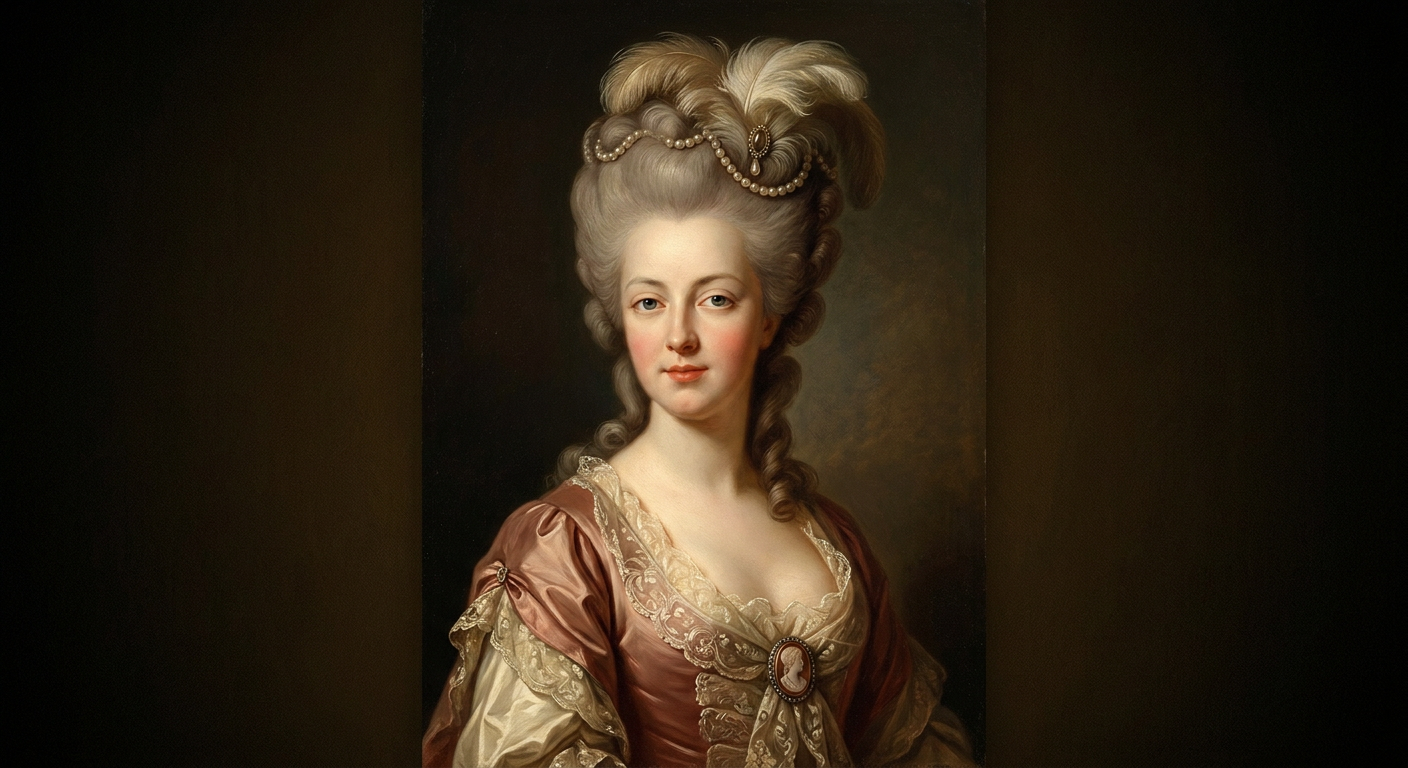
Quick Facts
- Years
- 1755 – 1793
- Category
- World Leaders & Revolutionaries
- Nationality
- Austrian-born French
- Occupation
- Queen consort of France and Navarre
Marie Antoinette
1755 – 1793 · Austrian-born French · Queen consort of France and Navarre
Recommended Audiobooks
Listen next from Marcus Alden

Life Lessons from Simon Bolivar
Marcus Alden · 55 min

Life Lessons from George Washington
Marcus Alden · 54 min
Marie Antoinette was the last queen of France before the monarchy collapsed during the French Revolution. Born an Austrian archduchess, she entered the French royal family as a teenager and became queen beside Louis XVI in 1774. Her life unfolded amid financial crisis, bitter political conflict and a transformation in how rulers were judged by the public.
She held no official governing office, yet her position gave her access, influence and enormous symbolic importance. She supported friends, artists and charitable causes; promoted fashion and theater; and eventually urged resistance to revolutionary limits on royal authority. Critics portrayed her as wasteful, immoral and disloyal. Some accusations had a basis in her early extravagance or political choices, while many others—including the claim that she said “Let them eat cake”—were inventions.
After the royal family’s failed flight from Paris, Marie Antoinette became closely associated with counterrevolution and foreign intervention. The monarchy fell in 1792, Louis XVI was executed, and she followed him to the guillotine on October 16, 1793.
Marie Antoinette remains important not because she controlled the French Revolution, but because her reputation reveals how gender, propaganda, celebrity culture and political distrust can shape history. Her surviving letters also illuminate the private fears of a mother and queen trapped inside a collapsing political order.
Quick Facts
| Field | Details |
|---|---|
| Full Name | Maria Antonia Josepha Johanna of Habsburg-Lorraine |
| Common Name(s) | Marie Antoinette; Madame Antoine; the Queen of France |
| Born | November 2, 1755 |
| Died | October 16, 1793 |
| Age at Death | 37 |
| Birthplace | Hofburg Palace, Vienna, Archduchy of Austria |
| Nationality | Austrian by birth; French by marriage and dynastic status |
| Occupation | Archduchess of Austria; dauphine and queen consort of France and Navarre |
| Historical Era | Late Ancien Régime and French Revolution |
| Famous For | Being France’s last pre-revolutionary queen and a major symbol of the monarchy’s downfall |
| Political Affiliation | Bourbon monarchy; later associated with royalist and counterrevolutionary efforts |
| Religion | Roman Catholicism |
| Education | Private court education in religion, languages, music, dance and etiquette |
| Parents | Francis I, Holy Roman Emperor, and Maria Theresa, ruler of the Habsburg lands |
| Spouse(s) | Louis XVI of France, married 1770 |
| Children | Marie-Thérèse Charlotte; Louis Joseph; Louis Charles; Sophie Hélène Béatrix |
| Major Works | No formal published works; extensive correspondence, patronage and involvement in court culture |
| Major Achievements | Helped secure early Franco-Austrian dynastic ties; patronized music, decorative arts and charitable activity; sustained royalist diplomacy during the Revolution |
Early Life
Maria Antonia was the fifteenth of the sixteen children of Empress Maria Theresa and Francis I. She grew up within the ceremonial world of the Habsburg court, although family life was less rigid than at Versailles. Music occupied a prominent place in her education, and she learned to sing, dance and play instruments.
Her academic preparation was uneven. Tutors reported weaknesses in spelling, handwriting, history and French, though she possessed social charm and musical ability. Her mother expected daughters to serve Habsburg diplomacy through marriage rather than rule independently.
Europe’s alliance system shaped Maria Antonia’s future. Austria and France had been long-standing rivals, but the Diplomatic Revolution of the 1750s made them allies against Prussia and Britain. A marriage between Maria Antonia and Louis-Auguste, heir to the French throne, was intended to strengthen that alliance.
Before leaving Vienna, the archduchess received accelerated instruction in French language and etiquette. In 1770, aged fourteen, she formally renounced claims associated with her Austrian birth and crossed into French territory. Her name was Frenchified to Marie Antoinette.
Rise to Prominence
Marie Antoinette married the fifteen-year-old dauphin Louis-Auguste at Versailles on May 16, 1770. The union was celebrated publicly, but festivities in Paris ended tragically when a crowd crush killed more than one hundred people.
Life at Versailles placed the young dauphine under relentless observation. Courtiers scrutinized her clothing, friendships, manners and failure to produce an heir. The marriage apparently remained unconsummated for several years. Historians debate the exact cause, but most reject older claims that Louis required surgery. Anxiety, inexperience and the couple’s difficult relationship are more plausible explanations.
Marie Antoinette resisted some court rituals and gravitated toward private entertainments, gambling, masked balls and a circle of favored companions. Her preference for the princesse de Lamballe and later Yolande de Polastron, duchesse de Polignac, generated jealousy among excluded courtiers.
Louis XV died in 1774, making the nineteen-year-old Marie Antoinette queen. Her visibility increased dramatically. She became a fashion leader, working with dressmaker Rose Bertin and hairdresser Léonard Autié. Towering hairstyles and elaborate gowns made her famous across Europe but also connected her image with luxury at a time of worsening hardship.
The birth of Marie-Thérèse Charlotte in 1778 improved her standing, although France still awaited a male heir. Louis Joseph was born in 1781, followed by Louis Charles in 1785 and Sophie in 1786. Sophie died the following year.
Major Achievements
Dynastic and diplomatic influence
The marriage embodied the Franco-Austrian alliance. Marie Antoinette occasionally passed information or advocated Austrian interests, usually under pressure from her mother and brother Joseph II. Her influence was inconsistent, however, and French ministers frequently resisted her requests.
Cultural patronage
She supported composers, performers, craftspeople and designers. The queen played the harp, participated in amateur theater and encouraged musical life at court. Her patronage contributed to the development of French decorative arts, fashion and interior design now associated with the late eighteenth century.
Charitable activity
Marie Antoinette gave money to poor families, assisted individuals who petitioned her and participated in customary royal charity. Such actions were genuine but could not repair the monarchy’s structural financial problems or overcome hostile publicity.
A less formal model of royal family life
At the Petit Trianon and nearby Queen’s Hamlet, she sought privacy from Versailles ceremony. She spent more time with her children than earlier court custom expected and commissioned intimate family portraits, particularly from Élisabeth Vigée Le Brun. These images promoted motherhood as part of queenship.
Defense of her family under pressure
During the Revolution, Marie Antoinette displayed discipline and courage, especially after the royal family was forced to Paris. She maintained political correspondence, negotiated secretly and tried to protect her children. Whether these efforts were loyal defense or dangerous resistance depends partly on one’s political perspective, but her persistence is well documented.
Leadership or Work
Marie Antoinette was a queen consort, not a sovereign ruler. She did not preside over councils, appoint every minister or control taxation. Claims that she personally governed France exaggerate her constitutional position.
Her influence operated informally through access to Louis XVI, patronage and correspondence. Early in the reign, she often treated politics as personal: she supported friends, opposed people she disliked and pursued appointments for favored families. This damaged her reputation and sometimes weakened confidence in the court.
She could be charming, generous and loyal, but also impatient with formal procedures. As the crisis deepened, she became more politically focused. She distrusted revolutionary leaders, favored preservation of substantial royal authority and communicated with foreign courts and royalist intermediaries.
Her strengths included composure, family loyalty and determination. Her weaknesses included poor political judgment, secrecy and an inability—or unwillingness—to appreciate how private privilege appeared to a suspicious public. By 1791, her reliance on foreign assistance reinforced accusations that she placed dynasty above nation.
Personal Life
Marie Antoinette and Louis XVI had different temperaments. He preferred hunting, reading and mechanical pursuits; she enjoyed music, fashion, theater and sociability. Their marriage matured slowly but eventually became affectionate and cooperative, especially during political danger.
Her closest friends included the princesse de Lamballe and the duchesse de Polignac. Favor shown to the Polignac circle attracted criticism because the family received prestigious appointments and financial benefits. Marie Antoinette’s relationship with the Swedish aristocrat Axel von Fersen was emotionally close. Some historians believe they became lovers; others argue that surviving evidence does not prove a sexual relationship. Their correspondence confirms trust, affection and political cooperation.
The queen loved children and was devastated by the deaths of Sophie and Louis Joseph. She also experienced pregnancies and health problems that altered her appearance and habits. After becoming a mother, she reduced some youthful amusements and cultivated a simpler—but still costly—private lifestyle.
The Queen’s Hamlet was not a place where she pretended to be an impoverished peasant, as popular legend suggests. It was an ornamental rural retreat based on aristocratic fashions for idealized nature, and parts of it supported a working farm.
Philosophy or Beliefs
Marie Antoinette was a practicing Catholic shaped by hereditary monarchy and dynastic duty. She did not produce a systematic political philosophy. Her beliefs must therefore be reconstructed cautiously from letters, conduct and the conventions of her position.
She accepted social hierarchy and regarded monarchy as legitimate, but she was not initially a rigid political reactionary. Before 1789, she sometimes supported administrative changes or ministers for practical reasons. Revolutionary violence and the royal family’s loss of freedom hardened her views.
She valued family loyalty, personal honor and the preservation of her son’s inheritance. These priorities often conflicted with revolutionary ideas of popular sovereignty. After 1789 she accepted limited concessions when unavoidable, yet secretly sought ways to restore stronger royal power.
Her religious convictions became more visible during imprisonment. In her final letter, she affirmed her Catholic faith, forgave her enemies and asked forgiveness from anyone she had harmed.
Challenges and Controversies
Spending and the financial crisis
Marie Antoinette spent heavily on clothing, gambling, renovations and favored companions, especially early in the reign. This invited legitimate criticism. Nevertheless, her expenses did not cause France’s fiscal collapse. War debts, an unequal tax system, borrowing costs and failed reforms were far more important.
The Diamond Necklace Affair
In 1785, fraudsters persuaded Cardinal de Rohan that the queen secretly wanted an extraordinarily expensive necklace. Marie Antoinette had rejected the necklace and knew nothing of the scheme. Although Rohan and others were tried, sensational reporting damaged her reputation because many people assumed she was somehow responsible.
Sexual and xenophobic propaganda
Pamphlets depicted her as adulterous, corrupt and unnaturally powerful. Much of this material was misogynistic and anti-Austrian rather than factual. At her 1793 trial, an accusation that she had sexually abused her son provoked outrage even among some hostile observers. No credible evidence supports it.
“Let them eat cake”
There is no reliable evidence that Marie Antoinette said this. A similar line appeared in Jean-Jacques Rousseau’s Confessions, referring anonymously to a “great princess,” when Marie Antoinette was still a child. The phrase became attached to her because it suited her public image.
The Flight to Varennes
In June 1791, the royal family attempted to escape Paris and reach a position of greater safety near the eastern frontier. They were recognized, arrested at Varennes and returned under guard. The failure shattered remaining trust in the king and queen and strengthened republicanism.
Foreign correspondence
Marie Antoinette secretly communicated with Austria and other royal powers. In 1792 she passed information concerning French political and military conditions. Royalists viewed this as a desperate attempt to save the monarchy; revolutionaries considered it betrayal during war. The evidence establishes her counterrevolutionary activity, although the extent of her effect on military events remains debated.
Trial and execution
After the monarchy fell on August 10, 1792, the family was imprisoned in the Temple. Louis XVI was executed in January 1793. Marie Antoinette was transferred to the Conciergerie in August and tried by the Revolutionary Tribunal in October.
The prosecution mixed evidence of political conspiracy with rumor and emotional accusation. She was convicted of treason and executed by guillotine on October 16, 1793. The compressed proceedings provided little chance for an effective defense and are generally regarded as politically determined.
Legacy
Marie Antoinette’s reputation has repeatedly changed. Revolutionaries made her an emblem of aristocratic corruption. Nineteenth-century royalists remembered her as a Catholic martyr and devoted mother. Later biographies sometimes romanticized her, while modern scholars place greater emphasis on political culture, gender and mass media.
Her life demonstrates that public images can become politically more powerful than financial accounts or constitutional facts. She was neither the foolish caricature responsible for France’s collapse nor merely an innocent victim. She participated in privilege, made damaging choices and resisted the Revolution, but she was also targeted by falsehoods that exploited her sex and foreign birth.
Versailles preserves her apartments, the Petit Trianon, gardens and Queen’s Hamlet. Objects connected with her appear in museums worldwide, and her portraits—especially those painted by Vigée Le Brun—remain central to studies of monarchy and fashion.
Books, films, operas and exhibitions continue to reinterpret her. She remains relevant to discussions of political celebrity, misinformation, women in public life and the dangers leaders face when private behavior becomes a symbol of national inequality.
Interesting Facts
- She was the youngest surviving daughter of Maria Theresa.
- The future queen was born on All Souls’ Day in 1755.
- Wolfgang Amadeus Mozart performed for the Habsburg family during her childhood, though later romantic stories about them are unreliable.
- She was only fourteen when she married the future Louis XVI.
- Her name changed from Maria Antonia to Marie Antoinette in France.
- The marriage produced no children for more than eight years.
- She gave birth to four children, but only Marie-Thérèse survived to adulthood.
- She was an accomplished amateur harpist.
- The Petit Trianon had originally been built for Louis XV, not for her.
- The Queen’s Hamlet included functional agricultural buildings as well as picturesque cottages.
- She was innocent of involvement in the Diamond Necklace fraud.
- “Madame Déficit” was a hostile political nickname rather than a neutral financial assessment.
- Her first son died during the opening phase of the Revolution in June 1789.
- Axel von Fersen helped organize the failed flight toward Montmédy in 1791.
- Her hair reportedly turned noticeably gray during the Varennes crisis, although claims that it changed overnight are exaggerated.
- At her trial, she appealed to the mothers present when confronted with the accusation of abusing her son.
- She accidentally stepped on her executioner’s foot and is traditionally reported to have apologized.
- Her remains were transferred to the Basilica of Saint-Denis during the Bourbon Restoration.
Famous Quotes
Translations vary, and words recorded by witnesses are less certain than surviving letters.
- “I have just been condemned, not to a shameful death, which is only for criminals, but to go and rejoin your brother.” From her final letter to Madame Élisabeth, written hours before her execution; it presents death as reunion with Louis XVI.
- “I die in the apostolic Roman Catholic religion, that of my fathers.” From the same letter, affirming the faith that sustained her in prison.
- “I sincerely ask pardon of God for all the faults I may have committed during my life.” Her final letter combines religious penitence with a defense of conscience.
- “I forgive all my enemies the evil they have done me.” Also from the final letter, expressing forgiveness within a Christian framework.
- “I had friends; the idea of being forever separated from them and their sorrows is one of the greatest regrets I carry with me.” A translated passage from her last letter showing her concern for those left behind.
- “Courage! I have shown it for years; think you I shall lose it at the moment when my sufferings are to end?” Traditionally attributed to her before execution. It fits eyewitness descriptions of her composure, but the exact wording is not securely documented.
- “Pardon me, sir, I did not do it on purpose.” Traditionally said after stepping on executioner Henri Sanson’s foot. Famous but based on later testimony rather than a surviving statement.
- “Let them eat cake.” Almost certainly misattributed. Rousseau recorded a similar remark before Marie Antoinette arrived in France, and no contemporary evidence connects it to her.
- “There is nothing new except what has been forgotten.” Frequently credited to Marie Antoinette, but its authorship is uncertain and should not be treated as authenticated.
Timeline
- 1755 — Maria Antonia is born in Vienna on November 2.
- 1765 — Her father, Francis I, dies; Joseph II becomes Holy Roman Emperor.
- 1770 — She travels to France and marries Louis-Auguste at Versailles.
- 1774 — Louis XV dies; Louis XVI and Marie Antoinette become king and queen.
- 1778 — Marie-Thérèse Charlotte, her first child, is born.
- 1781 — Louis Joseph, the long-awaited dauphin, is born.
- 1783 — The queen receives use of the Queen’s Hamlet as it is developed near the Petit Trianon.
- 1785 — Louis Charles is born; the Diamond Necklace Affair becomes a public scandal.
- 1786 — Sophie Hélène Béatrix is born.
- 1787 — Sophie dies in infancy.
- 1788 — France’s financial and political crisis intensifies.
- 1789 — Louis Joseph dies; the Bastille falls; the October Days force the royal family from Versailles to Paris.
- 1790 — The family lives under increasing supervision at the Tuileries Palace.
- 1791 — The Flight to Varennes fails; the family is returned to Paris.
- 1792 — France goes to war with Austria; the Tuileries is stormed; the monarchy is abolished.
- 1793 — Louis XVI is executed in January; Marie Antoinette is separated from her son, tried and guillotined on October 16.
- 1815 — Her remains and those of Louis XVI are transferred to Saint-Denis.
Frequently Asked Questions
1. Why is Marie Antoinette famous?
She is famous as the queen whose life became inseparable from the destruction of France’s Bourbon monarchy. Her clothing, friendships and private retreats made her an early international celebrity, while hostile pamphlets transformed her into a symbol of elite selfishness. During the Revolution she resisted attempts to reduce royal authority and sought foreign support. Her dramatic trial and execution ensured that later generations would view her either as a warning about privilege or as a victim of political hatred.
2. Was Marie Antoinette Austrian or French?
She was born an Austrian archduchess in Vienna and belonged to the Habsburg-Lorraine dynasty. Upon marrying the French heir in 1770, she surrendered Austrian possessions and entered the Bourbon royal house. Dynastic marriage made her France’s dauphine and then its queen, but critics continued calling her “the Austrian.” Her foreign origins mattered politically because France and Austria had been enemies within living memory, and suspicion revived when revolutionary France went to war with Austria in 1792.
3. Did she really say “Let them eat cake”?
There is no credible evidence that she did. Jean-Jacques Rousseau included a similar statement—usually translated as “Let them eat brioche”—in a work describing events from before Marie Antoinette became dauphine. He attributed it only to an unnamed princess. No contemporary witness recorded the queen saying it. The phrase was attached to her later because it neatly expressed the insensitive, extravagant character created for her by revolutionary propaganda and subsequent popular culture.
4. Did Marie Antoinette cause the French Revolution?
No single person caused the Revolution. France faced deep government debt, an inequitable tax system, expensive wars, food shortages, political deadlock and growing demands for representation. The queen’s spending and patronage contributed to the monarchy’s image problem but represented only a small part of state expenditure. Her later counterrevolutionary actions increased distrust, yet the crisis had structural causes far beyond her control. Making her solely responsible repeats a personalized explanation promoted by her enemies.
5. Was she as extravagant as people claimed?
She did spend heavily, particularly on fashion, gambling, interior decoration and favored courtiers during the early part of Louis XVI’s reign. These habits were politically unwise when the government needed reform. Nevertheless, pamphleteers greatly exaggerated her costs and blamed her for debts primarily created by warfare, long-term borrowing and resistance to taxation. Her nickname “Madame Déficit” was effective propaganda, not an accurate summary of the national budget.
6. What was the Diamond Necklace Affair?
It was an elaborate fraud involving Jeanne de La Motte, Cardinal de Rohan and a costly diamond necklace. La Motte convinced Rohan that he was secretly acting for the queen, using forged letters and an impersonator. Marie Antoinette neither ordered nor received the necklace. A public trial exposed the deception, but Rohan’s acquittal was widely interpreted as a rejection of royal authority. Paradoxically, the innocent queen suffered some of the affair’s greatest reputational damage.
7. Did Marie Antoinette have an affair with Axel von Fersen?
The Swedish count was unquestionably her intimate friend, trusted correspondent and political ally. He helped arrange the Flight to Varennes and remained devoted to her. Censored and decoded letters show affectionate language, encouraging some historians to believe that they were lovers. Others caution that emotionally intense correspondence does not establish a physical relationship. The fairest conclusion is that their bond was profound, while the sexual nature of it remains unproven and disputed.
8. What was the Queen’s Hamlet?
The Queen’s Hamlet was a group of picturesque rural buildings constructed near the Petit Trianon at Versailles. It reflected an aristocratic fashion for idealized country life and allowed the queen greater privacy. Contrary to legend, Marie Antoinette did not routinely dress as a starving peasant or perform farm labor. The estate included a functioning dairy and farm, but its carefully designed rustic appearance was expensive. It later became a powerful symbol of royal detachment from real rural hardship.
9. How many children did she have?
Marie Antoinette and Louis XVI had four children. Marie-Thérèse Charlotte, born in 1778, was the only one to survive into adulthood. Louis Joseph, born in 1781, died from illness in June 1789. Louis Charles, born in 1785 and regarded by royalists as Louis XVII after his father’s death, died in captivity in 1795. Their youngest child, Sophie Hélène Béatrix, lived for less than a year and died in 1787.
10. Why did the royal family attempt to escape?
By June 1791, the family lived under surveillance in Paris, and the king’s freedom of action had narrowed significantly. They planned to reach Montmédy, near forces considered loyal to the crown, from which Louis hoped to negotiate from a stronger position. Marie Antoinette and Fersen helped organize the operation. Delays, poor planning and recognition along the route led to arrest at Varennes. The attempt convinced many citizens that the king could not be trusted to uphold the new constitutional system.
11. Was Marie Antoinette a traitor?
That depends partly on the political framework applied. She secretly communicated with foreign monarchies and supported intervention capable of restoring royal power, even after France entered war. Revolutionary authorities regarded this as treason against the nation. Marie Antoinette understood herself as defending her family, dynasty and legitimate monarchy against coercion. Her counterrevolutionary involvement is established, but her trial included inflammatory accusations and denied her the protections expected in a fair modern proceeding.
12. Why was she executed?
Following the monarchy’s overthrow, the revolutionary government considered her a dangerous center of royalist conspiracy. She was accused of draining the treasury, maintaining intelligence with foreign powers and participating in plots against France. Some political evidence existed, especially in her correspondence, but the trial also relied on prejudice and sensational claims. Conviction was highly likely before proceedings began. She was found guilty of treason and executed by guillotine on October 16, 1793.
13. How did she behave before her death?
Contemporary reports generally describe her as composed. She wrote a final letter to her sister-in-law Élisabeth, affirming her faith, expressing love for her children and forgiving her enemies. Taken through Paris in an open cart, she maintained her dignity despite insults from spectators. The traditional story that she apologized after stepping on her executioner’s foot may be true, though its exact wording is not certain. She was thirty-seven when executed.
14. What happened to her surviving daughter?
Marie-Thérèse Charlotte remained imprisoned after her parents’ deaths and the deaths of her aunt and brother. In December 1795, French authorities released her in a prisoner exchange, and she traveled to Austria. She later married her cousin Louis-Antoine, Duke of Angoulême, and returned to France during the Bourbon Restoration. Known as Madame Royale, she remained committed to her family’s memory and died childless in 1851.
15. How do historians view Marie Antoinette today?
Most historians reject both the revolutionary monster and the completely innocent martyr. They acknowledge her privileged lifestyle, flawed patronage and active opposition to the Revolution while emphasizing that she did not create France’s financial crisis. Scholarship also studies the gendered and xenophobic nature of attacks against her. She is increasingly examined as a political communicator, mother, cultural patron and target of an expanding media culture rather than simply as an extravagant queen.
Lessons We Can Learn
- Reputation can outweigh accounting. Her spending did not bankrupt France, yet it became a convincing symbol of national debt. Modern interpretation: institutions must explain complex problems before simple false narratives dominate.
- Private privilege has public consequences. The Petit Trianon offered necessary privacy but appeared exclusionary. Leaders must consider how personal choices look beyond their immediate circle.
- Misinformation thrives on existing distrust. The necklace scandal harmed her despite her innocence because many already believed her corrupt.
- Foreignness can become a political weapon. Opponents repeatedly labeled her “the Austrian.” The record warns against treating origin as proof of disloyalty.
- Informal influence still carries responsibility. Though she lacked formal executive authority, her access to Louis XVI affected appointments and policy.
- Favoritism weakens legitimacy. Benefits granted to close companions encouraged resentment among both courtiers and the wider public.
- Secrecy can destroy remaining trust. The Varennes escape and foreign correspondence confirmed revolutionary suspicions, regardless of her motives.
- Dehumanizing propaganda has lasting effects. Sexualized attacks made reasoned debate nearly impossible and still influence popular memory.
- Courage does not erase misjudgment. Her composure in captivity was remarkable, but it cannot undo earlier political mistakes. Both facts can be true.
- Historical judgment requires proportion. Marie Antoinette made consequential choices, yet France’s collapse arose from systems, wars and collective failures—not one queen.
Related Historical Figures
- Louis XVI — Her husband and king of France, whose indecision and reform struggles shaped their shared fate.
- Maria Theresa — Her mother, who arranged the French marriage and advised her through demanding letters.
- Joseph II — Her brother and Holy Roman Emperor, who visited France and encouraged the royal couple to resolve their marital difficulties.
- Axel von Fersen — Swedish nobleman, intimate friend and organizer of the Flight to Varennes.
- Élisabeth Vigée Le Brun — Court artist whose portraits helped construct the queen’s public image.
- Yolande de Polastron — The duchesse de Polignac, her influential favorite and a focus of criticism over court patronage.
- Madame du Barry — Louis XV’s mistress, whom the young dauphine initially refused to acknowledge at court.
- Cardinal de Rohan — The deceived participant in the Diamond Necklace Affair, which devastated the queen’s reputation.
- Maximilien Robespierre — Revolutionary leader associated with the political climate of the Terror during which she was tried.
- Marie-Thérèse Charlotte — Her surviving daughter, who preserved the family’s memory through exile and restoration.
Watch and Learn
“What caused the French Revolution?” — TED-Ed — approximately 5½ minutes
This concise animated lesson explains the financial, social and political pressures surrounding Marie Antoinette and Louis XVI. It is recommended because it places the queen within the Revolution’s broader causes instead of repeating the misleading idea that her spending alone brought down France.
Watch and Learn
What caused the French Revolution? · TED-Ed
Related Historical Figures