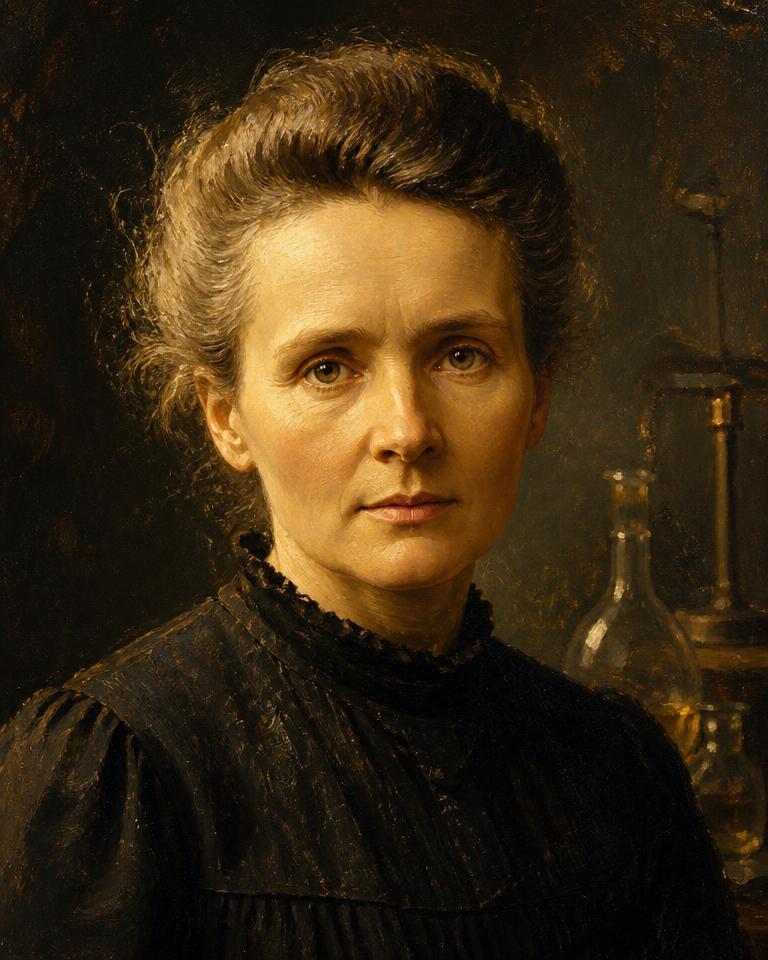
Quick Facts
- Years
- 1867 – 1934
- Category
- Scientists & Inventors
- Subcategory
- Radioactivity
- Nationality
- Polish-French
- Occupation
- Physicist & Chemist
Marie Curie
1867 – 1934 · Polish-French · Physicist & Chemist
Audiobook

Life Lessons from Marie Curie
Marcus Alden · 54 min
Marie Curie was a Polish-born physicist and chemist whose investigation of radioactivity transformed modern science. Born Maria Skłodowska in Warsaw under Russian imperial rule, she moved to Paris to pursue the university education largely denied to women in her homeland. Working first with her husband, Pierre Curie, and later as an independent scientist, she helped establish radioactivity as a field of experimental study, discovered the elements polonium and radium, and developed methods for isolating radioactive substances.
Curie was the first woman awarded a Nobel Prize, the first person to receive two Nobel Prizes, and remains the only individual honored in two different natural sciences: physics and chemistry. Her painstaking measurements challenged older ideas about the indivisibility of atoms and helped prepare the way for nuclear physics and nuclear medicine. During the First World War, she also organized mobile X-ray services that assisted military surgeons.
Her career exposed the institutional barriers, xenophobia, sexism, and sensationalist press scrutiny faced by prominent women. It also illustrates the hazards of early radiation research, undertaken before its biological effects were adequately understood. Curie remains important not simply as a record-breaking scientist, but as an experimental innovator, institution builder, medical volunteer, and international symbol of intellectual perseverance.
Quick Facts
| Field | Details |
|---|---|
| Full Name | Maria Salomea Skłodowska; after marriage, Maria Skłodowska-Curie |
| Common Name(s) | Marie Curie; Madame Curie |
| Born | 7 November 1867 |
| Died | 4 July 1934 |
| Age at Death | 66 |
| Birthplace | Warsaw, Congress Poland, Russian Empire; now Poland |
| Nationality | Polish-born; naturalized French |
| Occupation | Physicist, chemist, professor, laboratory director |
| Historical Era | Late 19th and early 20th centuries |
| Famous For | Research on radioactivity; discovery of polonium and radium; two Nobel Prizes |
| Political Affiliation | No formal party affiliation recorded; supported Polish independence and international scientific cooperation |
| Religion | Raised Roman Catholic; later accounts describe her as agnostic or religiously nonobservant |
| Education | Flying University, Warsaw; University of Paris (Sorbonne), degrees in physical sciences and mathematics |
| Parents | Władysław Skłodowski and Bronisława Boguska Skłodowska |
| Spouse(s) | Pierre Curie, married 1895; widowed 1906 |
| Children | Irène Joliot-Curie and Ève Curie |
| Major Works | Doctoral thesis, Research on Radioactive Substances; scientific papers on polonium, radium, and radioactivity; Treatise on Radioactivity |
| Major Achievements | Nobel Prize in Physics (1903); Nobel Prize in Chemistry (1911); discovery of polonium and radium; wartime radiology service; first female professor at the Sorbonne |
Early Life
Maria Skłodowska was the youngest of five children born to teachers Władysław Skłodowski and Bronisława Boguska. Her father taught mathematics and physics; her mother directed a respected girls’ school. The household valued learning and Polish culture, both politically sensitive under the Russian authorities governing Warsaw.
Her childhood included severe personal and financial losses. Her sister Zofia died of typhus in 1876, and her mother died of tuberculosis in 1878. Russian policies restricted Polish language and history in schools, while women could not enroll in the imperial University of Warsaw. Maria nevertheless graduated from secondary school with a gold medal in 1883.
She attended clandestine courses associated with the so-called Flying University, an underground educational network that offered advanced instruction, including opportunities for women. She also obtained elementary laboratory experience in Warsaw at the Museum of Industry and Agriculture, where her cousin Józef Boguski supervised a laboratory.
Maria and her sister Bronisława formed a practical pact: Maria would work to support Bronisława’s medical studies in Paris, after which Bronisława would help Maria. Maria spent several years as a governess, notably for the Żorawski family. She fell in love with their son Kazimierz Żorawski, but his family opposed a marriage, apparently because of her limited finances and social position.
In 1891, aged 24, she moved to Paris and adopted the French form of her name, Marie. She studied physics, chemistry, and mathematics at the University of Paris, living frugally in the Latin Quarter. She received a degree in physical sciences in 1893 and one in mathematics in 1894. Among the scientists who influenced her were physicists Gabriel Lippmann and Edmond Bouty. Her training emphasized precise measurement, a defining feature of her later work.
Rise to Prominence
Marie’s first substantial French research assignment concerned the magnetic properties of steels. Seeking laboratory space and specialist advice, she met Pierre Curie in 1894. Pierre and his brother Jacques had studied piezoelectricity and designed highly sensitive electrometers. Marie and Pierre shared scientific interests and married in July 1895.
A decisive opportunity followed Wilhelm Conrad Röntgen’s discovery of X-rays in 1895 and Henri Becquerel’s 1896 observation that uranium compounds emitted penetrating rays. Marie selected these poorly understood “uranium rays” for her doctoral research. Using the Curie electrometer, she measured the electrical conductivity produced when the radiation ionized air.
Her systematic tests showed that radiation intensity depended on the quantity of uranium rather than its chemical form. She concluded that the phenomenon arose from the atom itself—an important departure from conventional assumptions. She also found that thorium emitted similar radiation and introduced the term “radioactivity” for the phenomenon.
Marie discovered that pitchblende and chalcolite were more active than their uranium content could explain. She inferred that they contained unknown, intensely radioactive substances. Pierre suspended his crystal research to collaborate. In July 1898, they announced evidence for polonium, named for Poland. In December, working with Gustave Bémont, they announced radium.
Extracting radium required processing tons of pitchblende residue through repeated crushing, dissolving, filtering, precipitating, and crystallizing. The work took place under primitive conditions in a drafty shed. International attention grew as radium’s unusual properties became known. In 1903, Marie defended her doctorate and shared the Nobel Prize in Physics with Pierre Curie and Henri Becquerel.
Major Achievements
Establishing Radioactivity as an Atomic Property
Curie converted Becquerel’s observation into a quantitative research program. By measuring ionization, she demonstrated that radioactivity was linked to the amount of uranium present and was largely unaffected by ordinary chemical or physical changes.
This mattered because atoms were still often treated as stable, indivisible units. Radioactivity suggested that atoms possessed internal structures capable of transformation and energy release. Her work helped open the intellectual path toward nuclear physics, although later researchers developed the detailed theory of radioactive decay.
Discovery of Polonium and Radium
In 1898, Marie and Pierre Curie reported two new elements. Polonium honored Marie’s partitioned homeland; radium took its name from the Latin word for ray.
The discoveries showed how careful measurements could reveal substances present in minute concentrations. Radium became a major tool in research on atomic structure and radiation. Polonium later found specialized scientific and industrial uses, although both elements require strict controls because of their toxicity and radioactivity.
Isolation and Measurement of Radium
The Curies’ initial claims depended on radioactivity and chemical behavior rather than an immediately isolated sample of pure metal. Marie spent years separating radium compounds from pitchblende residues. With André-Louis Debierne, she obtained radium metal by electrolysis in 1910, while her earlier preparation of radium chloride enabled measurement of radium’s atomic weight.
These achievements strengthened radium’s status as a chemical element. They also demonstrated Curie’s extraordinary command of analytical chemistry and repetitive experimental work. In 1911, the Nobel Committee awarded her the Chemistry Prize for the discoveries of radium and polonium, the isolation of radium, and study of its compounds.
Two Nobel Prizes in Different Sciences
The 1903 Physics Prize recognized the Curies’ work on radiation phenomena, with Becquerel honored for discovering spontaneous radioactivity. Curie’s inclusion was not automatic: historical evidence indicates that Pierre alerted Swedish mathematician Gösta Mittag-Leffler when he learned Marie might be omitted from consideration.
Her 1911 Chemistry Prize recognized her independent scientific authority. She became the first person to win two Nobel Prizes and remains the only person to receive Nobel Prizes in both physics and chemistry.
First Female Professor at the Sorbonne
After Pierre died in a street accident in 1906, Marie assumed his teaching responsibilities. Her first lecture attracted enormous attention. She became the University of Paris’s first female professor.
The appointment carried significance beyond symbolism. It gave her a platform to train researchers, maintain a scientific program, and establish herself as more than Pierre’s collaborator. Her laboratory helped educate a generation of specialists in radioactivity.
Wartime Radiology
When war began in 1914, Curie redirected her expertise toward medical imaging. She helped equip automobiles with X-ray apparatus and electrical generators. These mobile units became popularly known as petites Curies, or “little Curies.” She learned anatomy and vehicle maintenance, instructed operators, and traveled to military hospitals.
Curie and her colleagues helped establish roughly 200 radiological installations, including about 20 mobile units, though historical totals vary by classification. X-rays allowed surgeons to locate bullets and fractures more accurately. Her wartime service advanced the practical integration of radiology into medicine, but exposed workers and patients to radiation at a time when protection was inadequate.
Building Radium Research Institutions
Curie helped create the Radium Institute in Paris, whose laboratories opened during the First World War and later developed into the Institut Curie. It combined physical and chemical research with biological and medical investigation. She also supported the Radium Institute in Warsaw, inaugurated in 1932 under the direction of her sister Bronisława.
These institutions embodied her belief that fundamental science and medical application could reinforce each other. The Institut Curie remains a major center for cancer research and treatment.
Leadership and Work
Curie led primarily through technical authority, persistence, and personal example. Her method was quantitative: measure carefully, repeat separations, compare results, and avoid conclusions unsupported by evidence. She tolerated severe physical discomfort and expected disciplined work from herself and her laboratory.
She could be reserved, austere, and demanding. These traits aided concentration but sometimes limited her ease in public or political settings. She disliked celebrity, yet learned to use public attention to secure radium and funding. American journalist Marie Meloney organized a campaign through which U.S. women presented Curie with one gram of radium in 1921; a later campaign supported the Warsaw institute.
Curie valued cooperation, working with Pierre, Gustave Bémont, André-Louis Debierne, physicians, technicians, and students. At the same time, laboratory hierarchies and authorship conventions reflected the period. Her greatest strength was sustained experimental focus. A weakness was her generation’s inadequate understanding—and at times inadequate precaution—regarding radiation exposure. That limitation was partly historical, though accumulating evidence eventually made the dangers harder to ignore.
Personal Life
Marie and Pierre Curie formed an unusually close scientific and personal partnership. They married in a civil ceremony and reportedly chose practical clothing and bicycles over elaborate wedding customs. Their daughters were Irène, born in 1897, and Ève, born in 1904. Pierre’s father, Eugène Curie, helped care for the children.
Pierre’s death on 19 April 1906, after he slipped in a Paris street and was struck by a horse-drawn vehicle, devastated Marie. Her private journal from the period records intense grief. She nevertheless continued their research and accepted his university position.
Irène became a physicist and chemist, married Frédéric Joliot, and shared the 1935 Nobel Prize in Chemistry for the discovery of artificial radioactivity. Ève became a writer, pianist, humanitarian, and author of an influential biography of her mother.
Around 1910–11, Curie had a relationship with physicist Paul Langevin, who was married but separated from his wife to an uncertain degree. Publication of private letters triggered a hostile press campaign. Curie was subjected to xenophobic, antisemitic-by-association, and sexist abuse, despite not being Jewish. The scandal affected her public life but did not invalidate her science.
She enjoyed long walks, cycling, swimming, and time outdoors. Years of radiation exposure contributed to chronic health problems, including cataracts. She died in 1934 of aplastic anemia, generally attributed to prolonged exposure to ionizing radiation.
Philosophy and Beliefs
Curie’s worldview centered on scientific evidence, education, work, and social usefulness. Raised Catholic, she appears to have moved away from religious observance after childhood losses; descriptions of her as agnostic are common, although her private metaphysical beliefs cannot be reconstructed with complete certainty.
She retained a strong Polish identity while becoming a French citizen. Naming polonium was a deliberate acknowledgment of Poland when it did not exist as an independent state. She supported Polish educational and scientific institutions without adopting a prominent party-political role.
Curie and Pierre declined to patent their method for processing radium. They believed scientific knowledge should circulate freely, though the decision also deprived them and their laboratory of potential income. Her wartime work reflected an ethical commitment to applying science to urgent human needs. She favored international scientific collaboration and served on the League of Nations’ International Committee on Intellectual Cooperation.
Challenges and Controversies
Curie faced structural discrimination throughout her career. Women were excluded from many academic pathways, and she was denied election to the French Academy of Sciences in 1911 by a narrow vote. Scholars debate the relative weight of sexism, xenophobia, scientific factionalism, and conservative institutional culture, but gender plainly shaped the contest.
Credit for the discovery of radium and polonium was collaborative. Marie initiated the radioactivity project and performed central measurements and chemical separations; Pierre contributed instruments, physical analysis, and experimental partnership. Gustave Bémont assisted in the radium work. Good history avoids portraying either spouse as merely the other’s assistant.
The Langevin affair became a public controversy because private correspondence was leaked during her Nobel year. Critics presented her as a foreign home-breaker; defenders emphasized marital separation, privacy, and a double standard that judged her more harshly than Langevin. The Nobel Committee advised her not to attend the ceremony. Curie replied that the prize concerned her scientific work and went to Stockholm.
Early researchers handled radioactive materials with little protection. Curie sometimes carried radium salts and admired their glow, as did other researchers of the era. She recognized harmful effects in some contexts and helped study medical uses, but did not fully appreciate cumulative exposure risks. Commercial “radium cures” later exploited public enthusiasm, often without her endorsement.
The Nobel system itself produced disputes. The 1903 prize initially risked underrecognizing Marie, while Ernest Rutherford and Frederick Soddy were crucial to explaining radioactive transformation. Curie’s lasting importance lies not in claiming sole ownership of nuclear science, but in her foundational experimental contributions.
Legacy
Curie changed physics, chemistry, medicine, and the public image of a scientist. The unit curie was named for Marie and Pierre, although the SI unit of radioactivity is now the becquerel. Element 96, curium, honors Marie and Pierre Curie, and minerals, institutions, streets, schools, and scholarships bear the family name.
In 1995, the remains of Marie and Pierre were transferred to the Panthéon in Paris. Marie became the first woman interred there on her own merits. Her Warsaw birthplace is now the Maria Skłodowska-Curie Museum. The Institut Curie in Paris and the Maria Skłodowska-Curie National Research Institute of Oncology in Poland continue the connection between laboratory science and cancer care.
Her notebooks and some personal objects remain radioactive and are stored under controlled conditions. This is both a safety reality and a striking material reminder of the risks faced by early researchers.
Curie remains relevant to discussions about women in science, migration, research funding, scientific credit, occupational safety, and the relationship between discovery and medical application. Her achievements should not be reduced to a story of solitary genius: they arose from exceptional ability, collaboration, institutions, and labor performed despite formidable barriers.
Interesting Facts
- She was born Maria Skłodowska and used the name Marie after moving to France.
- She graduated from secondary school with a gold medal.
- Women could not attend the University of Warsaw during her youth.
- She supported her sister’s Paris medical education before beginning her own studies there.
- She ranked first in her 1893 physical sciences degree examination.
- She coined or popularized the scientific term “radioactivity.”
- Polonium was named for Poland, then partitioned among empires.
- Several tons of mineral residue were processed to obtain small quantities of radium compounds.
- Her 1903 thesis was considered an unusually important doctoral work.
- She was the first woman to receive a Nobel Prize.
- She was the first person to receive two Nobel Prizes.
- She was the Sorbonne’s first female professor.
- She drove and maintained mobile radiology vehicles during the First World War.
- Her daughter Irène also became a Nobel laureate.
- Marie and Pierre did not patent their radium-separation process.
- President Warren G. Harding presented her with one gram of radium in 1921 after an American fundraising campaign.
- She served on a League of Nations committee promoting intellectual cooperation.
- Her laboratory papers remain sufficiently radioactive to require protective handling.
- Curium, atomic number 96, was named for Marie and Pierre Curie.
- She and Pierre were reinterred in the Panthéon in 1995.
Famous Quotes
Quotations vary in translation because Curie wrote and spoke in Polish and French.
- “Nothing in life is to be feared; it is only to be understood.” From an often-cited statement associated with her reflections on scientific knowledge. It expresses confidence that understanding can replace irrational fear, though wording differs among sources.
- “Now is the time to understand more, so that we may fear less.” Commonly presented as the continuation of the preceding thought; its exact original publication history is not always supplied and should be cited cautiously.
- “One never notices what has been done; one can only see what remains to be done.” Recorded in biographical tradition and descriptive of her relentless focus on unfinished work.
- “I was taught that the way of progress was neither swift nor easy.” From her autobiographical reflections, summarizing both her education and scientific career.
- “We must believe that we are gifted for something, and that this thing, at whatever cost, must be attained.” From autobiographical writing about vocation and perseverance.
- “I am among those who think that science has great beauty.” From a 1933 interview, linking scientific understanding with wonder rather than mere utility.
- “A scientist in his laboratory is not only a technician: he is also a child placed before natural phenomena which impress him like a fairy tale.” Also associated with her 1933 reflections; the period’s generic masculine is usually retained in translation.
- “You cannot hope to build a better world without improving the individuals.” Widely attributed to Curie in collections of her remarks; often quoted to connect personal responsibility with social progress, though readers should seek an archival citation before scholarly use.
- “Radium is not to enrich any one. It is an element; it is for all people.” Reported in connection with Marie Meloney’s 1920–21 fundraising campaign. It conveys Curie’s resistance to treating scientific discovery solely as private property.
- “Be less curious about people and more curious about ideas.” Frequently attributed to Curie, but a secure primary-source context is difficult to establish; treat the attribution as disputed.
Timeline
- 1867 — Maria Salomea Skłodowska is born in Warsaw on 7 November.
- 1876 — Her sister Zofia dies of typhus.
- 1878 — Her mother dies of tuberculosis.
- 1883 — Maria completes secondary school with a gold medal.
- 1880s — She studies through underground educational networks and works as a governess.
- 1891 — She moves to Paris and enrolls at the University of Paris.
- 1893 — She earns a degree in physical sciences.
- 1894 — She earns a mathematics degree and meets Pierre Curie.
- 1895 — Marie and Pierre marry on 26 July.
- 1897 — Their daughter Irène is born; Marie begins studying uranium rays.
- 1898 — She reports thorium’s radioactivity; the Curies announce polonium in July and radium in December.
- 1902 — Curie prepares radium chloride sufficiently pure to determine radium’s atomic weight.
- 1903 — She earns her doctorate and shares the Nobel Prize in Physics with Pierre Curie and Henri Becquerel.
- 1904 — Daughter Ève is born.
- 1906 — Pierre dies; Marie succeeds him at the Sorbonne.
- 1908 — She becomes a full professor.
- 1910 — She publishes Treatise on Radioactivity and, with André-Louis Debierne, obtains radium metal.
- 1911 — She loses election to the Academy of Sciences, faces the Langevin scandal, and receives the Nobel Prize in Chemistry.
- 1914 — The First World War begins; Curie organizes wartime radiology services.
- 1918 — The Radium Institute’s research work expands after the war.
- 1921 — She visits the United States and receives one gram of radium funded by American women.
- 1922 — She joins the League of Nations’ International Committee on Intellectual Cooperation.
- 1929 — A second U.S. campaign supports radium for the Warsaw institute.
- 1932 — The Warsaw Radium Institute opens.
- 1934 — Marie Curie dies on 4 July at the Sancellemoz sanatorium in France.
- 1935 — Irène and Frédéric Joliot-Curie receive the Nobel Prize in Chemistry.
- 1995 — Marie and Pierre Curie are reinterred in the Panthéon.
Frequently Asked Questions
Why is Marie Curie famous?
Marie Curie is famous for making radioactivity a measurable field of science and for helping discover polonium and radium. Her experiments showed that radioactive emission was associated with atoms rather than ordinary chemical arrangements. She shared the 1903 Nobel Prize in Physics and received the 1911 Nobel Prize in Chemistry. She also became the first female professor at the University of Paris and organized mobile X-ray services during the First World War. Her importance rests on both scientific discovery and the institutions she created for research and medicine.
What did Marie Curie discover?
Curie discovered that thorium, like uranium, was radioactive and that the intensity of uranium radiation depended on the amount of uranium present. With Pierre Curie, she identified evidence for two previously unknown elements in 1898: polonium and radium. Discovery was a multistage process involving radiation measurements, chemical separation, and eventual characterization. She did not discover radioactivity itself; Henri Becquerel first observed spontaneous uranium radiation in 1896. Curie transformed that observation into a broad, quantitative research program.
Did Marie Curie discover radiation?
No. Various forms of radiation were known before her work. Wilhelm Röntgen discovered X-rays in 1895, and Henri Becquerel discovered spontaneous radiation from uranium compounds in 1896. Curie investigated Becquerel’s rays systematically, showed that thorium also emitted them, and developed the concept of radioactivity as an atomic property. Her measurements led to the discovery of polonium and radium. Saying she “discovered radioactivity” is common shorthand, but it obscures Becquerel’s initial observation and her more precise contribution: establishing a new field of study.
Why did she name polonium after Poland?
Curie named polonium for Poland, her homeland, which in 1898 was divided among the Russian, German, and Austro-Hungarian empires. Poland did not then exist as a sovereign state. The name therefore carried cultural and political meaning, drawing international attention to Polish national identity. Curie later became a French citizen and built her career in Paris, but she retained strong ties to Poland, supported Polish scientific development, and helped establish the Warsaw Radium Institute.
How did Marie Curie isolate radium?
Curie processed pitchblende residue through repeated chemical operations. She crushed and dissolved material, separated groups of compounds, measured each fraction’s radioactivity, and repeatedly crystallized radium-bearing salts. Radium behaves chemically much like barium, making separation extremely difficult. By 1902 she had prepared sufficiently pure radium chloride to determine radium’s atomic weight. In 1910, she and André-Louis Debierne obtained metallic radium by electrolytic methods. The process required years of physical labor and precise measurement.
How many Nobel Prizes did Marie Curie win?
She received two. The 1903 Nobel Prize in Physics was shared with Pierre Curie and Henri Becquerel for research on radiation phenomena. The 1911 Nobel Prize in Chemistry honored Marie Curie for the discoveries of radium and polonium, the isolation of radium, and research on the element and its compounds. She was the first person to win two Nobel Prizes. She remains the only individual awarded Nobel Prizes in two different natural sciences.
Was Marie Curie the first woman to win a Nobel Prize?
Yes. Her share of the 1903 Physics Prize made her the first female Nobel laureate. Her inclusion is historically significant because evidence suggests she was at risk of being overlooked until Pierre Curie communicated that her contribution had to be recognized. In 1911, she also became the first woman to receive the Chemistry Prize and the first person of any gender to win a second Nobel Prize.
What happened to Pierre Curie?
Pierre Curie died on 19 April 1906. While crossing a rain-slicked Paris street, he fell and was struck by a heavy horse-drawn vehicle. His death was sudden and left Marie with two young daughters. She recorded her grief in a private journal but continued their scientific work. The University of Paris offered her Pierre’s teaching position, making her its first female professor. His death marked the end of their partnership but not of her research career.
What were the “little Curies”?
The petites Curies were vehicles equipped with X-ray machines, electrical generators, and photographic equipment during the First World War. Curie helped organize and sometimes operate them so radiological imaging could reach wounded soldiers near military hospitals. X-rays enabled physicians to locate bullets, shrapnel, and fractures before surgery. She also trained radiology personnel, including women. The project demonstrated the medical value of physics, although radiation protection for operators and patients was primitive by modern standards.
Did radiation cause Marie Curie’s death?
Marie Curie died of aplastic anemia, and medical and historical accounts generally attribute the illness to long-term exposure to ionizing radiation. She worked before scientists fully understood cumulative radiation injury and often handled radioactive substances without modern shielding or monitoring. Wartime X-ray work may have added to her exposure. A single dose cannot be identified as the cause, and she also experienced other health problems, but the connection between her occupational exposure and fatal bone-marrow disease is widely accepted.
Are Marie Curie’s notebooks still radioactive?
Some laboratory notebooks, papers, and objects associated with Curie remain radioactive because they were contaminated with long-lived isotopes, especially radium-226, whose half-life is about 1,600 years. Materials held by France’s national library and other institutions require controlled storage and protective procedures. Researchers may need to accept safety conditions before consultation. Claims that every personal paper is dangerously radioactive are exaggerated, but the contamination of important archival materials is real.
Did Marie Curie patent radium?
No. Marie and Pierre Curie did not patent their radium-separation process. They supplied information to other researchers and believed that scientific knowledge should be available for further investigation. This choice supported the development of radioactivity research but meant they did not profit substantially from an increasingly valuable material. Curie later struggled to obtain enough radium for her laboratory, prompting Marie Meloney’s American fundraising campaign. The episode remains a useful case study in open science, intellectual property, and research funding.
Was Marie Curie French or Polish?
She was both Polish-born and French by citizenship and career. Born in Warsaw as Maria Skłodowska, she grew up under Russian imperial rule and maintained a lifelong Polish identity. She moved to Paris in 1891, married the French scientist Pierre Curie, became a French citizen, and conducted most of her research in France. Describing her solely as French or solely as Polish misses an important feature of her life: she belonged to both national scientific traditions.
Did Marie Curie face discrimination?
Yes. Women faced restricted access to universities, laboratories, professional societies, and senior appointments. Curie had to leave Warsaw to obtain a formal university education. In France, her fame did not eliminate misogyny or xenophobia. She narrowly lost election to the Academy of Sciences in 1911 and was subjected to vicious press attacks during the Langevin scandal. Scientific rivalries also mattered, so not every disagreement can be reduced to sexism, but gender and foreign birth significantly shaped her treatment.
What was the Paul Langevin scandal?
Paul Langevin was a French physicist and former student of Pierre Curie. Around 1910–11, he and Marie Curie had an intimate relationship while Langevin’s marriage was deeply troubled. Private letters were stolen or leaked, and newspapers portrayed Curie as a foreign intruder destroying a French household. The coverage used sexist and nationalist stereotypes and sometimes falsely implied that she was Jewish. The controversy coincided with her second Nobel Prize. Curie insisted that private allegations had no bearing on the scientific merit of her work.
Did Marie Curie have children?
Yes, two daughters. Irène Curie became a scientist, married Frédéric Joliot, and shared the 1935 Nobel Prize in Chemistry with him for artificial radioactivity. Ève Curie pursued music and writing, produced a celebrated biography of her mother, worked in humanitarian affairs, and later married American diplomat Henry Labouisse. Marie’s demanding career and Pierre’s early death complicated family life, but education and public service remained central values across the family.
Why was radium considered important?
Radium emitted intense, persistent radiation and heat, offering researchers a powerful source for studying atomic processes. Its radiation could damage living tissue, which encouraged early cancer treatments and eventually contributed to radiotherapy. Radium also became a commercial sensation and was irresponsibly added to consumer products. Modern medicine generally uses safer or more controllable radioisotopes and technologies. Radium’s importance was therefore both scientific and medical, while its history also demonstrates the danger of adopting new discoveries before their risks are understood.
Where is Marie Curie buried?
Marie Curie and Pierre Curie are buried in the Panthéon in Paris. Their remains were transferred there in 1995 in a ceremony attended by French and Polish leaders. Marie was the first woman admitted to the Panthéon because of her own achievements; Sophie Berthelot had previously been interred there alongside her husband. The reinterment recognized Curie’s place in French national history while also acknowledging her Polish origins.
Lessons We Can Learn
- Measure before concluding. Curie used electrometers rather than visual impressions. Today, reliable decisions likewise require evidence and reproducible methods.
- Turn obstacles into plans. Barred from university in Warsaw, she worked, saved, and moved to Paris. Structural barriers are real, but strategic preparation can widen options.
- Collaboration strengthens discovery. Marie, Pierre, Bémont, and Debierne contributed different skills. Complex problems benefit from complementary expertise.
- Persistence includes repetitive work. Radium separation required years of crystallization and testing. Breakthroughs often rest on unglamorous, sustained labor.
- Credit should be examined carefully. Marie nearly went underrecognized in 1903. Institutions must make contributions visible rather than relying on status or convention.
- Knowledge carries safety obligations. Early radiation research caused serious harm. Innovation should be paired with monitoring, worker protection, and willingness to revise practice.
- Science can serve emergencies. Curie adapted physics to wartime radiology. Expertise has greatest public value when translated responsibly into practical help.
- Privacy and achievement should not be confused. Sensational reporting about Langevin threatened to overshadow her science. Personal scrutiny should not replace fair evaluation of professional work.
- Institutions outlast individuals. Curie built laboratories in Paris and Warsaw. Durable progress requires training, facilities, funding, and succession.
- Identity can be plural. Curie served French science while honoring Poland. Migration need not erase cultural loyalty or international responsibility.
Related Historical Figures
- Pierre Curie — Marie’s husband and closest scientific collaborator; shared the 1903 Physics Prize.
- Henri Becquerel — His discovery of uranium radiation prompted Curie’s research; co-laureate in 1903.
- Irène Joliot-Curie — Marie’s daughter, laboratory colleague, and later Nobel-winning chemist.
- Frédéric Joliot-Curie — Marie’s son-in-law and co-discoverer of artificial radioactivity.
- Paul Langevin — Physicist connected scientifically and personally to Curie; central to the 1911 press scandal.
- André-Louis Debierne — Chemist who worked with the Curies and helped obtain metallic radium.
- Gustave Bémont — Collaborator credited on the 1898 announcement of radium.
- Ernest Rutherford — Developed foundational theories of radioactive decay and nuclear structure alongside the field Curie helped create.
- Wilhelm Conrad Röntgen — Discoverer of X-rays, whose work enabled the wartime radiology Curie organized.
- Marie Meloney — American journalist who led campaigns to provide Curie’s laboratories with radium and research support.
Watch and Learn
The genius of Marie Curie - Shohini Ghose · TED-Ed
Related Historical Figures