Quick Facts
- Years
- 1835 – 1910
- Category
- Writers & Poets
- Subcategory
- Novelists
- Nationality
- American
- Occupation
- Novelist & Humorist
Mark Twain
1835 – 1910 · American · Novelist & Humorist
Audiobook

Life Lessons from Mark Twain
Marcus Alden · 42 min
Mark Twain was the pen name of Samuel Langhorne Clemens, an American novelist, humorist, lecturer, journalist, and social critic. Born in Missouri in 1835, he drew on childhood beside the Mississippi River, work as a steamboat pilot, adventures in the American West, and extensive travel to create a body of writing that helped define American literature. His greatest books—The Adventures of Tom Sawyer, Adventures of Huckleberry Finn, Life on the Mississippi, and A Connecticut Yankee in King Arthur’s Court—combined vivid storytelling with satire of hypocrisy, social pretension, racism, violence, and unthinking conformity.
Twain became internationally famous through newspaper sketches, travel books, fiction, and public lectures. His prose captured the rhythms of American speech at a time when many writers still looked to European literary models. Huckleberry Finn became especially influential for its vernacular narration and moral confrontation with slavery, although its racial language and portrayals remain subjects of serious debate.
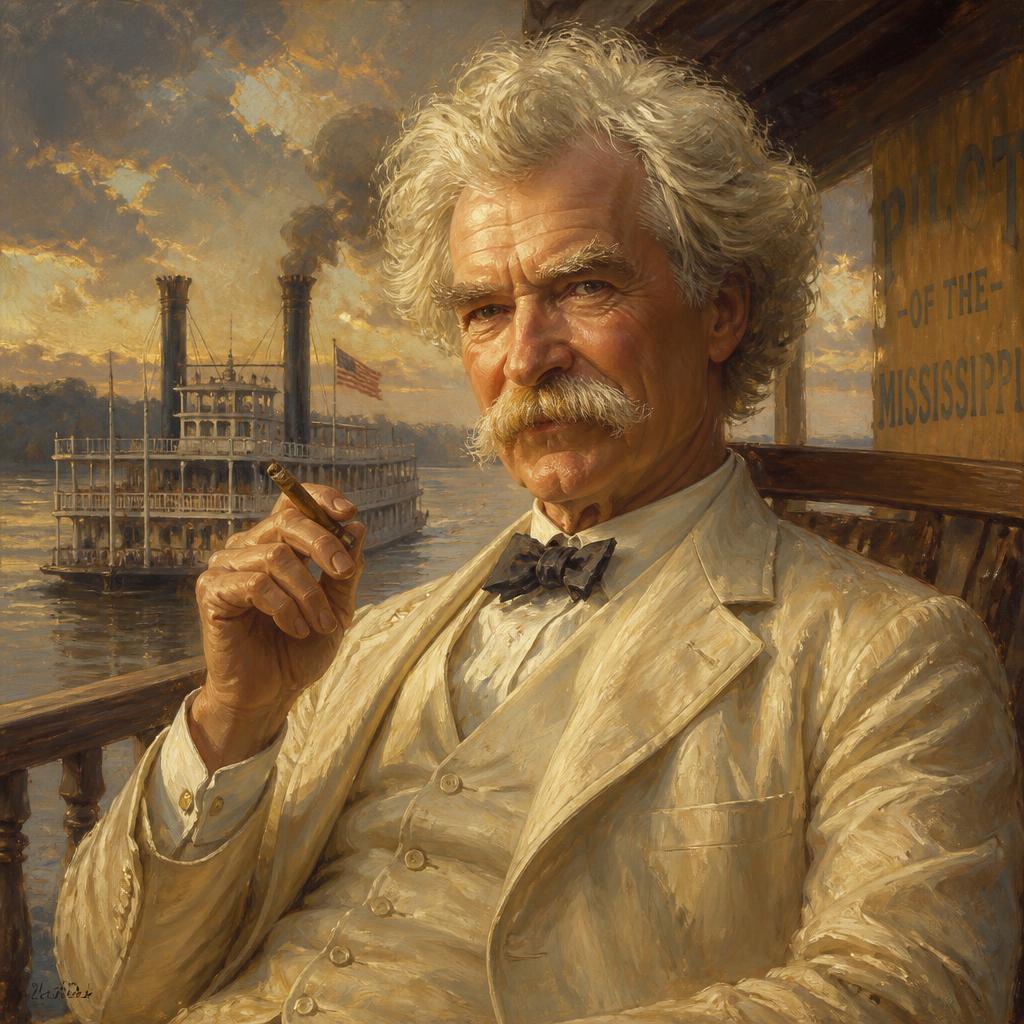
Beyond literature, Twain was a shrewd performer, an unsuccessful investor, a critic of imperialism, and a public celebrity whose white suit and unruly hair became instantly recognizable. He is still studied because his work illuminates nineteenth-century America while posing enduring questions about conscience, freedom, race, technology, power, and the stories societies tell about themselves.
Quick Facts
| Field | Details |
|---|---|
| Full Name | Samuel Langhorne Clemens |
| Common Name(s) | Mark Twain; Sam Clemens |
| Born | November 30, 1835 |
| Died | April 21, 1910 |
| Age at Death | 74 |
| Birthplace | Florida, Missouri, United States |
| Nationality | American |
| Occupation | Novelist, humorist, journalist, lecturer, memoirist, publisher |
| Historical Era | Nineteenth-century America; Gilded Age; Progressive Era |
| Famous For | Adventures of Huckleberry Finn, The Adventures of Tom Sawyer, social satire, travel writing, public lectures |
| Political Affiliation | Independent in outlook; briefly associated with the Mugwumps in 1884; later an anti-imperialist |
| Religion | Raised Presbyterian; later skeptical of organized religion and conventional theology |
| Education | Limited formal schooling; left school after his father’s death and trained as a printer |
| Parents | John Marshall Clemens and Jane Lampton Clemens |
| Spouse(s) | Olivia Langdon Clemens, married 1870–1904 |
| Children | Langdon, Susy, Clara, and Jean Clemens |
| Major Works | The Innocents Abroad; Roughing It; The Gilded Age; The Adventures of Tom Sawyer; The Prince and the Pauper; Life on the Mississippi; Adventures of Huckleberry Finn; A Connecticut Yankee in King Arthur’s Court; Pudd’nhead Wilson; Following the Equator |
| Major Achievements | Helped establish vernacular American prose; created enduring literary characters; became a leading humorist and lecturer; produced influential criticism of slavery, monarchy, imperialism, and social hypocrisy |
Early Life
Samuel Clemens was born in the small village of Florida, Missouri, the sixth of seven children, though only four survived childhood. His father, John Marshall Clemens, was a lawyer, merchant, and local official whose financial ventures rarely brought security. His mother, Jane Lampton Clemens, was known for humor, storytelling, and sympathy toward vulnerable people—traits later associated with her son.
In 1839 the family moved to Hannibal, a Mississippi River port. The town later supplied settings, personalities, caves, islands, and river culture for Tom Sawyer and Huckleberry Finn. Yet Twain’s nostalgic fiction softened a harsher reality. Missouri was a slave state, and enslaved people were part of the world he observed. Childhood contact with slavery became essential to his later moral imagination, although his understanding developed gradually and was never free from the assumptions and vocabulary of his era.
Clemens attended local schools until 1847, when his father died. At approximately eleven, he entered the workforce. He apprenticed to a printer and then worked for his brother Orion’s newspaper, the Hannibal Journal, setting type and contributing humorous pieces. Printing gave him an informal education in language, politics, news, and audience response.
As a young man he worked in printing offices in St. Louis, New York, Philadelphia, and other cities. He read widely in public libraries and learned through travel rather than university instruction. In 1857 he began training as a Mississippi steamboat pilot under Horace Bixby. Piloting required memorizing channels, landmarks, currents, and hazards across changing conditions. Twain later described it as one of the most demanding and satisfying occupations of his life.
The Civil War ended commercial traffic on much of the river. Clemens briefly joined a poorly organized Confederate volunteer unit, the Marion Rangers, but left after roughly two weeks. He later treated this episode humorously in “The Private History of a Campaign That Failed.” He then traveled west with Orion, who had been appointed secretary of Nevada Territory.
Rise to Prominence
In Nevada, Clemens tried silver prospecting but did not make a fortune. He turned instead to journalism, joining Virginia City’s Territorial Enterprise in 1862. There he wrote local reports, comic sketches, hoaxes, and political commentary. On February 3, 1863, he signed a dispatch “Mark Twain,” adopting a riverboat expression meaning a measured depth of two fathoms—water generally safe for navigation.
His sharp humor attracted readers but also created enemies. After a dispute involving rival journalists, he left Nevada for California in 1864. In San Francisco he wrote for newspapers, spent time with writers including Bret Harte, and endured financial and professional uncertainty.
The decisive breakthrough came with “Jim Smiley and His Jumping Frog,” first published in 1865 and later known as “The Celebrated Jumping Frog of Calaveras County.” Its deadpan narration and frontier tall-tale structure brought national attention. Twain converted success into a lecture career, demonstrating a gift for timing, facial expression, strategic pauses, and apparently spontaneous storytelling.
In 1867 he joined the Quaker City excursion to Europe and the Holy Land. Letters from the journey became The Innocents Abroad in 1869. The book mocked reverential tourism and cultural pretension while recording genuine curiosity about other societies. It sold extremely well and established Twain as a major author.
His marriage to Olivia Langdon in 1870 connected him with a wealthy, reform-minded New York family. Olivia became an important reader and editor. The couple settled in Hartford, Connecticut, in 1871, where Twain entered his most productive literary period. Fame did not eliminate obstacles: he struggled with deadlines, censorship concerns, family illness, and a recurring desire to become rich through inventions and publishing ventures.
Major Achievements
Transforming American Literary Language
Twain demonstrated that regional speech and everyday American idiom could sustain major literature. His narrators did not merely decorate standard prose with slang; their voices shaped perspective, ethics, and plot. This mattered because it challenged the assumption that serious American writing should imitate formal European models.
The long-term effect is especially visible in writers such as Ernest Hemingway, William Faulkner, and Ralph Ellison. Scholars dispute any single “father” of American literature, but Twain’s influence on narrative voice is exceptionally broad.
Creating Tom Sawyer and Huckleberry Finn
The Adventures of Tom Sawyer appeared in 1876, drawing imaginatively on Hannibal childhood. It balanced nostalgia with satire of schooling, religion, punishment, and adult authority.
Adventures of Huckleberry Finn was published in Britain in 1884 and the United States in 1885. Through Huck’s first-person voice and his journey with Jim, an enslaved man seeking freedom, Twain exposed the moral corruption of a society that treated bondage as normal. The book’s innovations in voice and structure made it a landmark.
Its legacy is complex. It condemns slavery and dramatizes Huck’s awakening conscience, yet uses racial slurs and sometimes relies on minstrelsy-era stereotypes. Educators continue debating whether, when, and how it should be taught.
Reinventing Travel Writing and Memoir
In The Innocents Abroad, Roughing It, A Tramp Abroad, Life on the Mississippi, and Following the Equator, Twain mixed observation, exaggeration, autobiography, history, and social criticism. He punctured romantic myths about Europe, the American frontier, and tourism.
These works helped popularize a distinctively comic form of travel writing. Their enduring value lies not only in destinations described, but in the exposure of travelers’ prejudices—including, at times, Twain’s own.
Satirizing Power, Technology, and Social Rank
Twain and Charles Dudley Warner co-wrote The Gilded Age in 1873. Its title became the standard label for an era marked by glittering wealth, corruption, speculation, and inequality.
Later, A Connecticut Yankee in King Arthur’s Court used time travel to compare industrial modernity with monarchy and feudalism. What begins as comic confidence in technology grows increasingly violent and bleak. The novel continues to invite debate over whether Twain celebrated technological progress, feared it, or did both.
Becoming an International Public Performer
Twain made literary authorship into public performance. His lectures blended prepared material with controlled improvisation, and his carefully cultivated persona helped make him one of the first globally recognized American literary celebrities.
His 1895–1896 world lecture tour was especially important. Facing bankruptcy, he traveled through North America, Australasia, India, and southern Africa. The income helped him honor creditors even after bankruptcy had relieved him of strict legal obligation, strengthening his reputation for personal responsibility.
Criticizing Imperialism and Institutional Cruelty
After initially sharing common American assumptions about expansion, Twain became a forceful opponent of overseas imperialism. He served as a vice president of the American Anti-Imperialist League from 1901 until his death and condemned the Philippine-American War, European colonial violence, and abuses in the Congo Free State.
Works such as “To the Person Sitting in Darkness” and King Leopold’s Soliloquy used irony to attack moral language used to conceal exploitation. These writings remain relevant to studies of propaganda, colonialism, and political satire.
Leadership and Work
Twain held no major elected office and should not be assessed as a conventional political leader. His leadership operated through authorship, public performance, publishing, philanthropy, and advocacy. He influenced audiences by turning difficult moral questions into memorable stories and jokes.
His working method was irregular but exacting. He drafted extensively, revised, read aloud, and depended on trusted listeners. Olivia Clemens reviewed manuscripts, often encouraging restraint in passages she considered offensive or excessive. Twain sometimes accepted her advice and sometimes restored material later.
As a businessman, he showed imagination but weak risk control. He invested heavily in the Paige typesetting machine, convinced it would transform printing. The machine was ingenious but complex and commercially unsuccessful. His publishing company scored a major success with Ulysses S. Grant’s memoirs, yet other decisions contributed to collapse.
His strengths included observational precision, adaptability, courage in revising his views, and mastery of audience psychology. His weaknesses included impatience, speculative enthusiasm, harsh judgments, and uneven treatment of associates. He valued honesty but built humor from exaggeration and persona, making the boundary between autobiography and performance deliberately unstable.
Personal Life
Clemens married Olivia “Livy” Langdon on February 2, 1870. Her family supported abolitionism, women’s education, and other reforms. Their marriage was intellectually close, and Livy served as companion, critic, household manager, and moral counterweight. They lived first in Buffalo and later in Hartford, where their elaborate home became a center of family life and literary production.
Their first child, Langdon, died in 1872 before reaching two years of age. Their daughters were Olivia Susan (“Susy”), Clara, and Jane Lampton (“Jean”). Susy died of spinal meningitis in 1896 while her parents were abroad. Livy died in 1904 after prolonged illness, and Jean, who had epilepsy, died in 1909. These losses intensified Twain’s grief and pessimism.
Twain’s friendships included writer William Dean Howells, clergyman Joseph Twichell, industrialist Henry Huttleston Rogers, and former president Ulysses S. Grant. Rogers helped him manage the financial crisis of the 1890s. Twain also enjoyed friendships with younger women whom he called his “Angel Fish,” relationships that scholars generally interpret as grandfatherly but that remain unusual and closely examined.
He loved cats, billiards, cigars, conversation, travel, and technological novelties. He cultivated unruly hair and, in later life, white suits as part of his public image. His health included recurring bronchial and cardiac problems. He died of heart disease at his home, Stormfield, in Redding, Connecticut.
Philosophy and Beliefs
Twain’s worldview changed over time and resists simple classification. Raised in a Presbyterian environment, he became skeptical of organized religion, providential explanations, and doctrines of eternal punishment. He distinguished compassionate moral action from institutional piety and often attacked believers who justified cruelty while professing virtue.
Politically, he prized individual conscience and distrusted parties. In 1884 he joined other reform-minded “Mugwumps” in opposing Republican presidential candidate James G. Blaine and supporting Democrat Grover Cleveland. Later he attacked both American and European imperialism.
His thought combined democratic sympathy with deep pessimism about human behavior. He opposed slavery and increasingly denounced racism, yet some early and comic writings reproduce racial and ethnic stereotypes. Scholars therefore trace development rather than treating him as either wholly enlightened or simply representative of prejudice.
Twain supported women’s rights publicly, including women’s suffrage, and admired reformers such as Helen Keller. Ethically, he returned repeatedly to the conflict between social training and personal conscience. Huck Finn’s decision to help Jim, despite believing society has taught him it is sinful, offers the best-known fictional example.
Challenges and Controversies
Financial failure was Twain’s greatest practical crisis. Investments in the Paige compositor consumed a large part of his fortune, while Charles L. Webster & Company failed in 1894. Twain declared bankruptcy. Critics view his decisions as evidence of vanity and poor judgment; defenders emphasize his loyalty to inventors and eventual effort to repay creditors.
Huckleberry Finn has faced objections since publication. Early critics complained of vulgarity and coarse manners. Modern challenges focus on repeated racial slurs, Jim’s characterization, and the prolonged comic “evasion” ending, in which Tom Sawyer turns Jim’s captivity into a game. Some scholars argue that the novel exposes racism by placing readers inside a corrupted moral vocabulary. Others contend that its satire does not erase the harm caused by language and stereotypes. Responsible teaching provides historical context and takes both positions seriously.
Twain also wrote harshly about religious institutions, missionaries, monarchs, politicians, and business leaders. Some anti-imperialist writings were withheld during his lifetime because publishers or family members feared controversy. His bleakest works, including The Mysterious Stranger manuscripts, survive in complicated editorial forms; no single published version perfectly represents a final text authorized by him.
His short Confederate service has generated misunderstanding. It does not support portraying him as a committed Confederate soldier: the unit was informal, his participation brief, and his later account self-critical. Still, it reflects his youthful place within a slaveholding border-state culture.
Finally, many popular quotations attributed to Twain are unverified. His reputation as a wit turned him into a magnet for sayings he never wrote. Documentary attribution requires a dated speech, letter, notebook, or publication—not merely repetition online.
Legacy
Twain’s lasting achievement is the union of comic voice and moral inquiry. He showed that humor could entertain mass audiences while exposing injustice and self-deception. His experiments with dialect and unreliable narration reshaped American fiction, while his lectures helped establish the modern author as public celebrity.
The Mark Twain House & Museum in Hartford preserves the home where he wrote several major books. The Mark Twain Boyhood Home & Museum in Hannibal interprets his childhood environment. Stormfield’s original house burned in 1923, though the site remains associated with his final years. His grave is in Woodlawn Cemetery in Elmira, New York, beside members of his family.
Institutions, schools, prizes, streets, and memorials carry his name. The Mark Twain Prize for American Humor, presented at the Kennedy Center, recognizes major contributions to American comedy. Statues and commemorations appear in Hannibal, Hartford, and elsewhere, while museum interpretation increasingly addresses slavery, race, Indigenous representation, and imperialism rather than presenting only a nostalgic humorist.
Twain remains modern because he distrusted polished public language. He asked who benefits when violence is called civilization, when greed is called progress, or when custom overrides conscience. Those questions continue to animate literature, journalism, comedy, and civic debate.
Interesting Facts
- “Mark twain” was a leadsman’s river call indicating two fathoms of water.
- Clemens first used the signature “Mark Twain” in print in 1863.
- Halley’s Comet appeared in 1835, the year he was born, and again in 1910, the year he died.
- He held a license as a Mississippi River steamboat pilot.
- He patented inventions, including an adjustable garment strap and a self-pasting scrapbook.
- His scrapbook patent was commercially successful.
- He briefly prospected for silver in Nevada.
- “The Celebrated Jumping Frog” made him nationally known.
- He co-wrote The Gilded Age with Charles Dudley Warner.
- The novel’s title gave a lasting name to an American historical era.
- He wrote major Hartford works in an ornate house completed for his family in 1874.
- His publishing firm issued Ulysses S. Grant’s bestselling memoirs.
- He lost heavily on the Paige typesetting machine.
- He undertook a world lecture tour to recover financially.
- Oxford University awarded him an honorary doctorate in 1907.
- He was a friend and supporter of Helen Keller.
- He served as a vice president of the American Anti-Imperialist League.
- He often wrote in bed and was famous for smoking cigars.
- His autobiography was deliberately scheduled for delayed, posthumous publication.
- He is buried in Elmira, where the Clemens family spent many summers.
Famous Quotes
- “The difference between the almost right word and the right word is really a large matter—’tis the difference between the lightning-bug and the lightning.” From an 1888 letter to George Bainton. It summarizes Twain’s belief in precise revision.
- “All right, then, I’ll go to hell.” Huck’s declaration in Adventures of Huckleberry Finn as he resolves not to betray Jim. The line dramatizes conscience resisting a corrupt social code.
- “Persons attempting to find a motive in this narrative will be prosecuted.” From the “Notice” opening Huckleberry Finn. The joke warns readers while inviting them to search for meaning.
- “There are three kinds of lies: lies, damned lies, and statistics.” Twain popularized this line in Chapters from My Autobiography and attributed it to Benjamin Disraeli, though firm evidence that Disraeli coined it has not been found.
- “Travel is fatal to prejudice, bigotry, and narrow-mindedness.” From The Innocents Abroad. Twain argues that direct experience can unsettle inherited assumptions.
- “The secret source of Humor itself is not joy but sorrow.” From Following the Equator. It reflects the darker foundation beneath much of his comedy.
- “Always do right. This will gratify some people and astonish the rest.” Recorded as part of remarks to the Young People’s Society at Greenpoint Presbyterian Church in 1901. It joins moral advice to comic skepticism.
- “I am opposed to having the eagle put its talons on any other land.” From a 1900 interview after Twain’s return to the United States. It expresses his anti-imperialism.
- “The reports of my death are greatly exaggerated.” This is the familiar version of Twain’s 1897 response to erroneous reporting. His actual wording to a correspondent was closer to “The report of my death was an exaggeration.”
- “History does not repeat itself, but it often rhymes.” Disputed attribution. No reliable evidence establishes that Twain wrote or said this exact sentence.
Timeline
- 1835 — Samuel Langhorne Clemens is born in Florida, Missouri.
- 1839 — The Clemens family moves to Hannibal.
- 1847 — His father dies; Samuel leaves regular schooling and begins work.
- 1851 — He works for Orion Clemens’s Hannibal Journal.
- 1857 — He begins training as a Mississippi steamboat pilot.
- 1859 — He receives his pilot’s license.
- 1861 — Civil War traffic disruption ends his river career; he briefly joins the Marion Rangers and then travels west.
- 1862 — He joins the Territorial Enterprise in Virginia City, Nevada.
- 1863 — He first signs a newspaper dispatch “Mark Twain.”
- 1864 — He moves to San Francisco.
- 1865 — “Jim Smiley and His Jumping Frog” brings national attention.
- 1866 — He visits Hawaii and develops a successful lecture program.
- 1867 — He sails on the Quaker City excursion and meets Olivia Langdon through her brother’s circle.
- 1869 — The Innocents Abroad is published.
- 1870 — He marries Olivia Langdon.
- 1871 — The family settles in Hartford.
- 1872 — Roughing It appears; his son Langdon dies.
- 1873 — The Gilded Age, co-written with Charles Dudley Warner, is published.
- 1874 — The family moves into its Hartford house.
- 1876 — The Adventures of Tom Sawyer appears.
- 1880 — A Tramp Abroad is published.
- 1881 — The Prince and the Pauper appears.
- 1883 — Life on the Mississippi is published.
- 1884–1885 — Adventures of Huckleberry Finn appears in Britain and then the United States.
- 1885 — Twain’s publishing firm releases Grant’s memoirs.
- 1889 — A Connecticut Yankee in King Arthur’s Court appears.
- 1894 — Pudd’nhead Wilson is published; his publishing company fails.
- 1895–1896 — Twain undertakes a world lecture tour.
- 1896 — His daughter Susy dies.
- 1897 — Following the Equator appears.
- 1901 — He becomes a vice president of the American Anti-Imperialist League.
- 1904 — Olivia Clemens dies.
- 1905 — King Leopold’s Soliloquy is published.
- 1907 — Oxford University awards him an honorary doctorate.
- 1908 — He moves into Stormfield in Redding, Connecticut.
- 1909 — His daughter Jean dies.
- 1910 — Mark Twain dies on April 21 and is buried in Elmira, New York.
Frequently Asked Questions
What was Mark Twain’s real name?
Mark Twain’s real name was Samuel Langhorne Clemens. He adopted “Mark Twain” as a newspaper signature in Nevada in 1863. The phrase came from Mississippi River navigation: a leadsman sounding the depth could call “mark twain” when the water measured two fathoms, or twelve feet. Clemens had previously used other signatures, but this one connected his literary identity to the river career that profoundly shaped his memory and fiction.
Why is Mark Twain important?
Twain helped make colloquial American speech a vehicle for ambitious literature. His fiction combined humor, regional observation, social criticism, and complex narrative voice. Huckleberry Finn influenced generations of writers, while his travel books and lectures shaped American humor. He also challenged slavery’s legacy, imperialism, corruption, monarchy, and religious hypocrisy. His importance does not require ignoring flaws: modern scholarship studies both his moral insight and his participation in racial conventions of his time.
What is Mark Twain’s most famous book?
Adventures of Huckleberry Finn is generally considered his most famous and critically influential book. It follows Huck Finn and Jim down the Mississippi River, using Huck’s vernacular narration to expose slavery, feuding, fraud, and social conformity. The Adventures of Tom Sawyer may be equally familiar in popular culture, but Huckleberry Finn has generated deeper debate about American language, race, freedom, and conscience.
Did Mark Twain invent his pen name?
He did not invent the underlying phrase. “Mark twain” belonged to riverboat sounding practice before Clemens adopted it. He later claimed that riverboat pilot Isaiah Sellers had used the name in newspaper reports, though historians have questioned parts of that story. What is certain is that Clemens began signing his own journalism “Mark Twain” in 1863 and made the name internationally famous.
Was Mark Twain a steamboat captain?
Twain was a licensed Mississippi River pilot, not primarily a captain. A pilot guided vessels through channels and around shifting sandbars, snags, and other hazards. The role required extensive knowledge and carried great responsibility. His years on the river, from training in 1857 until the Civil War disrupted traffic in 1861, informed Life on the Mississippi and supplied language, settings, and symbolism for later fiction.
Did Mark Twain fight in the Civil War?
Only briefly. In 1861 Clemens joined the Marion Rangers, an irregular pro-Confederate Missouri unit. The group disbanded after roughly two weeks, and Clemens went west with his brother Orion. His later sketch “The Private History of a Campaign That Failed” treated the episode critically and comically. Calling him a seasoned Confederate veteran would therefore be misleading, but the episode remains evidence of his early social environment.
Why is Huckleberry Finn controversial?
The novel repeatedly uses a racial slur, depicts attitudes formed by slavery, and sometimes presents Jim through conventions associated with nineteenth-century minstrelsy. Its final section also turns Jim’s captivity into an elaborate comic game. Supporters argue that the book condemns slavery and reveals how racism corrupts moral judgment. Critics answer that satirical intent does not prevent harmful effects or guarantee that every portrayal transcends stereotype. Contextual, age-appropriate teaching is essential.
Was Mark Twain racist?
A one-word answer obscures historical change. Twain grew up in a slave state and some writings use stereotypes and language now recognized as racist. At the same time, his mature work attacked slavery, racial violence, colonial exploitation, and white moral hypocrisy; he also reportedly supported the education of Black students. Scholars assess contradictions, development, genre, and context rather than declaring him either untouched by prejudice or reducible to it.
Did Mark Twain go bankrupt?
Yes. Twain’s publishing company failed in 1894, and his investments—especially in James W. Paige’s complicated typesetting machine—caused severe losses. He entered bankruptcy but worked to pay creditors beyond his strict legal obligation. With assistance from businessman Henry Huttleston Rogers, he reorganized his affairs and used income from writing and a worldwide lecture tour to restore financial stability.
Why did Twain wear white suits?
White clothing became a signature of Twain’s late public persona, although he did not wear it throughout his entire career. In December 1906 he drew notice by appearing at a congressional hearing in a white suit during winter. The striking costume complemented his white hair and mustache, making him visually unmistakable. Like his platform pauses and drawl, it illustrates his understanding that an author’s public image could be deliberately staged.
What did Mark Twain believe about religion?
Twain was raised in a Protestant, Presbyterian-influenced environment but became deeply skeptical of organized religion and conventional theology. He attacked doctrines and institutions that, in his view, excused cruelty or demanded belief without evidence. His private writings could be darker and more hostile than his public work. Nevertheless, he admired compassion and moral courage; his criticism targeted hypocrisy and the problem of suffering more than ethical concern itself.
Was Mark Twain an anti-imperialist?
Yes, particularly in his later career. After reconsidering American expansion in the Philippines, he became a prominent member and vice president of the American Anti-Imperialist League. He argued that the United States betrayed its republican principles by ruling other peoples through force. He also criticized European abuses in China and the Congo. His satire exposed the gap between humanitarian rhetoric and commercial or military domination.
How did Mark Twain’s family affect his work?
Olivia Clemens read and commented on manuscripts, helping shape their tone and publication. Family life in Hartford gave Twain stability during his most productive years. His children inspired affection, play, and storytelling, while the deaths of Langdon, Susy, Olivia, and Jean caused profound grief. These losses contributed to the pessimism of his later writings, although scholars avoid reducing his philosophical darkness to bereavement alone.
Did Mark Twain know Ulysses S. Grant?
Yes. Twain admired Grant and helped arrange publication of the former president’s memoirs through Charles L. Webster & Company. The contract gave Grant’s family unusually favorable royalties. Grant completed the memoir while dying of cancer, and its enormous sales secured his widow’s finances. The project was both a publishing triumph and one of Twain’s most successful acts of business judgment.
Did Mark Twain predict his death with Halley’s Comet?
Twain noted that he had arrived with Halley’s Comet in 1835 and expected to depart when it returned. He died on April 21, 1910, one day after the comet’s perihelion. The coincidence is genuine, but it was not a supernatural prediction. Twain knew the comet’s return could be calculated and transformed that knowledge into a memorable remark consistent with his theatrical public persona.
Where did Mark Twain die and where is he buried?
Twain died at Stormfield, his home in Redding, Connecticut, on April 21, 1910. The reported cause was heart disease, often described as angina pectoris. He was buried in the Clemens family plot at Woodlawn Cemetery in Elmira, New York. Elmira was Olivia’s hometown and the location of Quarry Farm, where Twain spent summers and wrote portions of several major works.
Are all famous Mark Twain quotations genuine?
No. Twain is among the most frequently misquoted authors in English. Sayings about history “rhyming,” quitting smoking, politicians and diapers, or opening one’s mouth and removing doubt often circulate under his name without reliable contemporary evidence. Verification should rely on his books, letters, notebooks, speeches, or reputable scholarly collections. A clever sentence sounding “Twain-like” is not proof that he wrote it.
Lessons We Can Learn
- Use lived experience creatively. Twain transformed printing, river work, mining, journalism, and travel into literature. Varied experience can become intellectual material rather than a disconnected résumé.
- Question respectable language. His anti-imperialist satire tested noble claims against actual conduct. Today, audiences should compare institutional rhetoric with evidence.
- Let conscience challenge custom. Huck’s decision to assist Jim shows that accepted rules can be morally wrong. Ethical judgment sometimes requires resisting one’s social training.
- Revise carefully. Twain’s “lightning” and “lightning-bug” comparison came from serious attention to words. Precision strengthens writing, leadership, and technical communication.
- Treat financial enthusiasm cautiously. The Paige machine damaged his finances despite its ingenuity. Innovation still requires due diligence, diversification, and realistic market analysis.
- Accept responsibility after failure. Twain’s lecture tour helped repay creditors. Recovery begins with transparent action rather than denial.
- Use humor to reveal power. Twain made hypocrisy visible by pushing official logic toward absurdity. Comedy remains an effective civic tool when grounded in fact.
- Permit beliefs to develop. His movement toward anti-imperialism illustrates the value of changing one’s mind when evidence and reflection demand it.
- Examine admired figures critically. Twain’s insight coexisted with stereotypes and misjudgments. Mature historical understanding accommodates achievement and fault together.
- Preserve complexity. His best characters are divided between social expectations and inner knowledge. Recognizing contradiction can produce wiser judgments about people and institutions.
Related Historical Figures
- Olivia Langdon Clemens — Twain’s wife, principal reader, and central intellectual and emotional partner.
- William Dean Howells — Novelist, editor, close friend, and advocate of literary realism who supported Twain’s career.
- Bret Harte — Western writer and early colleague whose regional fiction intersected with Twain’s rise, though their relationship later deteriorated.
- Ulysses S. Grant — Former president whose memoirs Twain’s publishing firm issued on favorable terms.
- Frederick Douglass — Abolitionist and writer connected to the reform culture Twain encountered; both transformed American public speech and autobiography.
- Harriet Beecher Stowe — Hartford neighbor and author whose work, like Twain’s, made slavery central to American literary debate.
- Helen Keller — Author and activist whom Twain befriended, admired, and defended against accusations that minimized her achievements.
- Nikola Tesla — Inventor whose laboratory Twain visited; their acquaintance reflected Twain’s fascination with technology.
- Andrew Carnegie — Industrialist, philanthropist, and fellow anti-imperialist associated with opposition to American colonial expansion.
- Rudyard Kipling — British imperial-era writer who visited Twain and admired him; their careers offer contrasting perspectives on empire and global literary fame.
Related Historical Figures