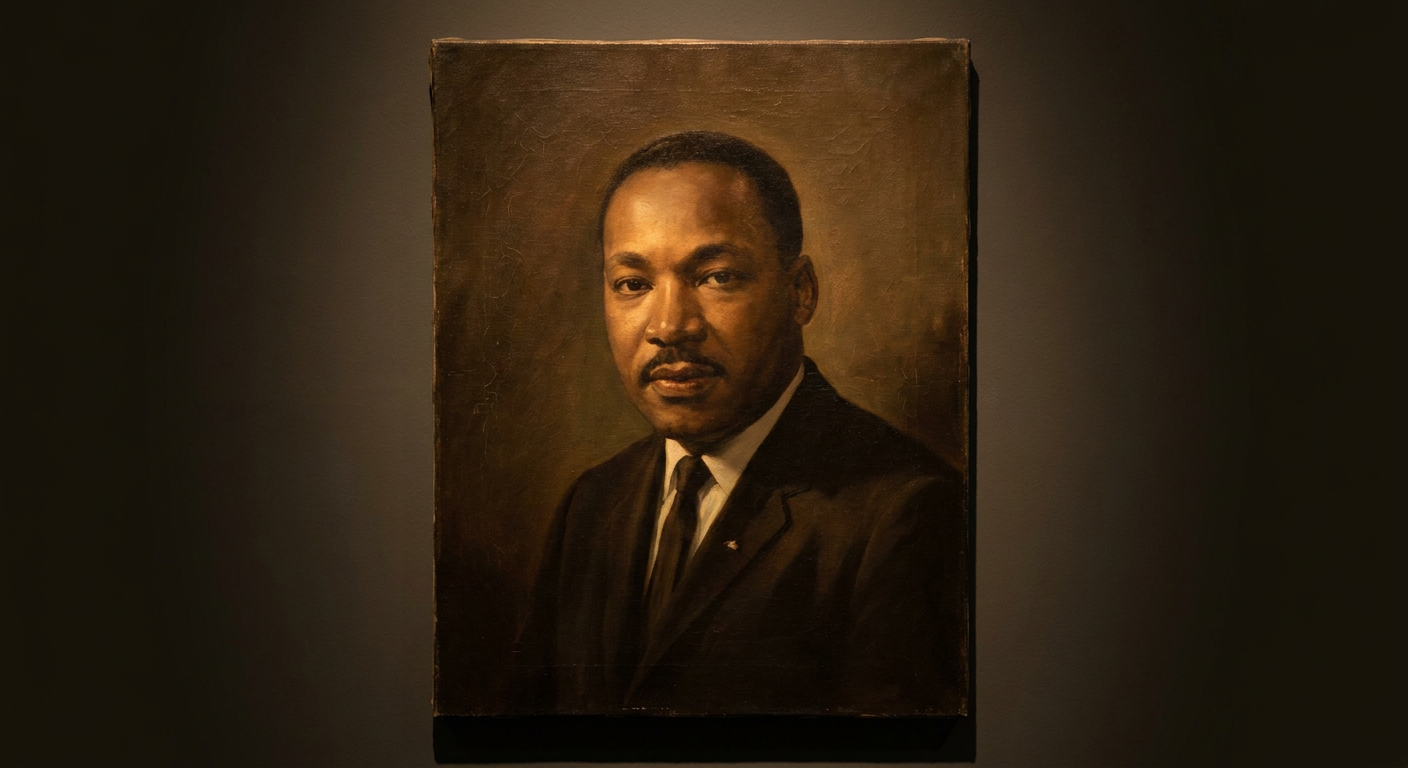
Quick Facts
- Years
- 1929 – 1968
- Category
- Social Reformers & Humanitarians
- Nationality
- American
- Occupation
- Baptist minister, civil rights leader, author, and activist
Martin Luther King Jr.
1929 – 1968 · American · Baptist minister, civil rights leader, author, and activist
Recommended Audiobooks
Listen next from Marcus Alden

Life Lessons from Harriet Beecher Stowe
Marcus Alden · 53 min

Life Lessons from Florence Nightingale
Marcus Alden · 48 min
Martin Luther King Jr. was a Baptist minister, gifted orator, and central leader of the modern American civil rights movement. From the Montgomery bus boycott of 1955–1956 to the voting-rights campaign that helped produce the Voting Rights Act of 1965, he helped turn local struggles against racial injustice into a national moral and political crisis.
King is remembered for advocating nonviolent resistance: disciplined protest intended not merely to defeat opponents but to expose injustice, awaken public conscience, and make negotiation unavoidable. His leadership contributed to the end of legally enforced segregation in much of the United States, earned him the 1964 Nobel Peace Prize, and inspired human-rights campaigns around the world.
Yet the familiar image of King delivering his 1963 “I Have a Dream” speech captures only part of his life. He also opposed economic exploitation, criticized American militarism, condemned the Vietnam War, supported labor organizing, and argued that civil rights without economic security would remain incomplete. Those positions brought criticism from conservatives, government officials, and some former allies.
King was assassinated in Memphis in 1968 at the age of 39. His life is still studied because it reveals both the power and the cost of organized moral resistance—and because the questions he raised about race, poverty, democracy, and violence remain unsettled.
Quick Facts
| Field | Details |
|---|---|
| Full Name | Martin Luther King Jr. |
| Common Name(s) | Martin Luther King Jr.; MLK; Dr. King |
| Born | January 15, 1929 |
| Died | April 4, 1968 |
| Age at Death | 39 |
| Birthplace | Atlanta, Georgia, United States |
| Nationality | American |
| Occupation | Baptist minister, civil rights leader, author, activist |
| Historical Era | Modern civil rights era; Cold War America |
| Famous For | Leading nonviolent campaigns against segregation, racial discrimination, poverty, and disenfranchisement |
| Political Affiliation | Formally nonpartisan; worked with politicians from both major parties while maintaining political independence |
| Religion | Baptist Christianity |
| Education | Morehouse College; Crozer Theological Seminary; Boston University |
| Parents | Martin Luther King Sr. and Alberta Williams King |
| Spouse(s) | Coretta Scott King, married 1953–1968 |
| Children | Yolanda, Martin III, Dexter, and Bernice King |
| Major Works | Stride Toward Freedom; Strength to Love; Why We Can't Wait; Where Do We Go from Here?; “Letter from Birmingham Jail” |
| Major Achievements | Montgomery bus boycott leadership; founding of the SCLC; March on Washington; Nobel Peace Prize; major influence on the Civil Rights Act and Voting Rights Act |
Early Life
Martin Luther King Jr. was born Michael King Jr. on January 15, 1929, in Atlanta. His father, also originally named Michael, later adopted the name Martin Luther King, and his son came to use it as well. The surviving birth certificate was formally amended in 1957.
King grew up in a financially stable but racially segregated neighborhood. His father was pastor of Ebenezer Baptist Church, while his mother, Alberta Williams King, was a musician and former teacher. His maternal grandfather, Adam Daniel Williams, had also led Ebenezer and participated in Atlanta's Black civic life.
The church gave King a platform, a community, and a model of public leadership. His father spoke forcefully against racial humiliation, teaching his children that segregation was unjust rather than natural. King nevertheless experienced discrimination personally. He later recalled the pain of losing contact with a white childhood friend after the other boy's parents objected to their friendship.
A bright student, King entered Morehouse College at 15 without completing the standard high-school graduation path. Morehouse president Benjamin Mays, a theologian and critic of segregation, became an important intellectual influence. Mays presented the ministry as a vehicle for principled social leadership rather than emotional preaching alone.
King earned a sociology degree in 1948 and entered Crozer Theological Seminary in Pennsylvania. There he encountered the writings of Walter Rauschenbusch, whose Social Gospel connected Christianity with social reform, and studied Mohandas Gandhi's campaigns against British rule. King did not simply copy Gandhi; he combined Gandhian methods with Black church traditions, democratic ideals, and Christian teachings about love.
After graduating first in his class at Crozer, King pursued doctoral study at Boston University. He received a Ph.D. in systematic theology in 1955. Decades later, university reviewers found that portions of his dissertation and other academic work used sources without adequate attribution. They concluded that the dissertation contained plagiarism but did not revoke his degree, judging that it still made an intellectual contribution. This finding is an established part of his record, although scholars differ over how heavily it should weigh in assessments of his career.
In Boston, King met Coretta Scott, an Alabama-born music student with strong political interests. They married on June 18, 1953. In 1954, King became pastor of Dexter Avenue Baptist Church in Montgomery, Alabama, placing him in a city where Black activists were already building a campaign against segregation.
Rise to Prominence
King did not create the Montgomery movement by himself. Years of organizing by figures such as Jo Ann Robinson, E. D. Nixon, and the Women's Political Council prepared the ground. Rosa Parks, an experienced activist, was arrested on December 1, 1955, for refusing to surrender her bus seat to a white passenger.
Local leaders called a boycott of Montgomery's segregated buses and formed the Montgomery Improvement Association. At 26, King was elected its president partly because he was a persuasive speaker and relatively new to local rivalries.
The boycott demanded stamina. Black residents walked, shared cars, and organized an alternative transportation system for more than a year. King's home was bombed in January 1956 while Coretta and their infant daughter were inside; neither was injured. Addressing an angry crowd afterward, King urged supporters not to retaliate.
The campaign ended after the Supreme Court allowed a federal ruling against bus segregation to stand. The buses were integrated in December 1956. The victory made King internationally famous, although it belonged to thousands of residents whose collective discipline sustained the boycott.
In 1957, King and other ministers founded the Southern Christian Leadership Conference, or SCLC. Unlike the NAACP, which often concentrated on litigation, the SCLC coordinated church-based mass action. Its early campaigns achieved uneven results, but they helped create a regional network of ministers, organizers, donors, and local activists.
Student sit-ins beginning in 1960 introduced a younger generation of leaders. King supported them, though some members of the Student Nonviolent Coordinating Committee considered the SCLC too cautious and overly centered on charismatic leadership. That tension between national visibility and local organizing followed King throughout his career.
Major Achievements
Montgomery bus boycott
The 381-day boycott demonstrated that sustained mass participation could challenge segregation. It combined legal action, economic pressure, religious organization, and nonviolent discipline. Its success encouraged similar campaigns across the South and transformed King into a national spokesperson.
Birmingham campaign
In 1963, the SCLC joined local leader Fred Shuttlesworth to confront segregation in Birmingham, Alabama. Initial demonstrations struggled to attract attention. Organizers then involved school-age participants in marches, a decision supporters considered necessary and critics regarded as dangerously risky.
Police commissioner Eugene “Bull” Connor ordered officers to use dogs and high-pressure fire hoses. Television images of the repression shocked audiences. While jailed, King wrote “Letter from Birmingham Jail,” answering white clergy who called the demonstrations untimely. He argued that people benefiting from injustice rarely surrender privilege voluntarily and that nonviolent pressure could create conditions for negotiation.
The campaign produced agreements to desegregate downtown facilities, although implementation was contested and violence continued. Nationally, Birmingham increased pressure for federal civil-rights legislation.
March on Washington
On August 28, 1963, approximately 250,000 people gathered at the Lincoln Memorial for the March on Washington for Jobs and Freedom. The event was organized chiefly by A. Philip Randolph and Bayard Rustin, with participation from major civil-rights groups.
King's “I Have a Dream” address linked Black freedom with the promises of the Declaration of Independence, biblical imagery, and a vision of interracial democracy. Its improvised concluding passages became among the most recognized words in American public life. The march did not alone pass legislation, but it displayed broad support for federal action.
Civil Rights Act and Voting Rights Act
King and the movement helped build the public pressure behind the Civil Rights Act of 1964, which prohibited segregation in public accommodations and outlawed many forms of employment discrimination. Legislative success also required congressional strategy and President Lyndon B. Johnson's political influence.
In 1965, voting-rights activists focused national attention on Selma, Alabama. After police attacked marchers on “Bloody Sunday,” King helped lead a later march from Selma to Montgomery under federal protection. The resulting Voting Rights Act attacked literacy tests and authorized federal enforcement in jurisdictions with entrenched discrimination.
Neither law ended racism, but together they dismantled central pillars of legal segregation and created tools for enforcing constitutional rights.
Nobel Peace Prize
King received the Nobel Peace Prize in Oslo on December 10, 1964. At 35, he was then its youngest recipient. He accepted it on behalf of the broader movement and donated the prize money to civil-rights causes. The award increased his international standing and affirmed nonviolent activism as a force in global politics.
Economic justice and the Poor People's Campaign
After 1965, King increasingly emphasized poverty, housing, labor rights, and economic inequality. The SCLC's Chicago campaign challenged housing discrimination but encountered violent resistance and complicated local politics. Its results were limited, revealing how difficult it was to turn dramatic protest into lasting urban reform.
King later proposed the Poor People's Campaign, bringing low-income Americans of different racial backgrounds to Washington to demand jobs, housing, and income security. He was killed before the campaign reached the capital, and the resulting encampment did not achieve its central legislative goals. Nevertheless, it showed the expanded scope of his final political vision.
Leadership or Work
King's leadership rested on moral argument, public speaking, coalition-building, and a willingness to accept personal risk. He framed civil rights as both a constitutional question and a test of national character. This language could reach religious communities, labor unions, students, and sympathetic white voters.
His speeches drew on biblical rhythms, Black preaching, American political texts, poetry, and ideas developed collectively within the movement. Advisers such as Stanley Levison, Clarence Jones, Bayard Rustin, Ralph Abernathy, and Wyatt Tee Walker contributed strategy, editing, fundraising, and organization.
King was not an authoritarian commander. Decisions often emerged through lengthy meetings and disagreements among organizations. He could be indecisive under pressure, and colleagues sometimes complained about poor administrative habits or delayed choices. His greatest strength was often not logistical management but the ability to interpret a campaign's meaning for a national audience.
His approach centered on several principles:
- Nonviolence required training and discipline, not mere passivity.
- Protest should expose injustice and open the way to negotiation.
- Ends and means were connected; a just society could not be built through hatred.
- Leadership required accepting criticism and physical danger.
- Coalitions were essential, even when allies disagreed.
King's national prominence sometimes overshadowed local organizers, especially women whose work received less media attention. Modern scholarship has corrected this “great man” emphasis by placing him within a much larger movement.
Personal Life
King and Coretta Scott King had four children: Yolanda, Martin Luther III, Dexter, and Bernice. His public duties kept him away from home for long periods, placing substantial parenting and organizational responsibilities on Coretta. She was an activist in her own right, particularly on peace, women's rights, and economic justice.
Friends described King as sociable, humorous, fond of music, and skilled at imitation. He enjoyed soul food and playing pool. Behind his confident public manner, he experienced exhaustion, periods of depression, recurring threats, and intense anxiety about the danger facing his family.
King was stabbed in the chest by Izola Ware Curry in Harlem in 1958 and narrowly survived. Doctors told him that a sudden movement could have proved fatal. He later used the experience to reflect on gratitude and the consequences of hatred.
His marriage faced strain. FBI surveillance recorded evidence interpreted by many biographers as showing extramarital relationships. The surviving material is incomplete, heavily mediated by an agency seeking to destroy him, and partly sealed, so specific sensational claims require caution. Most major biographers accept that he was unfaithful, while rejecting the FBI's broader campaign of insinuation as unreliable and abusive.
The relentless schedule damaged King's health. Associates observed that by 1968 he appeared far older than 39. He nevertheless continued traveling, preaching, negotiating, and joining demonstrations until his death.
Philosophy or Beliefs
King's worldview was rooted in Christianity. He taught that every person possessed God-given dignity and that love could resist evil without denying an opponent's humanity. His idea of agape meant active concern for others, not sentimental affection or approval of injustice.
Gandhi helped King understand nonviolence as a method of collective struggle. Nonviolent protest could dramatize hidden violence already embedded in segregation, jails, poverty, and political exclusion. Its purpose was not to make injustice comfortable but to produce constructive tension leading to change.
King also defended civil disobedience. In “Letter from Birmingham Jail,” he distinguished just laws, which respect human dignity, from unjust laws, which degrade people or are imposed without meaningful political participation. Breaking an unjust law openly and accepting punishment could, he argued, demonstrate respect for justice at a higher level.
His politics broadened over time. By the late 1960s, he described racism, poverty, and militarism as connected. In his 1967 “Beyond Vietnam” address, he called the United States “the greatest purveyor of violence in the world today.” Critics considered that judgment excessive and feared it would weaken the civil-rights coalition. King believed silence would contradict his religious commitment to peace.
He did not advocate communism and rejected its materialism and authoritarianism. Nor did he accept unrestricted capitalism. He favored stronger social provision, labor rights, and measures resembling a guaranteed income. Scholars debate what political label best describes his mature outlook, but there is broad agreement that it was more economically radical than his popular image often suggests.
Challenges and Controversies
King faced bombings, assaults, arrests, death threats, and organized white-supremacist violence. Segregationist officials accused him of provoking disorder, while he answered that protest revealed disorder already present within an unjust system.
Within the movement, younger activists criticized his dependence on national media, clergy, and white liberal support. Some advocates of Black Power viewed interracial nonviolence as inadequate after years of violence and slow progress. King understood their frustration but warned that separatism and retaliatory violence would deepen suffering.
His Chicago campaign produced no Southern-style breakthrough. His opposition to the Vietnam War strained relations with President Johnson, labor leaders, newspapers, and civil-rights allies who feared losing White House support. Even the Poor People's Campaign lacked a fully settled strategy at the time of his death.
King's academic plagiarism is documented and cannot be dismissed as an FBI invention. At the same time, it concerns his scholarly practice rather than the authorship of an entire political movement. A balanced assessment acknowledges the violation without treating it as proof that all his ideas or achievements were fraudulent.
The FBI, directed by J. Edgar Hoover, wiretapped and monitored King after alleging communist influence among his advisers. Agents gathered personal information, leaked hostile stories, and sent him an anonymous package and letter apparently intended to drive him from public life, possibly toward suicide. No evidence established that King was a communist agent. The operation is now widely regarded as a serious abuse of government power.
James Earl Ray pleaded guilty to murdering King in 1969, avoiding a trial, and later recanted. A 1999 civil jury, hearing a wrongful-death case brought by the King family, concluded that a conspiracy existed. However, the proceeding tested liability under a lower civil standard and did not include the full adversarial presentation of a criminal trial. A 2000 Justice Department review found no credible evidence supporting the alleged conspiracy. Ray remains the person officially convicted, while arguments about possible assistance continue.
Legacy
King's influence appears in law, political language, protest strategy, education, and global human-rights movements. Activists opposing apartheid, dictatorship, caste discrimination, and political repression have adapted his approach, though always within different local conditions.
Martin Luther King Jr. Day became a United States federal holiday in 1983 and was first observed in 1986. All states eventually recognized it. The holiday is often marked as a day of service, connecting remembrance with civic action.
The Martin Luther King Jr. Memorial opened in Washington, D.C., in 2011. The King Center in Atlanta preserves his work and promotes nonviolence. His birth home, Ebenezer Baptist Church, and burial site form part of the Martin Luther King Jr. National Historical Park.
Thousands of streets, schools, libraries, and public buildings bear his name. This commemoration has also produced debate. Critics argue that ceremonial praise can soften his demands for economic redistribution, peace, and structural change. Supporters of a fuller historical memory emphasize both his dream of racial fellowship and his criticism of institutions that maintained inequality.
King's legacy is therefore not a completed story. Voting access, policing, residential segregation, wealth inequality, labor rights, and war remain subjects of conflict. Different political groups invoke him for different purposes, sometimes quoting the same speech to support opposing conclusions. Studying his entire career helps distinguish the historical King from simplified public symbols.
Interesting Facts
- King was born Michael King Jr.; his name was later changed to Martin Luther King Jr.
- He entered Morehouse College at only 15.
- He initially felt uncertain about entering the ministry.
- He earned his doctorate in 1955, the year the Montgomery boycott began.
- King was 26 when chosen to lead the Montgomery Improvement Association.
- His home was bombed during the boycott, but his family escaped injury.
- He was arrested nearly 30 times, depending on how arrests and brief detentions are counted.
- A 1958 stabbing came so close to his heart that a sneeze might have killed him, according to his doctors.
- “Letter from Birmingham Jail” was drafted on scraps of paper passed among visitors and attorneys.
- The “dream” conclusion of his 1963 speech drew on themes he had used previously and was partly improvised.
- At 35, he became the youngest Nobel Peace Prize recipient up to that time.
- He donated his Nobel prize money to the civil-rights movement.
- King publicly opposed the Vietnam War one year before his assassination.
- He received a Grammy Award posthumously for a recorded speech album.
- He was in Memphis to support striking sanitation workers when he was killed.
- His final public address became known as the “Mountaintop” speech.
- King is the only individual American other than George Washington honored by a federal holiday observed under his name.
- Coretta Scott King led the long campaign to establish that holiday.
Famous Quotes
-
“Injustice anywhere is a threat to justice everywhere.” — “Letter from Birmingham Jail,” 1963. King meant that communities are interconnected and cannot safely ignore injustice imposed on others.
-
“The time is always right to do what is right.” — Oberlin College commencement address, 1965. The line rejected demands that reformers wait for a politically convenient moment.
-
“I have a dream that my four little children will one day live in a nation where they will not be judged by the color of their skin but by the content of their character.” — March on Washington, 1963. It expressed a hope for equal citizenship beyond racial hierarchy.
-
“The arc of the moral universe is long, but it bends toward justice.” — Used by King in several forms, including in 1965. He adapted an idea from abolitionist minister Theodore Parker; the wording should not be treated as entirely original to King.
-
“A riot is the language of the unheard.” — “The Other America,” 1967. King was explaining riots, not endorsing them; he immediately continued to condemn violence while asking what conditions produced it.
-
“Darkness cannot drive out darkness; only light can do that. Hate cannot drive out hate; only love can do that.” — Strength to Love, 1963. The statement summarizes his belief that destructive means reproduce destructive ends.
-
“The ultimate measure of a man is not where he stands in moments of convenience and comfort, but where he stands at times of challenge and controversy.” — Published in Strength to Love. It defined character through conduct under pressure.
-
“Life's most persistent and urgent question is, ‘What are you doing for others?’” — Montgomery address, 1957. The quotation reflects King's view of service as a moral duty.
-
“We must accept finite disappointment, but never lose infinite hope.” — Quoted in In My Own Words and associated with King's preaching. It contrasts temporary defeat with sustained moral commitment.
-
“I've been to the mountaintop.” — Memphis, April 3, 1968. In his final speech, King acknowledged danger while declaring confidence that justice would ultimately prevail.
Timeline
- 1929 — Born in Atlanta, Georgia, on January 15.
- 1944 — Entered Morehouse College at age 15.
- 1948 — Graduated from Morehouse and entered Crozer Theological Seminary.
- 1951 — Graduated from Crozer and began doctoral study at Boston University.
- 1953 — Married Coretta Scott.
- 1954 — Became pastor of Dexter Avenue Baptist Church in Montgomery.
- 1955 — Received his doctorate; elected president of the Montgomery Improvement Association.
- 1956 — His home was bombed; federal courts struck down Montgomery bus segregation.
- 1957 — Helped establish the Southern Christian Leadership Conference.
- 1958 — Published Stride Toward Freedom and survived an assassination attempt by stabbing.
- 1960 — Returned to Atlanta and became co-pastor of Ebenezer Baptist Church.
- 1961 — Supported the Albany Movement, which achieved limited immediate results.
- 1963 — Led the Birmingham campaign, wrote “Letter from Birmingham Jail,” and spoke at the March on Washington.
- 1964 — Civil Rights Act became law; King received the Nobel Peace Prize.
- 1965 — Participated in the Selma campaign; Voting Rights Act became law.
- 1966 — Helped lead the Chicago Freedom Movement.
- 1967 — Delivered “Beyond Vietnam” and announced the Poor People's Campaign.
- 1968 — Supported striking sanitation workers in Memphis; assassinated on April 4.
- 1983 — President Ronald Reagan signed legislation creating Martin Luther King Jr. Day.
- 1986 — The federal holiday was observed for the first time.
- 2011 — The Martin Luther King Jr. Memorial opened in Washington, D.C.
Frequently Asked Questions
1. Why is Martin Luther King Jr. important?
King helped make racial segregation and disenfranchisement unavoidable national issues. Through the SCLC, he supported campaigns that mobilized ordinary people, attracted international attention, and increased pressure for federal legislation. His importance does not mean he acted alone: local organizers, students, lawyers, labor leaders, and thousands of residents sustained the movement. His distinctive contribution was joining mass protest, Christian ethics, constitutional argument, and powerful public communication into an influential strategy of nonviolent change.
2. Did King begin the civil rights movement?
No. Black Americans had resisted slavery, segregation, and racial violence for generations. Organizations such as the NAACP and activists including Ella Baker, Septima Clark, A. Philip Randolph, E. D. Nixon, and many others were active before King became nationally known. He entered an existing movement and became one of its most visible leaders. His fame helped attract media attention and funding, but describing him as the movement's sole founder erases the decentralized work that made every major campaign possible.
3. What happened during the Montgomery bus boycott?
After Rosa Parks's arrest in December 1955, Montgomery's Black residents refused to use segregated city buses. Churches, volunteers, drivers, and the Women's Political Council organized carpools and communications. King served as president of the Montgomery Improvement Association and emerged as its leading public voice. The boycott lasted 381 days and survived arrests, economic pressure, and violence. It ended after federal courts ruled bus segregation unconstitutional, demonstrating the effectiveness of coordinated legal and economic resistance.
4. Was Rosa Parks simply a tired passenger?
Rosa Parks was physically tired after work, but her refusal was not merely an accidental response to fatigue. She was an experienced NAACP activist who had attended organizing workshops and investigated racial injustice. Movement leaders recognized that her character and circumstances made her case especially effective for challenging bus segregation. Acknowledging her preparation does not make the act less courageous; it shows that historic change usually grows from sustained organizing rather than spontaneous individual heroism alone.
5. What did nonviolence mean to King?
For King, nonviolence was active resistance rather than submission. Participants trained to endure insults, arrest, and assault without retaliating. Marches, boycotts, sit-ins, and civil disobedience disrupted ordinary life and exposed the violence required to preserve segregation. King believed the method could pressure opponents while keeping open the possibility of reconciliation. Critics questioned whether it could overcome every form of oppression, but he regarded it as both a practical strategy and a moral commitment.
6. Did King write “I Have a Dream” alone?
King was responsible for the speech, but it emerged from collaboration and earlier material. Adviser Clarence Jones helped prepare a draft, and King had previously used dream imagery in sermons and speeches. During the Washington address, he moved beyond parts of the written text into the famous “I have a dream” sequence, reportedly encouraged by Mahalia Jackson. Like many major speeches, it combined individual authorship, collaborative preparation, familiar traditions, and improvisation.
7. What laws did King help influence?
The movement in which King participated helped create political pressure for the Civil Rights Act of 1964 and Voting Rights Act of 1965. The first attacked segregation and employment discrimination; the second strengthened federal protection of voting rights. King did not write or pass either law by himself. Activists, litigators, members of Congress, presidents, and public opinion all mattered. His campaigns contributed by making the human cost of inaction visible and urgent.
8. Why was King jailed in Birmingham?
King was arrested in April 1963 for participating in demonstrations conducted without a parade permit. From jail, he answered white Alabama clergy who criticized the campaign as unwise and untimely. His response defended direct action, explained the difference between just and unjust laws, and challenged the preference for social order over justice. The resulting “Letter from Birmingham Jail” became one of the clearest statements of civil disobedience in modern political thought.
9. Why did King oppose the Vietnam War?
King believed the war killed civilians, diverted money from anti-poverty programs, and required poor Americans to fight abroad while facing discrimination at home. He also saw militarism as connected to racism and economic exploitation. Critics argued that foreign policy lay outside his civil-rights role and that his position endangered support from President Johnson. King replied that religious and moral responsibility could not stop at national borders or political convenience.
10. Was King a socialist or communist?
King was not a communist and criticized communism's atheism, materialism, and authoritarianism. The FBI never established claims that he was a communist agent. He did, however, sharply criticize economic inequality, defend organized labor, favor major social programs, and consider a guaranteed income. Scholars variously describe his later economics as social democratic, democratic socialist, or radical Christian reform. His ideas do not fit neatly within a single modern party label.
11. Why did the FBI investigate King?
FBI director J. Edgar Hoover claimed that advisers around King had communist associations. With authorization from senior federal officials, the bureau wiretapped and surveilled him. The operation expanded into an effort to discredit and intimidate him, including leaks and an anonymous threatening letter. No evidence showed that King was controlled by communists. The campaign is now recognized as an example of political surveillance exceeding legitimate national-security investigation.
12. Did King plagiarize his doctoral dissertation?
A Boston University investigation concluded in 1991 that King had used passages and ideas without proper attribution in his dissertation and other academic work. The committee did not revoke his doctorate because it found that the dissertation still contained an original contribution. Scholars agree that the attribution failures were serious, though they differ over their relevance to his later public leadership. The finding should neither be concealed nor exaggerated into a claim that all his speeches and ideas were stolen.
13. How did Martin Luther King Jr. die?
King was shot on the balcony of the Lorraine Motel in Memphis, Tennessee, on April 4, 1968. He had traveled there to support striking Black sanitation workers. James Earl Ray pleaded guilty in 1969 and received a 99-year sentence, then later recanted. Subsequent conspiracy allegations remain disputed. A federal review found insufficient credible evidence to overturn the official case, although the King family came to believe that Ray was not acting alone.
14. What was the Poor People's Campaign?
The Poor People's Campaign was King's effort to unite low-income Americans across racial and regional lines. It called for employment, housing, income support, and a stronger federal commitment to economic rights. King was assassinated before the planned Washington mobilization. The SCLC continued the campaign and built an encampment called Resurrection City, but it achieved few immediate policy victories. Historically, it reveals that King's final agenda extended well beyond desegregation.
15. How old was King when he received the Nobel Prize?
King was 35 when he received the Nobel Peace Prize in December 1964, making him the youngest recipient at that time. He presented the honor as recognition of the wider nonviolent movement rather than a personal triumph. King donated the prize money to civil-rights organizations. The award strengthened his global influence, but it also increased expectations that he address peace and human rights beyond the American South.
16. What is the most common misunderstanding about King?
A common misunderstanding is that King advocated politeness, gradual reform, or a society that simply ignored race. In reality, his nonviolence involved organized disruption, economic pressure, civil disobedience, and willingness to accept imprisonment. He wanted interracial reconciliation, but he insisted that it required dismantling unjust structures. Late in life, he spoke increasingly about wealth, housing, labor, policing, and war—issues often missing from ceremonial accounts of his career.
Lessons We Can Learn
- Organized communities create change. Montgomery succeeded because thousands coordinated transportation and sacrifice. Modern applications vary, but the historical evidence favors organization over isolated gestures.
- Preparation supports courage. Nonviolent demonstrators trained for hostile encounters. Courage was treated as a practiced discipline, not simply a personality trait.
- Power must be pressured as well as persuaded. Birmingham combined moral argument with disruption. King believed negotiation often followed pressure rather than preceding it.
- Coalitions require disagreement. King worked with groups whose methods differed from his own. Productive alliances did not require complete ideological uniformity.
- Public speaking works best when joined to action. His speeches mattered because campaigns gave their words urgency and credibility.
- Methods shape outcomes. King's commitment to nonviolence reflected his belief that hatred could reproduce domination. Whether every situation permits that strategy remains a legitimate modern debate.
- Leaders should be assessed honestly. His courage, infidelity, plagiarism, and political achievements can all be acknowledged without reducing him to either a saint or a fraud.
- Success may require expanding the question. King moved from public accommodations to voting, housing, poverty, and war because he saw injustice as interconnected.
- Timing arguments can preserve injustice. Birmingham showed that requests to “wait” often place the burden of patience on those already suffering.
- Memory should preserve difficult ideas. Honoring King means studying his challenges to racism, poverty, and militarism, not merely repeating his least controversial lines.
Related Historical Figures
- Coretta Scott King — King's wife, political partner, peace advocate, and leader of the campaign for the federal holiday.
- Rosa Parks — Her arrest triggered the Montgomery boycott that brought King national prominence.
- Ralph Abernathy — King's close colleague, SCLC co-founder, and successor as the organization's president.
- Ella Baker — SCLC organizer who championed grassroots leadership and helped foster SNCC.
- Bayard Rustin — Adviser on nonviolence and principal organizer of the 1963 March on Washington.
- John Lewis — SNCC chairman, Selma marcher, and later congressman whose activism intersected with King's campaigns.
- A. Philip Randolph — Labor leader who conceived the March on Washington and linked civil rights with economic justice.
- Thurgood Marshall — NAACP lawyer and Supreme Court justice whose legal work complemented mass protest.
- Lyndon B. Johnson — President who worked with movement leaders and Congress to enact landmark civil-rights laws.
- Mohandas Gandhi — Indian independence leader whose nonviolent methods strongly influenced King's strategy and philosophy.
Watch and Learn
“Martin Luther King Jr. - Civil Rights Leader | Biography” — Biography — approximately 5 minutes.
This concise overview introduces King's upbringing, Montgomery leadership, major speeches, Nobel Prize, and assassination. Biography is an established educational history channel, and the video's clear structure makes it a useful starting point for students before exploring King's writings and the broader movement in greater depth.
Watch and Learn
Martin Luther King Jr. - Civil Rights Leader | Biography · Biography
Related Historical Figures