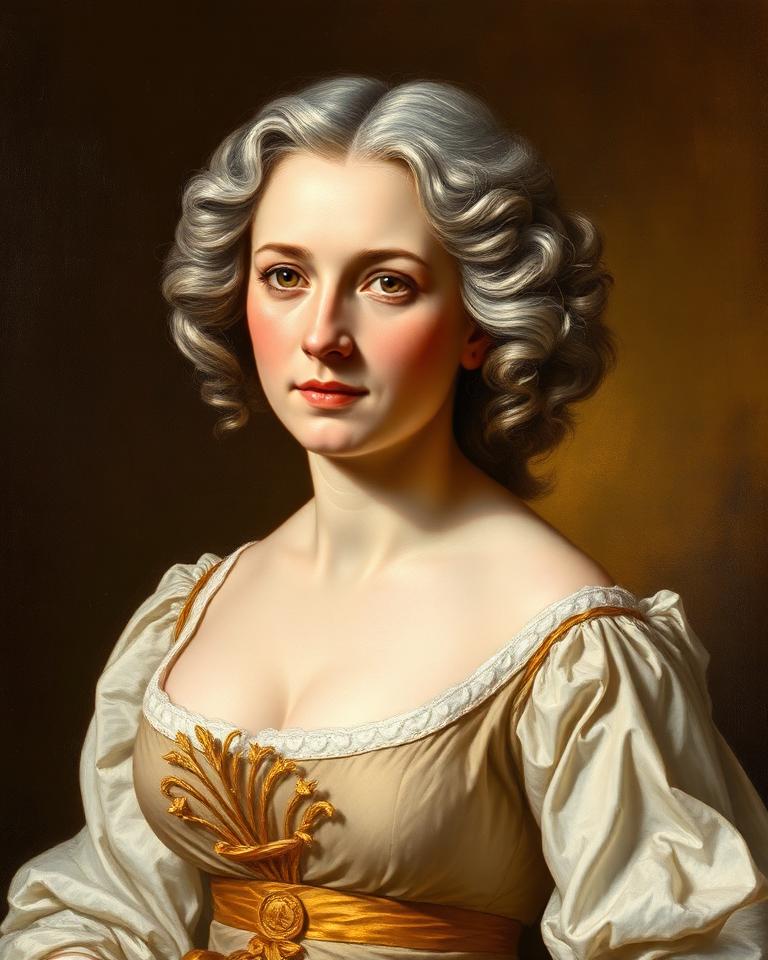
Quick Facts
- Years
- 1759 – 1797
- Category
- Social Reformers & Humanitarians
- Subcategory
- Feminist Theory
- Nationality
- British
- Occupation
- Philosopher and Writer
Mary Wollstonecraft
1759 – 1797 · British · Philosopher and Writer
Audiobook

Life Lessons from Mary Wollstonecraft
Marcus Alden · 55 min
Mary Wollstonecraft was an English philosopher, writer, educator, translator, and advocate of women’s equality. Born in 1759, she lived during the Enlightenment and the revolutions that transformed politics on both sides of the Atlantic. Her most famous book, A Vindication of the Rights of Woman (1792), challenged the assumption that women were naturally less rational than men. Wollstonecraft argued that apparent differences arose largely from unequal education, economic dependence, and social expectations.
Her importance extends beyond a single book. She wrote on education, political rights, history, literature, travel, marriage, family life, and moral responsibility. In A Vindication of the Rights of Men (1790), she entered Britain’s debate over the French Revolution and attacked inherited privilege. She also supported herself through professional writing—an unusual and difficult path for an eighteenth-century woman.
Wollstonecraft’s unconventional personal life made her controversial. After her death in 1797, William Godwin’s candid memoir exposed details that damaged her reputation for generations. Later reformers and scholars restored her standing as a foundational thinker in the history of feminism and human rights. She remains studied because her central questions—who receives education, how dependence shapes character, and whether liberty can exist without equality—are still urgent.
Quick Facts
| Field | Details |
|---|---|
| Full Name | Mary Wollstonecraft |
| Common Name(s) | Mary Wollstonecraft; briefly Mary Imlay in some legal and social contexts |
| Born | 27 April 1759 |
| Died | 10 September 1797 |
| Age at Death | 38 |
| Birthplace | Spitalfields, London, England |
| Nationality | English/British |
| Occupation | Philosopher, writer, educator, translator, reviewer |
| Historical Era | Enlightenment; Age of Revolutions |
| Famous For | A Vindication of the Rights of Woman and arguments for equal education and civil dignity |
| Political Affiliation if applicable | Radical reform circles; no formal party affiliation recorded |
| Religion if significant | Raised Anglican; developed a rational, dissenting form of Christian belief, though scholars debate aspects of her later faith |
| Education | Informal and largely self-directed; brief day-school attendance |
| Parents | Edward John Wollstonecraft and Elizabeth Dixon Wollstonecraft |
| Spouse(s) | William Godwin, married 1797 |
| Children | Fanny Imlay; Mary Wollstonecraft Godwin, later Mary Shelley |
| Major Works | Thoughts on the Education of Daughters; Mary: A Fiction; Original Stories from Real Life; A Vindication of the Rights of Men; A Vindication of the Rights of Woman; Letters Written During a Short Residence in Sweden, Norway, and Denmark; Maria; or, The Wrongs of Woman |
| Major Achievements | Foundational defense of women’s rational equality; major contribution to revolutionary political debate; pioneering professional literary career; influential educational and travel writing |
Early Life
Mary Wollstonecraft was born in Spitalfields, London, on 27 April 1759, the second of seven children. Her father, Edward John Wollstonecraft, inherited money but repeatedly moved the family while attempting farming and other ventures. His financial instability weakened the family’s social position. William Godwin later described him as violent and intemperate; because Godwin wrote from family testimony, historians use the account while recognizing its retrospective character.
Wollstonecraft’s mother, Elizabeth Dixon Wollstonecraft, followed conventional expectations of domestic obedience. Mary reportedly tried to protect her mother during episodes of paternal violence. These experiences helped shape her later hostility to arbitrary authority within households and her insistence that dependence could deform both marriage and character.
Her formal schooling was limited. Girls of her social class were generally taught accomplishments and domestic skills rather than the classical curriculum available to boys. Wollstonecraft therefore educated herself through reading, conversation, and friendships.
At Beverley, Yorkshire, she befriended Jane Arden, whose father, John Arden, encouraged intellectual discussion and scientific inquiry. Later, Fanny Blood became her closest friend. Blood’s intelligence, work, and difficult family circumstances influenced Wollstonecraft’s ideas about female friendship and independence.
The wider historical context was equally important. Enlightenment writers debated reason, natural rights, education, and government, while the American Revolution demonstrated that inherited authority could be challenged. Yet most arguments about universal rights excluded women. Wollstonecraft’s work would expose that contradiction.
Rise to Prominence
Determined to avoid economic dependence, Wollstonecraft sought paid work. She served as a companion to Sarah Dawson in Bath, then returned home to care for her ill mother. After her mother’s death in 1782, she lived for a time with Fanny Blood’s family.
In 1784, Wollstonecraft, Blood, and Mary’s sisters Eliza and Everina established a school at Newington Green, then a center of religious Dissent and reform politics. There Wollstonecraft encountered the minister Richard Price, whose sermons joined Christian ethics to arguments for liberty and civic reform.
The school struggled financially. In 1785 Wollstonecraft traveled to Lisbon to assist Fanny Blood during childbirth. Blood died soon afterward, a devastating loss that intensified Wollstonecraft’s concern with women’s health, marriage, and vulnerability. The school eventually closed.
Wollstonecraft next worked as a governess for the Anglo-Irish Kingsborough family. She disliked aristocratic conventions but developed a strong relationship with the children. Drawing on these experiences, she published Thoughts on the Education of Daughters in 1787.
Back in London, publisher Joseph Johnson gave her reviewing, translating, and editorial work. His circle included prominent radicals, artists, scientists, and writers. Wollstonecraft translated texts from French and German, contributed extensively to the Analytical Review, and published fiction and children’s literature.
Her national breakthrough came in 1790. Edmund Burke’s Reflections on the Revolution in France defended inherited institutions and attacked Richard Price. Wollstonecraft replied rapidly with A Vindication of the Rights of Men, criticizing aristocracy, property-based inequality, and sentimental defenses of hierarchy. The book established her as a forceful political controversialist. Two years later, A Vindication of the Rights of Woman made her argument international.
Major Achievements
A Foundational Argument for Women’s Equality
In A Vindication of the Rights of Woman (1792), Wollstonecraft argued that women possess the capacity for reason and therefore deserve serious education, moral agency, and civic respect. She did not claim that men and women were identical in every respect. Rather, she challenged confident claims about innate female inferiority when women had never received equal opportunities to develop their abilities.
The book mattered because it connected women’s condition to Enlightenment principles presented as universal. If virtue required reason, and if society expected women to be virtuous wives and mothers, denying them education was irrational. Its long-term impact can be seen in feminist arguments about schooling, employment, citizenship, and structural inequality.
Recasting Education as a Public Question
Wollstonecraft treated education not as private ornament but as a foundation of citizenship. She proposed a national system of day schools in which girls and boys would initially learn together. Education should cultivate judgment, physical health, practical ability, and social responsibility rather than vanity or obedience.
This was significant because she linked family reform to national reform. Educated women would be better able to support themselves, participate in moral life, and raise independent citizens. Her analysis anticipated later debates about coeducation, public schooling, and equal access.
Intervention in Revolutionary Politics
A Vindication of the Rights of Men made Wollstonecraft one of the earliest published respondents to Burke. She rejected the idea that political legitimacy rested on ancestry, inherited rank, or romantic attachment to tradition. Rights, she maintained, belonged to persons rather than classes.
Her intervention mattered both intellectually and professionally. She entered a public controversy dominated by men and wrote in an assertive political voice. The book connected opposition to aristocratic hierarchy with criticism of gender hierarchy, preparing the argument of her later Vindication.
Establishing a Career as a Professional Writer
Wollstonecraft supported herself through writing, translation, reviewing, and editorial labor. Joseph Johnson’s publishing network was vital, but her productivity and range were her own. She wrote educational theory, novels, history, political philosophy, travel literature, and criticism.
This achievement challenged assumptions that respectable women should remain economically dependent or confine themselves to private correspondence. Her career helped expand the model of the woman as a public intellectual, even though professional writing remained precarious.
Innovation in Travel Writing
Letters Written During a Short Residence in Sweden, Norway, and Denmark (1796) combined observation of landscapes, economies, customs, gender relations, and commerce with personal reflection. The journey arose partly from business undertaken for Gilbert Imlay, but the resulting book transcended its practical origin.
Its emotional immediacy and attention to the interaction between feeling and political judgment influenced Romantic-era prose. Godwin later said the book made him fall in love with its author. Modern scholars value it as travel writing, political economy, autobiography, and environmental observation.
Exposing Marriage and Law in Fiction
Wollstonecraft’s unfinished novel Maria; or, The Wrongs of Woman, published posthumously in 1798, portrays a woman confined by her husband and deprived of freedom and access to her child. Through several women’s stories, it examines marriage law, sexual double standards, poverty, and class.
The novel matters because it dramatized institutional injustice rather than treating suffering merely as private misfortune. Its unfinished state limits certainty about Wollstonecraft’s intended conclusion, but its critique of coercive marriage remained influential.
Leadership and Work
Wollstonecraft held no formal political office. Her leadership was intellectual, educational, and personal. She led by founding a school, publishing arguments, reviewing contemporary books, and treating women as participants in public reason.
Her method combined principle with experience. She moved from household dependence, teaching, governess work, travel, and motherhood to broader claims about institutions. She often tested social customs by asking whether they promoted reason, virtue, independence, and human happiness.
Important relationships sustained her work. Richard Price encouraged reformist thought; Joseph Johnson supplied professional opportunity; Henry Fuseli stimulated intense intellectual and emotional interest; Gilbert Imlay shaped a turbulent period of her life; and William Godwin became both partner and posthumous biographer.
Her strengths included courage, intellectual range, sympathy for vulnerable people, and willingness to revise inherited assumptions. She could write with speed and polemical force. Her weaknesses included occasional overgeneralization, sharp judgments, and a tendency to contrast reason and convention too starkly. Like many Enlightenment reformers, she sometimes treated European middle-class experience as more universal than it was.
Personal Life
Female friendship was central to Wollstonecraft’s life. Her bond with Fanny Blood was especially formative, and Blood’s death left a lasting mark. Wollstonecraft also remained involved with her sisters, helping Eliza leave an unhappy marriage—an action that brought social and practical consequences.
In the early 1790s, she developed a powerful attachment to the married painter Henry Fuseli. She proposed an unconventional arrangement involving Fuseli and his wife; Sophia Fuseli rejected it. Wollstonecraft then left for revolutionary France in December 1792.
In France she met the American merchant and adventurer Gilbert Imlay. They did not marry, although she was registered as his wife for protection during wartime and sometimes used his name. Their daughter, Fanny Imlay, was born in Le Havre in 1794. Imlay’s withdrawal from the relationship caused severe distress. Wollstonecraft survived two suicide attempts, one involving laudanum and another in the River Thames.
In 1796 she renewed her acquaintance with philosopher William Godwin. Their relationship developed into a partnership based on affection and intellectual respect. Although both had criticized conventional marriage, they married on 29 March 1797 because Wollstonecraft was pregnant and they wanted legal security for the child. They maintained nearby residences and considerable working independence.
Their daughter, Mary Wollstonecraft Godwin—later Mary Shelley—was born on 30 August 1797. Wollstonecraft died eleven days later from complications of childbirth, commonly identified as puerperal infection. She was initially buried at St Pancras Old Church in London; her remains were later moved to Bournemouth with Godwin’s.
Philosophy and Beliefs
Wollstonecraft’s philosophy centered on reason, virtue, liberty, and independence. She believed moral standards should apply to both sexes. Women should not be trained merely to please men, and men should not be excused from duties of fidelity, self-command, and care.
Her concept of independence was not simple isolation. Human beings required affection, family, education, and community, but relationships should rest on friendship and mutual respect rather than domination. She therefore envisioned marriage as a companionship between equals.
Politically, she opposed hereditary privilege and concentrated wealth while defending civil liberty and merit. She criticized monarchy and aristocracy, supported the early ideals of the French Revolution, and condemned violence and corruption when revolutionary events failed those ideals.
Religion remained part of her moral vocabulary. Influenced by Anglican and Dissenting Christianity, she viewed reason and divine justice as compatible. Her exact later theological position is debated, particularly because Godwin’s account reflects his own philosophical perspective. Her writings nevertheless repeatedly invoke Providence, virtue, duty, and an afterlife.
She also criticized a commercial culture that encouraged vanity and treated people as instruments. Yet her thought contained tensions. She sometimes valued traditionally masculine-coded reason over feminine-coded feeling, though her travel letters gave emotion a richer role. She also emphasized women’s roles as mothers, making her simultaneously radical in demanding equality and recognizably eighteenth-century in her social assumptions.
Challenges and Controversies
Wollstonecraft faced misogynistic opposition during and after her life. Critics dismissed female political authors as unfeminine and portrayed demands for equality as threats to family and religion. Her forceful tone made her especially visible.
Her relationship with Imlay and births outside conventional respectability became major sources of scandal. Godwin’s Memoirs of the Author of A Vindication of the Rights of Woman (1798) honestly described her love affairs, suicide attempts, and religious doubts. He intended a tribute to her sincerity and courage. Conservative reviewers instead used the disclosures to discredit her philosophy. For much of the nineteenth century, “Wollstonecraft” could function as a warning against female independence.
Her writings also attract substantive criticism. She did not present a fully developed program for women’s suffrage, although her principles encouraged later claims to political citizenship. Her rhetoric sometimes disparaged women shaped by restrictive culture, and it could reproduce class assumptions about servants, luxury, and respectability.
Scholars also debate whether she should be called a modern liberal feminist, a republican thinker, a radical egalitarian, or a religious moralist. Each label captures part of her work but can obscure others. Her ideas evolved across genres and experiences rather than forming a single systematic treatise.
Finally, her response to the French Revolution was complex. She defended its emancipatory principles but documented its failures and violence in An Historical and Moral View of the Origin and Progress of the French Revolution (1794). This was not necessarily abandonment of reform; it was a distinction between principles of liberty and their political betrayal.
Legacy
Wollstonecraft’s immediate reputation suffered after Godwin’s memoir, but her ideas did not disappear. Nineteenth-century reformers read her, sometimes privately or selectively. Later campaigners for women’s education, property rights, employment, and suffrage recognized her as an important predecessor.
Twentieth-century feminist scholarship restored the breadth of her achievement. Historians now examine not only Rights of Woman but also her novels, reviews, letters, educational works, travel book, and political history. She is studied within philosophy, literature, political theory, religious history, childhood studies, and the history of emotions.
Her influence also continued through Mary Shelley, author of Frankenstein, who grew up regarding her mother’s writings and memory with reverence. Wollstonecraft’s challenge to artificial dependence remains relevant to debates about educational inequality, unpaid care, workplace opportunity, marriage, and representation.
Sites associated with her include Newington Green Unitarian Church and St Pancras Old Church. A memorial sculpture by Maggi Hambling, titled A Sculpture for Mary Wollstonecraft, was installed on Newington Green in 2020. Its nude symbolic figure prompted controversy: supporters viewed it as a celebration of liberated female spirit, while critics argued that the memorial should have represented Wollstonecraft herself more directly. Her name also appears on the Reformers’ Memorial in Kensal Green Cemetery.
Interesting Facts
- Wollstonecraft was the second of seven children.
- Her formal education was brief; much of her learning was self-directed.
- She helped establish a girls’ school at Newington Green in 1784.
- Her close friend Fanny Blood died after childbirth in Lisbon.
- She worked as a governess in Ireland before becoming a London writer.
- Publisher Joseph Johnson employed her as a reviewer and translator.
- She translated works from French and German.
- Her reply to Edmund Burke appeared anonymously in its first edition.
- The second edition identified her, provoking gendered attacks.
- Rights of Woman was dedicated to French statesman Talleyrand.
- She traveled to Paris while the French Revolution was becoming increasingly violent.
- She witnessed the political aftermath of Louis XVI’s fall and execution period.
- Her daughter Fanny was named for Fanny Blood.
- She traveled in Scandinavia while handling business connected with Imlay.
- Her Scandinavian letters became her most personally revealing completed book.
- She and Godwin initially maintained separate nearby homes after marriage.
- She died eleven days after Mary Shelley’s birth.
- Godwin’s candid biography damaged her public reputation despite being intended as praise.
- Maria; or, The Wrongs of Woman was unfinished when she died.
- Her grave monument at St Pancras remains a place of commemoration although her remains were moved.
Famous Quotes
-
“I do not wish them [women] to have power over men; but over themselves.” — A Vindication of the Rights of Woman (1792). This summarizes her understanding of emancipation as self-government, not reversal of domination.
-
“Strengthen the female mind by enlarging it, and there will be an end to blind obedience.” — A Vindication of the Rights of Woman. The line connects education with resistance to arbitrary authority.
-
“It is justice, not charity, that is wanting in the world!” — A Vindication of the Rights of Woman. Wollstonecraft distinguished enforceable fairness from discretionary benevolence.
-
“Taught from their infancy that beauty is woman’s sceptre, the mind shapes itself to the body.” — A Vindication of the Rights of Woman. She argued that social training turns appearance into a substitute for intellectual development.
-
“Make women rational creatures, and free citizens, and they will quickly become good wives and mothers.” — A Vindication of the Rights of Woman. The statement uses familiar domestic roles to argue for broader freedom and citizenship.
-
“No man chooses evil because it is evil; he only mistakes it for happiness.” — A Vindication of the Rights of Men (1790). This reflects her Enlightenment belief that moral error often arises from corrupted judgment.
-
“The mind will ever be unstable that has only prejudices to rest on.” — A Vindication of the Rights of Woman. Durable character, she believed, required examined principles rather than convention.
-
“Independence I have long considered as the grand blessing of life, the basis of every virtue.” — Letters Written During a Short Residence in Sweden, Norway, and Denmark (1796). Written after emotional and financial upheaval, it captures a central theme of her life.
-
“The beginning is always today.” — From Maria; or, The Wrongs of Woman (published 1798). Often circulated without context, it expresses the possibility of moral renewal.
-
“It is vain to expect virtue from women till they are in some degree independent of men.” — A Vindication of the Rights of Woman. Economic and intellectual dependence, in her view, obstructed genuine moral agency.
No quotation above is known principally as a disputed attribution, though wording and punctuation vary among editions.
Timeline
- 1759 — Born on 27 April in Spitalfields, London.
- 1760s–1770s — Family moves repeatedly as her father pursues unsuccessful ventures.
- 1775 — Forms a close friendship with Fanny Blood.
- 1778 — Becomes a paid companion to Sarah Dawson in Bath.
- 1781 — Returns to care for her ailing mother.
- 1782 — Her mother dies; Wollstonecraft becomes increasingly involved in helping her sisters.
- 1784 — Opens a school at Newington Green with Fanny Blood and her sisters.
- 1785 — Travels to Lisbon; Fanny Blood dies following childbirth.
- 1786 — Works as governess to the Kingsborough family in Ireland.
- 1787 — Publishes Thoughts on the Education of Daughters and begins professional work for Joseph Johnson.
- 1788 — Publishes Mary: A Fiction and Original Stories from Real Life.
- 1790 — Publishes A Vindication of the Rights of Men.
- 1792 — Publishes A Vindication of the Rights of Woman; travels to France.
- 1793 — Begins relationship with Gilbert Imlay amid revolutionary turmoil.
- 1794 — Gives birth to Fanny Imlay; publishes her history of the French Revolution.
- 1795 — Undertakes Scandinavian journey; survives crises following Imlay’s abandonment.
- 1796 — Publishes Letters Written During a Short Residence in Sweden, Norway, and Denmark; relationship with Godwin develops.
- 1797 — Marries Godwin on 29 March; gives birth to Mary on 30 August; dies on 10 September.
- 1798 — Godwin publishes his memoir and Wollstonecraft’s posthumous works, including Maria.
- 1851 — Her remains and Godwin’s are moved to Bournemouth.
- 2020 — Maggi Hambling’s memorial sculpture is unveiled on Newington Green.
Frequently Asked Questions
Why is Mary Wollstonecraft important?
Wollstonecraft made one of the most influential early philosophical cases for women’s rational and moral equality. She argued that women appeared weak or frivolous because institutions trained them for dependence, not because nature made them inferior. By connecting education, economic independence, family relations, virtue, and citizenship, she gave later reformers a broad framework for challenging inequality. She also participated in major debates about revolution and inherited privilege, demonstrating that women could act as professional public intellectuals.
Was Mary Wollstonecraft the first feminist?
She is often called a founder or early pioneer of feminism, but “the first feminist” is too simple. Women and men had challenged aspects of female subordination before her, and the term feminism came into common use much later. Wollstonecraft’s distinctive achievement was to offer a sustained, philosophically ambitious account linking women’s education and dependence to universal principles of reason and rights. It is historically safer to describe her as a foundational feminist thinker rather than the sole originator of feminism.
What did A Vindication of the Rights of Woman argue?
The book argued that women are rational beings who should receive serious education and be treated as morally responsible persons. Wollstonecraft attacked schooling that cultivated beauty, submission, and social manipulation while neglecting judgment and practical competence. She proposed public education and defended women’s opportunities for useful work and civic contribution. The text did not provide a complete modern platform of political equality, but its logic undermined the legal, educational, and cultural structures that kept women dependent.
Did Wollstonecraft demand women’s suffrage?
Not in the detailed, organized form associated with nineteenth- and twentieth-century suffrage movements. She briefly suggested that women should have representatives rather than be arbitrarily governed, and her broader principles supported political citizenship. Her chief immediate emphasis was education, independence, virtue, employment, and reform of family relations. Scholars therefore view her as an important intellectual ancestor of suffrage, while avoiding the claim that she designed a comprehensive voting-rights campaign.
How was she educated?
Wollstonecraft received limited formal schooling, including attendance at local day schools, but she lacked the classical education commonly offered to boys preparing for professional life. She became largely self-educated through reading and discussion. John Arden, the father of her friend Jane Arden, exposed her to intellectual and scientific conversation. Later, the Newington Green Dissenting community and Joseph Johnson’s London circle expanded her knowledge of theology, politics, literature, science, and revolutionary debate.
How did she earn a living?
She worked successively as a companion, school founder, governess, translator, reviewer, editor, and author. These were among the limited respectable occupations available to educated women without substantial property. In London, Joseph Johnson became crucial to her professional career, commissioning translations and reviews and publishing several works. Wollstonecraft never enjoyed effortless financial security, but her ability to support herself through intellectual labor was itself a challenge to conventional female dependence.
What was her relationship with the French Revolution?
Wollstonecraft supported the Revolution’s early promise of liberty and opposition to hereditary privilege. Her Vindication of the Rights of Men defended revolutionary principles against Edmund Burke. She moved to France in 1792 and observed escalating conflict firsthand. In her 1794 historical account, she condemned court corruption and inequality but also criticized revolutionary cruelty and political failure. Her position was therefore neither uncritical enthusiasm nor simple rejection: she distinguished ideals of justice from violence committed in their name.
Who was Gilbert Imlay?
Gilbert Imlay was an American merchant, writer, and former soldier whom Wollstonecraft met in revolutionary France. They formed a relationship and had a daughter, Fanny, in 1794, but they never formally married. Wollstonecraft was sometimes treated as his wife for legal protection during wartime. Imlay’s emotional withdrawal caused her profound distress. She later traveled through Scandinavia on business connected with him, transforming that mission into her celebrated travel book.
Why did she attempt suicide?
The surviving evidence links both attempts to her despair over Imlay’s abandonment, compounded by isolation, insecurity, and the burdens of caring for their child. In 1795 she took laudanum but survived; later that year she attempted to drown herself in the Thames and was rescued. These events should not be romanticized or treated as proof that her philosophy failed. They reveal a severe personal crisis within a life otherwise marked by resilience and renewed creative work.
Who did Mary Wollstonecraft marry?
She married the philosopher and political writer William Godwin on 29 March 1797. Both had criticized conventional marriage, but Wollstonecraft’s pregnancy and concerns about the child’s legal status influenced their decision. Their partnership combined affection with intellectual independence; they maintained separate workspaces and, initially, nearby residences. Their daughter became Mary Shelley. The marriage lasted only a few months because Wollstonecraft died after childbirth in September 1797.
How did Mary Wollstonecraft die?
She died on 10 September 1797, eleven days after giving birth to Mary Wollstonecraft Godwin. The placenta did not separate normally, and medical intervention was followed by infection. Her illness is generally described as puerperal or childbed fever, a major cause of maternal mortality before germ theory and antiseptic practice. She was 38. Her death illustrates the grave reproductive risks faced by women in the eighteenth century, regardless of intelligence or social connections.
Was Mary Wollstonecraft Mary Shelley’s mother?
Yes. Wollstonecraft gave birth to Mary Wollstonecraft Godwin on 30 August 1797. The child later married Percy Bysshe Shelley and became Mary Shelley, author of Frankenstein. Wollstonecraft died shortly after the birth, so Mary Shelley never knew her mother personally. Nevertheless, she read Wollstonecraft’s works, visited her grave, and grew up under the powerful influence of her reputation and ideas.
Why did Godwin’s memoir damage her reputation?
Godwin believed that honest disclosure would display Wollstonecraft’s courage, emotional sincerity, and independence. His 1798 memoir openly discussed her relationships, child outside marriage, suicide attempts, and religious development. In a conservative climate reacting against revolutionary radicalism, reviewers treated these facts as moral scandal. Opponents then used her private life to dismiss her public arguments. The episode demonstrates how women thinkers have often been judged through sexual respectability more harshly than through the merits of their ideas.
What did she believe about marriage?
Wollstonecraft criticized marriages based on property, dependence, sexual domination, or superficial attraction. She wanted marriage to develop into friendship between rational equals. She did not reject affection, motherhood, or family life; rather, she believed that dependence corrupted love by encouraging tyranny in men and cunning in women. Her own decision to marry Godwin reflected both emotional commitment and practical concern for their child, revealing the difference between criticizing an institution and refusing every legal protection it offered.
Did she believe men and women were identical?
No. Wollstonecraft did not insist that the sexes were physically identical or certain to display exactly the same traits. Her key argument was epistemic and political: society could not confidently declare women naturally inferior when it denied them comparable education and freedom. She held that virtue and rationality have no sex and that common moral principles should govern everyone. Some of her assumptions about motherhood and gender remained rooted in her century, but they did not weaken her central challenge to manufactured inequality.
What is distinctive about her Scandinavian travel book?
The book combines political analysis with intimate reflection. Wollstonecraft discusses trade, landscape, labor, poverty, manners, war, and women’s situation while also revealing grief, longing, and resilience. This fusion of observation and personal voice distinguished it from more impersonal travel accounts. It also complicates the idea that she valued cold reason alone: feeling becomes a means of ethical perception. The work influenced Romantic prose and was admired by Godwin and later literary readers.
Where is Mary Wollstonecraft commemorated?
Her original grave monument stands at St Pancras Old Church in London, although her remains and Godwin’s were transferred to the Shelley family grave in Bournemouth in 1851. Newington Green, where she helped run a school and encountered Richard Price, is another major commemorative site. In 2020, Maggi Hambling’s A Sculpture for Mary Wollstonecraft was unveiled there after a long campaign. The memorial generated debate over how women should be represented in public art.
Lessons We Can Learn
- Test claims against opportunity. Wollstonecraft asked how women could be judged incapable when denied education. Today, performance should be assessed alongside access and structural barriers.
- Education creates agency. Her school and educational writings show that learning develops judgment, not merely employability. Equal education strengthens democratic participation.
- Rights must be genuinely universal. She exposed the inconsistency of proclaiming natural rights while excluding women. Modern principles also require scrutiny for hidden exclusions.
- Economic independence affects freedom. Her own employment and analysis of marriage linked material dependence to limited choice. Financial opportunity remains central to personal autonomy.
- Private relationships can contain political power. Wollstonecraft examined authority inside marriage and family life. Justice matters in homes as well as governments.
- Criticize allies when principles are betrayed. She supported revolutionary liberty but condemned revolutionary violence. Loyalty to ideals need not mean defending every action of a movement.
- Use experience without abandoning evidence. Her teaching, travel, and family experiences informed broader arguments. Personal insight becomes strongest when joined to critical reasoning.
- Professional networks matter. Joseph Johnson’s circle helped her publish and develop. Talent often requires communities, institutions, and access to opportunity.
- Reputation can distort intellectual judgment. Scandal overshadowed her work for generations. Ideas should be evaluated fairly rather than dismissed through gendered attacks on private life.
- Incomplete progress still matters. Wollstonecraft did not articulate every demand of later feminism, but she transformed the terms of debate. Historical change often develops through partial but courageous interventions.
Related Historical Figures
- William Godwin — Wollstonecraft’s husband, fellow radical philosopher, and author of the candid posthumous memoir that shaped her reputation.
- Mary Shelley — Her younger daughter, whose literary career and intellectual formation were deeply connected to her mother’s legacy.
- Fanny Imlay — Wollstonecraft’s elder daughter with Gilbert Imlay, named after her closest friend, Fanny Blood.
- Gilbert Imlay — American merchant and Wollstonecraft’s partner during the French Revolution; their relationship inspired personal crisis and Scandinavian travel.
- Fanny Blood — Her closest early friend, collaborator in the Newington Green school, and a major emotional and intellectual influence.
- Richard Price — Dissenting minister whose defense of liberty provoked Burke and helped connect Wollstonecraft to radical reform circles.
- Joseph Johnson — Publisher who employed Wollstonecraft, published her books, and introduced her to London’s intellectual network.
- Edmund Burke — Conservative statesman whose attack on the French Revolution prompted Wollstonecraft’s Rights of Men.
- Jean-Jacques Rousseau — Influential educational philosopher whom Wollstonecraft challenged for prescribing dependence and pleasing behavior for women.
- Olympe de Gouges — French revolutionary author of the Declaration of the Rights of Woman and of the Female Citizen, representing a parallel challenge to women’s political exclusion.
Related Historical Figures