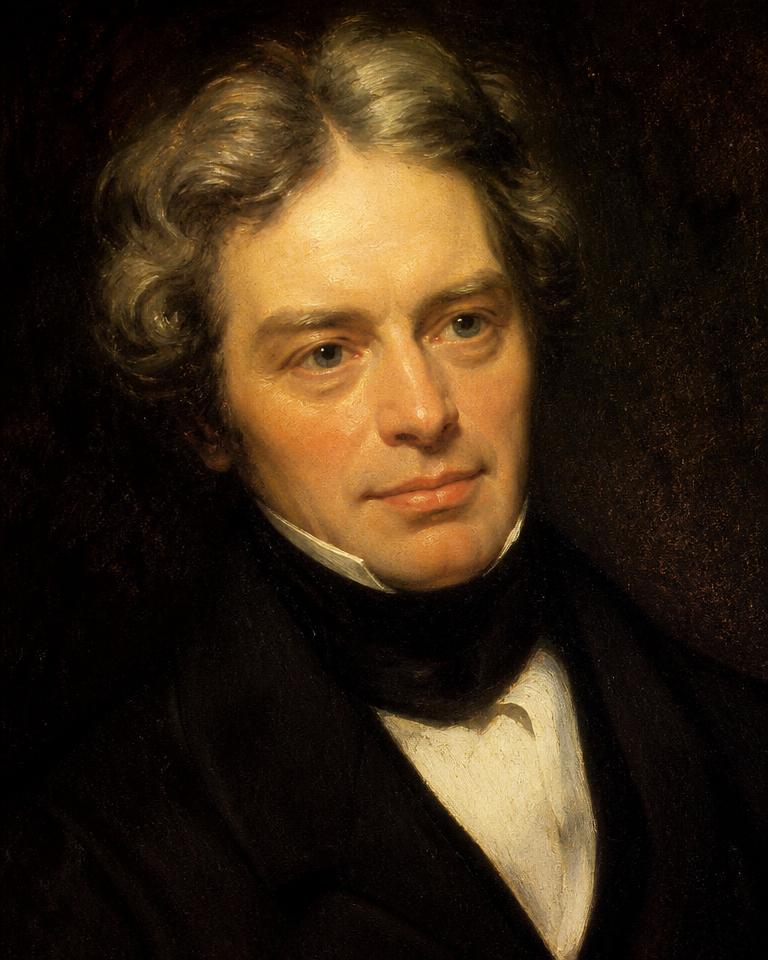
Quick Facts
- Years
- 1791 – 1867
- Category
- Scientists & Inventors
- Subcategory
- Electromagnetism
- Nationality
- English
- Occupation
- Physicist & Chemist
Michael Faraday
1791 – 1867 · English · Physicist & Chemist
Audiobook

Life Lessons from Michael Faraday
Marcus Alden · 42 min
Michael Faraday (1791–1867) was an English physicist and chemist whose experiments transformed the understanding of electricity, magnetism, and matter. Born into a poor family and given little formal schooling, he educated himself while working as a bookbinder’s apprentice. His curiosity, practical skill, and carefully disciplined experiments eventually brought him to the Royal Institution in London, where he became one of the nineteenth century’s most influential scientists.
Faraday discovered electromagnetic induction—the principle behind electric generators and transformers—and demonstrated the basic operating principle of the electric motor. He introduced the laws of electrolysis, helped establish the concept of the electromagnetic field, discovered benzene, and made important advances in liquefying gases and optical science. The SI unit of capacitance, the farad, bears his name.
Although Faraday used little advanced mathematics, his physical insights inspired James Clerk Maxwell’s mathematical theory of electromagnetism. Those ideas ultimately shaped electrical engineering, telecommunications, and modern physics. Faraday was also a gifted public lecturer who helped make experimental science accessible through the Royal Institution’s Friday Evening Discourses and Christmas Lectures. He remains studied not only for his discoveries, but also for his experimental method, intellectual humility, public service, and commitment to evidence.
Quick Facts
| Field | Details |
|---|---|
| Full Name | Michael Faraday |
| Common Name(s) | Michael Faraday |
| Born | 22 September 1791 |
| Died | 25 August 1867 |
| Age at Death | 75 |
| Birthplace | Newington Butts, Surrey, England—now part of London |
| Nationality | English; British |
| Occupation | Physicist, chemist, experimental scientist, lecturer |
| Historical Era | Industrial Revolution; Victorian era |
| Famous For | Electromagnetic induction, early electric motor, laws of electrolysis, field concept, Faraday effect, benzene |
| Political Affiliation | None recorded; he generally avoided party politics |
| Religion | Devout member and elder of the Sandemanian Christian church |
| Education | Limited elementary schooling; largely self-educated; no university degree |
| Parents | James Faraday and Margaret Hastwell Faraday |
| Spouse(s) | Sarah Barnard, married 1821 |
| Children | None |
| Major Works | Chemical Manipulation (1827); Experimental Researches in Electricity (1839–1855); Experimental Researches in Chemistry and Physics (1859); The Chemical History of a Candle (published 1861) |
| Major Achievements | Electromagnetic rotation; electromagnetic induction; laws of electrolysis; diamagnetism; magneto-optical effect; discovery of benzene; popularization of science |
Early Life
Michael Faraday was born on 22 September 1791 at Newington Butts, south of London. His father, James Faraday, was a blacksmith whose health was often poor. His mother, Margaret, managed a household with limited resources. The family belonged to the Sandemanians, a small Christian denomination that emphasized simplicity, communal responsibility, and close adherence to scripture.
Faraday received only a basic education in reading, writing, and arithmetic. At thirteen he became an errand boy for George Riebau, a bookseller and bookbinder in Blandford Street, London. He soon began a seven-year apprenticeship. The shop became an unconventional school: while binding books, Faraday read works on chemistry, electricity, and natural philosophy.
Particularly important influences included Isaac Watts’s writings on intellectual improvement and the Encyclopaedia Britannica article on electricity. Faraday repeated simple experiments using homemade apparatus and attended lectures organized by the City Philosophical Society, founded by John Tatum. His older brother Robert helped pay the lecture fees.
In 1812, a customer, William Dance, gave Faraday tickets to lectures by the celebrated chemist Humphry Davy at the Royal Institution. Faraday took detailed notes, illustrated them, and bound them into a volume. He sent the book to Davy with a request for scientific employment.
Davy initially had no position available, but an opening soon arose after a laboratory assistant was dismissed following a quarrel. In March 1813 Faraday joined the Royal Institution as a chemical assistant. The appointment changed his life.
Rise to Prominence
Faraday’s first duties were practical: cleaning apparatus, preparing demonstrations, assisting lectures, and maintaining the laboratory. Later in 1813, Davy took him on an extended European tour with Davy’s wife, Jane. They visited France, Italy, Switzerland, and other regions, meeting figures such as André-Marie Ampère and Alessandro Volta.
The journey exposed Faraday to continental science, but it also tested him. Because of his lower social status, he was expected to perform some duties associated with a servant. Lady Davy’s treatment of him was reportedly difficult. Nevertheless, the tour provided experience with leading laboratories and scientific networks.
After returning to Britain in 1815, Faraday resumed work at the Royal Institution and began publishing chemical research. He investigated steel alloys, optical glass, gases, and chemical compounds. In 1823 he liquefied chlorine by pressure and cooling, helping show that gases could be converted into liquids under suitable conditions. In 1825 he identified benzene in an oily residue produced during the manufacture of illuminating gas.
His decisive entry into electrical science followed Hans Christian Ørsted’s 1820 demonstration that an electric current deflected a compass needle. In 1821 Faraday devised an apparatus producing continuous electromagnetic rotation. It demonstrated the principle underlying the electric motor.
The publication brought both recognition and conflict. Faraday was accused of failing to give sufficient credit to Davy and William Hyde Wollaston, who had discussed related problems. Historians generally distinguish Faraday’s successful rotating apparatus from Wollaston’s proposed design, but the episode strained Faraday’s relationship with Davy.
Faraday continued working, lecturing, and improving his experimental technique. In 1824 he was elected a Fellow of the Royal Society, despite Davy’s opposition. He became director of the Royal Institution laboratory in 1825 and Fullerian Professor of Chemistry in 1833. His discovery of electromagnetic induction in 1831 secured his international reputation.
Major Achievements
Electromagnetic Rotation and the Motor Principle
In 1821 Faraday showed that a current-carrying conductor could rotate continuously around a magnet, and a magnet around a conductor. This converted electromagnetic interaction into sustained mechanical motion.
Earlier experiments had established a relationship between electricity and magnetism, but Faraday’s apparatus produced continuous movement. It therefore represented a fundamental motor principle. Modern motors are far more sophisticated, yet they still depend on converting electromagnetic forces into motion.
Electromagnetic Induction
On 29 August 1831 Faraday observed that changing the current in one coil induced a brief current in a nearby coil wound around an iron ring. He then showed that moving a magnet through a coil also generated electricity. A changing magnetic environment, rather than a static magnet alone, induced current.
This discovery provided the operating principle of generators and transformers. It made large-scale electrical power production possible: mechanical energy could be converted into electrical energy by moving conductors and magnetic fields relative to one another.
Faraday also built a copper-disc generator, often called the Faraday disc. Though inefficient as a practical machine, it demonstrated continuous electromagnetic generation.
Laws of Electrolysis
During the 1830s Faraday studied chemical decomposition caused by electric currents. He formulated two quantitative laws of electrolysis. First, the amount of chemical change is proportional to the quantity of electricity passed. Second, for the same quantity of electricity, deposited masses correspond to substances’ chemical equivalent weights.
With advice from the classical scholar William Whewell, Faraday introduced terminology including electrode, electrolyte, anode, cathode, anion, and cation. These laws connected electricity with chemical combination and helped prepare the way for electrochemistry and later ideas about electric charge at the atomic scale.
The Faraday Cage and Electrostatic Shielding
In 1836 Faraday constructed a room coated with conducting material and showed that electrical charge remained on its exterior, leaving the interior protected from electrostatic effects. This illustrated electrostatic shielding.
A conductive enclosure is now commonly called a Faraday cage. The principle is used in laboratories, communication cables, electronic equipment, lightning protection, and rooms designed to block electromagnetic interference. The familiar term covers configurations whose effectiveness depends on material, frequency, openings, and construction.
Field Theory and Lines of Force
Faraday visualized electric and magnetic influences as physical “lines of force” extending through space. This challenged explanations based solely on instantaneous action at a distance. His field-based reasoning grew directly from experiments with magnets, currents, iron filings, and dielectric materials.
James Clerk Maxwell later translated Faraday’s insights into mathematical equations. Maxwell openly acknowledged the conceptual power of Faraday’s work. The field became a central idea in modern physics, extending far beyond nineteenth-century electromagnetism.
Magnetism and Light: The Faraday Effect
In 1845 Faraday discovered that a magnetic field could rotate the plane of polarization of light passing through certain transparent materials. This magneto-optical phenomenon is known as the Faraday effect.
The result offered experimental evidence that light and electromagnetism were related. Maxwell’s subsequent theory identified light as an electromagnetic wave. The Faraday effect remains important in astronomy, plasma physics, materials science, and optical technologies.
Diamagnetism
Also in 1845, Faraday showed that many materials respond weakly to magnetic fields by tending to move away from stronger regions of the field. He called this behavior diamagnetism. He systematically investigated magnetic properties across numerous substances.
His work broadened magnetism beyond iron and permanent magnets. Modern physics explains diamagnetism through the response of electrons to applied magnetic fields, although Faraday worked before electron theory existed.
Chemical Discoveries
Faraday discovered benzene in 1825, calling it “bicarburet of hydrogen.” Benzene later became central to organic chemistry and industrial manufacture, though it is now known to be toxic and carcinogenic.
He also liquefied chlorine and investigated other gases, alloys, glass, and hydrocarbons. His book Chemical Manipulation presented practical laboratory methods, reflecting his reputation as an exceptionally careful experimental chemist.
Public Science Education
Faraday helped establish the Royal Institution’s Friday Evening Discourses and played a major role in its Christmas Lectures for young audiences. His lectures combined clear explanations with carefully rehearsed demonstrations.
His six-part 1860 lecture series on a candle traced combustion, gases, water, carbon, and the circulation of matter. Published as The Chemical History of a Candle, it remains a classic of science communication.
Leadership and Work
Faraday led primarily through experiment, example, and communication rather than institutional authority. At the Royal Institution he planned demonstrations meticulously and expected apparatus to work reliably before an audience. His notebooks reveal dated observations, repeated trials, failed attempts, and cautious conclusions.
His method was exploratory but disciplined. He often used visual and mechanical models to think about invisible forces. Because he lacked advanced mathematical training, he relied on geometry, physical intuition, precise measurements, and systematic variation of experimental conditions. This limitation prevented him from providing the mathematical synthesis later achieved by Maxwell, but it also encouraged powerful concrete concepts.
Faraday valued evidence over prestige. He advised younger investigators to work, finish, and publish, but not to mistake speculation for established fact. He maintained professional relationships with Davy, Whewell, Maxwell, and many Royal Institution colleagues, although disputes occasionally arose over credit and priorities.
He also accepted public-service investigations. He examined lighthouse lighting, mine safety, optical glass, and environmental problems. In 1855 he famously reported on the polluted state of the River Thames. He declined work on chemical weapons during the Crimean War on moral grounds, according to contemporary biographical evidence.
His strengths included patience, dexterity, imagination, clarity, and unusual persistence. His weaknesses included limited mathematics and periods of exhaustion and memory difficulty, which forced him to reduce his workload.
Personal Life
Faraday married Sarah Barnard on 12 June 1821. She came from the same Sandemanian community, and their marriage appears to have been affectionate and stable. They had no children. Sarah supported his domestic life and accompanied him through periods of illness and professional pressure.
The couple lived for many years in accommodation associated with the Royal Institution. From 1858 they had the use of a house at Hampton Court, granted through Queen Victoria’s favor. Faraday initially hesitated over accepting such benefits but ultimately took the residence without a title.
Friends and observers described him as lively, warm, courteous, and enthusiastic in the laboratory and lecture theater. His public performances were energetic, yet his private life was relatively modest. He enjoyed nature, travel, word games, and time with his family circle.
By the late 1830s and early 1840s, overwork contributed to deteriorating health. He suffered fatigue, dizziness, and memory problems. The exact diagnosis is uncertain, and modern retrospective explanations remain speculative. He took extended periods of rest and later limited his research and administrative duties.
Faraday refused a knighthood. He also declined the presidency of the Royal Society, reportedly more than once. He died at Hampton Court on 25 August 1867. He was buried in the dissenters’ section of Highgate Cemetery in London rather than in Westminster Abbey.
Philosophy and Beliefs
Faraday’s Sandemanian Christianity was central to his identity. He became a church deacon and later an elder, participating in worship, preaching, and congregational discipline. His faith stressed humility, service, moral accountability, and separation between religious revelation and scientific investigation.
He did not generally use scripture as a substitute for experimental evidence. In science, he insisted that claims be tested against nature. Scholars continue to examine how his theology may have encouraged his belief in an ordered creation and interconnected forces, but direct causal claims should be made cautiously.
Faraday avoided conventional political life and held no known party affiliation. His public actions nevertheless expressed ethical commitments. He valued education, performed government advisory work, criticized environmental neglect, and rejected honors that he believed might compromise simplicity.
He regarded science as demanding honesty and restraint. Hypotheses were useful, but investigators had to distinguish imagination from proof. His religious and scientific worlds were distinct in method, yet united in his personal commitment to truthfulness and duty.
Challenges and Controversies
Faraday’s social origins presented a major obstacle. British science remained strongly shaped by class, patronage, universities, and elite societies. His apprenticeship gave him manual expertise but no degree, classical education, or mathematical training. Davy’s patronage opened doors, while also placing Faraday in a subordinate position.
The 1821 electromagnetic-rotation paper produced the most serious priority dispute of his early career. Davy and Wollaston had investigated related ideas, and critics believed Faraday had inadequately acknowledged them. Faraday denied intentional appropriation. Most historians credit him with creating the first successful continuous electromagnetic-rotation devices while recognizing the preceding discussions.
Davy later opposed Faraday’s election to the Royal Society. The reason is debated. The rotation controversy, professional jealousy, or concerns about procedure may all have contributed. Faraday was elected in 1824 despite that opposition.
Not all his research succeeded. Years devoted to optical glass produced specialized materials but fell short of the original practical goals. His attempts to discover a direct effect of electricity or magnetism on gravity were unsuccessful. Importantly, he recorded negative results rather than presenting them as discoveries.
Some popular stories exaggerate his foresight. The famous exchange in which he allegedly told a politician that electricity would someday be taxed exists in multiple forms and lacks secure contemporary documentation. Likewise, simplistic claims that Faraday single-handedly “invented electricity” misrepresent both his work and the contributions of many predecessors and successors.
His scientific language could also be qualitative and difficult for mathematically trained contemporaries. Maxwell’s later formalization did not merely restate Faraday; it developed the field concept into a predictive mathematical theory.
Legacy
Faraday’s discoveries underpin electric motors, generators, transformers, electrochemistry, electromagnetic shielding, and aspects of optical technology. Every power station using electromagnetic induction reflects the principle he demonstrated in 1831.
His greatest theoretical legacy was the field concept. Maxwell developed Faraday’s lines of force into the classical theory of electromagnetism, and later physicists made fields fundamental to relativity and quantum theory. Albert Einstein reportedly kept portraits of Faraday, Maxwell, and Isaac Newton in his study, symbolizing their place in the development of physics.
Faraday is commemorated by the farad, the SI unit of electrical capacitance, and the Faraday constant, which relates electric charge to a mole of electrons. Faraday’s laws, Faraday cages, Faraday rotation, and the Faraday disc preserve his name in scientific language.
The Royal Institution maintains the Faraday Museum in London, including his laboratory and instruments. Statues and memorials honor him in London, including a statue at the Institution of Engineering and Technology’s headquarters at Savoy Place. His portrait appeared on the Bank of England £20 note issued from 1991 to 2001.
His Christmas Lectures continue at the Royal Institution. Beyond specific discoveries, his rise from apprentice to eminent scientist remains a powerful example of self-education—though it also illustrates the importance of access to books, mentors, laboratories, and institutions.
Interesting Facts
- Faraday began working for a bookseller at thirteen.
- He learned science largely by reading books he was binding.
- His handwritten notes from Davy’s lectures helped him obtain laboratory work.
- He traveled through Europe as Davy’s assistant from 1813 to 1815.
- He produced continuous electromagnetic rotation in 1821.
- He married Sarah Barnard in 1821; they had no children.
- He discovered benzene in 1825.
- He helped found the Royal Institution’s Christmas Lecture tradition in 1825.
- He discovered electromagnetic induction in 1831.
- He introduced much of the basic vocabulary of electrolysis with William Whewell’s linguistic assistance.
- The farad, a unit of capacitance, is named for him.
- He demonstrated electrostatic shielding with a conducting enclosure.
- He found that magnetism could affect polarized light.
- He coined the term diamagnetic.
- He had no university degree.
- He refused a knighthood.
- He declined the presidency of the Royal Society.
- He investigated the severe pollution of the River Thames.
- His best-known popular lecture examined the chemistry of a candle.
- He was buried at Highgate Cemetery.
Famous Quotes
- “Nothing is too wonderful to be true, if it be consistent with the laws of nature.” From Faraday’s laboratory diary, 19 March 1849; it summarizes his openness to surprising results governed by evidence.
- “Work. Finish. Publish.” Recorded as Faraday’s concise advice to the chemist William Crookes; it emphasizes carrying research through to communication.
- “The lecturer should give the audience full reason to believe that all his powers have been exerted for their pleasure and instruction.” From Faraday’s notes on lecturing; it reflects his respect for audiences and careful preparation.
- “A lecturer should appear easy and collected, undaunted and unconcerned.” From his lecture advice; it describes the self-command required for public demonstration.
- “I shall be with Christ, and that is enough.” Reported near the end of his life; it expresses his Sandemanian faith and confidence about death.
- “The book of nature which we have to read is written by the finger of God.” Documented in his writings and often cited to illustrate his belief in creation’s intelligible order.
- “There is no more open door by which you can enter into the study of natural philosophy than by considering the physical phenomena of a candle.” From the candle lectures; it shows how ordinary objects can reveal broad scientific principles.
- “I have far more confidence in the one man who works mentally and bodily at a matter than in the six who merely talk about it.” Attributed in biographical collections; consistent with his experimental outlook, though wording may derive from recollection.
- “Why, sir, there is every probability that you will soon be able to tax it.” Allegedly said when asked about electricity’s usefulness. Disputed: no secure contemporary source establishes the exchange, and versions differ.
- “But still try, for who knows what is possible?” Widely attributed to Faraday. Attribution uncertain: it captures his persistence, but its precise original source is difficult to verify.
Timeline
- 1791 — Born at Newington Butts on 22 September.
- 1804 — Begins work for bookseller and bookbinder George Riebau.
- 1805 — Starts his bookbinding apprenticeship.
- 1810 — Attends City Philosophical Society lectures.
- 1812 — Hears Humphry Davy lecture at the Royal Institution.
- 1813 — Becomes Davy’s laboratory assistant; leaves on a European scientific tour.
- 1815 — Returns to London and resumes Royal Institution work.
- 1816 — Publishes his first scientific paper.
- 1821 — Demonstrates electromagnetic rotation; marries Sarah Barnard.
- 1823 — Liquefies chlorine and investigates other gases under pressure.
- 1824 — Elected Fellow of the Royal Society.
- 1825 — Discovers benzene; becomes director of the Royal Institution laboratory; Christmas Lectures begin.
- 1827 — Publishes Chemical Manipulation.
- 1831 — Discovers electromagnetic induction and constructs an early generator.
- 1833 — Appointed Fullerian Professor of Chemistry.
- 1834 — States the laws of electrolysis.
- 1836 — Demonstrates electrostatic shielding in a conducting enclosure.
- 1839 — First volume of Experimental Researches in Electricity appears; health problems intensify.
- 1845 — Discovers the Faraday effect and diamagnetism.
- 1846 — Proposes ideas connecting forces and radiant phenomena.
- 1855 — Publicly reports on Thames pollution.
- 1858 — Moves to a grace-and-favor house at Hampton Court.
- 1860 — Delivers the Christmas Lectures later published as The Chemical History of a Candle.
- 1861 — The candle lectures appear in book form.
- 1862 — Conducts late experiments seeking magnetic effects on light’s spectrum.
- 1867 — Dies at Hampton Court on 25 August and is buried at Highgate Cemetery.
Frequently Asked Questions
Who was Michael Faraday?
Michael Faraday was an English experimental physicist and chemist. He worked mainly at London’s Royal Institution and made foundational discoveries in electromagnetism and electrochemistry. His most consequential result was electromagnetic induction, which explains how changing magnetic conditions generate electric current. He also demonstrated electromagnetic rotation, discovered benzene, formulated the laws of electrolysis, investigated diamagnetism, and showed that magnetism can influence polarized light. Despite minimal formal education, he became one of history’s leading experimental scientists.
What is Michael Faraday most famous for?
Faraday is most famous for discovering electromagnetic induction in 1831. He found that a changing magnetic field can induce an electric current in a conductor. This principle is fundamental to generators and transformers and therefore to modern electrical power systems. He is also famous for early electric-motor experiments, the laws of electrolysis, the Faraday cage, the Faraday effect, and his concept of lines of force, which influenced Maxwell’s field theory.
Did Faraday invent electricity?
No. Electricity is a natural phenomenon, not a single invention, and it had been studied long before Faraday by figures including William Gilbert, Benjamin Franklin, Luigi Galvani, Alessandro Volta, and others. Faraday discovered crucial principles governing electricity and magnetism. His work made practical electrical generation and motors conceptually possible, but modern electrical technology emerged through the contributions of many scientists, engineers, inventors, and manufacturers.
What did Faraday discover in 1831?
In 1831 Faraday discovered electromagnetic induction. Using coils wound around an iron ring, he observed a temporary current in one circuit when current in another circuit changed. He then demonstrated induction by moving magnets and conductors relative to each other. The discovery showed how mechanical motion could generate electricity. Faraday subsequently built a rotating copper-disc generator, establishing the basis for later dynamos and electrical power stations.
How did Faraday become a scientist without a university education?
Faraday educated himself during his apprenticeship as a bookbinder. He read scientific books, conducted simple experiments, attended lectures, and kept detailed notes. After hearing Humphry Davy lecture, he sent Davy a bound volume of those notes and asked for work. Davy hired him as a laboratory assistant in 1813. Access to the Royal Institution’s equipment, library, lectures, and scientific contacts allowed Faraday to develop his abilities through sustained practical work.
What was Faraday’s relationship with Humphry Davy?
Davy was Faraday’s patron, employer, and early mentor. He gave Faraday his first professional scientific position and took him on a European tour. Their relationship later became strained, particularly after Faraday’s 1821 electromagnetic-rotation work raised questions of credit involving Davy and Wollaston. Davy opposed Faraday’s Royal Society election in 1824. Even so, Faraday continued to acknowledge that Davy had provided his opportunity to enter science.
What is a Faraday cage?
A Faraday cage is a conducting enclosure that redistributes electrical charge and can shield its interior from certain external electric or electromagnetic fields. Faraday demonstrated the electrostatic principle in 1836 using a metal-covered room. Today, shielding is used in electronic devices, cables, laboratories, vehicles, and lightning protection. Performance varies: a cage is not an absolute barrier to every frequency, especially if it has large openings, poor connections, or unsuitable materials.
What are Faraday’s laws of electrolysis?
Faraday’s first law states that the amount of substance chemically changed at an electrode is proportional to the total electric charge passed through the electrolyte. His second law relates the masses of different substances produced by equal charge to their chemical equivalent weights. These quantitative relationships established a deep connection between electricity and chemical reactions and became foundations of electrochemistry. They later fitted naturally with the concept of discrete electric charge.
Did Faraday invent the electric motor?
Faraday did not invent the modern practical motor, but in 1821 he created devices that produced continuous electromagnetic rotation. A wire carrying current rotated around a magnet, or a magnet rotated around a current-carrying conductor. These experiments demonstrated the fundamental conversion of electrical energy into mechanical motion. Later inventors developed more efficient motors using coils, commutators, improved magnetic circuits, and industrial engineering.
What chemical element or compound did Faraday discover?
Faraday discovered benzene in 1825 while examining an oily residue associated with illuminating gas production. He called the substance “bicarburet of hydrogen.” Benzene later became central to theories of organic structure and to chemical manufacturing. Faraday also made major contributions to gas liquefaction, including liquefying chlorine, but he did not discover a chemical element.
How did Faraday influence James Clerk Maxwell?
Faraday introduced the idea that electric and magnetic interactions could be understood through lines of force occupying surrounding space. Maxwell recognized that Faraday’s qualitative physical picture contained profound theoretical insight. He represented electromagnetic fields mathematically and developed equations showing that light is an electromagnetic wave. Maxwell’s theory therefore extended and formalized Faraday’s experimental concepts rather than merely repeating them.
Was Michael Faraday religious?
Yes. Faraday was a committed member of the Sandemanian church, a small Christian community descended from eighteenth-century Scottish religious movements. He served as a deacon and elder. His faith influenced his humility, moral conduct, and community obligations. In scientific work, however, he relied on observation and experiment rather than treating theological claims as laboratory explanations. Historians debate the precise influence of his theology on his scientific concepts.
Why did Faraday refuse a knighthood?
Faraday declined a knighthood, apparently preferring to remain “plain Mr Faraday” and regarding worldly honors as inconsistent with his values. His Sandemanian faith emphasized simplicity and humility, although no single motive should be asserted too rigidly. He also declined the Royal Society presidency. He did accept a state-provided residence at Hampton Court after initial hesitation, showing that his attitude toward recognition and support was principled but not entirely inflexible.
Did Faraday have children?
No. Michael and Sarah Faraday had no children. They maintained close relationships with nieces, nephews, members of their church, and colleagues at the Royal Institution. Sarah played an important supportive role throughout Faraday’s career and cared for him during periods of poor health. Their marriage lasted from 1821 until his death in 1867.
What health problems did Faraday experience?
Faraday experienced serious fatigue, dizziness, and memory difficulties, especially from the late 1830s onward. Overwork appears to have worsened his condition, and he took periods of rest, including time in Switzerland. The exact medical cause cannot be confidently diagnosed from surviving historical evidence. Claims involving mercury exposure or specific neurological diseases are possibilities discussed retrospectively, not established facts. His health eventually reduced his research, lecturing, and administrative activity.
Where is Michael Faraday buried?
Faraday is buried in the western, dissenters’ section of Highgate Cemetery in London. He was offered burial in Westminster Abbey but did not receive that form of interment. A memorial plaque in Westminster Abbey nevertheless commemorates him near other major British scientists. His grave is comparatively modest, consistent with the simplicity associated with his personal and religious life.
Lessons We Can Learn
- Use available resources creatively. Faraday turned a bookbinding shop into a place of study. Today, libraries, public courses, and practical projects can supplement formal education.
- Take careful notes. His bound lecture notes impressed Davy and opened a career path. Good documentation preserves ideas and demonstrates seriousness.
- Experiment rather than merely speculate. Faraday repeatedly tested physical relationships. Evidence remains the strongest correction to attractive but unsupported theories.
- Record failure honestly. His unsuccessful gravity and optical-glass work was not concealed. Negative results prevent repetition and sharpen future questions.
- Build practical skill. Faraday’s dexterity with apparatus enabled discoveries others had imagined but not demonstrated. Hands-on competence complements abstract knowledge.
- Communicate clearly. His candle lectures made complex chemistry understandable without distorting it. Expertise gains public value when it can be explained accurately.
- Remain open to surprising results. Electromagnetic induction emerged through persistent variation of experiments. Innovation often requires noticing brief or unexpected effects.
- Seek help across disciplines. Faraday consulted Whewell for Greek-derived terminology. Collaboration can solve linguistic and conceptual problems outside one person’s expertise.
- Protect health and limits. Overwork contributed to Faraday’s long periods of incapacity. Sustainable effort is more valuable than uninterrupted exhaustion.
- Let values guide ambition. Faraday declined honors yet accepted duties he considered useful. Modern professionals can distinguish meaningful service from status for its own sake.
Related Historical Figures
- Humphry Davy — Faraday’s employer and mentor, later involved in disputes over credit and professional advancement.
- James Clerk Maxwell — Mathematically developed Faraday’s field concepts into electromagnetic theory.
- Hans Christian Ørsted — Discovered the magnetic effect of an electric current, inspiring Faraday’s rotation experiments.
- André-Marie Ampère — Developed electrodynamics and met Faraday during the European tour.
- Alessandro Volta — Invented the voltaic pile and met Faraday in Italy.
- William Hyde Wollaston — Investigated electromagnetic rotation and became central to the 1821 priority dispute.
- William Whewell — Scholar who helped Faraday create the terminology of electrochemistry.
- John Tyndall — Faraday’s Royal Institution colleague, successor, defender, and early biographer.
- Joseph Henry — American physicist who independently discovered induction-related effects and developed electromagnets.
- Nikola Tesla — Later advanced alternating-current motors and power systems built upon electromagnetic principles Faraday helped establish.
Related Historical Figures