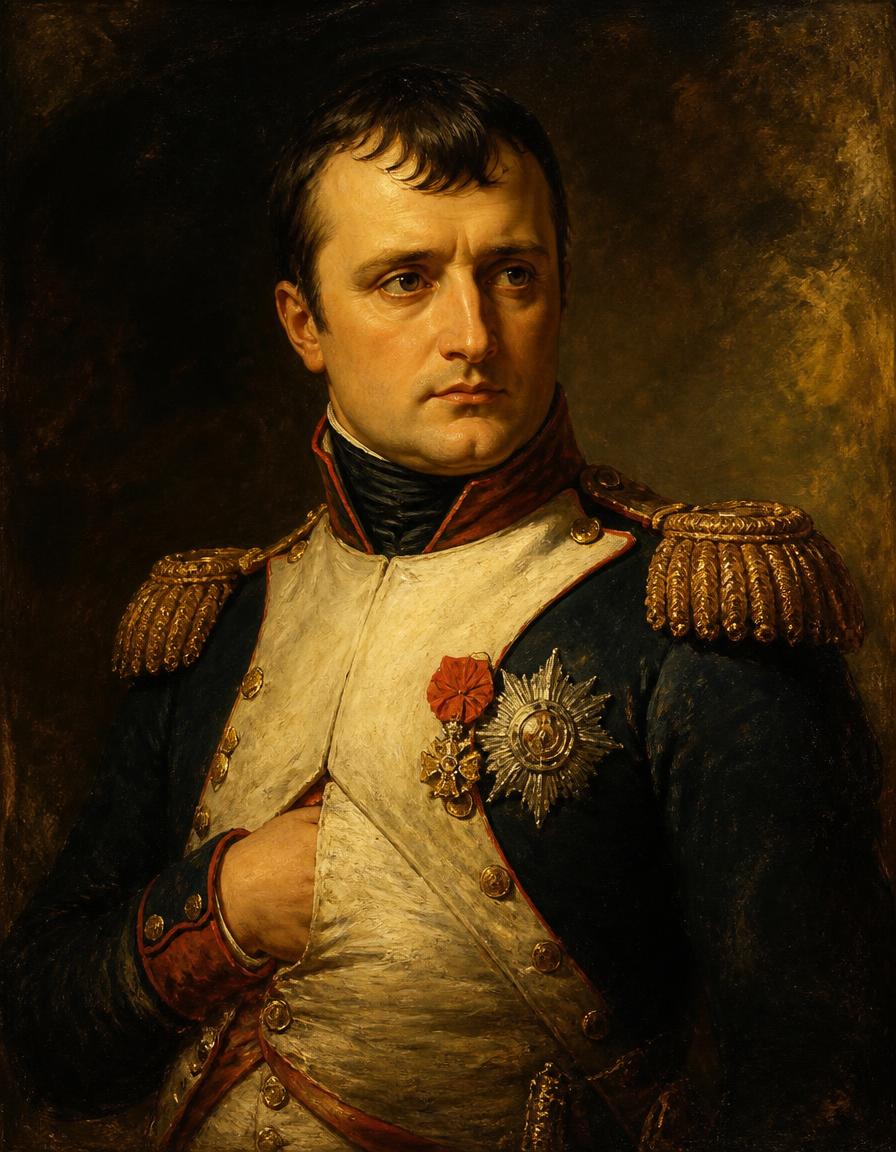
Quick Facts
- Years
- 1769 – 1821
- Category
- World Leaders & Revolutionaries
- Nationality
- French
- Occupation
- Emperor & Military Commander
Napoleon Bonaparte
1769 – 1821 · French · Emperor & Military Commander
Audiobook

Life Lessons from Napoleon Bonaparte
Marcus Alden · 55 min
Napoleon Bonaparte was a Corsican-born French general, statesman, and emperor whose career transformed France and reshaped Europe. Rising during the French Revolution, he won fame through rapid, carefully coordinated military campaigns before taking power in the coup of 18 Brumaire in 1799. As First Consul and, from 1804, Emperor of the French, Napoleon combined authoritarian government with enduring administrative reforms.
His armies defeated successive coalitions and established French dominance across much of continental Europe. His greatest institutional achievement, the Civil Code of 1804—widely called the Napoleonic Code—promoted legal equality for men, protected property, and helped replace inherited privilege with uniform law. He also reorganized education, taxation, finance, and government administration.
Napoleon's rule nevertheless carried immense costs. It depended on censorship, conscription, warfare, dynastic control, and colonial coercion. He restored slavery in French colonies in 1802, and his campaigns caused enormous military and civilian losses. Defeat in Russia, followed by coalition victories, led to exile, a brief return during the Hundred Days, and final defeat at Waterloo in 1815.
Napoleon remains important because his career links revolution, empire, nationalism, state-building, and modern warfare. Scholars still debate whether he preserved the Revolution's reforms or betrayed its liberties—a tension that makes him one of history's most studied rulers.
Quick Facts
| Field | Details |
|---|---|
| Full Name | Napoleone di Buonaparte; later French form: Napoléon Bonaparte |
| Common Name(s) | Napoleon I, Napoleon Bonaparte |
| Born | 15 August 1769 |
| Died | 5 May 1821 |
| Age at Death | 51 |
| Birthplace | Ajaccio, Corsica, Kingdom of France |
| Nationality | Corsican-born French |
| Occupation | Army officer, general, First Consul, emperor |
| Historical Era | French Revolution and Napoleonic Era |
| Famous For | Napoleonic Wars, French Empire, Napoleonic Code |
| Political Affiliation | Revolutionary French state; later Bonapartist imperial regime |
| Religion | Roman Catholic by upbringing; Concordat restored relations with the Church |
| Education | Schools at Autun and Brienne; École Militaire, Paris |
| Parents | Carlo Maria Buonaparte and Maria Letizia Ramolino |
| Spouse(s) | Joséphine de Beauharnais; Marie Louise of Austria |
| Children | One legitimate son, Napoleon II; acknowledged illegitimate sons included Charles Léon and Alexandre Colonna-Walewski |
| Major Works | Civil Code, Mémorial de Sainte-Hélène indirectly through Las Cases, military correspondence and proclamations |
| Major Achievements | Italian campaigns, administrative centralization, Concordat, Bank of France, educational reform, Civil Code |
Early Life
Napoleon was born in Ajaccio on Corsica, only months after France had defeated the island's republican resistance. His family belonged to the minor Corsican nobility. His father, Carlo, practiced law and entered French service; his mother, Letizia, managed a large household with discipline and economy.
French royal support enabled Napoleon to attend school on the mainland. After studying French at Autun, he entered the military academy at Brienne in 1779. Classmates sometimes mocked his accent and provincial background. He became particularly interested in mathematics, geography, history, and artillery—an arm requiring technical skill rather than the highest aristocratic pedigree.
In 1784 he entered the École Militaire in Paris. His father's death strained family finances, and Napoleon completed the course early. Commissioned as a second lieutenant of artillery in 1785, he served at Valence and Auxonne while reading Enlightenment writers, military history, and works about Corsica.
Initially devoted to Corsican affairs, he admired independence leader Pasquale Paoli. The Revolution of 1789 opened military advancement to talent, but political conflict divided Corsica. Napoleon and Paoli became enemies, and the Buonaparte family fled to mainland France in 1793. That rupture helped turn the young Corsican officer into a committed servant of revolutionary France.
Rise to Prominence
Napoleon's breakthrough came at Toulon in 1793, where royalists and their British allies occupied a major naval base. He helped devise an artillery plan that forced the allied evacuation. Promoted to brigadier general at only 24, he gained influential patrons among the revolutionary leadership.
The fall of Maximilien Robespierre in 1794 briefly endangered him because of his association with Robespierre's brother Augustin. Arrested and released, Napoleon spent months without a suitable command. His fortunes changed on 13 Vendémiaire Year IV—5 October 1795—when he helped suppress a royalist uprising in Paris with artillery. The victory made him indispensable to the Directory.
In 1796 Napoleon married Joséphine de Beauharnais and assumed command of the Army of Italy. Though poorly supplied, it was mobile and battle-tested. Napoleon separated Austrian and Piedmontese forces, defeated them repeatedly, and imposed settlements that expanded French influence. Victories at Lodi, Arcole, and Rivoli made him a national celebrity.
His Egyptian expedition of 1798 aimed to threaten British interests and enhance French power in the eastern Mediterranean. He won the Battle of the Pyramids, but Admiral Horatio Nelson destroyed the French fleet at the Nile. The expedition failed strategically, although its scholars advanced European study of ancient Egypt.
Returning to France amid political instability, Napoleon joined Emmanuel-Joseph Sieyès and other conspirators. The coup of 18–19 Brumaire—9–10 November 1799—overthrew the Directory. A new constitution established the Consulate, with Napoleon as First Consul and effective ruler.
Major Achievements
Military Ascendancy in Italy
The campaigns of 1796–1797 demonstrated Napoleon's operational skill. He moved quickly, concentrated force against divided opponents, and energized soldiers through proclamations and rewards. Austria accepted the Treaty of Campo Formio, recognizing major French gains. The campaign weakened old regimes in Italy and launched Napoleon's political career.
Reconstruction of the French State
After a decade of upheaval, Napoleon strengthened tax collection, appointed prefects to administer departments, and made promotion increasingly dependent on service and ability. The Bank of France, founded in 1800, supported monetary stability. These institutions gave France a centralized administrative structure that survived his fall.
The Concordat of 1801
The Concordat with Pope Pius VII reconciled the French government with much of the Catholic population. Catholicism was recognized as the religion of most French citizens, but the state retained control over appointments and preserved much revolutionary church property. The settlement promoted social peace without restoring the pre-revolutionary Church.
The Napoleonic Code
Promulgated in 1804, the Civil Code standardized private law across France. It confirmed legal equality among men, secular civil authority, property rights, and the abolition of feudal privilege. It also reinforced paternal power and restricted married women's legal independence. Adopted or adapted across Europe and beyond, it remains Napoleon's most durable international achievement.
Educational and Merit-Based Institutions
Napoleon created state-supervised secondary schools, or lycées, to train officers and administrators. He established the Legion of Honour in 1802 to reward military and civilian service. Although patronage and social advantage remained important, careers became less dependent on hereditary rank than under the old monarchy.
Victory at Austerlitz
On 2 December 1805 Napoleon defeated Russian and Austrian armies at Austerlitz. By encouraging an attack on his apparently weakened right wing, he exposed the allied center and seized the Pratzen Heights. The victory dissolved the Third Coalition and contributed to the end of the Holy Roman Empire in 1806.
Reshaping Europe
Napoleon reorganized German and Italian territories, abolished or weakened many feudal structures, and installed allied or family governments. French domination provoked resentment, but administrative reform and legal equality influenced later liberal and nationalist movements. His conquests unintentionally encouraged modern national identities among peoples resisting France.
Leadership and Work
Napoleon combined intense preparation with flexibility. He studied maps, troop strengths, roads, supplies, and reports, then sought decisive concentrations at vulnerable points. His corps system allowed separate formations to march independently and unite rapidly for battle.
He worked extraordinarily long hours and dictated correspondence to several secretaries. He demanded precise information and frequently intervened in local administration. He selected many officers for competence, though loyalty and family connections also shaped appointments.
His public leadership depended on image-making. Bulletins emphasized victories and minimized setbacks; ceremonies, paintings, medals, monuments, and newspapers presented him as both revolutionary heir and imperial sovereign. He understood morale and communicated directly with soldiers through memorable proclamations.
His strengths included speed, strategic imagination, organization, personal courage, and an ability to identify talented subordinates. Marshals such as Louis-Nicolas Davout and Jean Lannes flourished under him. Yet he increasingly centralized decisions and expected obedience. As the empire expanded, he underestimated logistics, local resistance, and the ability of enemies to learn from defeat.
Napoleon could be pragmatic in religion and administration but uncompromising where prestige or dynastic security was involved. The Peninsular War and invasion of Russia revealed his tendency to turn political problems into military contests that battlefield victory alone could not solve.
Personal Life
Napoleon married Joséphine de Beauharnais in 1796. He was deeply attached to her, especially early in their marriage, though both had affairs. Joséphine's social connections assisted his rise, and she became empress in 1804. Because they had no child together, Napoleon had the marriage annulled in 1810 for dynastic reasons.
He then married Archduchess Marie Louise, daughter of Emperor Francis I of Austria. Their son, Napoleon François Charles Joseph, was born in 1811 and styled King of Rome. Later known as Napoleon II by Bonapartists, he lived under Austrian supervision after his father's fall and died in 1832.
Napoleon maintained complicated relations with his siblings, placing several on European thrones while frequently criticizing their performance. His closest friendships often grew from military service. The death of Lannes in 1809 affected him deeply.
He preferred simple meals eaten quickly, took hot baths, and could work late before sleeping briefly. He enjoyed theater, history, classical literature, and conversation. Contemporary descriptions portray him as capable of charm, anger, irony, and calculated intimidation.
His health deteriorated during exile on Saint Helena. Symptoms included abdominal pain, weakness, vomiting, and weight changes. The official autopsy identified stomach cancer, a disease that had also killed his father. Arsenic poisoning has been proposed, but many modern scholars consider gastric cancer the strongest explanation, while acknowledging continuing debate over contributing factors.
Philosophy and Beliefs
Napoleon accepted several central results of the Revolution: civil equality for men, abolition of feudal privilege, secular law, careers open to talent, and state ownership of confiscated church lands. He rejected sustained popular democracy and believed social order required centralized executive authority.
His politics mixed revolutionary legitimacy, Roman imagery, monarchy, and plebiscitary approval. Constitutions and referendums remained, but voting occurred under official pressure and real power rested with the executive. He considered glory, stability, and national power essential measures of government.
Religiously, Napoleon was pragmatic. Raised Catholic, he recognized religion's social and political value, yet subordinated churches to the state. He negotiated the Concordat, supported Jewish consistories within an organized religious system, and later imprisoned Pope Pius VII during their conflict.
His legal worldview emphasized property, family authority, public order, and uniform rules. It advanced equality before law for male citizens while preserving unequal gender relations. His treatment of subject peoples likewise combined reform with exploitation.
Challenges and Controversies
Napoleon restricted press freedom, manipulated elections, used police surveillance, and imprisoned opponents. Admirers argue that centralization restored stability after revolutionary violence; critics answer that he replaced republican participation with personal dictatorship.
His wars remain central to moral assessment. Some conflicts were initiated by hostile coalitions, but Napoleon also pursued territorial expansion and refused compromises that might have preserved peace. Conscription and requisition imposed heavy burdens across Europe.
In 1802 his government restored slavery in colonies where revolutionary measures had abolished it. French forces attempted to reassert control in Saint-Domingue and arrested Haitian leader Toussaint Louverture, who died in captivity. Disease and Haitian resistance defeated the expedition, and Haiti declared independence in 1804. This policy is widely regarded as one of Napoleon's gravest actions.
The execution of the Duke of Enghien in 1804, after his seizure from neutral Baden, damaged Napoleon's reputation. Evidence did not establish the duke's involvement in the immediate assassination plot. Napoleon defended the act as state security; opponents called it judicial murder.
The Continental System sought to isolate Britain economically but encouraged smuggling and strained allies. The occupation of Spain in 1808 produced a brutal guerrilla war and British intervention. Napoleon later called it an ulcer that weakened his empire.
The invasion of Russia in 1812 was catastrophic. Supply failures, disease, combat, desertion, extreme weather, and Russian scorched-earth tactics destroyed much of the multinational Grande Armée. Popular memory often blames winter alone, but the army had suffered severely before the deepest cold.
Scholars also debate Napoleon's significance for nationalism. French rule spread reform and legal uniformity, but occupation, taxation, and conscription stimulated resistance in Spain, Germany, Italy, and elsewhere.
Legacy
Napoleon's empire collapsed, but many institutions survived. France retained centralized departments, prefects, lycées, the Legion of Honour, financial reforms, and a civil-law tradition. Versions of the Civil Code influenced legal systems in continental Europe, Latin America, Louisiana, Quebec, and other jurisdictions.
Military academies continue to study his concentration of force, corps organization, maneuver, logistics, and command. His failures are equally instructive: strategic overextension, occupation warfare, economic coercion, and the danger of allowing political ambition to outrun resources.
His conquests altered European politics. The abolition of the Holy Roman Empire helped reshape Germany; reforms in Italy and elsewhere weakened corporate and feudal privilege. Resistance to French rule contributed to nationalism, while the post-Napoleonic settlement created by the Congress of Vienna sought a durable balance of power.
Napoleon's remains were transferred from Saint Helena to Les Invalides in Paris in 1840. Major collections are held by the Musée de l'Armée, the Fondation Napoléon, the Château de Fontainebleau, and museums on Corsica and Saint Helena. Statues and street names remain widespread, though some have become subjects of debate because of war, authoritarianism, colonialism, and slavery.
His political memory—Bonapartism—joined charismatic leadership, centralized administration, military prestige, popular consultation, and dynastic rule. Napoleon therefore endures not simply as a commander, but as a case study in how revolutionary change can produce both modernization and empire.
Interesting Facts
- Napoleon was born French because Corsica had recently passed under French control.
- He trained as an artillery officer, a technically demanding specialization.
- He completed the Paris military academy course in roughly one year.
- His family originally used the Italianized surname Buonaparte.
- He was promoted to brigadier general after Toulon at age 24.
- Napoleon was not exceptionally short; his recorded height was normal for his era.
- He brought scholars, engineers, and artists on the Egyptian expedition.
- The Rosetta Stone was found by French soldiers in 1799.
- He became First Consul at age 30.
- Pope Pius VII attended his coronation, but Napoleon placed the crown on his own head.
- Austerlitz occurred on the first anniversary of his imperial coronation.
- He sold Louisiana to the United States in 1803.
- Beethoven initially associated his Third Symphony with Bonaparte, then rejected the dedication after Napoleon became emperor.
- Napoleon created the titles of marshals of the empire in 1804.
- His army entered Moscow in 1812, but Russia did not surrender.
- He escaped Elba in 1815 and returned to power without a major battle on the journey to Paris.
- His final exile was on Saint Helena in the South Atlantic.
- His tomb stands beneath the dome of Les Invalides in Paris.
Famous Quotes
- “Soldiers, you are naked and badly fed.” — Opening of Napoleon's proclamation to the Army of Italy in March 1796. It framed hardship as the prelude to conquest and reward.
- “From the summit of these pyramids, forty centuries look down upon you.” — Traditionally associated with the Battle of the Pyramids in 1798. The exact wording is not securely documented and should be treated cautiously.
- “Citizens, the Revolution is fixed to the principles that began it. It is finished.” — Proclamation after Brumaire, December 1799. It promised stability while signaling an end to revolutionary political struggle.
- “My true glory is not to have won forty battles... What nothing will destroy, what will live eternally, is my Civil Code.” — Recollected by Emmanuel de Las Cases on Saint Helena. It expresses Napoleon's belief that law would outlast military victories.
- “There is but one step from the sublime to the ridiculous.” — Reported from the retreat from Russia and recorded by witnesses. It reflects the rapid collapse of apparent greatness.
- “England is a nation of shopkeepers.” — Napoleon used a phrase already associated with earlier writers. Authentic in substance, but not original to him; it criticized Britain's commercial power.
- “A leader is a dealer in hope.” — Widely attributed to Napoleon, but no reliable primary source has been established; attribution disputed.
- “Impossible is a word to be found only in the dictionary of fools.” — Based loosely on an 1813 letter in which Napoleon rejected the claim that something was impossible. The familiar polished wording is probably later.
- “Never interrupt your enemy when he is making a mistake.” — Frequently attributed to Napoleon, but documentary evidence for this exact sentence is weak; attribution disputed.
- “I die before my time, killed by the English oligarchy and its hired assassins.” — From Napoleon's 1821 will. It shows how he framed his exile as political persecution.
Timeline
- 1769 — Born in Ajaccio, Corsica, on 15 August.
- 1779 — Enters the military school at Brienne.
- 1784 — Enters the École Militaire in Paris.
- 1785 — Commissioned as a second lieutenant of artillery.
- 1789 — French Revolution begins.
- 1793 — Family flees Corsica; Napoleon distinguishes himself at Toulon.
- 1794 — Briefly arrested after the fall of the Robespierres.
- 1795 — Suppresses the Vendémiaire royalist uprising in Paris.
- 1796 — Marries Joséphine and begins the first Italian campaign.
- 1797 — Treaty of Campo Formio confirms French gains.
- 1798 — Invades Egypt; wins at the Pyramids; French fleet loses at the Nile.
- 1799 — Returns to France and seizes power in the Brumaire coup.
- 1800 — Wins at Marengo; Bank of France founded.
- 1801 — Concordat agreed with Pope Pius VII.
- 1802 — Becomes First Consul for life; slavery restored in French colonies.
- 1803 — Louisiana sold to the United States; war with Britain resumes.
- 1804 — Civil Code promulgated; Duke of Enghien executed; Napoleon crowned emperor.
- 1805 — Defeats Austria and Russia at Austerlitz; French-Spanish fleet loses at Trafalgar.
- 1806 — Defeats Prussia; establishes Continental System.
- 1807 — Defeats Russia at Friedland; concludes Treaties of Tilsit.
- 1808 — Intervenes in Spain, beginning the Peninsular War.
- 1809 — Defeats Austria at Wagram.
- 1810 — Marries Marie Louise of Austria.
- 1811 — Birth of his legitimate son, the King of Rome.
- 1812 — Invades Russia and suffers catastrophic retreat.
- 1813 — Defeated at Leipzig in the Battle of the Nations.
- 1814 — Abdicates and is exiled to Elba.
- 1815 — Returns for the Hundred Days; defeated at Waterloo; exiled to Saint Helena.
- 1821 — Dies on Saint Helena on 5 May.
- 1840 — Remains transferred to Paris.
- 1861 — Reinterred in the completed tomb at Les Invalides.
Frequently Asked Questions
Who was Napoleon Bonaparte?
Napoleon was a French artillery officer who rose during the Revolution, became First Consul after the 1799 coup, and ruled as Emperor of the French from 1804 to 1814 and briefly in 1815. He combined exceptional military success with centralized administration and legal reform. His wars spread French influence across Europe but also caused vast destruction. His career ended after Waterloo and exile to Saint Helena.
Was Napoleon French or Italian?
He was born on Corsica after the island had come under French sovereignty. His family was culturally Corsican and used Italian forms of its names, and Napoleon initially spoke French with a Corsican accent. Legally and politically, however, he was French and built his entire mature career in French service. Calling him simply Italian applies a later national category too rigidly to eighteenth-century Corsica.
Was Napoleon really short?
No reliable evidence shows that Napoleon was unusually short for a Frenchman of his time. His recorded height, approximately 1.68 meters or 5 feet 6 inches under modern measurement, was near average. Confusion arose partly from differences between French and British units, caricature, and his appearance beside tall Imperial Guardsmen. The “Napoleon complex” is a much later stereotype, not a sound historical description.
How did Napoleon become emperor?
Military victories made Napoleon popular, while the Directory's weakness enabled him to seize power in the Brumaire coup of 1799. As First Consul, he centralized government, defeated foreign opponents, and secured approval through controlled plebiscites. In 1804 the Senate proclaimed him emperor, and another plebiscite ratified the change. He crowned himself at Notre-Dame Cathedral on 2 December, with Pope Pius VII present.
What was the Napoleonic Code?
The Civil Code of 1804 unified French private law. It protected property, established secular civil institutions, affirmed equality of male citizens before the law, and removed many remnants of feudal privilege. It also strengthened fathers and husbands, limiting women's legal autonomy. Its clear organization and export through conquest and imitation made it one of the foundations of the global civil-law tradition.
What was Napoleon's greatest victory?
Austerlitz in 1805 is commonly regarded as his masterpiece. Facing Russian and Austrian armies, Napoleon appeared to weaken his right wing and encouraged an allied attack there. Once the allied center became vulnerable, French forces seized the Pratzen Heights and divided the enemy. The victory ended the Third Coalition on the continent and demonstrated Napoleon's ability to unite deception, timing, maneuver, and concentrated force.
Why did Napoleon invade Russia?
Relations with Tsar Alexander I deteriorated over the Continental System, Poland, economic interests, and influence in Europe. Russia increasingly relaxed enforcement of restrictions on British trade. Napoleon invaded in 1812 to compel compliance and preserve his alliance system. He expected a decisive campaign, but Russian armies withdrew, supplies failed, and no political settlement followed the capture of Moscow. Retreat turned defeat into catastrophe.
Did winter alone defeat Napoleon in Russia?
No. Extreme cold intensified the disaster, especially during the retreat, but the army was already being destroyed by heat, exhaustion, disease, hunger, desertion, combat, dead horses, and inadequate supply lines. Russian commanders avoided the decisive political defeat Napoleon wanted and used scorched-earth measures. Winter was a major factor, not a complete explanation.
Why did Napoleon lose at Waterloo?
Napoleon needed to defeat the allied armies before they fully united. At Waterloo on 18 June 1815, French attacks failed to break the Anglo-allied army under the Duke of Wellington. Prussian forces under Gebhard Leberecht von Blücher arrived and struck Napoleon's flank. Delays, coordination problems, strong allied resistance, tactical errors, and Prussian intervention combined to produce the final defeat.
Did Napoleon betray the French Revolution?
The answer depends on which revolutionary principles are emphasized. He preserved legal equality for men, careers based partly on merit, secular administration, and the destruction of feudal privilege. Yet he ended republican competition, censored the press, established hereditary monarchy, and curtailed political liberty. Historians therefore often describe him as both a consolidator of the Revolution's social reforms and an opponent of its democratic possibilities.
Did Napoleon restore slavery?
Yes. In 1802 his government restored slavery in French colonies where revolutionary abolition had taken effect and maintained it elsewhere. The policy supported plantation interests and accompanied an effort to regain Saint-Domingue. French forces arrested Toussaint Louverture, but Haitian resistance defeated the expedition. France abolished slavery definitively only in 1848.
Who were Napoleon's wives?
His first wife was Joséphine de Beauharnais, a well-connected widow whom he married in 1796. She became empress but produced no child with him, leading to annulment. In 1810 he married Marie Louise of Austria, linking his dynasty to the Habsburg monarchy. Their son was born in 1811. Marie Louise did not join Napoleon during his exiles.
Did Napoleon have children?
Napoleon had one legitimate son, Napoleon François, born to Marie Louise in 1811 and titled King of Rome. Bonapartists later called him Napoleon II, although he never governed France. Napoleon also acknowledged illegitimate sons, including Charles Léon and Alexandre Colonna-Walewski. The existence of these children helped confirm that the lack of an heir with Joséphine was not caused by Napoleon's infertility.
What happened during the Hundred Days?
Napoleon escaped Elba in February 1815, landed in France, and regained power as royal forces defected or withdrew. Louis XVIII fled Paris. European powers renewed their coalition, and Napoleon attempted to defeat the British-led and Prussian armies in Belgium. After Waterloo, he abdicated for the second time. The period from his return to the Bourbon restoration became known as the Hundred Days.
How did Napoleon die?
Napoleon died on Saint Helena on 5 May 1821 after months of declining health. His autopsy described a severe stomach lesion consistent with cancer, and his father had died of a similar disease. Arsenic-poisoning theories arose from later hair analysis, but arsenic exposure was common in nineteenth-century materials. Most specialists favor gastric cancer, potentially complicated by ulcers, bleeding, or treatment.
Where is Napoleon buried?
Napoleon was first buried on Saint Helena. In 1840, with British permission, his remains were returned to France in a celebrated state ceremony known as the retour des cendres. They were placed at Les Invalides in Paris and later installed in the monumental tomb beneath the dome. The site remains one of France's most prominent military memorials.
Why is Napoleon still studied?
Napoleon offers evidence about military command, legal reform, propaganda, state administration, nationalism, revolution, colonialism, and authoritarian power. His victories show the importance of organization and operational speed; his defeats demonstrate the risks of overextension and strategic rigidity. Because his institutions endured while his empire collapsed, he also helps historians distinguish temporary conquest from lasting political change.
Lessons We Can Learn
- Talent needs opportunity. Revolutionary changes opened promotion to an artillery officer of minor nobility; institutions gain when ability is not blocked by birth.
- Preparation enables speed. Napoleon's rapid campaigns depended on maps, intelligence, corps organization, and planning—not improvisation alone.
- Law can outlast victory. Austerlitz changed a coalition; the Civil Code influenced centuries. Durable institutions often matter more than dramatic triumphs.
- Communication shapes morale. His army proclamations created shared purpose, though their exaggerations also warn against confusing propaganda with truth.
- Centralization has limits. Close supervision rebuilt France, but excessive dependence on one decision-maker weakened the expanding empire.
- Logistics outrank ambition. Russia showed that armies and organizations cannot succeed when supply, transport, climate, and distance are ignored.
- Local resistance matters. Spain demonstrated that occupying territory is not the same as securing political legitimacy.
- Economic pressure can backfire. The Continental System harmed allies and encouraged evasion, illustrating the unintended costs of broad sanctions.
- Success can reduce self-correction. Repeated victories encouraged Napoleon to discount warnings and escalate commitments.
- Judge legacies in full. Administrative modernization must be considered alongside censorship, war, and restored slavery; achievement does not erase harm.
Related Historical Figures
- Joséphine de Beauharnais — Napoleon's first wife, whose social world accompanied his early political rise.
- Marie Louise of Austria — His second wife and mother of Napoleon II, linking the Bonapartes to the Habsburgs.
- Horatio Nelson — British admiral whose victory at the Nile trapped Napoleon's Egyptian expedition.
- Arthur Wellesley, Duke of Wellington — Commander of the Anglo-allied army at Waterloo.
- Tsar Alexander I — Russian ruler who allied with, then opposed, Napoleon; central to the 1812 crisis.
- Emperor Francis I — Austrian opponent and later Napoleon's father-in-law.
- Pope Pius VII — Negotiated the Concordat, attended the coronation, and later clashed with Napoleon.
- Toussaint Louverture — Haitian revolutionary leader seized during France's attempt to restore colonial authority.
- Charles-Maurice de Talleyrand — Diplomat who served Napoleon but increasingly opposed his expansion.
- Louis-Nicolas Davout — One of Napoleon's most effective marshals, renowned for discipline and victory at Auerstedt.
Watch and Learn
History vs. Napoleon Bonaparte · TED-Ed
Related Historical Figures