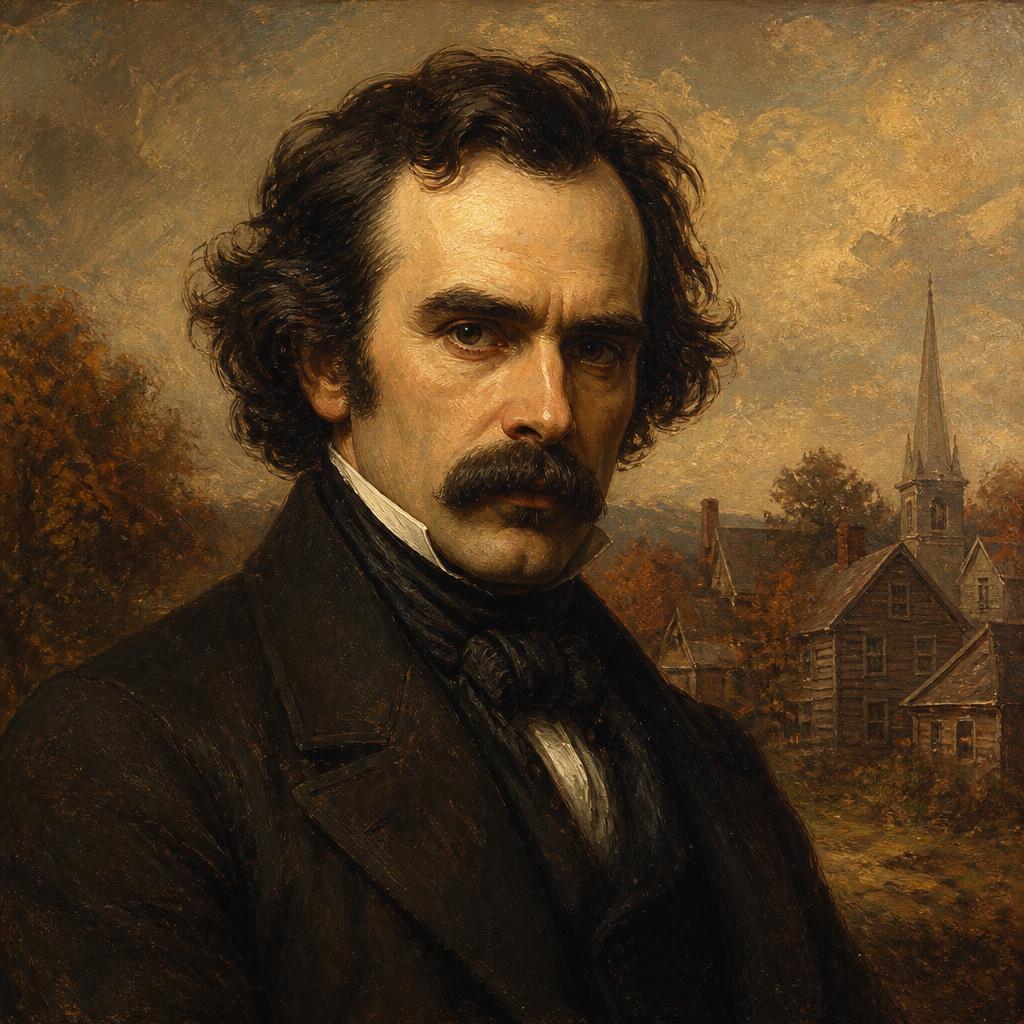
Quick Facts
- Years
- 1804 – 1864
- Category
- Writers & Poets
- Subcategory
- Novelists
- Nationality
- American
- Occupation
- Novelist
Nathaniel Hawthorne
1804 – 1864 · American · Novelist
Audiobook

Life Lessons from Nathaniel Hawthorne
Marcus Alden · 48 min
Nathaniel Hawthorne (1804–1864) was an American novelist and short-story writer whose psychologically complex fiction helped define nineteenth-century American literature. Closely associated with dark romanticism, he examined guilt, secrecy, sin, punishment, moral ambiguity, and the burdens of history. His best-known novel, The Scarlet Letter (1850), transformed a story of adultery and public shame in Puritan New England into a lasting study of identity, social judgment, and private conscience.
Born in Salem, Massachusetts, Hawthorne inherited a family connection to New England’s Puritan past, including the Salem witch trials. That legacy supplied both settings and moral tensions for his fiction. After years of limited recognition, financial uncertainty, and government employment, he achieved international fame through The Scarlet Letter, The House of the Seven Gables, The Blithedale Romance, and The Marble Faun. His shorter works—including “Young Goodman Brown,” “The Minister’s Black Veil,” and “Rappaccini’s Daughter”—remain widely taught.
Hawthorne’s achievement lies not simply in depicting Puritan society but in using symbolism, ambiguity, and romance to investigate universal conflicts. His treatment of women, race, reform, politics, and historical responsibility has also generated sustained debate. He remains important because his fiction asks how individuals live with concealed wrongdoing, inherited injustice, and communities eager to judge them.
Quick Facts
| Field | Information |
|---|---|
| Full Name | Nathaniel Hawthorne; born Nathaniel Hathorne |
| Common Name(s) | Nathaniel Hawthorne |
| Born | July 4, 1804 |
| Died | May 19, 1864 |
| Age at Death | 59 |
| Birthplace | Salem, Massachusetts, United States |
| Nationality | American |
| Occupation | Novelist, short-story writer, essayist, editor, customs official, diplomat |
| Historical Era | Antebellum America; American Renaissance; Civil War era |
| Famous For | The Scarlet Letter and symbolic tales exploring guilt, sin, secrecy, and Puritan history |
| Political Affiliation | Democratic Party; personally loyal to Franklin Pierce |
| Religion | Raised in New England Protestant culture; religious views were private, questioning, and not conventionally doctrinal |
| Education | Bowdoin College, Class of 1825 |
| Parents | Nathaniel Hathorne and Elizabeth Clarke Manning Hathorne |
| Spouse(s) | Sophia Amelia Peabody, married 1842 |
| Children | Una, Julian, and Rose Hawthorne |
| Major Works | Twice-Told Tales, The Scarlet Letter, The House of the Seven Gables, The Blithedale Romance, The Marble Faun, Our Old Home |
| Major Achievements | Central author of the American Renaissance; master of allegorical and psychological romance; enduring influence on American fiction |
Early Life
Nathaniel Hathorne was born in Salem on July 4, 1804. His father, a sea captain of the same name, died of yellow fever in Suriname in 1808. Hawthorne was consequently raised largely within his mother’s Manning family, whose commercial resources provided some security despite the emotional and financial consequences of his father’s death.
His ancestry strongly affected his imagination. William Hathorne, a seventeenth-century magistrate, persecuted Quakers, while William’s son John Hathorne served as a judge during the Salem witch trials and never publicly repented. Nathaniel later inserted a “w” into the family surname. The precise reason is undocumented, although scholars often connect the change with his wish to distinguish himself from his ancestors.
In 1813 Hawthorne injured his foot and spent an extended period recovering. During his confinement he read widely, developing an attachment to works such as John Bunyan’s The Pilgrim’s Progress and the fiction of Sir Walter Scott. He also lived for a time with Manning relatives near Sebago Lake in Maine, whose wooded landscape left a deep impression.
Hawthorne attended Bowdoin College in Brunswick, Maine, from 1821 to 1825. His classmates included future president Franklin Pierce and poet Henry Wadsworth Longfellow; future congressman Horatio Bridge became another lifelong friend. Hawthorne was not an exemplary student by conventional measures, but college gave him important friendships and access to literary culture.
After graduation he returned to Salem and entered a long period of concentrated apprenticeship. Later legend pictured him as almost completely isolated in an upstairs room. He was indeed private and devoted years to writing, but surviving evidence shows that he maintained family and social relationships. His development occurred amid an expanding American print market and a broader effort to create a literature independent of European models.
Rise to Prominence
Hawthorne anonymously published his first novel, Fanshawe, in 1828. Dissatisfied with it, he tried to suppress the book, and it attracted little notice. He then prepared collections titled Seven Tales of My Native Land and Provincial Tales, but publishers did not accept them as planned. Individual stories nevertheless appeared anonymously or pseudonymously in magazines and annual gift books.
These years produced many tales now regarded as classics. Hawthorne drew on colonial history, folklore, scientific speculation, and moral allegory. His narrators often withheld firm conclusions, leaving readers uncertain whether supernatural events were real, imagined, or symbolic.
Horatio Bridge privately guaranteed the publishing costs of Twice-Told Tales in 1837. The collection brought Hawthorne respectful critical attention, though not financial independence. That year he met Sophia Peabody, an artist and member of an intellectually prominent family. Their courtship encouraged him to seek steadier income.
Hawthorne worked at the Boston Custom House from 1839 to 1841. He then invested in Brook Farm, a communal reform experiment, partly hoping it would provide conditions for marriage. Farm labor exhausted him, and he left after several months. He married Sophia in July 1842, and they moved to the Old Manse in Concord, near Ralph Waldo Emerson and other transcendentalists.
Financial need remained persistent. Hawthorne served as surveyor of the Salem Custom House from 1846 until a Whig administration removed him in 1849. His mother died shortly afterward. In this painful period he wrote The Scarlet Letter, published in 1850 with an introductory essay, “The Custom-House.” The novel’s commercial and critical success made him nationally prominent and opened his most productive decade.
Major Achievements
Mastering the American Short Story
Through Twice-Told Tales (1837; expanded 1842) and Mosses from an Old Manse (1846), Hawthorne helped establish short fiction as a serious American art form. Stories such as “Young Goodman Brown” and “The Birth-Mark” unite concise plotting with layered symbols. Their ambiguity invited interpretation rather than delivering simple morals, influencing later writers from Herman Melville to modern psychological fabulists.
Writing The Scarlet Letter
Published in 1850, The Scarlet Letter follows Hester Prynne, Arthur Dimmesdale, and Roger Chillingworth through the consequences of concealed and exposed transgression. Hawthorne called it a “romance,” granting himself freedom to heighten reality through symbolism. The book mattered because it combined historical fiction with psychological analysis and made public punishment inseparable from private guilt. It remains his defining achievement.
Confronting Inherited History
The House of the Seven Gables (1851) presents a family burdened by an injustice committed generations earlier. Hawthorne linked property, class, ancestral wrongdoing, and social change through the decaying Pyncheon mansion. The novel helped make the haunted house a vehicle for historical criticism and advanced a recurring American theme: prosperity may rest on forgotten dispossession.
Transforming Reform Experience into Art
The Blithedale Romance (1852) drew partly on Hawthorne’s Brook Farm experience without serving as a literal record of it. Through an unreliable narrator and the tragic Zenobia, the novel questions reformers’ motives, gender relations, performance, and voyeurism. Its refusal either to celebrate or simply dismiss utopian reform makes it valuable evidence of antebellum intellectual conflict.
Expanding International Reputation
As U.S. consul in Liverpool from 1853 to 1857, Hawthorne observed Britain’s institutions and social divisions. His years abroad contributed to The Marble Faun (1860), set in Italy, and Our Old Home (1863), a collection of writings about England. The Marble Faun became especially influential among American travelers and expatriate writers by linking art, innocence, guilt, and cultural inheritance.
Defining the American Romance
Hawthorne distinguished the romance from the realist novel. He did not ignore reality; rather, he reshaped it so that objects, settings, and coincidences could carry intensified moral meaning. This method gave American writers a flexible form for addressing history and psychology when direct explanation seemed inadequate.
Leadership and Work
Hawthorne was not primarily an institutional leader. His influence arose from artistic discipline, public service, and loyal personal relationships. As a writer, he revised carefully, researched colonial sources, and organized narratives around recurring images rather than exhaustive social description.
His government posts reveal both strengths and limitations. At the Salem Custom House, he performed administrative duties but found bureaucracy creatively stifling. As consul in Liverpool, he handled extensive commercial and diplomatic responsibilities during a demanding period of transatlantic trade. Contemporary evidence indicates that he took the office seriously, although it was also a political appointment obtained through party connections.
Hawthorne valued privacy, loyalty, family security, and independence of imagination. He distrusted mass enthusiasm and often treated reform movements skeptically. This caution sharpened his perception of vanity and coercion but could become detachment from urgent injustice.
His working relationships were usually personal rather than organizational. Horatio Bridge supplied practical support; Sophia provided emotional and intellectual companionship; Franklin Pierce offered political opportunity; publishers James T. Fields and William Ticknor helped manage his career. Hawthorne’s friendship with Herman Melville briefly became an intense literary exchange.
His strengths included symbolic economy, psychological insight, tonal control, and the ability to preserve uncertainty. His weaknesses included political partisanship, uneven portrayals of social groups, and a tendency to translate public conflicts into private moral dramas.
Personal Life
Hawthorne married Sophia Peabody on July 9, 1842. Sophia was an artist, copyist, and writer who suffered recurring health problems. Their surviving correspondence reveals an affectionate marriage, though modern scholars also examine its conventional nineteenth-century assumptions about gender and domestic authority.
The couple had three children: Una, born in 1844; Julian, born in 1846; and Rose, born in 1851. Rose later became a Roman Catholic nun and founded a religious community devoted to caring for impoverished cancer patients.
The family lived in several notable homes, including the Old Manse in Concord, a house in Lenox, Massachusetts, and the Wayside in Concord. In Lenox, Hawthorne befriended Herman Melville, who dedicated Moby-Dick to him. Their closeness diminished after Hawthorne moved away, but the encounter had major literary significance.
Hawthorne was reserved in unfamiliar company yet could be warm and humorous among trusted friends. He enjoyed walking, reading, family excursions, and observing streets, landscapes, and people. His notebooks show an attentive collector of visual details and narrative possibilities.
His health declined during the early 1860s. He lost weight, experienced increasing weakness, and struggled to complete several romances. The exact nature of his final illness remains uncertain. He died in his sleep on May 19, 1864, while traveling in New Hampshire with Franklin Pierce, and was buried at Sleepy Hollow Cemetery in Concord.
Philosophy and Beliefs
Hawthorne’s religious imagination was shaped by Puritan history, biblical language, and Protestant ideas of sin, providence, and confession. Yet his fiction rarely endorses a simple creed. It repeatedly questions whether human beings can accurately judge one another and whether forced confession produces truth or merely spectacle.
He distrusted claims of moral purity. Reformers, ministers, scientists, judges, and idealists in his works may become dangerous when convinced of their own righteousness. At the same time, he did not reject moral responsibility. His characters suffer because actions have consequences, secrets distort relationships, and revenge corrodes the avenger.
Politically, Hawthorne was a Democrat and a committed friend of Franklin Pierce. He wrote Pierce’s 1852 campaign biography and received the Liverpool consulship after Pierce’s election. His partisan loyalty persisted even as the slavery crisis fractured the nation.
Hawthorne’s position on slavery was morally and politically inadequate by abolitionist standards. He was not a proslavery theorist, but neither was he an abolitionist, and he distrusted immediate antislavery activism. His 1862 essay “Chiefly About War-Matters” displayed skepticism toward wartime idealism and included troubling racial assumptions. Scholars continue to debate how his moral imagination could expose inherited guilt so powerfully while responding so cautiously to slavery.
Challenges and Controversies
Hawthorne’s first major obstacle was obscurity. Fanshawe failed, proposed collections collapsed, and magazine publication paid poorly. His slow emergence complicates the romantic image of effortless genius: he spent more than a decade mastering his craft.
“The Custom-House,” the introduction to The Scarlet Letter, satirized former colleagues and helped provoke local resentment. Defenders view it as comic autobiography and criticism of patronage; critics see personal retaliation and unflattering caricature.
His relationship to transcendentalism and reform was ambivalent. Hawthorne admired individuals such as Emerson but resisted systematic optimism. Some readers value his exposure of self-deception in idealistic communities. Others argue that his skepticism encouraged political passivity.
His Democratic allegiance is more controversial. The campaign biography of Pierce emphasized friendship and party loyalty. Pierce’s administration became associated with policies that deepened sectional conflict, especially the Kansas–Nebraska Act. Hawthorne did not publicly repudiate him.
Representations of women also divide critics. Hester Prynne and Zenobia are forceful, memorable characters constrained by patriarchal societies. Their depth has inspired feminist interpretation. Yet both narratives are controlled by male authors or narrators, and female independence is often linked with suffering or death.
His treatment of Indigenous peoples and race reflects nineteenth-century stereotypes in places. Modern scholarship examines these limitations alongside his critique of Puritan conquest and ancestral wrongdoing. A balanced assessment recognizes both the radical interpretive possibilities of his symbolism and the boundaries of his historical perspective.
Legacy
Hawthorne became a central figure in the American Renaissance, alongside Melville, Emerson, Henry David Thoreau, Walt Whitman, and Edgar Allan Poe. His symbolic narratives shaped later American treatments of guilt, family secrets, unreliable perception, and haunted history. Writers as different as Henry James, William Faulkner, Shirley Jackson, and Toni Morrison have worked within territories his fiction helped map, although often while revising his assumptions.
The Scarlet Letter remains a staple of secondary and university education. Its continuing relevance rests on questions of sexual double standards, public shaming, surveillance, identity, and resistance to imposed labels. Scholars also study how its nineteenth-century portrayal of the seventeenth century reflects Hawthorne’s own era.
Major sites preserve his memory. The House of the Seven Gables in Salem operates as a historic-site museum. The Old Manse and the Wayside in Concord are preserved for visitors, while his birthplace was moved to the House of the Seven Gables campus. His grave lies on Authors’ Ridge at Sleepy Hollow Cemetery.
Hawthorne’s reputation is no longer based on uncritical celebration. Current scholarship investigates his politics, race, gender, archival practices, and international experience. That critical scrutiny sustains rather than diminishes his importance: his works remain productive because their moral questions resist closure.
Interesting Facts
- Hawthorne was born on Independence Day, July 4, 1804.
- His surname was originally spelled “Hathorne.”
- His ancestor John Hathorne was a Salem witch-trial judge.
- His sea-captain father died when Nathaniel was four.
- Franklin Pierce and Henry Wadsworth Longfellow were his Bowdoin classmates.
- He anonymously published Fanshawe and later tried to suppress it.
- Horatio Bridge guaranteed the expenses of Twice-Told Tales.
- Hawthorne briefly joined the Brook Farm community.
- He wrote part of his early married work at Concord’s Old Manse.
- The Salem Custom House inspired the introduction to The Scarlet Letter.
- He consistently described several major books as “romances.”
- Herman Melville dedicated Moby-Dick to Hawthorne.
- Hawthorne wrote a presidential campaign biography of Franklin Pierce.
- He served four years as U.S. consul in Liverpool.
- He lived with his family in England, France, and Italy.
- His daughter Rose founded a Catholic nursing order.
- He died while traveling with Pierce in New Hampshire.
- He is buried near Emerson and Thoreau on Authors’ Ridge.
Famous Quotes
- “The scarlet letter had not done its office.” — The Scarlet Letter, Chapter 24. The line rejects the assumption that punishment automatically reforms or defines a person.
- “No man, for any considerable period, can wear one face to himself, and another to the multitude, without finally getting bewildered as to which may be the true.” — The Scarlet Letter, Chapter 20. It summarizes Hawthorne’s concern with divided identity.
- “Be true! Be true! Be true!” — The Scarlet Letter, Chapter 24. The narrator draws an ethical warning from Dimmesdale’s concealed life.
- “The past is but a coarse and sensual prophecy of the present and the future.” — The House of the Seven Gables, Chapter 12. The statement emphasizes history’s continuing, though imperfect, hold.
- “Shall we never, never get rid of this Past?” — The House of the Seven Gables, Chapter 17. Holgrave asks whether inherited structures can be escaped.
- “When an uninstructed multitude attempts to see with its eyes, it is exceedingly apt to be deceived.” — “The Minister’s Black Veil.” The remark warns against collective certainty based on appearances.
- “There is no good on earth; and sin is but a name.” — “Young Goodman Brown.” Brown’s despair illustrates how suspicion can destroy trust, not necessarily the author’s own doctrine.
- “My faith is gone!” — “Young Goodman Brown.” The cry refers both to Brown’s wife, Faith, and to his collapsing spiritual confidence.
- “The artist must create the beautiful; the critic must recognize it.” — “The Artist of the Beautiful.” It defends imaginative creation against utilitarian judgment.
- “Easy reading is damn hard writing.” — Frequently attributed to Hawthorne, but the exact wording and source are disputed; it should not be treated as securely documented.
Timeline
- 1804 — Born in Salem, Massachusetts, on July 4.
- 1808 — His father dies of yellow fever in Suriname.
- 1813 — Suffers a foot injury and spends a long period reading during recovery.
- 1816 — Lives for a time near Sebago Lake, Maine.
- 1821 — Enters Bowdoin College.
- 1825 — Graduates from Bowdoin and returns to Salem.
- 1828 — Publishes Fanshawe anonymously.
- 1837 — Publishes Twice-Told Tales and meets Sophia Peabody.
- 1839 — Begins work at the Boston Custom House.
- 1841 — Joins Brook Farm briefly.
- 1842 — Marries Sophia Peabody; moves to the Old Manse; expanded Twice-Told Tales appears.
- 1844 — Daughter Una is born.
- 1846 — Publishes Mosses from an Old Manse; becomes surveyor at Salem Custom House; son Julian is born.
- 1849 — Loses his customs position; his mother dies.
- 1850 — Publishes The Scarlet Letter; moves to Lenox.
- 1851 — Publishes The House of the Seven Gables; daughter Rose is born.
- 1852 — Publishes The Blithedale Romance and The Life of Franklin Pierce; purchases the Wayside.
- 1853 — Becomes U.S. consul in Liverpool.
- 1857 — Leaves the consulship and travels in Europe.
- 1860 — Publishes The Marble Faun and returns to the United States.
- 1862 — Publishes “Chiefly About War-Matters.”
- 1863 — Publishes Our Old Home.
- 1864 — Dies on May 19 in Plymouth, New Hampshire; buried in Concord.
Frequently Asked Questions
Who was Nathaniel Hawthorne?
Nathaniel Hawthorne was an American novelist and short-story writer associated with the American Renaissance and dark romanticism. He used colonial New England, family history, allegory, and psychological conflict to examine guilt, secrecy, judgment, and inherited wrongdoing. His principal novels are The Scarlet Letter, The House of the Seven Gables, The Blithedale Romance, and The Marble Faun. He also held customs and diplomatic posts through his connections with the Democratic Party.
What is Nathaniel Hawthorne best known for?
He is best known for The Scarlet Letter (1850), a historical romance about Hester Prynne, who is condemned to wear an embroidered “A” after bearing a child outside marriage. The novel’s power comes from its layered symbolism and its contrasting treatments of public shame, concealed guilt, revenge, and resilience. Hawthorne is also celebrated for short stories such as “Young Goodman Brown,” “The Minister’s Black Veil,” and “The Birth-Mark.”
Why did Hawthorne change the spelling of his surname?
He was born Nathaniel Hathorne but added a “w” as a young man. No surviving statement conclusively explains why. A common scholarly suggestion is that he wished to distinguish himself from ancestors such as John Hathorne, a judge in the Salem witch trials. That interpretation is plausible because ancestral guilt became central to his writing, but it should not be presented as a documented confession of motive.
Was Nathaniel Hawthorne descended from a Salem witch-trial judge?
Yes. John Hathorne, Hawthorne’s great-great-grandfather, was one of the magistrates involved in the 1692 Salem witch trials. Unlike fellow judge Samuel Sewall, John Hathorne left no public apology. Hawthorne referred to troubling aspects of his ancestry in “The Custom-House.” Scholars frequently connect this history with his recurring interest in inherited guilt, although literary themes cannot be reduced to ancestry alone.
What literary movement did Hawthorne belong to?
Hawthorne is commonly placed within the American Renaissance and described as a dark romantic. Dark romantic writers questioned human perfectibility and emphasized sin, obsession, uncertainty, and destructive impulses. Hawthorne knew transcendentalists such as Emerson and Thoreau but did not share their confidence in intuition and progress. His fiction tests idealistic projects by showing how egotism and concealed motives can corrupt them.
Is The Scarlet Letter historically accurate?
The novel uses genuine features of Puritan New England, including religious discipline, public punishment, and close links between church and civil authority. However, it is a nineteenth-century romance, not a documentary reconstruction. Hawthorne altered and heightened history for symbolic purposes. Hester Prynne is fictional, and the embroidered letter should not automatically be taken as proof of a universal historical practice. The book reveals as much about 1850 as about the seventeenth century.
Why did Hawthorne call his books “romances”?
For Hawthorne, romance allowed greater imaginative freedom than the conventional realist novel. In his prefaces, he suggested that romance could mingle the familiar with the marvelous and intensify selected elements of reality. This form supported ambiguous supernatural events, symbolic objects, unlikely coincidences, and psychologically charged settings. Calling the works romances did not mean that they were primarily love stories; it identified their artistic method.
Did Hawthorne live at Brook Farm?
Yes, but only briefly in 1841. Brook Farm was a communal experiment in Massachusetts associated with educational and transcendentalist reform. Hawthorne invested money and performed demanding farm labor, hoping in part to establish financial conditions for marriage. He became disillusioned and left. His later Blithedale Romance drew on the experience, but its characters and events should not be read as straightforward portraits or factual history.
What was Hawthorne’s relationship with Herman Melville?
The writers met in 1850 while living in western Massachusetts. Melville admired Hawthorne intensely and discussed his moral darkness in the essay “Hawthorne and His Mosses.” He dedicated Moby-Dick to Hawthorne “in token of my admiration for his genius.” Their friendship included visits and correspondence, but its most intense phase was brief. Scholars debate its emotional dimensions, while agreeing that Hawthorne influenced Melville’s developing masterpiece.
What government jobs did Hawthorne hold?
Hawthorne worked at the Boston Custom House, served as surveyor of the port at Salem, and later became U.S. consul in Liverpool. These positions brought financial stability but depended substantially on Democratic patronage. Losing the Salem post in 1849 contributed to the circumstances in which he wrote The Scarlet Letter. The Liverpool consulship was a demanding and valuable appointment secured after Franklin Pierce became president.
What were Hawthorne’s views on slavery?
Hawthorne was not an abolitionist and distrusted radical reform movements. Although his fiction powerfully examines oppression and inherited guilt, his public responses to slavery and the Civil War were cautious and sometimes racially prejudiced. He remained loyal to Franklin Pierce, whose politics angered many antislavery Northerners. Scholars interpret this tension differently, but there is broad agreement that Hawthorne’s political position fell short of contemporary abolitionist moral arguments.
Was Hester Prynne based on a real person?
No specific historical woman has been conclusively identified as Hester’s model. Hawthorne studied New England history and may have drawn on multiple accounts of punishment, religious dissent, and female nonconformity. The character is fundamentally a fictional creation. Claims linking her directly to one individual should therefore be treated cautiously unless supported by strong documentary evidence.
What is “Young Goodman Brown” about?
The story follows a young Puritan who enters a forest and apparently witnesses respected members of his community participating in a demonic ceremony. Hawthorne never settles whether the experience is supernatural reality, dream, hallucination, or temptation. Brown thereafter becomes suspicious and emotionally isolated. The tale explores lost faith, projection, hypocrisy, and the destructive effects of believing that hidden evil invalidates every human relationship.
Why is The House of the Seven Gables important?
The novel turns a cursed Salem mansion into a symbol of inherited injustice. A prosperous family’s status originates in the wrongful seizure of another man’s property, and later generations remain trapped by that act. By connecting architecture, property, class, and memory, Hawthorne created a major American meditation on how the past inhabits the present. The book also influenced later traditions of Gothic and haunted-house fiction.
How did Hawthorne die?
Hawthorne’s health deteriorated during the early 1860s, when he became thin and weak and found sustained writing difficult. While traveling through New Hampshire with former president Franklin Pierce, he died in his sleep at Plymouth on May 19, 1864. He was 59. The precise medical cause is not securely established in surviving records, so confident modern diagnoses are speculative.
Where is Nathaniel Hawthorne buried?
He is buried on Authors’ Ridge in Sleepy Hollow Cemetery, Concord, Massachusetts. The area also contains the graves of Ralph Waldo Emerson, Henry David Thoreau, Louisa May Alcott, and members of their families. Hawthorne’s funeral was attended by prominent literary figures. The site has become an important destination in the literary geography of Concord.
Lessons We Can Learn
- Mastery may require long obscurity. Hawthorne spent years publishing anonymously before succeeding; sustained practice can precede recognition.
- History remains active. The Pyncheon family’s inherited injustice shows why societies must investigate the origins of present privilege.
- Public labels do not define a whole person. Hester transforms the meaning of her scarlet letter through conduct and resilience.
- Concealment carries costs. Dimmesdale’s divided existence demonstrates how secrecy can damage health, identity, and relationships.
- Self-righteousness is dangerous. Hawthorne’s judges, reformers, and experimenters often harm others when they claim moral certainty.
- Revenge deforms the avenger. Chillingworth’s fixation makes retaliation his identity, warning against allowing injury to govern a life.
- Idealism needs self-criticism. Brook Farm and The Blithedale Romance show that noble projects can reproduce ego and inequality.
- Friendships can change careers. Bridge, Pierce, Melville, and Fields each affected Hawthorne’s opportunities; creative work is rarely wholly solitary.
- Ambiguity can deepen understanding. Hawthorne’s refusal to explain every mystery encourages readers to test competing interpretations.
- Artistic insight does not guarantee political courage. His weak response to slavery reminds modern readers to examine the gap between moral imagination and public action.
Related Historical Figures
- Sophia Peabody Hawthorne — His wife, an artist and intellectual partner whose marriage and travels shaped his domestic and creative life.
- Franklin Pierce — Bowdoin friend, Democratic president, and political patron; Hawthorne wrote his campaign biography.
- Herman Melville — Friend and admirer who dedicated Moby-Dick to Hawthorne.
- Henry Wadsworth Longfellow — Bowdoin classmate and fellow major American author.
- Horatio Bridge — Lifelong friend whose financial guarantee enabled Twice-Told Tales to appear.
- Ralph Waldo Emerson — Concord neighbor and transcendentalist whose optimism contrasted with Hawthorne’s skepticism.
- Henry David Thoreau — Concord contemporary who helped the Hawthorne family settle into the Old Manse and shared local intellectual circles.
- Margaret Fuller — Transcendentalist writer often discussed in relation to Zenobia in The Blithedale Romance, though direct identification is disputed.
- Edgar Allan Poe — Contemporary critic and short-story theorist who reviewed Hawthorne, praising his talent while criticizing allegorical excess.
- Elizabeth Peabody — Hawthorne’s sister-in-law, educator, publisher, and reformer who helped connect him to transcendentalist circles.
Related Historical Figures