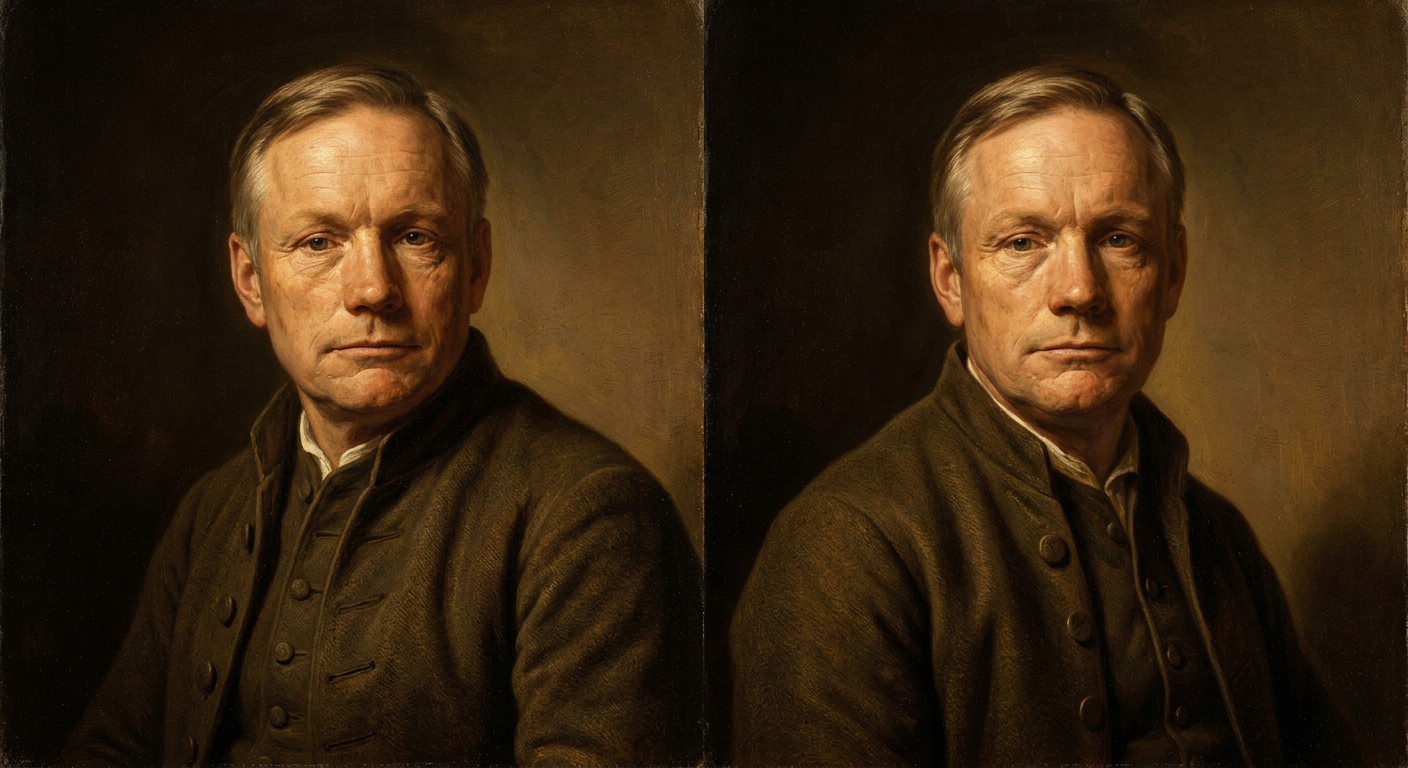
Quick Facts
- Years
- 1930 – 2012
- Category
- Explorers & Adventurers
- Nationality
- American
- Occupation
- Astronaut, aeronautical engineer, naval aviator, test pilot, and university professor
Neil Armstrong
1930 – 2012 · American · Astronaut, aeronautical engineer, naval aviator, test pilot, and university professor
Recommended Audiobooks
Listen next from Marcus Alden

Life Lessons from Christopher Columbus
Marcus Alden

Life Lessons from Sir Francis Drake
Marcus Alden
Neil Armstrong became one of history's most recognizable explorers by taking a single step onto the Moon. On July 20, 1969—July 21 in Coordinated Universal Time—he climbed down the ladder of the Apollo 11 lunar module and became the first human to stand on another world. His words, "That's one small step for [a] man, one giant leap for mankind," expressed both the personal scale of the moment and its significance for humanity.
Yet Armstrong's life was far larger than those few hours on the lunar surface. He was a Korean War naval aviator, an aeronautical engineer, an exceptionally skilled test pilot, commander of the dangerously troubled Gemini 8 mission, a NASA administrator, and a university professor. His success resulted not from reckless daring but from preparation, technical discipline, teamwork, and unusual calm under pressure.
Armstrong also resisted attempts to turn him into a larger-than-life celebrity. He repeatedly emphasized that Apollo 11 was the achievement of hundreds of thousands of people rather than three astronauts alone. His reserved public manner helped shape the ideal of the astronaut-engineer: capable, evidence-minded, and focused on the mission rather than personal fame. People continue to study Armstrong because his career illuminates the Cold War space race, the risks of experimental flight, and the combination of individual judgment and collective effort required to turn an ancient dream into a historical event.
Quick Facts
| Field | Details |
|---|---|
| Full Name | Neil Alden Armstrong |
| Common Name(s) | Neil Armstrong |
| Born | August 5, 1930 |
| Died | August 25, 2012 |
| Age at Death | 82 |
| Birthplace | Near Wapakoneta, Ohio, United States |
| Nationality | American |
| Occupation | Naval aviator, aeronautical engineer, test pilot, astronaut, administrator, professor |
| Historical Era | Cold War and Space Age |
| Famous For | Commanding Apollo 11 and becoming the first person to walk on the Moon |
| Political Affiliation | Not a political officeholder; generally private about partisan politics |
| Religion | Raised Methodist; later accounts describe his beliefs as private and broadly deistic rather than conventionally observant |
| Education | Purdue University, BS in Aeronautical Engineering; University of Southern California, MS in Aerospace Engineering |
| Parents | Stephen Koenig Armstrong and Viola Louise Engel Armstrong |
| Spouse(s) | Janet Shearon, married 1956–1994; Carol Held Knight, married 1994–2012 |
| Children | Eric, Karen, and Mark Armstrong; Karen died in early childhood |
| Major Works | Experimental-flight research, Gemini and Apollo mission work, university teaching, technical and policy service |
| Major Achievements | First person on the Moon; commander of Apollo 11; commander of Gemini 8; first docking of two spacecraft in orbit |
Early Life
Neil Alden Armstrong was born on August 5, 1930, on his grandparents' farm near Wapakoneta, Ohio. His father, Stephen, worked as an auditor for the state of Ohio, while his mother, Viola, managed the household and encouraged her children's education. Neil had a younger sister, June, and a younger brother, Dean.
Because Stephen Armstrong's job required travel, the family moved repeatedly before settling in Wapakoneta. Neil encountered aviation at an early age. When he was about six, his father took him for his first airplane ride in a Ford Trimotor, a corrugated-metal passenger aircraft popularly known as the Tin Goose. Model airplanes, books, music, and mechanical projects became important childhood interests.
Armstrong joined the Boy Scouts and eventually achieved the rank of Eagle Scout. He also played the baritone horn and participated in school musical activities. These interests complicate the later image of him as solely a quiet technician: he was reserved, but not detached from community life.
Determined to fly, Armstrong took lessons at a small airfield near Wapakoneta. He earned a student pilot certificate at sixteen, before he received an automobile driver's license. Flying lessons were expensive, so he worked at local jobs to help pay for them.
In 1947, Armstrong entered Purdue University to study aeronautical engineering. He attended under the Holloway Plan, a US Navy scholarship program that combined university study with naval service. After two years at Purdue, the Navy called him to active duty for flight training.
The historical setting mattered. Aviation technology had advanced rapidly during the Second World War, jet aircraft were replacing propeller-driven fighters, and the United States was investing heavily in military and scientific research. Armstrong entered adulthood just as flying was expanding beyond conventional limits toward supersonic speeds, high altitudes, and eventually space.
Rise to Prominence
Armstrong qualified as a naval aviator in 1950 and joined Fighter Squadron 51. During the Korean War, he flew Grumman F9F Panther jets from the aircraft carrier USS Essex. He completed 78 combat missions.
On September 3, 1951, his aircraft was damaged during a low-level bombing mission. Part of one wing was torn away after striking a cable or obstruction. Armstrong kept the damaged jet under control long enough to reach friendly territory, then ejected safely. The episode demonstrated a trait that would define his career: he reacted to emergencies by working through the available options rather than surrendering to panic.
After active service, Armstrong returned to Purdue and completed his bachelor's degree in 1955. He then joined the National Advisory Committee for Aeronautics, NASA's predecessor. After an initial assignment in Ohio, he moved to the High-Speed Flight Station at Edwards Air Force Base in California.
At Edwards, Armstrong became a research test pilot. He flew more than 200 types or variants of aircraft, including bombers, fighters, helicopters, gliders, and experimental machines. Most famously, he piloted the rocket-powered North American X-15, which explored the edges of the atmosphere at extreme speed and altitude.
Test flying was dangerous, but Armstrong did not fit the stereotype of the impulsive daredevil. Colleagues knew him as an analytical engineer who happened to be an excellent pilot. He studied systems carefully, reported technical details precisely, and treated unusual situations as engineering problems.
NASA selected Armstrong for its second astronaut group in September 1962. He was one of the first civilian test pilots admitted to the astronaut corps. His breakthrough assignment came with Gemini 8, launched on March 16, 1966. Armstrong commanded the spacecraft with David Scott as pilot.
Gemini 8 successfully completed the first docking of two vehicles in orbit. Soon afterward, however, the joined spacecraft began rolling. Armstrong and Scott initially believed the target vehicle was responsible and undocked, only to find that their own spacecraft rolled even faster. A stuck thruster was the cause. Armstrong shut down the main control system and used the reentry thrusters to stop the rotation, which had approached a rate that threatened unconsciousness or death. Mission rules required an immediate return to Earth.
Although the planned mission ended early, the emergency strengthened Armstrong's reputation. His composure and technical judgment helped place him among the leading candidates for an Apollo command.
Major Achievements
First orbital docking
Gemini 8's docking with an Agena target vehicle was a fundamental step toward reaching the Moon. Apollo's mission plan required spacecraft to meet, maneuver, and dock in orbit. Armstrong and Scott proved that such a connection was possible, even though the subsequent thruster failure forced an early landing.
The incident also produced valuable lessons about spacecraft controls and emergency diagnosis. Its long-term importance lies not only in the docking itself but in demonstrating how astronauts and ground controllers could respond when a complex system behaved unexpectedly.
Command of Apollo 11
NASA announced the Apollo 11 crew in January 1969: Armstrong as commander, Edwin “Buzz” Aldrin as lunar module pilot, and Michael Collins as command module pilot. The mission launched from Kennedy Space Center on July 16 aboard a Saturn V rocket.
Armstrong and Aldrin entered the lunar module Eagle, while Collins remained aboard the command module Columbia. During the descent on July 20, the crew encountered computer alarms. Mission control determined that the computer was overloaded but still performing essential tasks, allowing the landing to continue.
Near the surface, Armstrong saw that the automatic guidance system was taking Eagle toward a hazardous area containing rocks and a crater. He took semi-manual control, flew beyond the danger, and landed in the Sea of Tranquility with little fuel remaining. Exact estimates of the reserve vary according to how it is calculated, but there was clearly limited time for further maneuvering.
Armstrong reported, “Houston, Tranquility Base here. The Eagle has landed.” The landing fulfilled President John F. Kennedy's 1961 goal of landing a person on the Moon and returning safely before the decade ended.
First human step on the Moon
Armstrong stepped onto the lunar surface at 02:56 UTC on July 21, 1969. His prepared statement was heard as “That's one small step for man, one giant leap for mankind.” Armstrong maintained that he intended to say “for a man,” creating a contrast between one individual and humanity. Audio analysis has not produced universal agreement over whether the missing article was spoken but lost in transmission. Most modern quotations place the “a” in brackets.
Armstrong and Aldrin spent about two and a half hours outside Eagle. They collected rock and soil samples, photographed the landscape, deployed scientific experiments, raised the American flag, and unveiled a plaque stating that humans had come “in peace for all mankind.” Collins continued orbiting above, performing essential navigation and spacecraft duties.
The achievement mattered scientifically, technologically, and politically. It returned samples that transformed knowledge of lunar history, demonstrated extraordinary engineering capability, and gave the United States a decisive symbolic victory in the space race. At the same time, the astronauts framed the landing as an achievement for all humanity.
Safe return and public service
Apollo 11 left lunar orbit, returned to Earth, and splashed down in the Pacific Ocean on July 24. Because scientists could not yet rule out harmful lunar organisms, the crew spent time in quarantine. They later toured the world as representatives of the United States and the space program.
Armstrong left NASA in 1971 and joined the University of Cincinnati as a professor of aerospace engineering. He taught until 1979, valuing the university's relatively small engineering department and its emphasis on teaching. He later served on corporate boards and public commissions.
After the 1986 Challenger disaster, Armstrong became vice chairman of the presidential commission investigating the accident. His participation extended his influence beyond Apollo by helping examine institutional decision-making, technical warnings, and responsibility within NASA and its contractors.
Leadership or Work
Armstrong's leadership was quiet, procedural, and strongly rooted in engineering. He rarely dominated discussions merely to display authority. Instead, he listened, studied the evidence, and expected colleagues to understand their systems.
His working principles included:
- Preparation before improvisation: His emergency responses rested on extensive training.
- Calm communication: During Gemini 8 and Apollo 11, he transmitted essential information without dramatizing danger.
- Mission over celebrity: He credited technicians, controllers, scientists, and fellow astronauts.
- Technical precision: He wanted decisions grounded in measurable conditions rather than personal confidence alone.
- Acceptance of responsibility: As commander, he understood that final decisions could fall to him.
This style had limitations. His reserve could make him seem distant, and he was not a naturally expansive public communicator. Yet the same emotional restraint was valuable in experimental aircraft and spacecraft, where distraction or panic could be fatal.
Armstrong's relationships with Aldrin and Collins were professional rather than uniformly intimate. Differences in personality sometimes generated later discussion, especially because Aldrin was more openly ambitious and public-facing. Nevertheless, there is no sound evidence that personal rivalry prevented the crew from functioning effectively.
Personal Life
Armstrong married Janet Shearon in 1956. They had three children: Eric, Karen, and Mark. Their daughter Karen developed a brain tumor and died in 1962, shortly before her third birthday. Armstrong rarely discussed the loss publicly. Biographers differ in how much it affected his later behavior, and claims that it directly motivated his space career go beyond the available evidence.
The Armstrong household experienced the pressures common to astronaut families: long absences, dangerous work, intense training, and public attention. Neil and Janet divorced in 1994. Later that year he married Carol Held Knight, with whom he remained until his death.
Away from work, Armstrong enjoyed music, aviation, farming, and practical mechanical tasks. He generally protected his privacy, but the popular claim that he became a complete recluse is misleading. He gave selected speeches, served on commissions and boards, attended important commemorations, and participated in educational activities. What he resisted was constant celebrity exposure.
Armstrong underwent heart surgery in August 2012. He died on August 25 from complications following the procedure. In 2019, reporting revealed that his family had reached a confidential settlement with the hospital after raising concerns about his post-operative care. The settlement did not amount to a public judicial finding of negligence.
Philosophy or Beliefs
Armstrong avoided presenting himself as a political or spiritual spokesman. He was raised in a Methodist environment, but later descriptions commonly characterize his outlook as private and deistic: accepting a creator or ordering principle without emphasizing formal doctrine. Because Armstrong spoke little publicly about religion, categorical claims should be treated cautiously.
Ethically, his conduct reflected responsibility, competence, modesty, and service. He believed exploration arose from humanity's impulse to confront difficult frontiers. Yet he did not treat risk as valuable by itself. In his professional worldview, risk had to serve a meaningful objective and be reduced through knowledge, design, rehearsal, and teamwork.
Politically, Armstrong generally remained outside partisan campaigning. He defended human spaceflight and criticized major policy decisions when he believed they threatened American capabilities. His congressional testimony concerning space policy was technical and strategic rather than a broad declaration of party loyalty.
His insistence that Apollo belonged to a vast workforce also shaped the mission's meaning. Although the landing occurred amid Cold War rivalry, Armstrong publicly emphasized human achievement and peaceful exploration.
Challenges and Controversies
Mortal risk and mission failures
Armstrong survived several serious incidents. Besides his Korean War ejection and Gemini 8 emergency, he ejected from a Lunar Landing Research Vehicle in May 1968 when the craft lost control. He parachuted safely and returned to office work with little ceremony. These events show that Apollo's success emerged from a program in which equipment failures and death were real possibilities.
Who would step out first?
Some accounts have framed Armstrong's first step as the result of personal competition with Aldrin. NASA's stated reasoning emphasized cabin layout, operational simplicity, and Armstrong's position as commander. Personality and institutional preference may also have influenced planning, but evidence does not support sensational stories of a last-minute struggle for the honor.
The missing “a”
Armstrong said he intended the phrase to be “one small step for a man.” The transmission was heard without the article. Researchers have studied the recording and Armstrong's speech patterns, but there is no universally accepted conclusion. The uncertainty changes the grammar, not the historical importance of the statement.
National symbol or human achievement?
Apollo 11 was undeniably a major American Cold War success. Critics have argued that its enormous expense should have been directed toward social problems on Earth. Supporters answer that the program accelerated technology, science, education, and national confidence. Armstrong himself emphasized peaceful human exploration while accepting his role as an American representative.
Privacy and commercial use
Armstrong guarded his name and image. In 2005, he sued a barber who had sold his hair to a collector without permission; the dispute was settled, and the hair was not commercially exploited further. Some observers found his privacy unusually strict, while others regarded it as a reasonable response to relentless public interest.
Moon-landing conspiracy theories also attached themselves to Armstrong. These claims are false. Lunar samples, independent tracking, mission telemetry, photographs, retroreflectors still used for laser ranging, and later images of the landing sites provide extensive evidence that Apollo 11 landed on the Moon.
Legacy
Neil Armstrong's legacy operates on several levels. To the public, he represents the moment humanity first reached another celestial body. To engineers and pilots, he exemplifies disciplined judgment under pressure. To historians, his career provides a window into military aviation, Cold War competition, federal research, and the culture of NASA.
The Apollo 11 landing inspired generations of scientists, astronauts, teachers, artists, and students. Later lunar programs—including NASA's Artemis initiative—are routinely understood as extensions of the path opened by Apollo.
His name appears on schools, roads, aerospace facilities, awards, and landmarks. The Armstrong Air & Space Museum in Wapakoneta preserves artifacts connected with his life and Ohio's aviation heritage. NASA's Neil A. Armstrong Flight Research Center in California, formerly the Dryden Flight Research Center, honors his test-flying career. Purdue University commemorates him through Armstrong Hall of Engineering and its aerospace traditions.
Armstrong and the Apollo 11 crew received numerous honors, including the Presidential Medal of Freedom, the Congressional Space Medal of Honor, and the Congressional Gold Medal. Memorial services after his death celebrated not just the first step but his lifelong commitment to engineering and education.
His most durable influence may be his refusal to describe exploration as an individual performance. The footprints belonged to two astronauts, but the achievement depended on hundreds of thousands of people. That balance between individual responsibility and collective expertise remains relevant to complex projects today.
Interesting Facts
- Armstrong earned a student pilot certificate before obtaining a driver's license.
- He became an Eagle Scout and later greeted Scouts from the Moon.
- He flew 78 combat missions during the Korean War.
- He had to eject from a damaged jet during that conflict.
- He played the baritone horn and participated in musical groups.
- Armstrong flew more than 200 aircraft types or variants during his career.
- He made seven flights in the rocket-powered X-15.
- He was among NASA's first civilian astronaut selections.
- Gemini 8 achieved history's first docking between two spacecraft in orbit.
- Its stuck thruster caused the spacecraft to rotate dangerously fast.
- Armstrong ejected from a lunar-landing training vehicle in 1968 and escaped with seconds to spare.
- Apollo 11's computer alarms did not mean the computer had completely failed; it was shedding lower-priority tasks.
- He carried a piece of wood and fabric associated with the Wright brothers' 1903 Flyer to the Moon.
- His first lunar task was collecting a small emergency sample in case the moonwalk ended suddenly.
- Apollo 11 left medals commemorating Soviet cosmonauts Yuri Gagarin and Vladimir Komarov on the Moon.
- Armstrong spent approximately two hours and thirty minutes outside the lunar module.
- He later taught aerospace engineering rather than pursuing elected office or entertainment fame.
- He disliked signing autographs after discovering that many were immediately resold.
- He lived for more than four decades after Apollo 11.
- His family suggested honoring him by looking at the Moon and giving him a wink.
Famous Quotes
- “Houston, Tranquility Base here. The Eagle has landed.” — Armstrong's report after the Apollo 11 landing. Its controlled wording concealed the difficulty of the final descent.
- “That's one small step for [a] man, one giant leap for mankind.” — Spoken while stepping onto the Moon. Armstrong said he intended the bracketed article; whether it is faintly present in the transmission remains disputed.
- “The Eagle has wings.” — Said after the lunar module separated from Columbia, marking the start of the landing phase.
- “It has a stark beauty all its own.” — Armstrong's description of the lunar landscape during the mission, emphasizing its unfamiliar but compelling appearance.
- “We came in peace for all mankind.” — His reading of the central message on the plaque attached to Eagle's descent stage.
- “Pilots take no special joy in walking. Pilots like flying.” — A characteristically dry remark associated with Armstrong's identity as an aviator.
- “I am, and ever will be, a white-socks, pocket-protector, nerdy engineer.” — Spoken at the National Press Club in 2000, expressing pride in engineering rather than celebrity.
- “I think we're going to the Moon because it's in the nature of the human being to face challenges.” — From the Apollo era, connecting exploration with a broader human impulse.
- “The important achievement of Apollo was demonstrating that humanity is not forever chained to this planet.” — A later reflection on Apollo's meaning beyond short-term geopolitical competition.
- “Science has not yet mastered prophecy.” — Armstrong used this observation when discussing uncertain predictions; versions circulate with varying punctuation, so exact presentation differs among sources.
Timeline
- 1930 — Born near Wapakoneta, Ohio, on August 5.
- 1946 — Earned a student pilot certificate at age sixteen.
- 1947 — Entered Purdue University under the Navy's Holloway Plan.
- 1949 — Began active naval flight training.
- 1950 — Qualified as a naval aviator.
- 1951 — Flew combat missions in Korea and ejected from a damaged Panther jet.
- 1952 — Left active duty and resumed university study.
- 1955 — Graduated from Purdue and joined the NACA.
- 1956 — Married Janet Shearon.
- 1957 — Began flying experimental aircraft at Edwards, including later X-15 missions.
- 1962 — Daughter Karen died; Armstrong was selected as a NASA astronaut.
- 1966 — Commanded Gemini 8, completing the first orbital docking and surviving a thruster emergency.
- 1968 — Ejected safely from a failing lunar-landing training vehicle.
- 1969 — Commanded Apollo 11 and became the first person to walk on the Moon.
- 1970 — Completed a master's degree at the University of Southern California.
- 1971 — Left NASA and joined the University of Cincinnati faculty.
- 1979 — Ended his full-time university teaching career.
- 1986 — Served as vice chairman of the commission investigating the Challenger disaster.
- 1994 — Divorced Janet Shearon and married Carol Held Knight.
- 2000 — Publicly celebrated his engineering identity in a National Press Club address.
- 2011 — Received the Congressional Gold Medal with fellow Apollo pioneers.
- 2012 — Died on August 25 following complications from heart surgery.
- 2014 — NASA renamed its California flight-research center in his honor.
Frequently Asked Questions
1. Why was Neil Armstrong chosen to be the first person on the Moon?
Armstrong commanded Apollo 11 and occupied the position nearest the lunar module's hatch, making his exit operationally simpler than Aldrin's. NASA also followed a developing practice in which the commander performed the first surface activity. His technical experience, calm decision-making, and lack of interest in exploiting the honor personally made him a suitable representative. Claims that the choice resulted entirely from personal rivalry or favoritism oversimplify a decision shaped by spacecraft design, command responsibility, and institutional judgment.
2. When did Neil Armstrong walk on the Moon?
Armstrong stepped onto the Moon at 02:56 UTC on July 21, 1969. In the United States, where the mission was controlled and widely watched, it was still the evening of July 20. This difference explains why both dates sometimes appear. Apollo 11 had landed several hours earlier, at 20:17 UTC on July 20, in the Sea of Tranquility.
3. What exactly did Armstrong say?
The worldwide audience heard, “That's one small step for man, one giant leap for mankind.” Armstrong said he had intended “one small step for a man,” which creates the grammatical contrast between one individual and humanity. The tiny word may have been swallowed by his speech pattern or lost in radio transmission. Audio specialists have reached different conclusions, so careful publications usually insert the “a” in brackets rather than pretending the question is settled.
4. How close did Apollo 11 come to running out of fuel?
The lunar module landed with a small fuel reserve and warnings indicating that little maneuvering time remained. Popular accounts often give a figure of roughly 20 seconds, but calculations differ because engineers distinguish between usable propellant, sensor uncertainty, and the point at which an abort would have been required. The reliable conclusion is that the reserve was narrow but not literally zero. Armstrong's decision to fly beyond a hazardous landing area consumed additional fuel while preventing a potentially dangerous touchdown.
5. Why did Armstrong manually guide the lunar module?
The guidance system was directing Eagle toward an area scattered with rocks near a crater. Armstrong adjusted the flight path and selected a safer location while Aldrin monitored altitude, velocity, and fuel information. The landing was not wholly manual: the computer and automatic systems continued important functions. Armstrong's task is more accurately described as taking semi-manual control within an integrated guidance system.
6. What happened during Gemini 8?
Gemini 8 completed the first docking of two spacecraft in orbit, joining an Agena target vehicle. Soon afterward, a stuck thruster caused the joined craft to roll. After undocking, Gemini rotated even faster, and Armstrong used a separate reentry-control system to stop it. Because that system's fuel was essential for returning home, mission rules required an early landing. The crew's survival established Armstrong's reputation for remaining effective during a rapidly worsening emergency.
7. Was Neil Armstrong a military pilot?
Yes. Armstrong was a US Navy aviator who flew jet fighters during the Korean War. He completed 78 combat missions from the aircraft carrier USS Essex. After leaving active duty, he remained in the naval reserve for several years. His later identity as a civilian NASA astronaut can obscure this military experience, but naval flight training and combat helped develop the skills he later applied in test aviation and spaceflight.
8. Was Armstrong nearly killed while training for Apollo 11?
He narrowly escaped a Lunar Landing Research Vehicle accident on May 6, 1968. The vehicle lost control at low altitude, forcing him to eject. His parachute opened in time, and the craft crashed and burned. These free-flying vehicles were difficult to operate but offered valuable practice for lunar landing dynamics. Armstrong's quick response demonstrated both the danger of training and the importance NASA placed on realistic preparation.
9. How long did Armstrong remain on the Moon?
The Apollo 11 lunar module stayed on the surface for about 21 hours and 36 minutes. Armstrong and Aldrin spent approximately two and a half hours outside during their single moonwalk. They photographed the site, collected samples, set up experiments, spoke with President Richard Nixon, and inspected the spacecraft. Much of the remaining surface time was devoted to preparation, equipment checks, eating, and an attempted rest period inside the cramped module.
10. What did Michael Collins do during the landing?
Collins piloted Columbia alone in lunar orbit while Armstrong and Aldrin descended. He maintained the command module, performed navigation tasks, monitored communications, and prepared for rendezvous. Had Eagle failed to return, Collins would have faced the terrible duty of flying home alone. His work was essential: without a functioning command module and pilot, the lunar crew could not have returned to Earth.
11. Did Armstrong leave anything personal on the Moon?
Armstrong carried small commemorative objects, including material associated with the Wright brothers' first powered airplane. Apollo 11 also left its descent stage, experiments, tools, a plaque, the American flag, and a memorial package honoring deceased American astronauts and Soviet cosmonauts. Stories claiming that Armstrong secretly left jewelry belonging to his daughter Karen are not supported by conclusive evidence; the idea was popularized through later dramatic interpretation rather than established documentation.
12. Why did Armstrong avoid publicity?
Armstrong did not reject public service, but he disliked celebrity culture and the commercialization of his identity. He gave speeches, served on commissions, attended anniversaries, taught students, and represented aerospace organizations. He simply preferred purposeful appearances to constant exposure. His reserve reflected personality, concern for family privacy, and a belief that Apollo should not be reduced to the fame of one astronaut.
13. What did Armstrong do after NASA?
After leaving NASA in 1971, Armstrong taught aerospace engineering at the University of Cincinnati until 1979. He chose an institution where he could concentrate on teaching and contribute to a growing program. He later served on corporate boards, advised aerospace organizations, and participated in government investigations. His most notable public assignment was the Rogers Commission inquiry into the 1986 Challenger disaster.
14. Did Armstrong believe the Moon landing was primarily an American achievement?
He recognized Apollo 11 as an American mission funded, designed, and operated by the United States during the Cold War. Nevertheless, he repeatedly used language presenting the landing as a milestone for humanity. The plaque declared that the astronauts came in peace for all mankind. These two meanings are not mutually exclusive: Apollo was simultaneously a national technological victory and a species-wide first.
15. Are the Moon-landing conspiracy theories credible?
No. The landing is supported by physical lunar samples, radio and radar tracking by multiple countries, mission telemetry, photographs, scientific experiments, and testimony from the enormous technical workforce involved. Retroreflectors placed on the Moon are still used for laser measurements. Modern lunar-orbiting spacecraft have photographed Apollo hardware and astronaut paths. The evidence comes from many independent lines and cannot reasonably be explained as a studio fabrication.
16. How did Neil Armstrong die?
Armstrong underwent cardiovascular surgery in August 2012 and died on August 25 after complications. He was 82. His family later questioned aspects of his post-operative care and reached a confidential settlement with the hospital, disclosed publicly in 2019. Because the matter ended in settlement rather than a completed public trial, it should not be described as a judicial finding that medical negligence caused his death.
17. What was Armstrong's greatest skill?
No single skill explains his success, but his ability to combine engineering knowledge with practical flying judgment was exceptional. He could understand a system theoretically, sense how a vehicle was behaving, and make decisions under severe time pressure. Gemini 8 and Apollo 11 offer the clearest examples. His calmness was not emotional magic; it was supported by training, technical understanding, and repeated exposure to difficult flight conditions.
Lessons We Can Learn
- Preparation enables calm action. Armstrong's Gemini 8 response grew from training, showing why competence matters before a crisis begins.
- Use evidence under pressure. During Apollo 11's alarms, the crew and controllers relied on system data rather than fear.
- Leadership need not be theatrical. Armstrong led through listening and technical judgment, a historically observable style still useful in complex teams.
- Share credit. He consistently emphasized Apollo's vast workforce, reminding modern leaders that major achievements are collective.
- Risk should serve a purpose. His career involved danger, but not danger for entertainment; risk was tied to research, defense, or exploration.
- Adapt without abandoning the plan. He changed the landing point while preserving the mission's central objectives.
- Failure can yield knowledge. Gemini 8 ended early, yet its emergency taught lessons that strengthened later spaceflight.
- Technical expertise and communication belong together. Precise reports allowed ground teams to support decisions quickly.
- Privacy is compatible with public service. Armstrong limited celebrity access while continuing to teach and advise.
- Explore with humility. Interpreting Apollo as a human achievement rather than personal conquest is a modern lesson firmly grounded in Armstrong's public statements.
Related Historical Figures
- Buzz Aldrin — Apollo 11 lunar module pilot and the second person to walk on the Moon.
- Michael Collins — Command module pilot who remained in lunar orbit during the landing.
- John F. Kennedy — President who set the national goal of a crewed lunar landing before 1970.
- Yuri Gagarin — Soviet cosmonaut whose first human orbital flight intensified the space race.
- John Glenn — First American to orbit Earth and a fellow pioneer of NASA's early astronaut program.
- David Scott — Armstrong's Gemini 8 crewmate and later commander of Apollo 15.
- Gene Kranz — Flight director whose mission-control leadership supported Apollo operations.
- Christopher Kraft — NASA flight director and administrator who helped develop human-spaceflight operations.
- Wernher von Braun — Rocket engineer whose team led development of the Saturn V launch vehicle.
- Chuck Yeager — Test pilot associated with the supersonic frontier that shaped Armstrong's professional world.
Watch and Learn
“Apollo 11: Landing on the Moon” — NASA — approximately 5 minutes. This concise NASA video uses mission imagery and audio to present the descent, landing, and first steps on the lunar surface. It is recommended as a reputable primary-source-based introduction that allows viewers to hear the controlled communication between Apollo 11 and mission control.
Watch and Learn
Apollo 11: Landing on the Moon · NASA
Related Historical Figures