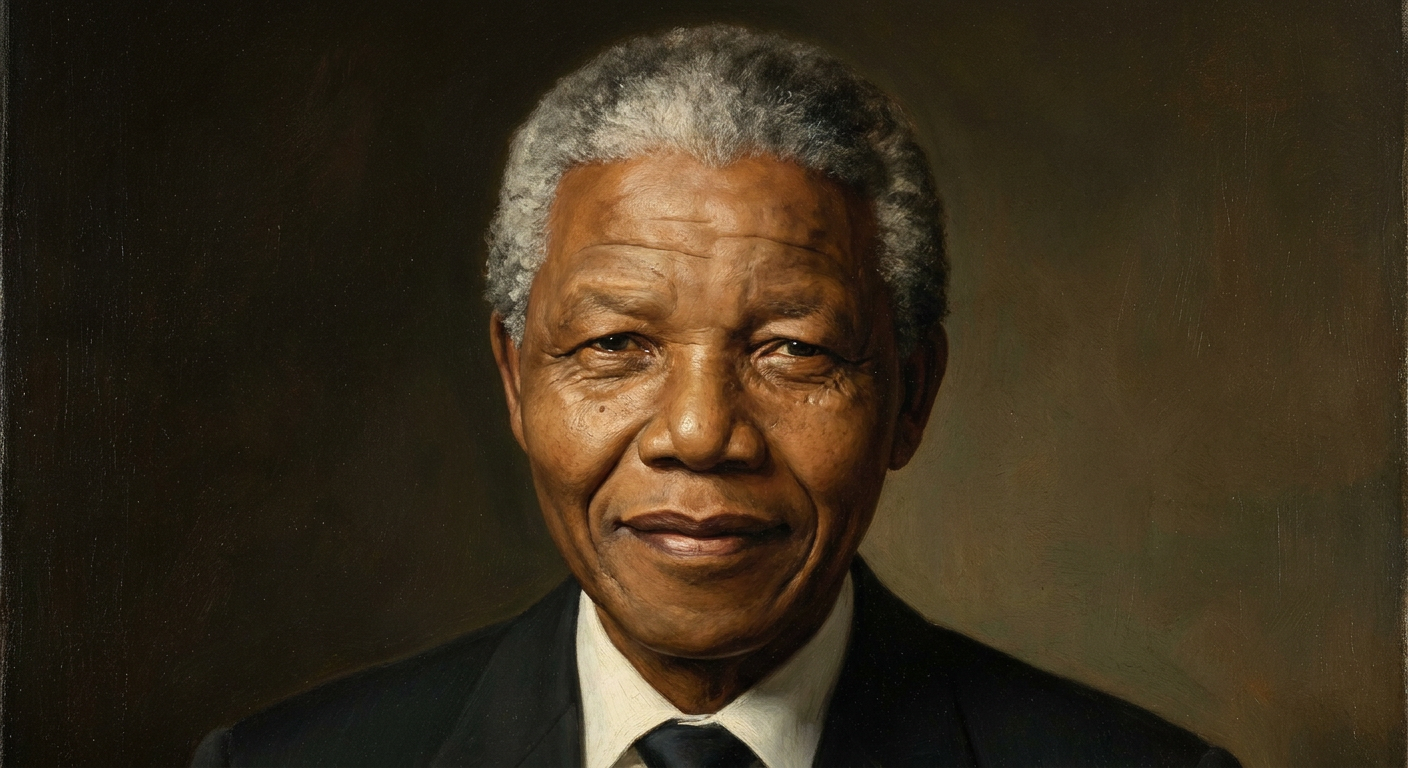
Quick Facts
- Years
- 1918 – 2013
- Category
- World Leaders & Revolutionaries
- Nationality
- South African
- Occupation
- Lawyer, anti-apartheid leader, political prisoner and president
Nelson Mandela
1918 – 2013 · South African · Lawyer, anti-apartheid leader, political prisoner and president
Recommended Audiobooks
Listen next from Marcus Alden

Life Lessons from Simon Bolivar
Marcus Alden · 55 min

Life Lessons from George Washington
Marcus Alden · 54 min
Nelson Mandela was a lawyer, revolutionary, political prisoner, peacemaker and president whose life became inseparable from South Africa’s struggle against apartheid. Born into a Thembu royal family in 1918, he entered politics as a young nationalist demanding full democratic rights for Black South Africans. When peaceful resistance met increasingly violent repression, he helped establish an armed organization committed to sabotage. Arrested and convicted, Mandela spent more than 27 years in prison.
His imprisonment made him the world’s best-known symbol of opposition to apartheid. Yet Mandela’s greatest historical achievement came after his release in 1990. Rather than pursue revenge or racial domination, he negotiated with the government that had imprisoned him. Those talks helped dismantle apartheid and produced South Africa’s first election based on universal adult suffrage.
In 1994, Mandela became the country’s first Black president. He promoted reconciliation, constitutional democracy and peaceful coexistence while confronting a society scarred by racism, violence and inequality. His administration did not solve South Africa’s deep economic and social problems, and elements of his record remain debated. Nevertheless, his ability to combine resistance with negotiation transformed his country and influenced peace movements worldwide. Mandela remains important not because he was flawless, but because he demonstrated how disciplined leadership can move from defiance to compromise without abandoning the demand for justice.
Quick Facts
| Field | Details |
|---|---|
| Full Name | Rolihlahla Nelson Mandela |
| Common Name(s) | Nelson Mandela; Madiba; Tata; Dalibunga |
| Born | 18 July 1918 |
| Died | 5 December 2013 |
| Age at Death | 95 |
| Birthplace | Mvezo, Cape Province, Union of South Africa |
| Nationality | South African |
| Occupation | Lawyer, anti-apartheid activist, political leader and president |
| Historical Era | Apartheid era and democratic transition in South Africa |
| Famous For | Opposing apartheid, enduring 27 years of imprisonment and becoming South Africa’s first democratically elected president |
| Political Affiliation | African National Congress (ANC); South African Communist Party membership has been acknowledged by the ANC and party, though its precise duration and role remain debated |
| Religion | Raised Methodist; Christianity remained part of his moral and educational background |
| Education | Clarkebury, Healdtown, University College of Fort Hare, University of South Africa and University of the Witwatersrand; LLB completed through the University of South Africa in 1989 |
| Parents | Gadla Henry Mphakanyiswa Mandela and Nosekeni Fanny |
| Spouse(s) | Evelyn Ntoko Mase, Winnie Madikizela-Mandela and Graça Machel |
| Children | Six: Madiba Thembekile, Makaziwe, Makgatho, a second daughter named Makaziwe, Zenani and Zindziswa |
| Major Works | Long Walk to Freedom; No Easy Walk to Freedom; Conversations with Myself; speeches and prison writings |
| Major Achievements | Led resistance to apartheid; helped negotiate democratic rule; received the 1993 Nobel Peace Prize; served as president from 1994 to 1999; supported reconciliation and constitutional government |
Early Life
Rolihlahla Mandela was born on 18 July 1918 in Mvezo, a small settlement beside the Mbashe River. His Xhosa birth name is often translated colloquially as “troublemaker,” although its literal sense relates to pulling a tree branch. He belonged to the Madiba clan of the Thembu people. “Madiba,” later used as an affectionate name for him, was a clan name rather than a personal nickname.
His father, Gadla Henry Mphakanyiswa Mandela, was a counselor to the Thembu royal house and a local chief before losing his official position after a dispute with a colonial magistrate. Mandela’s mother, Nosekeni Fanny, was one of Gadla’s wives in a polygynous household. After his father died, the young Mandela became a ward of the Thembu regent, Jongintaba Dalindyebo, at Mqhekezweni.
At a Methodist primary school, a teacher gave him the English name Nelson. Assigning English names to African pupils was common in colonial mission education. Christianity and mission schools exposed him to both European institutions and African teachers who modeled intellectual independence.
Mandela attended Clarkebury and Healdtown before enrolling at the University College of Fort Hare, one of the few higher-education institutions then open to Black southern Africans. He studied subjects including law, politics and anthropology. In 1940 he became involved in a student dispute and left without completing his degree there.
When the regent arranged marriages for Mandela and his cousin Justice, the two young men fled to Johannesburg in 1941. Mandela worked briefly as a mine-security guard and then as a law clerk. Walter Sisulu, who became one of his closest political colleagues, introduced him to activists, lawyers and members of the African National Congress. Mandela completed a bachelor’s degree through the University of South Africa and studied law at the University of the Witwatersrand, where he encountered people from varied racial and political backgrounds.
Johannesburg revealed the machinery of racial rule: restricted housing, pass laws, unequal wages and police control. These experiences transformed Mandela from an ambitious rural aristocrat into a committed political organizer.
Rise to Prominence
Mandela joined the ANC in 1944 and helped found its Youth League with Anton Lembede, Walter Sisulu, Oliver Tambo and others. The younger activists wanted to turn the ANC from a cautious petitioning organization into a mass movement. Their African nationalism initially emphasized Black leadership and self-determination; cooperation across racial and ideological lines expanded later.
In 1948, the National Party formally adopted apartheid. Although racial segregation long predated that election, apartheid organized it into an increasingly comprehensive system governing residence, employment, education, marriage and political rights.
The ANC adopted the Youth League’s more militant Programme of Action in 1949. Mandela gained national attention during the 1952 Defiance Campaign, in which volunteers deliberately violated discriminatory laws through disciplined nonviolent protest. He became the campaign’s national volunteer-in-chief and was arrested under anticommunist legislation.
That year Mandela and Oliver Tambo established a Johannesburg legal practice. Mandela and Tambo became known for representing Black clients who faced pass-law prosecutions, forced removals and other consequences of apartheid. Their practice also encountered harassment and restrictions.
The government banned Mandela from public gatherings and restricted his movements. Anticipating that the ANC might be outlawed, he developed the “M-Plan,” a proposed underground organizational structure based on small local cells.
In 1955, organizations opposed to apartheid adopted the Freedom Charter, which declared that South Africa belonged to everyone living in it, Black and white. Mandela supported the charter, though some African nationalists rejected its multiracial approach. In 1956 he and 155 others were charged with treason. The lengthy trial ended with their acquittal in 1961.
The turning point was the Sharpeville massacre of 21 March 1960, when police killed 69 people during a protest against pass laws. The government declared an emergency and banned the ANC and Pan Africanist Congress. Mandela concluded that exclusively peaceful methods were no longer sufficient under conditions in which legal opposition had been closed.
Major Achievements
Organizing mass resistance
Mandela helped transform the ANC into a movement capable of strikes, boycotts, civil disobedience and nationwide organization. He did not accomplish this alone: figures such as Sisulu, Tambo, Albert Luthuli, Lilian Ngoyi and many local activists were indispensable. His particular strength was connecting strategy, public symbolism and organizational discipline.
Establishing Umkhonto we Sizwe
In 1961 Mandela helped establish Umkhonto we Sizwe, or MK, meaning “Spear of the Nation.” It initially targeted infrastructure through sabotage, with instructions intended to avoid loss of life. Mandela argued that controlled sabotage might prevent a more uncontrolled racial war. Critics then and later maintained that abandoning nonviolence worsened conflict or legitimized coercion.
Mandela secretly left South Africa in 1962, received military training in Algeria and sought political and financial support elsewhere in Africa and Europe. After returning, he was arrested and sentenced to five years for leaving the country illegally and encouraging a strike.
Police later discovered documents at Liliesleaf Farm in Rivonia, the underground movement’s base. Mandela and other leaders were tried for sabotage. His statement from the dock on 20 April 1964 concluded that a democratic and free society was an ideal for which he was prepared to die. On 12 June, he and seven co-defendants received life sentences rather than the death penalty.
Surviving prison without political surrender
Mandela spent approximately 18 years on Robben Island, followed by periods at Pollsmoor and Victor Verster prisons. Prisoners performed hard labor, endured racial discrimination and faced censorship and restricted family contact. Mandela studied Afrikaans, debated political strategy, mentored younger prisoners and pressed officials for improved conditions.
His refusal to accept conditional release in return for renouncing resistance strengthened his standing. International campaigns demanding “Free Nelson Mandela” made him a global symbol, although the broader struggle also depended on internal activists, trade unions, students, neighboring states and international sanctions.
Negotiating the end of apartheid
Mandela began exploratory contacts with government representatives while imprisoned. He did so before receiving full authorization from every ANC colleague, a calculated risk that revealed both initiative and confidence in his political judgment.
President F. W. de Klerk unbanned the ANC and released Mandela on 11 February 1990. Negotiations then unfolded amid assassinations, township violence and conflict involving state security forces, the ANC and the Inkatha Freedom Party. Mandela combined talks with mass political pressure and was willing to suspend negotiations when violence made continued participation untenable.
The settlement created an interim constitution, universal suffrage and a Government of National Unity. Mandela and de Klerk jointly received the 1993 Nobel Peace Prize. Their cooperation was historically crucial, though their relationship was often tense and neither man alone produced the transition.
Becoming South Africa’s first democratically elected president
In April 1994, South Africans of all races voted in a national election. The ANC won a large majority, and Parliament elected Mandela president. His inauguration on 10 May symbolized the replacement of white-minority rule with constitutional democracy.
Mandela’s government expanded access to housing, water, electricity, education and health services, while integrating previously hostile state institutions. The 1996 Constitution created an influential framework for civil rights, judicial review and representative government.
Promoting reconciliation
Mandela supported the Truth and Reconciliation Commission, chaired by Archbishop Desmond Tutu. The commission offered possible amnesty for politically motivated crimes when applicants made full disclosure. It documented grave abuses committed by the apartheid state as well as violations by liberation movements.
Supporters viewed the process as a practical alternative to silence or mass prosecutions. Critics argued that victims received inadequate reparations and that some perpetrators escaped proportionate punishment. Its legacy therefore combines genuine truth-telling with unresolved questions about justice.
Leadership or Work
Mandela’s leadership joined moral symbolism to tactical flexibility. He could defend armed resistance in one period and negotiate with former enemies in another because he treated methods as tools rather than sacred principles. His consistent objective was democratic majority rule within a nonracial state.
He was attentive to ceremony and appearance. His upright posture, deliberate speech and later use of colorful Madiba shirts helped project dignity without the distance of formal presidential clothing. He learned Afrikaans and studied Afrikaner history, reasoning that understanding an opponent was necessary for effective negotiation.
His strengths included:
- Exceptional emotional discipline under pressure.
- A willingness to listen and allow colleagues to disagree.
- Skill in using symbolic gestures to reduce fear.
- Readiness to compromise on procedures while protecting central principles.
- An ability to communicate political goals in moral language.
Mandela could also be proud, stubborn and emotionally distant. His political commitments imposed heavy costs on his family. Some associates believed that his faith in personal persuasion occasionally underestimated institutional problems. His presidency depended heavily on experienced colleagues, civil servants and the wider ANC leadership rather than personal command alone.
A celebrated example of symbolic leadership came during the 1995 Rugby World Cup. Rugby had long been associated with white Afrikaner identity. Mandela appeared at the final wearing captain François Pienaar’s Springbok jersey, encouraging Black South Africans to support the national team. The gesture did not erase racial inequality, but it provided a powerful shared national moment.
Personal Life
Mandela married nurse Evelyn Ntoko Mase in 1944. They had four children: Madiba Thembekile, Makaziwe, who died in infancy, Makgatho and a second daughter also named Makaziwe. Political activism, long absences and religious and personal differences strained the marriage, which ended in divorce in 1958.
He married social worker Winnie Madikizela in 1958. Their daughters were Zenani and Zindziswa. Mandela’s imprisonment meant that the couple had little ordinary married life. Winnie endured banning orders, detention and exile by the apartheid state, becoming an important activist in her own right. She also became associated with serious abuses committed by her bodyguards during the 1980s. The couple separated in 1992 and divorced in 1996.
On his eightieth birthday in 1998, Mandela married Graça Machel, a Mozambican humanitarian and the widow of President Samora Machel. Their marriage provided companionship during his later years.
Prison caused profound family losses. Mandela’s mother died in 1968 and his son Thembekile died in a car crash in 1969; authorities refused to allow him to attend either funeral. His surviving children sometimes described the difficulty of sharing their father with a national cause.
Mandela maintained a disciplined routine, including early rising and physical exercise. Boxing had been a youthful interest. He valued gardening in prison and later enjoyed children’s company. Tuberculosis and other health problems affected him in later life. In 2005 he publicly announced that his son Makgatho had died of an AIDS-related illness, helping challenge the stigma surrounding HIV/AIDS.
Philosophy or Beliefs
Mandela’s political philosophy evolved. His early African nationalism emphasized African control of African political movements. Through campaigns and friendships, he embraced multiracial cooperation and defended a South Africa in which citizenship would not depend on race.
He was influenced by the ANC tradition, African communal values, Methodist education, anticolonial nationalism, liberal constitutionalism and Marxist analysis. Evidence confirms close cooperation with communists, and the ANC and South African Communist Party later stated that he had been a party member. Scholars continue to debate when he joined, how long he remained and how deeply Marxism shaped him. Mandela publicly denied party membership during the Rivonia Trial, when admitting it would have carried strategic and legal consequences.
His worldview was pragmatic rather than rigidly doctrinal. He believed oppressed people should seek peaceful change when possible but retained a claimed right to resist violent domination. He later emphasized reconciliation, not as forgetting, but as a way to prevent renewed civil conflict.
Mandela did not interpret forgiveness as political passivity. His negotiations demanded universal voting rights, an enforceable constitution and transfer of power. At the same time, he accepted compromises, including temporary power-sharing and protections for public employees, to reduce the danger of sabotage or civil war.
Challenges and Controversies
Armed struggle
Mandela’s role in founding MK remains the central controversy of his early career. Supporters argue that sabotage followed decades of failed petitions, state violence and the banning of legal opposition. Critics maintain that political violence can escape its original limits. MK later carried out attacks in which civilians died, especially while Mandela was imprisoned and unable to direct operations. Responsibility for different phases and actions must therefore be distinguished carefully.
Relationship with communist movements
Cold War governments often portrayed Mandela as controlled by Moscow. That depiction ignored the ANC’s independent objectives, but communist states and activists did provide substantial support when many Western governments tolerated or cooperated with apartheid South Africa. His precise party status remains an area of historical investigation rather than a reason to reduce his politics to a single label.
Winnie Madikizela-Mandela
Mandela remained loyal to Winnie publicly for years, despite mounting allegations surrounding the Mandela United Football Club. Critics believe he was too slow to confront abuses associated with her circle. Her own persecution by the apartheid state is well documented, but it does not erase evidence of kidnapping and violence by members of her entourage.
Economic inequality
Political democracy did not produce rapid economic equality. Mandela’s government inherited enormous disparities, limited administrative capacity and pressure from domestic business and international markets. Millions gained services, yet unemployment, land concentration and poverty persisted. Critics on the left argue that the ANC compromised too readily with existing economic power. Defenders answer that sudden restructuring could have triggered capital flight, institutional collapse or further conflict.
HIV/AIDS response
South Africa’s HIV epidemic expanded during Mandela’s presidency. His government’s response was not forceful enough, and Mandela later acknowledged that he had not given the crisis sufficient attention. The more notorious official denialism occurred under his successor, Thabo Mbeki, but Mandela’s presidential record cannot be separated entirely from the delay.
A heroic public image
Global admiration sometimes turns Mandela into a solitary savior. This obscures the work of women, trade unionists, community organizers, exiles, armed activists and ordinary citizens. Mandela himself frequently emphasized collective leadership. A balanced assessment recognizes his unusual importance without treating South African liberation as one man’s achievement.
Legacy
Mandela’s central legacy is South Africa’s transition from legally enforced racial domination to a constitutional democracy without the full-scale civil war many feared. The settlement remained incomplete in social and economic terms, but it established universal citizenship and regular competitive elections.
His willingness to serve only one presidential term strengthened the principle that political office should not become personal property. The Nelson Mandela Foundation now preserves archives, supports dialogue and promotes social justice. Mandela Day, observed internationally on 18 July, encourages people to devote time to community service.
Robben Island is a museum and UNESCO World Heritage Site. Mandela’s former home in Soweto operates as a museum, while his capture site near Howick has become a memorial complex. Statues stand at South Africa’s Union Buildings, Parliament Square in London and other locations. Universities, roads, hospitals and public institutions bear his name.
His legacy is invoked by advocates of reconciliation, democracy and human rights, sometimes too simplistically. Reconciliation without material reform can preserve inequality; resistance without a political settlement can prolong suffering. Mandela’s career remains relevant because it forces both problems into view.
Interesting Facts
- Mandela’s birth name, Rolihlahla, literally relates to pulling a branch from a tree.
- “Madiba” is his Thembu clan name and a respectful form of address.
- A primary-school teacher gave him the name Nelson.
- He was an amateur boxer and valued training more than victory.
- Mandela and Oliver Tambo ran an influential Black law practice in Johannesburg.
- He sometimes disguised himself as a chauffeur or laborer while underground.
- The press called him the “Black Pimpernel” during this period.
- He received military training in Algeria in 1962.
- His prisoner number on Robben Island was 466/64: the 466th prisoner admitted in 1964.
- He studied Afrikaans to understand prison officials and political opponents.
- He cultivated a garden while imprisoned.
- Mandela completed an LLB degree through correspondence in 1989.
- He spent about 27 years in prison across three principal institutions.
- He shared the 1993 Nobel Peace Prize with F. W. de Klerk.
- He voted in a national election for the first time at age 75.
- He was inaugurated as president at age 75.
- His 1995 appearance in a Springbok jersey became an enduring reconciliation image.
- He was the first South African president to step down voluntarily after a single elected term.
- The United Nations designated 18 July as Nelson Mandela International Day.
- He publicly identified AIDS as the cause of his son Makgatho’s death to challenge stigma.
Famous Quotes
-
“I have cherished the ideal of a democratic and free society in which all persons live together in harmony and with equal opportunities.” — From Mandela’s statement at the Rivonia Trial on 20 April 1964. It summarized the political objective for which he accepted the risk of execution.
-
“It is an ideal for which I am prepared to die.” — The closing words of the same statement. They transformed a legal defense into a declaration of political commitment.
-
“No one is born hating another person because of the colour of his skin, or his background, or his religion.” — Published in Long Walk to Freedom. Mandela used learned hatred to argue that people can also be taught to love.
-
“The brave man is not he who does not feel afraid, but he who conquers that fear.” — From Long Walk to Freedom. The observation reflects his view that courage is disciplined action, not the absence of fear.
-
“After climbing a great hill, one only finds that there are many more hills to climb.” — From Long Walk to Freedom. It warns that a major victory does not end the work of social transformation.
-
“It always seems impossible until it’s done.” — Recorded by the Nelson Mandela Foundation from remarks associated with a 2001 event. It is widely quoted because it captures the apparent improbability of apartheid’s negotiated end.
-
“Education is the most powerful weapon which you can use to change the world.” — From a 2003 speech launching the Mindset Network. “Weapon” was metaphorical: education equips people to transform their circumstances.
-
“I am not a saint, unless you think of a saint as a sinner who keeps on trying.” — From remarks in Houston in 1999. Mandela resisted attempts to portray him as morally perfect.
-
“Never, never and never again shall it be that this beautiful land will again experience the oppression of one by another.” — From his 1994 inauguration address. It announced the democratic state’s rejection of racial domination.
-
“I stand here before you not as a prophet, but as a humble servant of you, the people.” — Spoken after his release in Cape Town on 11 February 1990. It presented his freedom as the result of collective sacrifice rather than individual heroism.
Timeline
- 1918 — Born at Mvezo on 18 July.
- 1927 — His father died; Mandela later became a ward of Regent Jongintaba Dalindyebo.
- 1939 — Enrolled at the University College of Fort Hare.
- 1941 — Moved to Johannesburg after leaving the regent’s household.
- 1943 — Joined the African National Congress.
- 1944 — Helped establish the ANC Youth League and married Evelyn Mase.
- 1952 — Led volunteers in the Defiance Campaign and opened a law practice with Oliver Tambo.
- 1955 — The Congress of the People adopted the Freedom Charter.
- 1956 — Arrested with other activists in the Treason Trial; divorced Evelyn in 1958.
- 1958 — Married Winnie Madikizela.
- 1960 — Sharpeville massacre; ANC banned; Mandela detained during the emergency.
- 1961 — Acquitted in the Treason Trial and helped establish Umkhonto we Sizwe.
- 1962 — Traveled abroad, returned secretly and was arrested on 5 August.
- 1963 — Joined other defendants in the Rivonia Trial.
- 1964 — Sentenced to life imprisonment on 12 June and transferred to Robben Island.
- 1982 — Transferred to Pollsmoor Prison.
- 1985 — Rejected conditional release offered by President P. W. Botha.
- 1988 — Treated for tuberculosis and transferred to Victor Verster Prison.
- 1989 — Completed an LLB degree through the University of South Africa.
- 1990 — Released on 11 February after the ANC was unbanned.
- 1991 — Elected president of the ANC.
- 1992 — Separated from Winnie Mandela.
- 1993 — Shared the Nobel Peace Prize with F. W. de Klerk.
- 1994 — Voted in the first universal national election and became president on 10 May.
- 1995 — Supported national unity during the Rugby World Cup.
- 1996 — Signed the new Constitution; divorced Winnie Mandela.
- 1998 — Married Graça Machel.
- 1999 — Left the presidency after one term.
- 2004 — Retired from most public activity.
- 2005 — Announced that his son Makgatho had died of an AIDS-related illness.
- 2009 — The United Nations established Nelson Mandela International Day.
- 2013 — Died in Johannesburg on 5 December at age 95.
Frequently Asked Questions
1. Why is Nelson Mandela famous?
Mandela is famous for helping lead the struggle against apartheid, spending more than 27 years in prison and negotiating South Africa’s transition to democratic rule. In 1994 he became the country’s first Black president and the first chosen in a national election based on universal adult suffrage. His commitment to reconciliation reduced fears of racial retaliation, although the transition was a collective achievement involving many organizations and millions of people.
2. What was apartheid?
Apartheid was a system of racial domination imposed by South Africa’s National Party government from 1948, building upon older colonial segregation. Laws classified people by race, restricted where they could live and work, prohibited many interracial relationships and denied the Black majority national political power. Forced removals and unequal education supported a white-controlled economy. Resistance was met with banning, imprisonment, censorship and, at times, lethal police force.
3. How long was Mandela imprisoned?
Mandela was imprisoned from August 1962 until February 1990, approximately 27 years and six months. He first served a five-year sentence before receiving life imprisonment in the Rivonia Trial. He spent most of his captivity on Robben Island, then moved to Pollsmoor Prison and finally Victor Verster Prison. The familiar phrase “27 years” is therefore accurate as a rounded description, though exact calculations vary with how dates are counted.
4. Why was Mandela sent to prison?
Mandela was initially convicted of leaving South Africa without legal permission and encouraging workers to strike. During the Rivonia Trial, prosecutors presented evidence linking him and other activists to sabotage and plans for possible guerrilla warfare. Mandela acknowledged helping create MK and planning sabotage against infrastructure. He argued that state repression had closed peaceful channels. The court convicted him and sentenced him to life imprisonment in 1964.
5. Was Nelson Mandela a terrorist?
The apartheid government and some foreign governments used that label because Mandela helped found an armed organization. MK conducted sabotage and later attacks that caused deaths. Mandela maintained that initial operations were designed to avoid casualties and followed the suppression of legal resistance. Whether “terrorist” is applied often depends on definitions and political perspective; historically, it is more precise to describe him as a revolutionary who adopted armed resistance and later negotiated a democratic settlement.
6. Did Mandela personally commit violent attacks?
No verified evidence shows Mandela personally planting a bomb or killing anyone. He did, however, help establish MK, approve sabotage as a strategy and seek military support abroad. That gives him political responsibility for initiating armed resistance even if he was not an operational bomber. Most later MK attacks occurred while he was imprisoned. A balanced account distinguishes personal acts, command responsibility and the organization’s changing tactics over several decades.
7. What happened at the Rivonia Trial?
The 1963–1964 Rivonia Trial prosecuted Mandela and other anti-apartheid leaders after police raided Liliesleaf Farm. Documents revealed sabotage planning and discussion of guerrilla warfare. Mandela used his statement from the dock to explain why the movement had turned to sabotage and to defend democracy for all races. Eight defendants received life sentences. The trial made Mandela internationally known and could easily have ended with death sentences.
8. Why did the government release Mandela?
By the late 1980s, apartheid faced sustained internal resistance, international sanctions, economic pressure and a deteriorating security situation. The Cold War was also ending, reducing official fears that political change would automatically create a Soviet-aligned state. Secret contacts showed that Mandela was prepared to negotiate. President F. W. de Klerk concluded that apartheid could not continue and released Mandela as part of a wider legalization of political opposition.
9. How did Mandela help prevent civil war?
Mandela condemned racial revenge, negotiated with the government and used his authority to calm supporters during crises. After the 1993 assassination of ANC and Communist Party leader Chris Hani, he addressed the nation and urged disciplined action rather than uncontrolled retaliation. He also accepted temporary power-sharing and institutional compromises. Violence did continue, and many other leaders helped contain it, but Mandela’s credibility made compromise politically possible for millions of supporters.
10. What did Mandela accomplish as president?
Mandela’s government consolidated democratic institutions, supported the 1996 Constitution, integrated divided state structures and established the Truth and Reconciliation Commission. It expanded housing, electrification, clean-water access and primary health programs, though delivery was uneven. His administration re-entered international institutions and promoted peaceful diplomacy. Persistent unemployment, inequality, crime and the emerging HIV/AIDS catastrophe demonstrated that political liberation could not quickly repair centuries of structural injustice.
11. Why did Mandela serve only one term?
Mandela chose not to seek another term and left office in 1999. He was already 80 and wanted to make space for a younger generation, particularly his deputy and successor, Thabo Mbeki. His departure also reinforced constitutional government and peaceful succession. Although South African presidents were subject to constitutional term limits, Mandela’s voluntary retirement after one term carried particular symbolic weight in a continent often stereotyped through leaders who remained in power indefinitely.
12. What was Mandela’s relationship with F. W. de Klerk?
Mandela and de Klerk were negotiating partners, political rivals and joint Nobel laureates. De Klerk legalized the ANC and oversaw formal negotiations, while Mandela persuaded a mass liberation movement to pursue settlement. They distrusted one another, especially over political violence and the conduct of state security forces. Their cooperation was indispensable, but their joint Nobel Prize should not conceal major differences over responsibility for apartheid, the pace of reform and control of the transition.
13. What was the Truth and Reconciliation Commission?
Established under Mandela’s government, the commission investigated politically motivated human-rights abuses committed between 1960 and 1994. Victims gave public testimony, and perpetrators could seek amnesty by making full disclosure and proving political motivation. The process created an extensive public record and allowed many families to learn what had happened. Critics argue that reparations were inadequate and that amnesty sometimes sacrificed punishment, making its achievement substantial but incomplete.
14. Was Mandela a communist?
The ANC and South African Communist Party stated after his death that Mandela had been a member of the party’s central committee around the early 1960s. Archival evidence supports close involvement, but scholars dispute the duration and depth of his membership. He worked closely with communists and drew on Marxist ideas, yet his mature program favored constitutional pluralism and a mixed economy. Cold War claims that he was merely controlled by Moscow are not supported by his independent record.
15. How did Nelson Mandela die?
Mandela died at his home in Johannesburg on 5 December 2013, aged 95, after a prolonged respiratory illness. His lungs had been affected by tuberculosis contracted during imprisonment, and he experienced recurring infections in old age. South Africa held a national period of mourning, a large memorial service and a state funeral. He was buried at Qunu in the Eastern Cape, the rural community where he had spent much of his childhood.
Lessons We Can Learn
- Principles and methods are different. Mandela’s goal of equal citizenship remained stable while his methods changed from protest to sabotage and negotiation. Modern readers may interpret this as strategic adaptability, though it does not settle ethical debates about violence.
- Understanding opponents improves negotiation. He learned Afrikaans and studied Afrikaner history. The evidence shows deliberate preparation, while the broader lesson is that empathy can be practical without implying agreement.
- Courage includes controlled fear. Mandela openly recognized fear but continued acting. His prison record supports the value of discipline rather than a mythology of fearlessness.
- Symbolic gestures can change political emotions. Wearing the Springbok jersey did not solve inequality, but it reduced cultural hostility at an important moment. Symbols work best when accompanied by institutions and policy.
- Collective leadership is more durable than hero worship. The anti-apartheid victory depended on organizations and ordinary participants. Mandela’s prominence should encourage, not obscure, recognition of teamwork.
- Negotiation need not mean surrender. Mandela accepted compromises while preserving universal suffrage and constitutional rule. Effective compromise distinguishes central objectives from negotiable arrangements.
- Political freedom is not economic equality. Post-apartheid poverty illustrates the limits of legal reform alone. Modern interpretation should recognize both democratic achievement and unfinished material change.
- Leaders must acknowledge neglected issues. Mandela later admitted that HIV/AIDS deserved more attention during his presidency. Owning omissions can help society address them, even when the admission comes late.
- Public service should outlast office. After retiring, Mandela supported peace efforts, children’s charities and AIDS awareness. Leadership can continue without direct political power.
- Reconciliation requires truth. Mandela supported public investigation of past abuses rather than simple forgetting. The commission’s contested record shows that truth is necessary for reconciliation, though it may not provide complete justice.
Related Historical Figures
- Oliver Tambo — Mandela’s law partner, ANC colleague and exiled leader who sustained the movement internationally.
- Walter Sisulu — Mentor, close friend, organizer and fellow Rivonia prisoner whose influence shaped Mandela’s political career.
- Albert Luthuli — ANC president and Nobel laureate associated with the movement’s earlier nonviolent campaigns.
- Winnie Madikizela-Mandela — Mandela’s second wife and a major activist whose courageous resistance and controversial entourage formed part of his personal and political story.
- Desmond Tutu — Cleric, anti-apartheid advocate and chair of the Truth and Reconciliation Commission.
- F. W. de Klerk — South African president who released Mandela, negotiated political transition and shared the Nobel Peace Prize with him.
- Chris Hani — Popular liberation leader whose 1993 assassination threatened negotiations and tested Mandela’s national leadership.
- Steve Biko — Founder of the Black Consciousness Movement, which mobilized a younger generation while Mandela was imprisoned.
- Joe Slovo — Communist and ANC strategist who helped develop armed resistance and proposed transitional power-sharing compromises.
- Thabo Mbeki — ANC negotiator, Mandela’s deputy president and his successor as president of South Africa.
Watch and Learn
“Nelson Mandela, 1918-2013” — The New York Times — approximately 13 minutes
This concise documentary-style retrospective combines archival footage with an accessible account of Mandela’s political career, imprisonment, release and presidency. The New York Times provides reputable historical context while avoiding the length of a full documentary, making the video suitable as an introduction for students before deeper study.
Watch and Learn
Nelson Mandela, 1918-2013 · The New York Times
Related Historical Figures