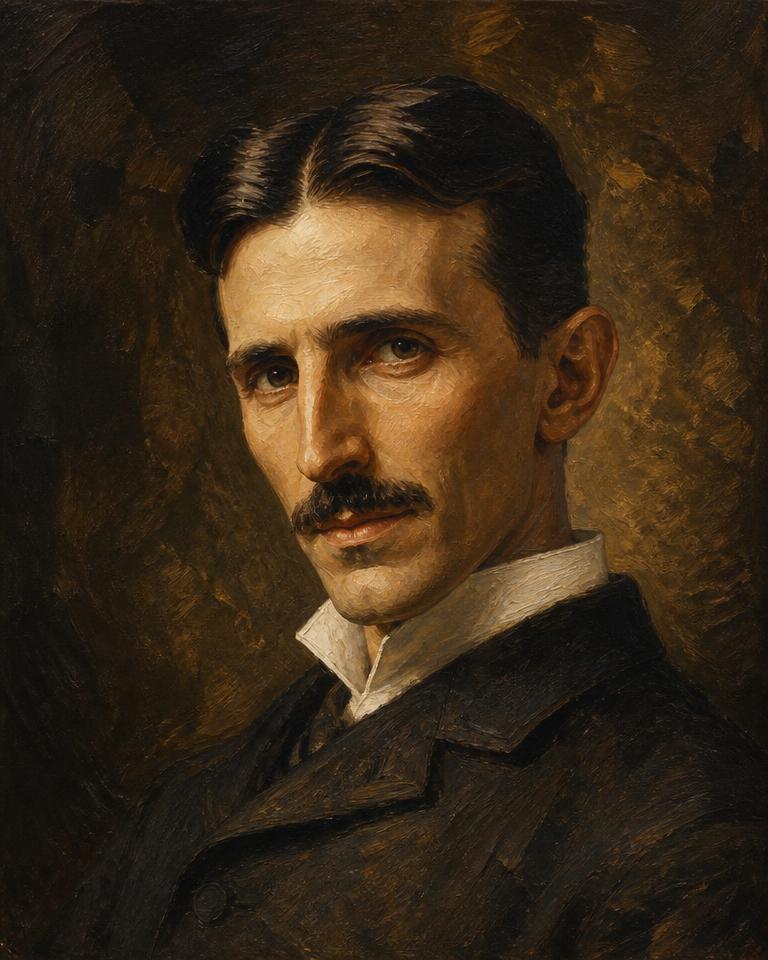
Quick Facts
- Years
- 1856 – 1943
- Category
- Scientists & Inventors
- Subcategory
- Electrical Engineering
- Nationality
- Serbian-American
- Occupation
- Inventor & Electrical Engineer
Nikola Tesla
1856 – 1943 · Serbian-American · Inventor & Electrical Engineer
Audiobook

Life Lessons from Nikola Tesla
Marcus Alden · 54 min
Nikola Tesla (1856–1943) was a Serbian-American inventor and electrical engineer whose work helped establish the modern alternating-current electrical system. Born in the Austrian Empire and educated in Central Europe, he worked in telegraphy and electric power before emigrating to the United States in 1884. There he developed practical polyphase motors, generators, and transformers, then licensed key patents to industrialist George Westinghouse.
Tesla's greatest achievement was not simply championing alternating current, which already existed, but creating an integrated polyphase system that made AC power generation, transmission, and industrial use far more practical. His induction motor and rotating magnetic-field designs became foundations of modern electrification. He also pioneered high-frequency and high-voltage experimentation, demonstrated radio control, investigated wireless communication, and helped popularize spectacular forms of electric lighting.
His career mixed genuine breakthroughs with costly disappointments. The success of the Westinghouse system and the Niagara Falls power project made him internationally famous, but later ventures—especially the unfinished Wardenclyffe wireless station—strained his finances and reputation. Tesla died in relative isolation in New York City.
Tesla remains important because electrical grids, AC motors, automation, and wireless technologies all intersect with his work. He is also studied as a case of extraordinary technical imagination complicated by weak commercialization, exaggerated publicity, and persistent myths.
Quick Facts
| Field | Details |
|---|---|
| Full Name | Nikola Tesla |
| Common Name(s) | Nikola Tesla; sometimes called “the Wizard of Electricity” in popular accounts |
| Born | 10 July 1856 (28 June, Old Style) |
| Died | 7 January 1943 |
| Age at Death | 86 |
| Birthplace | Smiljan, Austrian Empire; now in Croatia |
| Nationality | Serbian by heritage; naturalized United States citizen from 1891 |
| Occupation | Inventor, electrical engineer, mechanical engineer, experimentalist |
| Historical Era | Second Industrial Revolution; early electrical age |
| Famous For | Polyphase AC system, induction motor, Tesla coil, high-frequency research, radio control |
| Political Affiliation | No sustained party affiliation is recorded |
| Religion | Raised in the Serbian Orthodox tradition; adult beliefs combined spiritual language with a largely mechanistic view of nature |
| Education | Realschule in Karlstadt; studied at Graz Polytechnic; attended lectures at Charles-Ferdinand University in Prague; no completed university degree |
| Parents | Milutin Tesla and Georgina “Đuka” Mandić Tesla |
| Spouse(s) | Never married |
| Children | None |
| Major Works | Polyphase AC patents; induction motor; Tesla coil; radio-control system; Colorado Springs experiments; Wardenclyffe project; lectures and articles including My Inventions |
| Major Achievements | Practical polyphase power system; foundational AC motor designs; high-voltage experimentation; public demonstration of wireless control |
Early Life
Nikola Tesla was born at midnight during 9–10 July 1856 in Smiljan, a village in the Military Frontier of the Austrian Empire. His family was ethnically Serbian. His father, Milutin, was a Serbian Orthodox priest and an accomplished speaker and writer. His mother, Georgina, known as Đuka, had no formal advanced education but devised household implements and possessed a remarkable memory. Tesla later credited her with his inventive ability.
He grew up with an older brother, Dane, and three sisters: Angelina, Milka, and Marica. Dane died after a riding accident when Nikola was a child. Biographers have treated the death as a profound family trauma, although claims about its exact psychological effects should be made cautiously.
Tesla attended school in Smiljan and Gospić, then studied at the Higher Real Gymnasium in Karlstadt, now Karlovac. He excelled in mathematics and physics. During this period he encountered demonstrations of electricity that helped focus his ambitions. He later recalled completing the four-year program in three years.
In 1873 he contracted cholera and was seriously ill for months. According to Tesla's later account, his father promised to let him study engineering if he recovered. After a period in the mountains, Tesla entered Graz Polytechnic in 1875 on a Military Frontier scholarship.
At Graz he initially performed exceptionally well. He became fascinated by a Gramme dynamo and disputed a professor's claim that sparking at the commutator was unavoidable. Tesla imagined a motor without brushes or a commutator. His attendance and performance later deteriorated, likely amid overwork, gambling, and financial trouble. He left without earning a degree.
Tesla subsequently spent time in Maribor and returned to his family after his father's death in 1879. In 1880 he attended lectures at Charles-Ferdinand University in Prague but could not complete a formal course of study. His education was therefore substantial but unfinished—a fact sometimes obscured by honorary degrees he received later.
Rise to Prominence
In 1881 Tesla moved to Budapest and worked for the Budapest Telephone Exchange and its associated telegraph organization. While walking in City Park in 1882, he conceived a practical way to create a rotating magnetic field using alternating currents out of phase with one another. This insight became central to his later induction motors.
Later in 1882 he joined the Continental Edison Company in Paris, installing and repairing electrical equipment. He also worked on assignments in Strasbourg, where he built a prototype induction motor. Compensation disputes and limited opportunities encouraged him to seek work in America.
Tesla arrived in New York in June 1884 with little money and began working at Edison Machine Works. His ability to troubleshoot generators quickly became useful. Tesla later claimed Thomas Edison offered him $50,000 for extensive improvements and then dismissed the promise as a joke. Historians cannot fully verify this famous story, which rests heavily on Tesla's later recollection. What is clear is that he left Edison's organization after only months.
His first independent company, Tesla Electric Light and Manufacturing, was formed in 1885. It produced arc-lighting equipment, but investors reorganized the venture and left Tesla without control of his patents. He later described doing manual labor during the economically difficult winter of 1886–1887.
A crucial reversal came when lawyer Charles Peck and Western Union superintendent Alfred S. Brown backed a new laboratory. In 1887 and 1888 Tesla developed and patented motors and power equipment based on polyphase alternating current. He presented his work to the American Institute of Electrical Engineers in May 1888. George Westinghouse recognized its importance and licensed Tesla's patents.
The partnership placed Tesla at the center of competition over electrical standards. Westinghouse's AC system could transform voltage and transmit power efficiently over long distances, while Edison interests defended direct-current networks and publicly emphasized AC's dangers. Tesla's lectures and demonstrations made him a scientific celebrity as well as an inventor.
Major Achievements
The Rotating Magnetic Field and Induction Motor
Tesla's polyphase currents produced a magnetic field that rotated without mechanical switching. That field could drive a rotor in an induction motor without brushes or a commutator.
The advance mattered because commutators sparked, wore down, and required maintenance. Tesla's patents covered motors, generators, transformers, and distribution arrangements that worked as a system. Galileo Ferraris independently demonstrated a rotating magnetic field in Italy, and historians recognize that AC machinery emerged from several inventors. Tesla's particular patent package and its industrial development with Westinghouse nevertheless proved highly influential.
Induction motors remain essential in factories, pumps, fans, appliances, and transportation. Their durability and simplicity make Tesla's work one of the most consequential contributions to electrical engineering.
The Polyphase AC Power System
Tesla's designs helped make alternating current useful not merely for lighting but also for motive power. Multiple alternating currents, separated in phase, could efficiently operate motors and distribute energy.
Westinghouse purchased or licensed Tesla's patents in 1888 and employed him as a consultant in Pittsburgh. The system competed with direct current during the so-called War of Currents. AC ultimately prevailed for broad power distribution because transformers allowed voltage to be raised for efficient transmission and lowered for safer local use.
Tesla did not invent AC itself, nor did he single-handedly create the power grid. Westinghouse engineers, European innovators, transformer designers, and many others contributed. His polyphase patents, however, supplied a crucial part of the practical system.
The 1893 World's Columbian Exposition
Westinghouse won the contract to illuminate the World's Columbian Exposition in Chicago. Opened in 1893, the fair displayed an enormous AC lighting installation. Tesla presented high-frequency experiments, illuminated wireless lamps, and demonstrated that carefully controlled currents could create dramatic effects.
The exposition gave millions of visitors a vivid encounter with electric power. It strengthened public confidence in AC and enhanced Tesla's fame. Popular retellings sometimes imply that Tesla personally powered the entire fair; in reality, it was a major Westinghouse engineering project in which his system and demonstrations played prominent roles.
Niagara Falls Hydroelectric Power
The Niagara Falls Power Company selected a Westinghouse polyphase AC system for its generating plant. Tesla's patents informed the machinery, while engineers including Benjamin Lamme translated system principles into large industrial equipment. Generators began operating in 1895, and power reached Buffalo in 1896.
Niagara demonstrated that hydroelectric energy could be generated at scale and transmitted to distant users. It became an international symbol of electrification and strengthened the case for AC networks. Tesla's name is now closely associated with the project, though its construction was a collaborative corporate and engineering achievement.
The Tesla Coil and High-Frequency Research
In 1891 Tesla patented a resonant transformer now called the Tesla coil. It produces high-voltage, high-frequency alternating currents through coupled resonant circuits.
Tesla used coils to investigate insulation, electrical resonance, lighting, and wireless transmission. His lectures featured glowing tubes that were not connected by ordinary wires, helping scientists and the public imagine new forms of communication and illumination.
Tesla coils influenced early radio experimentation and remain important in educational demonstrations, entertainment, and specialized equipment. Modern solid-state electronics have replaced them in most practical communications, but the principles of resonance they displayed remain fundamental.
Radio and Wireless Control
Tesla pursued wireless signaling during the 1890s and obtained several relevant U.S. patents. In 1898 he publicly demonstrated a radio-controlled boat at Madison Square Garden. Commands sent by radio directed the vessel's rudder and propulsion, an early example of wireless remote control.
The demonstration anticipated robotics, drones, guided weapons, and industrial automation. Tesla called such machines “telautomata” and imagined devices able to act at a distance.
Claims that he simply “invented radio” are too broad. Guglielmo Marconi built successful commercial systems, while Heinrich Hertz, Oliver Lodge, Jagadish Chandra Bose, Alexander Popov, Tesla, and others made important contributions. A 1943 U.S. Supreme Court patent ruling invalidated certain Marconi patent claims partly because of earlier work, including Tesla's, but it did not formally declare Tesla the sole inventor of radio.
Colorado Springs Experiments
Tesla established a laboratory near Colorado Springs in 1899, attracted by open land and access to electrical power. There he built a huge magnifying transmitter, generated extremely long electrical discharges, studied resonance, and experimented with signals detected at a distance.
The work expanded practical knowledge of high-voltage behavior, though Tesla's records and later interpretations do not support every dramatic claim associated with the site. He believed Earth could participate in a global wireless transmission system. The laboratory advanced his vision but did not prove that economical worldwide power distribution without wires was feasible.
Wardenclyffe Tower
With funding from financier J. P. Morgan, Tesla began building a wireless station at Wardenclyffe on Long Island in 1901. Architect Stanford White designed the laboratory. Tesla initially presented the project as a transatlantic communications system but sought a broader network for messages, images, and perhaps power.
Costs rose as Tesla enlarged his ambitions. Marconi's successful transatlantic signal, changing financial conditions, technical uncertainty, and Morgan's refusal to provide unlimited additional funding undermined the project. The tower never became operational and was demolished in 1917.
Wardenclyffe failed commercially, yet its goal of rapid global communication appears strikingly modern. The surviving laboratory is now the center of the Tesla Science Center at Wardenclyffe.
Leadership and Work
Tesla usually led small laboratories rather than large industrial organizations. He visualized machines in extraordinary detail, mentally assembled and tested them, then proceeded to physical prototypes. This ability accelerated invention, but his confidence in internal visualization could also reduce systematic documentation and external testing.
He worked intensely, often late into the night, and demanded precision from assistants. His lectures combined rigorous apparatus with theatrical presentation. He understood that public demonstrations could attract investors and shape opinion.
Tesla valued elegance, efficiency, and bold scale. He was strongest at conceiving systems and designing experiments. He was weaker at budgeting, production management, sustained patent strategy, and adapting projects to investors' narrower commercial goals.
His relationships followed this pattern. Westinghouse turned Tesla's patents into practical infrastructure, but Tesla did not remain embedded in the company. Morgan financed Wardenclyffe but became wary as its scope expanded. Tesla could inspire patrons, journalists, and engineers, yet he often struggled to sustain the institutional partnerships necessary for costly inventions.
Personal Life
Tesla never married and had no children. He sometimes argued that celibacy allowed inventors to devote themselves completely to work. At other times he praised the influence of exceptional women, especially his mother. Claims that he had secret romances are speculative.
He cultivated friendships with public figures, including writer Mark Twain, whose visits to Tesla's laboratory produced famous photographs and anecdotes. He also knew Robert Underwood Johnson, editor of The Century Magazine, and Johnson's wife Katharine. Their correspondence provides insight into Tesla's social world.
Tesla dressed carefully, lived for long periods in New York hotels, and enjoyed fine dining when finances allowed. He walked extensively and claimed to sleep very little, although such self-reports may have been exaggerated.
He had pronounced compulsive habits. Tesla described an aversion to pearls, strong sensitivity to sounds and light, repeated actions, and a fixation on numbers divisible by three. Retrospective medical diagnosis is uncertain, but these behaviors affected daily life.
In later years he fed pigeons in New York parks and formed an intense attachment to a particular white pigeon, which he described in spiritual and emotional terms. His health and finances declined. In 1937 he was struck by a taxicab and injured but reportedly refused prolonged medical treatment.
Philosophy and Beliefs
Raised by an Orthodox priest, Tesla retained respect for religious culture but did not present himself as conventionally devout in adulthood. His published statements often described the universe in mechanistic terms. He regarded human beings as responsive “automata,” while also using poetic or spiritual language about inspiration and cosmic order.
Tesla believed science should reduce drudgery and increase human welfare. He imagined abundant energy, automated labor, global communication, and technologies that might deter war. Yet he also proposed powerful defensive weapons, including the late “teleforce” particle-beam concept popularly called a death ray. He presented it as a means to make borders impregnable rather than as an offensive weapon; it was never built as claimed.
Politically, Tesla expressed admiration for both Serbian culture and the United States. He advocated international understanding and hoped technology could unite societies. Some later statements reflected early-twentieth-century eugenic ideas about reproduction and human “improvement.” Those views were not unique to him in that era but are ethically unacceptable by modern standards.
Challenges and Controversies
Tesla's rivalry with Edison is often simplified into a personal duel. They represented competing technical and commercial systems, and Tesla briefly worked for Edison, but the War of Currents involved corporations, financiers, engineers, regulators, and propagandists. The claim that Edison cheated Tesla of $50,000 is possible but not independently documented.
The fate of Tesla's Westinghouse royalties is similarly disputed. Popular stories say he tore up a royalty contract to save Westinghouse from bankruptcy, sacrificing a vast fortune. Evidence confirms that contracts were renegotiated during Westinghouse's financial difficulties, but the dramatic contract-tearing scene and modern billion-dollar estimates lack firm documentation.
Tesla also made priority claims that require qualification. He was a major radio pioneer, not radio's sole creator. He contributed to fluorescent and wireless lighting experiments but did not single-handedly invent all modern lamps. Accounts linking him to the Tunguska explosion or claiming he caused earthquakes are unsupported.
Wardenclyffe exposed weaknesses in Tesla's management. He changed the project's scope, underestimated costs, and failed to provide investors with a clear path to revenue. Admirers see visionary ambition defeated by short-term finance; critics emphasize technical uncertainty and poor planning. Both factors mattered.
His later announcements—about turbines, worldwide energy, unusual cosmic signals, and particle beams—often received press attention before independent verification. Some contained important insights; others remained incomplete or implausible. Distinguishing patents, tested prototypes, stated intentions, and newspaper speculation is essential to evaluating him fairly.
Legacy
Tesla's strongest legacy is embedded in electrical infrastructure rather than in legend. Polyphase AC generation and induction motors remain central to power systems and industry. His radio-controlled boat foreshadowed remote systems and robotics, while his resonant circuits contributed to the experimental culture from which radio developed.
The SI unit of magnetic flux density was named the tesla in 1960. Tesla was inducted into the National Inventors Hall of Fame in 1975. The Nikola Tesla Museum in Belgrade preserves manuscripts, instruments, personal possessions, and his ashes. His Smiljan birthplace is part of a memorial center, and the Tesla Science Center is restoring the Wardenclyffe laboratory on Long Island.
Monuments stand at Niagara Falls, Belgrade, Zagreb, Smiljan, and elsewhere. Belgrade's main airport bears his name. Serbia has depicted him on currency, and Croatia has commemorated his birthplace and scientific contribution.
The electric-vehicle and energy company Tesla, Inc., founded in 2003, adopted his name because of the importance of AC induction motors, though Nikola Tesla had no connection to the modern firm.
His cultural image has grown far beyond the historical record. He is celebrated as a neglected genius, sometimes at Edison's expense. Serious scholarship offers a more useful conclusion: Tesla was genuinely exceptional, depended on collaborators and industrial partners, made mistakes, and pursued some ideas that exceeded available science or finance.
Interesting Facts
- Tesla was born during a thunderstorm, according to a family story repeated by biographers.
- His birth date appears as 28 June under the Julian calendar then used locally and 10 July in the Gregorian calendar.
- He spoke several languages and worked across the Austrian Empire, Hungary, France, and the United States.
- He became a U.S. citizen in 1891.
- His 1888 lecture brought his polyphase work to the attention of the American engineering community.
- George Westinghouse licensed his major AC patents.
- Tesla demonstrated a radio-controlled boat in 1898.
- His Houston Street laboratory burned in March 1895, destroying equipment and records.
- He generated spectacular high-voltage discharges at Colorado Springs.
- Stanford White designed the Wardenclyffe laboratory building.
- Tesla received the AIEE Edison Medal in 1917 despite his association with Edison's commercial rival.
- He shared the 1915 IEEE Rumelhart Prize—not a Nobel Prize—with no one; reports that he and Edison won the Nobel were erroneous.
- Tesla patented a bladeless turbine using smooth disks and boundary-layer effects.
- He appeared on the cover of Time magazine in 1931 for his 75th birthday.
- He was fond of Mark Twain's writing before becoming personally acquainted with Twain.
- Tesla spent his final decade at the New Yorker Hotel.
- The FBI asked the Office of Alien Property to review his papers after his death, although Tesla was a U.S. citizen.
- Engineer John G. Trump examined Tesla's papers and reported no immediately practical secret weapon.
- Tesla's ashes are housed in a gold-colored spherical urn in his Belgrade museum.
- The unit “tesla” equals one weber per square metre.
Famous Quotes
- “The practical success of an idea, irrespective of its inherent merit, depends on the attitude of the contemporaries.” — From My Inventions (1919). Tesla was reflecting on how social and financial acceptance affects innovation.
- “My method is different. I do not rush into actual work.” — My Inventions. He explained his practice of mentally developing an apparatus before constructing it.
- “The present is theirs; the future, for which I really worked, is mine.” — Reported by journalist Dragislav L. Petković after a 1927 conversation. It captures Tesla's conviction but is a recollected quotation, not a verbatim transcript.
- “The spread of civilization may be likened to a fire; first, a feeble spark, next a flickering flame, then a mighty blaze.” — “The Problem of Increasing Human Energy” (1900), describing technological and social development.
- “Every living being is an engine geared to the wheelwork of the universe.” — The same 1900 essay, expressing his mechanistic philosophy.
- “I have obtained electrical movements occurring at the rate of approximately one hundred thousand horse-power.” — Tesla's 1893 lecture on high-frequency phenomena, illustrating the scale with which he described oscillatory electrical effects.
- “I do not think you can name many great inventions that have been made by married men.” — Quoted in the New York Herald in 1896, reflecting his controversial defense of celibacy.
- “If we use fuel to get our power, we are living on our capital and exhausting it rapidly.” — The Century Magazine (1900), part of his case for renewable sources.
- “The harness of waterfalls is the most economical method known for drawing energy from the sun.” — From his writings on energy, emphasizing hydropower as indirectly solar.
- “If you want to find the secrets of the universe, think in terms of energy, frequency and vibration.” — Widely attributed to Tesla but not securely located in his authenticated writings; treat as disputed.
Timeline
- 1856 — Born in Smiljan on 10 July.
- 1863 — Older brother Dane dies after an accident.
- 1873 — Completes school at Karlstadt and suffers a severe bout of cholera.
- 1875 — Enters Graz Polytechnic.
- 1878 — Leaves Graz without a degree and moves to Maribor.
- 1879 — Father dies; Tesla teaches briefly in Gospić.
- 1880 — Attends university lectures in Prague.
- 1881 — Works in Budapest's telephone industry.
- 1882 — Conceives the rotating magnetic-field principle and joins Continental Edison in Paris.
- 1883 — Builds an induction-motor prototype in Strasbourg.
- 1884 — Emigrates to New York and works for Edison Machine Works.
- 1885 — Forms Tesla Electric Light and Manufacturing.
- 1887 — Establishes a new laboratory and develops polyphase motors.
- 1888 — Lectures before the AIEE; Westinghouse licenses his AC patents.
- 1891 — Patents the Tesla coil and becomes a U.S. citizen.
- 1892 — Lectures in London and Paris; his mother dies.
- 1893 — Demonstrates electrical inventions at the Chicago world's fair.
- 1895 — New York laboratory burns; Niagara generators begin operation.
- 1896 — Niagara power reaches Buffalo.
- 1898 — Demonstrates radio control at Madison Square Garden.
- 1899 — Conducts Colorado Springs experiments.
- 1900 — Publishes “The Problem of Increasing Human Energy.”
- 1901 — Begins Wardenclyffe with J. P. Morgan's backing.
- 1905 — Wardenclyffe financing largely collapses.
- 1906 — Demonstrates a bladeless turbine concept.
- 1917 — Wardenclyffe tower is demolished; Tesla receives the Edison Medal.
- 1928 — Receives his final U.S. patent, for a vertical-takeoff aircraft design.
- 1931 — Appears on the cover of Time at age 75.
- 1934 — Publicly describes his “teleforce” defensive weapon proposal.
- 1937 — Injured in a traffic accident.
- 1943 — Dies in New York on 7 January.
- 1960 — The SI unit of magnetic flux density is named the tesla.
Frequently Asked Questions
Who was Nikola Tesla?
Nikola Tesla was a Serbian-American inventor and electrical engineer best known for polyphase alternating-current technology. His motors and power-system patents, licensed by George Westinghouse, helped make long-distance electrical distribution and industrial AC motors practical. He also developed the Tesla coil, demonstrated radio control, and experimented with wireless communication and high-voltage electricity. Tesla was neither an isolated magician nor the inventor of every electrical technology attributed to him online. He was a highly original engineer whose best work depended on existing science, skilled collaborators, manufacturing organizations, and investors.
Where and when was Tesla born?
Tesla was born in Smiljan in the Austrian Empire, now part of Croatia, during the night of 9–10 July 1856. Records commonly give 10 July under the Gregorian calendar and 28 June under the Julian calendar then used by his church community. He came from a Serbian Orthodox family. Because modern national borders did not exist in their present form, describing him only through a current country can be misleading. His birthplace was in present-day Croatia, his ethnic and cultural heritage was Serbian, and he later became an American citizen.
What did Nikola Tesla invent?
Tesla developed a practical polyphase AC system, including induction motors and associated generators and transformers. He invented the resonant transformer called the Tesla coil and patented an early radio-control system demonstrated with a model boat. He also designed high-frequency lamps, oscillators, turbines, meters, and other devices. Some inventions were commercially transformative; others remained experimental. He did not invent alternating current, electricity, radio in isolation, radar, or the modern power grid by himself. Accurate assessment distinguishes his documented patents and demonstrations from later claims.
Did Tesla invent alternating current?
No. Alternating current was known and used before Tesla began his career. European and American engineers had developed alternators, transformers, and AC lighting systems. Tesla's major contribution was an integrated polyphase approach that created rotating magnetic fields and powered efficient motors. This helped extend AC from lighting into industrial power and made it more competitive as a general electrical system. George Westinghouse and his engineering staff then commercialized and refined the technology. Tesla was therefore a central architect of practical polyphase AC, not the sole inventor of AC itself.
What was the War of Currents?
The War of Currents was a late-nineteenth-century competition over electrical distribution standards. Edison-associated companies promoted direct current, while Westinghouse and others developed alternating-current systems. AC could be transformed to high voltage for efficient transmission and lowered near users, giving it an economic advantage for broad networks. Opponents emphasized high-voltage AC's dangers, and the controversy included disturbing public demonstrations and its use in the electric chair. Tesla's polyphase patents strengthened Westinghouse's system, but the conflict involved many corporations, inventors, engineers, and public officials.
Did Tesla work for Thomas Edison?
Yes. Tesla joined Edison Machine Works in New York in 1884 and worked there for only a short period. He repaired and improved electrical machinery, then resigned. Tesla later said Edison had promised him $50,000 for redesign work and withdrew the offer as “American humor.” No surviving independent record conclusively verifies that exchange. Their technical preferences differed: Edison had built a business around direct current, while Tesla pursued polyphase alternating current. Later portrayals often exaggerate their limited personal relationship into a lifelong private feud.
Why was Tesla's induction motor important?
Tesla's induction motor used a rotating magnetic field generated by polyphase alternating currents. The rotor was driven electromagnetically without needing a commutator to switch current mechanically. This reduced sparking, wear, and maintenance. Such motors were robust and suitable for industrial machinery. Modern induction motors still power pumps, compressors, fans, conveyors, appliances, and some vehicles. Galileo Ferraris independently explored rotating fields, and Westinghouse engineers made major manufacturing improvements, but Tesla's patented system was a foundational commercial advance.
What was the Tesla coil used for?
A Tesla coil is a resonant transformer that produces high-voltage, high-frequency alternating currents. Tesla used it to investigate resonance, insulation, lighting, and wireless transmission. Early radio researchers employed related circuits, and spectacular discharges made the device valuable in public education. Tesla coils also contributed historically to some medical and entertainment apparatus. They are not a practical source of free energy. Today they are most often used in demonstrations, museums, specialist experiments, and musical displays in which controlled sparks produce audible tones.
Did Tesla invent radio?
Tesla was an important radio pioneer, but assigning radio to one inventor distorts its collaborative history. He patented oscillators, tuned circuits, and wireless methods, and he demonstrated radio control in 1898. Marconi created commercially successful long-distance systems, drawing on work by Hertz and other researchers. In 1943 the U.S. Supreme Court invalidated certain Marconi patent claims because earlier patents—including Tesla's—anticipated parts of them. The decision concerned patent priority and government liability; it did not proclaim Tesla the single inventor of radio.
What happened at Niagara Falls?
The Niagara Falls Power Company built a major hydroelectric plant using Westinghouse polyphase AC technology. Tesla's patents contributed core system principles, while Westinghouse engineers designed and built the large generators and distribution equipment. Power generation began in 1895, and electricity was transmitted to Buffalo in 1896. The project proved that large amounts of hydroelectric power could serve users many miles away. It became a landmark in industrial electrification and a lasting symbol of Tesla's work, although it was achieved by a broad engineering team.
What was Wardenclyffe Tower?
Wardenclyffe was Tesla's wireless station at Shoreham, Long Island. Construction began in 1901 with support from J. P. Morgan. Tesla hoped to compete in transatlantic communications and eventually envisioned a worldwide system transmitting information and possibly power. As ambitions expanded, costs exceeded available funds. Marconi's progress, technical doubts, and Morgan's refusal to continue financing contributed to failure. The station never entered operation, and its tower was demolished in 1917. The laboratory building survives and is being developed as the Tesla Science Center at Wardenclyffe.
Was Tesla trying to provide free electricity?
Tesla hoped to transmit power wirelessly and wrote about making energy broadly available, but “free electricity” can misrepresent both physics and his plans. Energy still had to be generated, equipment built, and systems financed. Wardenclyffe's initial business proposal involved paid communications, not a fully developed plan to give unlimited energy away. The frequently repeated story that financiers stopped Tesla solely because electricity could not be metered lacks adequate evidence. Technical uncertainty, rising costs, competition, and unclear revenue all contributed to the project's collapse.
Did Tesla die poor and forgotten?
Tesla died with limited finances and debts while living at the New Yorker Hotel, but he was not completely forgotten. Newspapers regularly covered his birthdays and speculative announcements, and he had received major honors, including the Edison Medal. Yugoslav representatives and admirers maintained contact with him, and his funeral drew public attention. “Poor and forgotten” captures his decline from the peak of his fame but overstates his obscurity. He remained a recognized inventor, though many later projects lacked commercial success.
Why did Tesla never marry?
Tesla said that remaining unmarried allowed him to devote his energy to invention. He sometimes portrayed celibacy as advantageous for creative men, a view shaped by his era and personal temperament rather than established fact. He had meaningful friendships with women and expressed profound admiration for his mother, but no verified marriage or long-term romantic partnership is known. Claims about secret relationships generally lack documentary evidence. His solitude appears to have reflected intense work habits, personal preference, and compulsive traits rather than one simple cause.
Did Tesla create an earthquake machine?
Tesla experimented with compact mechanical oscillators and described resonance effects. Newspaper stories later claimed that one device shook a building and that he stopped it with a hammer. The dramatic account is poorly documented and may have grown through retelling. Small oscillators can cause noticeable vibration if matched to a structure's resonant properties, but no evidence shows Tesla built a machine capable of producing geological earthquakes. The “earthquake machine” is therefore best treated as an exaggerated story rooted in genuine experiments with mechanical resonance.
Was Tesla awarded a Nobel Prize?
No. Tesla never received a Nobel Prize. A 1915 news report suggested that Tesla and Edison might share the Nobel Prize in Physics, but the award went to William Henry Bragg and William Lawrence Bragg. Why the erroneous report appeared is uncertain, and stories that Tesla or Edison rejected a shared prize are unsupported. Tesla did receive many other honors, including the American Institute of Electrical Engineers' Edison Medal in 1917 and honorary degrees from several institutions.
What happened to Tesla's papers after his death?
After Tesla died in 1943, U.S. authorities secured his hotel-room property during wartime and arranged for electrical engineer John G. Trump to evaluate the technical material. Trump reported that it contained no new, workable weapon of immediate value. Much of Tesla's estate was later transferred to Belgrade through his nephew, Sava Kosanović, and became the core of the Nikola Tesla Museum collection. Persistent stories about permanently suppressed superweapons are not supported by the available official assessment, though archival questions continue to interest researchers.
How accurate are popular Tesla myths?
Popular accounts often combine real achievements with unsupported claims. Tesla truly pioneered polyphase motors, high-frequency systems, and radio control. He did not demonstrably possess unlimited free energy, communicate with aliens, cause the Tunguska event, or leave a completed death ray. Some famous anecdotes—such as tearing up a fortune-making royalty contract—have uncertain documentation. Reliable study compares patents, laboratory notes, contemporary newspapers, corporate records, and Tesla's own sometimes promotional statements rather than accepting either hero worship or dismissal.
Lessons We Can Learn
- Build systems, not isolated gadgets. Tesla's motor succeeded because it belonged to a polyphase generation and distribution system. Modern innovation also depends on infrastructure and compatibility.
- Demonstrate ideas clearly. His lectures made invisible electrical processes vivid. Communication can determine whether technical work attracts support.
- Credit collaboration. Niagara required Tesla's patents, Westinghouse capital, and many engineers. Breakthroughs rarely belong to one person alone.
- Match ambition to resources. Wardenclyffe expanded beyond its financing. Vision needs staged goals, budgets, and measurable results.
- Protect intellectual property strategically. Tesla gained leverage through patents but sometimes lost control in poorly structured ventures. Inventors need legal and commercial knowledge.
- Distinguish prototypes from products. Tesla could produce astonishing experiments, yet some could not become reliable services. Demonstration is only one step toward adoption.
- Revise plans when evidence changes. His confidence sometimes kept him committed to uncertain theories. Today, testing and willingness to pivot remain essential.
- Do not confuse publicity with proof. Tesla used newspapers effectively, but late claims sometimes exceeded verification. Extraordinary statements require reproducible evidence.
- Let failure inform future work. His first company collapsed, yet he returned with the patents that made him famous. A failed venture need not end a career.
- Judge historical figures in full context. Tesla was both a brilliant inventor and an imperfect manager. Balanced understanding is more useful than turning innovators into saints or frauds.
Related Historical Figures
- George Westinghouse — Industrialist who licensed Tesla's polyphase patents and commercialized AC power.
- Thomas Edison — Tesla's brief employer and the leading commercial advocate of direct current.
- Galileo Ferraris — Italian physicist who independently developed rotating-magnetic-field concepts.
- Guglielmo Marconi — Wireless pioneer and commercial rival whose radio patents overlapped earlier work.
- Heinrich Hertz — Physicist whose experimental confirmation of electromagnetic waves enabled wireless research.
- Michael Faraday — Earlier scientist whose discoveries in electromagnetic induction underlay electric motors and generators.
- Charles Proteus Steinmetz — General Electric mathematician and engineer who advanced practical analysis of AC systems.
- Benjamin Garver Lamme — Westinghouse engineer who developed industrial machinery based partly on Tesla's system.
- J. P. Morgan — Financier whose investment launched Wardenclyffe but did not sustain its expanding scope.
- Mark Twain — Author and friend who visited Tesla's laboratory and helped connect the inventor to New York cultural life.
Watch and Learn
Nikola Tesla vs Thomas Edison: Epic Rap Battle? · TED-Ed
Related Historical Figures