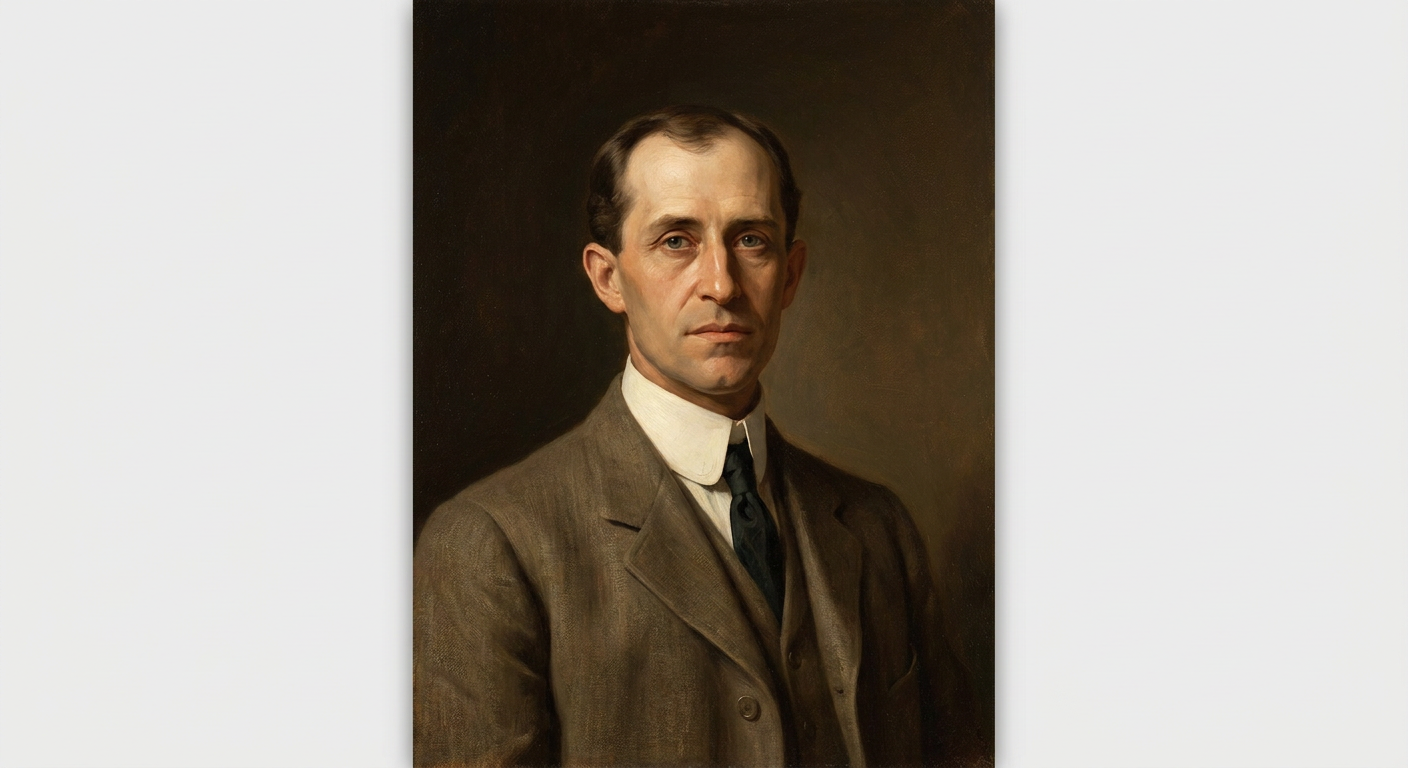
Quick Facts
- Years
- 1871 – 1948
- Category
- Scientists & Inventors
- Nationality
- American
- Occupation
- Inventor, aviation pioneer, engineer, printer, and bicycle manufacturer
Orville Wright
1871 – 1948 · American · Inventor, aviation pioneer, engineer, printer, and bicycle manufacturer
Recommended Audiobooks
Listen next from Marcus Alden

Life Lessons from James Clerk Maxwell
Marcus Alden · 42 min

Life Lessons from Archimedes
Marcus Alden · 48 min
Orville Wright helped transform one of humanity’s oldest dreams—controlled flight—into an engineering reality. Working with his elder brother Wilbur, he designed, built, and tested the first successful powered airplane. On December 17, 1903, near Kitty Hawk, North Carolina, Orville piloted the Wright Flyer for 12 seconds and traveled 120 feet. The distance was modest, but the achievement was revolutionary: a piloted, powered, heavier-than-air machine had taken off under its own power and remained under control.
That flight was not a lucky leap into the wind. It grew from years of disciplined experimentation involving gliders, wind-tunnel tests, propeller research, engine construction, and repeated failure. The brothers’ most important contribution was arguably not the engine but their practical system for controlling an aircraft in three dimensions. Modern airplanes use different mechanisms, yet they still operate around the same three axes the Wrights learned to command.
Orville’s career continued long after 1903. He helped improve the airplane, demonstrated it publicly, defended the Wright patents, advised the United States government on aviation, and guarded the historical reputation of the brothers’ work. His disputes with rivals and institutions made him controversial, but his place in technological history is secure. Students still study him because his life illustrates how observation, testing, partnership, persistence, and careful measurement can turn an improbable idea into a world-changing technology.
Quick Facts
| Field | Details |
|---|---|
| Full Name | Orville Wright |
| Common Name(s) | Orville; one of the Wright brothers |
| Born | August 19, 1871 |
| Died | January 30, 1948 |
| Age at Death | 76 |
| Birthplace | Dayton, Ohio, United States |
| Nationality | American |
| Occupation | Inventor, aviation pioneer, engineer, printer, bicycle manufacturer |
| Historical Era | Second Industrial Revolution; early age of aviation |
| Famous For | Piloting the first successful powered airplane flight and co-inventing a practical three-axis control system |
| Political Affiliation | No major partisan affiliation central to his public career |
| Religion | Raised in the Church of the United Brethren in Christ; his adult religious practice was private |
| Education | Dayton public schools; left high school without receiving a diploma |
| Parents | Milton Wright and Susan Catherine Koerner Wright |
| Spouse(s) | Never married |
| Children | None |
| Major Works | 1902 Wright glider; 1903 Wright Flyer; Wright Flyer III; U.S. Patent No. 821,393 |
| Major Achievements | First controlled powered flight; development of three-axis aircraft control; construction of an early practical airplane |
Early Life
Orville Wright was born in Dayton, Ohio, the fourth surviving child of Milton and Susan Catherine Koerner Wright. Milton was a clergyman who later became a bishop in the Church of the United Brethren in Christ. His responsibilities required frequent travel, and the family moved several times before settling permanently in Dayton in 1884.
Susan Wright had mechanical abilities unusual for anyone without formal technical training. She made household devices and toys and understood tools well enough to assist her children’s projects. Orville and Wilbur later credited their parents with encouraging curiosity rather than demanding unquestioning conformity.
A small toy helicopter brought home by Milton helped awaken the brothers’ interest in flight. Based on a design associated with the French aviation experimenter Alphonse Pénaud, it used twisted rubber bands to spin its rotors. The toy eventually broke, but the boys built copies. It did not directly produce the airplane; rather, it showed them that a heavier object could rise through aerodynamic force.
Orville was energetic, mischievous, and mechanically inclined. He enjoyed making things and once organized a neighborhood group of boys. He also took up printing. While still a teenager, he designed and assembled a printing press using discarded materials. With Wilbur, he published newspapers including the West Side News and later the short-lived Evening Item.
Neither brother graduated from high school. Orville left before completing his final year to pursue printing, while Wilbur’s plans for higher education had already been disrupted by injury and family responsibilities. Their lack of university training later made their accomplishments appear even more remarkable, although they were far from uneducated. They read extensively, corresponded with experts, and taught themselves the mathematics and mechanics required by each problem.
In 1892 they opened a bicycle business in Dayton. The Wright Cycle Company sold, repaired, and eventually manufactured bicycles under names such as the Van Cleve and St. Clair. The shop supplied income, tools, and practical experience with lightweight structures, bearings, chains, balance, and precision workmanship.
Rise to Prominence
The death of German glider pioneer Otto Lilienthal in 1896 drew Wilbur’s attention toward the unsolved problem of flight. Lilienthal had compiled valuable lift data and completed many gliding experiments, but his fatal crash also demonstrated the danger of inadequate control.
The brothers studied works by Lilienthal, Samuel Langley, Octave Chanute, and other experimenters. They wrote to the Smithsonian Institution for aviation literature and began corresponding with Chanute, an experienced civil engineer who became an adviser and supporter.
Their central insight was that flight required control, not merely powerful engines or large wings. Watching birds, Wilbur noticed how they altered the angles of their wings to remain balanced. The brothers developed wing warping, in which cables twisted the wings in opposite directions to control roll. A forward elevator controlled pitch, while a movable rudder eventually coordinated turning and corrected unwanted yaw.
They selected the sand dunes near Kitty Hawk and Kill Devil Hills, North Carolina, as a testing ground because the region offered steady winds, soft sand, open space, and relative privacy. Their 1900 glider carried a pilot but produced less lift than calculations predicted. The larger 1901 glider also performed poorly and sometimes behaved dangerously.
The disappointing 1901 season nearly ended the project. Rather than accept published aerodynamic tables, however, the brothers questioned them. During the winter of 1901–1902, they built a small wind tunnel and tested roughly 200 wing shapes, with detailed measurements on dozens of the most promising designs. The results produced more reliable lift and drag calculations.
Their 1902 glider was the breakthrough. Its combined wing warping and movable rudder gave the pilot effective control around three axes: roll, pitch, and yaw. The brothers completed hundreds of successful glides, some covering more than 600 feet. They were now confident that they could control an aircraft; the next problem was propulsion.
Major Achievements
Solving Three-Axis Control
The Wrights’ greatest conceptual achievement was integrating controls for roll, pitch, and yaw. Earlier experimenters often treated an aircraft as a vehicle that should remain naturally stable. The Wrights treated it more like a bicycle: a machine that a trained operator could actively balance and steer.
Wing warping was later replaced by ailerons on most airplanes, but the underlying principle of lateral control remained. Combined with elevators and rudders, this created the basic control framework still used in aviation.
Wind-Tunnel Research
The brothers’ wind tunnel allowed them to replace doubtful published figures with repeatable experimental evidence. Their homemade balances compared aerodynamic forces on different wing shapes. This work improved the 1902 glider and provided the data needed for a powered machine.
The historical importance of these tests lies in their method. Rather than building full aircraft by trial and error alone, the Wrights reduced a large problem into smaller measurable questions.
The First Powered Flights
Unable to find a manufacturer willing to produce a light enough engine, the brothers designed one themselves. Their mechanic, Charles E. Taylor, built a four-cylinder gasoline engine in the bicycle shop. It produced about 12 horsepower while remaining light enough for flight.
The Wrights also discovered that an aircraft propeller was not simply a ship’s screw used in air. They treated each propeller blade as a rotating wing and calculated an efficient design. Two wooden propellers were driven by chains from the engine.
On December 17, 1903, the Flyer was launched from a rail into a strong wind. Orville won a coin toss for the first piloting turn after Wilbur’s unsuccessful attempt three days earlier. The four flights were:
- Orville: 12 seconds and 120 feet
- Wilbur: about 12 seconds and 175 feet
- Orville: 15 seconds and 200 feet
- Wilbur: 59 seconds and 852 feet
After the fourth flight, a gust overturned and badly damaged the machine. It never flew again. Nevertheless, the brothers had demonstrated powered takeoff, sustained flight, and pilot control.
Developing a Practical Airplane
The 1903 Flyer was historic but difficult to operate. At Huffman Prairie outside Dayton, the brothers built improved machines. By 1905, Flyer III could take off repeatedly, circle, turn, and remain airborne for extended periods. On October 5, Wilbur flew more than 24 miles in about 39 minutes.
Many historians regard the 1905 machine as the first genuinely practical airplane because it could be controlled over meaningful distances and landed without major damage.
Public Demonstrations and Military Adoption
The Wrights initially avoided public flying while seeking patent protection and contracts. This secrecy contributed to skepticism. In 1908, however, Wilbur gave spectacular demonstrations in France, while Orville conducted U.S. Army trials at Fort Myer, Virginia.
Orville suffered severe injuries there on September 17, 1908, when a propeller split and the aircraft crashed. His passenger, Lieutenant Thomas Selfridge, died, becoming the first person killed in a powered-airplane accident. Orville returned to complete the trials in 1909. The Army then purchased its first airplane from the Wrights.
Leadership or Work
Orville and Wilbur worked through intense collaboration. They argued freely, tested competing explanations, and changed positions when evidence demanded it. Family members recalled that their debates could sound hostile, but the brothers regarded argument as a tool for uncovering errors.
Their working method emphasized:
- Breaking difficult problems into testable parts
- Recording results in notebooks and photographs
- Building equipment when commercial tools were inadequate
- Distrusting authority when observations contradicted it
- Protecting inventions through patents and controlled disclosure
Wilbur generally appeared more forceful in public and became the brothers’ principal negotiator. Orville was an exceptionally skilled mechanic and pilot, with a playful inventive streak. After Wilbur died of typhoid fever in 1912, Orville became president of the Wright Company. He disliked corporate management and sold his interests in 1915.
Orville’s strengths included patience, precision, courage, and experimental discipline. His weaknesses included stubbornness and a tendency to maintain disputes long after compromise might have served him better.
Personal Life
Orville never married and had no children. He remained deeply attached to his family, particularly Wilbur and their sister Katharine. Katharine managed domestic affairs, supported the brothers’ work, and accompanied them during their celebrated European visit in 1909.
The relationship between Orville and Katharine later deteriorated. When she married journalist Henry J. Haskell in 1926, Orville felt abandoned and refused contact. They reconciled only shortly before Katharine died in 1929. Biographers generally view the episode as evidence of Orville’s emotional dependence on family and his capacity for prolonged resentment.
He enjoyed practical jokes, collecting objects, cooking sweets, and tinkering with machinery. He lived quietly at Hawthorn Hill, the Dayton-area house he shared first with family members and later with household staff.
The Fort Myer crash left him with lasting physical problems, including recurring pain. He suffered a heart attack in 1947 and another in January 1948. He died in Dayton on January 30 and was buried in Woodland Cemetery beside Wilbur and other family members.
Philosophy or Beliefs
Orville grew up in a religious household, but he was not known primarily as a theological thinker. His father’s church career exposed the children to debates about conscience, institutional authority, and moral responsibility. As an adult, Orville kept his religious views comparatively private.
His clearest philosophy was practical and empirical: claims should be tested against evidence. The wind-tunnel campaign demonstrated his willingness to reject respected data when experiments produced different results.
The brothers also valued independence. They financed their early work themselves and resisted investors who might control it. Yet their commitment to patents shows that they did not regard invention as an entirely open public resource. They believed inventors deserved legal ownership and compensation.
Orville’s politics were not a major feature of his career. He worked with military institutions and accepted the airplane’s defense applications, but he also witnessed how aviation increased the destructive reach of war. His public outlook was generally civic-minded, technologically optimistic, and cautious about unsupported claims.
Challenges and Controversies
Priority Disputes
The Wrights were not the only aviation experimenters. Alberto Santos-Dumont, Glenn Curtiss, Samuel Langley, and others occupy important places in early flight history. Some national traditions give Santos-Dumont special recognition because his 1906 flights in France were publicly witnessed and used wheels rather than a launch rail.
Most aviation historians nevertheless identify the Wrights’ December 1903 flights as the first controlled, sustained flights of a powered, heavier-than-air piloted machine. Debate often reflects differing definitions of takeoff, public verification, and practical flight rather than denial that the Kitty Hawk flights occurred.
Patent Litigation
The Wrights received U.S. Patent No. 821,393 in 1906, focused on their system of aerodynamic control. They sued Glenn Curtiss and others whom they believed infringed it. A U.S. court ruled in the Wright Company’s favor in 1913.
Supporters argue that the brothers were defending legitimate intellectual property after years of costly research. Critics contend that aggressive litigation consumed attention, burdened manufacturers, and hindered American aviation before World War I. Historians disagree about how much the patent war delayed progress, since technical, financial, and government-policy factors also mattered.
Smithsonian Dispute
The Smithsonian Institution promoted Samuel Langley’s Aerodrome as capable of flight after Glenn Curtiss modified and flew it in 1914. Orville believed the tests misleadingly suggested that Langley’s original 1903 machine had been airworthy.
In protest, he loaned the 1903 Flyer to London’s Science Museum rather than the Smithsonian. The dispute ended after the Smithsonian revised its position. The Flyer returned to the United States and went on display in Washington in 1948, after Orville’s death.
The Fort Myer Crash
The 1908 accident raised difficult questions about aviation risk. Investigation indicated that a damaged propeller set off a chain of mechanical failures. There is no evidence that Orville knowingly flew an unsafe machine, but the tragedy demonstrated the hazards faced by passengers and pilots during experimental development.
Legacy
Orville Wright lived to see aviation grow from fragile wooden machines into a global transportation system. He witnessed military air power, commercial airlines, metal aircraft, and the beginnings of the jet age. His achievement influenced engineering, warfare, commerce, communication, exploration, and ideas about distance.
He served on the National Advisory Committee for Aeronautics, the predecessor of NASA, from 1920 until his death. His continued involvement linked the pioneer era to modern government-supported aerospace research.
Important places preserving the Wright story include:
- Wright Brothers National Memorial at Kill Devil Hills
- Dayton Aviation Heritage National Historical Park
- Carillon Historical Park in Dayton, home to the 1905 Wright Flyer III
- Smithsonian National Air and Space Museum, custodian of the 1903 Flyer
- Hawthorn Hill in Oakwood, Ohio
- Woodland Cemetery in Dayton
Ohio and North Carolina both commemorate the achievement. Ohio emphasizes the brothers’ design and construction work; North Carolina emphasizes the site of the first flights. The familiar phrase “First in Flight” is especially associated with North Carolina.
The brothers’ legacy is not that they invented every element of aviation. Their achievement came from combining existing knowledge with original control, aerodynamic, propulsion, and testing solutions. They converted scattered experiments into a functioning aircraft system.
Interesting Facts
- Orville was the pilot of the first successful flight, but Wilbur made the longest flight that day.
- A coin toss helped determine which brother would first attempt powered flight.
- The 1903 Flyer cost the brothers less than many competing government-backed projects.
- Charles E. Taylor built its engine in about six weeks.
- The Flyer used no wheels; it launched from a rail and landed on skids.
- The brothers’ propellers were hand-carved from laminated spruce.
- Orville took a camera to Kitty Hawk and arranged for John T. Daniels to photograph the first flight.
- Daniels had never operated a camera before taking the famous image.
- The Flyer’s engine is displayed with the aircraft at the Smithsonian.
- The 1903 machine flew only four times.
- Orville survived the world’s first fatal powered-airplane crash.
- He flew for less than five minutes during the entire year of 1903.
- Orville and Wilbur had no engineering degrees.
- Their bicycle shop funded much of their early research.
- Orville’s final airplane flight was in 1918 as a passenger in a military aircraft.
- He lived long enough to learn of Chuck Yeager’s 1947 supersonic flight.
- A piece of Wright Flyer fabric and wood traveled to the Moon with Apollo 11.
- Neither Wright brother married.
Famous Quotes
The brothers often wrote and spoke collectively, and popular quotation collections sometimes assign poorly sourced sayings to Orville. The following are documented or carefully qualified.
- “Success four flights Thursday morning.” — From Orville’s December 17, 1903 telegram to his father. Its restrained wording announced a world-changing result.
- “The longest 57 seconds.” — The same telegram understated the fourth flight, now timed at 59 seconds in the brothers’ records.
- “The first flight lasted only 12 seconds.” — Orville’s later account emphasized how small the beginning looked beside its historical importance.
- “It was nevertheless the first in the history of the world.” — From Orville’s description of the 1903 achievement, expressing the brothers’ claim to priority.
- “We now hold all the records!” — Written by Orville after the successful 1905 flights. The remark reflected confidence that they had produced a practical airplane.
- “The airplane stays up because it doesn’t have the time to fall.” — Frequently attributed to Orville, but its original source is uncertain; it should not be treated as securely documented.
- “Isn’t it astonishing that all these secrets have been preserved for so many years just so we could discover them!” — Commonly traced to family recollection and associated with the brothers’ exhilaration during experimentation.
- “No flying machine will ever fly from New York to Paris.” — Often attributed to Orville as a prediction from 1908, but wording and context vary. It is usually cited to show how rapidly aviation exceeded even a pioneer’s expectations.
- “We were lucky enough to grow up in an environment where there was always much encouragement to children to pursue intellectual interests.” — Orville, recalling the family culture that supported experimentation.
- “Curiosity is our most common trait.” — Often circulated under Orville’s name, but documentary support is weak; attribution should be considered uncertain.
Timeline
- 1871 — Orville Wright is born in Dayton, Ohio.
- 1878 — A toy helicopter helps inspire the brothers’ interest in mechanical flight.
- 1889 — Orville begins publishing the West Side News.
- 1892 — The brothers open their bicycle business.
- 1896 — Lilienthal’s death intensifies their interest in aviation.
- 1899 — Wilbur formally requests aviation literature from the Smithsonian; experiments with wing warping begin.
- 1900 — First glider tests take place near Kitty Hawk.
- 1901 — The second glider disappoints; the brothers build a wind tunnel.
- 1902 — Their third glider demonstrates effective three-axis control.
- 1903 — Orville makes the first powered flight on December 17.
- 1904 — Testing moves to Huffman Prairie near Dayton.
- 1905 — Flyer III demonstrates sustained, practical flight.
- 1906 — The Wright control-system patent is granted.
- 1908 — Orville demonstrates the airplane at Fort Myer and is seriously injured in the crash that kills Thomas Selfridge.
- 1909 — Orville completes Army trials; the military purchases a Wright airplane.
- 1909 — The Wright Company is incorporated.
- 1912 — Wilbur dies of typhoid fever; Orville becomes company president.
- 1913 — The Wright interests prevail in major patent litigation against Curtiss.
- 1915 — Orville sells his interest in the Wright Company.
- 1920 — He joins the National Advisory Committee for Aeronautics.
- 1926 — Katharine’s marriage causes a family estrangement.
- 1928 — The 1903 Flyer goes on display at the Science Museum in London.
- 1929 — Orville reconciles with Katharine shortly before her death.
- 1942 — The Smithsonian modifies its claims concerning Langley’s Aerodrome.
- 1947 — Orville suffers a heart attack and learns of the first supersonic flight.
- 1948 — He dies on January 30; the Flyer returns from Britain later that year.
Frequently Asked Questions
1. What exactly did Orville Wright invent?
Orville and Wilbur jointly developed an integrated airplane rather than a single isolated device. Their most influential invention was a system of aerodynamic control combining roll, pitch, and yaw. They also produced efficient propellers, gathered improved wing data, and built powered aircraft capable of controlled flight. Aircraft existed in experimental forms before them, but the Wrights solved the linked problems necessary to make powered piloted flight successful.
2. Did Orville fly before Wilbur?
Orville piloted the first successful powered flight on December 17, 1903. Wilbur had made an unsuccessful attempt on December 14 after winning an earlier coin toss, but the Flyer stalled and was damaged. Once repairs were complete, Orville took the next turn. Both brothers piloted two successful flights on December 17.
3. How far did Orville’s first flight travel?
The first flight covered 120 feet in 12 seconds. Orville lay face down beside the engine and operated the controls while the machine moved into a strong headwind. The achievement mattered because the Flyer took off under engine power, carried a pilot, remained airborne, and responded to its control system—not because it traveled a great distance.
4. Why did the Wrights choose Kitty Hawk?
They needed steady winds to provide additional airspeed, soft ground to reduce damage, open terrain, and freedom from crowds. Weather data suggested that coastal North Carolina was suitable. The local postmaster, William Tate, also responded helpfully to their inquiry. The dunes near Kill Devil Hills provided slopes for gliding and space for powered tests.
5. Were the Wright brothers really first?
Under the definition accepted by most aviation historians, yes: their 1903 Flyer achieved the first controlled and sustained powered flights by a piloted heavier-than-air machine. Competing claims depend on different criteria, such as public observation, wheeled takeoff, or earlier uncontrolled hops. Santos-Dumont’s public European flights remain historically important but occurred in 1906.
6. Why was aircraft control so important?
An engine could make an airplane move, but without control the pilot could not reliably balance, turn, climb, or descend. The Wrights coordinated movement around three axes. This changed flying from an unstable leap into an activity a pilot could direct. Modern controls differ mechanically, but aircraft still maneuver through roll, pitch, and yaw.
7. Did Orville build the Flyer’s engine?
The brothers designed the engine’s requirements, but their bicycle-shop mechanic Charles E. Taylor performed much of the construction. Taylor produced a lightweight four-cylinder engine with an aluminum crankcase. His contribution was essential, although historical accounts once gave him less attention than the Wrights.
8. Why did people initially doubt the Wrights?
The 1903 flights occurred in an isolated area before only a few witnesses, and early press reports contained errors. The brothers then limited public demonstrations while seeking patents and contracts. Meanwhile, exaggerated claims by other experimenters had made journalists skeptical. Dramatic demonstrations in Europe and the United States in 1908 finally removed serious doubt.
9. What happened in Orville’s 1908 crash?
During an Army demonstration at Fort Myer, part of a propeller failed. The resulting damage affected the aircraft’s control and structure, causing it to plunge to the ground. Orville suffered broken bones and other injuries. His passenger, Lieutenant Thomas Selfridge, died from a skull injury. The accident became the first fatality involving a powered airplane.
10. Why were the Wright patent lawsuits controversial?
The Wrights believed competitors were using their patented control principles without permission. Courts largely supported their claim. Critics argued that litigation discouraged American manufacturers and absorbed energy that might have gone into innovation. Scholars continue to debate the lawsuits’ overall effect, and it is overly simple either to blame them for every American weakness or dismiss their impact entirely.
11. Why did Orville send the Flyer to Britain?
Orville objected to Smithsonian statements suggesting that Samuel Langley’s Aerodrome had been capable of flight before the Wrights’ success. He believed later tests used extensive modifications that were not properly acknowledged. To protest, he loaned the Flyer to London’s Science Museum in 1928. It returned after the dispute was resolved.
12. Did Orville continue flying?
Orville’s active piloting declined as business, legal disputes, and advisory work occupied him. His last flight as a pilot occurred in 1918, according to standard Wright chronologies, and he later flew as a passenger. He remained deeply involved in aviation through research advice, public service, historical preservation, and his membership on the NACA.
13. Why did Orville never marry?
No surviving evidence provides one definitive reason. Both brothers devoted much of their adulthood to family, business, and aviation, and neither married. It would be speculative to assign a private motive without documentation. Orville maintained especially close relationships with Wilbur and Katharine, and changes in those relationships affected him strongly.
14. Did the Wrights invent the airplane entirely by themselves?
No invention emerges without predecessors. The brothers learned from Lilienthal, Chanute, Pénaud, Cayley, Langley, and others. Their achievement was to identify errors, create effective control, improve aerodynamic data, design propellers, and integrate the components into a working system. Recognizing earlier contributors does not diminish the originality of their solution.
15. What became of the original Flyer?
After the final 1903 flight, a gust overturned and damaged it. The brothers repaired and stored the machine but never flew it again. It was later exhibited in Britain during Orville’s dispute with the Smithsonian. Since 1948 it has belonged to the Smithsonian and is displayed by the National Air and Space Museum.
16. What did Orville do after Wilbur died?
Orville assumed the presidency of the Wright Company but found corporate administration burdensome. He sold the company in 1915 and concentrated on technical consultation, public honors, historical disputes, and advisory service. His long NACA membership allowed him to contribute to American aeronautical policy without managing a factory.
Lessons We Can Learn
- Test accepted wisdom. The Wrights checked published lift tables in a wind tunnel. Modern lesson: authority is useful, but evidence should remain open to verification.
- Solve the controlling problem first. They focused on balance and steering before engine power. This suggests identifying the bottleneck rather than the most visible problem.
- Break complexity into parts. Wings, controls, propellers, and engines were studied separately before integration.
- Use failure as data. The poor 1901 glider almost ended the project, yet its failure led to better measurements.
- Keep careful records. Notes and photographs helped the brothers compare results and later establish what occurred.
- Choose complementary partners. Orville’s mechanical instincts and Wilbur’s analytical and public strengths reinforced one another.
- Build missing tools. When reliable testing equipment was unavailable, they constructed a wind tunnel and measuring balances.
- Protect ideas without losing perspective. Their patents were legitimate, but the later conflict shows how legal defense can consume inventive energy.
- Take calculated, not careless, risks. Their experiments were hazardous, yet they advanced in stages from kites to gliders to powered machines.
- Expect achievements to have unintended effects. Aviation enabled travel and exchange but also transformed warfare. Innovation carries consequences beyond an inventor’s original purpose.
These are modern interpretations drawn from documented events, not a formal list of principles written by Orville.
Related Historical Figures
- Wilbur Wright — Orville’s brother, co-inventor, experimental partner, and principal public representative.
- Charles E. Taylor — Wright Cycle Company mechanic who built the Flyer’s engine.
- Otto Lilienthal — German glider pioneer whose data and death influenced the brothers.
- Octave Chanute — Engineer, aviation author, adviser, and early supporter of the Wright experiments.
- Alberto Santos-Dumont — Brazilian aviation pioneer associated with the first widely witnessed powered flights in Europe.
- Glenn Curtiss — American pilot and manufacturer who became the Wrights’ chief patent rival.
- Samuel Pierpont Langley — Smithsonian secretary whose unsuccessful Aerodrome project prompted a later priority dispute.
- Katharine Wright — Orville’s sister, family organizer, teacher, and important public supporter of the brothers.
- Thomas Selfridge — Army officer killed while flying as Orville’s passenger in 1908.
- John T. Daniels — Lifesaving Service member who took the famous photograph of the first flight.
Watch and Learn
Video: Wright Brothers First Flight, 1903
Channel: AIRBOYD
Approximate duration: 1–2 minutes
This widely circulated archival presentation offers a concise visual introduction to the Wrights’ 1903 achievement. Because genuine motion-picture footage of the December 17 flights does not exist, viewers should understand it as a short historical presentation built around surviving images and aviation records rather than film of the first flight itself.
Watch and Learn
Wright Brothers First Flight, 1903 · AIRBOYD
Related Historical Figures