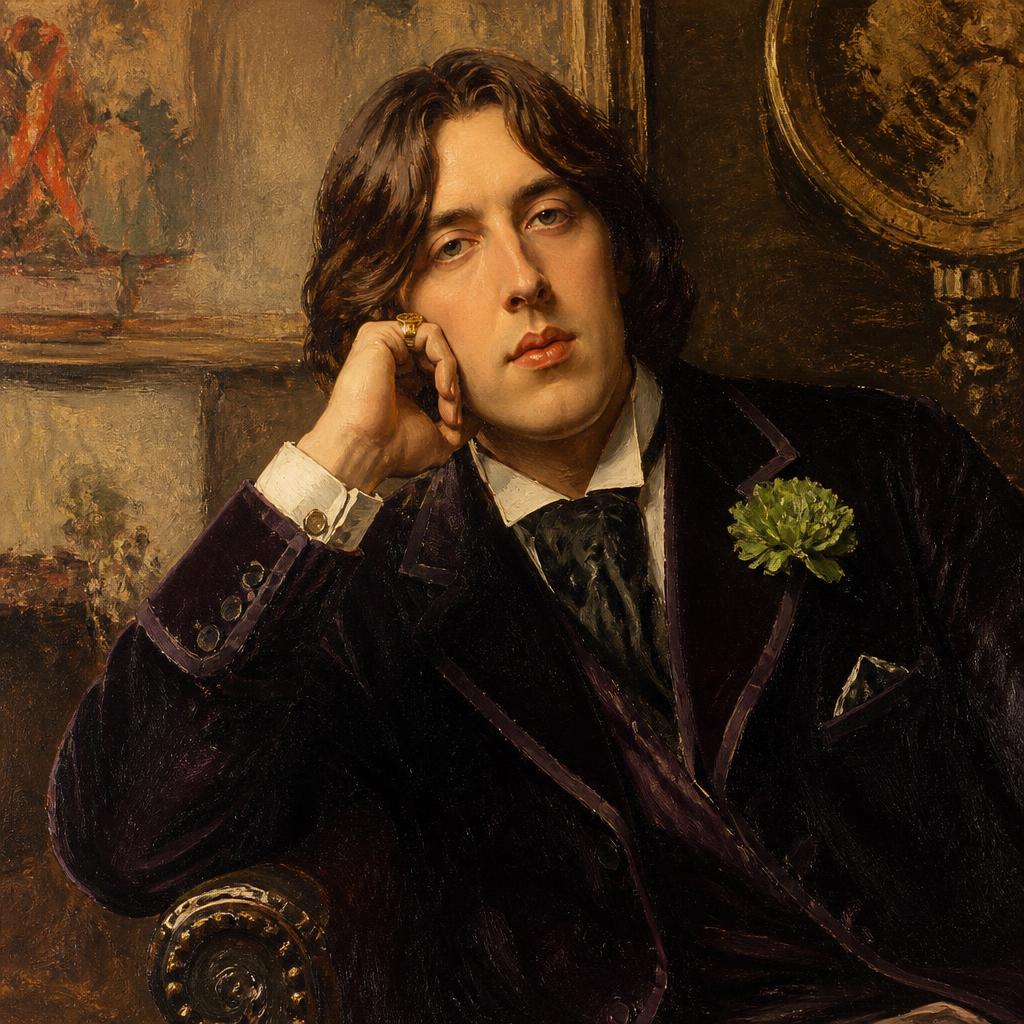
Quick Facts
- Years
- 1854 – 1900
- Category
- Writers & Poets
- Subcategory
- Playwrights
- Nationality
- Irish
- Occupation
- Playwright & Novelist
Oscar Wilde
1854 – 1900 · Irish · Playwright & Novelist
Audiobook

Life Lessons from Oscar Wilde
Marcus Alden · 48 min
Oscar Wilde was an Irish playwright, novelist, poet, essayist, and critic whose verbal brilliance made him one of the most celebrated—and ultimately most persecuted—writers of the late Victorian age. Born in Dublin in 1854, he distinguished himself as a classical scholar before becoming famous in London for his wit, flamboyant self-presentation, and advocacy of aestheticism: the belief that art need not serve a moral or practical purpose.
Wilde wrote in several forms, but his reputation rests especially on The Picture of Dorian Gray, the fairy-tale collections, the critical dialogue The Critic as Artist, and four major social comedies culminating in The Importance of Being Earnest. Through epigrams, mistaken identities, and elegantly constructed plots, his plays exposed the vanity and hypocrisy beneath respectable Victorian manners.
His public triumph ended catastrophically in 1895. After an unsuccessful libel action against the Marquess of Queensberry, Wilde was prosecuted for sexual acts between men and sentenced to two years of imprisonment with hard labour. The experience damaged his health and inspired De Profundis and The Ballad of Reading Gaol. He died in exile in Paris in 1900, aged 46. Wilde remains important for his literary innovation, his critique of social conformity, and his place in the history of sexuality, censorship, and LGBTQ+ persecution.
Quick Facts
| Field | Details |
|---|---|
| Full Name | Oscar Fingal O’Flahertie Wills Wilde |
| Common Name(s) | Oscar Wilde |
| Born | 16 October 1854 |
| Died | 30 November 1900 |
| Age at Death | 46 |
| Birthplace | 21 Westland Row, Dublin, Ireland |
| Nationality | Irish |
| Occupation | Playwright, novelist, poet, essayist, critic, lecturer |
| Historical Era | Victorian era; Irish Literary Revival context |
| Famous For | The Picture of Dorian Gray; The Importance of Being Earnest; society comedies; epigrams; aestheticism |
| Political Affiliation if applicable | No formal party affiliation recorded; expressed individualist and socialist ideas |
| Religion if significant | Raised in the Church of Ireland; long attracted to Roman Catholicism and received into the Catholic Church shortly before death |
| Education | Portora Royal School; Trinity College Dublin; Magdalen College, Oxford |
| Parents | Sir William Wilde and Jane Francesca Wilde, known as “Speranza” |
| Spouse(s) | Constance Lloyd, married 1884 |
| Children | Cyril Holland and Vyvyan Holland |
| Major Works | The Picture of Dorian Gray; The Importance of Being Earnest; An Ideal Husband; Lady Windermere’s Fan; Salome; De Profundis; The Ballad of Reading Gaol |
| Major Achievements | Leading figure in aestheticism; master of Victorian social comedy; influential novelist, critic, and prison writer |
Early Life
Oscar Wilde was born at 21 Westland Row, Dublin, on 16 October 1854. His father, Sir William Wilde, was a prominent eye and ear surgeon who also studied Irish archaeology, folklore, and antiquities. His mother, Jane Francesca Wilde, wrote nationalist poetry under the name “Speranza” and hosted a literary salon. Their household brought together science, folklore, politics, and performance, all of which shaped Oscar’s imagination.
Wilde had an older brother, William, and a younger sister, Isola, who died in childhood in 1867. Her death affected him deeply; he later commemorated her in the poem “Requiescat.” Sir William also had children born outside his marriage.
From 1864 to 1871, Wilde attended Portora Royal School at Enniskillen, where he excelled in classical studies. He then entered Trinity College Dublin. The classicist John Pentland Mahaffy encouraged his interest in ancient Greek culture and accompanied him on travels. Wilde won academic distinctions, including the Berkeley Gold Medal.
In 1874 he received a scholarship to Magdalen College, Oxford. There he encountered the writings and lectures of John Ruskin and Walter Pater. Ruskin linked beauty with moral and social responsibility; Pater emphasized intense aesthetic experience. Wilde absorbed both influences without simply adopting either position.
At Oxford, Wilde cultivated a conspicuous public image involving long hair, decorative rooms, lilies, sunflowers, and provocative remarks about beauty. He also became an accomplished scholar, travelled in southern Europe, and won the 1878 Newdigate Prize for his poem “Ravenna.” The late Victorian world prized respectability, imperial confidence, and rigid gender conventions, but it also contained vigorous debates over faith, science, art, class, and sexuality. Wilde’s career emerged from those tensions.
Rise to Prominence
After leaving Oxford in 1878, Wilde settled in London. His first collection, Poems, appeared in 1881. Reviews were mixed, and critics questioned its originality, but the volume attracted attention and went through further impressions.
His public persona soon became almost as famous as his writing. Gilbert and Sullivan’s comic opera Patience satirized aesthetic fashions, and Wilde was associated in the public mind with the movement. In 1882, impresario Richard D’Oyly Carte arranged a lecture tour across the United States and Canada. Wilde spoke on aestheticism, decorative arts, dress, and the “English Renaissance” in art. The tour combined serious advocacy with publicity, caricature, and theatrical self-presentation.
Wilde lectured in Britain after returning from North America and spent part of 1883 in Paris. In 1884 he married Constance Lloyd. Seeking stable income, he edited the magazine The Woman’s World from 1887 to 1889, broadening its attention to literature, education, politics, and women’s professional lives.
His literary standing rose through short fiction and criticism. The Happy Prince and Other Tales appeared in 1888, followed by the essay “The Decay of Lying” and the novel The Picture of Dorian Gray. First published in Lippincott’s Monthly Magazine in 1890, the novel provoked moral criticism. Wilde revised and expanded it for book publication in 1891, adding a preface of aphorisms defending artistic autonomy.
The decisive breakthrough came in the theatre. Lady Windermere’s Fan opened in 1892 and succeeded with fashionable audiences. A Woman of No Importance followed in 1893, while An Ideal Husband and The Importance of Being Earnest opened in 1895. Wilde had become one of London’s leading dramatists just before legal scandal destroyed his career.
Major Achievements
Transforming Victorian Social Comedy
Wilde revitalized the comedy of manners through Lady Windermere’s Fan, A Woman of No Importance, An Ideal Husband, and The Importance of Being Earnest. He combined tightly controlled plots with epigrams that reverse conventional assumptions about marriage, morality, politics, and social rank.
These plays mattered because their elegance did not prevent serious criticism. Wilde showed how respectable society could forgive wrongdoing when money, status, or charm made forgiveness convenient. His comedies influenced later dramatists, including Noël Coward and Tom Stoppard, and remain regularly performed.
Writing The Picture of Dorian Gray
Wilde’s only novel tells of a beautiful young man whose portrait records the corruption concealed by his unchanged face. The work explores influence, desire, conscience, secrecy, art, and self-destruction.
Contemporary critics often treated the novel as morally dangerous. Wilde answered that art should not be judged by simple moral instruction, although the narrative itself undeniably portrays consequences. Its ambiguity has ensured its longevity, making it central to studies of Gothic fiction, decadence, sexuality, and Victorian culture.
Advancing Aesthetic and Critical Thought
In essays and dialogues such as “The Decay of Lying,” “The Critic as Artist,” and “The Truth of Masks,” Wilde argued that art transforms rather than merely copies life. He elevated criticism into a creative activity and challenged utilitarian expectations.
His paradoxes anticipated later debates about interpretation, performance, and the instability of identity. Although he was not the sole or founding theorist of aestheticism, he became its most recognizable English-language public representative.
Creating Fairy Tales with Social Depth
The Happy Prince and Other Tales and A House of Pomegranates joined fantasy with reflections on poverty, sacrifice, love, beauty, and exclusion. Stories such as “The Happy Prince,” “The Selfish Giant,” and “The Nightingale and the Rose” can be read by children, but their irony and sorrow also address adults.
Their long-term influence extends through children’s literature, adaptations, school curricula, music, theatre, and film.
Turning Imprisonment into Literature
During imprisonment Wilde wrote a long letter to Lord Alfred Douglas, later published in an edited form as De Profundis. After release, he wrote The Ballad of Reading Gaol, inspired particularly by the execution of fellow prisoner Charles Thomas Wooldridge.
These works replaced the polish of the society comedies with suffering, introspection, and institutional criticism. They became important testimonies about punishment, shame, compassion, and the destructive conditions of Victorian prisons.
Leadership and Work
Wilde held no major political office or institutional command, so “leadership” in his case was cultural. He led through performance, conversation, journalism, and literary example. He understood publicity exceptionally well, turning clothing, speech, and social appearances into extensions of his artistic identity.
His working method balanced apparent spontaneity with extensive revision. Manuscripts show that many seemingly effortless epigrams were carefully refined. In drama, he adapted inherited conventions—the secret past, misplaced objects, mistaken identities—and made them vehicles for linguistic surprise.
As editor of The Woman’s World, Wilde commissioned prominent contributors and shifted the periodical away from narrow fashion coverage. His editorial record reflected an interest in women’s education and public participation, though his views still bore marks of his time.
Wilde valued beauty, individuality, intellectual freedom, and style. He could be generous to friends and younger writers, but he was also extravagant, sometimes imprudent, and dangerously confident in his ability to control events. His decision to sue Queensberry, despite grave legal risks, revealed both courage and catastrophic misjudgment.
His relationships mixed affection, patronage, rivalry, and dependency. Friends such as Robert Ross remained loyal; others withdrew during scandal. Wilde’s greatest strengths—boldness, theatrical confidence, and resistance to convention—could become weaknesses when applied to law, money, or hostile social institutions.
Personal Life
Wilde married Constance Lloyd on 29 May 1884. Intelligent, educated, and interested in dress reform and social causes, Constance brought financial stability to the marriage. Their sons Cyril and Vyvyan were born in 1885 and 1886. Wilde wrote and told stories for children, and accounts from his sons indicate that he was affectionate before the family was divided by scandal.
During the later 1880s and 1890s, Wilde had relationships with men. His most consequential attachment was to Lord Alfred Douglas, called “Bosie,” whom he met in 1891. Their intense and frequently quarrelsome relationship involved emotional attachment, lavish spending, separations, and reconciliations. Douglas’s conflict with his father, the Marquess of Queensberry, helped precipitate Wilde’s trials.
Wilde enjoyed fine clothing, food, hotels, conversation, books, theatre, and decorative interiors. His wit was celebrated in drawing rooms, but surviving accounts also describe kindness and serious intellectual engagement beneath the comic persona.
Imprisonment severely harmed his health. He endured hard labour, poor diet, isolation, and illness; after a collapse, an ear injury contributed to continuing problems. Following release, he lived mainly in France under the name Sebastian Melmoth and was often short of money.
Constance changed the family surname to Holland and kept the children apart from him. She died in 1898 following complications after surgery. Wilde died at the Hôtel d’Alsace in Paris on 30 November 1900. Meningitis was diagnosed near the end of his life, probably connected to chronic ear disease; older claims that syphilis caused his death remain disputed and are not established by surviving evidence.
Philosophy and Beliefs
Wilde resisted fixed systems. His aestheticism defended art’s freedom from crude moral measurement. The preface to Dorian Gray declares that books are well or badly written rather than moral or immoral. Yet his fiction and drama repeatedly examine ethical responsibility, cruelty, forgiveness, and the costs of self-deception.
In “The Soul of Man under Socialism,” Wilde imagined a society in which machinery and common ownership would free individuals from degrading labour and coercive charity. His socialism was libertarian and individualist rather than party-based. He opposed authoritarian control because he believed genuine personality required freedom.
Wilde’s Irish background mattered, although he built his career in Britain and did not pursue organized nationalist politics. His mother’s nationalism, his father’s antiquarian interests, and his own status as an Irish outsider informed his complex relationship with English society.
Religiously, Wilde was raised Protestant but remained fascinated by Catholic ritual, symbolism, sin, forgiveness, and suffering. He did not maintain conventional observance throughout life. According to Robert Ross’s account, a priest received him into the Roman Catholic Church when he was dying.
His ethical vision became more explicitly compassionate after prison. De Profundis interprets suffering through Christian imagery, while The Ballad of Reading Gaol attacks dehumanizing punishment. Scholars differ over how literally to take Wilde’s shifting declarations: paradox and role-playing were central to his thought, not merely decorative habits.
Challenges and Controversies
Wilde faced criticism from the beginning. Some reviewers dismissed his aesthetic persona as artificial, while others accused his early poetry of borrowing too heavily from established writers. His talent for publicity also encouraged the misconception that he was only a performer rather than a disciplined author.
The Picture of Dorian Gray became a major controversy. Critics described it as unhealthy or corrupting, using language often coded around same-sex desire. Wilde defended artistic freedom and revised the novel. One interpretation sees the revisions as concessions to censorship; another emphasizes that they enriched the book’s philosophical and narrative structure.
The defining crisis began when Queensberry left a card at Wilde’s club accusing him, in misspelled wording, of “posing as a somdomite.” Encouraged by Douglas, Wilde prosecuted Queensberry for criminal libel in 1895. Queensberry’s defense gathered evidence about Wilde’s sexual life. When the case collapsed, Wilde was arrested.
A first criminal trial ended without a verdict on the principal charges. At a second trial, Wilde was convicted of “gross indecency” under the Criminal Law Amendment Act 1885 and sentenced to two years with hard labour. The law criminalized sexual acts between men; women were not included. Modern assessments recognize Wilde as a victim of discriminatory legislation and social persecution.
Historical sympathy does not remove all difficult questions. Evidence introduced at the trials concerned encounters with younger working-class men, creating issues of class, money, and power. The known individuals were legally adults or near adulthood under contemporary law, and claims that Wilde was convicted of child abuse are false. Scholars nevertheless debate the ethics and social inequalities surrounding some relationships.
Wilde’s libel action was a major personal error. Friends had warned him, and Queensberry’s defense could expose private conduct. However, the choice occurred amid provocation, attachment to Douglas, concern for reputation, and a legal culture that made open acknowledgment of homosexuality impossible.
After prison, Wilde reunited briefly with Douglas despite objections from supporters. Their separation followed. His expenditure and dependence strained friendships. These failures form part of the biography without diminishing the injustice of his prosecution or the achievement of his work.
Legacy
Wilde’s reputation recovered gradually after his death. Early publications of De Profundis, biographies, editions of his letters, and revivals of the plays moved discussion beyond scandal. His works are now central to English-language theatre, Irish literary history, queer studies, Victorian studies, and debates about censorship.
His influence is visible in modern comedy’s epigrammatic dialogue and in literature that treats identity as performance. Writers and dramatists from George Bernard Shaw and Noël Coward to later authors have responded to his style, courage, and contradictions.
Wilde has also become an international symbol of LGBTQ+ history. That status must be handled historically: modern identity labels do not map perfectly onto Victorian experience, but his punishment clearly exemplifies the persecution of male same-sex desire.
Major memorials include Jacob Epstein’s tomb in Père Lachaise Cemetery, Paris; Maggi Hambling’s A Conversation with Oscar Wilde in London; and Danny Osborne’s statue in Merrion Square, Dublin. His birthplace survives in Dublin, and collections relating to him are held by institutions including Trinity College Dublin, the British Library, and major university libraries.
The Oscar Wilde Society promotes interest in his life and work. His plays continue to be staged worldwide, while his stories and novel inspire films, operas, ballets, illustrations, and new fiction. He remains modern because he asks enduring questions: Who controls reputation? Is identity authentic or performed? What does society conceal behind morality? What responsibilities accompany beauty and freedom?
Interesting Facts
- Wilde’s full name was Oscar Fingal O’Flahertie Wills Wilde.
- His mother published Irish nationalist verse as “Speranza.”
- His father was knighted for his medical service.
- Wilde won Oxford’s Newdigate Prize for “Ravenna” in 1878.
- He lectured across North America throughout much of 1882.
- He visited a silver mine at Leadville, Colorado, during that tour.
- His first play, Vera; or, The Nihilists, was staged in New York in 1883.
- He edited The Woman’s World from 1887 to 1889.
- The Picture of Dorian Gray first appeared in a magazine in 1890.
- The expanded book edition of the novel appeared in 1891.
- Salome was written in French.
- Sarah Bernhardt planned to play Salome, but the London production was prohibited.
- Richard Strauss later transformed Salome into a famous opera.
- Wilde’s two sons adopted the surname Holland after his conviction.
- Prison records identified him as C.3.3 at Reading Gaol.
- The Ballad of Reading Gaol was initially published under the name C.3.3.
- Wilde adopted “Sebastian Melmoth” as an alias after prison.
- He died in Paris and is buried in Père Lachaise Cemetery.
- Visitors’ lipstick repeatedly marked his tomb until protective glass was installed.
- The word “Earnest” in his best-known play evokes both moral seriousness and concealed identity.
Famous Quotes
- “All art is quite useless.” — From the preface to The Picture of Dorian Gray (1891). The paradox rejects demands that art justify itself through practical utility; it does not mean art lacks value.
- “There is no such thing as a moral or an immoral book.” — Also from the Dorian Gray preface. Wilde was answering critics who judged fiction mainly by presumed moral effects.
- “The only way to get rid of a temptation is to yield to it.” — Lord Henry in The Picture of Dorian Gray. The line expresses his seductive hedonism, not necessarily Wilde’s settled advice.
- “Life imitates Art far more than Art imitates Life.” — “The Decay of Lying” (1889). Wilde argues that artistic conventions teach people how to perceive reality.
- “The truth is rarely pure and never simple.” — Algernon in The Importance of Being Earnest (1895). It undercuts moral certainty while setting up the play’s deceptions.
- “In matters of grave importance, style, not sincerity, is the vital thing.” — Gwendolen in The Importance of Being Earnest. The joke exposes a society that rewards appearances.
- “A man who does not think for himself does not think at all.” — “The Soul of Man under Socialism” (1891). It summarizes Wilde’s defense of individual intellectual freedom.
- “We are all in the gutter, but some of us are looking at the stars.” — Lord Darlington in Lady Windermere’s Fan (1892). Its context mixes idealism with the speaker’s compromised motives.
- “Yet each man kills the thing he loves.” — The Ballad of Reading Gaol (1898). Wilde broadens one prisoner’s tragedy into a meditation on destructive human conduct.
- “The supreme vice is shallowness.” — De Profundis. Written after his downfall, it marks Wilde’s effort to reinterpret experience through humility and suffering.
- “Be yourself; everyone else is already taken.” — Widely attributed to Wilde but not reliably found in his authenticated works; attribution is disputed.
Timeline
- 1854 — Born in Dublin on 16 October.
- 1864 — Entered Portora Royal School.
- 1867 — His sister Isola died.
- 1871 — Began studying at Trinity College Dublin.
- 1874 — Entered Magdalen College, Oxford, on scholarship.
- 1878 — Won the Newdigate Prize for “Ravenna” and completed his Oxford degree.
- 1881 — Published Poems.
- 1882 — Conducted an extensive North American lecture tour.
- 1883 — Vera; or, The Nihilists opened in New York; Wilde spent time in Paris.
- 1884 — Married Constance Lloyd.
- 1885 — Son Cyril was born.
- 1886 — Son Vyvyan was born.
- 1887 — Began editing The Woman’s World.
- 1888 — Published The Happy Prince and Other Tales.
- 1890 — The Picture of Dorian Gray appeared in Lippincott’s Monthly Magazine.
- 1891 — Expanded Dorian Gray published; Wilde met Lord Alfred Douglas; Intentions and A House of Pomegranates appeared.
- 1892 — Lady Windermere’s Fan opened; Salome was barred from public performance in England.
- 1893 — A Woman of No Importance opened.
- 1895 — An Ideal Husband and The Importance of Being Earnest opened; Wilde’s libel action failed; he was convicted and imprisoned.
- 1897 — Released from prison; moved to France.
- 1898 — Published The Ballad of Reading Gaol; Constance died.
- 1900 — Died in Paris on 30 November.
- 1905 — A shortened version of De Profundis was published.
- 1962 — A substantially fuller version of De Profundis became publicly available in Wilde’s collected letters.
Frequently Asked Questions
Who was Oscar Wilde?
Oscar Wilde was an Irish writer famous for plays, fiction, criticism, poetry, and conversation. Educated in Dublin and Oxford, he became the most visible advocate of British aestheticism and later a highly successful London dramatist. His best-known works include The Picture of Dorian Gray and The Importance of Being Earnest. In 1895 he was convicted under a law criminalizing sexual acts between men and imprisoned for two years. His later writing transformed that suffering into criticism of punishment and reflections on responsibility.
Why is Oscar Wilde important?
Wilde reshaped English comedy by combining intricate theatrical construction with paradoxical language and social criticism. His novel became a classic of Gothic and decadent literature, while his essays challenged assumptions about realism, criticism, and artistic morality. His prosecution also makes his life central to the history of sexuality and state persecution. Modern readers study him not only as a witty celebrity but as an Irish intellectual whose career illuminates class, gender, censorship, religion, empire, and the gap between public respectability and private conduct.
What is Oscar Wilde’s most famous work?
The Importance of Being Earnest is probably Wilde’s most famous play and perhaps his most frequently performed work. Its characters invent identities, pursue marriage, and confuse a name with moral character. The Picture of Dorian Gray is equally famous internationally as his only novel. Choosing between them depends on genre: the play represents Wilde’s comic mastery, while the novel provides his most sustained exploration of beauty, influence, secrecy, and moral consequence.
Was Oscar Wilde Irish or British?
Wilde was born and raised in Dublin, so he is properly described as Irish. Ireland was then part of the United Kingdom of Great Britain and Ireland, and he built most of his career in London. His education, publishing network, and legal ordeal unfolded within British institutions, but his Irish family background was significant. Both parents engaged deeply with Irish culture, and his mother wrote nationalist poetry. Scholars therefore often emphasize his position as an Irish outsider who mastered and mocked English high society.
What was aestheticism?
Aestheticism was a broad nineteenth-century movement emphasizing beauty, artistic experience, and art’s independence from conventional moral or practical purposes. Wilde did not invent it; figures such as Walter Pater, James McNeill Whistler, and others helped shape its ideas. Wilde became its most famous public spokesman through lectures, essays, clothing, decoration, and satire. His phrase “art for art’s sake” outlook opposed the belief that every artwork must teach a clear lesson, although his own works frequently engage with moral and social questions.
Why was The Picture of Dorian Gray controversial?
Reviewers objected to its atmosphere of decadence, its treatment of influence and vice, and suggestions of desire between men. Victorian critics often assumed that fiction should uphold recognizable moral standards. Wilde responded that artistic quality should not be confused with moral instruction. For the 1891 book edition, he expanded the story, modified passages, and added a provocative preface. Scholars disagree about whether those changes chiefly represented censorship, strategic self-defense, or artistic development; they likely involved all three.
Who was Lord Alfred Douglas?
Lord Alfred Douglas was a young aristocrat and poet whom Wilde met in 1891. Known as Bosie, he became Wilde’s lover and a central figure in his private life. Their relationship was passionate but volatile. Douglas’s bitter conflict with his father, the Marquess of Queensberry, led to public confrontation. After Queensberry accused Wilde of posing as a sodomite, Wilde sued him for libel, a decision that opened his own conduct to investigation. Wilde and Douglas later separated after a brief post-prison reunion.
Why did Oscar Wilde go to prison?
Wilde was imprisoned after being convicted of “gross indecency” under Section 11 of the Criminal Law Amendment Act 1885, which criminalized sexual acts between men. The prosecution followed Wilde’s failed libel case against Queensberry. Evidence gathered for Queensberry’s defense was passed to the authorities. Wilde’s first criminal trial ended with the jury unable to agree on most counts; a second trial produced a conviction. He received the maximum sentence of two years with hard labour, a punishment now recognized as profoundly unjust and discriminatory.
Did Wilde write De Profundis in prison?
Yes. During the final part of his imprisonment at Reading Gaol, Wilde wrote a long letter addressed to Lord Alfred Douglas. Prison authorities permitted writing under controlled conditions, but Wilde could not send the manuscript as he composed it. He entrusted it to Robert Ross after release. Ross published a shortened version titled De Profundis in 1905. The work combines accusation, self-criticism, spiritual reflection, and an effort to interpret suffering. Publication history matters because early readers encountered an incomplete text.
What is The Ballad of Reading Gaol about?
The poem reflects on imprisonment and the execution of Charles Thomas Wooldridge, a soldier convicted of murdering his wife. Wilde uses the case to examine guilt, fear, punishment, and the emotional destruction caused by prison. Its refrain insists that people destroy what they love in different ways. Published in 1898 under Wilde’s prison designation, C.3.3, it reached a wide readership. The poem is both a personal response to confinement and an indictment of a penal system that degraded prisoners rather than reforming them.
Was Oscar Wilde religious?
Wilde’s religious life was complex. Raised in the Church of Ireland, he became fascinated by Roman Catholic ritual and theology while young. His writing often uses Christian themes—sin, sacrifice, forgiveness, suffering—without consistently affirming orthodox doctrine. In De Profundis, he presents Christ as an artist and supreme individualist. Robert Ross reported that a Catholic priest received Wilde into the Church shortly before his death. His religion is therefore best understood as a lifelong attraction that intensified at particular moments rather than straightforward observance.
Was Oscar Wilde a socialist?
Wilde advocated a distinctive socialism in “The Soul of Man under Socialism.” He imagined common ownership and automation eliminating poverty and compulsory labour, thereby allowing individual creativity to flourish. His position was anti-authoritarian and suspicious of organized coercion, including coercive government. He was not a party organizer, economic theorist, or conventional Marxist. Calling him a socialist is accurate when tied to this essay, but his socialism should not be confused with every movement that has used that label.
How did prison affect Wilde?
Prison destroyed Wilde’s public career, finances, domestic life, and much of his health. Hard labour, isolation, inadequate food, and humiliating discipline caused physical and psychological suffering. Yet imprisonment also changed his literary voice. De Profundis and The Ballad of Reading Gaol confront pain, responsibility, compassion, and institutional cruelty more directly than his society comedies. After release he campaigned privately for prison reform and wrote about abuses affecting children. He never recovered his former health or professional position.
How did Oscar Wilde die?
Wilde died on 30 November 1900 at the Hôtel d’Alsace in Paris. He had suffered persistent ill health after prison, including serious ear problems. Doctors diagnosed meningitis near the end. Some older biographies asserted that syphilis caused his death, but the evidence is inconclusive, and modern medical-historical assessments often favor meningitis associated with chronic ear infection. Certainty is impossible because the surviving medical documentation is limited. He was 46 and living under financially reduced circumstances.
What happened to Wilde’s wife and children?
Constance Wilde remained legally married to Oscar but separated from him after the scandal. She changed her surname and those of their sons to Holland, seeking protection from publicity. Cyril and Vyvyan were prevented from seeing their father again. Constance died in 1898 after complications associated with surgery. Cyril later died in military service during the First World War. Vyvyan became an author and translator, wrote about his father, and had a son, Merlin Holland, who became an important editor and researcher of Wilde materials.
Was Salome banned?
A planned London production starring Sarah Bernhardt was stopped in 1892 because British law prohibited theatrical portrayals of biblical characters. The decision was not a formal ban on owning or reading Wilde’s text, but it prevented public staging in England at that time. Wilde had written the play in French, and it was first produced in Paris in 1896 while he was imprisoned. Richard Strauss’s 1905 opera later made the story internationally influential in music and theatre.
Are all quotations attributed to Wilde authentic?
No. Wilde’s reputation for wit has attracted many sayings that cannot be traced to his plays, essays, letters, or reliable contemporary testimony. “Be yourself; everyone else is already taken” is a prominent example of uncertain attribution. Even authentic lines are often removed from their dramatic speakers and treated as Wilde’s personal beliefs. Responsible quotation requires a source and context. His characters frequently make seductive, foolish, or self-serving statements, so a line in a Wilde play is not automatically his direct opinion.
Lessons We Can Learn
- Craft can look effortless only after revision. Wilde polished his epigrams and plots extensively. Modern communicators should not mistake a graceful result for an improvised process.
- Public image can create opportunity. His aesthetic persona gained attention for his lectures and writing. Thoughtful presentation matters, though image cannot substitute permanently for substance.
- Question inherited conventions. Wilde reversed familiar assumptions about morality, class, and marriage. Innovation often begins by asking why accepted rules appear natural.
- Humour can expose power. His comedies entertained audiences while revealing hypocrisy. Constructive satire can reach people whom direct accusation may repel.
- Know when confidence becomes recklessness. The Queensberry libel suit was disastrous. Before acting under emotional pressure, seek independent advice and assess worst-case outcomes.
- Law and justice are not identical. Wilde’s conviction followed existing law, but that law discriminated against same-sex relationships. Citizens should evaluate whether legal systems protect human dignity.
- Art resists simple moral formulas. Dorian Gray supports competing interpretations. Complex works can deepen ethical thought without delivering a single approved lesson.
- Suffering should enlarge compassion, not romanticize pain. Prison inspired important writing, but it damaged Wilde irreparably. Creativity after trauma does not justify the trauma.
- Relationships require boundaries. Wilde’s attachment to Douglas repeatedly overrode financial and legal judgment. Affection should not eliminate honest assessment or personal responsibility.
- Reputation can change across generations. Wilde died disgraced but became canonical. Contemporary condemnation is not always a reliable measure of lasting value.
Related Historical Figures
- Jane Francesca Wilde (“Speranza”) — Wilde’s mother, nationalist poet, and salon host; she fostered his theatricality and literary ambitions.
- Sir William Wilde — His father, a surgeon, folklorist, and antiquarian whose scholarship linked medicine with Irish cultural study.
- Constance Wilde — His wife, mother of his sons, writer, and participant in dress-reform and social causes.
- Lord Alfred Douglas — Wilde’s lover; their relationship and Douglas’s family conflict were central to the 1895 crisis.
- John Sholto Douglas, Marquess of Queensberry — Douglas’s father, whose accusation prompted Wilde’s fatal libel action.
- Robert Ross — Loyal friend, literary executor, and early lover of Wilde who helped preserve and publish his work.
- Walter Pater — Oxford critic whose emphasis on aesthetic experience strongly influenced Wilde’s intellectual development.
- John Ruskin — Oxford teacher whose ideas about beauty, labour, and social obligation offered another major influence.
- George Bernard Shaw — Fellow Irish dramatist who admired Wilde’s gifts, criticized aspects of his choices, and helped shape modern British theatre.
- Sarah Bernhardt — Celebrated French actor who planned to star in Salome before British theatrical restrictions halted the production.
Related Historical Figures