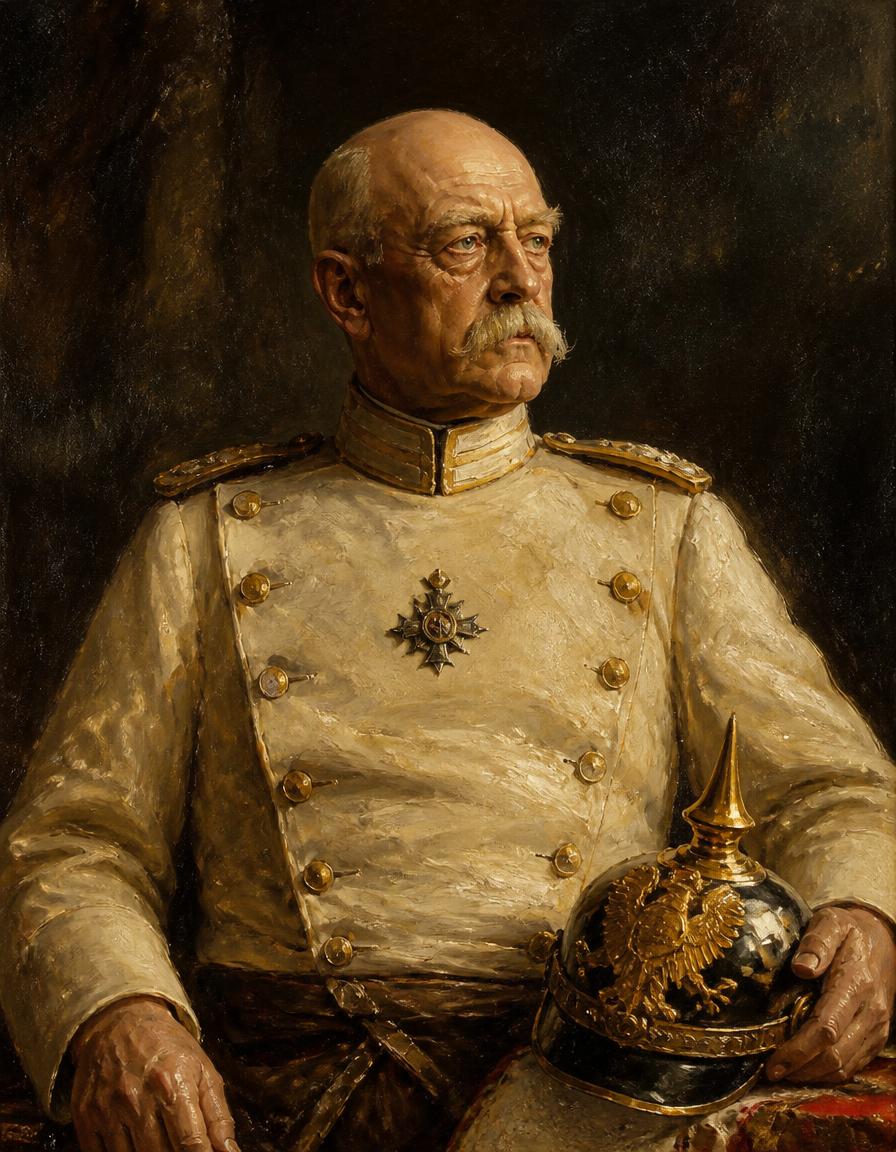
Quick Facts
- Years
- 1815 – 1898
- Category
- World Leaders & Revolutionaries
- Nationality
- German
- Occupation
- Chancellor & Statesman
Otto von Bismarck
1815 – 1898 · German · Chancellor & Statesman
Audiobook

Life Lessons from Otto von Bismarck
Marcus Alden · 54 min
Otto von Bismarck was the Prussian-German statesman who engineered the unification of Germany and became the German Empire’s first chancellor. Born into the Prussian landed elite in 1815, he rose from provincial conservatism to international prominence through forceful parliamentary debate, calculated diplomacy, and three limited wars. His political methods—later associated with Realpolitik—combined ideological flexibility with a consistent commitment to monarchy, Prussian power, and European stability.
As Prussia’s minister-president, Bismarck defeated opposition to army reform and helped isolate Denmark, Austria, and France in successive conflicts. These victories produced a Prussian-led German nation-state in 1871. As imperial chancellor, he then changed direction: rather than seeking further conquest, he built alliances intended to preserve peace and prevent France from finding powerful partners. At home, he fought Catholics and socialists, yet also introduced pioneering national social-insurance programs.
Bismarck remains important because his record contains striking contrasts. He was a conservative who used nationalism, an opponent of socialism who established social protections, and a war leader who later acted as a guardian of peace. Historians continue to study whether his achievements reflected strategic mastery, favorable circumstances, or both—and whether the authoritarian institutions he helped create burdened Germany’s later political development.
Quick Facts
| Field | Details |
|---|---|
| Full Name | Otto Eduard Leopold von Bismarck-Schönhausen |
| Common Name(s) | Otto von Bismarck; Prince Bismarck; the “Iron Chancellor” |
| Born | 1 April 1815 |
| Died | 30 July 1898 |
| Age at Death | 83 |
| Birthplace | Schönhausen, Province of Saxony, Kingdom of Prussia |
| Nationality | Prussian; German after 1871 |
| Occupation | Statesman, diplomat, minister-president, chancellor |
| Historical Era | Nineteenth-century Europe; German unification |
| Famous For | Unifying Germany under Prussian leadership; serving as its first chancellor |
| Political Affiliation | Independent conservative; aligned with Prussian monarchism |
| Religion | Lutheran Protestant |
| Education | University of Göttingen; University of Berlin; agricultural studies at Eldena |
| Parents | Karl Wilhelm Ferdinand von Bismarck and Wilhelmine Luise Mencken |
| Spouse(s) | Johanna von Puttkamer, married 1847–1894 |
| Children | Marie, Herbert, and Wilhelm von Bismarck |
| Major Works | Political speeches, diplomatic correspondence, and memoirs published as Gedanken und Erinnerungen (Thoughts and Memories) |
| Major Achievements | German unification; creation of the German Empire; alliance diplomacy; early national social insurance |
Early Life
Otto von Bismarck was born at Schönhausen, northwest of Berlin, into a Junker family—the Protestant landowning class that supplied Prussia with many officers and officials. His father, Karl Wilhelm Ferdinand von Bismarck, embodied rural aristocratic traditions. His mother, Wilhelmine Mencken, came from an educated civil-service family and wanted her sons to receive rigorous schooling.
From 1822, Bismarck attended schools in Berlin, including the Plamann Institute and the Friedrich Wilhelm Gymnasium. The urban, disciplined environment differed sharply from country-estate life. He later studied law at Göttingen, where he joined the student corps Hannovera and acquired a reputation for sociability and dueling. He completed his legal studies in Berlin and briefly entered the Prussian civil service.
Administrative routine did not suit him. After resigning, he helped manage family estates in Pomerania, earning the youthful nickname “mad Bismarck” for his unconventional energy and turbulent habits. Estate management nevertheless taught him about agriculture, finance, and relations among landlords, peasants, and officials.
A religious and emotional turning point came through the Pietist circle surrounding the Puttkamer family. Bismarck married Johanna von Puttkamer in 1847. Her faith and steadiness gave his private life greater structure, although his religious practice and political conduct did not always align neatly.
His formative context was the post-Napoleonic German world: a loose German Confederation of 39 states, with Austria and Prussia competing for influence. Liberalism and nationalism were growing, but Prussia remained an authoritarian monarchy dominated by conservative elites.
Rise to Prominence
Bismarck entered public politics in 1847 as a representative in the United Diet, where his fiery defense of royal authority made him conspicuous. During the revolutions of 1848, he opposed liberal constitutionalism and was prepared to help defend the monarchy. Yet he gradually learned that conserving Prussian power might require adaptation rather than simple resistance.
In 1851, King Frederick William IV appointed him Prussia’s envoy to the German Confederation at Frankfurt. There Bismarck confronted Austrian efforts to keep Prussia subordinate. This experience transformed him from a narrow provincial conservative into a practitioner of power politics. Diplomatic postings in St. Petersburg from 1859 and Paris from 1862 broadened his understanding of Russia, France, and the European balance.
His decisive opportunity came during Prussia’s constitutional crisis. King William I and War Minister Albrecht von Roon wanted to enlarge and reorganize the army, but the liberal lower house refused the necessary budget. In September 1862, William appointed Bismarck minister-president and foreign minister.
Bismarck argued that the government could collect taxes under the previous budget because the constitution provided no mechanism for resolving deadlock. His famous “blood and iron” speech declared that major questions would not be settled by speeches and majority votes alone. The phrase was controversial and did not amount to a general glorification of war; it expressed his conviction that national power depended on military capacity and executive resolve.
Prussian victories soon made him internationally famous. His success also persuaded many National Liberals to cooperate with a statesman they had previously regarded as unconstitutional.
Major Achievements
Defeat of Denmark and the Schleswig-Holstein Settlement
In 1864, Prussia and Austria fought Denmark over Schleswig and Holstein, duchies tied to the Danish crown but entangled in German and international law. Denmark was defeated, and the Treaty of Vienna transferred the duchies to the two victors.
Bismarck used their joint administration to create leverage against Austria. The conflict increased Prussian prestige and provided the first military stage of unification. Its lasting importance lay less in territorial gain than in opening a controlled path toward deciding leadership in Germany.
Victory over Austria and Prussian Leadership
Bismarck prepared diplomatically for conflict by seeking French neutrality, maintaining Russian goodwill, and reaching an understanding with Italy, which wanted Austrian-controlled Venetia. Disputes over Schleswig-Holstein then contributed to the Austro-Prussian War of 1866.
Prussia’s modernized army won the decisive Battle of Königgrätz. Bismarck urged William I not to humiliate Austria or annex its core territory. The Peace of Prague dissolved the German Confederation and excluded Austria from German political affairs, while Prussia annexed several northern states.
In 1867, Prussia organized the North German Confederation. Its constitution combined universal male suffrage for the Reichstag with strong monarchical and federal authority. This framework became the foundation of the empire created four years later.
Unification of Germany
The final stage followed the candidacy of a Hohenzollern prince for the Spanish throne. France objected. After William I reported a courteous encounter with the French ambassador at Ems, Bismarck edited the published dispatch so that it appeared sharper, while not fabricating the central exchange. The resulting outrage helped France declare war in July 1870.
The southern German states joined Prussia under existing defensive agreements. German armies defeated France and captured Emperor Napoleon III at Sedan. On 18 January 1871, German princes proclaimed William I German emperor at Versailles.
Unification altered Europe’s balance of power. Germany became a populous, industrializing state at the center of the continent. Yet its creation through Prussian institutions also preserved a powerful monarchy, military influence, and an executive not responsible to parliament.
Preservation of Peace through Alliances
After 1871, Bismarck regarded Germany as territorially “satisfied.” His diplomacy aimed to isolate France and prevent a hostile coalition. He promoted the Three Emperors’ League, made the Dual Alliance with Austria-Hungary in 1879, helped form the Triple Alliance with Italy in 1882, and negotiated the Reinsurance Treaty with Russia in 1887.
He also hosted the Congress of Berlin in 1878, presenting Germany as an “honest broker” in disputes arising from the Russo-Turkish War. The settlement temporarily managed great-power tensions but disappointed Russia and subordinated Balkan aspirations to imperial interests.
Bismarck’s system helped avoid a general European war during his chancellorship. It was complicated, dependent on his management, and difficult for successors to maintain.
Foundations of the Welfare State
Facing a growing socialist movement, Bismarck combined repression with reform. His government sponsored health insurance in 1883, accident insurance in 1884, and old-age and disability insurance in 1889. Employers, workers, and the state participated in different ways.
These measures did not create a modern welfare state in full, nor were they purely humanitarian. Bismarck hoped to strengthen workers’ loyalty to the monarchy and weaken socialism. Nonetheless, they established durable principles of national social insurance and influenced systems around the world.
Leadership and Work
Bismarck led through mastery of detail, personal access to monarchs, tactical flexibility, and a keen sense of rival states’ interests. He often pursued limited objectives rather than abstract programs. Before each unification war, he worked to reduce the chance that Prussia would face a broad coalition.
His methods included persuasion, pressure, secrecy, selective disclosure, and manipulation of press opinion. He could shift alliances without abandoning his central objectives. The conservative who opposed nationalism in 1848 later harnessed it; the opponent of socialism adopted social insurance; the victor of 1866 restrained Prussian demands against Austria.
Bismarck’s relationship with William I was indispensable. The king sometimes resisted him, but their partnership gave the minister unusual authority. Bismarck repeatedly threatened resignation during disputes, a tactic that could compel support. Crown Prince Frederick and his British-born wife Victoria were more liberal and often distrusted him.
His strengths were strategic timing, diplomatic realism, administrative stamina, and an ability to connect domestic and foreign policy. His weaknesses included vindictiveness, authoritarian instincts, intolerance of independent colleagues, and a tendency to make institutions depend upon his own dominance. He could manage opponents brilliantly, but he rarely prepared a stable succession.
Personal Life
Bismarck’s marriage to Johanna von Puttkamer was close and enduring. His letters reveal strong attachment and frequent dependence on her emotional reassurance. Their children were Marie, Herbert, and Wilhelm. Herbert became a diplomat and served under his father, whose expectations and influence complicated the son’s life.
Bismarck valued his estates, especially Varzin in Pomerania and Friedrichsruh in the Sachsenwald, granted to him after unification. Rural life, hunting, dogs, food, and conversation offered relief from government. He had a particularly famous affection for large dogs, including mastiff-type hounds often called Reichshunde.
He was physically imposing and capable of charm, humor, tears, explosive anger, and prolonged resentment. Heavy eating, drinking, smoking, insomnia, neuralgia, digestive trouble, and weight problems affected his health. The physician Ernst Schweninger imposed a stricter regimen in the 1880s and improved his condition.
Among important associates were Albrecht von Roon and Helmuth von Moltke the Elder. Their cooperation joined political direction, army reform, and operational command, although each had distinct responsibilities. Bismarck was not himself the battlefield architect of Prussia’s victories.
Philosophy and Beliefs
Bismarck believed in hereditary monarchy, social hierarchy, and the special mission of the Prussian state. He distrusted parliamentary sovereignty and liberal claims that political legitimacy arose solely from majority rule. At the same time, he accepted constitutions, elections, and nationalism when they could reinforce monarchical authority.
The term Realpolitik is strongly associated with him, though it was coined by writer Ludwig von Rochau. In Bismarck’s practice, it meant judging circumstances, balancing interests, and choosing achievable ends. He was not without principles; his realism served conservative and Prussian goals.
His Lutheran faith became more important in adulthood. He often spoke of divine providence and human limits. Nevertheless, opponents regarded some of his methods as incompatible with Christian ethics, and historians should not treat religious language as a simple explanation for every policy.
He saw international politics as a shifting balance rather than a struggle for universal ideals. After unification, restraint became essential because Germany’s central position made encirclement a permanent danger. Domestically, however, his readiness to label Catholics and socialists “enemies of the Reich” repeatedly intensified division.
Challenges and Controversies
Bismarck governed without an approved budget from 1862 to 1866, stretching Prussia’s constitution during the army conflict. Supporters argue that he resolved a constitutional gap and later obtained legislative indemnity. Critics consider the episode an authoritarian breach that weakened parliamentary government.
The Ems Dispatch remains controversial. Bismarck deliberately shortened and sharpened the account to influence public opinion. France formally declared war, and Napoleon III’s government had its own motives, but Bismarck acknowledged that publication was intended to provoke a reaction. Debate concerns the degree of responsibility, not whether he manipulated presentation.
From 1871, the Kulturkampf sought greater state control over Catholic institutions amid fears about papal authority and political Catholicism. Measures restricted clergy and religious orders, producing resistance and imprisonment. The Catholic Centre Party grew stronger, and Bismarck eventually retreated and cooperated with Pope Leo XIII. Liberals saw part of the campaign as secular reform; Catholics experienced it as persecution.
After assassination attempts on William I in 1878—neither proven to have been directed by the Social Democratic Party—Bismarck secured Anti-Socialist Laws. These prohibited socialist organizations, meetings, and publications while allowing socialist candidates to contest elections. Repression failed to eliminate the movement, whose vote expanded.
His policies toward national minorities included pressure for Germanization, especially against Poles in Prussia’s eastern provinces. Measures affecting language, landholding, and settlement remain a serious part of his record.
Bismarck initially had little enthusiasm for colonies, but from 1884 Germany acquired African and Pacific protectorates. His reversal reflected commercial pressure, domestic politics, and diplomacy. Colonial rule developed coercive structures whose gravest later consequences unfolded after his departure.
Historians also debate his broader legacy. One interpretation praises a diplomatic genius who unified Germany and preserved peace. Another argues that he constructed an authoritarian empire with weak parliamentary accountability. More recent scholarship often stresses contingency: Bismarck was exceptionally skillful, but military reforms, economic integration, nationalism, and errors by his opponents were also decisive.
Legacy
Bismarck transformed the map of Europe. The empire he created survived until 1918, while German national unification endured in altered forms. His social-insurance laws became models for state responsibility toward sickness, injury, disability, and old age.
His dismissal by Wilhelm II in 1890 exposed the fragility of a system centered on one statesman. The Reinsurance Treaty with Russia was not renewed, although the road to later alliance confrontation cannot be reduced to that decision alone. Admirers later turned Bismarck into a nationalist icon, sometimes detaching him from his post-1871 caution.
Hundreds of Bismarck towers, monuments, streets, and place names appeared across Germany and former German territories. Major memorials stand in Berlin and Hamburg. Friedrichsruh contains the Bismarck Museum and mausoleum; Schönhausen also preserves a museum associated with his birthplace. These sites increasingly present both his achievements and the exclusions embedded in his politics.
Modern scholars study him to understand state-building, executive power, alliance management, social policy, political communication, and the dangers of institutions designed around an irreplaceable leader.
Interesting Facts
- Bismarck was born on 1 April 1815, the year of Napoleon’s final defeat.
- He studied law but disliked routine civil-service work.
- As a Göttingen student, he participated in numerous saber duels.
- A dueling scar remained visible on his face.
- He represented Prussia at Frankfurt, St. Petersburg, and Paris.
- He served simultaneously as Prussian minister-president and foreign minister.
- The “blood and iron” phrase came from an 1862 speech to a budget committee.
- Germany’s three unification wars occurred within seven years.
- He opposed annexing Austrian core lands in 1866.
- The imperial proclamation took place in the Hall of Mirrors at Versailles.
- He received the title Prince of Bismarck in 1871.
- He also became Duke of Lauenburg in 1890 but rarely used that title.
- The term Realpolitik predates his rise to national leadership.
- He introduced universal male suffrage at the federal level while resisting parliamentary cabinet government.
- His social legislation preceded comparable national programs in many countries.
- He hosted both the Congress of Berlin and the Berlin Conference on African affairs.
- The nickname “Iron Chancellor” reflected his hard political image.
- A British cartoon titled “Dropping the Pilot” famously depicted his 1890 dismissal.
- He spent his final years at Friedrichsruh.
- He was buried beside Johanna in the Bismarck Mausoleum.
Famous Quotes
- “Not through speeches and majority decisions will the great questions of the day be decided … but by iron and blood.” — Budget Committee speech, 30 September 1862. Usually rendered “blood and iron,” it expressed his argument that Prussian military strength—not parliamentary rhetoric alone—would determine German affairs.
- “Politics is the art of the possible.” — Widely documented in variant formulations from an 1867 conversation. It summarizes his preference for attainable outcomes over doctrinal purity.
- “We Germans fear God, but nothing else in the world.” — Reichstag speech, 6 February 1888. He immediately added that fear of God encouraged love and peace, a qualification often omitted.
- “The whole Eastern Question is not worth the healthy bones of a single Pomeranian musketeer.” — Associated with his reluctance to risk Germany for Balkan disputes. Wording varies in translation.
- “Germany is perhaps too large to form an alliance with another power, but she is not large enough to dispense with alliances.” — A statement of the strategic insecurity underlying his diplomacy; English wording varies.
- “Preventive war is like committing suicide for fear of death.” — Attributed to Bismarck in discussions of striking Russia before it grew stronger. The sentiment is well attested, though translations differ.
- “If there is ever another war in Europe, it will come out of some damned silly thing in the Balkans.” — Famous attribution reflecting Balkan instability, but its exact source and wording are disputed.
- “Laws are like sausages; it is better not to see them being made.” — Commonly credited to Bismarck, but no reliable contemporary evidence confirms that he said it.
- “When you say that you agree to a thing in principle, you mean that you have not the slightest intention of carrying it out in practice.” — Often attributed to Bismarck; documentation is uncertain and the wording may be apocryphal.
Timeline
- 1815 — Born at Schönhausen on 1 April.
- 1822 — Sent to school in Berlin.
- 1832 — Began legal studies at Göttingen.
- 1833–1835 — Continued studies in Berlin and passed legal examinations.
- 1836–1839 — Worked briefly in Prussian government service.
- 1839 — Left the civil service to manage family estates.
- 1847 — Entered the United Diet and married Johanna von Puttkamer.
- 1848 — Defended the monarchy during the revolutions.
- 1851 — Appointed Prussian envoy to the German Confederation.
- 1859 — Became ambassador to Russia.
- 1862 — Served briefly as ambassador to France; appointed minister-president and foreign minister; delivered the “blood and iron” speech.
- 1864 — Prussia and Austria defeated Denmark.
- 1866 — Prussia defeated Austria; the German Confederation was dissolved.
- 1867 — Became chancellor of the North German Confederation.
- 1870 — Ems Dispatch crisis and outbreak of the Franco-Prussian War.
- 1871 — German Empire proclaimed; Bismarck became imperial chancellor and prince.
- 1873 — Three Emperors’ League formed.
- 1878 — Hosted the Congress of Berlin; Anti-Socialist Laws enacted.
- 1879 — Dual Alliance concluded with Austria-Hungary.
- 1882 — Triple Alliance formed with Austria-Hungary and Italy.
- 1883 — Health-insurance law enacted.
- 1884 — Accident-insurance law enacted; Germany began formal colonial expansion.
- 1884–1885 — Hosted the Berlin Conference.
- 1887 — Reinsurance Treaty concluded with Russia.
- 1888 — Year of the Three Emperors; Wilhelm II came to the throne.
- 1889 — Old-age and disability insurance enacted.
- 1890 — Dismissed as chancellor and minister-president.
- 1894 — Johanna died.
- 1898 — Died at Friedrichsruh on 30 July.
Frequently Asked Questions
Who was Otto von Bismarck?
Otto von Bismarck was a Prussian statesman and the first chancellor of the German Empire. As Prussia’s minister-president from 1862, he used diplomacy, military power, and agreements with German states to achieve unification under Prussian leadership. After 1871, he concentrated on maintaining peace among Europe’s great powers and preserving the monarchy at home. His nearly three decades at the center of government made him one of nineteenth-century Europe’s most influential political figures.
Why is Bismarck called the Iron Chancellor?
The nickname reflected Bismarck’s reputation for firmness, authority, and association with the “blood and iron” speech of 1862. It captured his willingness to confront parliament, use military power, and repress political opposition. Yet it can oversimplify him. He often preferred negotiation, limited aims, and compromise when these better served Prussia or Germany. His post-1871 diplomacy was generally designed to prevent war rather than promote it.
Did Bismarck create Germany by himself?
No. Bismarck provided crucial political direction, but unification depended on many forces: the Prussian army reforms associated with Roon, Moltke’s operational leadership, industrial and railway growth, the customs union, German nationalism, and mistakes by Austria, France, and Denmark. Monarchs, diplomats, soldiers, voters, and liberal nationalists all played roles. Bismarck’s achievement was to coordinate favorable conditions and use crises with unusual effectiveness.
What did “blood and iron” mean?
In September 1862, Bismarck told a legislative committee that the major questions of the age would not be decided by speeches and majority decisions but by “iron and blood.” He was defending army reform during a budget dispute and referring to the failures of liberal nationalism in 1848–1849. The remark signaled the importance of military power, but it should not be treated as proof that he wanted unlimited warfare.
What wars did Bismarck use to unify Germany?
The three principal conflicts were the Second Schleswig War against Denmark in 1864, the Austro-Prussian War in 1866, and the Franco-Prussian War of 1870–1871. Each changed Germany’s political structure. Denmark lost Schleswig and Holstein; Austria was excluded from German affairs; and war with France brought the southern German states into a Prussian-led empire. Bismarck worked to keep each conflict limited and diplomatically manageable.
What was Bismarck’s role in the Ems Dispatch?
William I sent Bismarck an account of his encounter with the French ambassador at Ems. Bismarck shortened the text before publication, removing conciliatory details and making the exchange appear more abrupt. The edited version inflamed opinion in both countries, and France declared war. Bismarck did not invent the encounter, but he consciously manipulated its presentation to produce political pressure and strengthen German unity.
Was Bismarck a dictator?
He was not a dictator in the modern totalitarian sense. He governed within monarchical constitutions, worked with elected legislatures, and faced courts, federal states, parties, and royal authority. Nevertheless, he was strongly authoritarian. He governed Prussia for years without a newly approved budget, restricted socialists and Catholics, manipulated the press, and rejected parliamentary responsibility for the executive. Describing him as an authoritarian constitutional statesman is generally more precise.
What was the Kulturkampf?
The Kulturkampf was a conflict between Bismarck’s governments and the Catholic Church, especially during the 1870s. Laws expanded state control over clerical education and appointments, restricted religious orders, and penalized resistant clergy. Bismarck feared the political strength of Catholic organizations and papal claims after the First Vatican Council. The campaign failed to break Catholic solidarity, strengthened the Centre Party, and was gradually abandoned.
Why did Bismarck oppose socialism?
Bismarck believed socialism threatened monarchy, property, social hierarchy, and national unity. The Anti-Socialist Laws suppressed socialist organizations and publications from 1878 to 1890, although socialist candidates could still stand for election. At the same time, he promoted social insurance to address workers’ insecurity and draw them toward the state. Repression failed politically: Social Democratic support continued to increase.
Did Bismarck invent the welfare state?
He did not invent public welfare, but his government established the first broad national system of compulsory social insurance. Laws covered sickness, workplace accidents, disability, and old age. Earlier mutual-aid societies, local poor relief, and employer schemes already existed. Bismarck’s innovation was to place major protections within a nationwide legal framework, creating a model that influenced later welfare systems.
What was Bismarck’s foreign-policy goal after 1871?
His central goal was preserving the new empire. Germany’s location and strength could alarm neighboring powers, so he tried to isolate France, maintain ties with Russia, anchor Austria-Hungary to Germany, and avoid simultaneous conflict in east and west. His overlapping alliances were designed to manage rivalries rather than prepare territorial expansion. The system maintained relative great-power peace but required delicate, continuous management.
Was Bismarck responsible for World War I?
Bismarck died sixteen years before World War I and generally opposed a major European war after 1871. Some historians argue that his alliance practices, authoritarian institutions, annexation of Alsace-Lorraine, and use of force left dangerous legacies. Others emphasize that his successors abandoned his restraint and faced new conditions. The war cannot credibly be attributed to him alone; responsibility involved decisions by several states over decades.
Why did Bismarck annex Alsace-Lorraine?
After France’s defeat, German military leaders and nationalist opinion demanded Alsace and part of Lorraine for strategic and national reasons. Bismarck accepted annexation in the Treaty of Frankfurt. The decision weakened France defensively and added largely German-speaking territories, but it also created lasting French resentment. Historians differ on how strongly Bismarck personally desired the annexation, yet he bore governmental responsibility for the settlement.
Why was Bismarck dismissed?
Wilhelm II, who became emperor in 1888, wanted to rule personally and disagreed with Bismarck over anti-socialist policy, ministerial access to the emperor, and political control. Bismarck’s habitual dominance, effective under the aging William I, was unacceptable to the young monarch. Their relationship deteriorated, and in March 1890 Bismarck resigned under pressure. The episode demonstrated that his authority ultimately depended on imperial confidence.
What happened after Bismarck left office?
Bismarck retired to Friedrichsruh, criticized his successors, cultivated journalists, and worked on his memoirs. Chancellor Leo von Caprivi pursued a “New Course,” allowing the Anti-Socialist Laws to lapse and declining to renew the Reinsurance Treaty with Russia. Germany’s diplomacy gradually changed, although later tensions resulted from many international and domestic developments rather than from Bismarck’s departure alone.
Where is Otto von Bismarck buried?
Bismarck is buried with his wife, Johanna, in the Bismarck Mausoleum at Friedrichsruh, east of Hamburg. Friedrichsruh became his principal retirement home and remains an important site for studying his life and political memory. A museum and archival collections in the area preserve personal objects, documents, and exhibitions connected with Bismarck and nineteenth-century German history.
Lessons We Can Learn
- Match ambitions to available power. Bismarck pursued limited objectives in 1864 and 1866. Modern leaders benefit from defining attainable goals rather than confusing aspiration with capacity.
- Prepare coalitions before acting. He worked to isolate opponents diplomatically before war. Stakeholder planning remains essential in government and organizations.
- Know when victory is sufficient. His moderate peace with Austria avoided a permanently embittered eastern neighbor. Restraint can preserve future cooperation.
- Adapt methods without losing strategic focus. Bismarck used elections, nationalism, and welfare policies despite conservative suspicion of each. Effective leadership requires flexibility.
- Do not let institutions depend on one person. His diplomatic system weakened after his dismissal. Durable systems need succession plans and shared expertise.
- Communication can change events. The Ems Dispatch shows how editing and framing can intensify conflict. Today’s leaders must use information responsibly.
- Repression rarely eliminates social movements. Anti-socialist laws failed to stop socialist electoral growth. Addressing causes is often more effective than suppressing symptoms.
- Policy motives can be mixed. Social insurance served both worker protection and political control. Good outcomes do not erase strategic motives, and motives do not erase real benefits.
- Domestic and foreign policy interact. Bismarck repeatedly used external affairs to shape internal coalitions. Leaders should recognize this connection without exploiting crises recklessly.
- Success can create new vulnerabilities. Unification solved the German national question in one form but produced fears of German dominance. Every major achievement changes the surrounding risks.
Related Historical Figures
- William I of Germany — Prussian king and first German emperor; his trust made Bismarck’s long tenure possible.
- Wilhelm II — German emperor who clashed with and dismissed Bismarck in 1890.
- Helmuth von Moltke the Elder — Chief of the Prussian General Staff who directed the armies in the unification wars.
- Albrecht von Roon — War minister whose army reforms underpinned Prussia’s victories.
- Napoleon III — French emperor defeated in the war that completed German unification.
- Emperor Franz Joseph I — Austrian ruler whose empire lost leadership in Germany after 1866.
- Camillo di Cavour — Architect of Italian unification and a useful comparison in nationalist state-building.
- Giuseppe Garibaldi — Popular Italian nationalist whose methods contrasted with Bismarck’s state-directed unification.
- Benjamin Disraeli — British prime minister and prominent participant at the 1878 Congress of Berlin.
- Karl Marx — German theorist of communism whose movement represented the socialist challenge Bismarck tried to repress and contain.
Related Historical Figures