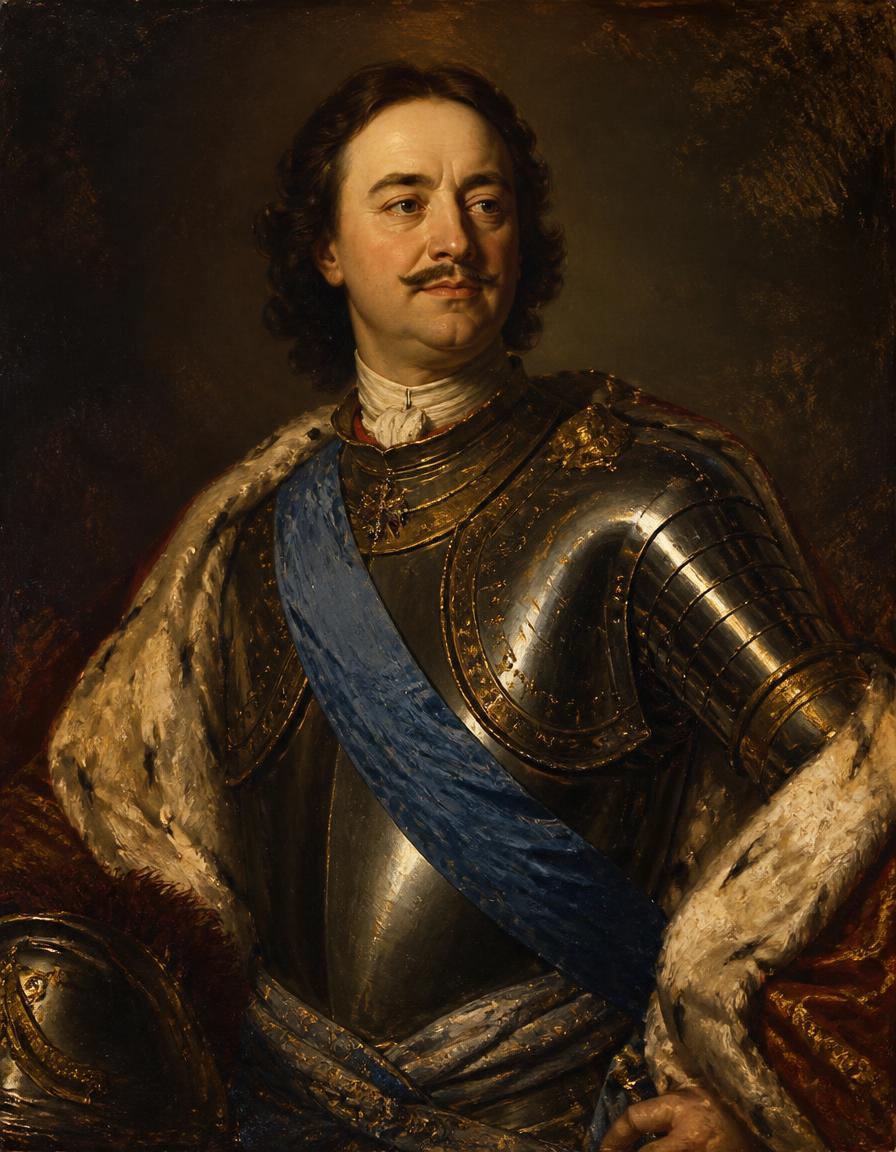
Quick Facts
- Years
- 1672 – 1725
- Category
- World Leaders & Revolutionaries
- Nationality
- Russian
- Occupation
- Tsar & Reformer
Peter the Great
1672 – 1725 · Russian · Tsar & Reformer
Audiobook

Life Lessons from Peter the Great
Marcus Alden · 52 min
Peter I of Russia, better known as Peter the Great, was a tsar, emperor, military organizer, and reformer who transformed the Russian state. Born in 1672, he inherited a vast country with limited access to major seas, institutions shaped by Muscovite tradition, and armed forces that often lagged behind leading European powers. Through war, coercive reform, foreign study, and relentless personal involvement, Peter sought to make Russia a formidable European power.
His greatest achievements included creating a permanent navy, reorganizing the army and central government, expanding technical education, winning access to the Baltic Sea, and founding Saint Petersburg. Victory over Sweden in the Great Northern War altered Europe’s balance of power, while Peter’s adoption of the title “Emperor of All Russia” in 1721 announced Russia’s arrival as an empire.
Peter’s methods were frequently brutal. Heavy taxation, forced labor, political repression, and interference in religious and private life imposed enormous costs. His conflict with his son Alexei ended in the heir’s death after torture and conviction for treason. Peter is therefore studied both as a state-builder and as an autocrat whose modernization depended heavily on compulsion. His reign remains central to debates about Russia’s relationship with Europe, the power of the state, and the human price of rapid reform.
Quick Facts
| Field | Information |
|---|---|
| Full Name | Pyotr Alekseyevich Romanov |
| Common Name(s) | Peter I; Peter the Great |
| Born | 9 June 1672 (30 May, Old Style) |
| Died | 8 February 1725 (28 January, Old Style) |
| Age at Death | 52 |
| Birthplace | Moscow, Tsardom of Russia |
| Nationality | Russian |
| Occupation | Tsar, emperor, military commander, reformer |
| Historical Era | Early modern period; Romanov Russia |
| Famous For | Modernizing the Russian state, founding Saint Petersburg, creating a navy, and defeating Sweden in the Great Northern War |
| Political Affiliation | House of Romanov; absolute monarchy |
| Religion | Russian Orthodox Christianity |
| Education | Privately tutored; largely practical and self-directed, including military, naval, mechanical, and technical studies |
| Parents | Tsar Alexei Mikhailovich and Natalya Kirillovna Naryshkina |
| Spouse(s) | Eudoxia Lopukhina; Catherine I |
| Children | Several children, most of whom died young; survivors included Alexei Petrovich, Anna Petrovna, and Elizabeth Petrovna |
| Major Works | State decrees and institutional reforms; no single major authored literary work |
| Major Achievements | Great Northern War victory; Baltic expansion; foundation of Saint Petersburg; army, navy, administrative, educational, church, and calendar reforms; proclamation of the Russian Empire |
Early Life
Peter was born in Moscow on 9 June 1672, the son of Tsar Alexei and his second wife, Natalya Naryshkina. The Romanov court contained competing family networks. Children from Alexei’s first marriage were associated with the Miloslavsky family, while Peter’s maternal relatives belonged to the Naryshkin interest.
When Alexei died in 1676, Peter’s half-brother Feodor III became tsar. Feodor’s death without a surviving heir in 1682 triggered a succession crisis. Supporters of Peter competed with those of his older half-brother Ivan, whose health was poor. A violent uprising by the streltsy—Moscow’s hereditary infantry corps—resulted in the killing of several Naryshkin supporters before the young Peter. Ivan V and Peter were then proclaimed joint tsars, with their sister Sophia acting as regent.
Peter spent much of his youth away from the central Kremlin court, particularly at Preobrazhenskoye. His formal education was less systematic than that expected of many Western princes. Tutors taught him basic literacy, scripture, and history, but his strongest education came through practical experimentation.
He became fascinated by artillery, fortification, shipbuilding, navigation, and mechanical crafts. Foreign soldiers and artisans living in Moscow’s Foreign Quarter broadened his knowledge. Among important early associates were the Swiss officer François Lefort, the Scots-born general Patrick Gordon, and the Russian companion Alexander Menshikov. Peter organized groups of play soldiers that developed into the Preobrazhensky and Semyonovsky Guards, future elite regiments of the imperial army.
Russia at the time was neither isolated nor static, but its diplomatic, naval, educational, and military institutions differed substantially from those of maritime Western Europe. Peter’s childhood experiences persuaded him that expertise had to be imported, taught, and applied directly.
Rise to Prominence
In 1689, Peter’s supporters overcame Regent Sophia during another political crisis. Sophia was confined to the Novodevichy Convent, although Ivan V remained nominal co-tsar until his death in 1696. Peter’s mother and senior advisers initially handled much routine government, while Peter concentrated on military exercises, ships, and foreign contacts.
His first major campaigns targeted the Ottoman fortress of Azov. The 1695 attack failed, in part because Russia lacked the naval power needed to blockade the fortress. Peter responded by ordering ships constructed at Voronezh. A second campaign captured Azov in 1696. Although Russia’s later hold on the area proved temporary, the experience demonstrated Peter’s willingness to learn from failure and confirmed the importance he attached to naval forces.
From 1697 to 1698, Peter traveled through Europe with the “Grand Embassy.” Officially, the mission sought allies against the Ottoman Empire; practically, it also recruited specialists and studied European technology. Traveling at times under the name Pyotr Mikhailov, Peter worked in Dutch shipyards and observed English naval facilities, workshops, hospitals, museums, and government institutions. His identity was widely known despite the nominal disguise.
The embassy failed to create the desired anti-Ottoman coalition. Peter returned early after learning of another streltsy revolt. The uprising was suppressed, and Peter personally participated in interrogations and punishments. The episode destroyed the streltsy as an independent political force and revealed the severity with which he treated resistance.
By 1700, Peter had redirected his ambitions toward the Baltic. He joined Denmark-Norway and Saxony-Poland-Lithuania against the Swedish Empire, beginning the Great Northern War. An early defeat at Narva exposed Russian weaknesses, but it became the catalyst for sustained military reconstruction.
Major Achievements
Rebuilding the Army
After Sweden’s victory at Narva in 1700, Peter expanded conscription, improved artillery, standardized training, and developed a more permanent officer corps. Foreign specialists assisted, but increasing numbers of Russians acquired technical and command experience.
The reformed army eventually defeated Charles XII’s forces at Poltava in 1709. This mattered because it broke the momentum of the Swedish invasion and demonstrated that Russia could defeat one of Europe’s strongest military states. The resulting military system endured beyond Peter, though it depended heavily on compulsory service and peasant resources.
Creating a Russian Navy
Peter created Russia’s first lasting state navy. The Azov campaigns produced an early fleet, while the Baltic struggle required shipyards, naval bases, trained crews, and specialized schools. Peter studied shipbuilding himself and employed Dutch, English, and other foreign experts.
The navy supported Russia’s Baltic expansion and victories such as Gangut in 1714. In the long term, naval power made Russia an enduring participant in European maritime politics. Maintaining it, however, placed severe financial and labor burdens on the population.
Victory in the Great Northern War
The Great Northern War lasted from 1700 to 1721. Peter survived defeat at Narva, Charles XII’s invasion, and years of costly campaigning. Russia’s victory at Poltava was decisive, although the war continued for another twelve years.
The Treaty of Nystad in 1721 transferred Estonia, Livonia, Ingria, and part of Karelia to Russia. Russia secured access to the Baltic and replaced Sweden as the leading power in northeastern Europe. The outcome permanently altered European diplomacy and trade.
Founding Saint Petersburg
Peter founded Saint Petersburg in 1703 on territory taken from Sweden near the Neva River. He envisioned it as a fortress, port, administrative center, and outward-looking capital connected to Baltic Europe. The government moved there in stages, and the city became the capital in 1712.
Its construction required soldiers, laborers, artisans, and enormous state resources. Disease, difficult conditions, and forced service caused extensive suffering, although exact death totals often repeated in popular accounts cannot be established securely. Saint Petersburg became one of Peter’s most visible legacies and remained the imperial capital until 1918.
Reforming Government and Service
Peter replaced the old Boyar Duma with a Governing Senate in 1711 and later reorganized executive administration through specialized colleges. Provincial reforms attempted to make taxation, recruitment, and justice more effective.
The Table of Ranks, issued in 1722, classified military, civil, and court service into fourteen grades. In principle, advancement depended more on state service than ancestry alone. In practice, noble privilege persisted, but service became a defining obligation of the elite. This bureaucratic model influenced imperial Russia for nearly two centuries.
Expanding Education and Technical Knowledge
Peter founded or encouraged schools for navigation, mathematics, engineering, artillery, and medicine. He sent Russians abroad to learn specialized skills, imported books and equipment, promoted translation, and supported the institution that became the Saint Petersburg Academy of Sciences shortly after his death.
These measures did not create universal education. They primarily served military and administrative needs and often met resistance. Nevertheless, they expanded Russia’s pool of technically trained personnel and strengthened secular learning.
Reshaping Church Administration
After Patriarch Adrian died in 1700, Peter did not permit the election of a successor. In 1721, the Spiritual Regulation established the Holy Governing Synod, supervised by a secular official, to administer the Russian Orthodox Church.
The change subordinated church governance more directly to the monarchy. Supporters viewed it as administrative reform; critics regarded it as an assault on ecclesiastical independence. The synodal arrangement remained in place until 1917.
Establishing the Russian Empire
Following the Treaty of Nystad, the Senate and Synod granted Peter the titles “Emperor,” “the Great,” and “Father of the Fatherland.” His acceptance of the imperial title in 1721 represented more than a change in style. It expressed Russia’s new status as a European great power.
Not every foreign government recognized the title immediately, but its adoption marked the formal beginning of the Russian Empire, which lasted until 1917.
Leadership and Work
Peter led through direct intervention. He inspected shipyards, handled tools, questioned specialists, drafted decrees, and traveled constantly. He valued practical competence and sometimes promoted men of relatively modest origin, most famously Alexander Menshikov, although patronage and corruption remained widespread.
His decision-making was energetic but often improvised. Peter experimented, revised institutions, and abandoned measures that failed. This flexibility helped Russia recover after Narva. Yet frequent decrees, overlapping offices, and rapid changes could produce confusion.
He expected service from nearly every social group. Nobles owed military or civil service; peasants supplied taxes, recruits, labor, and provisions; clergy were increasingly incorporated into state administration. Peter’s strengths were persistence, curiosity, strategic ambition, and an unusual willingness to learn technical work. His weaknesses included impatience, violence, suspicion, and insufficient concern for the social cost of his policies.
Relationships were instrumental as well as personal. He rewarded capable associates but punished betrayal severely. His court culture mixed informality with intimidation. The “All-Joking, All-Drunken Synod,” a circle staging elaborate parodies and drinking rituals, reflected both his irreverence toward old court conventions and his capacity for humiliating coercion.
Personal Life
Peter was exceptionally tall—contemporaries placed him at roughly two meters, though precise measurements vary. He preferred active work, military exercises, sailing, and workshops to traditional court ceremony. He collected scientific curiosities, promoted anatomical study, and established the Kunstkamera museum.
In 1689, Peter married Eudoxia Lopukhina in a match arranged largely by his mother. Their relationship deteriorated. Eudoxia was eventually compelled to enter a convent. Their surviving son, Alexei, rejected many of Peter’s policies and became the focus of a dynastic crisis.
Peter formed a relationship with Marta Skowrońska, later baptized into Orthodoxy as Catherine Alexeyevna. They married privately around 1707 and publicly in 1712. Catherine accompanied him on campaigns and became empress consort; Peter crowned her in 1724. She succeeded him as Catherine I.
Peter fathered numerous children, but high infant mortality meant that only a few reached adulthood. His daughters Anna and Elizabeth survived him; Elizabeth later ruled Russia from 1741 to 1762.
Contemporaries described Peter as energetic, inquisitive, intimidating, and prone to fierce anger. He experienced recurrent facial or bodily convulsions, whose cause cannot now be diagnosed confidently. Heavy drinking was common in his circle. In his final years, urinary illness worsened. He died in Saint Petersburg on 8 February 1725 without naming a successor under the succession rules he had himself revised.
Philosophy and Beliefs
Peter did not present a systematic political philosophy. His worldview is best reconstructed from policies, decrees, correspondence, and conduct. He believed that the ruler possessed broad authority to mobilize society for the strength and “common good” of the state. In practice, he identified that good with military security, fiscal capacity, orderly service, and international power.
He admired useful knowledge rather than Europe in every respect. He borrowed selectively from Dutch, English, German, Swedish, and other models, adapting them to Russian conditions. His goal was not simply cultural imitation but increased state effectiveness.
Peter remained Orthodox, visited churches, and defended Russia as an Orthodox monarchy. Yet he subordinated ecclesiastical institutions to secular authority and mocked forms of religious ceremony that he associated with hypocrisy or backwardness. His attitude combined personal belief with political control.
Ethically, he elevated duty and measurable service above inherited custom. That principle opened some paths for talented servants, but it did not challenge serfdom or social hierarchy. His reforms strengthened an autocratic, militarized state rather than representative government or individual liberty.
Challenges and Controversies
Peter’s achievements carried immense costs. The poll tax, military recruitment, requisitions, monopolies, and forced labor placed intense pressure on peasants and townspeople. Serfdom was not abolished; state demands helped make social control more systematic. Some historians therefore describe his modernization as the modernization of government power rather than of society as a whole.
Resistance occurred repeatedly. The streltsy revolts were suppressed through executions, exile, and torture. The Astrakhan uprising of 1705–1706 and the Bulavin rebellion of 1707–1708 reflected grievances involving taxation, military pressure, fugitives, and regional autonomy. Government forces crushed both.
The case of Tsarevich Alexei remains Peter’s darkest family and political crisis. Alexei fled abroad in 1716, fearing punishment and opposing his father’s direction. Persuaded to return under assurances, he was interrogated, tortured, convicted of treason, and sentenced to death. He died in custody in 1718 before execution. Peter regarded him as a threat to the state; critics see the episode as proof that dynastic security and ideology overrode paternal restraint and law.
Cultural reforms also generated resentment. Peter ordered courtiers to adopt Western-style dress, imposed a tax on many men who retained beards, changed the calendar so that the year began on 1 January, and promoted new social customs. Such measures were symbolically powerful but sometimes superficial. They affected elites more directly than the rural majority.
His southern policy produced a major failure. During the Pruth River campaign of 1711, Ottoman forces trapped Peter’s army. Russia had to return Azov and dismantle nearby fortifications. Later Persian campaigns gained territory along the Caspian, but many acquisitions proved difficult to retain.
Scholars continue to debate whether Peter created a coherent new order or accelerated trends already developing under earlier Romanovs. Most agree that he transformed Russia’s scale of military and administrative activity. They differ over how efficiently his institutions worked and whether the gains justified the coercion involved.
Legacy
Peter left Russia larger, more militarily capable, more bureaucratically organized, and more deeply involved in European affairs. The navy, Saint Petersburg, the Senate, the colleges, technical schools, and the Table of Ranks changed the empire’s institutions and elite culture.
His legacy also contained unresolved problems. Succession became unstable after his death. The service state was expensive, corruption persisted, and the burdens on peasants intensified. The cultural distance between a Europeanized elite and much of the population became a lasting feature of imperial society.
Later rulers invoked Peter selectively. Catherine II associated herself with him and commissioned Étienne Maurice Falconet’s equestrian monument, the Bronze Horseman, unveiled in 1782. Nineteenth-century Westernizers praised his opening toward Europe, while Slavophiles criticized his disruption of indigenous traditions. Soviet interpretations often admired state-building and economic development while condemning autocracy. Modern assessments remain divided.
Peter is commemorated at the Peter and Paul Fortress, Peterhof, the Kunstkamera, the Central Naval Museum, and numerous sites in Saint Petersburg and Moscow. Statues include the Bronze Horseman and Zurab Tsereteli’s large Moscow monument. Educational and cultural institutions continue to bear his name. He remains relevant wherever historians debate reform from above, forced modernization, and the relationship between national power and human welfare.
Interesting Facts
- Peter and his half-brother Ivan V were joint tsars from 1682 to 1696.
- A special double throne allowed the two boys to appear together at ceremonies.
- Peter traveled with the Grand Embassy under the name Pyotr Mikhailov, though his identity was no real secret.
- He worked and studied in Dutch shipyards.
- He also visited England and inspected naval facilities and scientific collections.
- His childhood “play” regiments became elite Guards units.
- The failure of the first Azov campaign encouraged him to build a fleet.
- Saint Petersburg was founded in 1703 during an ongoing war with Sweden.
- Peter moved the capital from Moscow to Saint Petersburg.
- Russia’s calendar began the year on 1 January from 1700, rather than 1 September.
- Russia retained the Julian calendar; Peter did not adopt the Gregorian calendar.
- The beard tax allowed many men to keep beards if they paid and carried a token.
- He promoted a simplified civil typeface for secular printing.
- The Kunstkamera grew from his collection of scientific and anatomical curiosities.
- He practiced dentistry on willing or unwilling acquaintances, according to contemporary evidence and surviving collections.
- He accepted the title of emperor in 1721.
- He issued the Table of Ranks in 1722.
- He altered succession law but died without formally naming an heir.
- His second wife succeeded him as Catherine I.
- His daughter Elizabeth later became empress.
Famous Quotes
Peter’s words survive in decrees, letters, memoirs, and later retellings. Translation varies, and several popular sayings are insecurely sourced.
-
“For an Englishman is an island, and when he has a ship, he is everywhere.” Attributed to Peter in later accounts of his admiration for English seafaring. It captures his belief that naval strength multiplied national power, but the exact wording is not securely documented.
-
“We need Europe for a few decades, and then we must turn our backs upon her.” Widely attributed but unsupported by reliable contemporary evidence. It should not be treated as an authenticated quotation.
-
“I have conquered an empire, but I have not been able to conquer myself.” A famous attribution connected with Peter’s temper. Its documentary basis is doubtful.
-
“Money is the artery of war.” A maxim associated with Peter’s fiscal policies and military correspondence. Versions differ in translation; its meaning reflects the dependence of his reforms on taxation and revenue.
-
“Delay is like death.” Often translated from the terse formula “Procrastination is death” in instructions attributed to Peter. It expresses his impatience and demand for rapid execution, though English wording varies.
-
“The student should thank the teacher.” A reported remark connected with Russia’s eventual victory over Sweden, whose army had forced Peter to improve his own. The sentiment is well known, but surviving formulations differ.
-
“It is not enough merely to keep things in order; one must work and work.” A translation or paraphrase associated with Peter’s service ethic. Exact wording depends on the edition and should be cited cautiously.
-
“I am an ordinary man and want to live like an ordinary man.” Reported in anecdotal literature about Peter’s dislike of ceremony. The attribution is plausible in spirit but not securely verifiable verbatim.
-
“The Tsar is a slave of the state.” Frequently attributed to Peter as a summary of his conception of sovereign duty. Historians caution that the compact wording may be a later formulation.
-
“All trades and arts are useful to the state.” A translated sentiment reflected in his educational and economic decrees. It accurately summarizes policy, but should not be presented as a fixed verbatim sentence without a primary-source citation.
Because many “Peter the Great quotes” circulate without dates or manuscript references, documented decrees and letters are safer evidence of his thinking than polished aphorisms.
Timeline
- 1672 — Peter is born in Moscow.
- 1676 — His father, Tsar Alexei, dies; Feodor III succeeds.
- 1682 — Feodor dies; the streltsy uprising erupts; Ivan V and Peter become joint tsars under Sophia’s regency.
- 1689 — Peter’s supporters remove Sophia from power; Peter marries Eudoxia Lopukhina.
- 1694 — Peter’s mother dies, increasing his direct involvement in rule.
- 1695 — First Azov campaign fails.
- 1696 — Second Azov campaign succeeds; Ivan V dies, leaving Peter sole tsar.
- 1697–1698 — Peter travels through Europe with the Grand Embassy.
- 1698 — Peter returns to suppress and punish the streltsy revolt.
- 1699 — Russia prepares an alliance against Sweden.
- 1700 — Great Northern War begins; Russia is defeated at Narva; calendar reform takes effect.
- 1703 — Saint Petersburg is founded.
- 1704 — Russia captures Narva and Dorpat.
- 1707–1708 — Bulavin rebellion challenges state authority in the south.
- 1709 — Russia defeats Charles XII at Poltava.
- 1711 — Governing Senate is established; Pruth campaign ends in Russian concessions to the Ottomans.
- 1712 — Saint Petersburg becomes the capital; Peter publicly marries Catherine.
- 1714 — Russia wins the naval battle of Gangut; compulsory education measures for some noble children expand.
- 1716 — Tsarevich Alexei flees Russia.
- 1717 — Peter undertakes a second major European journey.
- 1718 — Alexei is convicted of treason and dies in custody; collegial administrative reform advances.
- 1721 — Treaty of Nystad ends the Great Northern War; Peter becomes emperor; Holy Synod replaces the patriarchate.
- 1722 — Table of Ranks is issued; succession rules are changed; Persian campaign begins.
- 1724 — Catherine is crowned empress consort; the Academy of Sciences is authorized.
- 1725 — Peter dies in Saint Petersburg; Catherine I succeeds him.
Frequently Asked Questions
Who was Peter the Great?
Peter the Great was Peter I, ruler of Russia from 1682 to 1725—initially as joint tsar with Ivan V and later as sole monarch. In 1721 he adopted the title of emperor. He reorganized the armed forces, founded a permanent navy, expanded technical education, restructured central administration, subordinated church government to the crown, and established Saint Petersburg. His defeat of Sweden in the Great Northern War made Russia a dominant Baltic and European power. His rule was also intensely autocratic and imposed heavy costs through taxation, conscription, forced labor, torture, and repression.
Why is Peter called “the Great”?
After victory in the Great Northern War, the Senate and Holy Synod formally offered Peter the titles “the Great,” “Father of the Fatherland,” and “Emperor of All Russia” in 1721. The title celebrated his military success and transformation of Russia’s international position. Historians still use it as his conventional name, but not necessarily as an unqualified moral judgment. Peter’s achievements in state-building and war were extraordinary, while his methods caused extensive suffering. “Great” in this historical context primarily denotes scale, power, and influence.
When did Peter the Great rule Russia?
Peter became joint tsar in 1682 at age ten, sharing the title with his half-brother Ivan V while their sister Sophia served as regent. Peter’s supporters displaced Sophia in 1689, though Ivan remained co-tsar until his death in 1696. Peter then ruled alone until his death in 1725. He became Emperor of All Russia in 1721. Consequently, his reign is usually dated 1682–1725, with the important qualification that he did not exercise full independent authority throughout its earliest years.
What did Peter the Great modernize?
Peter modernized institutions that strengthened the state: the army, navy, taxation, provincial government, central administration, technical education, secular printing, and elite service. He imported specialists and adapted European military and bureaucratic practices. However, “modernization” should be used carefully. He did not create democratic government, free the serfs, or provide mass education. His reforms primarily increased the monarchy’s capacity to wage war and command resources. Russia became more powerful and technically connected to Europe, but also more administratively intrusive and socially burdensome.
Why did Peter build Saint Petersburg?
Peter founded Saint Petersburg in 1703 to secure Russia’s new position on the Baltic, defend the Neva region, support a fleet, and create a port linked to European trade. He also wanted a new administrative center reflecting his reformed monarchy. The location was strategically valuable but difficult to build upon. Construction relied heavily on commanded labor, materials requisitions, and state direction. The city became Russia’s capital in 1712 and remained the imperial capital until 1918. It symbolized both Peter’s geopolitical success and the coercive methods behind his transformation.
Did Peter the Great westernize Russia?
He westernized important parts of the court, armed forces, bureaucracy, education, and urban elite culture. He required European-style dress in certain settings, taxed beards, encouraged foreign languages and technical study, and adopted administrative models from several European states. Yet he did not copy a single “Western” system, nor did his changes reach all Russians equally. Rural life remained largely traditional, and serfdom persisted. Scholars therefore often describe his project as selective Europeanization directed toward military and governmental effectiveness rather than the wholesale Westernization of society.
What happened at the Battle of Poltava?
On 8 July 1709 by the modern calendar, Peter’s Russian army defeated Charles XII’s Swedish forces near Poltava in present-day Ukraine. Charles had invaded Russia but suffered from supply problems, attrition, harsh conditions, and Russian resistance. Wounded before the battle, he could not exercise normal battlefield command. The Russian victory destroyed the main Swedish field army; Charles escaped into Ottoman territory. Poltava did not immediately end the Great Northern War, but it transformed the strategic balance and established Russia as the stronger contender.
Why did Peter fight Sweden?
Peter sought reliable access to the Baltic Sea, ports for commerce and naval power, and territories once contested in earlier Russo-Swedish conflicts. Sweden controlled a major Baltic empire under the young Charles XII. Russia joined Denmark-Norway and Augustus II’s Saxon–Polish-Lithuanian interests in attacking Sweden in 1700. The war began disastrously for Russia at Narva, but Peter rebuilt his forces. By the Treaty of Nystad in 1721, Russia acquired key Baltic provinces. The conflict made Russia a great power and ended Sweden’s period of regional predominance.
Did Peter the Great travel in disguise?
During the Grand Embassy of 1697–1698, Peter traveled under the name Pyotr Mikhailov and formally presented himself as a lower-ranking member of the mission. This allowed a degree of informality and helped him work in shipyards. Nevertheless, his unusual height, entourage, and political importance made genuine anonymity impossible. European hosts generally knew who he was. Calling the journey “secret” can therefore mislead. The assumed name reflected diplomatic convention and Peter’s preference for practical observation rather than successful concealment.
What was the Table of Ranks?
The Table of Ranks was a 1722 law organizing military, civil, and court positions into fourteen grades. It sought to define status through service to the monarch and regulate advancement within the imperial elite. In principle, a capable person could rise through service rather than depend entirely on ancient lineage. In reality, family connections, wealth, and noble privilege remained important. The system nevertheless changed Russian elite identity by tying rank and honor more closely to state employment. With modifications, it survived until the fall of the empire in 1917.
Why did Peter tax beards?
Peter associated the long beards worn by many Orthodox Russian men with older social customs he wanted to weaken among officials, courtiers, and urban groups. Rather than universally banning beards, the government required many men who wished to retain them to pay a tax and carry a token. Clergy and some peasants were treated differently. The policy raised revenue but was chiefly symbolic: appearance became a visible test of compliance with the tsar’s cultural program. Opponents could regard shaving as an offense against religious tradition and personal dignity.
What happened to Peter’s son Alexei?
Tsarevich Alexei, Peter’s son by Eudoxia Lopukhina, disliked military life and was associated with opponents of his father’s reforms. He fled abroad in 1716. Peter’s agents persuaded him to return after promises of mercy, but investigators accused him of treasonous intentions and examined his contacts. Alexei was tortured, convicted, and sentenced to death. He died in prison in 1718 before the sentence was carried out. The case eliminated a possible center of opposition but remains one of the clearest examples of Peter’s ruthlessness.
Was Peter the Great religious?
Peter was an Orthodox Christian and understood Russia as an Orthodox monarchy, but his religious behavior did not conform neatly to traditional expectations. He attended worship and supported the church’s pastoral role, yet mocked clerical pretension, appropriated church resources, and subordinated ecclesiastical administration to the state. In 1721 he replaced the patriarchate with the Holy Governing Synod. His religion combined personal belief, political utility, and suspicion of independent corporate authority. It is inaccurate either to portray him as simply irreligious or as a conventional Orthodox ruler.
Did Peter improve life for ordinary Russians?
Some reforms eventually improved military security, trade opportunities, technical knowledge, and state infrastructure. Their immediate effect on many ordinary people, however, was harsh. Peasants and townspeople bore heavier taxes, recruitment, requisitions, and labor obligations. Serfdom remained fundamental, and industrial enterprises sometimes used coerced labor. Benefits were uneven and often concentrated among the state, military, merchants, specialists, and elites. Historians therefore distinguish Russia’s increased power from the welfare of its population: the former rose dramatically, while the latter did not necessarily improve under Peter.
How did Peter the Great die?
Peter’s health deteriorated during his final months, apparently from severe urinary or bladder-related illness, possibly complicated by infection. Contemporary medicine could not diagnose or treat the condition effectively, and modern retrospective diagnoses remain uncertain. He died in Saint Petersburg on 8 February 1725, aged fifty-two. A popular story says that rescuing sailors from freezing water caused his death; although he may have participated in a rescue, the simple causal version is not securely established. He died without formally designating an heir.
Who succeeded Peter the Great?
Peter’s second wife, Catherine I, succeeded him with support from leading courtiers and Guards regiments, especially figures associated with Alexander Menshikov. Her accession was not the straightforward operation of a clear hereditary rule. Peter had issued a statute in 1722 allowing the monarch to choose a successor, but he never completed a valid designation. Catherine ruled until 1727. The uncertainty inaugurated a period of palace politics and disputed succession, illustrating that Peter’s institutional reforms did not solve the fundamental problem of dynastic continuity.
Was Peter’s transformation entirely new?
No. Earlier Romanov rulers had already employed foreign officers, reorganized military units, expanded diplomacy, experimented with education, and engaged with European culture. Peter accelerated these trends, expanded their scale, and imposed them with unusual intensity. His long wars created powerful incentives for fiscal and administrative change. The scholarly debate concerns degree and coherence: some interpretations emphasize a revolutionary break, while others stress continuity with seventeenth-century developments. The most balanced conclusion is that Peter built upon existing foundations but transformed their reach, speed, and political importance.
Lessons We Can Learn
-
Learn from failure. After the failed Azov campaign and defeat at Narva, Peter changed organization, logistics, and training. Modern leaders should treat setbacks as evidence requiring adaptation, not denial.
-
Technical knowledge matters. Peter studied shipbuilding and recruited specialists. Ambition without expertise is insufficient; institutions need people who understand implementation.
-
Invest in durable institutions. Fleets, schools, administrative colleges, and service systems outlasted individual campaigns. Sustainable reform requires structures, not only charismatic direction.
-
Selective borrowing can be effective. Peter adapted practices from several countries rather than copying one model wholesale. Today, imported ideas work best when adjusted to local conditions.
-
Speed has human costs. Saint Petersburg and military expansion were achieved rapidly through coercive labor and taxation. Efficiency should never be measured without considering welfare and rights.
-
Power can distort reform. Peter often treated disagreement as disloyalty. Organizations improve when leaders preserve channels for criticism and distinguish obstruction from legitimate dissent.
-
Symbols influence behavior. Dress rules, beard taxes, titles, and a new capital signaled cultural change. Symbols can support reform, but they cannot substitute for substantive improvement.
-
Succession planning is essential. Peter changed the succession law but died without naming an heir. Even transformative leaders create instability if they neglect orderly transfer of authority.
-
Military success is not social progress. Russia became a great power while serfdom and coercion remained entrenched. National strength and citizens’ well-being are separate measures.
-
Judge legacies in full. Peter’s achievements and brutality were intertwined. Responsible historical analysis should recognize institutional innovation without excusing repression.
Related Historical Figures
- Tsar Alexei Mikhailovich — Peter’s father and Romanov predecessor; his reign began developments that Peter later accelerated.
- Sophia Alekseyevna — Peter’s half-sister and regent from 1682 to 1689; her removal enabled his eventual personal rule.
- Ivan V — Peter’s half-brother and joint tsar until 1696.
- Charles XII of Sweden — Peter’s principal military opponent in the Great Northern War; his defeat at Poltava changed northern Europe.
- Catherine I — Peter’s second wife, political companion, and successor as empress.
- Tsarevich Alexei Petrovich — Peter’s son and heir, whose opposition and death exposed the violence within the dynasty.
- Alexander Menshikov — Close associate, commander, administrator, and beneficiary of Peter’s service-based patronage.
- François Lefort — Foreign-born officer and friend who encouraged Peter’s military and European interests.
- Patrick Gordon — Experienced general who helped train forces loyal to Peter and supported him in political crises.
- Catherine the Great — Later empress who cultivated Peter’s imperial legacy and commissioned the Bronze Horseman monument.
Related Historical Figures