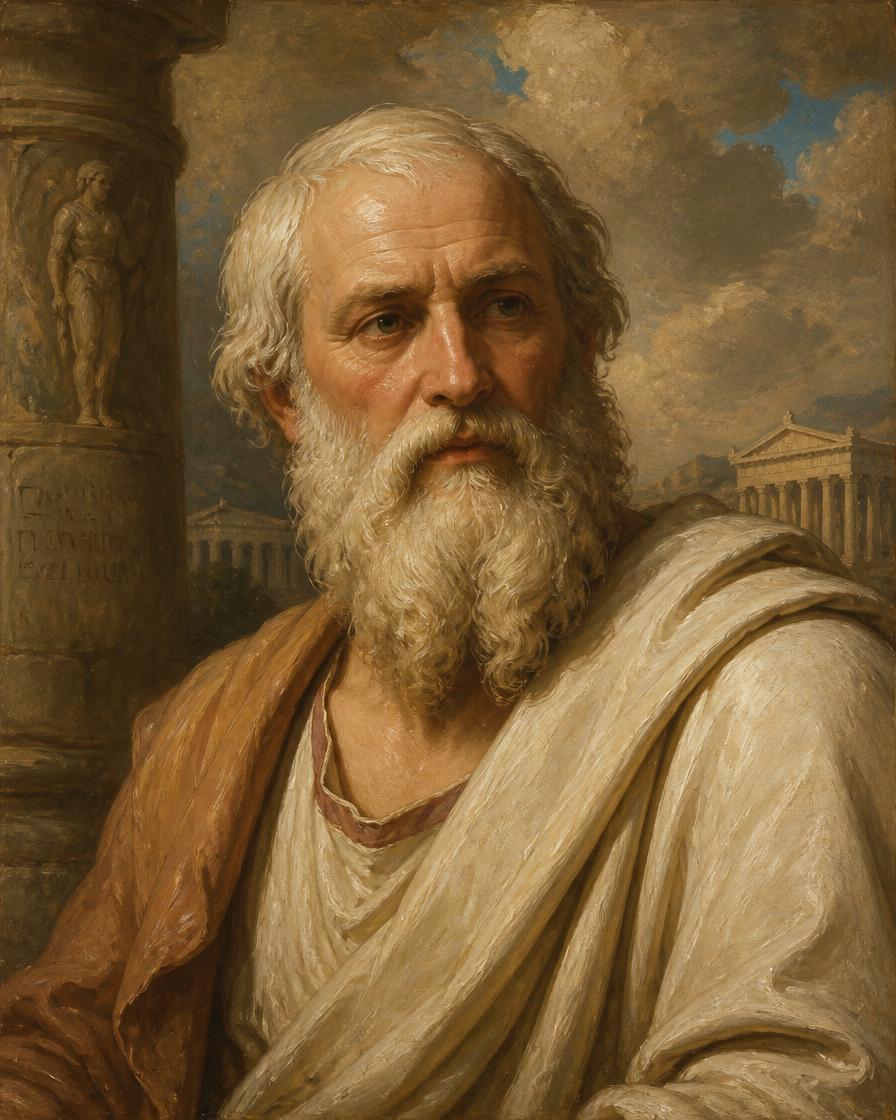
Quick Facts
- Years
- 428 BC – 348 BC
- Category
- Philosophers & Thinkers
- Subcategory
- Ancient Greek Philosophy
- Nationality
- Greek
- Occupation
- Philosopher & Founder of the Academy
Plato
428 BC – 348 BC · Greek · Philosopher & Founder of the Academy
Audiobook

Life Lessons from Plato
Marcus Alden · 46 min
Plato was an ancient Greek philosopher, writer, and teacher whose work helped define Western philosophy. Born into an aristocratic Athenian family around 428/427 BCE, he became a devoted associate of Socrates, whose questioning method and execution deeply shaped his intellectual life. Plato later founded the Academy at Athens, one of antiquity’s most influential centers of advanced study.
Rather than writing systematic treatises, Plato usually presented philosophy through dialogues in which Socrates and other speakers investigate justice, knowledge, virtue, love, politics, language, and reality. Works such as the Republic, Symposium, Phaedo, and Theaetetus continue to influence philosophy, political theory, education, theology, mathematics, and literature. His theory of Forms proposed that intelligible realities—not merely changing physical objects—are central to genuine knowledge.
Plato’s importance also rests on his institutional legacy. The Academy educated generations of thinkers, including Aristotle, and endured in various forms for centuries. His political proposals remain controversial, especially his ideal of rule by philosopher-kings and the tightly regulated society described in the Republic. Yet Plato is still studied because he framed lasting questions rather than offering easy answers: What is justice? Can virtue be taught? What makes knowledge different from opinion? How should power be governed? His writings remain models of philosophical argument, literary craftsmanship, and disciplined inquiry.
Quick Facts
| Field | Information |
|---|---|
| Full Name | Plato; Greek: Platōn (Πλάτων). His alleged birth name, Aristocles, is reported only by later tradition and is uncertain. |
| Common Name(s) | Plato |
| Born | Traditionally 428/427 BCE; exact year unknown |
| Died | 348/347 BCE |
| Age at Death | About 80; uncertain because the birth date is disputed |
| Birthplace | Probably Athens or nearby Aegina; ancient reports differ |
| Nationality | Athenian Greek |
| Occupation | Philosopher, author, teacher, founder of the Academy |
| Historical Era | Classical Greece |
| Famous For | Platonic dialogues, theory of Forms, political philosophy, founding the Academy |
| Political Affiliation if applicable | No formal affiliation securely recorded; connected by family to Athenian aristocratic and oligarchic circles |
| Religion if significant | Traditional Greek religious background, interpreted through a philosophical theology emphasizing divine goodness and rational order |
| Education | Aristocratic Athenian education; philosophical association with Socrates; other influences are debated |
| Parents | Ariston and Perictione, according to ancient tradition |
| Spouse(s) | None recorded |
| Children | None recorded |
| Major Works | Apology, Crito, Phaedo, Symposium, Republic, Phaedrus, Theaetetus, Parmenides, Sophist, Statesman, Timaeus, Philebus, Laws |
| Major Achievements | Founded the Academy; developed influential accounts of knowledge, Forms, ethics, politics, psychology, education, and cosmology; preserved a literary portrait of Socrates |
Early Life
Plato was born around 428/427 BCE, during the Peloponnesian War between Athens and Sparta. His youth unfolded amid military defeat, epidemic disease, political polarization, oligarchic coups, and the eventual collapse of the Athenian empire. This instability helps explain his lifelong concern with whether political power can be guided by knowledge and virtue.
Ancient sources identify his father as Ariston and his mother as Perictione. His family was wealthy and politically connected. Perictione’s relatives included Critias and Charmides, both associated with the oligarchic regime known as the Thirty Tyrants. Plato’s brothers Adeimantus and Glaucon appear as speakers in the Republic; his half-brother Antiphon appears in the Parmenides. How accurately these literary portrayals reflect family relationships cannot always be determined.
Later biographers claimed that Plato’s original name was Aristocles and that “Plato,” perhaps meaning “broad,” was a nickname. Modern scholars treat this cautiously because the story appears relatively late. His precise birthplace is also uncertain: Athens and Aegina both appear in ancient traditions.
As an aristocratic youth, Plato likely received instruction in poetry, music, gymnastics, and literacy. Reports that he studied painting, wrote poetry, or competed as a wrestler may preserve genuine memories, but they cannot be securely verified. His dialogues nevertheless reveal exceptional familiarity with Homer, drama, rhetoric, mathematics, medicine, and civic institutions.
The decisive influence was Socrates. Plato probably joined the circle around him while still young. Socrates wrote nothing; his philosophy survives through Plato, Xenophon, Aristophanes, and later testimony. Plato’s Socrates relentlessly asks speakers to define concepts such as courage, piety, and justice, exposing contradictions in conventional assumptions.
Other intellectual influences included Parmenidean arguments about being, Heraclitean ideas about change, Pythagorean mathematics and beliefs about the soul, and the rhetorical culture of the sophists. The extent of direct contact with particular teachers remains debated.
Rise to Prominence
Plato may initially have contemplated a political career. In the Seventh Letter, its authenticity disputed but often treated as containing valuable historical material, the author describes disillusionment with both the Thirty Tyrants and restored democracy. The Thirty committed violence, while democratic Athens executed Socrates in 399 BCE on charges of impiety and corrupting the young.
Socrates’ death was the central turning point in Plato’s career. It sharpened his suspicion of political decision-making driven by ignorance, faction, or persuasion rather than knowledge. Dialogues commonly classified as early—including the Apology, Crito, and Euthyphro—present Socratic inquiry into moral questions, though assigning exact dates or developmental stages to the dialogues is difficult.
Ancient tradition says that Plato traveled after Socrates’ execution, perhaps visiting Megara, Egypt, southern Italy, and Sicily. Contact with Pythagorean thinkers in Italy is plausible and may have reinforced his interest in mathematics and the immortality of the soul. Not every reported journey is equally well documented.
Around 387 BCE, Plato founded the Academy in or near a sacred grove outside Athens associated with the hero Academus. It was not a modern university with standardized degrees, but a durable community of research, teaching, discussion, and shared intellectual life. Mathematics held an important place, as did dialectic, astronomy, politics, and natural philosophy.
Plato’s dialogues circulated among educated Greek readers and established him as both a philosopher and a literary artist. His reputation grew through the combination of provocative arguments, memorable myths, dramatic characterization, and the Academy’s influence. Aristotle’s arrival around 367 BCE further strengthened the institution’s intellectual importance.
Plato also became involved in Sicilian politics, attempting—directly or indirectly—to encourage philosophical rule at Syracuse. These ventures were disappointing and possibly dangerous, but they illustrate his determination to connect theory with public life.
Major Achievements
Founding the Academy
Around 387 BCE, Plato established the Academy at Athens. Members pursued mathematics, philosophy, astronomy, politics, and related subjects through discussion and research.
The Academy mattered because it gave philosophical inquiry an institutional home beyond one teacher’s lifetime. It trained Aristotle and influenced ancient education for centuries. Later Platonists transformed its doctrines, so it should not be imagined as an entirely unchanging school.
Creating the Platonic Dialogue
Plato made philosophical conversation into a sophisticated literary form. His dialogues combine argument, drama, irony, myth, and characterization. Socrates is usually central, although later works increasingly feature other speakers.
This method encourages readers to participate rather than merely receive conclusions. Apparent failures, unresolved endings, and competing perspectives make interpretation demanding. Philosophical dialogue remains an important educational model today.
Developing the Theory of Forms
In works such as the Phaedo, Republic, and Symposium, Plato distinguishes changing sensible things from stable intelligible realities commonly called Forms. Particular beautiful objects differ and decay, but the Form of Beauty provides an objective standard by which they are understood.
The theory supplied a framework for explaining knowledge, definition, value, and universality. Plato also subjected it to searching criticism in the Parmenides, and scholars dispute whether his later thought revised or abandoned parts of the theory. Its influence reaches Christian theology, Islamic philosophy, metaphysics, mathematics, and debates about universals.
Reframing Justice and Political Education
The Republic asks what justice is and whether a just life is happier than an unjust one. Plato links justice in the city to harmony within the soul and argues that rulers should undergo rigorous intellectual and moral education.
His philosopher-king ideal expressed a lasting claim: political authority requires competence and commitment to the common good. Yet the dialogue’s censorship, social hierarchy, communal arrangements for guardians, and limited tolerance of dissent have generated enduring criticism.
Advancing Epistemology and Psychology
Plato distinguished knowledge from mere true belief and explored how justification, explanation, recollection, perception, and rational understanding relate. The Theaetetus tests several definitions of knowledge without reaching a final solution.
He also analyzed the soul’s conflicts. The Republic presents reason, spirit, and appetite as distinguishable elements. Although not modern scientific psychology, this model profoundly influenced later theories of motivation, self-government, and moral development.
Joining Philosophy with Mathematics and Cosmology
Plato treated mathematics as preparation for abstract reasoning. The educational program in the Republic includes arithmetic, geometry, astronomy, harmonics, and dialectic.
In the Timaeus, he portrays the cosmos as ordered by a divine craftsman according to intelligible patterns. Its physics is not scientifically valid by modern standards, but the work became one of Plato’s most influential texts in late antiquity and the medieval world.
Leadership and Work
Plato led primarily as an educator and institutional founder. The Academy appears to have encouraged collaborative inquiry rather than enforcing one fixed creed. Its members pursued different problems, and Aristotle eventually criticized central Platonic doctrines while remaining indebted to Plato’s methods.
His working method was dialectical: formulate a question, test definitions, reveal contradictions, divide concepts carefully, and move toward more coherent explanations. Plato also used myths when strict argument seemed unable to settle questions about the soul, judgment after death, or the cosmos. These stories should not automatically be read as literal doctrine.
His values included rational self-government, moral education, intellectual discipline, and orientation toward the good. He distrusted rhetoric detached from truth and criticized political systems that rewarded popularity without expertise.
Plato’s strengths were breadth, imaginative power, analytical depth, and the ability to connect ethics with psychology, politics, and metaphysics. His weaknesses included a tendency toward political paternalism and insufficient safeguards against concentrated authority. His dialogues also leave interpreters uncertain about which statements represent his own final position.
Relationships were central to his work. Socrates supplied his greatest model; Pythagorean thinkers encouraged mathematical and metaphysical inquiry; Dion of Syracuse became a political associate; and Aristotle became his most famous student and critic.
Personal Life
Reliable evidence about Plato’s private life is sparse. No spouse or children are recorded. Later stories about romances, athletic achievements, or unusual habits are difficult to verify and should not be treated as established biography.
His closest documented relationships were intellectual and familial. His dialogues include relatives such as Glaucon, Adeimantus, Charmides, Critias, and Antiphon. They also preserve vivid portraits of Socrates and many prominent Athenians.
Plato apparently spent much of his mature life teaching, writing, and directing the Academy. His wide knowledge suggests sustained engagement with poetry, music, mathematics, politics, religion, and natural inquiry. His criticism of poetry was selective rather than evidence of indifference: he quoted poets extensively and wrote with remarkable dramatic artistry.
Ancient anecdotes describe him as dignified, reserved, and physically broad, but such details are uncertain. His dialogues suggest a mind drawn both to rigorous classification and to symbolic storytelling.
No reliable medical history survives. Ancient accounts usually place his death in 348/347 BCE at about eighty years old. Stories that he died at a wedding feast or peacefully while music played are late and cannot be confirmed.
Philosophy and Beliefs
Plato’s philosophy centers on the possibility that reason can discover standards more stable than convention or appetite. Ethics, for him, concerns the order of the soul. A good person is not merely someone who follows rules but someone whose reason, spirited ambition, and desires are properly harmonized.
His political thought follows from this psychology. Cities become unjust when their parts pursue private interests without rational coordination. In the Republic, the best rulers are philosophers because they understand the good and do not seek office for wealth or prestige. The Statesman and Laws place greater emphasis on practical governance and legal institutions.
Plato’s religious outlook emerged from Greek tradition but transformed it philosophically. He rejected stories portraying gods as deceitful or morally corrupt. The divine, in his view, should be good, orderly, and rational. The Timaeus describes a benevolent craftsman ordering preexistent disorder; other dialogues speak of divine signs, judgment after death, and the soul’s immortality.
The theory of Forms supports his belief in objective truth. Justice, equality, and beauty are not reduced to whatever a society happens to approve. Yet the dialogues differ in presentation, and scholars debate whether Plato maintained one consistent metaphysical system throughout his life.
Education is the bridge between individual virtue and public order. Mathematics disciplines thought; gymnastics and music shape character; dialectic tests assumptions; and responsible government requires long preparation. Plato therefore saw education not simply as job training but as formation of judgment and desire.
Challenges and Controversies
The execution of Socrates was Plato’s formative political trauma. Critics argue that his response led him to underestimate democratic accountability. Defenders answer that he identified genuine dangers in demagoguery, misinformation, and unqualified leadership.
His Sicilian interventions were major practical disappointments. Plato reportedly hoped Dionysius II of Syracuse might become a philosophically educated ruler. Court rivalry, mistrust, and Dion’s exile undermined the effort. The evidence depends heavily on disputed letters and later narratives, so details remain uncertain.
The Republic is controversial for censorship, selective breeding among guardians, communal family arrangements within the guardian class, rule by an educated elite, and the “noble falsehood.” Some readers interpret the dialogue as a sincere authoritarian blueprint. Others see it as an idealized thought experiment about the soul, or as a deliberately provocative work not intended for literal implementation. Its political implications remain disputed.
Plato’s treatment of women is similarly complex. The Republic allows qualified women to become guardians and rulers, an unusually expansive proposal in classical Athens. Yet he also repeated some assumptions characteristic of his male-dominated society, and equality was tied to service within a rigid hierarchy.
His criticism of poetry has often been called hostile to art. In context, Plato objected especially to imitation that cultivates irrational emotion or presents immoral gods as models. The tension is unmistakable because he communicated philosophy through highly artistic prose and powerful myths.
Questions of authorship also matter. Nearly all works transmitted under Plato’s name were once accepted, but modern scholars regard some dialogues and letters as doubtful or spurious. The Seventh Letter, important for reconstructing his life, remains particularly contested.
Legacy
Plato’s Academy continued through several phases until the first century BCE; later Athenian Platonist schools revived its intellectual heritage. It should not simply be equated with the school closed by Emperor Justinian in 529 CE, though that event is often presented as the Academy’s endpoint.
Aristotle developed his philosophy through both inheritance and criticism of Plato. Middle Platonists and Neoplatonists, especially Plotinus, systematized Platonic metaphysics. Jewish, Christian, and Islamic thinkers adapted Platonic ideas about God, intellect, creation, soul, and moral ascent.
During the Renaissance, renewed study of Greek texts stimulated Platonic scholarship in Italy. In modern philosophy, Plato remains central to metaphysics, epistemology, ethics, political theory, aesthetics, philosophy of education, and philosophy of mathematics.
His political legacy is double-edged. Advocates cite his insistence on educated leadership and the common good. Critics use the Republic to warn against technocracy, censorship, social engineering, and rule without consent.
The archaeological site of Plato’s Academy lies in modern Athens, where the surrounding district bears the name Akadimia Platonos. Statues and busts of Plato appear in museums, universities, libraries, and civic spaces worldwide. Institutions and educational initiatives bear his name, while “academy,” derived from the place where he taught, has become a global term for organized learning.
Plato endures because his dialogues stage disagreements that remain alive. Readers do not merely learn what he thought; they are invited to examine what they themselves mean by knowledge, justice, love, freedom, and a good life.
Interesting Facts
- Plato’s exact birth year is uncertain, usually given as 428/427 BCE.
- “Plato” was his Greek name; the claim that he was born Aristocles comes from later tradition.
- He was related to Critias and Charmides, who were associated with the Thirty Tyrants.
- Plato was probably in his late twenties when Socrates was executed in 399 BCE.
- Socrates is the principal speaker in most Platonic dialogues.
- Plato himself appears by name only rarely in the dialogues.
- The Apology says Plato was present at Socrates’ trial.
- The Phaedo reports that Plato was absent from Socrates’ death because he was ill.
- The Academy took its name from a location connected with the hero Academus.
- Aristotle studied at the Academy for roughly twenty years.
- Plato wrote dialogues rather than a surviving conventional textbook of his philosophy.
- The Republic discusses women serving as guardians and rulers if appropriately qualified.
- The allegory of the cave occupies Book VII of the Republic.
- Atlantis appears in the Timaeus and unfinished Critias as part of a philosophical narrative.
- Plato’s works contain myths, but their intended level of literal truth varies.
- The Laws, probably his final major work, does not make Socrates a character.
- No spouse or children are securely recorded for Plato.
- Several letters attributed to him are disputed, especially in questions of authenticity.
Famous Quotes
“The unexamined life is not worth living for a human being.” — Apology 38a
At his trial, Plato’s Socrates defends philosophical examination even under threat of death. The line expresses the ethical importance of reflection; it is documented in Plato, though whether Socrates used these exact words cannot be independently verified.
“It is not living that should be valued most, but living well.” — Crito 48b
Socrates explains why survival cannot justify wrongdoing. The passage places moral integrity above mere self-preservation.
“No one errs willingly.” — Common summary of Protagoras 345d–e and related passages
This wording condenses a Socratic-Platonic argument that wrongdoing results from ignorance or mistaken judgment. It is a documented doctrine but not always a verbatim translation.
“Until philosophers rule as kings … cities will have no rest from evils.” — Republic 473c–d
Socrates argues that political power and genuine philosophy must coincide. The passage grounds the famous philosopher-king ideal and its controversies.
“The beginning is the most important part of every work.” — Republic 377a–b
The statement occurs during a discussion of childhood education. Early formation matters because stories and habits shape character before mature reasoning develops.
“The object of education is to teach us to love what is beautiful.” — Disputed paraphrase
Often attributed to Plato, this exact sentence is not a securely documented quotation from his surviving works. It loosely reflects themes in the Republic concerning musical education and proper love.
“Love is the desire for the perpetual possession of the good.” — Symposium 206a
Diotima’s teaching, reported by Socrates, defines love as aspiration toward enduring goodness. The context links love with creativity, generation, and immortality.
“Wonder is the feeling of a philosopher, and philosophy begins in wonder.” — Theaetetus 155d
Socrates identifies wonder as the proper starting point of philosophy. It describes inquiry as arising from astonishment rather than complacency.
“Opinion is intermediate between knowledge and ignorance.” — Republic 478d–479d, condensed
This summary reflects Socrates’ distinction between knowledge of what is and opinion concerning unstable appearances. The precise wording varies by translation.
“Time is the moving image of eternity.” — Timaeus 37d, conventional translation
The dialogue’s cosmological speaker explains time through the ordered motions of the heavens. The phrase became deeply influential in later metaphysics and theology.
Timeline
- 428/427 BCE — Plato is probably born in Athens or Aegina into an aristocratic Athenian family.
- 431–404 BCE — The Peloponnesian War shapes the political world of his childhood and youth.
- Circa 408–407 BCE — Traditional approximate period for Plato’s association with Socrates; exact date unknown.
- 404–403 BCE — The Thirty Tyrants govern Athens; Plato’s relatives Critias and Charmides participate.
- 399 BCE — Socrates is tried and executed; Plato’s intellectual and political direction is transformed.
- 399–390s BCE — Plato probably begins composing dialogues and may travel; itinerary uncertain.
- Circa 388/387 BCE — Traditional date for Plato’s first visit to Sicily and encounter with Dion.
- Circa 387 BCE — Plato founds the Academy at Athens.
- 380s–370s BCE — Major middle-period dialogues are commonly assigned to these decades, though dating remains debated.
- 367 BCE — Aristotle arrives at the Academy; Plato makes another journey to Syracuse after Dionysius II succeeds his father.
- 366–365 BCE — Plato returns to Athens after the Sicilian venture deteriorates.
- 361–360 BCE — Plato undertakes a final reported journey to Syracuse and again fails to secure lasting reform.
- 357 BCE — Dion captures Syracuse; later conflict prevents stable realization of Platonic political hopes.
- 354 BCE — Dion is assassinated.
- 350s–340s BCE — Plato continues teaching and composing later works, including the Laws.
- 348/347 BCE — Plato dies in Athens at about eighty; Speusippus succeeds him as head of the Academy.
Frequently Asked Questions
Who was Plato?
Plato was a classical Greek philosopher, author, and founder of the Academy at Athens. A student or close associate of Socrates and the teacher of Aristotle, he lived from approximately 428/427 to 348/347 BCE. His dialogues explore justice, knowledge, virtue, love, language, politics, education, the soul, and reality. Plato’s combination of rigorous argument and literary drama made him one of history’s most influential thinkers.
When and where was Plato born?
Plato was probably born in 428 or 427 BCE. Athens is the most likely birthplace, although an ancient tradition names the island of Aegina. Neither the exact year nor place can be established with certainty. These uncertainties result from the limited and often late nature of ancient biographical evidence. What is clear is that he belonged to a wealthy Athenian family during the Peloponnesian War.
Was Plato his real name?
Plato, or Platōn in Greek, is the name under which he was known in antiquity. Later writers claimed that his birth name was Aristocles and that “Plato,” possibly meaning “broad,” was a nickname referring to his physique, forehead, or style. Because this account comes from sources written long after his lifetime, historians do not regard it as certain. It is safest to identify him simply as Plato.
How was Plato connected to Socrates?
Plato was one of the young men associated with Socrates in late fifth-century Athens. His writings make Socrates the leading speaker in most dialogues and provide the most philosophically influential account of Socrates’ trial and death. Yet Plato’s literary Socrates cannot always be equated with the historical man. Scholars continue to debate where Socrates’ ideas end and Plato’s own philosophy begins.
Why did Plato found the Academy?
Plato founded the Academy around 387 BCE to create a continuing community for advanced intellectual inquiry. Its members investigated mathematics, dialectic, astronomy, natural philosophy, ethics, and politics. It was not a modern university, but it offered a stable institutional setting in which teachers and students could pursue knowledge collaboratively. Its greatest long-term achievement was making philosophy an organized, multigenerational enterprise.
What is Plato’s theory of Forms?
The theory holds, broadly, that stable intelligible realities underlie or explain the changing particulars encountered through the senses. Beautiful objects vary and decay, for example, while Beauty itself supplies an objective standard. Forms are central in several dialogues, but Plato never presents one simple textbook account. The Parmenides raises serious objections, so scholars debate how the theory developed and whether later dialogues modified it.
What is the allegory of the cave?
In Book VII of the Republic, Socrates imagines prisoners who have always watched shadows projected on a cave wall and mistake them for reality. One prisoner is freed, gradually sees the world outside, and ultimately confronts sunlight. The image represents education as a difficult reorientation of the soul from appearances toward understanding. It also raises political questions about whether enlightened people must return to help govern others.
What did Plato mean by philosopher-king?
A philosopher-king is a ruler whose authority rests on knowledge of justice and the good rather than wealth, inheritance, or popularity. In the Republic, such rulers undergo decades of physical, mathematical, moral, and dialectical training. Plato’s point was that governing requires expertise and disciplined character. Critics object that his proposal concentrates power and lacks democratic accountability; defenders emphasize its demand that leaders serve the common good.
Was Plato against democracy?
Plato was deeply critical of Athenian democracy, especially its vulnerability to demagoguery, unstable desire, and decisions made without expertise. Socrates’ democratic trial and execution reinforced his distrust. Nevertheless, labeling him simply “anti-democratic” can conceal the complexity of his thought. He also condemned oligarchic violence, and the Laws develops a mixed legal order rather than reproducing the ideal city of the Republic.
Did Plato believe the soul was immortal?
Several dialogues support immortality, most prominently the Phaedo, Republic, and Phaedrus. Plato offers arguments and myths suggesting that the soul survives bodily death and faces moral consequences. Scholars disagree about how literally every account should be read and whether all arguments are intended as conclusive. At minimum, immortality serves his ethical claim that care of the soul matters more than wealth, status, or bodily pleasure.
What are Plato’s most important works?
Frequently studied dialogues include the Apology, Crito, Meno, Phaedo, Symposium, Republic, Phaedrus, Theaetetus, Parmenides, Sophist, Statesman, Timaeus, Philebus, and Laws. Their chronology is not completely certain. Different works serve different purposes: the Apology depicts Socrates’ defense, the Republic examines justice, the Symposium explores love, and the Theaetetus investigates knowledge.
Did Plato write about Atlantis?
Yes. Atlantis appears in the Timaeus and Critias. The story describes a powerful island civilization defeated by ancient Athens and later destroyed by catastrophe. No credible archaeological evidence establishes Plato’s Atlantis as a historical civilization matching the narrative. Most scholars interpret it as a philosophical or political story, perhaps assembled from varied traditions, rather than a literal geographic report awaiting discovery.
Did Plato teach Aristotle?
Aristotle joined the Academy around 367 BCE and remained associated with it for approximately twenty years. He was therefore Plato’s student in a broad institutional sense, although ancient teaching did not necessarily resemble modern classroom instruction. Aristotle adopted many Platonic questions and methods but criticized separate Forms and developed distinctive approaches to logic, biology, ethics, metaphysics, and politics.
Was Plato married or did he have children?
No reliable ancient evidence records a wife or children. That does not prove with absolute certainty that Plato never married, but historians cannot responsibly supply details that the sources do not preserve. Ancient biographical traditions focus much more heavily on his family ancestry, relationship with Socrates, Academy, travels, and supposed encounters with Sicilian rulers than on domestic life.
Did Plato travel to Egypt?
Ancient biographers report travels to Egypt, Italy, and Sicily after Socrates’ death. The Sicilian journeys are comparatively well rooted in the tradition, although details remain disputed. A visit to Egypt is possible but less securely documented. Greek intellectuals often associated Egypt with ancient wisdom, which encouraged later writers to connect famous philosophers with Egyptian learning. Historians therefore treat the claim cautiously.
Why did Plato go to Syracuse?
Plato’s Sicilian journeys were connected with Dion, a Syracusan aristocrat interested in philosophy, and the rulers Dionysius I and Dionysius II. He apparently hoped that education might turn political power toward wisdom and justice. Court rivalry, suspicion, and competing ambitions frustrated these efforts. The episode is often viewed as a test—and failure—of the philosopher-ruler ideal, though uncertain sources prevent a complete reconstruction.
How did Plato die?
Plato died in 348/347 BCE, probably in Athens, at roughly eighty years of age. The exact circumstances are unknown. Later anecdotes offer picturesque accounts, including death during a wedding celebration, but these cannot be verified. Speusippus, Plato’s nephew, succeeded him as leader of the Academy. Plato’s long life allowed him to teach and write across several generations of fourth-century Greek intellectual history.
Why is Plato still important today?
Plato framed questions that remain central: What is justice? How does knowledge differ from opinion? What should education accomplish? Can leaders be both competent and accountable? His dialogues also demonstrate how assumptions can be tested through questioning. Modern readers need not accept his metaphysics or politics to benefit from his methods—or from criticism of his elitism, censorship, and confidence in expert rule.
Lessons We Can Learn
-
Question confident assumptions. Socrates’ examinations in Plato’s dialogues reveal how certainty can conceal confusion. Today, careful definitions and follow-up questions remain essential in education, research, and public debate.
-
Distinguish knowledge from opinion. The Theaetetus and Republic ask what converts belief into understanding. Modern decisions should depend on evidence and explanation, not repetition or popularity.
-
Educate character as well as skill. Plato’s guardians receive moral, physical, and intellectual training. Technical ability without integrity can make leadership more dangerous rather than better.
-
Do not confuse persuasion with truth. Plato criticized rhetoric used merely to win. In advertising, politics, and social media, persuasive presentation should still be tested against facts.
-
Examine the structure of incentives. The Republic connects personal desire with political institutions. Organizations function better when incentives encourage service and responsibility instead of short-term self-interest.
-
Let criticism refine a theory. The Parmenides challenges central claims about Forms. Strong thinkers should expose their own ideas to objections rather than protect them from scrutiny.
-
Recognize the limits of ideal plans. Plato’s Sicilian disappointments show that sound principles do not automatically overcome rivalry, mistrust, and entrenched power. Reform requires institutional realism.
-
Use stories carefully. The cave, chariot, and afterlife myths make abstract problems memorable. Narratives can teach effectively, but audiences must distinguish illustration from proof.
-
Treat leadership as a discipline. Philosopher-rulers undergo long preparation because governing affects entire communities. Modern leadership likewise requires competence, ethical judgment, and continuous learning.
-
Preserve communities of inquiry. By founding the Academy, Plato created a structure that outlived him. Durable institutions can amplify individual insight while allowing later generations to revise it.
Related Historical Figures
- Socrates — Plato’s teacher and principal literary character; his trial, method, and death shaped Plato’s philosophical mission.
- Aristotle — Plato’s most famous student, who developed major criticisms of Forms while extending the Academy’s intellectual legacy.
- Xenophon — Another writer associated with Socrates whose works provide an alternative portrait of their teacher.
- Critias — Plato’s relative, a sophisticated writer, and a leading member of the Thirty Tyrants; he embodies the dangers of intelligence without justice.
- Charmides — Plato’s relative and a participant in the oligarchic regime; he appears in the dialogue named after him.
- Dion of Syracuse — Plato’s friend and political associate, who hoped to reform Syracusan government through philosophy.
- Dionysius II — Tyrant of Syracuse whom Plato reportedly attempted to educate in philosophical rule.
- Pythagoras — Earlier philosopher and religious teacher whose tradition influenced Platonic mathematics, cosmology, and ideas about the soul.
- Parmenides — Presocratic thinker whose arguments about being and change profoundly affected Plato; he appears in the Parmenides.
- Plotinus — Third-century CE philosopher who transformed Plato’s thought into the tradition now called Neoplatonism.
Watch and Learn
PHILOSOPHY - Plato · The School of Life
Related Historical Figures