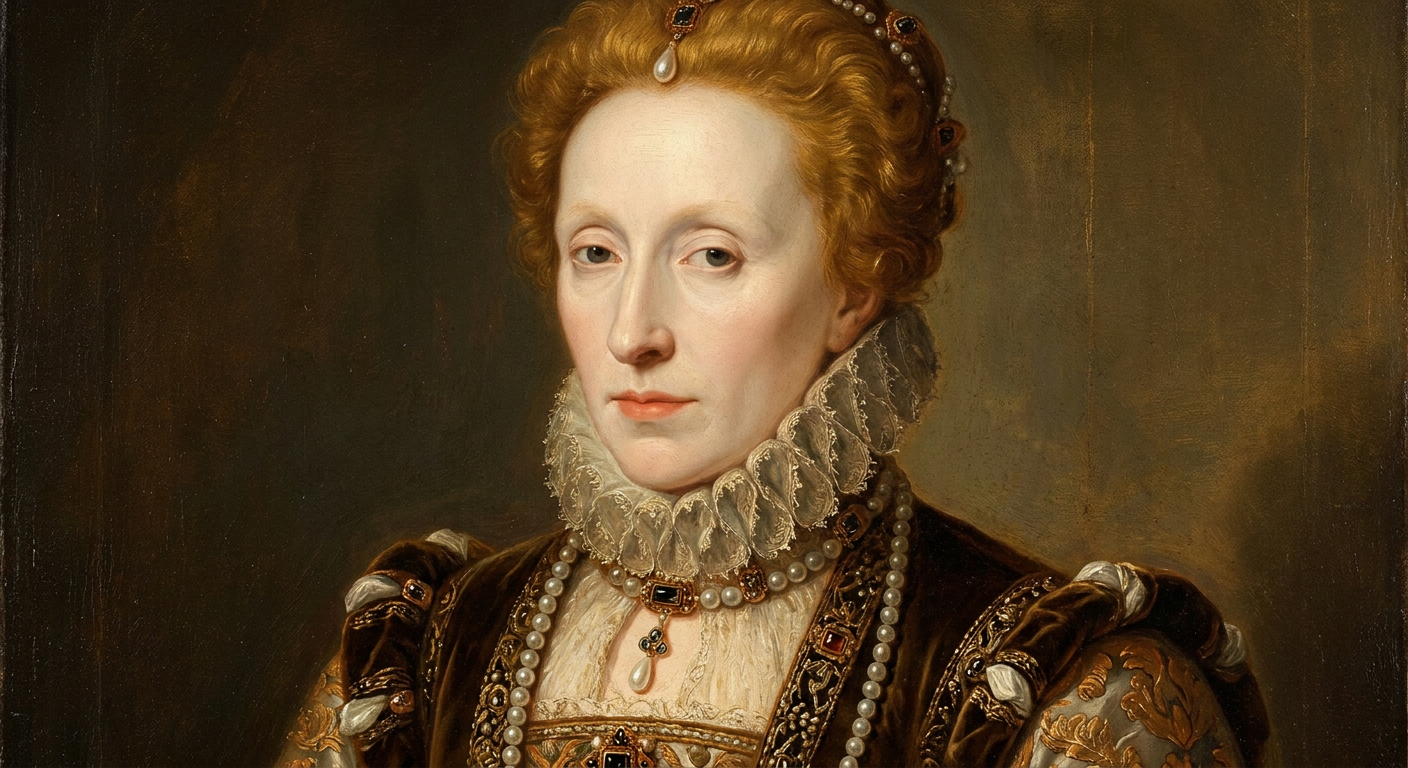
Quick Facts
- Years
- 1533 – 1603
- Category
- World Leaders & Revolutionaries
- Nationality
- English
- Occupation
- Queen of England and Ireland
Queen Elizabeth I
1533 – 1603 · English · Queen of England and Ireland
Recommended Audiobooks
Listen next from Marcus Alden

Life Lessons from Simon Bolivar
Marcus Alden · 55 min

Life Lessons from George Washington
Marcus Alden · 54 min
Queen Elizabeth I ruled England and Ireland from 1558 until 1603, transforming a vulnerable kingdom into a more confident Protestant power. The daughter of Henry VIII and Anne Boleyn, she survived family tragedy, political suspicion and imprisonment before becoming one of England’s most celebrated monarchs.
Elizabeth inherited a government burdened by debt, religious conflict and war with France. Her long reign brought a durable Protestant settlement, cautious financial recovery, naval expansion and a remarkable flowering of drama, poetry and music. The defeat of the Spanish Armada in 1588 became the defining triumph of her rule, although English sailors, commanders, geography and severe weather all contributed to that outcome.
Her record was not uniformly glorious. Religious persecution, warfare in Ireland, poverty, censorship and the execution of Mary, Queen of Scots complicate the traditional image of a golden age. Elizabeth could be pragmatic and inspiring, but also indecisive, severe and unwilling to resolve the succession openly.
She remains important because her reign shaped English national identity, helped establish Protestant government and encouraged the maritime ambitions that later produced a global empire. Historians continue to study how Elizabeth used ceremony, language, gender and political calculation to exercise power in a society that generally expected rulers to be men.
Quick Facts
| Field | Details |
|---|---|
| Full Name | Elizabeth Tudor |
| Common Name(s) | Elizabeth I; the Virgin Queen; Gloriana; Good Queen Bess |
| Born | 7 September 1533 |
| Died | 24 March 1603 |
| Age at Death | 69 |
| Birthplace | Greenwich Palace, England |
| Nationality | English |
| Occupation | Queen of England and Ireland |
| Historical Era | Tudor period; English Renaissance; Reformation |
| Famous For | The Elizabethan Religious Settlement, defeat of the Spanish Armada and patronage of an age of cultural expansion |
| Political Affiliation | Not applicable in the modern party sense; head of the Tudor monarchy |
| Religion | Protestant, within the Church of England |
| Education | Privately educated by leading humanist tutors, including William Grindal and Roger Ascham |
| Parents | Henry VIII and Anne Boleyn |
| Spouse(s) | None |
| Children | None |
| Major Works | Speeches, prayers, poems, translations and extensive royal correspondence; no single authored political treatise |
| Major Achievements | Religious settlement of 1559; political stability; survival of the Armada crisis; naval and commercial expansion; strengthened poor-law administration |
Early Life
Elizabeth was born at Greenwich Palace on 7 September 1533. Henry VIII had ended his marriage to Catherine of Aragon and broken with papal authority partly because he hoped Anne Boleyn would produce a male heir. Elizabeth’s sex therefore caused disappointment at court, although she was initially treated as a legitimate princess.
Her world changed before she was three. Anne Boleyn was executed in May 1536 after a trial widely regarded by modern historians as politically driven and unreliable. Elizabeth was declared illegitimate, as her half-sister Mary had been earlier. Nevertheless, she remained in the royal succession under Henry VIII’s final arrangements, after Prince Edward and Mary.
Elizabeth received an exceptional humanist education. Her tutors taught Latin, Greek, French, Italian, rhetoric, theology, history and music. Roger Ascham praised her intellectual discipline, although his admiration should be read as that of a tutor seeking to celebrate a royal pupil. Her surviving writings confirm unusual linguistic skill and a strong command of formal argument.
Her childhood households were supervised by women including Margaret Bryan and Katherine Champernowne, later Katherine Ashley. Ashley became a trusted attendant and lasting influence. Elizabeth also developed a close relationship with Henry VIII’s sixth wife, Katherine Parr.
After Henry died in 1547, Elizabeth lived for a time with Parr and Parr’s new husband, Thomas Seymour. Seymour behaved flirtatiously and inappropriately toward the teenage princess. Following Parr’s death, his political schemes led to his arrest. Elizabeth, only fifteen, underwent intense questioning in 1549 but answered cautiously and avoided implication. The episode taught her how dangerous court politics could be.
Rise to Prominence
During Edward VI’s Protestant reign, Elizabeth publicly conformed to the reformed religion. When the Catholic Mary I became queen in 1553, Elizabeth’s position became perilous. Protestant rebels involved in Wyatt’s Rebellion of 1554 claimed to act partly in her interest, though proof that Elizabeth supported them is lacking.
Mary had her imprisoned in the Tower of London and later confined at Woodstock. Elizabeth repeatedly protested her innocence. She survived because the evidence against her was insufficient and because executing Henry VIII’s daughter would have carried enormous political risk.
Mary died childless on 17 November 1558. Elizabeth, then twenty-five, succeeded peacefully and received an enthusiastic welcome. She was crowned at Westminster Abbey on 15 January 1559. Her accession was more than a personal victory: it restored Protestant leadership while creating urgent questions about worship, marriage, foreign policy and succession.
Major Achievements
The Elizabethan Religious Settlement
Parliament passed the Acts of Supremacy and Uniformity in 1559. Elizabeth became Supreme Governor of the Church of England, while a revised Book of Common Prayer established public worship. The settlement was Protestant in doctrine but retained bishops, vestments and ceremonial elements that some radical reformers disliked.
Its importance lay in creating a workable national framework after decades of upheaval. It did not produce complete tolerance. Catholics faced increasing penalties, particularly after papal condemnation of Elizabeth in 1570 and Catholic-backed plots. Puritans were also restricted when they challenged episcopal authority.
Preservation of the Tudor State
Elizabeth maintained the crown through forty-four years without civil war or a disputed change of monarch during her lifetime. She relied on experienced councillors, especially William Cecil, later Lord Burghley, and Francis Walsingham. Her government used local justices of the peace and Parliament while preserving royal authority.
The 1598 and 1601 Poor Laws organized parish-based relief for people unable to work and measures for the able-bodied unemployed. They were not a modern welfare system, but they created an administrative structure that endured for more than two centuries.
Defeat of the Spanish Armada
In 1588 Philip II of Spain sent a vast fleet to escort an invasion army from the Netherlands. English ships harassed the Armada in the Channel, while fireships disrupted its formation at Calais. The English attack near Gravelines and later storms forced the fleet to retreat around Scotland and Ireland.
Elizabeth’s appearance before troops at Tilbury became a powerful act of leadership. Victory prevented invasion and strengthened her image, although it did not end the Anglo-Spanish War. Spain remained a major power, and England’s own counter-armada failed badly in 1589.
Cultural and Maritime Expansion
Elizabeth’s reign coincided with the work of William Shakespeare, Christopher Marlowe, Edmund Spenser and composers such as William Byrd. The queen did not personally create this cultural movement, but court patronage, commercial theatres, printing and urban growth helped it flourish.
Sailors including Francis Drake pursued trade, exploration, privateering and raids on Spanish possessions. These voyages expanded geographical knowledge and commercial ambition, but they were also connected to violence, plunder and the beginnings of English participation in Atlantic slavery and colonial dispossession.
Leadership or Work
Elizabeth governed through consultation but reserved final decisions for herself. She read dispatches closely, wrote notes in the margins and often forced rival advisers to argue before her. Delay was one of her principal tools: postponing a choice could preserve flexibility, especially in marriage negotiations and foreign affairs.
Her strengths included political intelligence, memory, command of language and an ability to turn public appearances into demonstrations of royal unity. Annual progresses allowed her to meet subjects outside London while shifting some costs of the court onto hosts.
Her weaknesses were connected to the same cautious temperament. Ministers became frustrated by delayed military decisions and inconsistent funding. She could berate councillors, resist unwelcome evidence and demand ambitious results without providing adequate resources. Yet she usually kept competing factions from dominating the state until the final years of her reign.
Personal Life
Elizabeth never married and had no children. Suitors included Philip II of Spain, Archduke Charles of Austria, Erik XIV of Sweden and Francis, Duke of Anjou. Marriage negotiations served diplomatic purposes, but historians disagree over whether she seriously intended to marry at particular moments.
Robert Dudley, Earl of Leicester, was her best-known favourite and probably the man she loved most deeply. There is no reliable evidence that they secretly married or had a child. Dudley’s wife, Amy Robsart, died after falling down stairs in 1560; an inquest judged the death accidental, though scandal made a royal marriage politically difficult.
Elizabeth enjoyed dancing, music, hunting, elaborate clothing, conversation and learned display. She cultivated an appearance of ageless magnificence as she grew older, using portraits and ceremony to protect royal authority. A bout of smallpox in 1562 nearly killed her and left facial scarring. Her final illness is uncertain; she declined gradually and reportedly resisted going to bed before dying at Richmond Palace.
Philosophy or Beliefs
Elizabeth believed monarchy was ordained by God, but she understood that successful rule required cooperation with councillors, nobles, Parliament and local officials. She defended royal prerogative while presenting herself as a ruler bound to the welfare of her people.
Religiously, she was firmly Protestant but generally less interested than many contemporaries in detailed theological disputes. She valued outward conformity and political obedience. Her government’s tolerance narrowed when Catholic missionary activity, rebellion and foreign invasion appeared linked.
Elizabeth’s language often combined masculine and feminine imagery. She could describe herself as a mother or bride of the kingdom, yet also claim the courage expected of a king. This was not modern feminism: she did not challenge the wider legal and social subordination of women. Rather, she treated herself as an exceptional female monarch whose authority came from dynasty and God.
Challenges and Controversies
Mary, Queen of Scots
Mary fled Scotland and entered England in 1568. As a Catholic with a strong hereditary claim, she became a focus for plots against Elizabeth. After evidence connected Mary to the Babington Plot, an English commission convicted her of treason. Elizabeth signed the death warrant, then reacted angrily when Mary was executed in 1587.
Some historians see Elizabeth’s hesitation as genuine moral and political anxiety about executing an anointed queen. Others emphasize her habit of preserving deniability. Mary’s captivity and death removed a threat but damaged Elizabeth’s reputation among Catholic rulers.
Religious Persecution
Elizabeth initially sought broad conformity rather than investigation of private belief. Conditions hardened after the Northern Rebellion, the pope’s 1570 excommunication and missionary missions. Catholic priests could be prosecuted as traitors, and more than one hundred were executed during the reign. Catholic laypeople faced fines for missing Anglican services.
Puritans who demanded further reform also encountered censorship, imprisonment and loss of office. Defenders argue that the government faced genuine assassination and invasion plans; critics note that it increasingly treated religious identity as a security threat.
Ireland
English policy in Ireland was among the reign’s darkest aspects. Military campaigns, plantation projects and suppression of rebellion caused extensive destruction. During the Nine Years’ War, forces under Hugh O’Neill challenged English rule until 1603. Scorched-earth tactics and famine inflicted severe suffering on civilians.
Officials framed conquest as security and reform, while many Irish communities experienced it as dispossession and coercion. Elizabeth’s Irish wars were expensive and exposed the limits of her government’s resources.
War, Poverty and Monopolies
The later reign brought bad harvests, inflation, plague, unemployment and heavy military expenditure. Veterans and ordinary taxpayers did not necessarily share in courtly prosperity. Royal grants of monopolies allowed individuals to control the sale of goods, raising prices and provoking parliamentary anger.
Elizabeth addressed the crisis in her Golden Speech of 1601 and promised reforms. Her response showed political skill, but the controversy revealed how patronage could become abuse. The romantic idea of an entirely prosperous “Golden Age” therefore describes cultural memory better than everyday life for many subjects.
Legacy
Elizabeth died on 24 March 1603 and was buried in Westminster Abbey. James VI of Scotland succeeded her as James I of England, uniting the crowns while preserving separate states. The peaceful succession reflected careful late-reign communication, particularly involving Robert Cecil.
Later generations turned Elizabeth into a symbol of Protestant independence, naval power and national resilience. Paintings, plays, novels, films and television have repeatedly recreated her, often blurring history with legend. Her name was given to the modern Elizabethan age of Elizabeth II, as well as towns, institutions and public monuments.
Important places associated with her include Westminster Abbey, the Tower of London, Hampton Court, Hatfield House and the remains of Tilbury Fort’s later defenses. Modern scholarship presents a balanced legacy: a gifted political survivor who stabilized her kingdom, but also a ruler whose government practiced persecution, colonial violence and harsh social control.
Interesting Facts
- Elizabeth was only two years and eight months old when Anne Boleyn was executed.
- Her signature often ended with an elaborate flourish.
- She could read and write Latin, French and Italian and had knowledge of Greek.
- As a teenager, she translated works by Marguerite of Navarre and others.
- She was imprisoned in the Tower where her mother had previously been held.
- She adopted the title “Supreme Governor,” not “Supreme Head,” of the Church of England.
- Elizabeth survived smallpox in 1562.
- She made more than twenty regional progresses during her reign.
- Parliament repeatedly petitioned her to marry or name an heir.
- Robert Dudley remained influential despite the scandal surrounding his wife’s death.
- The pope excommunicated Elizabeth in 1570.
- Francis Drake’s circumnavigation ended in 1580, and Elizabeth knighted him in 1581.
- She spoke to troops at Tilbury after the Armada had entered the Channel but before the invasion danger had completely passed.
- Her government sponsored one of England’s earliest attempted colonies on Roanoke Island.
- She owned hundreds of dresses, though precise totals reported in popular accounts are uncertain.
- Elizabeth shared a Westminster Abbey tomb monument with her half-sister Mary I.
- Her motto was Semper eadem, meaning “Always the same.”
- Her reign of 44 years and 127 days was the longest of any English monarch before the eighteenth century.
Famous Quotes
- “I know I have the body but of a weak and feeble woman; but I have the heart and stomach of a king.” Attributed to the Tilbury speech of 1588. The speech captures Elizabeth’s use of gendered language, but its familiar text survives in a version recorded decades later, so exact wording is debated.
- “I have already joined myself in marriage to a husband, namely the kingdom of England.” Reported from her 1559 response to Parliament. It expressed the political image of a queen wedded to her realm; surviving versions differ.
- “There will never queen sit in my seat with more zeal to my country, care to my subjects.” From the Golden Speech of 1601, emphasizing duty rather than hereditary status alone.
- “Though God hath raised me high, yet this I count the glory of my crown, that I have reigned with your loves.” Golden Speech. Elizabeth represented affection between monarch and subjects as her greatest success.
- “I was never any greedy, scraping grasper, nor a strait, fast-holding prince.” Golden Speech, delivered during the monopolies controversy as she defended her intentions.
- “You may have many mightier and wiser princes sitting in this seat, but you never had, nor shall have, any that will love you better.” Recorded in accounts of the Golden Speech; wording varies slightly by source.
- “Let tyrants fear.” From the received Tilbury text, presenting courage and trust in loyal subjects as answers to foreign invasion.
- “I have no desire to make windows into men’s souls.” Frequently attributed to Elizabeth as a statement of religious moderation, but no secure contemporary source proves that she used these exact words.
- “Much suspected by me, nothing proved can be.” A line associated with Elizabeth’s poem “On Monsieur’s Departure.” The poem is traditionally attributed to her, although its transmission leaves some scholarly uncertainty.
Timeline
- 1533 — Elizabeth is born at Greenwich Palace.
- 1536 — Anne Boleyn is executed; Elizabeth is declared illegitimate.
- 1544 — Parliament restores Elizabeth to the succession after Edward and Mary.
- 1547 — Henry VIII dies; Edward VI becomes king.
- 1548–1549 — The Thomas Seymour scandal leads to Elizabeth’s interrogation.
- 1553 — Mary I becomes queen.
- 1554 — Elizabeth is imprisoned in the Tower after Wyatt’s Rebellion, then confined at Woodstock.
- 1558 — Elizabeth succeeds Mary on 17 November.
- 1559 — She is crowned; Parliament establishes the religious settlement.
- 1562 — Elizabeth nearly dies from smallpox.
- 1568 — Mary, Queen of Scots, enters England and is detained.
- 1569 — The Northern Rebellion challenges Elizabeth’s government.
- 1570 — Pope Pius V excommunicates Elizabeth.
- 1571 — The Ridolfi Plot increases fears of Catholic conspiracy.
- 1577–1580 — Francis Drake circumnavigates the globe.
- 1585 — England openly intervenes against Spain in the Netherlands.
- 1586 — The Babington Plot leads to Mary’s trial.
- 1587 — Mary, Queen of Scots, is executed.
- 1588 — The Spanish Armada is defeated.
- 1589 — The English counter-armada ends in costly failure.
- 1594–1603 — The Nine Years’ War is fought in Ireland.
- 1598 — Lord Burghley dies; major poor-law legislation is enacted.
- 1601 — Essex’s rebellion fails; Elizabeth delivers the Golden Speech; a new Poor Law is passed.
- 1603 — Elizabeth dies; James VI of Scotland succeeds as James I.
Frequently Asked Questions
1. Why is Elizabeth I famous?
Elizabeth is famous for presiding over a period of relative political stability, establishing a lasting Protestant church and surviving the Spanish Armada crisis. Her reign also coincided with major literary and maritime developments. The familiar “Golden Age” label captures genuine cultural achievement, but it can obscure war, poverty, persecution and suffering in Ireland.
2. Was Elizabeth I really a virgin?
Elizabeth never married and publicly cultivated the identity of the Virgin Queen. No reliable evidence proves that she had a sexual relationship or secretly bore a child. Claims involving Robert Dudley and supposed hidden descendants are unsupported by credible contemporary documentation. Her private feelings cannot be known with certainty, but her official unmarried status is beyond dispute.
3. Why did Elizabeth never marry?
Marriage could have produced an heir, but it also carried serious risks. An English husband might divide the nobility, while a foreign prince could draw England into unwanted alliances. Elizabeth used courtship negotiations diplomatically and may have felt genuine attachment to certain suitors. Historians disagree about her intentions, but remaining unmarried allowed her to retain personal political control.
4. How did Elizabeth become queen if she had been declared illegitimate?
Henry VIII’s final succession arrangements and the Succession Act of 1544 placed Elizabeth after Edward and Mary, even though her legitimacy was not formally restored. Edward died without children, and Mary also died childless. Elizabeth was therefore recognized as the lawful successor in 1558, with broad political acceptance and no stronger candidate capable of preventing her accession.
5. What religion was Elizabeth I?
Elizabeth was Protestant, although her personal ceremonial preferences were more traditional than those of many radical reformers. The 1559 settlement made her Supreme Governor of the Church of England and required common worship. She sought unity through outward conformity, but her government increasingly punished Catholics and also suppressed Puritans who challenged the established church.
6. Did Elizabeth create the Church of England?
No. Henry VIII separated the English church from papal authority, while Edward VI’s government introduced more explicitly Protestant doctrine. Mary I restored Catholic worship and papal ties. Elizabeth’s achievement was to re-establish and reshape an independent Protestant Church of England through legislation passed in 1559 and later doctrinal development.
7. Did Elizabeth personally defeat the Spanish Armada?
Elizabeth provided political leadership, approved defensive preparations and inspired troops, but she did not command the fleet. Lord Howard of Effingham, Francis Drake, John Hawkins and other officers directed English naval operations. Better maneuverability, Spanish logistical problems, the engagement at Gravelines and dangerous weather all contributed to the Armada’s failure.
8. What happened in the Spanish Armada campaign?
Spain planned to sail through the Channel, join the Duke of Parma’s army in the Netherlands and escort an invasion force to England. English ships attacked from a distance and scattered the Spanish formation with fireships near Calais. After fighting at Gravelines, the Armada retreated northward; storms and difficult navigation caused heavy additional losses.
9. Why did Elizabeth execute Mary, Queen of Scots?
Mary had become the focus of Catholic plots and was implicated by intercepted correspondence in the Babington Plot. A commission convicted her of involvement in a plan to kill Elizabeth. Elizabeth feared both assassination and the precedent of executing a crowned monarch. She eventually signed the warrant, although controversy remains over how directly she intended its immediate implementation.
10. Was Elizabeth tolerant of Catholics?
Her early government generally demanded public conformity rather than systematic inquiry into private belief. Policy became harsher after rebellion, excommunication, missionary activity and invasion threats. Priests trained abroad could be treated as traitors, and Catholic recusants faced heavy fines. Security dangers were real, but modern historians also recognize these policies as religious persecution.
11. What was Elizabeth’s relationship with Robert Dudley?
Dudley was a childhood acquaintance, favourite, political ally and probably Elizabeth’s closest romantic attachment. She spent considerable time with him and made him Earl of Leicester. His wife’s unexplained but officially accidental death made rumours inevitable. There is no convincing evidence of a secret marriage, sexual relationship or child between Dudley and Elizabeth.
12. Was Elizabeth a powerful ruler or controlled by advisers?
Elizabeth depended on skilled ministers, especially William Cecil and Francis Walsingham, but she was not their puppet. She controlled appointments, read diplomatic material and made final decisions. Advisers shaped options and sometimes maneuvered around her delays. Government was therefore collaborative and contested, with the queen maintaining decisive constitutional authority.
13. Why was the Elizabethan era culturally important?
Population growth, printing, education, commercial entertainment and aristocratic patronage helped drama, poetry and music flourish. Shakespeare, Marlowe and Spenser worked during the reign, while permanent public theatres transformed London culture. Elizabeth encouraged court performance and symbolic display, but the creative achievement belonged to a broad community of writers, actors, musicians, patrons and audiences.
14. What happened in Ireland during Elizabeth’s reign?
English governments attempted to expand direct authority, impose legal and religious change and establish plantations. Resistance produced repeated warfare, culminating in the Nine Years’ War led by Hugh O’Neill. English commanders employed devastating methods, including destruction of crops. The conflict brought famine, displacement and enduring resentment and is essential to any balanced assessment of the reign.
15. Who succeeded Elizabeth I?
James VI of Scotland, the son of Mary, Queen of Scots, succeeded as James I of England. Elizabeth never publicly named him heir, but her ministers communicated with him as her health failed. His accession united the English and Scottish crowns under one monarch in 1603, although the two kingdoms remained legally separate until 1707.
Lessons We Can Learn
- Education strengthens resilience. Elizabeth’s languages and rhetorical training helped her survive interrogation and govern effectively. Modern application is an interpretation, but the historical connection between preparation and performance is clear.
- Delay can be strategic. She postponed decisions when commitment would reduce her options. Delay, however, became harmful when soldiers and officials needed timely orders.
- Public communication matters. Speeches, progresses and portraits helped turn authority into a shared political story.
- Compromise can stabilize institutions. The religious settlement balanced competing Protestant preferences, though it did not create genuine freedom of conscience.
- Expert advisers are valuable. Elizabeth retained capable ministers for decades while continuing to test their recommendations.
- Symbolism cannot replace resources. Armada-era inspiration succeeded alongside ships, supplies and trained commanders; later underfunded campaigns exposed the opposite problem.
- Security policies need limits. Genuine plots encouraged increasingly broad persecution, showing how fear can erode justice.
- Cultural achievement has social costs. Court splendour coexisted with poverty, war and colonial violence; celebratory narratives should include those experiences.
- Succession planning protects institutions. Elizabeth preserved flexibility by avoiding the subject, but uncertainty remained dangerous until ministers quietly prepared James’s accession.
- Historical reputations require balance. Elizabeth was both an exceptional political survivor and a ruler responsible for coercive policies. Mature judgment can hold both conclusions together.
Related Historical Figures
- Henry VIII — Elizabeth’s father, whose marriages and break with Rome shaped her life and kingdom.
- Anne Boleyn — Her mother, executed in 1536 after losing Henry’s support.
- Mary I — Her Catholic half-sister, predecessor and former jailer.
- Edward VI — Her Protestant half-brother and predecessor before Mary.
- Mary, Queen of Scots — A dynastic rival whose captivity and execution defined Elizabethan politics.
- William Cecil, Lord Burghley — Elizabeth’s principal minister and administrative anchor.
- Francis Walsingham — Secretary, diplomat and organizer of intelligence against plots.
- Robert Dudley, Earl of Leicester — Favourite, possible suitor and military commander.
- Philip II of Spain — Former suitor turned principal foreign enemy and sponsor of the Armada.
- James VI and I — Mary’s son and Elizabeth’s successor, who inaugurated Stuart rule in England.
Watch and Learn
“History vs. Elizabeth I of England” — TED-Ed — approximately 5 minutes. This concise animated lesson tests Elizabeth’s heroic reputation against evidence about religion, war, culture and colonization. It is especially useful as an introduction because it distinguishes later legend from the more complicated historical record.
Watch and Learn
History vs. Elizabeth I of England · TED-Ed
Related Historical Figures