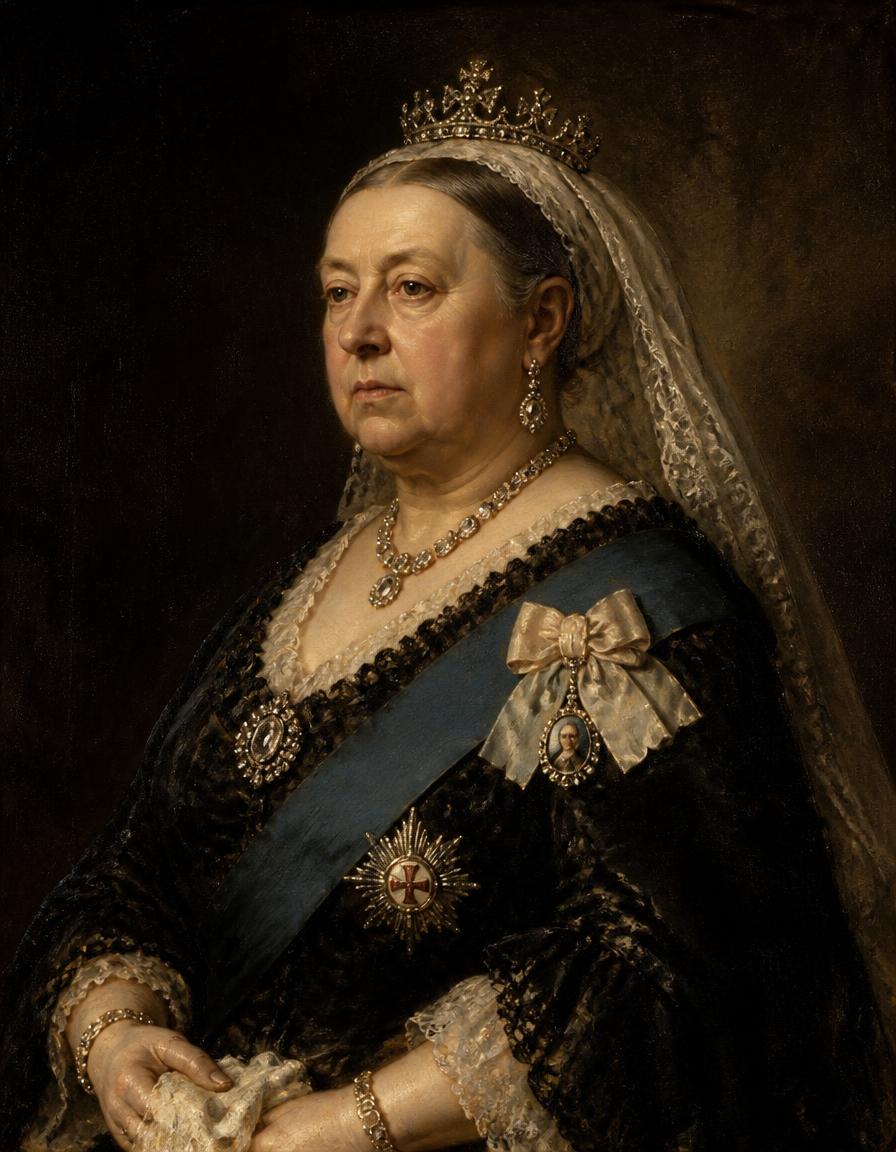
Quick Facts
- Years
- 1819 – 1901
- Category
- World Leaders & Revolutionaries
- Nationality
- British
- Occupation
- Queen & Empress
Queen Victoria
1819 – 1901 · British · Queen & Empress
Audiobook

Life Lessons from Queen Victoria
Marcus Alden · 54 min
Queen Victoria (1819–1901) was queen of the United Kingdom of Great Britain and Ireland from 1837 until her death and, from 1876, empress of India. Her reign of more than 63 years—then the longest in British history—became so closely associated with industrial growth, imperial expansion, social change, and strict public morality that the period took her name: the Victorian era.
Victoria did not personally govern Britain as an absolute ruler. She reigned within a developing constitutional monarchy, working with ten prime ministers while elected governments exercised increasing authority. Nevertheless, she possessed political influence, especially through private correspondence, ministerial appointments, court patronage, and her role as a symbol of national continuity. Her marriage to Prince Albert created an influential royal partnership, and their nine children connected Britain’s dynasty to ruling houses across Europe.
Her reign encompassed the expansion of the British Empire, the Great Exhibition of 1851, major electoral reforms, wars in Crimea and South Africa, and profound transformations in science, technology, religion, and society. It also unfolded amid colonial conquest, racial hierarchy, poverty, and political conflict. Victoria remains important because her life illuminates both the modernization of monarchy and the contradictions of nineteenth-century Britain: constitutional progress alongside imperial domination, domestic respectability alongside deep inequality, and private grief transformed into public symbolism.
Quick Facts
| Field | Information |
|---|---|
| Full Name | Alexandrina Victoria |
| Common Name(s) | Queen Victoria; Victoria; Empress of India |
| Born | 24 May 1819 |
| Died | 22 January 1901 |
| Age at Death | 81 |
| Birthplace | Kensington Palace, London, England |
| Nationality | British |
| Occupation | Monarch; Queen of the United Kingdom; Empress of India |
| Historical Era | Victorian era; nineteenth century |
| Famous For | Britain’s long Victorian reign, constitutional monarchy, imperial symbolism, marriage to Prince Albert |
| Political Affiliation if applicable | None formally; personally favored particular ministers at different times |
| Religion if significant | Church of England; supreme governor of the established church |
| Education | Privately educated at Kensington Palace by tutors, especially Louise Lehzen |
| Parents | Prince Edward, Duke of Kent and Strathearn; Princess Victoria of Saxe-Coburg-Saalfeld |
| Spouse(s) | Prince Albert of Saxe-Coburg and Gotha, married 1840–1861 |
| Children | Victoria, Albert Edward, Alice, Alfred, Helena, Louise, Arthur, Leopold, and Beatrice |
| Major Works | Extensive journals and correspondence; Leaves from the Journal of Our Life in the Highlands |
| Major Achievements | Reigned 1837–1901; helped stabilize the constitutional monarchy; supported the Great Exhibition; became empress of India; established a far-reaching European royal dynasty |
Early Life
Alexandrina Victoria was born at Kensington Palace on 24 May 1819. She was the only child of Prince Edward, Duke of Kent, the fourth son of King George III, and Princess Victoria of Saxe-Coburg-Saalfeld. She was named Alexandrina after her godfather, Emperor Alexander I of Russia, but preferred her second name.
Her birth followed a succession crisis. Princess Charlotte, the only legitimate child of the future George IV, had died in 1817. George III’s unmarried sons hurried to produce legitimate heirs. Victoria’s father died of pneumonia in January 1820, when she was eight months old; George III died days later. Victoria was therefore raised by her widowed mother under financially and politically uncertain circumstances.
Her childhood was governed by the “Kensington System,” devised chiefly by her mother and the comptroller Sir John Conroy. It kept Victoria closely supervised, socially isolated, and dependent on them. She slept in her mother’s room, followed a rigid timetable, and was rarely permitted to be alone. Conroy hoped to retain influence if the underage Victoria inherited the throne and her mother became regent. Victoria later remembered this upbringing with resentment and refused Conroy’s pressure to appoint him her private secretary.
Her principal governess, Baroness Louise Lehzen, gave her emotional support and encouraged independence. The Reverend George Davys supervised her formal studies. Victoria learned history, geography, religion, music, drawing, and languages including German, English, French, and Italian. Her education was broad but not designed as rigorous statecraft training.
By 1830, after the death of George IV and the accession of William IV, Victoria was heir presumptive. Parliament passed the Regency Act of 1830 to provide for her mother to serve as regent if Victoria succeeded before turning eighteen. She reached eighteen on 24 May 1837, eliminating that possibility shortly before William IV died.
Rise to Prominence
King William IV died early on 20 June 1837. Victoria was awakened at Kensington Palace and informed that the archbishop of Canterbury and the lord chamberlain wished to see her. Meeting them without her mother, she learned that she was queen. The personal union between Britain and Hanover ended because Hanoverian succession law excluded women while a male heir existed; Victoria’s uncle Ernest Augustus became king there.
Victoria moved to Buckingham Palace and quickly asserted independence from her mother and Conroy. At first she relied heavily on the Whig prime minister, Lord Melbourne, who became her political mentor and paternal adviser. Her closeness to Melbourne led critics to call her the “Queen of the Whigs,” revealing her initial lack of political neutrality.
The Bedchamber Crisis of 1839 exposed the limits and ambiguities of royal power. When Melbourne resigned, Conservative leader Sir Robert Peel sought changes among the ladies of Victoria’s household, many of whom were connected to Whig politicians. Victoria refused, and Peel declined to form a government; Melbourne returned. Although constitutional responsibility was debated, Victoria later accepted that a monarch’s household could not be used to obstruct a change of ministry.
On 10 February 1840, she married her first cousin Prince Albert of Saxe-Coburg and Gotha. As sovereign, Victoria had proposed to him. Albert initially lacked a defined constitutional position, but gradually became her closest adviser and a major force in court organization, education, art, science, and philanthropy. Their partnership strengthened Victoria’s public standing and helped establish the image of a disciplined domestic monarchy.
Major Achievements
Modernizing the Constitutional Monarchy
Victoria inherited a monarchy damaged by the reputations of several Hanoverian predecessors. Through public ceremony, family imagery, charitable patronage, and long service, she helped restore respect for the Crown. She retained the right to be consulted, to advise, and to warn ministers, but government increasingly depended on Parliament rather than royal preference.
This adaptation mattered because Britain was becoming more democratic. Reform Acts in 1867 and 1884 expanded the electorate, while organized parties and the press gained influence. Victoria did not create these changes and sometimes disliked them, but the monarchy survived partly because it adjusted to them. Her successors inherited a model in which political influence was exercised mainly through counsel and symbolism.
The Royal Partnership with Prince Albert
Albert became an active partner in Victoria’s work. He reviewed official papers, advised on foreign affairs, and promoted administrative efficiency. Together they projected an idealized image of marriage, parenthood, duty, and domestic respectability that appealed to many middle-class subjects.
The image was never a complete account of their private life: their marriage included arguments, and Victoria found pregnancy burdensome. Yet the partnership helped transform the court from a target of scandal into a center of cultural and philanthropic activity. Its long-term influence can be seen in the expectation that Britain’s royal family should embody service and respectable family life.
The Great Exhibition of 1851
Prince Albert was the leading royal patron of the Great Exhibition, held in Joseph Paxton’s Crystal Palace in Hyde Park. Victoria enthusiastically supported it and attended repeatedly. The exhibition displayed industrial products, machinery, art, and raw materials from Britain and other countries.
It celebrated manufacturing, commerce, and international exchange while also showcasing imperial resources and British confidence. Profits helped develop the South Kensington cultural district, eventually associated with institutions including the Victoria and Albert Museum, the Science Museum, and the Royal Albert Hall. The exhibition became a defining event of the age.
A Global and Imperial Monarchy
During Victoria’s reign, Britain acquired or consolidated territories across Asia, Africa, and the Pacific. After the Indian Rebellion of 1857, government of India passed from the East India Company to the Crown in 1858. Victoria’s proclamation promised religious noninterference, equal legal protection, and respect for Indian princes, although colonial practice often failed to fulfill those ideals.
At Prime Minister Benjamin Disraeli’s initiative, Parliament granted Victoria the title empress of India in 1876. She valued the title and cultivated relationships with Indian attendants and aristocrats. Her status gave the empire a personal symbol, but it also tied her legacy to conquest, economic exploitation, racial inequality, and famines under colonial government.
Dynastic Influence Across Europe
Victoria and Albert’s nine children married into several European royal families. Their descendants occupied or married into the thrones of Germany, Russia, Greece, Romania, Spain, Norway, and other states. Victoria became popularly known as the “Grandmother of Europe.”
These marriages created channels of personal diplomacy, though kinship did not prevent international rivalry or war. They also spread hemophilia through several royal lines; Victoria was probably the source of the mutation among her descendants, though its precise origin cannot be proven.
Longevity and National Continuity
Victoria’s Golden Jubilee in 1887 and Diamond Jubilee in 1897 turned royal anniversaries into vast public and imperial celebrations. Colonial premiers and troops participated, while new communications carried the ceremonies widely.
Her longevity gave an era of rapid disruption a sense of continuity. By her death, railways, telegraphs, mass newspapers, factories, and expanded cities had transformed Britain. The Crown’s association with stable national ritual became one of her most durable institutional achievements.
Leadership and Work
Victoria took monarchy seriously as a vocation. She read dispatches, annotated documents, corresponded energetically, and expected ministers to keep her informed. Her political influence was greatest in foreign and military affairs, court appointments, and private advice. She could be perceptive, hardworking, and courageous, but also impulsive, partisan, and resistant to unwelcome opinions.
Her relationships with prime ministers varied sharply. She adored Melbourne, distrusted Peel before coming to respect him, disliked Lord Palmerston’s independence, admired Disraeli’s tact and imperial vision, and had a difficult relationship with William Gladstone. Disraeli understood how to flatter and involve her; Gladstone’s earnest manner often irritated her, although she performed her constitutional duties under his governments.
Albert encouraged a more systematic, politically balanced court. After his death, Victoria relied heavily on private secretaries, notably Sir Charles Phipps, General Charles Grey, Sir Henry Ponsonby, and later Arthur Bigge. Their work helped professionalize communications between monarch and government.
Her strengths included stamina, a strong memory for persons and events, devotion to duty, and an ability to embody continuity. Her weaknesses included emotional favoritism, hostility toward some reformers, limited sympathy for organized feminism, and a tendency to interpret disagreement personally.
Personal Life
Victoria and Albert had nine children between 1840 and 1857. Victoria loved Albert intensely but disliked repeated pregnancies and could be demanding toward her children. She expected them to uphold dynastic duty, and her efforts to influence their marriages and conduct sometimes produced strained relationships.
The royal family divided its time among Buckingham Palace, Windsor Castle, Osborne House on the Isle of Wight, and Balmoral in Scotland. Victoria enjoyed sketching, music, dancing in her youth, dogs, horseback riding, theatrical performances, and Highland scenery. She kept extensive journals from childhood, although her daughter Beatrice later edited and transcribed much of them, destroying many originals.
Albert died of typhoid fever on 14 December 1861, though modern historians have considered whether other illness contributed. Victoria entered profound mourning, wore black for the rest of her life, and withdrew from many public appearances. Her prolonged seclusion damaged her popularity and generated republican criticism.
Her Scottish servant John Brown became a trusted companion. Rumors alleged a secret marriage or romantic relationship, but no reliable evidence proves either claim. After Brown’s death in 1883, she formed a close bond with Abdul Karim, an Indian attendant whom she promoted as her “Munshi,” or teacher. Their friendship provoked racism, jealousy, and opposition within the royal household.
In later life Victoria suffered from rheumatism, impaired eyesight, and reduced mobility. She continued official business almost until her death at Osborne House on 22 January 1901.
Philosophy and Beliefs
Victoria’s worldview combined Protestant Christianity, hereditary monarchy, family duty, patriotism, and belief in Britain’s global mission. She viewed sovereign authority as a responsibility under God, though she also enjoyed the status and ceremony of monarchy.
Politically, she was not consistently aligned with a modern party ideology. Her early Whig sympathies gave way to a more conservative outlook, particularly on monarchy, empire, social hierarchy, and foreign affairs. Yet she sometimes supported humanitarian causes and could be pragmatic when constitutional practice required cooperation with governments she disliked.
She opposed women’s suffrage and privately condemned the “mad, wicked folly” of women’s rights agitation. Her position illustrates a central paradox: a powerful female sovereign did not see her exceptional hereditary role as an argument for political equality among women.
Her religious outlook was sincere but comparatively broad in personal relations. She opposed sectarian conflict, valued the promise of religious toleration in India, and showed interest in different cultures. Nevertheless, her attitudes remained shaped by nineteenth-century imperial assumptions.
Challenges and Controversies
Victoria’s early handling of the Bedchamber Crisis was criticized as partisan interference. Defenders note that constitutional conventions governing household appointments were still evolving; critics argue that she prevented Peel from forming a workable ministry.
Her seclusion after Albert’s death became another major controversy. Many contemporaries sympathized with her grief, but taxpayers and politicians questioned why a publicly funded monarch appeared absent. Her eventual return to ceremony restored popularity, yet the episode demonstrated that symbolic visibility had become essential to modern monarchy.
Victoria opposed or distrusted several democratic and feminist reforms. Although she reigned during electoral expansion, credit belongs chiefly to Parliament, campaigners, and ministers. Her personal hostility to women’s rights contrasts strongly with later attempts to treat her automatically as a feminist icon.
Her imperial title and celebrations associated her directly with British expansion. Admirers viewed the empire as a source of order, commerce, and global connection. Critics then and now emphasize military conquest, confiscation, racial discrimination, coerced labor, cultural disruption, and failures during famine. Victoria did not personally direct colonial administration, but she endorsed imperial monarchy and benefited from its prestige.
Her relationships with John Brown and Abdul Karim produced court disputes and sensational rumors. Brown was accused of exercising improper influence, while Karim faced investigations and hostility. Surviving evidence supports the closeness of both relationships, but not the most dramatic claims about secret marriage or sexual scandal.
Victoria also supported harsh resistance to rebellion and expressed strong opinions during wars. Her private writings sometimes contain racial and cultural stereotypes characteristic of her milieu. A balanced assessment neither removes her from her historical context nor uses that context to erase the consequences of such attitudes.
Legacy
Victoria’s greatest institutional legacy was the adaptation of monarchy to an age of parliamentary government, mass media, and expanding political participation. Royal influence persisted, but the sovereign increasingly stood above day-to-day party competition. Public ceremony, family presentation, philanthropy, and continuity became central sources of legitimacy.
The “Victorian” label covers extraordinary achievements in engineering, medicine, literature, education, and urban development. It also evokes class inequality, restrictive gender norms, industrial exploitation, and empire. Historians therefore use Victoria’s reign not as a single uniform culture but as a framework for studying competing forces.
Her name survives worldwide in places including the state of Victoria in Australia, Victoria in British Columbia, Lake Victoria, Victoria Falls, and numerous streets, schools, parks, and public buildings. Many names arose through colonial expansion and are now subjects of debate over commemoration and Indigenous history.
Major sites connected with her include Kensington Palace, Buckingham Palace, Windsor Castle, Osborne House, Balmoral Castle, the Victoria and Albert Museum, and the Victoria Memorial outside Buckingham Palace. Statues stand throughout Britain and the former empire. Their continued presence invites discussion about constitutional history, imperial power, and public memory.
Interesting Facts
- Victoria was fifth in line to the throne at birth.
- Her first language in early childhood was German, though she became fully fluent in English.
- She began keeping a journal in 1832 and continued for most of her life.
- She was only 4 feet 11 inches, or about 150 centimeters, tall.
- She became queen less than a month after turning eighteen.
- She was the first British sovereign to live at Buckingham Palace.
- As reigning monarch, she proposed marriage to Prince Albert.
- Her wedding helped popularize white bridal clothing, though she did not originate the custom.
- She was the first British monarch known to have been photographed.
- She survived several assassination attempts and assaults.
- She spoke German and English and studied French and Italian.
- She and Albert introduced family Christmas trees at court, helping popularize an existing German custom in Britain.
- She used chloroform during the birth of Prince Leopold in 1853, encouraging wider acceptance of obstetric anesthesia.
- She visited the Great Exhibition dozens of times.
- Her favorite homes included Osborne House and Balmoral Castle.
- She learned some Hindustani from Abdul Karim.
- Her 1897 Diamond Jubilee marked sixty years on the throne.
- Her reign lasted 63 years, 216 days.
- She was buried beside Albert at the Royal Mausoleum, Frogmore.
- Her son Edward VII succeeded her at age fifty-nine.
Famous Quotes
- “I will be good.” Victoria reportedly said this after learning as a child that she would probably inherit the throne. The story comes through later recollection and expresses her early sense of duty, but the exact wording cannot be independently verified.
- “Since it has pleased Providence to place me in this station, I shall do my utmost to fulfil my duty towards my country.” Written in her journal upon becoming queen in 1837, it states her conception of monarchy as providential service.
- “I was married at half past 12 by the Archbishop of Canterbury.” Her journal entry for 10 February 1840 records the central event of her personal life in characteristically direct language.
- “He was perfection in every way—in beauty—in everything.” Victoria’s recollections of Albert conveyed admiration that deepened after his death and shaped his public memorialization.
- “The important day is here, and I am dreadfully nervous.” Written before opening the Great Exhibition in 1851, this reveals the anxiety behind a triumphant public occasion.
- “The poor fatherless baby of eight months is now the utterly broken-hearted and crushed widow of forty-two!” Her journal after Albert’s death connected the loss of her father with her widowhood.
- “I am every day more convinced that we women, if we are to be good women, feminine and amiable and domestic, are not fitted to reign.” In a private letter, Victoria expressed conventional views about gender despite being a reigning queen.
- “The Queen is most anxious to enlist everyone who can speak or write to join in checking this mad, wicked folly of ‘Woman’s Rights.’” A documented 1870 letter showing her opposition to the women’s movement.
- “I feel sure that the admission of ladies to the gallery would be a great inconvenience.” Her resistance to women observing parliamentary proceedings illustrates her social conservatism.
- “We are not amused.” Famous but poorly documented. No reliable contemporary source proves that Victoria said it, and historians treat the attribution cautiously.
- “Everybody grows but me.” Commonly attributed to the young Victoria after recognizing her place in the succession; the precise wording rests on later accounts.
Timeline
- 1819 — Alexandrina Victoria is born at Kensington Palace on 24 May.
- 1820 — Her father dies; George III dies shortly afterward.
- 1830 — William IV becomes king, making Victoria heir presumptive.
- 1832 — Victoria begins the journals she will maintain throughout her life.
- 1836 — She meets Prince Albert during his visit to Britain.
- 1837 — William IV dies; Victoria becomes queen on 20 June.
- 1838 — She is crowned at Westminster Abbey on 28 June.
- 1839 — The Bedchamber Crisis occurs; Victoria becomes engaged to Albert.
- 1840 — Victoria marries Albert; Princess Victoria is born; the queen survives an assassination attempt by Edward Oxford.
- 1841 — Albert Edward, the future Edward VII, is born; Robert Peel becomes prime minister.
- 1845 — The royal family acquires Osborne House.
- 1848 — Victoria and Albert begin leasing Balmoral, later purchasing the estate.
- 1851 — The Great Exhibition opens in London.
- 1853 — Victoria uses chloroform during childbirth.
- 1854 — Britain enters the Crimean War.
- 1857 — Her ninth child, Beatrice, is born; rebellion spreads across northern and central India.
- 1858 — Government of India transfers from the East India Company to the Crown.
- 1861 — Victoria’s mother dies in March; Prince Albert dies in December.
- 1867 — The Second Reform Act expands the British electorate.
- 1868 — Disraeli and then Gladstone serve as prime minister during the year.
- 1876 — Victoria is proclaimed empress of India under the Royal Titles Act.
- 1877 — The imperial title is formally proclaimed in India at the Delhi Durbar.
- 1883 — John Brown dies.
- 1887 — Victoria celebrates her Golden Jubilee and meets Abdul Karim.
- 1888 — Several of her children and grandchildren gather for dynastic celebrations.
- 1897 — Her Diamond Jubilee becomes a major imperial spectacle.
- 1899 — The Second South African War begins.
- 1900 — Victoria visits Ireland during the South African War.
- 1901 — She dies at Osborne House on 22 January and is succeeded by Edward VII.
Frequently Asked Questions
When and where was Queen Victoria born?
Victoria was born on 24 May 1819 at Kensington Palace in London. She was baptized Alexandrina Victoria, honoring Emperor Alexander I of Russia and her mother. At birth she was only fifth in the succession, but the deaths of relatives without surviving legitimate children steadily moved her closer to the throne. Her birthplace remained important throughout her story: it was the setting of her constrained childhood under the Kensington System and the place where she learned that she had become queen in June 1837.
How did Victoria become queen?
Victoria inherited the throne because her three uncles who preceded her in the succession—George IV, Frederick Duke of York, and William IV—left no surviving legitimate heirs. Her own father had died in 1820. When William IV died on 20 June 1837, eighteen-year-old Victoria became queen automatically. Because she had reached legal adulthood a month earlier, no regency was necessary. Hanover passed separately to Ernest Augustus because its succession rules did not permit Victoria to inherit while an eligible male relative lived.
How long did Queen Victoria reign?
She reigned for 63 years and 216 days, from 20 June 1837 until 22 January 1901. This was the longest reign of any British monarch until Elizabeth II surpassed it in September 2015. Victoria’s longevity mattered politically and culturally because it linked several generations through an era of extraordinary transformation. Britain changed from a largely rural and aristocratic society into an industrial, urban, globally connected state with a much larger electorate and an enormous empire.
Why is the period called the Victorian era?
The term identifies the period broadly corresponding to Victoria’s reign, although historians sometimes use different starting and ending points for cultural trends. Her long tenure made her an emblem of nineteenth-century Britain. “Victorian” can refer to industrialization, urbanization, scientific innovation, religious debate, imperialism, domestic morality, and distinctive art and literature. Victoria did not cause all these developments, and society was far more diverse than the label suggests. The term is therefore useful as a chronological framework rather than as proof that the queen personally directed the age.
Who was Prince Albert?
Prince Albert of Saxe-Coburg and Gotha was Victoria’s first cousin, husband, and most important adviser. They married in 1840 and had nine children. Albert promoted education, science, art, administrative reform, and the Great Exhibition of 1851. Although initially regarded by some Britons as an unwelcome foreign prince, he gradually achieved considerable influence. His death in 1861 devastated Victoria and fundamentally altered her reign. She spent decades preserving his memory through monuments, publications, and court ritual.
How many children did Victoria have?
Victoria and Albert had nine children: Victoria, Albert Edward, Alice, Alfred, Helena, Louise, Arthur, Leopold, and Beatrice. All survived infancy, unusual even among privileged nineteenth-century families. Their marriages linked the British royal house with dynasties across Europe. Descendants included Kaiser Wilhelm II of Germany, Empress Alexandra of Russia, and queens or kings in several countries. These family connections encouraged informal diplomacy but could not overcome competing national interests, as the First World War later demonstrated.
Was Queen Victoria politically powerful?
She had meaningful influence but did not rule as an absolute monarch. Governments depended increasingly on support in the House of Commons. Victoria could question ministers, advise them privately, request information, influence appointments, and warn against policies. Her knowledge and long experience strengthened this consultative role. However, she could not normally maintain a government that lacked parliamentary support. Her reign helped clarify the constitutional principle that the monarch reigns while elected ministers govern and accept public responsibility.
Who were Victoria’s prime ministers?
Ten prime ministers served during her reign: Lord Melbourne, Sir Robert Peel, Lord John Russell, the Earl of Derby, the Earl of Aberdeen, Viscount Palmerston, Benjamin Disraeli, William Gladstone, the Marquess of Salisbury, and the Earl of Rosebery. Some held office more than once. Her warmest relationships were with Melbourne and Disraeli. She eventually respected Peel but frequently clashed with Palmerston and Gladstone. These relationships show how personality could affect royal influence even as constitutional constraints became stronger.
Why did Queen Victoria become empress of India?
The Royal Titles Act of 1876 allowed Victoria to add “Empress of India” to her titles, largely through Disraeli’s initiative. The title reflected direct Crown rule established after the 1857 rebellion and matched the imperial titles used by other European rulers. Victoria welcomed it because it elevated her rank and symbolized her connection with Indian princes and peoples. Critics regarded it as theatrical or constitutionally troubling. Today it is also examined as a symbol of colonial domination and Britain’s appropriation of political authority in India.
Did Victoria actually govern India?
No. India was governed through British ministers, the India Office, the viceroy, civil officials, military authorities, and princely alliances. Victoria reviewed information and occasionally expressed views, especially about religious toleration, clemency, and treatment of Indian princes, but she did not administer the subcontinent. Her 1858 proclamation promised equal protection and respect for religion, yet colonial governance remained unequal and frequently coercive. The imperial title gave Victoria immense symbolic importance without making her an executive ruler in India.
Why did Victoria wear black?
Victoria adopted mourning dress after Albert died in December 1861 and continued wearing black for the rest of her life. Nineteenth-century mourning customs could be elaborate, especially among wealthy families, but her lifelong observance was exceptional. It reflected genuine grief, continued devotion to Albert, and a deliberate memorial culture at court. Her widowhood became a central part of her public identity. While many subjects sympathized, some criticized the prolonged withdrawal that accompanied it, believing the queen had neglected ceremonial duties.
Did Queen Victoria marry John Brown?
There is no reliable evidence that Victoria secretly married John Brown, her Scottish servant and trusted companion. Their closeness generated gossip, jokes, hostile pamphlets, and the nickname “Mrs. Brown.” Victoria defended him strongly and valued his frankness, loyalty, and personal protection. Some documentation was destroyed after her death, leaving room for speculation, but no authenticated marriage record or decisive proof of a sexual relationship has emerged. Historians generally distinguish the documented emotional intimacy from unsupported claims of secret marriage.
Who was Abdul Karim?
Abdul Karim arrived from India in 1887 to serve at Victoria’s Golden Jubilee. He soon became her favored attendant and “Munshi,” teaching her Hindustani and discussing Indian affairs. She granted him privileges, land, and honors. Senior courtiers and members of the royal family resented his advancement and subjected him to scrutiny marked by class prejudice and racism. After Victoria died, Edward VII ordered Karim’s correspondence with her collected and burned, though other records survived. Their relationship reveals both her curiosity about India and the inequalities of the imperial court.
Did Queen Victoria support women’s rights?
No. Despite occupying the highest hereditary office in Britain, Victoria opposed organized campaigns for women’s political rights. In private correspondence she described women’s rights activism in hostile terms and endorsed conventional domestic gender roles. She treated her sovereignty as a unique duty determined by birth, not as evidence that women generally should participate equally in politics. Her life nevertheless demonstrated female capacity for public authority, creating a historical contradiction later feminists could discuss without claiming her as an ally.
What was the Great Exhibition?
The Great Exhibition of 1851 was an international display of industry, technology, design, art, and raw materials held in the Crystal Palace in Hyde Park. Prince Albert was its best-known royal champion, and Victoria opened it ceremonially and visited often. It attracted millions of visitors and projected confidence in British manufacturing and global commerce. Its profits supported museums and educational institutions in South Kensington. Historians also interpret it as an imperial showcase because many exhibits presented colonized territories as sources of materials and objects for British classification.
How many assassination attempts did Victoria survive?
Victoria survived multiple attacks or apparent attempts, commonly counted as at least seven serious incidents, though classifications vary because some assailants used unloaded weapons or had unclear intentions. Edward Oxford fired at her carriage in 1840; later attackers included John Francis, John William Bean, William Hamilton, Robert Pate, Arthur O’Connor, and Roderick Maclean. Victoria often appeared publicly soon afterward, strengthening her reputation for courage. The incidents also contributed to changing legal and medical approaches toward offenders considered mentally ill.
What did Queen Victoria die from?
Victoria died at Osborne House on the Isle of Wight on 22 January 1901 after declining health, including weakness, rheumatism, impaired vision, and possible cerebral vascular disease. Contemporary official accounts described cerebral hemorrhage as the immediate cause. She was surrounded by members of her family, including the future Edward VII and Kaiser Wilhelm II. Her death ended a reign so long that most of her subjects had never known another monarch. She was buried beside Albert in the Royal Mausoleum at Frogmore.
What is Queen Victoria’s most important legacy?
Her most durable legacy is the reshaping of Britain’s monarchy into a largely constitutional, ceremonial, and family-centered institution suited to mass politics. She also became the personal emblem of Britain’s industrial and imperial century. That dual legacy remains contested. Admirers emphasize duty, continuity, and public service; critics stress her association with colonial power, hierarchy, and resistance to democratic and feminist causes. Studying her therefore helps explain both the resilience of monarchy and the moral contradictions of the British Empire.
Lessons We Can Learn
- Institutions survive by adapting. Victoria accepted the growing authority of Parliament; modern organizations likewise endure when they adjust without abandoning their central purpose.
- Public trust requires visibility. Her post-1861 seclusion weakened support, showing that leaders must remain present even during personal hardship.
- Advisers shape outcomes. Melbourne and Albert educated and restrained her; capable advisers can compensate for limited experience.
- Partisanship damages neutral offices. The Bedchamber Crisis showed how perceived favoritism can undermine institutional legitimacy.
- Private discipline supports public service. Victoria’s sustained attention to documents demonstrates the value of preparation and administrative consistency.
- Symbolism has political power. Jubilees and family imagery strengthened attachment to the Crown; leaders should understand the messages conveyed by ritual.
- Personal grief deserves compassion but has public consequences. Victoria’s mourning was authentic, yet her role imposed duties that could not be indefinitely suspended.
- Achievement can coexist with injustice. Industrial and scientific progress unfolded alongside exploitation and empire; historical success should be evaluated broadly.
- Exceptional success does not guarantee support for equality. Victoria’s opposition to women’s rights warns against assuming that individual advancement produces systemic reform.
- Relationships across cultures require humility. Her interest in India broadened her perspective, but imperial hierarchy limited genuine equality—a continuing lesson for international engagement.
Related Historical Figures
- Prince Albert — Victoria’s husband, adviser, and partner in cultural and institutional projects.
- King William IV — Her uncle and immediate predecessor on the British throne.
- Lord Melbourne — Her first prime minister and formative political mentor.
- Sir Robert Peel — Conservative prime minister involved in the Bedchamber Crisis who later earned her respect.
- Benjamin Disraeli — Favored prime minister who promoted her imperial title and cultivated a warm royal relationship.
- William Gladstone — Liberal prime minister whose reforms shaped late Victorian Britain despite his strained relationship with Victoria.
- Edward VII — Her eldest son and successor, whose long wait as heir affected their relationship.
- Princess Victoria, German Empress — Her eldest child, an intelligent liberal influence within the Prussian royal family.
- John Brown — Scottish servant and trusted companion during Victoria’s widowhood.
- Abdul Karim — Indian attendant and teacher whose closeness to Victoria exposed racial and class tensions at court.
Related Historical Figures