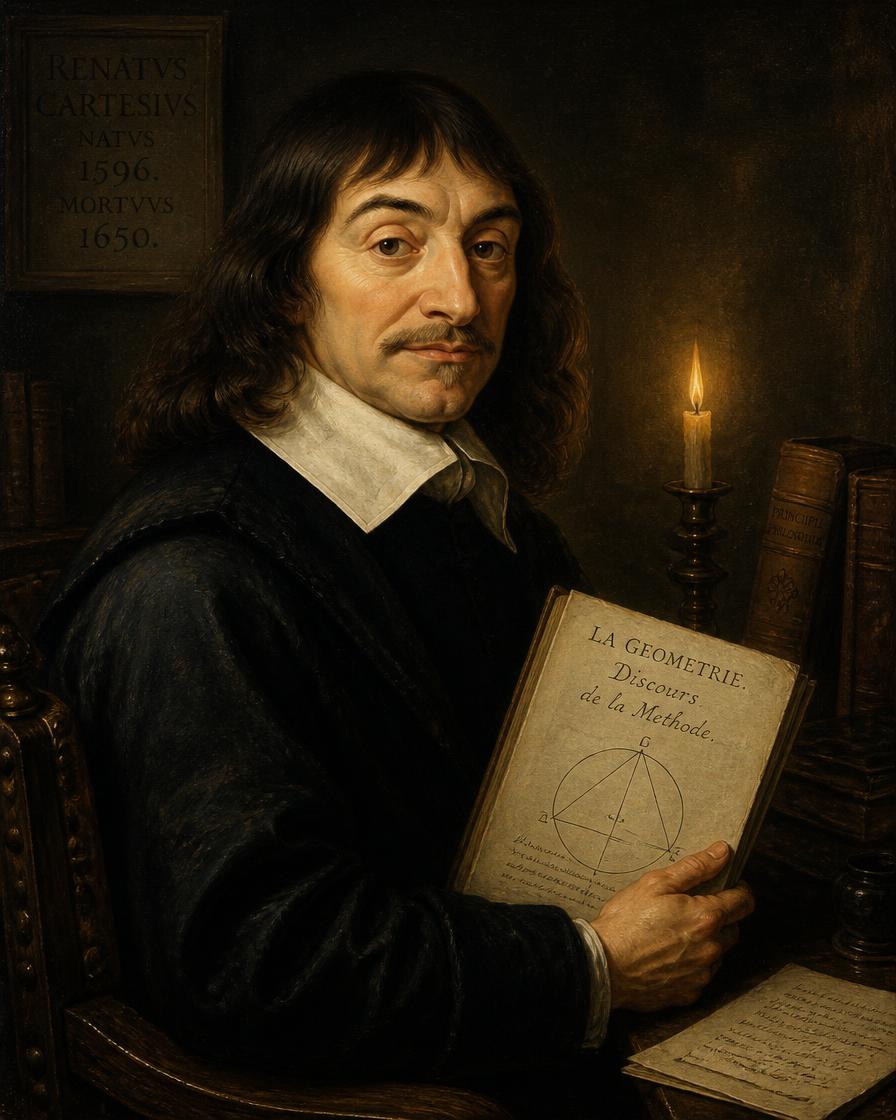
Quick Facts
- Years
- 1596 – 1650
- Category
- Philosophers & Thinkers
- Subcategory
- Rationalism
- Nationality
- French
- Occupation
- Philosopher & Mathematician
René Descartes
1596 – 1650 · French · Philosopher & Mathematician
Audiobook

Life Lessons from René Descartes
Marcus Alden · 44 min
René Descartes was a French philosopher, mathematician, and natural philosopher whose search for secure knowledge helped transform European intellectual life. Born in 1596, he lived during the Scientific Revolution, when inherited Aristotelian explanations increasingly faced challenges from observation, experiment, and mathematical analysis. Descartes sought a unified method that could place philosophy and science on foundations as certain as geometry.
His best-known statement, Cogito, ergo sum—“I think, therefore I am”—summarizes one stage of his method: even radical doubt cannot eliminate the existence of the thinker who doubts. In mathematics, he helped unite algebra and geometry through methods that became central to analytic geometry and the Cartesian coordinate tradition. His mechanistic accounts of nature also influenced physics, physiology, and debates about animals and machines.
Descartes did not work without controversy. Church authorities condemned some of his propositions, philosophers disputed his arguments about God and mind, and modern scholars criticize aspects of his animal theory, metaphysics, and scientific models. Yet his questions remain foundational: What can we know? How are mind and body related? Can nature be explained mathematically? Because he reshaped both the problems and methods of modern thought, Descartes remains essential to philosophy, mathematics, and the history of science.
Quick Facts
| Field | Details |
|---|---|
| Full Name | René Descartes |
| Common Name(s) | René Descartes; Renatus Cartesius (Latinized name) |
| Born | 31 March 1596 |
| Died | 11 February 1650 |
| Age at Death | 53 |
| Birthplace | La Haye en Touraine, Kingdom of France; now Descartes, Indre-et-Loire |
| Nationality | French |
| Occupation | Philosopher, mathematician, natural philosopher, writer |
| Historical Era | Scientific Revolution; early modern period |
| Famous For | Methodic doubt, Cogito, Cartesian dualism, analytic geometry, mechanistic natural philosophy |
| Political Affiliation if applicable | None recorded |
| Religion if significant | Roman Catholic |
| Education | Jesuit Collège Royal Henry-Le-Grand at La Flèche; law degree from the University of Poitiers |
| Parents | Joachim Descartes and Jeanne Brochard |
| Spouse(s) | Never married |
| Children | Francine Descartes (1635–1640), with Helena Jans van der Strom |
| Major Works | Discourse on the Method, Meditations on First Philosophy, Principles of Philosophy, Passions of the Soul, Geometry |
| Major Achievements | Major founder of modern philosophy; key contributor to analytic geometry; influential advocate of mathematical and mechanistic science |
Early Life
René Descartes was born in La Haye en Touraine on 31 March 1596. His father, Joachim, was a councillor in the Parlement of Brittany. His mother, Jeanne Brochard, died when René was about one year old. He and his siblings were subsequently raised largely within the extended family, especially under the care of their maternal grandmother.
Around 1607, Descartes entered the Jesuit Collège Royal Henry-Le-Grand at La Flèche. The school offered an elite curriculum grounded in classical languages, logic, philosophy, mathematics, and Catholic theology. Descartes later praised parts of his education while criticizing the uncertainty of much scholastic learning. Mathematics impressed him because its demonstrations seemed unusually clear and reliable.
He studied law at the University of Poitiers and received degrees in civil and canon law in 1616. Rather than enter legal practice, however, he pursued military and intellectual experience. In 1618 he joined the army of Maurice of Nassau in the Dutch Republic, although his exact military duties are unclear.
In Breda he met Isaac Beeckman, a Dutch scholar who encouraged him to apply mathematics to physical questions. Their collaboration was formative. Descartes dedicated the early mathematical-musical treatise Compendium of Music to Beeckman.
Europe was then divided by confessional tensions and soon devastated by the Thirty Years’ War. At the same time, Copernican astronomy, new instruments, and mathematical physics were undermining older pictures of the cosmos. Descartes’ intellectual project emerged from this mixture of religious conflict, scholastic education, and scientific innovation.
Rise to Prominence
In 1619 Descartes traveled in central Europe, possibly while connected with the forces of Maximilian of Bavaria. On the night of 10–11 November, he experienced a series of dreams that he interpreted as pointing toward a unified intellectual vocation. Later reports, especially Adrien Baillet’s biography, are the principal evidence, so elaborate retellings should be treated cautiously.
During the 1620s Descartes traveled, studied, and developed rules for directing reason. His unfinished Rules for the Direction of the Mind proposed that complex problems should be reduced to simpler, intuitively grasped elements. Around 1628 he settled in the Dutch Republic, where he remained for most of the next two decades. Its cities, publishing networks, and comparative intellectual flexibility gave him privacy and access to learned correspondents.
Descartes initially planned a large physical treatise, The World. After learning in 1633 that Galileo had been condemned for supporting heliocentrism, he withheld it from publication. This decision reflected caution rather than abandonment of his science.
His public breakthrough came in 1637 with the anonymous French publication of Discourse on the Method, accompanied by essays on optics, meteorology, and geometry. Writing in French expanded his audience beyond university Latinists. The work presented a concise intellectual autobiography, rules of method, scientific applications, and the famous formulation Je pense, donc je suis.
The Meditations on First Philosophy followed in Latin in 1641, with objections from prominent scholars and Descartes’ replies. This carefully staged debate established him as a major European philosopher while exposing him to sustained criticism.
Major Achievements
Methodic Doubt and the Cogito
Descartes proposed withholding assent from beliefs that could reasonably be doubted. Sensory experience can mislead; dreams may resemble waking life; even mathematical reasoning can be imagined as manipulated by a powerful deceiver. This doubt was methodological, not a permanent recommendation to believe nothing.
The process reaches a limit: if he is doubting or being deceived, thinking is occurring, and the thinker necessarily exists while thinking. In the Meditations, this appears as “I am, I exist,” while the Discourse gives “I think, therefore I am.”
This mattered because Descartes relocated philosophical certainty toward the thinking subject. Later rationalists, empiricists, phenomenologists, and existentialists developed or resisted that move. The Cogito remains central to debates about consciousness, selfhood, and certainty.
A New Foundation for Philosophy
Descartes attempted to rebuild knowledge from clear and distinct perceptions. He argued that a non-deceiving God guarantees the reliability of properly grasped truths, then used that framework to defend knowledge of the external world.
His approach helped define “foundationalism”: the view that knowledge rests upon basic, securely justified beliefs. Critics have long questioned whether his proof of God depends on clear and distinct ideas while their reliability already depends on God—the alleged “Cartesian Circle.” Regardless of whether his argument succeeds, the demand for an explicit account of justification transformed epistemology.
Analytic Geometry
The appendix Geometry showed how algebraic equations could represent geometrical curves and how geometrical problems could be attacked algebraically. Descartes did not invent every element of coordinate methods, nor did he use the modern coordinate notation exactly as students do today. Pierre de Fermat independently developed closely related techniques.
Nevertheless, Descartes’ systematic connection between algebra and geometry was revolutionary. It helped make curves calculable and contributed to the mathematical environment from which calculus emerged. The adjective “Cartesian” survives in Cartesian coordinates, planes, products, and other concepts.
Mathematical and Mechanistic Natural Philosophy
Descartes envisioned physical nature as matter in motion governed by intelligible laws. He rejected substantial forms and occult qualities as scientific explanations, preferring size, shape, motion, and collision. He formulated laws of nature, including an early inertia-like principle, although some of his collision rules were incorrect.
His vortex cosmology attempted to explain planetary motion through circulating matter rather than empty space and action at a distance. Newtonian physics eventually displaced it, but its ambition—to explain the heavens through general mathematical laws—was historically important.
Optics and the Rainbow
In Dioptrics and Meteorology, Descartes examined vision, lenses, refraction, and atmospheric phenomena. He gave an influential explanation of the rainbow using refraction and internal reflection in water droplets. His account built partly on earlier work and did not provide the later wave-based theory of color.
The law of refraction is often called Snell’s law after Willebrord Snell, who found it earlier but did not publish it. Descartes published the relationship and helped disseminate it. Claims that either man alone “invented” it oversimplify the history.
Mind–Body Dualism
Descartes distinguished thinking substance from extended substance. Mind is characterized by thought and is not spatial in the same way as body; body is characterized by extension and operates mechanically. He nevertheless held that human minds and bodies interact.
This framework sharpened the modern “mind–body problem.” Princess Elisabeth of Bohemia famously asked how an immaterial mind could cause bodily motion. Contemporary philosophy of mind still uses “Cartesian dualism” as a major reference point, often critically.
Physiology and the Passions
Descartes treated many bodily processes as mechanical. He discussed reflex-like responses, nerves, muscles, animal spirits, and the brain, assigning the pineal gland a special role in mind–body interaction. Much of the physiology is obsolete, and he was not the sole discoverer of reflex action.
In The Passions of the Soul he analyzed emotions as embodied processes that can guide or disrupt conduct. Rather than demanding the elimination of passion, he emphasized understanding and governing it through judgment and habit. The work influenced later moral psychology.
Leadership and Work
Descartes led no state, university, or large institution. His leadership was intellectual: he organized research programs, corresponded with scholars, and modeled a new image of the independent philosophical investigator.
His method emphasized four habits:
- Accept as true only what appears clear and indubitable.
- Divide difficult problems into manageable parts.
- Proceed from simpler matters to more complex ones.
- Review the reasoning carefully so nothing is omitted.
He valued order, autonomy, and mathematical precision. He also managed publication strategically. Marin Mersenne served as his principal correspondent and intermediary, circulating manuscripts and objections across Europe.
Descartes’ strengths included intellectual ambition, clarity of structure, and unusual ability to connect mathematics, metaphysics, and natural science. His weaknesses included overconfidence in speculative physical models, defensiveness toward critics, and a tendency to present contested conclusions as deductions from secure principles.
His relationships could be productive but tense. He acknowledged Beeckman’s early importance, yet disputes arose over intellectual credit. His exchanges with Elisabeth were more sustained and constructive: her objections pressed him to clarify the practical and philosophical problems of embodiment.
Personal Life
Descartes never married. While living in the Dutch Republic, he had a relationship with Helena Jans van der Strom, who may have worked in a domestic capacity. Their daughter, Francine, was born in 1635 and baptized in Deventer. Descartes acknowledged her and planned for her education. She died of scarlet fever in 1640 at age five, a serious personal loss.
He moved frequently within the Netherlands, partly to preserve privacy and uninterrupted working conditions. He corresponded extensively but often guarded his address. Accounts portray him as fond of working in bed during the morning, although later anecdotes can exaggerate this habit.
Mersenne was his most important intellectual facilitator. Other significant correspondents included Elisabeth of Bohemia, Constantijn Huygens, and Queen Christina of Sweden. His letters to Elisabeth addressed mind–body interaction, emotion, health, and ethical contentment.
Descartes had experienced fragile health in youth, and school authorities reportedly allowed him a flexible morning schedule. In 1649 he moved to Stockholm at Queen Christina’s invitation. The traditional account links his final illness to early lessons in the Swedish winter, but historians caution against making that schedule the sole cause. He died on 11 February 1650, conventionally from pneumonia; a later poisoning theory remains unproven and is not the scholarly consensus.
Philosophy and Beliefs
Descartes was a Roman Catholic and repeatedly presented his philosophy as compatible with Christianity. His metaphysics defended the existence of God and the distinction between the immortal soul and material body. He also avoided publishing The World after Galileo’s condemnation, demonstrating awareness of ecclesiastical danger.
Scholars debate how to interpret his religious posture. Some see sincere apologetic aims; others emphasize strategic caution in a confessional age. There is no sufficient evidence to dismiss his stated Catholic commitment as mere disguise.
Politically, he produced no major systematic political theory. His “provisional morality” advised obeying the laws and customs of one’s country, remaining firm in action, mastering one’s desires rather than fortune, and pursuing the cultivation of reason. These rules were designed to guide life while radical intellectual doubt remained a method of inquiry.
Ethically, he valued generosity: a proper awareness of one’s freedom combined with resolve to use it well. In correspondence and The Passions of the Soul, he argued that emotional health depends on understanding passions and directing judgments, not suppressing all feeling.
His natural philosophy treated the material universe as a mechanism. Human beings were distinctive because rational souls could not, in his view, be reduced to bodily machinery. This combination of mechanical science, theism, and dualism shaped his scientific choices and later controversies.
Challenges and Controversies
Descartes’ project attracted opposition from both scholastic and innovative thinkers. Critics challenged his proofs of God, the criterion of clear and distinct perception, and the claim that mind and body are genuinely distinct.
Theologian Antoine Arnauld identified the possible Cartesian Circle. Thomas Hobbes rejected Descartes’ move from “I am thinking” to a distinct thinking substance. Pierre Gassendi criticized his rationalism from an atomist and empirically oriented perspective. Elisabeth asked the especially influential question of causal interaction between immaterial mind and material body.
In Utrecht, theologian Gisbertus Voetius opposed Cartesian teaching and supported attacks by Martin Schoock. The dispute became personal and institutional, involving accusations about atheism and educational disorder. Descartes appealed to authorities and defended his orthodoxy.
His treatment of animals is another major controversy. Descartes described nonhuman animals as lacking rational souls and explained their behavior mechanically. Scholars debate whether later reports accurately capture all his practical views, but his writings clearly establish a sharp human–animal divide. Modern critics argue that this underestimated animal consciousness and could encourage indifference to suffering.
Several scientific claims proved wrong, including his vortex cosmology, many collision rules, and his placement of mind–body interaction at the pineal gland. These failures illustrate the limits of deriving nature primarily from metaphysical principles without sufficient experimental constraint.
In 1663, after his death, several works were placed on the Roman Catholic Index of Prohibited Books, with qualification until corrected. Cartesian philosophy nevertheless spread throughout Europe, often provoking more debate than suppression could prevent.
Legacy
Descartes helped establish the agenda of modern Western philosophy. Rationalists such as Baruch Spinoza and Gottfried Wilhelm Leibniz inherited his demand for systematic reason, while empiricists including John Locke and David Hume challenged Cartesian accounts of innate ideas, substance, and certainty. Immanuel Kant later framed his own philosophy partly as a response to the conflict between these traditions.
His mathematical legacy is embedded in analytic geometry and Cartesian coordinate systems. Although modern notation and techniques developed through many contributors, the algebra–geometry synthesis associated with his name became indispensable to calculus, mechanics, engineering, computer graphics, and data visualization.
In philosophy of mind, “Cartesian dualism” remains a standard position against which physicalism, idealism, functionalism, and embodied cognition define themselves. His skeptical scenarios also anticipate modern thought experiments about simulated reality and deceptive environments.
His birthplace was renamed Descartes in 1967 and contains the Maison Musée René Descartes. The Université Paris Cité preserves part of the legacy of the former Paris Descartes University. Statues and commemorations appear in France and elsewhere, and a lunar crater bears his name.
Descartes’ remains have a complicated history. They were transferred from Stockholm to France in the seventeenth century and later reinterred at the Abbey of Saint-Germain-des-Prés in Paris. Claims concerning the authenticity and whereabouts of his skull have generated historical investigation.
He is still studied not because every conclusion was correct, but because he posed enduring questions with exceptional force and joined philosophical analysis to mathematical science.
Interesting Facts
- His birthplace, La Haye en Touraine, was renamed Descartes in 1967.
- He commonly Latinized his name as Renatus Cartesius.
- He earned a law degree but did not pursue a conventional legal career.
- Isaac Beeckman helped stimulate his early interest in mathematical physics.
- His first known work concerned music and mathematics.
- He lived mainly in the Dutch Republic from 1628 until 1649.
- The 1637 Discourse appeared anonymously and in French.
- Geometry was originally one of three scientific essays attached to the Discourse.
- The Meditations was first published with scholarly objections and his replies.
- He withheld The World after Galileo’s condemnation.
- He never married but had a daughter, Francine.
- Princess Elisabeth pressed him on how mind and body could interact.
- He believed the pineal gland had a special role in mind–body union.
- “Cartesian” derives from the Latin form of his name.
- His rainbow theory used refraction and internal reflection in droplets.
- He wrote his final major work, The Passions of the Soul, partly in response to Elisabeth’s questions.
- Queen Christina invited him to Sweden in 1649.
- He died in Stockholm in 1650.
- His works entered the Catholic Index in 1663 with the designation “until corrected.”
- His remains were eventually interred at Saint-Germain-des-Prés in Paris.
Famous Quotes
- “I think, therefore I am.” — Discourse on the Method (1637). The conclusion identifies thought as an indubitable sign of the thinker’s existence.
- “I am, I exist, is necessarily true whenever it is put forward by me or conceived in my mind.” — Meditations II (1641). This is the more precise meditative form of the Cogito.
- “Good sense is the best distributed thing in the world.” — Opening of the Discourse. Descartes argues that disagreement often reflects different methods rather than unequal claims to reason.
- “It is not enough to have a good mind; the main thing is to use it well.” — Discourse. Intellectual ability requires disciplined method.
- “Divide each of the difficulties I examined into as many parts as possible and as may be required in order to resolve them better.” — Discourse, Part II. This states his analytic rule of problem-solving.
- “The reading of all good books is like a conversation with the finest minds of past centuries.” — Discourse, Part I. He values learning from tradition while refusing blind submission to it.
- “I desired to learn to distinguish truth from falsehood, in order to see my way clearly and walk with confidence through life.” — Discourse, Part I. Philosophy is presented as practical orientation as well as theory.
- “We ought never to allow ourselves to be persuaded except by the evidence of our reason.” — Principles of Philosophy (translation wording varies). The statement captures his rational standard of assent.
- “The chief good of this life consists in the correct use of free will.” — Correspondence with Princess Elisabeth, 1645; wording varies by translation. It expresses his ethics of responsible judgment.
- “Conquer yourself rather than fortune.” — From the provisional morality in the Discourse; translation varies. It recommends governing desires rather than trying to control everything external.
The popular saying “Doubt is the origin of wisdom” is often attributed to Descartes, but this exact wording is not securely documented in his works and should be treated as disputed.
Timeline
- 1596 — Born on 31 March in La Haye en Touraine.
- 1597 — His mother, Jeanne Brochard, dies.
- c. 1607 — Enters the Jesuit college at La Flèche.
- 1616 — Receives law degrees from the University of Poitiers.
- 1618 — Goes to the Dutch Republic and meets Isaac Beeckman.
- 1618 — Composes the Compendium of Music.
- 1619 — Experiences the dreams later associated with his intellectual mission.
- 1620s — Travels in Europe and develops his methodological program.
- c. 1628 — Settles in the Dutch Republic.
- c. 1628–1629 — Works on the unfinished Rules for the Direction of the Mind.
- 1633 — Withholds The World after Galileo’s condemnation.
- 1635 — His daughter Francine is born.
- 1637 — Publishes Discourse on the Method with three scientific essays.
- 1640 — Francine dies at age five.
- 1641 — Publishes the first edition of Meditations on First Philosophy.
- 1642 — A second edition of the Meditations appears with expanded objections and replies.
- 1643 — Begins influential correspondence with Princess Elisabeth.
- 1644 — Publishes Principles of Philosophy.
- 1647 — Receives a pension from the French crown; publishes Comments on a Certain Broadsheet.
- 1648 — Publishes Conversation with Burman in later-reported form; meets Frans Burman.
- 1649 — Publishes The Passions of the Soul and moves to Stockholm.
- 1650 — Dies on 11 February in Stockholm.
- 1663 — Several works are placed on the Catholic Index.
- 1667 — The World and Treatise on Man appear posthumously in French.
Frequently Asked Questions
Who was René Descartes?
René Descartes was a seventeenth-century French philosopher, mathematician, and natural philosopher. He sought a method capable of producing certain knowledge and applied mathematical reasoning to problems in geometry, optics, physics, physiology, and metaphysics. His best-known works include Discourse on the Method, Meditations on First Philosophy, and Principles of Philosophy. He is often called a founder of modern philosophy because he made the knowing subject, justification, and skepticism central philosophical concerns.
Why is Descartes called the father of modern philosophy?
The title reflects his influence, not an uncontested claim that modern philosophy had one founder. Descartes attempted to suspend inherited assumptions and rebuild knowledge from an indubitable starting point. His emphasis on the thinking subject helped redirect philosophy from scholastic disputes toward questions of consciousness, evidence, and justification. Francis Bacon, Galileo, Hobbes, and others also shaped modern thought, so historians generally treat the title as shorthand for Descartes’ exceptional importance rather than literal parentage.
What does “I think, therefore I am” mean?
The phrase means that the act of thinking confirms the thinker’s existence at the moment of thought. Descartes can imagine that his senses, memories, and calculations are mistaken. Yet deception itself requires something that is being deceived. The claim does not immediately prove a permanent personality, a physical body, or the entire external world. It establishes a minimal certainty: while thinking occurs, the thinker cannot coherently deny existing.
Did Descartes invent Cartesian coordinates?
Descartes made a foundational contribution by systematically connecting algebraic equations with geometrical curves in Geometry (1637). Pierre de Fermat independently developed related methods, and the modern x–y coordinate format emerged through later standardization. It is therefore more accurate to say that Descartes was a principal founder of analytic geometry than to credit him with the complete modern coordinate system in a single act. His work nevertheless explains why the system is called Cartesian.
What was Descartes’ method of doubt?
Methodic doubt is a temporary investigative procedure. Descartes treats as uncertain any belief vulnerable to doubt, including sensory beliefs, the distinction between dreams and waking, and—under the evil-deceiver hypothesis—even calculations. The purpose is not lifelong skepticism. It is to identify propositions that remain secure under the strongest challenge and then reconstruct knowledge from them. The Cogito emerges as the first certainty in this process.
Was Descartes a skeptic?
Descartes used skeptical arguments, but he was not a skeptic in his final position. He deployed doubt as a tool for defeating skepticism by discovering an indubitable foundation. From the certainty of thought, he attempted to establish God’s existence, the reliability of clear and distinct perceptions, and knowledge of material reality. Critics dispute whether this reconstruction works, but his intention was explicitly anti-skeptical.
What is Cartesian dualism?
Cartesian dualism holds that mind and body are fundamentally distinct. Mind is a thinking, non-extended substance; body is an extended, non-thinking substance governed by mechanical laws. Human experience nevertheless involves their close union and interaction. The difficulty of explaining how such different substances can causally affect each other was identified by Princess Elisabeth and remains the classic objection. Many contemporary philosophers reject substance dualism, but the problem Descartes sharpened remains influential.
What did Descartes believe about God?
Descartes believed in a perfect, non-deceiving God and offered several arguments for divine existence. One argues that the idea of an infinite, perfect being requires an adequate cause; another develops a version of the ontological argument. God plays a structural role in his epistemology by guaranteeing that clear and distinct perceptions are not systematically deceptive. Philosophers have challenged both the proofs and their role in his system, especially through the Cartesian Circle objection.
Was Descartes religious?
Yes. Descartes identified as a Roman Catholic, defended doctrines such as the soul’s distinction from the body, and took ecclesiastical authority seriously. He suppressed The World after Galileo’s condemnation. Scholars debate the balance between sincere conviction and strategic self-protection, but evidence does not justify simply labeling him an atheist in disguise. Catholic authorities later objected to elements of Cartesian philosophy despite his professions of orthodoxy.
Why did Descartes live in the Netherlands?
The Dutch Republic offered active publishing networks, internationally connected scholars, and a degree of intellectual flexibility. Descartes also valued privacy, mobility, and freedom from social demands. He lived in several Dutch locations from about 1628 to 1649 rather than settling permanently in one city. The Netherlands was not free of conflict: his ideas triggered a serious dispute at Utrecht and opposition from theologians such as Gisbertus Voetius.
What did Descartes contribute to science?
Descartes promoted mathematical explanation and a mechanistic account of material nature. He worked on refraction, lenses, vision, rainbows, motion, cosmology, physiology, and animal behavior. His rainbow analysis was influential, and his publication of the refraction law helped spread it. Many particular theories—especially vortex cosmology and several collision rules—were later rejected. His durable contribution was partly methodological: nature should be explained through general, mathematically expressible processes rather than obscure qualities.
Did Descartes discover Snell’s law?
Willebrord Snell found the law of refraction before Descartes but did not publish it. Descartes published the relationship in Dioptrics in 1637 and used it in optical analysis. Scholars have debated whether Descartes derived it independently or knew of earlier results, but no simple accusation resolves the evidence. The formula is commonly called Snell’s law in English and the Snell–Descartes law in some other traditions.
What did Descartes believe about animals?
Descartes believed animal behavior could be explained mechanically and denied nonhuman animals the rational, immaterial souls he attributed to humans. This led to the influential concept of animals as automata. Interpretation requires care: “machine” did not necessarily mean inert or simple, and some anecdotes about his cruelty are poorly supported. Nonetheless, his sharp human–animal distinction is clear and has been strongly criticized in light of modern evidence about animal cognition and suffering.
Did Descartes marry or have children?
Descartes never married. He had a daughter, Francine, with Helena Jans van der Strom in the Dutch Republic. Francine was born in 1635 and died from scarlet fever in 1640, when she was five. Surviving evidence indicates that Descartes acknowledged her and intended to provide for her education. Her death is commonly regarded as one of the most painful events in his personal life.
Why did Descartes go to Sweden?
Queen Christina of Sweden invited Descartes to Stockholm because of her interest in philosophy and plans for intellectual reform. He arrived in 1649 and provided instruction to the queen. The climate and schedule reportedly strained him, although later storytelling may dramatize the famous early-morning lessons. He became ill and died in February 1650. Pneumonia is the conventional diagnosis; theories that he was poisoned remain speculative.
How did Descartes die?
Descartes died in Stockholm on 11 February 1650, aged 53. Contemporary tradition records pneumonia after a severe respiratory illness. A modern hypothesis proposes arsenic poisoning, possibly by a Catholic cleric worried about his influence on Queen Christina, but the evidence is circumstantial and the theory has not displaced the conventional account. Responsible biographies therefore describe pneumonia as the accepted explanation while acknowledging the disputed alternative.
How did Descartes influence later philosophy?
Spinoza, Malebranche, and Leibniz transformed Cartesian metaphysics; Locke, Berkeley, and Hume criticized its ideas of substance, innateness, and certainty. Kant responded to the broader rationalist–empiricist conflict that Descartes helped define. Later thinkers, including Husserl, revisited first-person certainty, while Gilbert Ryle and many contemporary philosophers attacked the Cartesian picture of mind. Even positions opposed to Descartes frequently use problems and vocabulary shaped by him.
Lessons We Can Learn
- Question assumptions systematically. Descartes tested inherited beliefs rather than rejecting them impulsively. Today, disciplined skepticism helps distinguish evidence-based criticism from cynicism.
- Break difficult problems into parts. His second rule of method made complexity manageable. The approach remains valuable in research, engineering, and planning.
- Seek firm starting points. The Cogito illustrates the importance of identifying what evidence genuinely supports before building larger claims.
- Connect different disciplines. Descartes united algebra and geometry. Innovation often occurs when methods cross traditional boundaries.
- Publish demonstrations, not only conclusions. The scientific essays attached to the Discourse showed his method in action. Transparent reasoning enables evaluation and correction.
- Invite serious objections. The Meditations appeared with critics’ arguments and Descartes’ replies. Strong work improves through informed challenge.
- Treat caution as part of judgment. Withholding The World protected Descartes, though it also delayed debate. Context matters when deciding how and when to communicate.
- Do not confuse elegance with truth. His vortex theory was systematic but incorrect. Beautiful theories still require empirical testing.
- Learn from perceptive critics. Elisabeth exposed a central weakness in mind–body dualism. A critic can reveal what an entire system overlooks.
- Accept that lasting influence can include productive failure. Many Cartesian scientific details were superseded, yet his questions generated centuries of progress. Valuable inquiry need not yield only final answers.
Related Historical Figures
- Isaac Beeckman (1588–1637) — Early mentor and collaborator who encouraged Descartes’ mathematical approach to physical problems.
- Marin Mersenne (1588–1648) — Friar, mathematician, and correspondent who distributed Descartes’ writings and gathered objections.
- Galileo Galilei (1564–1642) — His condemnation influenced Descartes’ decision not to publish The World.
- Pierre de Fermat (1607–1665) — Independently developed analytic geometry and disputed aspects of Descartes’ optics.
- Princess Elisabeth of Bohemia (1618–1680) — Correspondent whose questions exposed the interaction problem in Cartesian dualism.
- Thomas Hobbes (1588–1679) — Materialist critic who contributed objections to the Meditations.
- Pierre Gassendi (1592–1655) — Empirically oriented philosopher and atomist who challenged Cartesian metaphysics.
- Baruch Spinoza (1632–1677) — Post-Cartesian rationalist who rejected Descartes’ two-substance framework.
- Gottfried Wilhelm Leibniz (1646–1716) — Rationalist mathematician who developed and criticized Cartesian ideas in metaphysics and physics.
- Queen Christina of Sweden (1626–1689) — Royal patron who invited Descartes to Stockholm, where he spent his final months.
Watch and Learn
PHILOSOPHY - René Descartes · The School of Life
Related Historical Figures