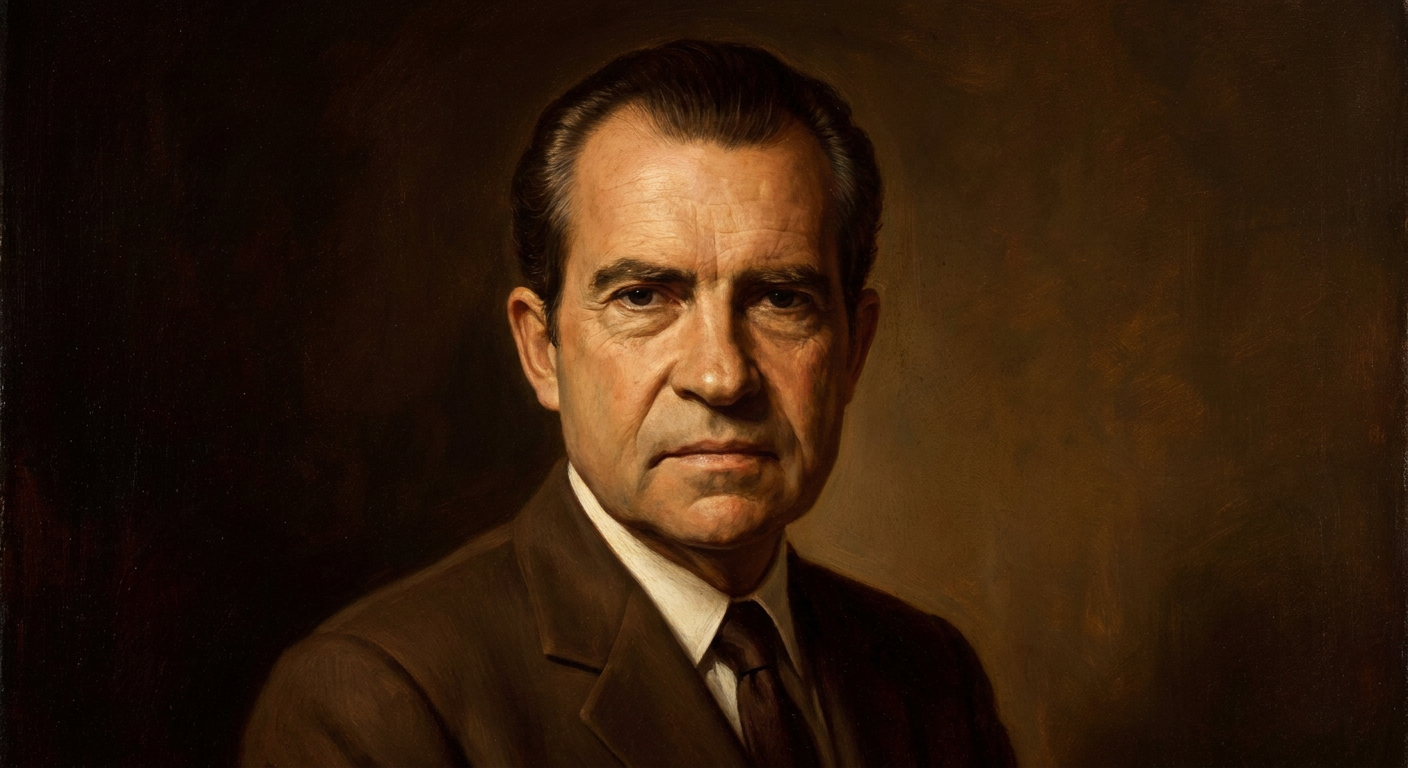
Quick Facts
- Years
- 1913 – 1994
- Category
- World Leaders & Revolutionaries
- Nationality
- American
- Occupation
- Lawyer, politician, vice president, and 37th U.S. president
Richard Nixon
1913 – 1994 · American · Lawyer, politician, vice president, and 37th U.S. president
Recommended Audiobooks
Listen next from Marcus Alden

Life Lessons from Simon Bolivar
Marcus Alden · 55 min

Life Lessons from George Washington
Marcus Alden · 54 min
Richard Milhous Nixon was one of the most consequential—and contradictory—American presidents of the twentieth century. Rising from modest beginnings in California, he became a congressman, senator, vice president, presidential candidate, political exile, and finally the 37th president of the United States. His administration opened formal relations with the People’s Republic of China, negotiated arms controls with the Soviet Union, reduced direct American involvement in Vietnam, advanced school desegregation, and helped create a lasting framework for federal environmental regulation.
Yet Nixon is remembered above all for Watergate. A burglary committed by members of his reelection operation led to investigations that exposed campaign misconduct, abuses of executive power, and a presidential cover-up. Facing almost certain impeachment, Nixon resigned in August 1974—the only U.S. president ever to do so.
That ending has made him difficult to assess. Nixon could be strategically imaginative abroad and politically innovative at home, but he was also secretive, suspicious, and willing to use presidential power against perceived enemies. His career illuminates the Cold War, the Vietnam era, the transformation of American political parties, and the dangers of unchecked executive authority. Scholars still study him because his achievements were substantial, his failures were constitutional in scale, and both arose from many of the same qualities: ambition, resilience, intelligence, insecurity, and a relentless desire to prevail.
Quick Facts
| Field | Details |
|---|---|
| Full Name | Richard Milhous Nixon |
| Common Name(s) | Richard Nixon; Dick Nixon |
| Born | January 9, 1913 |
| Died | April 22, 1994 |
| Age at Death | 81 |
| Birthplace | Yorba Linda, California, United States |
| Nationality | American |
| Occupation | Lawyer, naval officer, congressman, senator, vice president, president, author |
| Historical Era | Great Depression, World War II, Cold War, Vietnam era |
| Famous For | Opening relations with China, détente, ending direct U.S. combat in Vietnam, and resigning over Watergate |
| Political Affiliation | Republican Party |
| Religion | Quaker upbringing; attended various Protestant services as an adult |
| Education | Whittier College; Duke University School of Law |
| Parents | Francis Anthony Nixon and Hannah Milhous Nixon |
| Spouse(s) | Thelma Catherine “Pat” Ryan Nixon, married 1940–1993 |
| Children | Tricia Nixon Cox and Julie Nixon Eisenhower |
| Major Works | Six Crises, RN: The Memoirs of Richard Nixon, No More Vietnams, and other books on diplomacy |
| Major Achievements | China opening, détente and SALT I, environmental institutions, revenue sharing, desegregation efforts, and transition to an all-volunteer military |
Early Life
Richard Nixon was born in Yorba Linda, California, in a small house built by his father. Francis Nixon had worked in several occupations before operating a grocery store and gasoline station in nearby Whittier. Hannah Milhous Nixon, a devout Quaker, emphasized self-control, hard work, and personal responsibility.
The family was neither destitute nor secure. Its finances were strained, and illness brought repeated tragedy. Richard’s younger brother Arthur died in childhood, while his older brother Harold endured tuberculosis for years before dying in 1933. These experiences imposed responsibilities on Nixon and contributed to the seriousness, discipline, and emotional reserve noted by later biographers.
At Whittier High School, Nixon debated, acted in plays, played football as a determined reserve, and earned strong grades. He was offered financial assistance to attend Harvard but remained close to home because his family needed him. He enrolled at Whittier College, where he became a prominent debater and student politician.
Nixon believed that Whittier’s established social club, the Franklins, looked down on students from less privileged backgrounds. He helped organize a rival group, the Orthogonians. The episode became part of his lifelong self-image: an outsider competing against polished elites. Historians differ over how accurately that perception reflected his circumstances, but there is little doubt that Nixon used resentment as a source of motivation.
After graduating in 1934, he attended Duke University School of Law on scholarship. He performed well academically and graduated in 1937. Unable to secure work with leading New York firms or the Federal Bureau of Investigation, he returned to Whittier and practiced law. He met teacher and amateur actress Pat Ryan during a community theater production, and they married in June 1940.
During World War II, Nixon served in the U.S. Navy. He worked mainly as a logistics officer in the South Pacific rather than in front-line combat. He left active service in 1946 as a lieutenant commander, equipped with administrative experience, a military record, and an opportunity to enter politics.
Rise to Prominence
In 1946, California Republicans recruited Nixon to challenge Democratic congressman Jerry Voorhis. Nixon linked Voorhis to political organizations influenced by communists, presenting himself as an energetic anti-communist veteran. He won, although critics later argued that his campaigning unfairly blurred distinctions between liberalism and communist sympathy.
Nixon gained national attention through the House Committee on Un-American Activities. In 1948, former federal official Whittaker Chambers accused Alger Hiss, a respected diplomat, of having participated in a communist underground. Hiss denied the charge. Nixon pressed the investigation when others were ready to abandon it, and evidence eventually contributed to Hiss’s conviction for perjury. Records released after the Cold War strengthened the case that Hiss had engaged in espionage, although disputes over specific evidence have continued.
Elected to the Senate in 1950 after a harsh campaign against Helen Gahagan Douglas, Nixon was selected as Dwight D. Eisenhower’s running mate in 1952. Accusations that a private political fund had improperly benefited him threatened his place on the ticket. Nixon responded with a nationally televised address known as the “Checkers speech,” releasing financial details and emotionally referring to a dog given to his daughters. The address saved his candidacy and demonstrated television’s growing political power.
As vice president from 1953 to 1961, Nixon traveled widely, chaired meetings during Eisenhower’s illnesses, and developed foreign-policy expertise. His 1959 “Kitchen Debate” with Soviet leader Nikita Khrushchev showcased his combative confidence.
Nixon narrowly lost the 1960 presidential election to John F. Kennedy. The contest included the first televised presidential debates, in which Kennedy appeared more relaxed and camera-ready. Claims that fraud alone decided the election remain unproven; irregularities existed, but historians cannot establish that they changed the national outcome.
After losing the 1962 California governor’s race, Nixon told reporters they would no longer “have Nixon to kick around.” Many assumed his career was over. Instead, he rebuilt Republican connections, campaigned for candidates, studied national and international affairs, and captured the 1968 presidential nomination. Promising “peace with honor” in Vietnam and appealing to Americans troubled by unrest, he defeated Hubert Humphrey and George Wallace.
Major Achievements
Opening Relations with China
In February 1972, Nixon visited the People’s Republic of China and met Mao Zedong and Zhou Enlai. The journey ended more than two decades of high-level isolation between Washington and Beijing.
The opening mattered because it altered the Cold War balance. China and the Soviet Union had become rivals, allowing the United States to improve relations with Beijing while pressuring Moscow. Full diplomatic recognition came under President Jimmy Carter in 1979, but Nixon’s initiative made it possible. The relationship later became economically vast and strategically complicated.
Détente and Arms Control
Nixon and national security adviser Henry Kissinger pursued détente, meaning a relaxation of tensions with the Soviet Union. At the 1972 Moscow summit, Nixon and Leonid Brezhnev signed the Anti-Ballistic Missile Treaty and the interim Strategic Arms Limitation Agreement, known as SALT I.
These agreements did not end the nuclear rivalry, but they placed limits on parts of the arms competition and created habits of negotiation. Critics believed détente accepted Soviet repression or gave Moscow advantages; supporters viewed it as realistic management of a dangerous rivalry.
Vietnam Withdrawal
Nixon gradually withdrew U.S. ground forces while expanding South Vietnam’s responsibility for the war, a policy called Vietnamization. The Paris Peace Accords were signed in January 1973, American prisoners of war returned, and direct U.S. combat participation ended.
The result was not a stable peace. Fighting continued, and South Vietnam fell to communist forces in 1975. Nixon’s supporters argue that he obtained time and acceptable withdrawal terms; critics emphasize that the war expanded into Cambodia and Laos and continued for four more destructive years.
Environmental and Regulatory Measures
Nixon proposed the reorganization that created the Environmental Protection Agency in 1970. He also signed major legislation associated with cleaner air, endangered species protection, workplace safety, and marine conservation. Many measures depended upon bipartisan congressional action and a broader environmental movement, so they should not be credited to Nixon alone.
Nevertheless, his administration helped establish institutions that permanently expanded the federal role in environmental and workplace regulation. This record contrasts with the later Republican movement’s frequent hostility toward federal regulation.
Desegregation and Social Policy
Under Nixon, the federal government pressed Southern school districts to implement desegregation orders. The proportion of Black children attending legally segregated schools fell dramatically. Courts, civil-rights activists, local officials, and earlier legislation were essential to this process, but the administration’s enforcement was consequential.
Nixon also signed the 1972 Education Amendments containing Title IX, which prohibited sex discrimination in federally funded education. Congress drove the measure, and its enormous impact on women’s athletics developed over time. His administration additionally supported expanded food assistance and increased federal funding for several social programs.
Government Reform and the Volunteer Military
Nixon promoted revenue sharing, distributing federal funds to state and local governments with fewer restrictions. He also oversaw the end of military conscription in 1973, replacing the draft with an all-volunteer force. The change transformed relations between American society and the armed services, although debate continues over whether it placed military burdens on a narrower segment of the population.
Leadership or Work
Nixon approached government as a strategist. He absorbed detailed briefings, thought in terms of leverage, and could reconsider old assumptions. Opening relations with communist China was possible partly because his anti-communist credentials protected him from accusations of softness—the origin of the expression “Nixon goes to China.”
He preferred small circles, confidential memoranda, and controlled decision-making. Kissinger became central to foreign policy, sometimes bypassing the State Department. Nixon was less comfortable with ceremonial leadership and spontaneous personal contact than with analysis and political planning.
His strengths included resilience, preparation, geopolitical imagination, and an ability to identify neglected voters. His weaknesses were equally important: suspicion, secrecy, resentment, and a tendency to divide the world into allies and enemies. He often interpreted criticism as deliberate persecution.
Nixon’s domestic politics mixed conservatism with pragmatic federal activism. He spoke for a “silent majority” that disliked disorder and rapid cultural change, yet accepted or enlarged programs that later conservatives opposed. His governing style was therefore more flexible than his campaign rhetoric sometimes suggested.
Personal Life
Nixon’s marriage to Pat was durable but tested by public life. Pat Nixon traveled extensively as second lady and first lady, visited hospitals and schools, and promoted volunteer service. Their daughters, Tricia and Julie, both defended their father during Watergate. Julie married David Eisenhower, President Eisenhower’s grandson.
Friends and aides described Nixon as formal, introverted, hardworking, and awkward in casual social situations. He enjoyed classical music, played the piano, followed football, and relaxed by bowling. He could be generous in private, but the White House recordings also preserve angry, prejudiced, and profane remarks that sharply contradict his controlled public image.
Nixon experienced significant health problems. He suffered from phlebitis, an inflammation associated with dangerous blood clots, and was hospitalized after leaving office. Pat died in 1993. Nixon died in New York on April 22, 1994, four days after suffering a stroke. He was buried beside Pat at the Nixon Library in Yorba Linda.
Philosophy or Beliefs
Nixon’s Quaker upbringing stressed discipline and peace, although his political conduct did not consistently reflect traditional Quaker pacifism. He rarely presented himself as a theological thinker, but religious language and ideas of providence appeared in his speeches.
Politically, Nixon was an anti-communist and a realist. He believed nations generally followed interests rather than affection. This outlook shaped his triangular diplomacy with China and the Soviet Union and his willingness to negotiate with ideological adversaries.
At home, he valued order, national unity, and executive authority. He believed established institutions were under assault from radicals, hostile journalists, and bureaucratic opponents. Some threats were real: the era included riots, bombings, espionage, and intense political violence. Yet Nixon’s worldview often magnified opposition into conspiracy, helping him justify surveillance and other abuses.
His economic policy was pragmatic rather than consistently free-market. In 1971 he imposed temporary wage and price controls, ended the dollar’s direct convertibility into gold, and introduced import measures. These actions stabilized politics in the short term but contributed to economic distortions and did not prevent inflation.
Challenges and Controversies
Watergate and the Cover-Up
On June 17, 1972, police arrested five men inside Democratic National Committee offices in the Watergate complex. The burglars were connected to Nixon’s reelection organization. No credible evidence has established that Nixon ordered the original break-in.
The constitutional crisis arose from the cover-up. Nixon participated in efforts to obstruct the investigation, approved attempts to limit the FBI inquiry, and discussed using payments to maintain the burglars’ silence. Investigations uncovered campaign misconduct, political espionage, misuse of agencies, and a White House taping system.
When Nixon resisted subpoenas for recordings, the Supreme Court unanimously ordered their release in United States v. Nixon. The “smoking gun” tape revealed that he had joined a plan to impede the FBI investigation only days after the burglary. With Republican support collapsing and impeachment likely, he resigned on August 9, 1974. President Gerald Ford pardoned him the following month.
Executive Power and the “Enemies” Mentality
The Nixon White House assembled lists of political opponents and explored using government agencies against them. The “Plumbers,” created to stop leaks after publication of the Pentagon Papers, committed illegal acts, including a break-in at the office of Daniel Ellsberg’s psychiatrist.
Defenders note that previous administrations had also used secret surveillance and political intelligence. That context is important, but it does not excuse Nixon’s conduct. Watergate demonstrated how practices tolerated in the name of national security could spread into domestic political sabotage.
Cambodia, Laos, and the Costs of War
Nixon secretly bombed Cambodian areas used by North Vietnamese forces and later supported a ground incursion. He argued that these operations protected American troops and pressured Hanoi. Critics contend that secrecy evaded democratic accountability, killed civilians, destabilized Cambodia, and contributed to conditions in which the Khmer Rouge grew. Scholars debate the degree of direct causation, but the expansion undeniably widened the war’s human costs.
Foreign-Policy Moral Compromises
Nixon and Kissinger supported Pakistan during the 1971 Bangladesh crisis despite reports of mass atrocities by Pakistani forces. They also worked to undermine Chilean president Salvador Allende and welcomed the strategic outcome after his overthrow, although available evidence has not established that Nixon personally directed the 1973 military coup itself.
These cases reveal a central criticism of Nixonian realism: strategic objectives often took priority over democracy and human rights.
Race, Crime, and Political Realignment
Nixon appealed to voters alienated by riots, antiwar protests, and rapid social change. His “law and order” language and courtship of Southern voters helped reshape the Republican coalition. Scholars debate how broadly to define a deliberate “Southern strategy.” His administration enforced desegregation, yet some rhetoric and electoral tactics exploited white anxiety. Both parts of that record are necessary for a fair assessment.
Nixon also declared drug abuse “public enemy number one” and expanded federal enforcement and treatment programs. Later generations associated this initiative with the punitive “war on drugs,” though the policies of his administration included more public-health funding than simplified accounts sometimes acknowledge.
Legacy
Nixon left two major legacies that cannot be separated. In foreign affairs, he changed the global balance through China diplomacy and détente. At home, his administration helped institutionalize environmental protection, workplace regulation, revenue sharing, and the all-volunteer military.
Watergate, however, transformed American political language. The suffix “-gate” became shorthand for scandal. Congress strengthened campaign-finance rules, oversight, and controls on presidential power, although many reforms were later modified or weakened. Public confidence in government, already damaged by Vietnam, declined further.
Nixon spent his final decades writing books and advising political leaders, gradually regaining a measure of respect as an elder commentator on international affairs. This rehabilitation did not erase Watergate. Historians usually rank him below average or in the lower tier of presidents because abuse of power weighs heavily against his policy achievements.
The Richard Nixon Presidential Library and Museum in Yorba Linda preserves records, exhibits, his birthplace, and his burial site. Its presentation of Watergate has evolved, especially after the institution became part of the federal presidential-library system. Nixon remains relevant wherever leaders invoke national security, attack the press, resist oversight, or claim broad immunity for official conduct.
Interesting Facts
- Nixon was the first U.S. president born in California.
- His middle name came from his mother’s Milhous family.
- He played college football but was usually a substitute.
- He graduated third in his class at Duke Law School.
- The FBI did not hire him after he applied in the 1930s.
- He served as a Navy logistics officer during World War II.
- He was 39 when nominated for vice president.
- His “Checkers speech” was watched by tens of millions of Americans.
- As vice president, he survived an attack on his motorcade in Caracas in 1958.
- He debated Khrushchev beside a model American kitchen in Moscow.
- He was an accomplished amateur pianist and performed publicly.
- Nixon appeared briefly as himself on television’s Laugh-In in 1968.
- He won reelection in 1972 with more than 60 percent of the popular vote.
- He carried 49 states in that election, losing only Massachusetts and the District of Columbia.
- Apollo 11 astronauts spoke with him from the Moon by telephone in 1969.
- He became the first sitting U.S. president to visit mainland China.
- He was also the first sitting U.S. president to visit Moscow.
- Nixon appointed four justices to the Supreme Court.
- He wrote numerous books after leaving office.
- He remains the only U.S. president to have resigned.
Famous Quotes
- “Let us move from the era of confrontation to the era of negotiation.” — First inaugural address, 1969. It summarized Nixon’s ambition to manage the Cold War through diplomacy.
- “The greatest honor history can bestow is the title of peacemaker.” — First inaugural address. The line expressed his desired legacy, though the continuation of the Vietnam War complicated it.
- “You won’t have Nixon to kick around anymore.” — Press conference after his 1962 California defeat. Intended as a farewell, it became the prelude to his comeback.
- “We cannot learn from one another until we stop shouting at one another.” — First inaugural address. Nixon called for civility during a deeply divided era.
- “People have got to know whether or not their president is a crook. Well, I’m not a crook.” — Televised press conference, November 17, 1973. The denial became inseparable from Watergate.
- “When the president does it, that means that it is not illegal.” — David Frost interview, 1977. Nixon was discussing presidential national-security actions; the statement remains a stark example of expansive executive-power reasoning.
- “I have never been a quitter.” — Resignation address, August 8, 1974. Nixon said leaving office was contrary to instinct but necessary because he had lost political support.
- “Only if you have been in the deepest valley can you ever know how magnificent it is to be on the highest mountain.” — Farewell to White House staff, August 9, 1974. He reflected on defeat and resilience.
- “Always remember, others may hate you, but those who hate you don’t win unless you hate them—and then you destroy yourself.” — White House farewell. The observation was poignant because Nixon’s own resentments had contributed to his downfall.
- “Defeat doesn’t finish a man—quit does.” — Commonly associated with Nixon and appearing in his political thought. Variations circulate, so exact wording should be cited carefully when used.
Timeline
- 1913 — Born in Yorba Linda, California.
- 1934 — Graduated from Whittier College.
- 1937 — Graduated from Duke University School of Law.
- 1940 — Married Pat Ryan.
- 1942 — Entered U.S. Navy service.
- 1946 — Elected to the House of Representatives.
- 1948 — Gained prominence in the Alger Hiss investigation.
- 1950 — Elected to the U.S. Senate.
- 1952 — Delivered the Checkers speech and was elected vice president.
- 1953–1961 — Served as vice president under Dwight Eisenhower.
- 1959 — Engaged Khrushchev in the Kitchen Debate.
- 1960 — Narrowly lost the presidency to John F. Kennedy.
- 1962 — Lost the California governor’s race.
- 1968 — Elected president.
- 1969 — Took office and began Vietnamization.
- 1970 — EPA began operating; U.S. and South Vietnamese forces entered Cambodia.
- 1971 — Announced planned China visit and introduced major economic controls.
- 1972 — Visited China and Moscow; signed SALT I; won reelection.
- 1973 — Paris Peace Accords signed; Watergate investigation intensified; draft ended.
- 1974 — Supreme Court ordered release of tapes; Nixon resigned on August 9.
- 1974 — Gerald Ford granted Nixon a full presidential pardon.
- 1977 — Participated in televised interviews with David Frost.
- 1978 — Published RN: The Memoirs of Richard Nixon.
- 1990 — Richard Nixon Library opened in Yorba Linda.
- 1993 — Pat Nixon died.
- 1994 — Nixon died following a stroke.
Frequently Asked Questions
1. Why is Richard Nixon historically important?
Nixon reshaped Cold War diplomacy by opening relations with China and negotiating arms controls with the Soviet Union. His administration also withdrew American forces from Vietnam, established important environmental institutions, and presided over substantial domestic policy changes. At the same time, Watergate exposed criminal conduct around his reelection operation and his own participation in obstruction. His presidency therefore offers an unusually clear example of major policy accomplishment existing alongside profound constitutional failure.
2. What was Watergate?
Watergate began with the June 1972 burglary of Democratic National Committee offices in Washington. The burglars had connections to Nixon’s reelection organization. Investigations gradually revealed political espionage, illegal campaign activities, hush-money discussions, and attempts to obstruct law enforcement. Nixon’s secret White House recordings proved that he had participated in the cover-up. The scandal led to convictions of numerous officials, impeachment proceedings, and Nixon’s resignation.
3. Did Nixon order the Watergate burglary?
No conclusive evidence shows that Nixon ordered or knew beforehand about the specific break-in. His established misconduct concerned what happened afterward. Within days, he approved a plan to use the CIA to impede the FBI’s investigation and later participated in efforts to conceal connections, manage testimony, and contain political damage. This distinction is important, but it does not reduce the seriousness of presidential obstruction and abuse of power.
4. Why did Nixon resign rather than face impeachment?
After the Supreme Court ordered release of White House recordings, the “smoking gun” tape showed Nixon participating in obstruction soon after the burglary. Republican congressional leaders told him that impeachment in the House and conviction in the Senate were highly likely. Nixon concluded that he no longer had the political support needed to govern or survive a trial. He announced his resignation on August 8, 1974, and left office the following day.
5. Was Nixon convicted of a crime?
Nixon was never criminally tried or convicted. In September 1974, President Gerald Ford granted him a full and unconditional pardon for federal offenses he had committed or might have committed while president. Ford argued that a prolonged prosecution would prevent national recovery. Critics saw the pardon as denying accountability, while supporters believed it ended a destabilizing crisis. Several Nixon aides were convicted for Watergate-related crimes.
6. What did Nixon accomplish in China?
Nixon’s 1972 visit reopened high-level contact between the United States and the People’s Republic of China. The resulting Shanghai Communiqué acknowledged differences while establishing a basis for cooperation. The move exploited the Sino-Soviet split and changed the strategic balance of the Cold War. It did not immediately create full diplomatic relations—that occurred in 1979—but it began a relationship that transformed global politics and trade.
7. Did Nixon end the Vietnam War?
Nixon ended direct U.S. military participation but did not secure a permanent end to the conflict. American troop levels fell dramatically, and the 1973 Paris Peace Accords enabled withdrawal and prisoner returns. Fighting between North and South Vietnam continued, however, and Saigon fell in 1975. Whether Nixon achieved “peace with honor” remains disputed because withdrawal came after years of additional warfare and expansion into neighboring countries.
8. What was Vietnamization?
Vietnamization was Nixon’s policy of building South Vietnam’s military capacity while gradually withdrawing American ground forces. It sought to reduce U.S. casualties without immediately abandoning the South Vietnamese government. The policy made withdrawal possible, but South Vietnam remained dependent on American supplies, financing, and air power. When congressional support and assistance declined, its forces could not withstand the final North Vietnamese offensive in 1975.
9. What was Nixon’s role in creating the EPA?
Nixon proposed an executive reorganization combining federal environmental responsibilities into the Environmental Protection Agency, which began work in December 1970. Congress and a strong nationwide environmental movement were also essential. Nixon was not the sole author of modern environmentalism, but his administration accepted a durable federal regulatory role and signed important environmental laws during an era of broad bipartisan support.
10. Was Nixon a conservative?
Nixon was conservative in his anti-communism, emphasis on order, judicial appointments, and electoral appeals. In practice, however, he often governed pragmatically. He accepted a substantial welfare state, imposed wage and price controls, expanded regulation, proposed health reforms, and supported revenue sharing. Scholars frequently describe him as politically conservative but more flexible—or opportunistic—on economic and administrative policy than later Republican presidents.
11. What was the “Southern strategy”?
The term describes Republican efforts to attract white Southern voters who were leaving the Democratic Party during the civil-rights era. Nixon appealed to concerns about crime, protest, local control, and rapid social change while avoiding openly segregationist language. Historians debate the strategy’s precise scope and intent. Nixon simultaneously courted conservative Southern whites and enforced court-ordered school desegregation, making his racial record complex rather than one-dimensional.
12. Why was the 1960 presidential debate important?
The Kennedy–Nixon debates were the first nationally televised general-election presidential debates. Many viewers believed Kennedy appeared calm and vigorous, while Nixon looked pale after illness and refused heavy television makeup. Claims that radio listeners overwhelmingly preferred Nixon are often repeated but rest on weak evidence. Even so, the debates demonstrated that visual presentation had become a major part of presidential politics.
13. What was détente?
Détente was an effort to reduce Cold War tensions through negotiation, trade, summits, and arms agreements. Nixon and Kissinger believed the United States could manage Soviet power by combining strength with diplomacy and improved relations with China. SALT I and the Anti-Ballistic Missile Treaty were major results. Critics argued that détente legitimized Soviet expansion, while supporters believed it lowered nuclear risks and created necessary channels of communication.
14. What were the Nixon tapes?
Nixon secretly recorded conversations and telephone calls in several White House locations. The system was installed for historical and administrative purposes, but its existence became known during Senate testimony in 1973. The recordings provided direct evidence of presidential discussions about Watergate and other abuses. Nixon fought their release, but the Supreme Court rejected his claim of absolute executive privilege. The tapes ultimately destroyed his remaining congressional support.
15. Why did Ford pardon Nixon?
Gerald Ford believed that a trial of the former president would prolong national division and consume his new administration. He issued a broad pardon on September 8, 1974. The decision damaged Ford politically and encouraged suspicions of a secret bargain, although investigators found no proof of one. Many historians now regard the choice as defensible but costly, while others maintain that prosecution was necessary to affirm equality before the law.
16. How did Nixon rebuild his reputation?
After several years of relative isolation, Nixon published memoirs and books on foreign policy, traveled abroad, and privately advised presidents and candidates. His knowledge of China, Russia, and geopolitical strategy earned renewed attention. By his death, political leaders publicly praised his diplomatic accomplishments. This partial rehabilitation restored his status as a serious strategist, but it did not remove Watergate from historical evaluations of his presidency.
17. How did Nixon die?
Nixon suffered a severe stroke at his home in Park Ridge, New Jersey, on April 18, 1994. He died four days later at NewYork–Presbyterian Hospital in Manhattan at age 81. Five living U.S. presidents attended his funeral in Yorba Linda. In accordance with his wishes, the ceremony was not a formal Washington state funeral. He was buried next to Pat Nixon.
Lessons We Can Learn
- Policy success does not excuse misconduct. Nixon’s diplomacy was historically significant, but Watergate showed that achievements cannot place leaders above constitutional limits.
- Resilience can revive a career. His return after defeats in 1960 and 1962 demonstrates the practical value of preparation and persistence.
- Secrecy can become self-defeating. Confidential diplomacy helped Nixon negotiate, but excessive secrecy also enabled unlawful behavior and destroyed trust.
- Choose advisers who challenge assumptions. Nixon’s insular circle often reinforced his fears. Modern leadership research supports dissent and structured debate; applying that lesson is an interpretation grounded in his documented decision-making.
- Negotiation is possible between adversaries. The China opening showed that ideological opponents can pursue shared interests without resolving every disagreement.
- Short-term tactics can create long-term damage. Campaign espionage was intended to secure political advantage but helped end Nixon’s presidency and weaken public confidence.
- Institutions matter most during crises. Courts, Congress, investigators, journalists, and career officials collectively limited presidential obstruction during Watergate.
- Language can unite or divide. Nixon called for national reconciliation while privately and publicly encouraging an enemies-based politics. Leaders are judged by both message and conduct.
- Historical records change reputations. The tapes revealed behavior that public speeches concealed, illustrating why archives and primary sources are essential.
- Legacies remain mixed. Nixon’s record warns against reducing complicated figures to either heroes or villains. Nuanced judgment must acknowledge achievement, context, agency, and harm.
Related Historical Figures
- Dwight D. Eisenhower — Nixon served as his vice president for eight years and gained national and international experience.
- John F. Kennedy — Defeated Nixon narrowly in the pivotal 1960 presidential election.
- Lyndon B. Johnson — His Vietnam policies and domestic reforms shaped the problems Nixon inherited.
- Henry Kissinger — Nixon’s principal national-security strategist and partner in détente, China diplomacy, and Vietnam negotiations.
- Mao Zedong — Met Nixon during the historic 1972 China visit.
- Zhou Enlai — Chinese premier who conducted much of the detailed diplomacy behind the U.S.–China opening.
- Leonid Brezhnev — Soviet leader who negotiated arms-control agreements and détente with Nixon.
- Gerald Ford — Became president after Nixon resigned and later pardoned him.
- Daniel Ellsberg — Leaked the Pentagon Papers; efforts against him helped expose abuses by Nixon’s Plumbers unit.
- Bob Woodward and Carl Bernstein — Washington Post reporters whose Watergate reporting became central to uncovering the scandal, alongside courts, investigators, and congressional committees.
Watch and Learn
“History vs. Richard Nixon” — TED-Ed — approximately 6 minutes. This concise animated lesson places Nixon’s diplomatic and domestic achievements against Watergate and other abuses of power. It is recommended as an accessible starting point because it frames historical interpretation as a debate and encourages viewers to weigh evidence rather than accept a one-sided verdict.
Watch and Learn
History vs. Richard Nixon · TED-Ed
Related Historical Figures