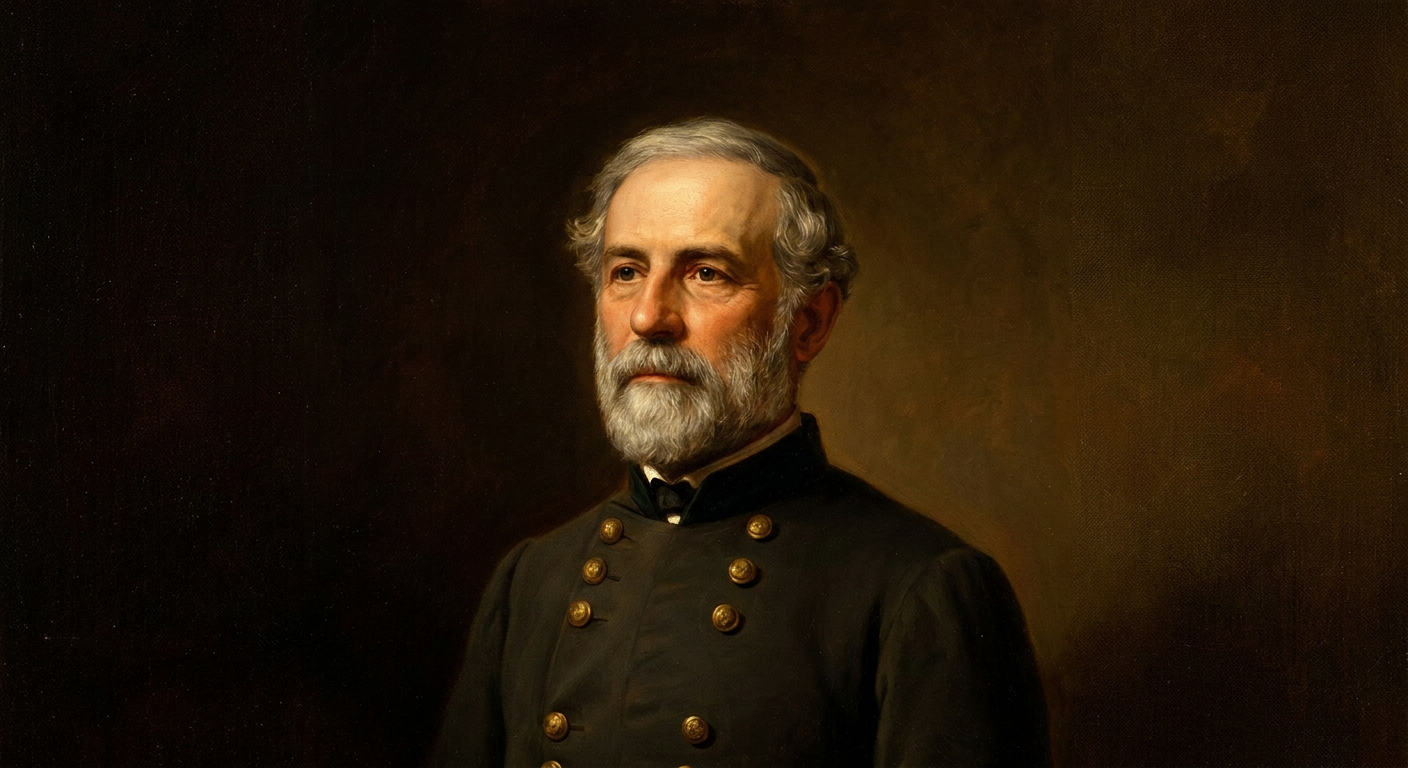
Quick Facts
- Years
- 1807 – 1870
- Category
- World Leaders & Revolutionaries
- Nationality
- American
- Occupation
- United States Army officer, Confederate general, and college president
Robert E. Lee
1807 – 1870 · American · United States Army officer, Confederate general, and college president
Recommended Audiobooks
Listen next from Marcus Alden

Life Lessons from Simon Bolivar
Marcus Alden · 55 min

Life Lessons from George Washington
Marcus Alden · 54 min
Robert E. Lee was one of the most capable—and most controversial—military commanders in American history. A gifted United States Army engineer and veteran of the Mexican-American War, he became the Confederacy’s leading general after Virginia seceded from the Union in 1861. His Army of Northern Virginia won dramatic victories against larger federal forces, but his invasions of Union territory failed, and he surrendered to Ulysses S. Grant at Appomattox Court House in April 1865.
Lee matters not only because of his battlefield record. His decision to serve Virginia rather than the United States placed his talents at the service of a rebellion created to preserve a slaveholding republic. He called slavery a moral and political evil, yet enslaved people, enforced the terms of a slaveholding estate, opposed immediate abolition before the war, and offered no public program for racial equality afterward.
After his death, admirers transformed Lee into the central hero of the Lost Cause—a misleading interpretation that minimized slavery and romanticized the Confederacy. Modern scholarship instead examines the whole record: professional brilliance, costly strategic errors, personal restraint at surrender, participation in slavery, and resistance to Black political equality. Lee remains worth studying because his life reveals how loyalty, ambition, military leadership, race, memory, and national identity collided during the United States’ greatest crisis.
Quick Facts
| Field | Details |
|---|---|
| Full Name | Robert Edward Lee |
| Common Name(s) | Robert E. Lee; General Lee |
| Born | January 19, 1807 |
| Died | October 12, 1870 |
| Age at Death | 63 |
| Birthplace | Stratford Hall, Westmoreland County, Virginia, United States |
| Nationality | American; served the Confederate States from 1861 to 1865 |
| Occupation | Army officer, military engineer, Confederate general, college president |
| Historical Era | Antebellum United States, Mexican-American War, American Civil War, Reconstruction |
| Famous For | Commanding the Army of Northern Virginia and surrendering at Appomattox |
| Political Affiliation | No sustained party affiliation; opposed secession before joining Virginia and the Confederacy |
| Religion | Episcopalian |
| Education | United States Military Academy, graduated 1829 |
| Parents | Henry “Light-Horse Harry” Lee III and Ann Hill Carter Lee |
| Spouse(s) | Mary Anna Randolph Custis Lee |
| Children | George Washington Custis, Mary, William Henry Fitzhugh, Anne, Eleanor Agnes, Robert Edward Jr., and Mildred Childe Lee |
| Major Works | Military reports, correspondence, General Orders No. 9, and college administrative writings |
| Major Achievements | Distinguished Mexican War service; command of the Army of Northern Virginia; victories in the Seven Days, Second Manassas, Fredericksburg, and Chancellorsville; peaceful surrender at Appomattox; presidency of Washington College |
Early Life
Lee was born into Virginia’s planter aristocracy at Stratford Hall. His father, Henry Lee III, had been a celebrated Revolutionary War cavalry commander, governor of Virginia, and congressman. Poor financial decisions, however, destroyed much of the family fortune. He spent time in debtors’ prison and left the United States when Robert was young.
Lee’s mother, Ann Hill Carter Lee, held the household together. The family moved to Alexandria, where Robert experienced a more constrained childhood than his famous ancestry might suggest. He helped care for his frequently ill mother and developed habits of self-control, responsibility, and careful attention to appearances.
In 1825 Lee entered the United States Military Academy at West Point. He excelled in mathematics and engineering, graduated second in the class of 1829, and famously accumulated no recorded demerits. The achievement reflected exceptional discipline, although later hero worship sometimes treated it as proof of moral perfection rather than academic conduct.
Commissioned into the Corps of Engineers, Lee worked on coastal defenses and river improvements. Engineering demanded patient observation, accurate mapping, logistical planning, and practical problem-solving—skills that later strengthened his military command.
In 1831 he married Mary Anna Randolph Custis, the daughter of George Washington Parke Custis and great-granddaughter of Martha Washington. Their home, Arlington House, stood above the Potomac River opposite Washington. The marriage connected Lee to the Washington family’s public prestige and to a plantation economy sustained by enslaved labor.
Rise to Prominence
For much of his early career, Lee was respected within the army but little known to the public. His breakthrough came during the Mexican-American War of 1846–1848. Serving on General Winfield Scott’s staff, Lee reconnoitered routes, positioned artillery, and found approaches around Mexican defenses. Scott called him one of the finest soldiers he had ever seen.
Lee received brevet promotions for gallantry at Cerro Gordo, Contreras, Churubusco, and Chapultepec. The campaign gave him direct experience with offensive operations, difficult terrain, staff work, and relationships with officers—including Ulysses S. Grant, George B. McClellan, Joseph E. Johnston, and others—who would later fight in the Civil War.
He became superintendent of West Point in 1852 and then lieutenant colonel of the 2nd U.S. Cavalry in Texas. In October 1859, while home on leave, Lee commanded troops that suppressed John Brown’s raid on the federal arsenal at Harpers Ferry. Brown hoped to ignite a revolt against slavery; his capture made Lee briefly prominent in a rapidly polarizing nation.
The decisive turning point arrived in April 1861. Lee opposed secession and described disunion as a calamity. Nevertheless, when Virginia left the Union following the attack on Fort Sumter and President Abraham Lincoln’s call for troops, Lee chose Virginia.
Francis Preston Blair, acting with Lincoln’s knowledge, discussed a senior Union command with Lee. The exact scope of the contemplated appointment is debated, but Lee declined to lead forces against the seceded states. He resigned his U.S. Army commission on April 20, 1861, and accepted command of Virginia’s military forces. That choice defined his historical reputation.
Major Achievements
Mexican-American War Service
Lee’s reconnaissance and engineering work helped Winfield Scott’s army advance from Veracruz to Mexico City. He demonstrated courage under fire and an unusual ability to read landscapes. These campaigns established the professional reputation that brought him high command in 1861.
Reorganization and the Seven Days
Lee’s first field command in western Virginia produced disappointing results, but he subsequently strengthened Confederate coastal defenses and advised President Jefferson Davis. In June 1862, after Joseph E. Johnston was wounded, Lee took command near Richmond and renamed his force the Army of Northern Virginia.
During the Seven Days Battles, Lee forced McClellan’s Army of the Potomac away from Richmond. Confederate attacks were poorly coordinated and costly, but the campaign changed the strategic initiative. Lee’s willingness to attack became a defining characteristic of his command.
Second Manassas and Fredericksburg
Working with Thomas “Stonewall” Jackson and James Longstreet, Lee defeated John Pope at Second Manassas in August 1862. Jackson’s wide movement and Longstreet’s massive counterattack produced one of the Confederacy’s clearest victories.
At Fredericksburg in December, Lee used strong defensive ground to repel repeated Union assaults. The victory demonstrated his understanding of terrain, although his reported observation that war was terrible lest people grow fond of it also acknowledged the slaughter before him.
Chancellorsville
In May 1863 Lee faced Joseph Hooker’s larger army. He divided his outnumbered force and sent Jackson on a flank march that crushed the Union right. The victory is often described as Lee’s tactical masterpiece.
It came at a severe price. Jackson was accidentally shot by Confederate soldiers and died eight days later. Confederate casualties were difficult to replace, and Lee lost the subordinate commander who had most effectively converted his aggressive plans into action.
Sustaining Resistance in 1864
Grant’s Overland Campaign placed continuous pressure on Lee from the Wilderness to Cold Harbor and Petersburg. Lee repeatedly anticipated federal movements and prevented the quick destruction of his army. Yet Grant could replace losses more readily, move south after tactical setbacks, and exploit the Union’s larger resources. Lee’s defensive performance prolonged the conflict but could not reverse its outcome.
Appomattox Surrender
By April 1865, Richmond and Petersburg had fallen, Lee’s supply lines were broken, and his army was surrounded. He rejected suggestions that the troops disperse into prolonged guerrilla warfare. On April 9 he surrendered to Grant at Appomattox Court House.
Grant offered generous terms: soldiers could return home, officers retained sidearms, and men could keep privately owned horses. Lee’s acceptance helped prevent further bloodshed. It did not reunite the country by itself, but it provided a powerful model for the orderly conclusion of major Confederate resistance.
Leadership or Work
Lee led through personal example, formal courtesy, intense preparation, and confidence in selected subordinates. He was usually calm in public and inspired remarkable loyalty among soldiers who endured hunger, inadequate clothing, and heavy casualties.
His command had notable strengths:
- A keen eye for terrain and enemy vulnerabilities
- Speed in shifting forces within Virginia
- Willingness to accept calculated operational risks
- Strong relationships with commanders such as Jackson and Longstreet
- An ability to maintain morale despite material shortages
Its weaknesses were equally important. Lee sometimes issued discretionary orders when precise instructions were needed. His style worked best with officers who understood his intentions. At Gettysburg, uncertainty, delays, poor reconnaissance, and divided responsibility contributed to failure.
Lee also favored offensive action even when Confederate manpower could not easily absorb losses. Historians disagree over whether aggressiveness was strategically necessary because the Confederacy faced long odds, or whether it wasted irreplaceable soldiers. Both considerations matter: passive defense offered little prospect of independence, but repeated attacks weakened the army that the Confederacy most depended upon.
Personal Life
Lee and Mary married in 1831 and had seven children. Military assignments often separated them, and their surviving letters show affection alongside the formality expected within an elite nineteenth-century household. Several sons served in the Confederate military; Rooney Lee became a cavalry general, while Custis Lee served on Jefferson Davis’s staff and later led Washington and Lee University.
Arlington was central to the family’s identity, although title to it came through Mary’s father. Federal forces occupied the property in 1861, and part of the estate became Arlington National Cemetery in 1864. The United States later compensated the Lee family after the Supreme Court ruled that the government had obtained the land through an unlawful tax-sale process.
Lee enjoyed horses and was closely associated with his gray gelding Traveller. He was attentive to animals, family obligations, and religious observance. Accounts portray him as reserved, courteous, and occasionally playful within his family, but the polished postwar image of an untroubled Christian gentleman obscures harder dimensions of his authority over soldiers, dependents, and enslaved workers.
His wartime health deteriorated. Many historians believe he suffered heart disease, and he experienced significant illness in 1863. A stroke in September 1870 left him seriously weakened. He died in Lexington, Virginia, on October 12.
Philosophy or Beliefs
Lee’s worldview joined Christian duty, personal honor, social hierarchy, military obedience, and loyalty to Virginia. These commitments could conflict. He had sworn allegiance to the United States and opposed secession, yet concluded that he could not fight his native state.
His choice reflected a period when state and national identities competed, but it was not inevitable. Many Virginians—including Winfield Scott, George H. Thomas, and thousands of civilians—remained loyal to the Union. Lee exercised agency, and describing his decision as merely unavoidable understates its moral and political importance.
On slavery, Lee’s beliefs were paternalistic rather than egalitarian. In an 1856 letter he called slavery a moral and political evil, but also claimed that enslavement disciplined Black people and that emancipation should occur through divine providence rather than immediate political action. Such views criticized aspects of slavery while rationalizing its continuation.
After the war, Lee supported restoration of the Union and advised former Confederates to obey federal law. He favored education and economic rebuilding. However, he opposed Black suffrage and testified in 1866 that he did not consider African Americans prepared to vote. His reconciliation therefore centered primarily on peace between white Northerners and white Southerners, not equal citizenship.
Challenges and Controversies
Slavery
Lee participated directly in slavery. Before the Civil War he owned enslaved people, and as executor of George Washington Parke Custis’s estate he supervised nearly 200 enslaved men, women, and children. Custis’s will required their emancipation within five years. Lee signed emancipation documents in December 1862, near the end of that period.
Wesley Norris, formerly enslaved at Arlington, stated in 1866 that Lee had ordered him and two others whipped after an escape attempt in 1859. The account appeared after the war, and Lee left no known direct response to its central accusation. Surviving contemporary evidence and related testimony lead many historians to regard the incident as credible, though some older biographers rejected it. It should be presented as a well-supported allegation rather than disguised as either an uncontested document or a baseless rumor.
The Confederate Cause
The Confederacy’s founding documents and secession declarations identify slavery as a central cause of separation. Lee was not the Confederacy’s chief political theorist, but his military service protected a government founded by slaveholding states seeking independence. His personal reservations about slavery do not detach his command from that cause.
Antietam and Gettysburg
Lee’s Maryland campaign ended at Antietam in September 1862. Although his army escaped, the invasion failed to gain foreign recognition or decisive political advantage. Lincoln used the strategic Union success to announce the preliminary Emancipation Proclamation.
At Gettysburg in July 1863, Lee attacked a strong Union position over three days. Pickett’s Charge failed with devastating losses. Lee accepted responsibility, but historians continue to debate Longstreet’s performance, J. E. B. Stuart’s absence, Confederate command problems, and Lee’s persistence. The larger responsibility belonged to Lee as commanding general.
Lost Cause Memory
After Lee’s death, writers and memorial organizations portrayed him as nearly faultless and insisted that the Confederacy fought mainly for constitutional liberty. This Lost Cause tradition minimized slavery, blamed subordinates for defeats, and separated Lee from the racial system he defended.
Beginning in the late twentieth century, and especially after 2015, communities reconsidered statues and institutions bearing his name. Supporters of removal argue that many monuments promoted white supremacy during segregation. Opponents often cite heritage or artistic value. Dates and original purposes matter: memorials created decades after the war frequently reveal more about Jim Crow politics than about mourning in 1865.
Legacy
Lee became president of Washington College in Lexington in 1865. He expanded its curriculum, encouraged practical subjects, and helped revive the financially distressed institution. After his death it was renamed Washington and Lee University. The university now studies both his educational role and its own historical entanglement with slavery and Confederate memory.
His military campaigns remain important in staff colleges and battlefield studies. Analysts examine his use of maneuver, delegation, morale, and risk—as well as the dangers of unclear orders, excessive offensives, and strategy disconnected from resources.
Lee’s memorial landscape has changed dramatically. Arlington House is preserved by the National Park Service with interpretation of the Lee and Custis families and the enslaved community. Major battlefields are protected, while numerous Lee statues and school names have been removed or changed. Virginia stopped observing Lee-Jackson Day as a state holiday in 2020.
Modern assessments resist choosing between genius and villain as if only one category were possible. Lee could be a formidable commander, a gracious defeated general, an educator, a slaveholder, an opponent of Black political equality, and an icon reshaped by later generations. His significance lies partly in those uncomfortable combinations.
Interesting Facts
- Lee graduated second in West Point’s class of 1829.
- He completed his cadet career without a recorded demerit.
- He spent much of his prewar service building or improving fortifications.
- Winfield Scott considered him exceptionally talented during the Mexican War.
- Lee was superintendent of West Point from 1852 to 1855.
- He commanded the force that captured John Brown at Harpers Ferry.
- He opposed secession before resigning from the U.S. Army.
- His Arlington residence had belonged to George Washington’s step-grandson.
- Arlington National Cemetery was established on the family estate during the war.
- Lee did not command the Army of Northern Virginia until June 1862.
- His best-known victory, Chancellorsville, cost him Stonewall Jackson.
- Lee assumed general-in-chief command of all Confederate armies only in February 1865.
- He wore a colonel’s insignia at Appomattox, reflecting his last permanent U.S. Army rank.
- Traveller, his famous horse, was originally named Greenbrier.
- Lee discouraged guerrilla resistance after conventional defeat became unavoidable.
- He became a college president less than six months after Appomattox.
- He applied for restored U.S. citizenship, but the oath was misplaced and not processed.
- Congress restored his citizenship posthumously in 1975.
Famous Quotes
-
“I can anticipate no greater calamity for the country than a dissolution of the Union.” — Letter to his son Custis, January 23, 1861. It documents Lee’s opposition to secession before Virginia left the Union.
-
“Save in defense of my native State, I never desire again to draw my sword.” — Resignation letter to Winfield Scott, April 20, 1861. The statement explains Lee’s declared priority of Virginia loyalty.
-
“Slavery as an institution, is a moral & political evil in any Country.” — Letter to Mary Lee, December 27, 1856. The same letter defended gradual, providential emancipation and expressed racist paternalism, so the sentence should not be quoted alone as proof of abolitionism.
-
“It is well that war is so terrible, or we should grow too fond of it.” — Reported by James Longstreet from Fredericksburg. The wording rests on later recollection but is widely accepted as substantially authentic.
-
“There is nothing left for me to do but to go and see General Grant, and I would rather die a thousand deaths.” — Recalled by General Edward Porter Alexander regarding April 9, 1865. It conveys Lee’s anguish, though it is a memoir-based quotation rather than a transcript.
-
“After four years of arduous service, marked by unsurpassed courage and fortitude, the Army of Northern Virginia has been compelled to yield.” — General Orders No. 9, April 10, 1865. The farewell praised the army while explaining surrender through overwhelming resources.
-
“You will take with you the satisfaction that proceeds from the consciousness of duty faithfully performed.” — General Orders No. 9. It helped shape the army’s memory of honorable service, while leaving the Confederate cause itself unexamined.
-
“I think it wiser, moreover, not to keep open the sores of war.” — Letter declining an invitation connected with Gettysburg memorial activity, 1869. Lee favored quiet reconciliation over renewed sectional ceremony.
-
“Duty is the sublimest word in our language.” — Long attributed to Lee in a supposed letter to his son. Scholars demonstrated that the published letter was spurious; the quotation should not be treated as authentic.
Timeline
- 1807 — Born at Stratford Hall, Virginia.
- 1825 — Enters the United States Military Academy.
- 1829 — Graduates second and joins the Corps of Engineers.
- 1831 — Marries Mary Anna Randolph Custis.
- 1846–1848 — Serves with distinction in the Mexican-American War.
- 1852 — Becomes superintendent of West Point.
- 1855 — Joins the 2nd U.S. Cavalry in Texas.
- 1857 — Becomes executor of the Custis estate.
- 1859 — Commands troops against John Brown’s raid at Harpers Ferry.
- 1861 — Declines a senior Union role, resigns, and enters Virginia and Confederate service.
- 1862 — Takes command of the Army of Northern Virginia; fights the Seven Days, Second Manassas, Antietam, and Fredericksburg; formally emancipates people held under the Custis will.
- 1863 — Wins at Chancellorsville; loses at Gettysburg.
- 1864 — Opposes Grant through the Overland Campaign and siege of Petersburg.
- 1865 — Becomes Confederate general-in-chief; surrenders at Appomattox; becomes president of Washington College.
- 1866 — Testifies before Congress during Reconstruction.
- 1870 — Suffers a stroke and dies in Lexington.
- 1975 — U.S. citizenship restored posthumously by Congress.
Frequently Asked Questions
1. Why is Robert E. Lee famous?
Lee is famous chiefly for commanding the Army of Northern Virginia, the Confederacy’s most prominent field army. Between 1862 and 1865 he defeated or frustrated several Union commanders and won victories at Second Manassas, Fredericksburg, and Chancellorsville. His campaigns made him the Confederacy’s leading military symbol. He is also remembered for the failed invasion culminating at Gettysburg and for surrendering to Grant at Appomattox. Later admirers elevated him into a symbol of the Lost Cause, making his historical memory almost as influential as his wartime service.
2. Was Lee offered command of the Union Army?
Francis Preston Blair discussed a senior Union command with Lee in April 1861, acting with President Lincoln’s knowledge. Traditional accounts often say Lee was formally offered command of all Union armies. Historians caution that the army’s command structure was still evolving and that no surviving formal commission establishes the exact position. What is clear is that Lee was sounded out for a major role, declined to fight the seceded states, and soon resigned his commission after Virginia’s secession.
3. Why did Lee choose the Confederacy?
Lee said he could not take up arms against Virginia. State loyalty, family identity, regional culture, and his concept of honor shaped that decision. Yet Virginia loyalty did not compel every Virginian to make the same choice; General George H. Thomas and many others remained with the United States. Lee also understood that secession defended a slaveholding social order. His choice should therefore be explained through historical context without treating it as morally or practically inevitable.
4. Did Lee oppose secession?
Yes, before Virginia seceded. In January 1861 Lee called dissolution of the Union a calamity and regarded secession as revolution rather than a clear constitutional right. Nevertheless, he believed coercing a seceded state would create an even greater conflict. When Virginia withdrew, his allegiance shifted to the state. His conduct illustrates the difference between opposing secession in principle and refusing to resist it once his own state acted.
5. Did Robert E. Lee own enslaved people?
Yes. Lee personally owned enslaved people earlier in his life and later controlled nearly 200 as executor of his father-in-law’s estate. George Washington Parke Custis’s will required emancipation within five years. Lee kept the estate’s labor system operating while addressing debts and signed emancipation deeds in December 1862. The historical record therefore contradicts claims that Lee never owned or managed enslaved people, although legal ownership within the Custis estate was more complicated than simple personal inheritance.
6. Did Lee have an enslaved man whipped?
Wesley Norris stated that after an attempted escape in 1859, Lee ordered him, his sister, and a cousin whipped, with brine applied to their wounds. Norris published his account in 1866. Lee left no known direct rebuttal of its core claim. Newspaper evidence and related testimony provide corroborating context, and many modern historians judge Norris’s account credible. Because no order signed by Lee survives, careful biographies identify it as a strongly supported testimony rather than claiming documentary certainty beyond the evidence.
7. Was Lee an abolitionist?
No. Lee described slavery as a moral and political evil in an 1856 private letter, but he opposed immediate abolition, portrayed slavery as a supposed form of discipline for Black people, and expected God rather than political activists to end it gradually. He managed enslaved labor and fought for the Confederacy. Calling him an abolitionist extracts one sentence from a letter whose complete argument was paternalistic and explicitly hostile to abolitionist action.
8. Was Lee the commander of the entire Confederate Army?
Not for most of the war. Lee commanded the Army of Northern Virginia from June 1862. President Jefferson Davis coordinated Confederate strategy through separate departmental commanders, which often made cooperation difficult. Lee was appointed general-in-chief of the Confederate armies in February 1865, only two months before his surrender. By then Confederate resources and transportation networks were collapsing, leaving little opportunity to exercise effective nationwide command.
9. What was Lee’s greatest victory?
Chancellorsville is most often named his greatest tactical victory. In May 1863, Lee divided a smaller army in the face of Joseph Hooker’s larger force and authorized Stonewall Jackson’s successful flank attack. The result forced the Union army to retreat. Yet the Confederates suffered serious casualties, and Jackson died after being wounded by friendly fire. The victory displayed operational boldness while also showing the human cost and long-term danger of Lee’s aggressive approach.
10. Why did Lee lose at Gettysburg?
No single explanation is sufficient. Confederate cavalry provided inadequate early intelligence; unfamiliar command relationships reduced coordination; Union troops held strong defensive terrain; and several attacks began later or less coherently than intended. Lee also underestimated the Army of the Potomac’s resilience and persisted with frontal attacks, culminating in Pickett’s Charge. Some Lost Cause writers shifted primary blame to James Longstreet, but most historians emphasize that Lee, as commander, bore ultimate responsibility for the plan and its continuation.
11. Was Lee a better general than Grant?
The question depends on the standard used. Lee was exceptionally effective at maneuvering within Virginia and winning tactical victories against larger armies. Grant was better at coordinating multiple theaters, sustaining pressure, using national resources, and linking battlefield action to political objectives. Lee often won battles without changing the strategic balance; Grant accepted tactical setbacks while advancing toward Confederate defeat. Most modern comparisons therefore recognize Lee’s operational gifts while judging Grant the more successful strategist.
12. Why did Lee surrender at Appomattox?
Lee’s army was exhausted, undersupplied, outnumbered, and blocked from further retreat. Union forces captured essential supplies and closed routes toward North Carolina. Continued conventional fighting promised heavy casualties without a realistic path to victory. Lee rejected dispersal into guerrilla warfare because it could devastate communities and prolong disorder. On April 9, 1865, he met Grant and accepted terms permitting soldiers to return home on parole.
13. Did Lee help reconcile the country?
Lee accepted defeat, supported restored national authority, discouraged guerrilla warfare, and advised former Confederates to obey the law. These actions aided peaceful reunion. However, his idea of reconciliation did not include full racial equality. He opposed Black suffrage and held paternalistic racial beliefs. It is therefore accurate to say he promoted sectional peace while recognizing that his postwar program fell far short of equal democratic citizenship.
14. What did Lee do after the Civil War?
In October 1865 Lee became president of Washington College in Lexington. He stabilized enrollment and finances, broadened the curriculum, and encouraged practical and professional education. He also served as a symbolic figure for former Confederates adjusting to defeat. He generally avoided partisan agitation, although his congressional testimony reflected opposition to Black voting rights. The college renamed itself Washington and Lee University after his death.
15. Where is Lee buried?
Lee is buried in the University Chapel at Washington and Lee University in Lexington, Virginia. His wife and several family members are also interred there, and Traveller’s remains are buried nearby. Formerly called Lee Chapel, the building has become a focal point in debates about institutional history, Confederate remembrance, and how universities should interpret memorial spaces without converting them into places of uncritical reverence.
16. Why are statues of Lee controversial?
Many Lee monuments were installed decades after the Civil War, especially during the establishment of Jim Crow segregation or resistance to civil rights. Their meaning therefore extends beyond memorializing a dead soldier. Supporters have viewed them as military or regional heritage; critics identify them as public celebrations of the Confederacy and white supremacy. Modern disputes concern not only Lee’s character but who receives honor in shared civic spaces and how historical objects should be preserved, relocated, or interpreted.
Lessons We Can Learn
- Loyalty requires moral judgment. Lee prioritized Virginia over the United States. His example shows that loyalty to home or community does not remove responsibility for the cause being served.
- Tactical success is not strategic success. Confederate victories did not secure independence. Modern leaders must connect immediate wins to achievable long-term goals.
- Resources shape outcomes. Lee’s skill could not permanently overcome the Union’s population, industry, transport, and naval strength.
- Clear orders matter. Discretion encouraged initiative but contributed to confusion when commanders misunderstood Lee’s intentions.
- Aggressiveness has a price. Lee’s offensives created opportunities while consuming soldiers the Confederacy could not replace.
- Personal courtesy does not erase harmful systems. Lee’s manners coexisted with authority over enslaved people and service to a slaveholding republic.
- Accepting reality can prevent further harm. His surrender and rejection of guerrilla war helped spare lives when military success was no longer plausible.
- Memory must be tested against evidence. Lost Cause stories demonstrate how later generations can turn complex people into political symbols.
- Reconciliation without equality is incomplete. Lee supported reunion but not Black suffrage, illustrating the limits of peace that leaves injustice intact.
- Historical figures should be studied whole. Evidence supports recognition of Lee’s military ability without ignoring slavery, strategic failure, or racial beliefs.
Related Historical Figures
- Ulysses S. Grant — Union general who defeated Lee’s army and accepted his surrender at Appomattox.
- Abraham Lincoln — President whose administration sought Lee’s services before directing the war to preserve the Union and end slavery.
- Jefferson Davis — Confederate president and Lee’s principal civilian superior.
- Thomas “Stonewall” Jackson — Lee’s most celebrated corps commander, crucial at Second Manassas and Chancellorsville.
- James Longstreet — Senior subordinate whose relationship with Lee became distorted by postwar Gettysburg controversies.
- George B. McClellan — Union commander defeated in the Seven Days and opposed by Lee at Antietam.
- Winfield Scott — Lee’s mentor and commander in Mexico who remained loyal to the Union.
- George H. Thomas — Fellow Virginian and U.S. Army officer whose Union loyalty provides an important contrast to Lee.
- John Brown — Abolitionist captured by troops under Lee’s command at Harpers Ferry.
- Frederick Douglass — Abolitionist who challenged the glorification of Confederate leaders and advocated equal citizenship.
Watch and Learn
The Civil War, Part I: Crash Course US History #20 — CrashCourse — approximately 12 minutes.
This widely viewed educational overview clearly explains secession, slavery, military strategy, and the Civil War’s political stakes. It is not a stand-alone Lee biography, but it provides essential context for evaluating his command without separating battlefield history from the cause and consequences of the conflict.
Watch and Learn
The Civil War, Part I: Crash Course US History #20 · CrashCourse
Related Historical Figures