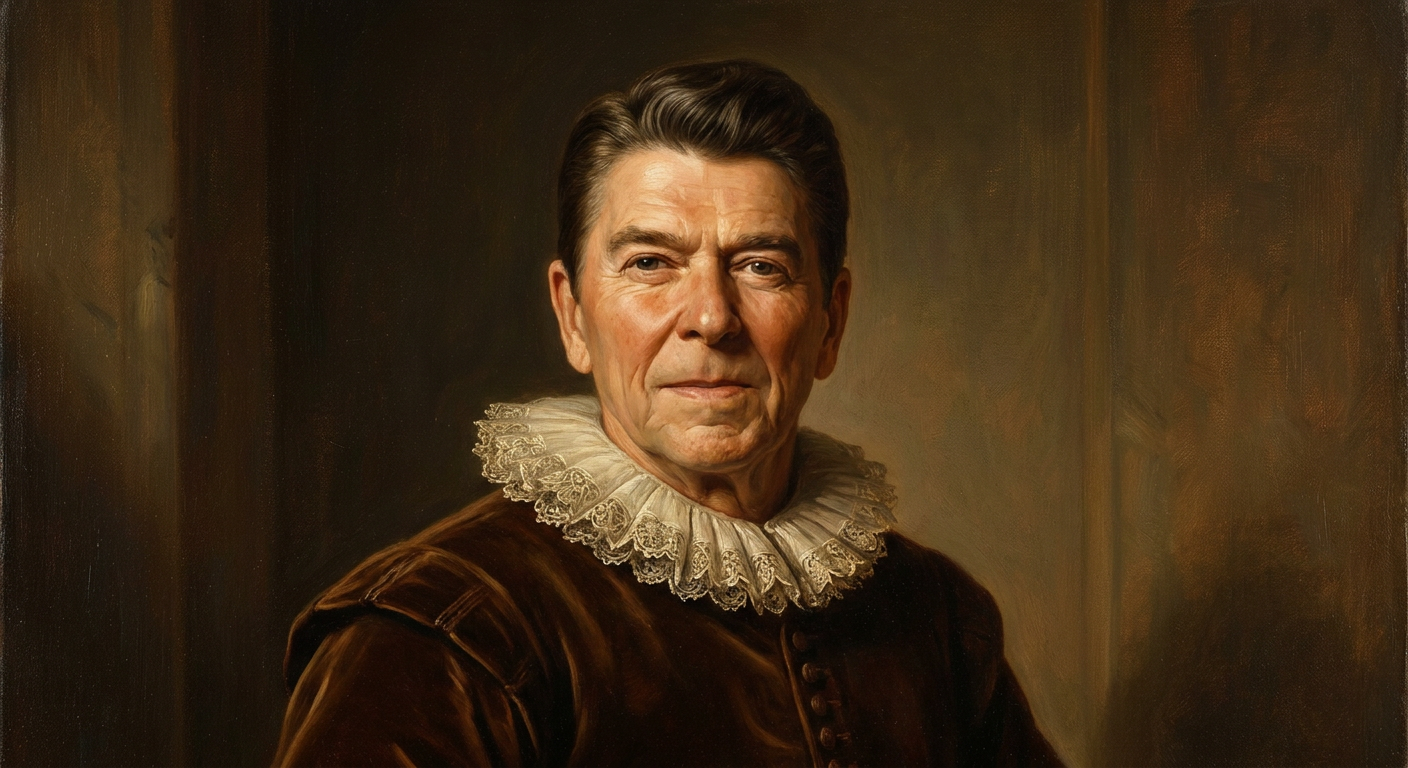
Quick Facts
- Years
- 1911 – 2004
- Category
- World Leaders & Revolutionaries
- Nationality
- American
- Occupation
- Actor, labor union leader, governor, and U.S. president
Ronald Reagan
1911 – 2004 · American · Actor, labor union leader, governor, and U.S. president
Recommended Audiobooks
Listen next from Marcus Alden

Life Lessons from Simon Bolivar
Marcus Alden · 55 min

Life Lessons from George Washington
Marcus Alden · 54 min
Ronald Reagan traveled one of the most unusual paths to the American presidency. Before entering national politics, he worked as a radio sports announcer, Hollywood actor, labor leader, corporate spokesman, and governor of California. From 1981 to 1989, he served as the 40th president of the United States, reshaping the Republican Party and the language of American conservatism.
Reagan promised to reduce taxes, limit federal regulation, strengthen the military, and restore confidence after years marked by inflation, the Vietnam War, Watergate, and the Iran hostage crisis. His administration enacted major tax changes, confronted organized labor, expanded defense spending, appointed a generation of conservative judges, and intensified pressure on the Soviet Union. During his second term, however, Reagan also negotiated with Soviet leader Mikhail Gorbachev and signed a landmark nuclear arms treaty.
Supporters credit Reagan with reviving national optimism, promoting economic growth, and helping create conditions for the Cold War's peaceful conclusion. Critics emphasize increased inequality, large budget deficits, the Iran-Contra affair, inadequate leadership during the AIDS epidemic, and policies that harmed vulnerable communities. Historians continue to debate how much credit or blame belongs to Reagan personally. That combination of political skill, consequential policy, and enduring controversy makes him essential to understanding the modern United States.
Quick Facts
| Field | Details |
|---|---|
| Full Name | Ronald Wilson Reagan |
| Common Name(s) | Ronald Reagan; Dutch; the Great Communicator |
| Born | February 6, 1911 |
| Died | June 5, 2004 |
| Age at Death | 93 |
| Birthplace | Tampico, Illinois, United States |
| Nationality | American |
| Occupation | Radio announcer, actor, union leader, corporate spokesman, governor, president |
| Historical Era | Cold War; late 20th century |
| Famous For | 40th U.S. president, conservative political transformation, Cold War diplomacy |
| Political Affiliation | Democrat in early adulthood; Republican from 1962 |
| Religion | Raised in the Disciples of Christ; later Presbyterian |
| Education | Eureka College, B.A., 1932 |
| Parents | John Edward “Jack” Reagan and Nelle Clyde Wilson Reagan |
| Spouse(s) | Jane Wyman, 1940–1949; Nancy Davis Reagan, 1952–2004 |
| Children | Maureen, Christine, Michael, Patti, and Ronald Jr. |
| Major Works | “A Time for Choosing”; An American Life; presidential speeches and radio addresses; published presidential diaries |
| Major Achievements | Two-term presidency; 1981 and 1986 tax laws; Social Security compromise; immigration reform; INF Treaty; appointment of Sandra Day O'Connor |
Early Life
Ronald Reagan was born above a commercial building in Tampico, Illinois. His father, Jack, sold shoes and struggled with alcoholism; his mother, Nelle, was active in her church and local charitable work. The family moved repeatedly before settling in Dixon. Reagan later remembered Nelle's optimism and belief that people could choose a better course as important influences.
As a boy, Reagan enjoyed sports, storytelling, and performing. He worked as a lifeguard at Lowell Park near Dixon and recorded 77 rescues over several summers. At Dixon High School he participated in football, drama, and student activities.
Reagan attended Eureka College, a small Disciples of Christ institution. He studied economics and sociology, played football, joined the swimming and track teams, acted in plays, and became student-body president. He also joined a student protest over proposed faculty cuts. Although he was not an outstanding scholar, college strengthened his confidence as a speaker and organizer.
He graduated in 1932, during the Great Depression. Jobs were scarce, but Reagan obtained radio work at WOC in Davenport, Iowa, and then at WHO in Des Moines. He became known for recreating Chicago Cubs baseball games from telegraphic reports, using sound effects and vivid narration to make listeners feel present.
Rise to Prominence
A 1937 trip to California led to a screen test and a Warner Bros. contract. Reagan appeared in more than 50 films, usually as a genial leading man or dependable supporting actor. His best-known roles included George Gipp in Knute Rockne, All American and Drake McHugh in Kings Row. The line “Where's the rest of me?” from the latter film later became the title of his first autobiography.
During the Second World War, poor eyesight kept Reagan from overseas combat. He served in the Army Air Forces' First Motion Picture Unit, helping produce training and informational films. He left military service as a captain.
Reagan became president of the Screen Actors Guild from 1947 to 1952 and again from 1959 to 1960. He dealt with strikes, contract negotiations, and allegations of communist influence in Hollywood. He cooperated with the FBI and testified before the House Committee on Un-American Activities, while opposing the formal banning of the Communist Party. His union years gave him practical experience in negotiation and public leadership.
His film career declined during the 1950s, but General Electric hired him to host its television program and tour company plants. Reagan delivered speeches to employees across the country. These appearances refined his accessible speaking style and moved him toward a strongly conservative defense of private enterprise and limited government.
Once a New Deal Democrat, Reagan increasingly opposed high taxes and expanding federal programs. He supported Republican Barry Goldwater in 1964 and delivered the televised speech “A Time for Choosing.” Its success made Reagan a national conservative figure. Elected governor of California in 1966, he served from 1967 through 1975, balancing conservative promises with pragmatic compromises on taxes, abortion law, welfare, and environmental protection.
After unsuccessful bids for the Republican presidential nomination in 1968 and 1976, Reagan won it in 1980. He defeated President Jimmy Carter amid inflation, unemployment, energy concerns, and the prolonged captivity of American hostages in Iran.
Major Achievements
Economic and tax policy
Reagan signed the Economic Recovery Tax Act of 1981, sharply reducing individual income-tax rates. His administration also supported deregulation and restrained parts of domestic spending. Federal Reserve chairman Paul Volcker's tight monetary policy—begun before Reagan took office—helped break inflation but contributed to a severe 1981–1982 recession.
The subsequent expansion was long and created millions of jobs. Supporters identify lower tax rates, business investment, and confidence as major causes. Critics note that monetary policy, falling oil prices, deficit spending, and the normal rebound from recession also mattered. Federal debt increased substantially as tax revenue failed to match defense spending and other commitments.
The bipartisan Tax Reform Act of 1986 lowered rates while eliminating many deductions and shelters. It remains one of the most extensive restructurings of the federal tax code.
Social Security and immigration compromises
In 1983 Reagan signed a bipartisan Social Security rescue package negotiated with congressional leaders. It gradually raised the retirement age, increased payroll taxation, and taxed some benefits. The agreement extended the program's financial stability, although it did not solve every long-term problem.
The Immigration Reform and Control Act of 1986 legalized the status of roughly 2.7 million eligible undocumented immigrants over time, while imposing penalties on employers who knowingly hired unauthorized workers. Reagan celebrated legalization as humane, but enforcement proved uneven and future unauthorized immigration continued.
Military buildup and Cold War policy
Reagan expanded American defense spending, deployed new missiles in Europe, supported anti-communist governments and insurgencies, and announced the Strategic Defense Initiative, a proposed missile-defense system. He described the Soviet Union in morally confrontational terms, alarming critics who feared escalation.
His policy later combined pressure with negotiation. Beginning in 1985, Reagan met repeatedly with Mikhail Gorbachev. Their 1986 Reykjavik summit failed to produce a sweeping agreement but prepared the way for the 1987 Intermediate-Range Nuclear Forces Treaty. The INF Treaty eliminated an entire category of American and Soviet land-based missiles and introduced extensive verification.
The Soviet Union collapsed after Reagan left office. Most scholars regard his policies as one contributing factor, alongside Soviet economic weakness, Gorbachev's reforms, resistance in Eastern Europe, long-term containment, and forces beyond any president's control. Claims that Reagan single-handedly “won” the Cold War therefore go beyond the historical evidence.
Elections, communication, and the judiciary
Reagan survived an assassination attempt in March 1981 and reassured the public with humor and composure. His communication skills helped him build public support, especially through televised addresses. In 1984 he won reelection in 49 states.
He appointed Sandra Day O'Connor, the first woman on the U.S. Supreme Court, as well as Antonin Scalia and Anthony Kennedy. He elevated William Rehnquist to chief justice. His judicial appointments strengthened the conservative legal movement and influenced American law long after his presidency.
Leadership or Work
Reagan set broad objectives and delegated many details. He preferred short briefing papers, personal stories, and clearly framed choices. This approach enabled him to communicate a consistent political vision, but it could leave him detached from complicated administrative operations.
His greatest leadership strength was persuasion. Reagan presented policy disputes as understandable moral choices and projected confidence during difficult periods. He could negotiate without publicly abandoning his principles, as demonstrated by agreements on taxes, Social Security, and arms control.
His weaknesses included limited attention to detail and dependence on aides. Rivalries among advisers sometimes produced confusion. The Iran-Contra affair showed the danger of delegation without strong oversight. The Tower Commission concluded that Reagan's disengaged management style had contributed to the breakdown in accountability, though investigations did not establish that he authorized illegal diversion of funds.
Reagan valued loyalty and generally avoided direct personal confrontation. He developed productive relationships with Democratic House Speaker Tip O'Neill despite sharp ideological differences. With Gorbachev, personal diplomacy helped turn suspicion into a working relationship.
Personal Life
Reagan married actress Jane Wyman in 1940. They had Maureen and Christine, who died shortly after birth, and adopted Michael. Their marriage ended in divorce in 1949. Reagan remains the only divorced person elected U.S. president at the time of his inauguration, though Donald Trump later also entered office having been divorced.
He married actress Nancy Davis in 1952. They had Patti and Ronald Jr. Nancy became his closest companion and an influential protector of his schedule, image, and access. Their devotion was evident in private letters, although tensions sometimes arose between Nancy and Reagan's children.
Reagan enjoyed horseback riding, ranch work, swimming, jelly beans, and reading. Rancho del Cielo, his California property, offered a retreat where he cleared brush and rode horses. Associates often described him as warm and humorous yet emotionally reserved.
His health became a major concern after the 1981 shooting. He later underwent surgery for colon cancer and treatment for other conditions. In 1994 he publicly announced that he had Alzheimer's disease. Some observers had questioned his memory during the presidency, but historians and physicians cannot retrospectively establish that he then had diagnosable Alzheimer's. He withdrew from public life and died of pneumonia complicated by the disease in 2004.
Philosophy or Beliefs
Reagan believed that political and economic freedom were closely connected. He argued that high taxes, regulation, and centralized bureaucracy weakened initiative. His conservatism favored private enterprise, military strength, federalism, traditional social values, and a confident form of American patriotism.
His governing record was less rigid than his rhetoric. Federal spending and debt rose; he accepted several tax increases after the 1981 reduction; and he compromised with Democrats. As governor, he signed a liberalized abortion law he later regretted. He also supported environmental protections in California while opposing many federal regulations as president.
Religion shaped his language about good, evil, freedom, and national purpose. Raised in a Protestant household, Reagan maintained Christian beliefs but attended church infrequently as president, partly because of security concerns. He regarded Soviet communism as both a geopolitical opponent and a system that denied spiritual and individual liberty.
Challenges and Controversies
- Iran-Contra: Administration officials secretly facilitated arms sales to Iran, despite an embargo, in hopes of securing hostage releases. Money was diverted to Nicaragua's Contra rebels despite congressional restrictions. Reagan accepted responsibility for what occurred on his watch, but denied knowing about the diversion. The scandal damaged his credibility.
- AIDS epidemic: Reagan did not deliver a major public address on AIDS until 1987, years after the crisis began. Critics argue that silence, inadequate urgency, and prejudice within the political climate cost lives. Federal research spending did rise, but public-health historians generally view the administration's early leadership as seriously deficient.
- Race and civil rights: Reagan opposed affirmative-action policies and initially resisted extending parts of the Voting Rights Act, though he eventually signed its extension. His 1980 appearance near Philadelphia, Mississippi, and his emphasis on “states' rights” remain controversial because of the region's civil-rights history. Supporters reject claims of racial intent; critics argue that his rhetoric exploited racial resentment.
- Labor: In 1981 Reagan fired more than 11,000 striking air-traffic controllers who ignored an order to return to work. He argued that federal law and public safety required action. The decision weakened PATCO and signaled a broader shift against organized labor.
- Deficits and inequality: Defense spending, tax cuts, and resistance to reducing popular programs generated large deficits. Economic growth was strong after 1982, but income inequality widened, manufacturing communities faced disruption, and homelessness became more visible.
- Foreign interventions: Reagan ordered the 1983 invasion of Grenada and the 1986 bombing of Libya, while supporting anti-communist forces abroad. Supporters saw resolve; critics cited civilian harm, questionable legality, and partnerships with abusive governments. In Lebanon, a bombing killed 241 American service members in 1983, after which U.S. forces withdrew.
- Bitburg: Reagan's 1985 visit to a German cemetery containing graves of Waffen-SS members drew widespread condemnation, even though the visit was intended to symbolize reconciliation.
Legacy
Reagan left office with high approval and restored the presidency's public stature after Vietnam and Watergate. He made tax reduction, deregulation, military strength, and skepticism toward federal government central Republican principles. Later conservatives repeatedly invoked his language and example, though their policies did not always match his willingness to compromise or support immigration legalization.
His Cold War legacy remains especially influential. Reagan combined an arms buildup and aid to anti-communist movements with direct diplomacy and arms reduction. Supporters emphasize his pressure on Moscow; critics warn against overlooking Gorbachev, European dissidents, previous administrations, and structural Soviet weaknesses.
The Ronald Reagan Presidential Library and Museum in Simi Valley, California, preserves records, exhibitions, and Air Force One. Washington National Airport was renamed for him in 1998, and numerous buildings, roads, schools, and statues bear his name. The USS Ronald Reagan entered service in 2003. Reagan is buried at his presidential library beside Nancy Reagan.
Academic rankings usually place him above average, though assessments differ sharply by ideology and by the issues historians prioritize. His presidency remains modernly relevant because debates over taxes, immigration, presidential communication, executive accountability, Russia, and the proper size of government still draw upon choices made during his era.
Interesting Facts
- Reagan was born in an apartment above a Tampico, Illinois, store.
- His father reportedly nicknamed him “Dutch” because of his appearance as a baby.
- He recorded 77 rescues while working as a lifeguard.
- He broadcast baseball recreations without watching the games in person.
- Warner Bros. signed him after a 1937 screen test.
- He portrayed Notre Dame football player George Gipp on film.
- His poor eyesight limited him to stateside military service.
- He served seven one-year terms as Screen Actors Guild president.
- He was a registered Democrat for much of his early political life.
- He remains the only U.S. president who headed a labor union.
- At 69, he was then the oldest person elected to a first presidential term.
- A would-be assassin's bullet came within roughly an inch of his heart.
- His fondness for jelly beans helped popularize the candy nationally.
- He appointed the Supreme Court's first female justice.
- His 1984 victory produced 525 electoral votes, one of the largest totals in U.S. history.
- Reagan and Gorbachev seriously discussed eliminating nuclear weapons at Reykjavik, although no comprehensive agreement resulted.
- He kept an extensive presidential diary through most of his eight years in office.
- His 1994 Alzheimer's announcement became an important public statement about the disease.
Famous Quotes
- “Government is not the solution to our problem; government is the problem.” — First inaugural address, 1981. Reagan was criticizing excessive government, not claiming that government had no legitimate role.
- “Are you better off than you were four years ago?” — Closing argument in the 1980 debate with Jimmy Carter, reducing economic dissatisfaction to a memorable personal test.
- “Mr. Gorbachev, tear down this wall!” — Brandenburg Gate speech, 1987. The demand made the Berlin Wall a symbol of communist repression; it fell in 1989.
- “Trust, but verify.” — Repeated during arms negotiations. Reagan identified it as a Russian proverb and used it to explain verification requirements.
- “Whatever else history may say about me when I'm gone, I hope it will record that I appealed to your best hopes, not your worst fears.” — Farewell address, 1989, summarizing his desired legacy.
- “We will never forget them, nor the last time we saw them.” — Address after the Challenger disaster, 1986, honoring the seven astronauts.
- “Freedom is never more than one generation away from extinction.” — Widely circulated from a 1961 recording for the American Medical Association; it expressed his belief that liberty required active defense.
- “The future doesn't belong to the fainthearted; it belongs to the brave.” — Challenger address, praising exploration despite tragedy.
- “I have left orders to be awakened at any time in case of national emergency—even if I'm in a Cabinet meeting.” — A documented example of Reagan's self-deprecating humor, often repeated in collections of his remarks.
- “My fellow Americans, I am pleased to tell you today that I've signed legislation that will outlaw Russia forever. We begin bombing in five minutes.” — A 1984 microphone-test joke, never intended as policy; its leakage caused international criticism.
Timeline
- 1911 — Born in Tampico, Illinois.
- 1920 — Reagan family settles in Dixon, Illinois.
- 1932 — Graduates from Eureka College and begins radio work.
- 1937 — Signs with Warner Bros. and enters the Army Reserve.
- 1940 — Marries Jane Wyman; appears in Knute Rockne, All American.
- 1942 — Appears in Kings Row and begins wartime film-unit service.
- 1947 — Begins first term as Screen Actors Guild president.
- 1949 — Divorce from Jane Wyman becomes final.
- 1952 — Marries Nancy Davis.
- 1954 — Begins hosting General Electric's television program.
- 1962 — Formally becomes a Republican.
- 1964 — “A Time for Choosing” brings national political attention.
- 1966 — Elected governor of California.
- 1967–1975 — Serves two terms as governor.
- 1976 — Narrowly loses the Republican nomination to Gerald Ford.
- 1980 — Defeats Jimmy Carter for the presidency.
- 1981 — Takes office, survives assassination attempt, signs major tax cut, and fires striking air-traffic controllers.
- 1983 — Announces Strategic Defense Initiative; signs Social Security compromise; U.S. invades Grenada.
- 1984 — Wins reelection in 49 states.
- 1985 — Begins summit diplomacy with Gorbachev.
- 1986 — Signs tax and immigration reforms; Iran-Contra affair becomes public.
- 1987 — Calls for removal of the Berlin Wall and signs the INF Treaty.
- 1989 — Leaves office and returns to California.
- 1994 — Announces Alzheimer's disease diagnosis.
- 2004 — Dies in Los Angeles on June 5.
Frequently Asked Questions
1. What was Ronald Reagan best known for?
Reagan was best known as the 40th U.S. president and the leading political voice of modern American conservatism. He promoted lower taxes, deregulation, increased military spending, and resistance to Soviet power. His optimistic speaking style earned him the title “the Great Communicator.” He is also remembered for negotiating with Mikhail Gorbachev, signing the INF Treaty, and surviving a 1981 assassination attempt.
2. Was Ronald Reagan a successful actor?
Reagan was a reliable professional actor rather than one of Hollywood's greatest stars. He appeared in more than 50 films and gained recognition for Knute Rockne, All American and Kings Row. His acting experience taught him camera awareness, timing, script delivery, and audience communication. Those skills later strengthened his political career, but his leadership roles in the Screen Actors Guild were equally important preparation.
3. Why did Reagan change political parties?
Reagan admired Franklin Roosevelt and began as a Democrat, but his views shifted during the postwar decades. He became concerned about taxation, regulation, communism, and the growth of federal programs. His work for General Electric exposed him to business-oriented conservative arguments. He campaigned for Republican candidates before formally changing registration in 1962, later saying that he had not left the Democratic Party so much as it had left him.
4. What was Reaganomics?
“Reaganomics” describes policies emphasizing lower marginal tax rates, deregulation, restrained domestic spending, and tight control of inflation, alongside substantial defense spending. Inflation fell and a long expansion followed the severe 1981–1982 recession. Economists disagree about how much credit belongs to tax policy because Federal Reserve actions, lower energy prices, deficits, and cyclical recovery also influenced the results. Debt and inequality increased during the era.
5. Did Reagan end the Cold War?
Reagan helped shape the Cold War's final phase but did not end it alone. Military pressure, ideological criticism, and negotiations with Gorbachev contributed to change. Equally important were Soviet economic weakness, Gorbachev's reforms, dissident movements, Eastern European resistance, and decades of Western containment. The Berlin Wall fell after Reagan left office, and the Soviet Union dissolved in 1991. Most historians therefore favor a multicausal explanation.
6. What happened during the assassination attempt?
On March 30, 1981, John Hinckley Jr. fired at Reagan outside a Washington hotel. A bullet ricocheted off the presidential limousine and entered Reagan's chest, causing serious internal bleeding. Press secretary James Brady, a police officer, and a Secret Service agent were also wounded. Reagan recovered after emergency surgery. His humor and calm public image during the crisis increased sympathy and political goodwill.
7. What was the Iran-Contra affair?
Officials secretly arranged arms sales to Iran, partly hoping to gain help freeing American hostages in Lebanon. Proceeds were diverted to Contra rebels fighting Nicaragua's Sandinista government despite congressional restrictions. Reagan said he had not known of the diversion, and investigations did not prove that he authorized it. Nevertheless, the episode revealed major failures of oversight and contradicted his public pledge not to bargain with hostage-takers.
8. Why did Reagan fire air-traffic controllers?
Members of the Professional Air Traffic Controllers Organization struck in August 1981 despite a federal prohibition on government-employee strikes. Reagan ordered them back to work within 48 hours and dismissed more than 11,000 who refused. He argued that safety and law required decisive action. Critics viewed the response as unnecessarily harsh. The episode weakened organized labor and encouraged private employers to take firmer positions against unions.
9. How did Reagan respond to AIDS?
The administration funded growing levels of AIDS research, particularly as the epidemic expanded, but Reagan's public leadership came late. He did not deliver a major speech on AIDS until 1987. Activists and many public-health historians argue that earlier presidential attention could have reduced stigma, encouraged prevention, and accelerated action. Defenders point to research spending, but the delayed public response remains one of the most criticized parts of his record.
10. What was Reagan's relationship with Gorbachev?
The relationship evolved from caution to productive personal diplomacy. Reagan and Gorbachev met at Geneva, Reykjavik, Washington, and Moscow. They disagreed sharply over missile defense and geopolitical conflicts, yet both recognized the danger and cost of nuclear competition. Their negotiations produced the INF Treaty and improved communication. The partnership did not erase rivalry, but it helped lower tensions and made later arms-control agreements possible.
11. Why was the 1984 election important?
Reagan defeated Democrat Walter Mondale with 525 electoral votes and carried every state except Minnesota and the District of Columbia. Economic recovery, Reagan's communication skills, and perceptions of renewed national confidence contributed to the result. The landslide demonstrated the breadth of his coalition, including many traditionally Democratic voters. It did not, however, give Republicans control of the House of Representatives, so bipartisan negotiation remained necessary.
12. Did Reagan reduce the size of government?
Not in a simple overall sense. He reduced taxes, regulation, and some domestic programs, but military spending grew and major benefit programs remained. Federal employment changed less dramatically than his rhetoric suggested, while annual deficits and national debt rose. Reagan changed priorities and public attitudes toward government more clearly than he reduced government's total scale. This distinction is central to scholarly evaluations of his presidency.
13. What role did Nancy Reagan play?
Nancy Reagan was her husband's closest adviser in personal and political matters, although she held no official policymaking office. She guarded his schedule, monitored personnel and public presentation, and encouraged improved relations with Gorbachev. After the assassination attempt, she consulted an astrologer about scheduling, a practice disclosed during the Iran-Contra period and criticized. As first lady, she became known for the “Just Say No” anti-drug campaign.
14. Did Reagan have Alzheimer's disease while president?
Reagan announced an Alzheimer's diagnosis in 1994, nearly six years after leaving office. Some former aides and journalists recalled lapses or moments of confusion during his presidency, especially in the second term. Others who worked closely with him reported no evidence of incapacitation. Retrospective diagnosis is unreliable, and available medical records have not established that he had diagnosable Alzheimer's while serving. The question should therefore be treated cautiously.
15. How do historians rank Ronald Reagan?
Many presidential surveys place Reagan in the above-average range, especially for communication, political leadership, and influence on public policy. Ratings vary because scholars disagree about his economic record, Cold War contribution, civil-rights policies, and executive management. Conservative writers often rank him more highly, while critics emphasize inequality, deficits, AIDS, and Iran-Contra. His historical importance is less disputed than the overall quality of his presidency.
Lessons We Can Learn
- Communication can define leadership. Reagan translated complex policies into memorable themes. Modern leaders can learn from his clarity without treating persuasive language as a substitute for evidence.
- Optimism has political power. His confidence reassured many Americans after a troubled decade. Historically, optimism strengthened his coalition; today it remains useful when paired with realistic planning.
- Delegation requires oversight. Iran-Contra demonstrated that broad instructions and weak supervision can produce serious misconduct. Accountability cannot be delegated away.
- Negotiation need not mean surrender. Reagan maintained strong public positions while bargaining with Gorbachev. The historical example suggests that rivals can negotiate without first eliminating every disagreement.
- Economic outcomes have multiple causes. Reagan claimed credit for recovery, but Federal Reserve policy and global conditions also mattered. Modern interpretation should resist assigning an entire economy to one leader.
- Compromise can preserve institutions. The 1983 Social Security agreement joined a conservative president with a Democratic Congress. Durable reform often requires shared ownership.
- Silence in a crisis has consequences. Reagan's delayed public response to AIDS illustrates how presidential attention can affect stigma, urgency, and resources.
- Rhetoric carries historical associations. Words such as “states' rights” do not exist outside their racial and regional context. Leaders must consider how different audiences reasonably hear political language.
- Personal relationships can alter diplomacy. Reagan's meetings with Gorbachev helped reduce mutual suspicion, though structural forces remained crucial. Trust can assist policy but cannot replace verification.
- Legacies remain contested. Reagan inspired devoted support and serious criticism. Studying both is more useful than reducing a consequential presidency to either triumph or failure.
Related Historical Figures
- Mikhail Gorbachev — Soviet leader whose negotiations with Reagan produced the INF Treaty and eased Cold War tensions.
- Jimmy Carter — President defeated by Reagan in 1980; their records are often compared on inflation, energy, and foreign policy.
- George H. W. Bush — Reagan's vice president and successor, who managed the Cold War's final collapse.
- Nancy Reagan — Wife, first lady, confidante, and influential guardian of Reagan's public and political interests.
- Margaret Thatcher — British prime minister, ideological ally, and important partner in Western Cold War policy.
- Barry Goldwater — Conservative presidential candidate whose 1964 campaign gave Reagan his national breakthrough.
- Paul Volcker — Federal Reserve chairman whose anti-inflation policy shaped the recession and recovery of Reagan's first term.
- Tip O'Neill — Democratic House speaker who opposed Reagan but negotiated major bipartisan agreements with him.
- Sandra Day O'Connor — Reagan appointee and the first woman to serve on the U.S. Supreme Court.
- Franklin D. Roosevelt — Reagan's early political hero; his New Deal coalition formed the tradition Reagan later challenged.
Watch and Learn
“The Reagan Revolution: Crash Course US History #43” — CrashCourse — approximately 14 minutes. This widely viewed educational overview explains Reagan's rise, economic program, conservative coalition, and place in late Cold War America. Its brisk presentation is especially useful as an introduction, although viewers should pair it with detailed sources when evaluating disputed questions such as economic causation and Reagan's role in ending the Cold War.
Watch and Learn
The Reagan Revolution: Crash Course US History #43 · CrashCourse
Related Historical Figures