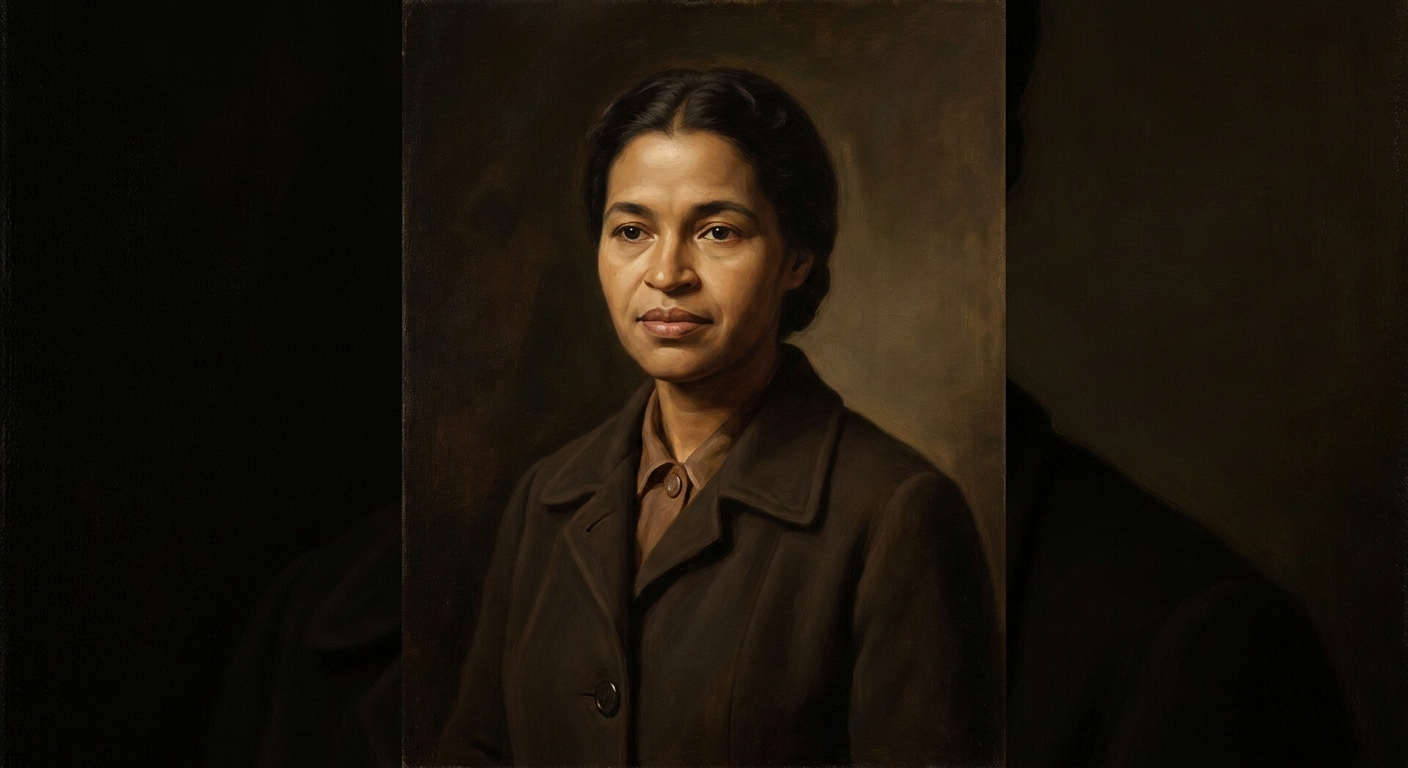
Quick Facts
- Years
- 1913 – 2005
- Category
- Social Reformers & Humanitarians
- Nationality
- American
- Occupation
- Civil rights activist and congressional staff member
Rosa Parks
1913 – 2005 · American · Civil rights activist and congressional staff member
Recommended Audiobooks
Listen next from Marcus Alden

Life Lessons from Harriet Beecher Stowe
Marcus Alden · 53 min

Life Lessons from Florence Nightingale
Marcus Alden · 48 min
Rosa Parks is often remembered as the quiet seamstress who refused to surrender her bus seat in Montgomery, Alabama. That familiar image captures a courageous moment, but it leaves out much of the person behind it. Parks was already an experienced civil rights activist when police arrested her on December 1, 1955. As secretary of the local National Association for the Advancement of Colored People, or NAACP, she had documented racial injustice, supported people facing violence and investigated the sexual assault of Recy Taylor.
Her arrest helped ignite the Montgomery bus boycott, a 381-day campaign that brought Martin Luther King Jr. to national attention and contributed to the judicial destruction of segregated public transportation. Yet Parks paid heavily for her stand. She lost her job, received threats and eventually left Alabama for Detroit, where she spent decades challenging discrimination, poverty, political repression and police brutality.
Parks matters not because she acted alone, but because her individual decision joined years of organized resistance by Black communities—especially Black women. Her life reveals how movements are built through preparation, networks, persistence and ordinary work as well as famous moments. Students still study her because she connects personal courage with collective action and because the inequalities she opposed did not disappear when Montgomery's buses were integrated.
Quick Facts
| Field | Details |
|---|---|
| Full Name | Rosa Louise McCauley Parks |
| Common Name(s) | Rosa Parks; sometimes called the “Mother of the Civil Rights Movement” |
| Born | February 4, 1913 |
| Died | October 24, 2005 |
| Age at Death | 92 |
| Birthplace | Tuskegee, Alabama, United States |
| Nationality | American |
| Occupation | Civil rights activist, seamstress and congressional staff member |
| Historical Era | Jim Crow era and modern civil rights movement |
| Famous For | Refusing to surrender her bus seat and helping launch the Montgomery bus boycott |
| Political Affiliation | Democratic Party; active in broader civil rights, labor and peace causes |
| Religion | African Methodist Episcopal Christianity |
| Education | Montgomery Industrial School for Girls; Alabama State Teachers College High School diploma, 1933 |
| Parents | Leona Edwards McCauley and James McCauley |
| Spouse(s) | Raymond Parks, married 1932–1977 |
| Children | None |
| Major Works | Rosa Parks: My Story; Quiet Strength |
| Major Achievements | Montgomery bus boycott catalyst; Presidential Medal of Freedom; Congressional Gold Medal |
Early Life
Rosa Louise McCauley was born in Tuskegee, Alabama, to Leona Edwards, a teacher, and James McCauley, a carpenter. After her parents separated, Rosa and her younger brother, Sylvester, lived with their mother and maternal grandparents near Pine Level, outside Montgomery.
Her childhood unfolded under Jim Crow, the system of laws, customs and violence used to enforce white supremacy. Black and white children attended separate schools. Public facilities were segregated, Black voting was suppressed and racial terror remained an ever-present threat. Parks later recalled her grandfather, Sylvester Edwards, keeping watch with a firearm when the Ku Klux Klan was active nearby. Such experiences taught her that dignity sometimes required deliberate resistance.
She attended rural schools and the Montgomery Industrial School for Girls, a private institution founded by white women from the North. Its emphasis on self-respect, discipline and academic development left a lasting impression. She later enrolled at the laboratory school of the Alabama State Teachers College for Negroes but left to care for her ill grandmother and then her mother. In 1933, after her marriage, she completed her high school education—a relatively uncommon achievement for a Black woman in Alabama at the time.
Her childhood influences included her mother's commitment to education, her grandparents' pride and the Black churches and communities that sustained people under segregation. Parks was not raised to seek public celebrity. She developed a reserved manner, close attention to detail and a strong conviction that unequal treatment was neither natural nor morally acceptable.
Rise to Prominence
In 1932, Rosa married Raymond Parks, a barber and activist. Raymond supported the Scottsboro Boys, nine Black teenagers falsely accused of raping two white women in 1931. Discussing that dangerous case introduced Rosa to organized resistance and the risks faced by Southern activists.
Parks joined the Montgomery NAACP in 1943. She became secretary partly because she was one of the few women present and was asked to take notes, but the position grew into serious investigative work. Working alongside chapter president E. D. Nixon, she recorded discrimination complaints and assisted campaigns involving wrongful prosecution, racial violence and voting rights.
In 1944, Parks investigated the gang rape of Recy Taylor, a Black woman from Abbeville, Alabama. She helped build the Committee for Equal Justice for Mrs. Recy Taylor, which turned the case into a national campaign. No one was prosecuted, despite strong evidence and identifications, but the organizing effort anticipated methods later used by the civil rights movement.
Parks also tried repeatedly to register to vote, finally succeeding in 1945 after overcoming discriminatory tests and administrative obstruction. While employed at Maxwell Air Force Base, federal rules allowed her to use integrated transportation on the base, showing her that segregation was a policy rather than an unavoidable feature of life.
During the summer of 1955, she attended a workshop at Tennessee's Highlander Folk School, where activists discussed school integration and social change. The workshop did not script her later bus protest, but it strengthened connections and gave her space to consider resistance.
December 1, 1955
On a Montgomery bus that evening, Parks sat in the first row of the section available to Black passengers. When the white section filled, driver James F. Blake ordered Parks and three other Black riders to vacate their row so a white passenger could sit. The others moved; Parks remained seated.
She was not occupying a seat initially designated for white passengers, and she did not refuse because her feet were unusually tired. She later explained that she was tired of yielding to injustice. Police arrested her under Montgomery's segregation ordinance.
Parks was not the first Black person to resist bus segregation. Claudette Colvin, Mary Louise Smith and others had been arrested earlier in 1955. Activists nevertheless believed Parks's maturity, record of service and respected public reputation made it difficult for opponents to discredit her. Her arrest became the immediate catalyst for a mass campaign already made possible by years of local organizing.
Major Achievements
Catalyzing the Montgomery Bus Boycott
On December 5, 1955, the day of Parks's trial, tens of thousands of Black residents avoided city buses. Women's Political Council activists, including Jo Ann Robinson, distributed leaflets, while ministers and community leaders formed the Montgomery Improvement Association. Martin Luther King Jr. became its president.
The boycott continued for 381 days. Participants walked, shared cars and created an extensive transportation network despite arrests, intimidation and violence. Parks attended meetings, raised funds and became an international symbol of the campaign.
The boycott mattered because Black riders formed most of the bus system's customer base. By withholding their fares, they combined moral protest with economic pressure. The action also demonstrated that sustained, disciplined mass participation could challenge entrenched segregation.
Helping Defeat Bus Segregation
Parks's own criminal case was appealed, but the decisive constitutional challenge came through Browder v. Gayle. The plaintiffs were Aurelia Browder, Susie McDonald, Claudette Colvin and Mary Louise Smith; Jeanetta Reese withdrew after intimidation. Parks was not a plaintiff, partly because lawyers pursued a federal strategy separate from her state prosecution.
In 1956, a federal court ruled segregated buses unconstitutional, and the U.S. Supreme Court allowed the decision to stand. Montgomery integrated its buses in December. Parks's arrest had triggered the boycott, while the plaintiffs and attorneys secured its central legal victory. Recognizing both roles prevents the movement from being reduced to a single hero.
Sustaining a Lifetime of Activism
After moving to Detroit, Parks continued working on civil rights, housing, employment and criminal justice issues. She supported John Conyers's successful 1964 congressional campaign and worked in his Detroit office from 1965 until retiring in 1988. Her duties included helping constituents navigate housing, welfare, immigration and other federal matters.
Parks attended the 1963 March on Washington, supported the Selma voting-rights campaign and maintained relationships with activists associated with nonviolence, labor organizing and Black Power. She spoke against the Vietnam War and supported political prisoners and campaigns against police abuse. This broader record complicates portrayals of her as merely passive or politically moderate.
Preserving History and Educating Youth
In 1987, Parks and Elaine Eason Steele founded the Rosa and Raymond Parks Institute for Self Development. Its programs encouraged young people to study African American history, leadership and community responsibility. Parks also published Rosa Parks: My Story with Jim Haskins in 1992 and Quiet Strength with Gregory J. Reed in 1995.
Receiving National Recognition
President Bill Clinton awarded Parks the Presidential Medal of Freedom in 1996. Congress presented her with the Congressional Gold Medal in 1999. These honors recognized both the Montgomery protest and her wider life of public service.
Leadership or Work
Parks led through reliability, careful listening and moral consistency rather than flamboyant speechmaking. As an NAACP secretary, she gathered facts, maintained records and listened to people whose complaints authorities routinely dismissed. Her work required discretion because open activism in Alabama could cost a person employment, safety or life.
Her core strengths included:
- Preparation: years of organizing preceded her famous arrest.
- Discipline: she remained composed under humiliation and legal pressure.
- Solidarity: she viewed her protest as part of a collective struggle.
- Persistence: she remained politically active long after Montgomery.
- Empathy: congressional casework placed practical assistance beside public advocacy.
Parks was reserved and not always comfortable as a celebrity speaker. That could limit her influence in settings built around powerful oratory, but it also made her an effective listener and symbol of disciplined conviction. She sometimes faced financial and organizational difficulties, and her iconic status occasionally allowed other people to speak for her. Nevertheless, she resisted attempts to confine her politics to one safe, simplified episode.
Personal Life
Raymond Parks was Rosa's husband, political partner and an important source of encouragement. Their marriage lasted until his death in 1977. They had no children, but Parks remained close to relatives and invested considerable energy in young people through educational programs.
After the boycott, both Rosa and Raymond struggled economically. Rosa lost her department-store job, while Raymond also encountered employment problems. Threats and ill health contributed to their decision to leave Montgomery. They lived briefly in Hampton, Virginia, before settling in Detroit in 1957, near Rosa's brother Sylvester and his family.
Friends described Parks as courteous, dignified, humorous in private and firm in her convictions. She enjoyed sewing and continued making clothing long after becoming famous. Her Christian faith shaped her daily life, and she carried a reputation for modest living rather than personal luxury.
The late 1970s were painful: Raymond died in 1977, and her brother and mother died in 1979. Parks also experienced recurring health and financial problems. In 1994, a man assaulted and robbed her in her Detroit home. She recovered physically, expressed concern about the social conditions surrounding violence and later moved to a more secure residence.
Philosophy or Beliefs
Parks understood freedom as both a legal right and a moral condition. Equal treatment required more than changing signs on buses; it involved voting power, decent housing, education, safety and economic opportunity.
Her African Methodist Episcopal faith sustained her conviction that every person possessed dignity. Prayer and scripture gave her strength, but her religion did not encourage passivity. She believed moral faith should produce responsible action.
Politically, Parks supported integration and voting rights while also embracing economic justice and Black self-determination. She admired Martin Luther King Jr. but did not limit herself to one faction of the movement. Her willingness to appear with Malcolm X, support Black Power activists and defend prisoners targeted by the state reflected a broader political range than popular memory often acknowledges.
Her ethical approach joined personal restraint with refusal. She did not seek physical confrontation, yet neither did she believe oppressed people should endlessly accommodate injustice. Evidence from her writings and activism shows that her bus decision grew from this established worldview, not from a spontaneous mood.
Challenges and Controversies
Parks faced arrest, threats, unemployment and years of economic hardship. The boycott made her famous but did not provide financial security. She sometimes depended on speaking fees, supporters and institutional assistance.
A persistent myth portrays her as an apolitical, exhausted seamstress who acted without preparation. That version made the story easy to teach, but it obscured her NAACP investigations, Highlander training and years of resistance. Correcting the myth does not mean the arrest was staged. No persuasive evidence shows that Parks boarded the bus as part of a prearranged plan that evening.
Historians also debate why earlier resisters did not become the boycott's central symbol. Claudette Colvin believed age, class, skin color and her later pregnancy affected leaders' decisions. Movement organizers considered public respectability when selecting cases, reflecting both strategic calculation and social prejudices. Parks's importance should therefore be understood alongside, not instead of, the women who resisted before her.
In the 1990s, Parks and her representatives objected to the hip-hop group Outkast using her name as a song title. Litigation alleged unauthorized commercial use and defamation; Outkast argued that the title was protected expression. The dispute ended in a settlement involving educational projects. Commentators differed over whether Parks personally directed every phase of the lawsuit, especially as her health declined.
Late in life, questions arose about her finances, legal representation and mental health. Court records indicated dementia. Scholars and journalists should therefore distinguish Parks's documented views from decisions attributed to representatives acting in her name.
Legacy
Rosa Parks reshaped public memory of the civil rights movement. Her refusal became a global example of civil disobedience, while the boycott demonstrated the strength of organized communities. Activists in later movements have drawn on the same combination of personal witness, economic pressure, legal action and local networks.
Her legacy is preserved by the Rosa Parks Museum at Troy University in Montgomery, the Library of Congress's Rosa Parks Collection and the Rosa and Raymond Parks Institute. The bus associated with her arrest is displayed at the Henry Ford Museum in Michigan. Numerous schools, streets, transit centers and public buildings bear her name.
After her death, Parks lay in honor in the U.S. Capitol Rotunda—the first woman to receive that distinction. Statues of her stand in the U.S. Capitol and elsewhere. Congress designated December 1 as Rosa Parks Day for commemorative purposes, and several states observe Rosa Parks Day on December 1 or February 4.
Her modern relevance lies partly in the gap between symbol and reality. Parks became a national icon, but she insisted that racism, poverty and violence remained unfinished problems. Remembering her accurately means celebrating one bus protest while also examining the lifelong organizer who worked before and after it.
Interesting Facts
- Parks was an experienced NAACP secretary twelve years before her arrest.
- She investigated the 1944 sexual assault of Recy Taylor.
- She made several attempts to register to vote before succeeding in 1945.
- Her husband, Raymond, supported the Scottsboro Boys' defense.
- She was seated in a section initially available to Black passengers.
- Driver James F. Blake had expelled her from a bus in 1943.
- She attended Highlander Folk School months before the boycott.
- The Montgomery boycott lasted 381 days.
- Parks was not a plaintiff in Browder v. Gayle.
- She moved permanently to Detroit in 1957.
- She worked for Representative John Conyers for more than two decades.
- She opposed the Vietnam War.
- She appeared at events supporting Angela Davis and other political prisoners.
- She co-founded an institute focused on youth education.
- She wrote autobiographical books for general and younger readers.
- The U.S. Postal Service issued a Rosa Parks stamp in 2013.
- The bus from her arrest survives at the Henry Ford Museum.
- She was the first woman to lie in honor in the Capitol Rotunda.
Famous Quotes
Quotation wording can vary among interview transcripts and later reprints. The following statements are documented in Parks's memoirs or recorded interviews rather than anonymous internet collections.
- “The only tired I was, was tired of giving in.” In Rosa Parks: My Story, she corrected the claim that physical fatigue caused her protest. The line emphasizes moral exhaustion with segregation.
- “I was not tired physically, or no more tired than I usually was at the end of a working day.” Her memoir explains that the decision was deliberate rather than accidental.
- “I knew someone had to take the first step and I made up my mind not to move.” Parks used similar wording in interviews about December 1, stressing personal responsibility within collective struggle.
- “Arrest me for sitting on a bus? You may do that.” In her recollection of the arrest, the statement conveys calm recognition of what police power could do.
- “I would like to be remembered as a person who wanted to be free … so other people would be also free.” Given in reflections on her legacy, it links her own dignity to universal freedom.
- “Each person must live their life as a model for others.” Commonly documented in published collections of her reflections, this summarizes her belief in example-based leadership.
- “Memories of our lives, of our works and our deeds will continue in others.” Parks used this idea when discussing service and historical continuity.
- “Racism is still with us. But it is up to us to prepare our children for what they have to meet.” In later-life commentary, she warned that legal victories had not eliminated racial injustice.
- “There is just so much hurt, disappointment, and oppression one can take.” Her memoir places the bus refusal within years of accumulated injustice.
- “Whatever my individual desires were to be free, I was not alone.” Parks emphasized that her story belonged to a much larger community movement.
Timeline
- 1913 — Born in Tuskegee, Alabama, on February 4.
- 1932 — Married Raymond Parks.
- 1933 — Completed her high school diploma.
- 1943 — Joined the Montgomery NAACP and became chapter secretary.
- 1944 — Investigated the Recy Taylor case.
- 1945 — Successfully registered to vote.
- 1955 — Attended Highlander Folk School; arrested on December 1.
- 1955 — Montgomery bus boycott began on December 5.
- 1956 — Convicted under local law; Browder v. Gayle ended legal bus segregation; boycott concluded in December.
- 1957 — Settled in Detroit.
- 1963 — Participated in the March on Washington era of national activism.
- 1965 — Began working for Representative John Conyers.
- 1977 — Raymond Parks died.
- 1987 — Co-founded the Rosa and Raymond Parks Institute.
- 1988 — Retired from Conyers's office.
- 1992 — Published Rosa Parks: My Story.
- 1994 — Assaulted and robbed in her Detroit home.
- 1995 — Published Quiet Strength.
- 1996 — Received the Presidential Medal of Freedom.
- 1999 — Received the Congressional Gold Medal.
- 2005 — Died in Detroit on October 24; lay in honor in the Capitol Rotunda.
- 2013 — Honored with a U.S. postage stamp and a statue in the U.S. Capitol.
Frequently Asked Questions
1. Why did Rosa Parks refuse to give up her seat?
Parks refused because she no longer wished to cooperate with an unjust segregation system. She explicitly denied the popular claim that unusually tired feet caused her decision. Her fatigue was moral: she was tired of surrendering dignity and rights. Years of NAACP service, voting-rights struggles and encounters with racist treatment informed the choice. There is no strong evidence that the incident was prearranged, but it was also not the action of someone unfamiliar with protest.
2. Where was Rosa Parks sitting?
She sat in the first row of the bus section then available to Black passengers, not in a seat originally marked exclusively for white riders. Montgomery's rules allowed drivers to move the racial dividing line when the white section filled. Driver James F. Blake demanded that Parks and three other Black passengers vacate their row so one white passenger could sit without sharing the row with Black riders.
3. Was Rosa Parks the first person to resist bus segregation?
No. Black Montgomerians had challenged segregated transportation for years. In 1955 alone, Claudette Colvin and Mary Louise Smith were arrested before Parks. Colvin, Smith, Aurelia Browder and Susie McDonald later became plaintiffs in the federal lawsuit that defeated bus segregation. Parks's arrest became the boycott's catalyst because of timing, organizing networks and her established standing in the community.
4. Was her protest planned?
The broader struggle against bus segregation was organized, but historians have found no persuasive evidence that Parks's specific refusal on December 1 was scheduled in advance. Activists had discussed potential legal cases and were prepared to respond to arrests. Parks made her decision in the moment, drawing on years of political experience. Describing the action as deliberate is accurate; calling it staged goes beyond the evidence.
5. What happened after her arrest?
E. D. Nixon and allies arranged bail and discussed challenging segregation. The Women's Political Council circulated thousands of boycott notices. On December 5, Parks was convicted and fined, while Black residents overwhelmingly stayed off the buses. That evening, community members created the Montgomery Improvement Association, selected Martin Luther King Jr. as president and continued the boycott for more than a year.
6. How long did the Montgomery bus boycott last?
The boycott lasted 381 days, from December 5, 1955, until December 20, 1956. Participants organized carpools, walked long distances and accepted rides from supporters. Officials retaliated through arrests, insurance pressure and intimidation. The campaign ended after the Supreme Court allowed the federal judgment against segregated buses to take effect.
7. Did Rosa Parks win the court case that integrated the buses?
Her arrest and prosecution sparked the campaign, but Browder v. Gayle produced the decisive federal ruling. Parks was not one of its plaintiffs. Lawyers used other women's cases to challenge segregation directly under the Constitution while Parks's criminal appeal moved through state courts. Both the boycott she inspired and the lawsuit brought by other resisters were essential.
8. Why was Claudette Colvin not made the movement's main symbol?
Colvin was fifteen when arrested and later became pregnant outside marriage. Organizers worried that segregationists would exploit her age and personal circumstances. Colvin and some historians have also highlighted colorism, class expectations and respectability politics. These explanations are not mutually exclusive. Her courage and role as a Browder v. Gayle plaintiff are now more widely recognized.
9. What did Parks do before 1955?
She worked as a domestic employee, seamstress and other wage earner while serving the NAACP. As secretary, she documented complaints and supported people facing racial injustice. Her investigation of Recy Taylor's assault helped create a national campaign. She also pursued voting rights, attended political meetings and participated in the NAACP Youth Council.
10. Why did she move to Detroit?
After the boycott, Parks faced death threats, unemployment and financial stress. Raymond Parks also had difficulty finding stable work, and both experienced health problems. They briefly relocated to Hampton, Virginia, before joining Rosa's brother in Detroit in 1957. The move offered family support, although Northern segregation and economic inequality soon became central concerns in her activism.
11. What work did she do in Detroit?
Parks worked in several positions before joining Representative John Conyers's staff in 1965. As a congressional employee, she assisted constituents with housing, benefits, immigration and other concerns. She also attended demonstrations, supported civil rights and antiwar campaigns, spoke publicly and helped educate young people. She remained active until well beyond her 1988 retirement.
12. Was Rosa Parks politically radical?
Labels depend on context. She supported nonviolent mass protest and worked within electoral institutions, but she also criticized economic injustice, opposed the Vietnam War and supported figures associated with Black Power and political-prisoner campaigns. Scholars increasingly describe her politics as broader and more militant than the harmless, passive image often presented in schoolbooks.
13. Did she know Martin Luther King Jr.?
Yes. King became president of the Montgomery Improvement Association after her arrest, and they worked within the same boycott movement. Parks respected him and participated in events connected to his leadership. However, she had been active before King became nationally famous and maintained relationships across several branches of the freedom struggle.
14. Did Rosa Parks have children?
No. Rosa and Raymond Parks did not have children. They were close to extended family members, and Rosa devoted considerable attention to younger generations. The institute bearing Rosa and Raymond's names created educational programs that encouraged youth to explore history, leadership and civic responsibility.
15. How did Rosa Parks die?
Parks died of natural causes at her Detroit home on October 24, 2005, aged 92. She had experienced declining health and dementia in her final years. Public memorials took place in Montgomery, Washington and Detroit. Her body lay in honor in the U.S. Capitol Rotunda, an unprecedented distinction for a woman at that time.
16. Why is Rosa Parks still important?
Her life shows how an individual's refusal can activate collective power when communities possess networks, strategy and determination. She also demonstrates that famous victories rarely end the need for activism. Her work on voting, housing, youth education and criminal justice connects the mid-century freedom movement with continuing debates about equality and citizenship.
Lessons We Can Learn
- Preparation makes courage effective. Parks's NAACP experience gave her action political context; today, knowledge and organization can turn protest into sustained change.
- Quiet leadership is still leadership. Her recordkeeping and listening were less visible than speeches but indispensable to movement work.
- Individual action needs collective support. The boycott succeeded because thousands participated, not because one arrest automatically changed the law.
- Economic choices can exert pressure. Withholding bus fares transformed daily spending into organized leverage.
- Legal and grassroots strategies can reinforce each other. Boycotters created urgency while Browder v. Gayle secured constitutional change.
- Correcting myths strengthens history. Recognizing Colvin, Robinson, Nixon and others does not diminish Parks; it reveals how movements actually operate.
- Dignity may carry a personal cost. Parks endured threats and unemployment, reminding modern readers that principled stands are not always rewarded quickly.
- Victory is rarely complete. Her later Detroit activism shows that ending one discriminatory law does not eliminate structural inequality.
- Education can preserve freedom struggles. Parks used memoir and youth programs to connect new generations with evidence-based history.
- Coalitions need different kinds of leaders. Her career suggests—not as a timeless formula, but as a historically grounded lesson—that speakers, lawyers, organizers and ordinary participants all matter.
Related Historical Figures
- Raymond Parks — Her husband and early political partner, active in defending the Scottsboro Boys.
- E. D. Nixon — Montgomery NAACP leader who worked closely with Parks and helped organize her legal response.
- Jo Ann Robinson — Women's Political Council leader who rapidly mobilized the bus boycott.
- Martin Luther King Jr. — President of the Montgomery Improvement Association during the boycott.
- Claudette Colvin — Teenager who resisted bus segregation before Parks and became a federal plaintiff.
- Recy Taylor — Assault survivor whose campaign Parks helped organize in 1944.
- Virginia Durr — White Alabama activist who supported Parks and helped her attend Highlander.
- Ella Baker — Movement organizer whose emphasis on grassroots leadership parallels Parks's long-term work.
- John Conyers — Detroit congressman who employed Parks from 1965 to 1988.
- Malcolm X — Black nationalist leader whom Parks admired and encountered within the broader freedom struggle.
Watch and Learn
“The hidden life of Rosa Parks” — TED-Ed — approximately 5 minutes. This concise animated lesson, written by scholar Riché D. Richardson, moves beyond the simplified bus-seat story to explain Parks's long record of activism. It is especially useful as an introduction for students because it distinguishes the familiar public icon from the experienced organizer documented by historians.
Watch and Learn
The hidden life of Rosa Parks · TED-Ed
Related Historical Figures