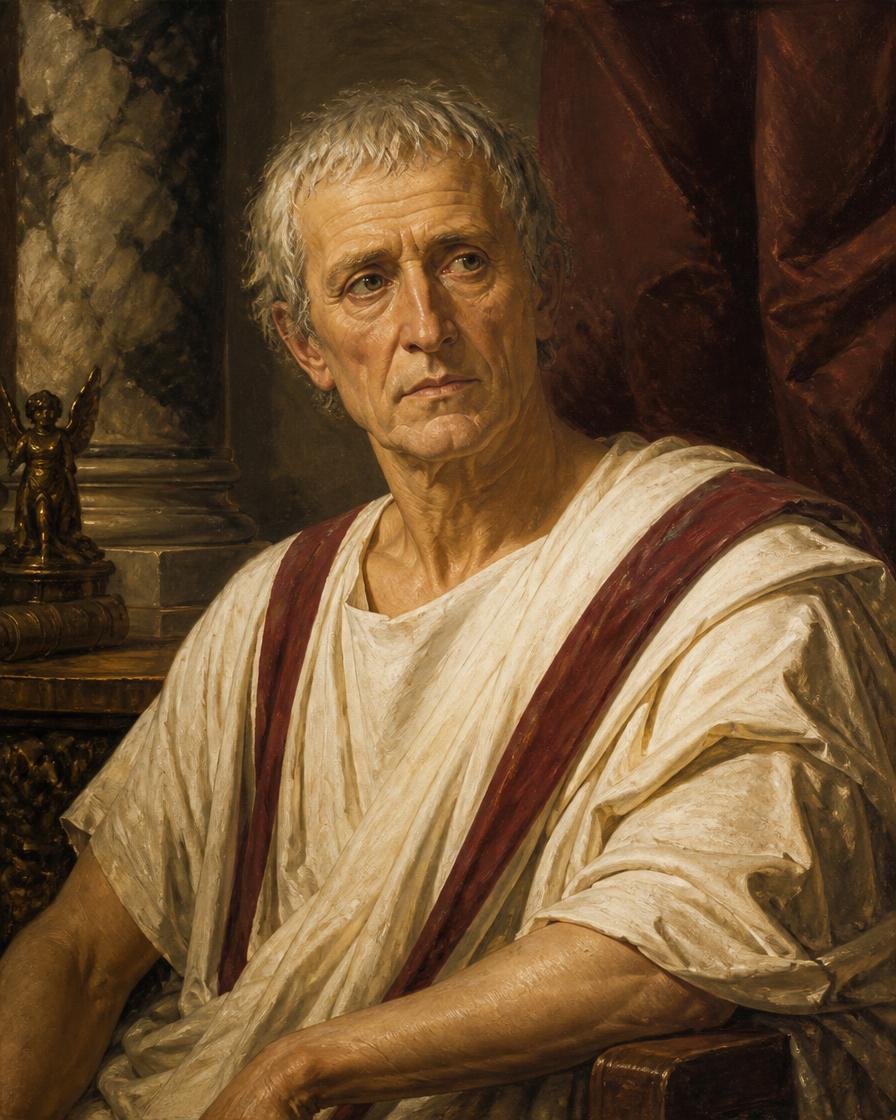
Quick Facts
- Years
- 4 BC – 65
- Category
- Philosophers & Thinkers
- Subcategory
- Stoicism
- Nationality
- Roman
- Occupation
- Stoic Philosopher, Statesman & Dramatist
Seneca
4 BC – 65 · Roman · Stoic Philosopher, Statesman & Dramatist
Audiobook

Life Lessons from Seneca
Marcus Alden · 46 min
Lucius Annaeus Seneca—usually called Seneca the Younger—was a Roman Stoic philosopher, statesman, essayist, letter writer, and dramatist. Born at Corduba in Roman Spain around 4 BCE, he rose through Rome’s political hierarchy, survived exile under Emperor Claudius, and became tutor and adviser to Nero. For several years after Nero’s accession in 54 CE, Seneca and the praetorian prefect Sextus Afranius Burrus helped guide an administration remembered for relative moderation. Seneca’s influence later declined, and Nero ordered him to die in 65 after alleging his connection to the Pisonian conspiracy.
Seneca’s greatest achievement was literary. His moral essays and Moral Letters to Lucilius translated Greek Stoic ideas into vivid Latin arguments about anger, grief, wealth, mortality, friendship, and the responsible use of time. His tragedies profoundly influenced Renaissance and early modern European drama, while his prose helped shape the Latin literary tradition.
Seneca remains compelling partly because his life exposes tensions within applied philosophy. He praised simplicity yet became extremely wealthy; condemned cruelty yet served an increasingly autocratic emperor; and defended inner freedom while participating in imperial politics. Scholars therefore study him not merely as a source of maxims, but as a complex thinker confronting fear, ambition, compromise, and death under Roman rule.
Quick Facts
| Field | Information |
|---|---|
| Full Name | Lucius Annaeus Seneca |
| Common Name(s) | Seneca; Seneca the Younger; Seneca Philosophus |
| Born | Traditionally about 4 BCE; exact year uncertain |
| Died | 65 CE |
| Age at Death | About 68–69, depending on birth date |
| Birthplace | Corduba, Hispania Baetica, Roman Empire—modern Córdoba, Spain |
| Nationality | Roman |
| Occupation | Philosopher, statesman, orator, essayist, letter writer, dramatist |
| Historical Era | Early Roman Empire; Julio-Claudian period |
| Famous For | Roman Stoicism, moral essays, letters, tragedies, and advising Nero |
| Political Affiliation | Roman Senate and imperial administration; no modern-style political party |
| Religion | Traditional Roman religious culture interpreted through Stoic philosophy |
| Education | Educated at Rome in rhetoric and philosophy, including Stoic and Pythagorean-influenced teaching |
| Parents | Seneca the Elder and Helvia |
| Spouse(s) | Pompeia Paulina; an earlier marriage is inferred but poorly documented |
| Children | At least one son from an earlier marriage, who died young; details uncertain |
| Major Works | Moral Letters to Lucilius, On Anger, On Clemency, On Benefits, On the Shortness of Life, Natural Questions, tragedies including Medea, Phaedra, and Thyestes |
| Major Achievements | Leading Latin Stoic author; imperial adviser; major influence on prose, ethics, and European drama |
Early Life
Seneca was born at Corduba in Hispania Baetica into a prosperous provincial Roman family. Ancient evidence does not establish his exact birth year, although about 4 BCE is conventional. His father, commonly known as Seneca the Elder, was an accomplished writer on rhetoric who preserved examples of Roman declamation. His mother, Helvia, came from a respectable family and was later praised by her son for her character and intellectual ability.
Seneca had two brothers. Lucius Junius Gallio Annaeanus became a senator and served as proconsul of Achaia; the New Testament’s Acts of the Apostles mentions Gallio in connection with Paul. Marcus Annaeus Mela became the father of the poet Lucan.
Taken to Rome while young, Seneca received the rhetorical education expected of an ambitious elite Roman. He also studied philosophy with several teachers. The Stoic Attalus impressed him deeply, as did Sotion, whose teaching drew upon Pythagorean traditions. Papirius Fabianus combined philosophical instruction with rhetorical skill. Seneca briefly adopted demanding practices such as abstaining from meat, although family and political considerations led him to relax some of them.
His youth coincided with Augustus’s final years and the reign of Tiberius, when monarchy operated beneath republican titles. Public advancement depended on eloquence, patronage, and caution around the imperial household. Seneca also suffered from chronic ill health, apparently involving serious respiratory difficulties. He spent a period in Egypt with an aunt whose husband was prefect there, probably to recover. The precise dates are debated, but the stay broadened his experience of the empire and helped prepare his eventual public career.
Rise to Prominence
After returning to Rome, Seneca entered public life and probably became quaestor in the 30s CE, thereby joining the Senate. His eloquence and literary talent attracted notice. According to the historian Cassius Dio, Emperor Caligula became hostile to Seneca’s success as an orator and considered having him killed; the story’s details cannot be independently confirmed. Seneca survived, perhaps because his poor health made him seem unlikely to live long.
A greater reversal came in 41. Soon after Claudius became emperor, Seneca was accused of adultery with Julia Livilla, Caligula’s sister. The Senate condemned him, and Claudius exiled him to Corsica. Whether the charge reflected genuine misconduct or court politics remains uncertain. Seneca spent roughly eight years there. He wrote consolatory works, including one addressed to his mother Helvia and another to Polybius, a powerful imperial freedman. The latter’s praise of Claudius and plea for recall have often been viewed as humiliatingly deferential.
In 49, Claudius’s wife Agrippina the Younger secured Seneca’s return. He received a praetorship and became tutor to her son Nero. When Nero succeeded Claudius in 54, Seneca occupied the center of imperial government. He drafted speeches for the young ruler and worked with Burrus to promote orderly administration and senatorial cooperation. His treatise On Clemency urged Nero to make merciful self-restraint the moral foundation of monarchy. Seneca had now become both a famous intellectual and one of Rome’s most influential political advisers.
Major Achievements
Making Stoicism a Practical Latin Philosophy
Seneca transformed Stoic ethics into direct, memorable Latin prose. Instead of constructing a fully systematic textbook, he examined ordinary moral problems: wasted time, uncontrolled anger, fear of death, grief, luxury, ingratitude, and unstable fortune.
This mattered because his works made philosophy usable beyond specialist schools. His letters often resemble conversations with a learner, while his essays employ examples from Roman social and political life. Their long-term impact reaches Christian moral writing, Renaissance humanism, early modern political thought, and present-day revivals of Stoicism.
Advising Nero’s Early Government
During Nero’s first years, Seneca and Burrus were leading advisers. Ancient accounts credit this phase with comparative restraint, although responsibility cannot be assigned neatly and Agrippina remained powerful. Seneca prepared official statements, including Nero’s accession address and, according to Tacitus, the Senate communication justifying Agrippina’s killing in 59.
His role mattered because he attempted to apply ethical counsel inside an autocratic court. On Clemency presents the ruler’s control of anger and power as essential to public security. Its enduring importance lies less in Nero’s failure to follow it than in its influential analysis of humane rulership.
Producing a Major Body of Moral Literature
Works such as On Anger, On the Shortness of Life, On Tranquillity of Mind, On Benefits, and Moral Letters to Lucilius form one of antiquity’s richest surviving ethical collections. On Benefits analyzes giving, receiving, gratitude, and social obligation; On Anger treats rage as a destructive judgment rather than an irresistible force.
These writings preserve Roman Stoicism in a distinctively personal voice. They remain central sources for understanding ancient ethics, emotional discipline, social reciprocity, and philosophical therapy.
Advancing Roman Natural Inquiry
In Natural Questions, Seneca discussed thunder, lightning, earthquakes, comets, waters, winds, and other phenomena. Some explanations are scientifically obsolete, but his aim was larger than description: investigating nature should reduce superstition and expand moral perspective.
The work mattered as part of Greco-Roman natural philosophy. It transmitted earlier theories, encouraged rational inquiry, and joined the study of the cosmos to ethical reflection about humanity’s limited place within it.
Shaping European Drama
Ten tragedies circulated under Seneca’s name, though authorship is not equally secure for all. Eight are generally accepted as his: Hercules, Trojan Women, Phoenician Women, Medea, Phaedra, Oedipus, Agamemnon, and Thyestes. Hercules on Oeta remains disputed, while Octavia is almost certainly by another author because it alludes to Nero’s death.
Senecan tragedy emphasizes intense rhetoric, revenge, tyranny, supernatural dread, and passions escaping rational control. Whether these plays were staged, recited, or designed primarily for reading remains debated. Their long-term influence was enormous, especially on Renaissance revenge tragedy and writers such as Shakespeare’s predecessors and contemporaries.
Leadership and Work
Seneca’s leadership operated through counsel, rhetoric, education, and access rather than military command. He tried to shape Nero by praising clemency, moderation, and respect for institutions. This indirect method suited an imperial system in which an adviser’s power depended entirely on the ruler’s confidence.
His strengths included intellectual range, persuasive language, administrative experience, and awareness of emotion’s political dangers. He understood that cruelty could arise from fear, vanity, and anger as well as deliberate policy. His writings repeatedly recommend pausing before acting, examining motives, and treating authority as a moral responsibility.
His weaknesses were bound to the same position. He lacked the power to enforce his advice and remained in office after Nero’s conduct became increasingly violent. Court survival required accommodation. His involvement in official messaging after Agrippina’s death illustrates how philosophical counsel could become political complicity.
Seneca’s partnership with Burrus appears to have been important. Burrus provided military and administrative authority as praetorian prefect; Seneca supplied education, speeches, and civilian counsel. After Burrus died in 62, Seneca’s influence weakened sharply. He sought permission to retire and offered to surrender his wealth, but Nero did not formally accept the entire proposal. Seneca then reduced his public activity and concentrated on writing.
Personal Life
Seneca’s best-documented wife was Pompeia Paulina, whom he portrays affectionately. Tacitus says she attempted to die alongside him in 65, but Nero ordered that she be saved. She survived the forced blood loss, reportedly remaining notably pale afterward. Evidence also suggests an earlier marriage and a son who died before Seneca’s exile, but the surviving record is fragmentary.
Family relationships mattered to him. His consolation to Helvia is both a philosophical exercise and a personal address to his grieving mother. His brother Gallio and nephew Lucan linked him to a prominent literary and political family. Lucan also died after the Pisonian conspiracy.
Seneca’s letters are addressed to Lucilius Junior, a real associate who held administrative office in Sicily. Scholars debate how extensively the surviving correspondence was revised for publication, but it should not simply be treated as spontaneous private mail.
He described recurring poor health, especially breathing attacks that he associated with death. Philosophy became, for him, a daily discipline: reading, self-examination, conversation, controlled diet, and preparation for mortality. Yet he also possessed estates and immense wealth. His personal habits therefore combined philosophical austerity with elite Roman privilege—a tension he acknowledged without fully resolving.
Philosophy and Beliefs
Seneca belonged broadly to the Stoic tradition founded by Zeno of Citium. Stoics held that virtue is the only true good and moral failure the only true evil. Wealth, illness, reputation, and even death are “indifferents”: they may be preferred or avoided, but they do not determine a person’s moral worth.
Reason should bring human judgment into harmony with nature. Seneca did not demand emotional numbness. Rather, he sought freedom from destructive passions—emotions intensified by false judgments. Grief and fear may arise, but reason can prevent them from becoming tyrannical.
Time is among his central themes. On the Shortness of Life argues that life is not inherently too short; people make it so by surrendering their days to ambition, distraction, and obligations chosen without reflection. Awareness of death should clarify priorities rather than produce despair.
Seneca defended a cosmopolitan moral outlook. Human beings share reason and belong to a wider community beyond status or nationality. He criticized cruel treatment of enslaved people and urged masters to remember shared humanity. He did not, however, demand abolition of Roman slavery, revealing the limits of his social critique.
His theology reflects Stoic ideas of divine reason, providence, fate, and an ordered cosmos, expressed within Roman religious culture. God, nature, reason, and fate can appear closely related in his language. Although later Christian readers admired him and a forged correspondence paired him with Saint Paul, Seneca was not a Christian, and the supposed letters are not authentic.
Politically, he accepted monarchy as Rome’s practical reality and sought to moralize it through clemency. His philosophy shaped his decisions by encouraging public service, but it also offered grounds for retirement when service became ethically compromised.
Challenges and Controversies
Seneca’s wealth is the most famous challenge to his credibility. Ancient sources portray him as extraordinarily rich, with extensive estates and loans. Cassius Dio connects harsh loan collection in Britain with unrest preceding Boudica’s revolt, but the account is late and its details are disputed. Critics see hypocrisy in a philosopher of simplicity accumulating such resources. Defenders answer that Stoicism permits wealth if it is honestly acquired and not treated as necessary for happiness. The unresolved question is whether Seneca lived up to his own standard of detachment.
His service to Nero creates a deeper controversy. Seneca may have restrained a dangerous ruler during the early reign, preserving lives and improving government. Conversely, his prestige helped legitimize Nero. Tacitus says Seneca drafted the message defending Agrippina’s killing. Even if he did so under pressure, the episode compromised his role as an advocate of clemency.
The Corsican exile also raises questions. The adultery allegation involving Julia Livilla cannot be verified. Seneca’s consolation to Polybius praises Claudius extravagantly, leading some readers to accuse him of servility. Others emphasize that an exile seeking return faced severe constraints and wrote within a conventional genre of petition and consolation.
Seneca’s authorship has generated debate. Octavia is regarded as non-Senecan, and Hercules on Oeta is disputed. The anonymous satire Apocolocyntosis, which mocks Claudius’s deification, is traditionally assigned to Seneca and widely treated as his, though certainty is impossible.
Finally, scholars disagree over the Pisonian conspiracy. Tacitus presents uncertain evidence connecting Seneca to the plot. He may have known more than he admitted, may have been viewed as a possible beneficiary, or may simply have offered Nero a convenient target. No secure evidence proves that he actively conspired.
Legacy
Seneca’s reputation changed repeatedly. Some ancient readers admired his moral force; others, including Quintilian, found aspects of his compressed, pointed style attractive but potentially corrupting for young writers. Early Christians valued his language about conscience, providence, and shared humanity. The forged Seneca–Paul correspondence strengthened the mistaken belief that the two men had been close.
Medieval and Renaissance scholars copied and interpreted his prose. His tragedies became models for European drama, especially revenge tragedy, ghost scenes, rhetorical monologues, and depictions of tyrannical passion. Humanists treated him as both stylist and moral teacher.
Modern readers encounter Seneca in philosophy courses, leadership studies, psychotherapy-informed discussions of emotion, and contemporary Stoic practice. His advice about time, anger, bereavement, and uncertainty remains accessible, although responsible interpretation must avoid turning historically situated arguments into context-free slogans.
Córdoba commemorates its famous Roman-born author with public monuments, including a statue near the Puerta de Almodóvar. Museums and archaeological institutions concerned with Roman Córdoba present the imperial world from which his family emerged. Universities, classical associations, and research projects continue to edit and translate his works. His strongest memorial, however, is literary: an unusually extensive body of writing that forces each generation to ask whether wisdom can survive wealth, power, fear, and compromise.
Interesting Facts
- Seneca is called “the Younger” to distinguish him from his father, Seneca the Elder.
- He was born in Roman Spain but spent most of his career at Rome.
- His brother Gallio appears in the New Testament’s Acts of the Apostles.
- The epic poet Lucan was his nephew.
- Seneca spent roughly eight years exiled on Corsica.
- Agrippina brought him back to Rome to educate Nero.
- On Clemency was addressed to Nero early in the emperor’s reign.
- His 124 surviving Moral Letters are addressed to Lucilius.
- His works repeatedly compare philosophy to medical treatment for the mind.
- He discussed earthquakes, comets, and lightning in Natural Questions.
- He opposed cruelty toward enslaved people without rejecting slavery as an institution.
- The satire Apocolocyntosis mocks Emperor Claudius’s deification and is traditionally attributed to Seneca.
- Scholars debate whether his tragedies were publicly staged or chiefly recited and read.
- Octavia, once attributed to him, was written after his death.
- He regarded anger as a judgment that could be corrected, not an unavoidable force.
- Tacitus provides the best-known narrative of Seneca’s final hours.
- Pompeia Paulina attempted to share his death but was kept alive by Nero’s order.
- A purported correspondence between Seneca and Saint Paul is a later forgery.
Famous Quotes
Translations vary; references identify the ancient work rather than claiming a unique English wording.
- “It is not that we have a short time to live, but that we waste much of it.” — On the Shortness of Life 1. Seneca introduces his argument that misused attention, not nature alone, makes life seem brief.
- “We suffer more often in imagination than in reality.” — Moral Letters 13. The line addresses anticipatory fear: imagined future pain can exceed present hardship.
- “While we are postponing, life speeds by.” — Moral Letters 1. Written while urging Lucilius to take possession of his time.
- “No one can be called happy who is beyond the reach of truth.” — On the Happy Life 5, wording dependent on translation. Happiness requires sound judgment rather than pleasant illusion.
- “The greatest remedy for anger is delay.” — On Anger 2.29. A pause allows the initial impulse to be examined before it becomes action.
- “Wherever there is a human being, there is an opportunity for kindness.” — On the Happy Life 24. Seneca connects virtue with service to others.
- “I am not born for one corner; the whole world is my native land.” — Moral Letters 28. The statement expresses Stoic cosmopolitanism.
- “He who is brave is free.” — Moral Letters 85. Moral courage frees a person from domination by fear and fortune.
- “We should conduct ourselves not as if we ought to live for the body, but as if we could not live without it.” — Moral Letters 14. The body deserves care without becoming life’s supreme value.
- “The wise person is self-sufficient, yet desires friends.” — Moral Letters 9. Independence does not eliminate affection or community.
The popular phrase “Luck is what happens when preparation meets opportunity” is frequently attributed to Seneca, but no secure passage in his surviving works matches it; the attribution should be treated as disputed or spurious.
Timeline
- c. 4 BCE — Born at Corduba in Hispania Baetica; exact year uncertain.
- Early 1st century CE — Taken to Rome and educated in rhetoric and philosophy.
- c. 20s CE — Spends time in Egypt, probably for health reasons, with his aunt’s household.
- c. 31 CE — Returns to Rome and begins advancing in public life; chronology is approximate.
- 30s CE — Serves as quaestor and enters the Senate.
- 41 CE — Accused of adultery with Julia Livilla and exiled to Corsica.
- 41–49 CE — Writes during exile, including consolations associated with Helvia and Polybius.
- 49 CE — Recalled through Agrippina’s influence, appointed praetor, and made Nero’s tutor.
- 54 CE — Nero becomes emperor; Seneca becomes a principal adviser.
- c. 55–56 CE — Composes On Clemency for Nero.
- 59 CE — Agrippina is killed; Seneca reportedly drafts Nero’s explanatory communication to the Senate.
- 62 CE — Burrus dies; Seneca’s political influence declines, and he seeks retirement.
- c. 62–65 CE — Writes or completes major later works, including the Moral Letters and Natural Questions.
- 65 CE — Implicated in the Pisonian conspiracy and ordered by Nero to die.
Frequently Asked Questions
Who was Seneca?
Seneca the Younger was a Roman philosopher, politician, writer, and dramatist of the first century CE. He is one of the principal surviving authors of Roman Stoicism. Born in Corduba and educated at Rome, he became a senator, endured exile under Claudius, and later served as Nero’s tutor and adviser. His essays and letters examine how reason and virtue can guide people through anger, grief, wealth, illness, political danger, and death.
When and where was Seneca born?
He was born at Corduba in Hispania Baetica, now Córdoba in southern Spain. His birth is conventionally dated to about 4 BCE, but ancient evidence does not establish an exact year. His family belonged to the prosperous Roman provincial elite and had strong cultural ambitions. Although Spanish by birthplace in modern geographical terms, Seneca was a Roman citizen whose education, career, and literary language placed him firmly within the Roman imperial establishment.
Why is he called Seneca the Younger?
The label distinguishes him from his father, Lucius Annaeus Seneca, known as Seneca the Elder. The elder Seneca wrote about Roman rhetoric and declamation and preserved valuable material concerning famous speakers. Ancient naming practices and repeated family names can cause confusion, so later scholars adopted the convenient descriptions “Elder” and “Younger.” Seneca the Younger was the philosopher and adviser to Nero; his father was the rhetorical author.
Was Seneca really Nero’s teacher?
Yes. Agrippina the Younger arranged Seneca’s recall from exile in 49 CE and appointed him to educate her son Nero. When Nero became emperor in 54, Seneca’s role expanded from tutor to senior adviser and speechwriter. Together with Burrus, he influenced the early government. How much authority Seneca actually exercised is uncertain because imperial decisions involved Nero, his family, advisers, freedmen, soldiers, and the Senate.
What is Stoicism in Seneca’s writings?
For Seneca, Stoicism teaches that virtue—excellent rational and moral character—is the only secure good. External conditions such as money, status, health, and longevity do not guarantee happiness. People should examine judgments that produce destructive fear, anger, or craving and learn to live in agreement with nature and reason. Seneca presents this not as instant serenity but as continuing moral training by an imperfect person making progress.
What are Seneca’s most important works?
His most widely read works include the Moral Letters to Lucilius, On Anger, On the Shortness of Life, On Clemency, On Benefits, and On Tranquillity of Mind. Natural Questions joins scientific inquiry with ethical reflection. His tragedies include Medea, Phaedra, Oedipus, and Thyestes. Dating many works precisely is difficult, and not every text transmitted under his name is authentic.
Why was Seneca exiled?
In 41 CE, Seneca was accused of adultery with Julia Livilla, a sister of Caligula, and sent to Corsica. The accusation arose amid upheaval after Claudius’s accession. Ancient evidence does not allow historians to determine whether an affair occurred or whether the charge was politically motivated. He remained exiled until 49, when Agrippina secured his recall and made him tutor to Nero.
Was Seneca a hypocrite because he was wealthy?
That judgment remains contested. Seneca accumulated immense wealth while urging detachment from luxury. Critics, ancient and modern, see a serious contradiction between his teachings and conduct. Seneca’s defense was Stoic: wealth is not evil if acquired and used properly, and a wise person can possess it without depending upon it. Yet whether his fortune was ethically obtained and genuinely held with detachment cannot be settled from the surviving evidence.
Did Seneca support Nero’s crimes?
Seneca did not openly advocate Nero’s later tyranny, and he probably tried to restrain the emperor. Nevertheless, he remained a leading servant of the regime and helped communicate its policies. Most troublingly, Tacitus reports that he drafted the Senate letter used to justify Agrippina’s death. Some historians stress coercion and his limited options; others argue that his continued service made him morally complicit. Both restraint and compromise belong to an honest assessment.
Why did Nero order Seneca’s death?
After the Pisonian conspiracy was uncovered in 65 CE, Nero ordered Seneca to die. Tacitus’s account suggests that evidence against him was ambiguous. Seneca may have had contact with conspirators or may have been viewed as a potential alternative figure, but active participation is unproven. Nero also had reasons to distrust a wealthy, famous former adviser. In Roman elite practice, the order allowed Seneca to take his own life rather than undergo public execution.
How did Seneca die?
According to Tacitus, Seneca opened his veins after receiving Nero’s command. Because blood flowed slowly, he also took poison and entered a warm bath. The account is literary and shaped by Roman traditions of exemplary death, but it remains the principal source. His wife Paulina attempted to die with him; Nero ordered her wounds bound, and she survived. Seneca reportedly dictated final thoughts, though Tacitus says these were already well known and does not reproduce them.
Did Seneca meet Saint Paul?
There is no reliable evidence that they met. Seneca’s brother Gallio encountered a legal case involving Paul in Corinth, according to Acts, which made later readers imagine a direct connection. A collection of letters supposedly exchanged between Seneca and Paul circulated in late antiquity, but scholars recognize it as forged. Similarities between Stoic and Christian moral language reflect overlapping ethical concerns, not proof of personal contact or conversion.
Did Seneca oppose slavery?
Seneca criticized arrogant and cruel treatment of enslaved people, especially in Moral Letters 47. He reminded slaveholders that fortune could reverse status and that enslaved people shared the same human nature. This was morally significant within an intensely hierarchical society. However, he did not call for abolition and continued to inhabit a slave-owning social order. His position was humanitarian and cosmopolitan but limited by ancient assumptions.
Are all plays attributed to Seneca authentic?
No. Eight tragedies are generally accepted as Senecan, although scholars debate dates, performance conditions, and details of composition. Hercules on Oeta has disputed authorship. Octavia, a historical drama about Nero’s first wife, cannot be Seneca’s because it refers prophetically to events after his death, including Nero’s downfall. The surviving tragic collection therefore reflects both Seneca’s work and later transmission under his prestigious name.
Were Seneca’s letters real correspondence?
Lucilius was a real person, and the letters adopt the form of an ongoing exchange. Most scholars nevertheless regard the collection as carefully composed literature intended for broader readership, perhaps using genuine correspondence as a foundation. The sequence develops philosophical themes and constructs both writer and recipient as moral learners. Calling the letters literary does not make them insincere; it recognizes deliberate revision, arrangement, and publication.
What did Seneca believe about death?
Seneca regarded death as natural and neither morally good nor evil in itself. Fear of death enslaves people to rulers, illness, and fortune; rehearsing mortality can therefore support freedom. He did not treat life as worthless. Rather, its value depended on living honorably, not merely living long. His repeated discussion of suicide must be understood within Roman Stoicism and ancient political coercion, not applied casually to modern mental-health situations.
Why is Seneca still relevant?
His writings address problems that remain recognizable: distraction, anger, anxiety, grief, status competition, political compromise, and uncertainty. He offers concrete practices such as reviewing one’s conduct, delaying angry reactions, distinguishing controllable judgments from external events, and remembering that time is finite. His contradictions also matter. They prevent his philosophy from becoming simplistic self-help and invite scrutiny of how ethical ideals function amid privilege and power.
Lessons We Can Learn
- Protect time deliberately. In On the Shortness of Life, Seneca argues that unexamined commitments consume life. Today, calendars and attention should reflect chosen priorities rather than constant reaction.
- Delay anger before acting. On Anger recommends postponement as a remedy. A pause before sending a message or making a decision can prevent lasting harm.
- Examine imagined fears. Seneca observed that anticipation often magnifies suffering. Testing predictions against evidence remains useful in stressful personal and professional situations.
- Treat status as unstable. His exile and recall showed how quickly imperial favor changed. Modern titles and reputations likewise should not become the foundation of identity.
- Use power with restraint. On Clemency urged Nero to measure leadership by self-control. Authority today is strongest when accountability limits impulse and retaliation.
- Value shared humanity. His appeal for humane treatment of enslaved people challenged elite contempt, even if it stopped short of abolition. Ethical progress begins by questioning normalized dehumanization.
- Accept correction as part of growth. Seneca presents himself as a learner, not a completed sage. Improvement is more realistic when imperfection is acknowledged without becoming an excuse.
- Study nature to gain perspective. Natural Questions links inquiry with humility. Evidence-based curiosity can reduce superstition and place immediate troubles in a wider frame.
- Beware compromise near power. Service under Nero gave Seneca influence but implicated him in the regime. Access can achieve good while gradually weakening moral independence.
- Judge teachings alongside conduct. Seneca’s wealth complicates his praise of simplicity. Modern readers should assess both the strength of an argument and the example set by its advocate.
Related Historical Figures
- Seneca the Elder — Seneca’s father, a writer on rhetoric whose educational interests shaped the family’s literary culture.
- Helvia — His mother and the recipient of a philosophical consolation written during his exile.
- Nero — Seneca’s pupil, emperor, and later persecutor; their relationship defines the political drama of his career.
- Agrippina the Younger — Nero’s mother, who recalled Seneca from exile and installed him as tutor.
- Sextus Afranius Burrus — Praetorian prefect and Seneca’s principal partner in advising the early Neronian government.
- Claudius — Emperor who exiled Seneca; later the target of the satire traditionally attributed to him.
- Julia Livilla — Imperial woman with whom Seneca was accused of adultery, causing his Corsican exile.
- Lucan — Seneca’s nephew, a major epic poet who also died in the aftermath of the Pisonian conspiracy.
- Gallio — Seneca’s brother, senator, and proconsul known from both Roman history and the New Testament.
- Epictetus — A later Roman Stoic whose teachings provide an important comparison with Seneca’s approach to freedom, judgment, and external circumstances.
Watch and Learn
PHILOSOPHY - The Stoics · The School of Life
Related Historical Figures