Quick Facts
- Years
- 1856 – 1939
- Category
- Philosophers & Thinkers
- Nationality
- Austrian; later British
- Occupation
- Neurologist and founder of psychoanalysis
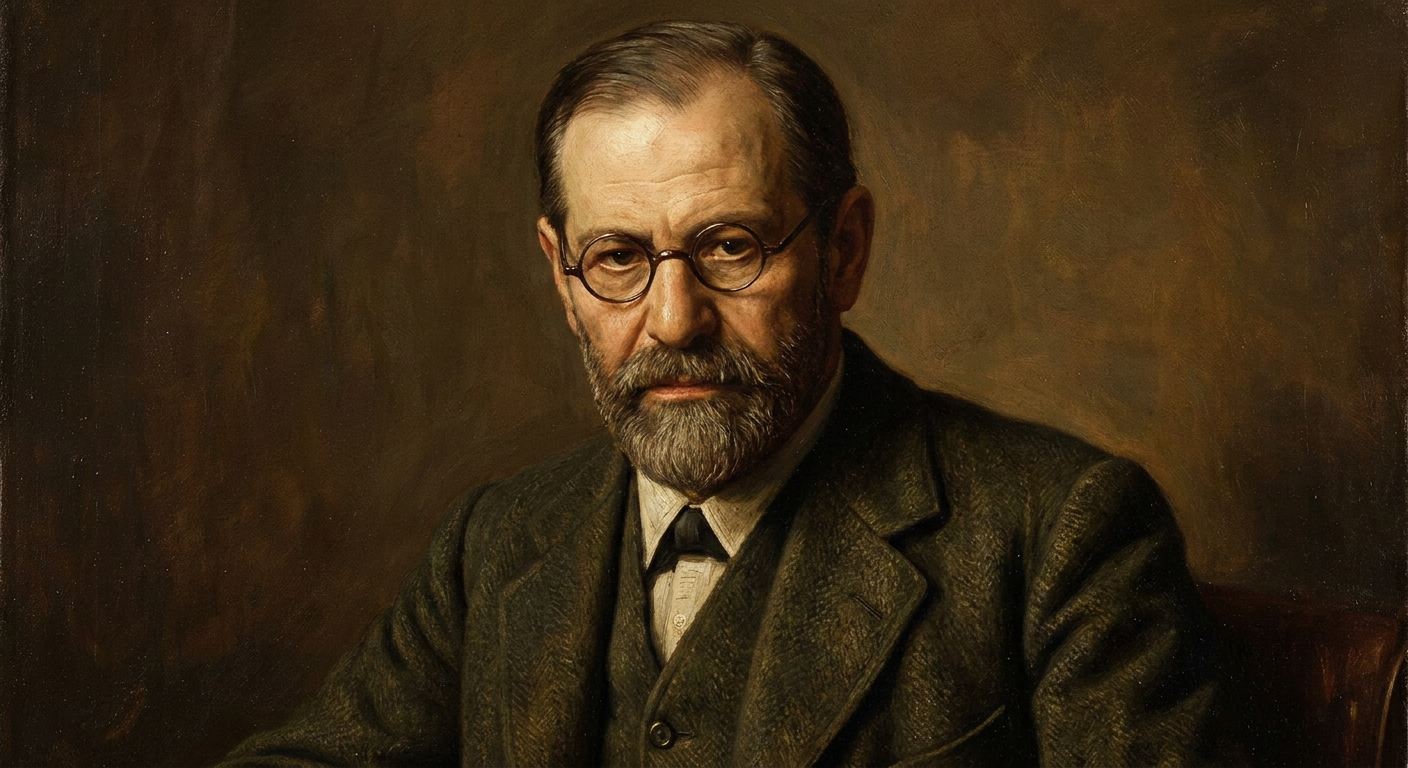
Sigmund Freud
1856 – 1939 · Austrian; later British · Neurologist and founder of psychoanalysis
Recommended Audiobooks
Listen next from Marcus Alden

Life Lessons from Aristotle
Marcus Alden · 51 min

Life Lessons from Plato
Marcus Alden · 46 min
Sigmund Freud changed how millions of people understood the human mind. An Austrian neurologist who founded psychoanalysis, he argued that much of mental life occurs outside conscious awareness and that dreams, slips of speech, symptoms and fantasies can reveal hidden conflicts. His methods—especially free association, close attention to childhood and the extended analysis of individual patients—helped establish the modern practice of psychotherapy.
Freud was not the first thinker to discuss unconscious motives, sexuality or psychological conflict. His achievement was to combine such ideas into an ambitious system and build an international movement around it. Works including The Interpretation of Dreams, Three Essays on the Theory of Sexuality and Civilization and Its Discontents influenced medicine, literature, art, philosophy and popular culture.
His reputation remains deeply contested. Supporters credit him with making private suffering discussable and treating patients as people whose words mattered. Critics argue that many of his theories were difficult to test, shaped by restrictive assumptions about gender and based on a narrow collection of cases. Some of his clinical reports have also been challenged by later research.
Freud therefore matters not because every claim he made proved correct, but because he transformed the questions asked about memory, desire, childhood and identity. Studying him reveals both the creative power and the dangers of building a far-reaching theory of human nature.
Quick Facts
| Field | Details |
|---|---|
| Full Name | Sigismund Schlomo Freud; he later used Sigmund Freud |
| Common Name(s) | Sigmund Freud; Freud |
| Born | 6 May 1856 |
| Died | 23 September 1939 |
| Age at Death | 83 |
| Birthplace | Freiberg in Mähren, Austrian Empire, now Příbor, Czech Republic |
| Nationality | Austrian; became a British subject after settling in Britain |
| Occupation | Neurologist, psychoanalyst, author and lecturer |
| Historical Era | Late nineteenth and early twentieth centuries |
| Famous For | Founding psychoanalysis; theories of the unconscious, dreams, repression and personality |
| Political Affiliation | No lasting party affiliation; broadly liberal in outlook but politically cautious |
| Religion | Born into a Jewish family; personally atheist and critical of organized religion |
| Education | University of Vienna, medical degree, 1881 |
| Parents | Jakob Freud and Amalia Nathansohn Freud |
| Spouse(s) | Martha Bernays, married 1886 |
| Children | Mathilde, Jean-Martin, Oliver, Ernst, Sophie and Anna Freud |
| Major Works | The Interpretation of Dreams, The Psychopathology of Everyday Life, Three Essays on the Theory of Sexuality, Beyond the Pleasure Principle, The Ego and the Id, Civilization and Its Discontents |
| Major Achievements | Founded psychoanalysis, developed free association, created an influential model of unconscious conflict and helped establish talking therapy |
Early Life
Freud was born in 1856 in Freiberg, a Moravian textile town within the Austrian Empire. His father, Jakob, was a wool merchant who had children from an earlier marriage. Freud's mother, Amalia, was considerably younger than Jakob and gave birth to eight children, seven of whom survived infancy. This unusual family structure meant that Freud grew up with nephews close to his own age and half-brothers old enough to be his father.
Economic difficulties encouraged the family to leave Freiberg. After a brief stay in Leipzig, they settled in Vienna in 1860. The imperial capital offered cultural and educational opportunities, but its Jewish population also faced legal barriers and persistent antisemitism. Those experiences helped shape Freud's identity as an outsider, although historians disagree over how directly they influenced individual theories.
A talented pupil, Freud attended the Leopoldstädter Kommunal-Realgymnasium and performed especially well in languages and classical subjects. He later learned or read several languages, including Latin, Greek, English, French and Italian. In 1873 he entered the University of Vienna to study medicine.
His education proceeded slowly because he was drawn toward laboratory research rather than immediate medical practice. Under physiologist Ernst Wilhelm von Brücke, Freud studied the nervous systems of animals and absorbed a scientific outlook that sought physical explanations for biological events. He also worked with the anatomist and psychiatrist Theodor Meynert.
Freud received his medical degree in 1881. Financial necessity—and his wish to marry Martha Bernays—eventually led him away from poorly paid laboratory work and toward clinical medicine. His early training as a neurologist remained important: psychoanalysis emerged from medicine, even though it later moved far beyond conventional neurology.
Rise to Prominence
In 1882 Freud began working at Vienna General Hospital. He served in several departments, studied neurological disorders and published research on conditions such as aphasia and cerebral palsy. During this period he also investigated cocaine. He correctly recognized some of its anesthetic and stimulating effects, but promoted it too enthusiastically and failed to appreciate its addictive dangers. Ophthalmologist Carl Koller, drawing on related discussions and experiments, achieved recognition for introducing cocaine as a local anesthetic in eye surgery.
A decisive opportunity came in 1885, when Freud received funding to study in Paris with the celebrated neurologist Jean-Martin Charcot. At the Salpêtrière hospital, Charcot used hypnosis while investigating hysteria—symptoms such as paralysis or seizures that appeared without an identifiable organic injury. Freud became convinced that psychological events could produce genuine bodily symptoms.
After returning to Vienna, he married Martha Bernays in September 1886 and opened a private neurological practice. He initially used hypnosis and methods learned from his older colleague Josef Breuer. Breuer had treated Bertha Pappenheim, presented under the pseudonym “Anna O.,” by encouraging her to describe emotionally charged experiences.
Freud and Breuer published Studies on Hysteria in 1895. Their collaboration soon broke down over theoretical and personal differences, particularly Freud's growing emphasis on sexuality. Freud gradually replaced hypnosis with free association, asking patients to report thoughts without deliberate censorship.
In 1896 he began calling his approach “psychoanalysis.” He initially proposed that hysteria commonly resulted from actual childhood sexual abuse, a position known as the seduction theory. By the late 1890s he had abandoned that general explanation and increasingly emphasized childhood fantasy, desire and unconscious conflict. Scholars continue to debate why he changed his mind and whether he underestimated real abuse.
Freud's intensive self-analysis, especially after his father's death in 1896, contributed to his ideas about dreams and childhood attachment. The Interpretation of Dreams appeared in November 1899 but carried a 1900 publication date. Sales were initially slow, yet the book eventually became his defining work.
Recognition grew through a small Vienna discussion circle begun in 1902. In 1909 Freud, Carl Jung and Sándor Ferenczi lectured at Clark University in Massachusetts. The visit gave psychoanalysis international visibility and marked Freud's arrival as a major intellectual figure.
Major Achievements
Founding psychoanalysis
Freud created a systematic method for exploring emotional distress through sustained conversation. Patients were encouraged to associate freely while the analyst listened for recurring themes, resistance and emotional displacement. This mattered because treatment centered on meaning and personal history rather than confinement, punishment or purely physical intervention.
Modern psychotherapy does not simply reproduce Freud's technique, but many forms retain his premise that a confidential therapeutic relationship can help people recognize patterns they do not fully understand.
Developing a theory of unconscious conflict
Freud argued that conscious intentions represent only part of mental life. Unacceptable wishes, fears and memories may be repressed yet continue to influence behavior. He did not invent the concept of the unconscious, but he made it central to a detailed psychology.
Research in cognitive science supports the broad idea that much mental processing is unconscious. It does not, however, confirm Freud's entire model of repression, symbolism or instinctual conflict.
Reinterpreting dreams and everyday errors
In The Interpretation of Dreams, Freud distinguished a dream's remembered story from its proposed latent meaning. In The Psychopathology of Everyday Life, he argued that forgetting names and slips of speech could sometimes express concealed concerns.
These ideas encouraged serious attention to ordinary mental life. Yet the claim that particular symbols possess predictable hidden meanings remains difficult to verify, and contemporary sleep science explains dreams through several competing biological and psychological models.
Emphasizing childhood development
Freud described childhood as emotionally and sexually significant rather than innocent in a simple sense. His psychosexual stage theory and Oedipus complex became famous, but neither is accepted as a universal scientific account today.
His broader insistence that early relationships can shape adult personality had greater durability. Attachment theory, developmental psychology and trauma research developed through different evidence and should not be treated as direct confirmation of Freud, though they share attention to childhood experience.
Building an international movement
The Vienna Psychoanalytic Society emerged from Freud's early discussion group, and the International Psychoanalytical Association was founded in 1910. Freud attracted prominent followers, including Jung, Ferenczi, Karl Abraham, Ernest Jones and his daughter Anna.
The movement created institutes, training systems and journals. It also suffered damaging disputes. Alfred Adler and Jung established independent schools after rejecting important Freudian claims. These divisions demonstrated both Freud's organizational success and his difficulty tolerating challenges to psychoanalytic orthodoxy.
Extending psychology into culture
Freud applied psychoanalytic ideas to religion, art, mythology, war and civilization. In Civilization and Its Discontents, he argued that social order requires people to restrain powerful desires, creating an unavoidable tension between individual gratification and communal life.
Such cultural works were speculative rather than experimental, but they profoundly influenced twentieth-century debates about authority, aggression and modern identity.
Leadership or Work
Freud worked with extraordinary discipline. He saw patients for much of the day, wrote late into the evening and maintained a huge international correspondence. His consulting room used the now-famous couch, while Freud sat outside the patient's direct line of sight. He believed this arrangement encouraged free speech and reduced pressure to respond to the analyst's expressions.
He listened for resistance, repetition, dreams and transference—the redirection toward the analyst of feelings formed in earlier relationships. Freud regarded transference as both an obstacle and an essential source of insight.
As a movement leader, he could be persuasive, generous and intellectually stimulating. He helped colleagues, promoted institutions and revised his theories over time. He was also protective of his authority. Disagreements with Adler, Jung and others became personal as well as theoretical, and dissenters often left the movement.
His greatest working strength was his ability to connect clinical observation, literature and broad theories. His central weakness was a tendency to treat interpretation as evidence. Because the analyst could explain disagreement as resistance, some propositions became hard to disprove.
Personal Life
Freud became engaged to Martha Bernays in 1882. During their four-year engagement they exchanged hundreds of letters. They married in 1886 and had six children. Martha managed a large household, while her unmarried sister Minna Bernays lived with the family for many years.
Claims that Freud and Minna had a sexual relationship remain disputed. Carl Jung repeated the allegation, and a hotel register shows that Freud and Minna once traveled together, but no conclusive evidence establishes an affair.
Freud was closely attached to several family members. The death of his daughter Sophie during the influenza era in 1920, and the death of Sophie's young son Heinz in 1923, caused profound grief. His youngest daughter, Anna Freud, became a leading psychoanalyst specializing in children and served as an important colleague and caregiver.
Freud enjoyed archaeology, literature, walking and collecting antiquities. Objects from ancient Egypt, Greece, Rome and Asia crowded his consulting room. He saw archaeology as a metaphor for analysis: buried layers of the past could be uncovered and interpreted.
He smoked cigars heavily. In 1923 he was diagnosed with cancer of the jaw or palate. He underwent more than thirty procedures and used a painful prosthesis, yet continued seeing patients and writing. His chow dogs, especially Jofi, were familiar companions during his later years.
Philosophy or Beliefs
Freud described himself as a “godless Jew.” He rejected religious belief but retained a strong Jewish cultural identity, intensified by antisemitism and by loyalty to Jewish intellectual organizations. In The Future of an Illusion, he interpreted religion as a human creation answering wishes for protection and order.
Politically, Freud was generally liberal, skeptical of mass enthusiasm and wary of utopian promises. He did not formulate a democratic political program, and his social outlook sometimes reflected the assumptions of Vienna's educated bourgeois class.
His worldview was psychologically pessimistic. Human beings, he argued, possess aggressive and sexual impulses that cannot be completely harmonized with civilization. After the First World War, he introduced the controversial concept of a death drive to account for repetition, destructiveness and aggression.
Freud valued truth-seeking, intellectual independence and the reduction of self-deception. Nevertheless, critics contend that his clinical methods did not always meet those ideals because interpretations could be imposed by an authoritative analyst. His ethical significance therefore lies partly in the questions he opened and partly in the standards later practitioners developed in response to his limitations.
Challenges and Controversies
Freud's scientific standing is the central controversy surrounding him. Philosopher Karl Popper argued that psychoanalysis was difficult to falsify: almost any response could be interpreted as confirming the theory. Other scholars maintain that selected psychoanalytic claims can be studied empirically, while distinguishing them from Freud's larger system.
His case histories were literary and theoretically influential, but they were not controlled clinical studies. Later archival research has raised questions about whether some outcomes were presented too positively. The identity and treatment history of patients including “Dora,” the “Rat Man” and the “Wolf Man” have been repeatedly reassessed.
Freud's views on women have drawn extensive criticism. Concepts such as “penis envy” and his descriptions of female development treated male anatomy and experience as the norm. Some historians note that he listened seriously to women and opened sexual subjects excluded from polite discussion. Others argue that his framework translated social inequality into supposed biological psychology. Both points can be true without making his specific theories scientifically valid.
His emphasis on sexuality challenged Victorian convention but could become reductive. Adler emphasized social striving, while Jung rejected Freud's narrow understanding of libido and developed analytical psychology.
Freud's early cocaine advocacy was a genuine error. Cocaine later contributed to the addiction and deteriorating health of his friend Ernst von Fleischl-Marxow. Freud was not solely responsible, but the episode exposed the risks of premature medical enthusiasm.
The abandonment of the seduction theory remains especially sensitive. One interpretation is that Freud responsibly revised an unsupported universal claim. Another is that he retreated from patients' reports of abuse and converted real events into fantasies. Surviving records do not support a simple verdict for every case.
Finally, psychoanalytic organizations sometimes developed rigid hierarchies around Freud. Admirers see necessary defense of a new discipline; critics see dogmatism. Modern historical judgment generally recognizes Freud as a transformative thinker without accepting him as an infallible scientist.
Legacy
Freud permanently altered the language of selfhood. Terms such as ego, repression, denial, fixation, unconscious and Freudian slip entered everyday speech, often with meanings different from his technical usage. Novelists, filmmakers, artists and critics adopted psychoanalytic interpretations of symbols, family conflict and desire.
His medical legacy is mixed but substantial. Classical psychoanalysis declined relative to medication, cognitive behavioral therapy and shorter treatments, yet psychodynamic therapies remain practiced and researched. Ideas concerning defense mechanisms, therapeutic relationships and recurring interpersonal patterns continue in modified forms.
Freud's London home at 20 Maresfield Gardens is now the Freud Museum London. It preserves his couch, library and antiquities. His former Vienna premises at Berggasse 19 house the Sigmund Freud Museum. The Freud Museum in Příbor commemorates his birthplace, while psychoanalytic institutes across the world continue training and scholarship.
The Nazis burned his books in 1933. After Germany annexed Austria in March 1938, Freud's home and publishing organization were searched, and his daughter Anna was interrogated by the Gestapo. With international assistance—and after financial exactions imposed by the regime—the family escaped to London in June.
Freud died there in 1939. His physician Max Schur administered morphine during his final agony, in accordance with an earlier understanding between them. Scholars commonly describe this as physician-assisted relief that hastened death, although historical terminology and ethical interpretation vary.
Today Freud is studied simultaneously as clinician, institution-builder, cultural critic and controversial theorist. Few researchers accept his complete system, but few accounts of modern psychology and culture can ignore him.
Interesting Facts
- Freud was born Sigismund and adopted the shorter form Sigmund as a young man.
- His birthplace is now in the Czech Republic, though it belonged to the Austrian Empire in 1856.
- He began professionally as a laboratory researcher and neurologist, not as a psychiatrist.
- His early scientific work included research on eels and crayfish nervous systems.
- He translated some of John Stuart Mill's writings into German.
- His Paris studies with Charcot helped redirect him toward psychological explanations of symptoms.
- The Interpretation of Dreams was published in 1899 but dated 1900 by the publisher.
- Freud analyzed many of his own dreams while developing psychoanalysis.
- The Wednesday Psychological Society originally met in his Vienna home.
- Composer Gustav Mahler consulted Freud during a long walk in Leiden in 1910.
- Freud visited the United States only once, for the 1909 Clark University lectures.
- He kept hundreds of archaeological objects in his consulting room.
- He often compared psychoanalysis to excavating a buried city.
- His daughter Anna became an internationally important child psychoanalyst.
- Heavy cigar smoking contributed to decades of severe illness and repeated surgery.
- His distinctive couch was a gift from a patient, Madame Benvenisti.
- He received the Goethe Prize in 1930 for his literary and intellectual work.
- He signed the Gestapo's required departure statement with an ironic additional sentence praising its treatment; the exact circumstances complicate retellings of the episode.
- His ashes and those of Martha were placed in an ancient Greek urn at Golders Green Crematorium.
Famous Quotes
- “The interpretation of dreams is the royal road to a knowledge of the unconscious activities of the mind.” — The Interpretation of Dreams. Freud meant that dreams offered privileged access to disguised conflict.
- “The ego is not master in its own house.” — “A Difficulty in the Path of Psycho-Analysis.” The line summarizes his claim that conscious intention does not control the whole mind.
- “Where id was, there ego shall be.” — New Introductory Lectures on Psycho-Analysis. English translations vary; Freud described analysis as expanding reflective control where instinct and conflict had dominated.
- “The voice of the intellect is a soft one, but it does not rest until it has gained a hearing.” — The Future of an Illusion. It expresses cautious confidence in reason rather than immediate optimism.
- “Religion would thus be the universal obsessional neurosis of humanity.” — The Future of an Illusion. This reflects Freud's controversial psychological interpretation of religion.
- “Civilized society is perpetually menaced with disintegration through this primary hostility of men towards one another.” — Civilization and Its Discontents. Freud argued that aggression threatens social cooperation.
- “A man should not strive to eliminate his complexes but to get into accord with them.” — Recorded in Freud's 1927 interview with George Sylvester Viereck. The context stresses management rather than complete removal of conflict.
- “Sometimes a cigar is just a cigar.” — Frequently attributed to Freud, but no reliable primary source has been found. It should be treated as apocryphal, despite neatly warning against overinterpretation.
- “Love and work are the cornerstones of our humanness.” — Widely attributed to Freud, but the exact wording lacks secure documentation. It may paraphrase ideas associated with his clinical outlook rather than quote a surviving text.
Timeline
- 1856 — Born in Freiberg in Mähren on 6 May.
- 1860 — Freud's family settles in Vienna.
- 1873 — Enters the University of Vienna.
- 1881 — Receives his medical degree.
- 1882 — Begins hospital work and becomes engaged to Martha Bernays.
- 1884 — Publishes on cocaine and advocates its medical use.
- 1885–1886 — Studies with Charcot in Paris.
- 1886 — Marries Martha and opens a private practice in Vienna.
- 1895 — Publishes Studies on Hysteria with Josef Breuer.
- 1896 — Uses the term “psychoanalysis”; his father dies.
- 1897 — Undertakes an intensive self-analysis.
- 1900 — The Interpretation of Dreams appears under its official publication date.
- 1902 — The Wednesday discussion group begins meeting regularly.
- 1905 — Publishes the “Dora” case, Three Essays on the Theory of Sexuality and his study of jokes.
- 1908 — First international psychoanalytic congress meets in Salzburg.
- 1909 — Lectures at Clark University in the United States.
- 1910 — International Psychoanalytical Association is founded.
- 1911 — Break with Alfred Adler becomes formal.
- 1913 — Breaks with Carl Jung; publishes Totem and Taboo.
- 1920 — Publishes Beyond the Pleasure Principle; daughter Sophie dies.
- 1923 — Publishes The Ego and the Id and is diagnosed with cancer.
- 1927 — Publishes The Future of an Illusion.
- 1930 — Publishes Civilization and Its Discontents and receives the Goethe Prize.
- 1933 — Nazis publicly burn Freud's books in Germany.
- 1938 — Flees Nazi-occupied Vienna and settles in London.
- 1939 — Dies in London on 23 September.
Frequently Asked Questions
1. What is Sigmund Freud best known for?
Freud is best known as the founder of psychoanalysis, a method of treatment and a theory of mind centered on unconscious conflict. He argued that symptoms could express wishes, fears and memories excluded from awareness. His techniques included free association, dream interpretation and analysis of transference. Many specific theories—particularly his universal sexual stages and symbolic interpretations—remain disputed or unsupported. Nevertheless, his focus on hidden motives, childhood experience and sustained therapeutic conversation changed psychology, psychiatry and modern culture.
2. Did Freud discover the unconscious?
No. Philosophers, physicians and writers had discussed unconscious mental activity long before Freud. Thinkers such as Leibniz, Schopenhauer and Nietzsche, along with nineteenth-century researchers of hypnosis, developed related ideas. Freud's importance lies in constructing an extensive clinical theory around unconscious conflict and creating techniques intended to investigate it. Modern psychology confirms that much information processing occurs outside awareness, but this does not automatically verify Freud's dynamic unconscious, in which repressed wishes seek disguised expression.
3. What is psychoanalysis?
Psychoanalysis is both a theory of psychological development and an intensive form of talking treatment. Classical patients met an analyst several times weekly, associated freely and examined dreams, resistance and feelings toward the analyst. The goal was insight into recurring unconscious conflicts rather than rapid symptom management. Contemporary psychoanalysis contains many schools and does not always follow Freud closely. Less intensive psychodynamic therapies draw on related concepts while using shorter treatment, face-to-face conversation and modern research methods.
4. What did Freud mean by id, ego and superego?
In Freud's later structural model, the id represented instinctual pressures seeking satisfaction. The ego negotiated among those pressures, external reality and moral demands. The superego embodied internalized prohibitions, ideals and conscience. These were not physical brain regions or separate personalities, but theoretical descriptions of mental functions and conflict. They remain useful metaphors for some clinicians and cultural commentators, although neuroscience has not identified them as distinct biological systems.
5. What was Freud's theory of dreams?
Freud proposed that dreams often fulfill wishes in disguised form. He distinguished the manifest content—the remembered narrative—from latent thoughts supposedly transformed through condensation, displacement and symbolism. The theory encouraged careful attention to a dreamer's personal associations rather than relying solely on fixed symbol dictionaries. Contemporary dream research offers multiple explanations involving memory, emotion and brain activity. Evidence does not establish Freud's wish-fulfillment theory as a universal account, though dreams can clearly reflect personal concerns.
6. What is a Freudian slip?
A Freudian slip is an error in speech, memory or action interpreted as revealing a hidden concern. Freud called such events parapraxes and discussed them in The Psychopathology of Everyday Life. Some mistakes may indeed be influenced by expectation, emotion or competing thoughts. Others result from fatigue, attention failure or ordinary language processing. The popular assumption that every slip exposes a secret desire goes beyond what evidence can support and risks turning a suggestive possibility into a certainty.
7. Was Freud a psychiatrist?
Freud was medically trained and specialized in neurology. He worked with patients experiencing nervous and psychological symptoms before psychiatry assumed its modern form. Calling him a psychiatrist is understandable in general discussion, but “neurologist and psychoanalyst” is more historically precise. He founded a treatment movement that eventually influenced psychiatry, especially in Europe and the United States, where psychoanalytic approaches became powerful during the mid-twentieth century.
8. Why did Freud emphasize sexuality?
Freud used sexuality broadly to describe pleasure-seeking energies beginning in childhood, not merely adult intercourse. He believed conflicts around desire were frequently repressed because social conventions made them difficult to acknowledge. This emphasis challenged the respectable culture of his era and helped make sexuality discussable. Critics argue that he overgeneralized from selected patients and interpreted many forms of distress through one framework. Later analysts broadened motivation to include attachment, social relations, identity and interpersonal security.
9. What was the Oedipus complex?
Freud proposed that young children experience an unconscious pattern of desire for one parent and rivalry with the other, naming it after the Greek figure Oedipus. He treated its resolution as important to personality and conscience. The theory became culturally famous but lacks strong evidence as a universal developmental stage. Family attachment, jealousy and rivalry are real phenomena, yet they vary widely across individuals and cultures and do not require Freud's specific sexual interpretation.
10. Did Freud cure his patients?
The record is mixed and often uncertain. Freud reported insights and improvements in influential case histories, but his accounts were not controlled outcome studies. Archival research suggests that some patients continued to struggle or received additional treatment. It would therefore be inaccurate to say that he consistently cured them. His historical influence came less from demonstrated success rates than from creating a new method of listening and a framework for discussing psychological symptoms.
11. Why did Freud and Carl Jung separate?
Freud initially viewed Jung as an important successor who could broaden psychoanalysis beyond its Viennese Jewish circle. Their relationship deteriorated because Jung rejected Freud's dominant emphasis on sexuality and developed different concepts of libido, symbolism and the unconscious. Personal rivalry and disputes over authority intensified the theoretical conflict. By 1913 their break was effectively complete. Jung subsequently founded analytical psychology, emphasizing archetypes, myth and a collective unconscious.
12. Was Freud religious?
Freud was born into a Jewish family and strongly identified with Jewish history and culture, especially amid European antisemitism. He did not believe in God and criticized organized religion as an illusion rooted in wishes for protection. He compared religion to a collective neurosis, a judgment many religious thinkers rejected. His identity therefore combined atheism with cultural Jewishness; describing him simply as either religious or detached from Judaism misses that distinction.
13. Why did Freud leave Vienna?
Nazi Germany annexed Austria in March 1938. As a Jewish public intellectual, Freud faced immediate danger. Nazi authorities searched his premises, seized assets and interrogated Anna Freud. International supporters, particularly Marie Bonaparte and Ernest Jones, helped secure permission for the family to leave after complex negotiations and payments. Freud arrived in London in June 1938. Four of his elderly sisters, unable to escape, were later murdered during the Holocaust.
14. How did Freud die?
Freud suffered from cancer in his mouth and jaw for sixteen years, enduring repeated surgery, pain and difficulty eating or speaking. In September 1939, with his condition terminal, he reminded physician Max Schur of their agreement not to prolong unbearable suffering. Schur administered morphine in repeated doses, and Freud died on 23 September. Historians generally accept that the medication hastened his death, while differing over the most appropriate modern ethical label.
15. Are Freud's theories still accepted?
Freud's complete theoretical system is not accepted as a scientific consensus. Psychologists generally reject universal psychosexual stages, many symbolic claims and theories that cannot be reliably tested. However, modified ideas about unconscious processes, defenses, early relationships, emotional conflict and therapeutic interaction remain influential. Modern findings should not be presented as simple proof of Freud because they often use different definitions and methods. His strongest continuing status is as a foundational, provocative and historically transformative thinker.
16. What is Freud's relevance today?
Freud remains relevant whenever people discuss hidden motives, childhood influence, self-deception or the meaning of symptoms. Psychodynamic clinicians continue to develop evidence-based treatments partly descended from psychoanalysis. Humanities scholars use Freud to interpret literature, cinema and social life, often critically. He also offers a lesson in scientific caution: an imaginative theory can expose neglected problems while still containing assumptions that later evidence fails to support.
Lessons We Can Learn
- Listen closely to personal experience. Freud's case-based practice treated speech as meaningful. Modern interpretation should add safeguards against assuming the listener always knows best.
- Childhood deserves serious attention. Freud challenged indifference toward early emotional life. Current developmental evidence supports childhood's importance without validating every Freudian stage.
- Conscious intentions are incomplete guides. His work highlighted motives outside awareness. Today this is better treated as a research question than an excuse for untestable interpretation.
- Revise theories when evidence creates difficulty. Freud repeatedly altered his models. His changes show flexibility, although the seduction-theory controversy demonstrates that revision also requires transparency.
- Intellectual movements need room for dissent. Breaks with Adler and Jung show how personal authority can intensify theoretical disagreement. Healthy institutions protect rigorous criticism.
- Medical enthusiasm requires caution. Freud's cocaine advocacy illustrates the danger of recommending treatments before risks are understood.
- Language can transform public discussion. By naming repression, conflict and transference, Freud made difficult experiences easier to discuss, even when his definitions were disputed.
- Case studies inspire but do not prove universal laws. Freud's narratives generated hypotheses, yet individual examples cannot establish claims about everyone.
- Culture shapes theories. His assumptions about gender and family reflected nineteenth-century Vienna. Modern readers should examine how their own settings likewise influence judgment.
- Creative influence and factual correctness are different. Freud's enormous cultural impact does not make every theory true, while rejected claims do not erase his historical importance.
Related Historical Figures
- Josef Breuer — Collaborated with Freud on Studies on Hysteria and helped shape the early talking method.
- Jean-Martin Charcot — Parisian neurologist whose work on hypnosis and hysteria strongly influenced Freud.
- Carl Jung — Early ally and intended successor who broke with Freud and founded analytical psychology.
- Alfred Adler — Former member of Freud's circle who created individual psychology after rejecting Freudian priorities.
- Sándor Ferenczi — Hungarian psychoanalyst, close collaborator and important innovator in therapeutic technique.
- Anna Freud — Freud's daughter, caregiver and leading theorist of child analysis and defense mechanisms.
- Melanie Klein — Developed an influential school of child psychoanalysis that sometimes conflicted with Anna Freud's approach.
- Ernest Jones — British psychoanalyst, organizer, biographer and key figure in Freud's escape from Austria.
- Marie Bonaparte — Psychoanalyst and patron whose money and connections assisted the Freud family's departure from Vienna.
- Ivan Pavlov — Contemporary investigator of conditioned behavior whose experimental approach contrasted with Freud's interpretive method.
Watch and Learn
“History vs. Sigmund Freud” — TED-Ed — approximately 6 minutes. This concise animated lesson presents both Freud's historical importance and the strongest criticisms of his theories. It is recommended as an accessible starting point because it avoids treating him either as an unquestioned genius or as a figure whose influence can simply be dismissed.
Watch and Learn
History vs. Sigmund Freud · TED-Ed
Related Historical Figures