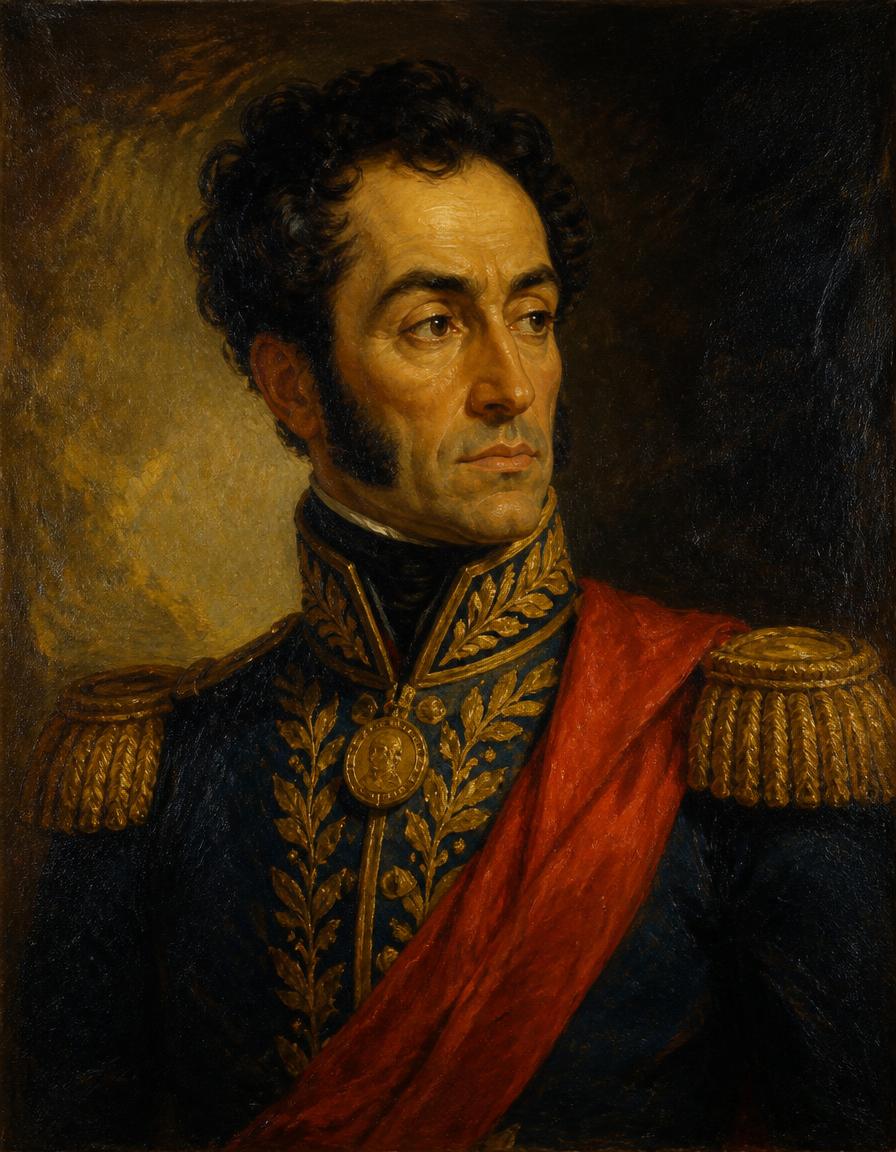
Quick Facts
- Years
- 1783 – 1830
- Category
- World Leaders & Revolutionaries
- Nationality
- Venezuelan
- Occupation
- Revolutionary Leader
Simón Bolívar
1783 – 1830 · Venezuelan · Revolutionary Leader
Audiobook

Life Lessons from Simon Bolivar
Marcus Alden · 55 min
Simón Bolívar (1783–1830) was a Venezuelan revolutionary commander, political thinker, and statesman whose campaigns transformed northern South America. Known as El Libertador, he became the central military and political figure in the independence of present-day Venezuela, Colombia, Ecuador, Panama, Bolivia, and, alongside José de San Martín and Antonio José de Sucre, Peru. Few individuals played so extensive a role in dismantling Spanish rule in the Americas.
Bolívar’s importance extends beyond battlefield victories. He attempted to replace the Spanish Empire with durable republics, promoted continental cooperation, and helped create Gran Colombia and Bolivia. His writings—including the Cartagena Manifesto, Jamaica Letter, and Angostura Address—examined liberty, political order, social divisions, and the difficulties facing newly independent states.
His record was also deeply contradictory. Bolívar defended republican independence and took important steps against slavery, yet concentrated executive authority, authorized severe wartime measures, and grew skeptical of federalism and unrestricted democracy. Gran Colombia disintegrated, and he died politically isolated before completing his vision of American unity.
Bolívar remains important because his life raises enduring questions: how should revolutions balance liberty and order, how can divided societies form stable states, and when does emergency leadership become authoritarian? Revered, criticized, and repeatedly appropriated by later movements, he remains one of Latin America’s most studied historical figures.
Quick Facts
| Field | Information |
|---|---|
| Full Name | Simón José Antonio de la Santísima Trinidad Bolívar y Palacios Ponte-Andrade y Blanco |
| Common Name(s) | Simón Bolívar; El Libertador; the Liberator |
| Born | 24 July 1783 |
| Died | 17 December 1830 |
| Age at Death | 47 |
| Birthplace | Caracas, Captaincy General of Venezuela, Spanish Empire |
| Nationality | Venezuelan; historically also associated with Gran Colombia |
| Occupation | Revolutionary leader, military commander, statesman, political writer |
| Historical Era | Spanish American wars of independence |
| Famous For | Leading independence campaigns across northern South America |
| Political Affiliation | Spanish American patriot and republican; no modern political party affiliation |
| Religion | Raised Roman Catholic; his personal outlook also reflected Enlightenment influences |
| Education | Private tutors; military instruction; study and travel in Europe; no completed university degree |
| Parents | Juan Vicente Bolívar y Ponte; María de la Concepción Palacios y Blanco |
| Spouse(s) | María Teresa Rodríguez del Toro y Alayza (married 1802; died 1803) |
| Children | No acknowledged legitimate children |
| Major Works | Cartagena Manifesto; Decree of War to the Death; Jamaica Letter; Angostura Address; Bolivian Constitution of 1826 |
| Major Achievements | Liberation campaigns in Venezuela, New Granada, Ecuador, and Peru; creation of Gran Colombia; foundation of Bolivia; Congress of Panama |
Early Life
Bolívar was born in Caracas into a wealthy creole family of Basque ancestry. Creoles were American-born people of European descent who often possessed land and social status but were excluded from many of the Spanish monarchy’s highest offices. The Bolívar family’s wealth came from estates, urban property, mines, and enslaved labor—an important contradiction in the later liberator’s life.
His father died in 1786 and his mother in 1792. Orphaned before age nine, Bolívar passed among relatives and guardians. His sisters María Antonia and Juana and brother Juan Vicente survived into adulthood. Family disputes shaped his childhood, and he briefly resisted living with his uncle Carlos Palacios.
Bolívar received private education rather than following a continuous institutional course. The most famous of his teachers was Simón Rodríguez, an unconventional educator influenced by Enlightenment thought. Rodríguez encouraged independent judgment and introduced Bolívar to ideas associated with Rousseau and European reform. Andrés Bello, later a major humanist and jurist, also taught him. Military instruction began early; Bolívar entered a militia unit associated with his family as a teenager.
In 1799 he traveled to Spain to continue his education. In Madrid he moved within aristocratic circles and met María Teresa Rodríguez del Toro y Alayza. They married in 1802 and returned to Venezuela, but she died of yellow fever in January 1803. Bolívar later described this loss as decisive, saying that had she lived, his life might have followed a domestic rather than revolutionary path.
Returning to Europe, Bolívar visited France and Italy. He observed Napoleon Bonaparte’s rise, admired his talent, and recoiled from his imperial self-coronation. According to Bolívar’s later recollection, he vowed in Rome in 1805 not to rest until Spanish America was free. Historians accept the journey and his growing commitment, although the vow’s exact later wording cannot be independently verified.
Rise to Prominence
The crisis of the Spanish monarchy created Bolívar’s political opening. Napoleon invaded Spain in 1808 and forced the Bourbon monarchs from power. Across Spanish America, disputes erupted over who could legitimately govern in the king’s absence.
On 19 April 1810, Caracas leaders displaced the captain general and established a junta. Bolívar joined the patriot cause and traveled with Luis López Méndez and Andrés Bello on a diplomatic mission to Britain. London did not recognize Venezuelan independence, but Bolívar helped persuade the veteran revolutionary Francisco de Miranda to return home.
Venezuela declared independence on 5 July 1811. The First Republic soon faced royalist resistance, economic disruption, political division, and a devastating earthquake in March 1812. Miranda capitulated in July. Bolívar participated in Miranda’s arrest at La Guaira, believing him a traitor; Spanish authorities later sent Miranda to prison, where he died. The episode became one of the most controversial of Bolívar’s career.
Exiled in New Granada, Bolívar wrote the Cartagena Manifesto, attributing Venezuela’s collapse partly to federal weakness and poor military coordination. New Granadan authorities entrusted him with troops. His victories opened the route to Venezuela, and the Admirable Campaign of 1813 carried him triumphantly into Caracas, where he received the title Libertador.
Success proved temporary. Bolívar’s Decree of War to the Death intensified an already brutal conflict, while royalist commander José Tomás Boves mobilized plainsmen and marginalized groups alienated from the creole republic. The Second Republic collapsed in 1814. Bolívar endured exile in Jamaica and Haiti before returning with crucial Haitian assistance and a broader political strategy.
Major Achievements
Rebuilding the Venezuelan Independence Movement
After repeated defeats, Bolívar established a durable patriot base in the Orinoco region. The capture of Angostura gave the movement access to river communications, livestock country, foreign volunteers, and printing facilities. At the Congress of Angostura in 1819, he presented a constitutional program and secured political support for a union of Venezuela and New Granada.
This mattered because the struggle became more than a sequence of coastal rebellions. Bolívar built institutions, widened recruitment, and recognized the need to appeal to enslaved people, free people of color, and llanero cavalrymen. The resulting coalition was imperfect but more socially and militarily viable.
Liberation of New Granada
In 1819 Bolívar led an extraordinary march from the Venezuelan plains across flooded country and the high Andes. The campaign culminated in the Battle of Boyacá on 7 August, where patriot forces broke the royalist defense of Bogotá.
Boyacá delivered New Granada’s treasury, population, and strategic depth to the independence movement. It made the projected Republic of Colombia—usually called Gran Colombia by historians—practical rather than merely aspirational. The campaign remains a classic example of strategic surprise and operational endurance.
Victory at Carabobo
On 24 June 1821 Bolívar defeated the principal royalist army in Venezuela at Carabobo. The battle did not end every royalist stronghold immediately, but it secured most of Venezuela and opened the way to the liberation of Caracas.
Carabobo became Venezuela’s foundational military victory. It also demonstrated Bolívar’s ability to coordinate infantry, cavalry, foreign volunteers, and regional commanders within a larger campaign.
Creation of Gran Colombia
The Congress of Cúcuta formally organized the Republic of Colombia in 1821, joining Venezuela and New Granada; Panama entered after declaring independence from Spain, and Quito was incorporated following liberation. Bolívar became president and Francisco de Paula Santander vice president.
The union was intended to provide military strength, international credibility, and resistance to European intervention. Although Gran Colombia dissolved by 1831, its creation powerfully influenced later dreams of Latin American integration.
Liberation of Quito and Peru
Antonio José de Sucre, Bolívar’s trusted lieutenant, won the Battle of Pichincha in 1822, securing Quito. That year Bolívar met Argentine liberator José de San Martín at Guayaquil. Their private discussions were not fully recorded, so explanations for San Martín’s subsequent withdrawal remain debated.
Bolívar then entered Peru, where political fragmentation and royalist armies threatened independence. His forces won at Junín in August 1824, and Sucre achieved the decisive victory at Ayacucho in December. Ayacucho effectively destroyed Spain’s major field power in continental South America.
Foundation of Bolivia
Upper Peru became an independent republic in 1825 and adopted the name Bolivia in Bolívar’s honor. Bolívar drafted a constitution featuring a president for life who could nominate a successor, balanced by other institutions.
Supporters considered the design a safeguard against anarchy; critics saw a disguised monarchy. The constitution had limited durability, but Bolivia’s foundation secured a new sovereign state and demonstrated Bolívar’s continental prestige.
Congress of Panama
Bolívar called the Congress of Panama in 1826 to promote cooperation among Spanish American republics. Delegates discussed defense, arbitration, and confederation, but attendance was incomplete and the resulting treaty achieved little practical force.
Even so, the congress became an early precedent for Pan-American and Latin American international organization. Its limited results also exposed the obstacles Bolívar faced: distance, mistrust, competing national interests, and foreign pressure.
Leadership and Work
Bolívar led through personal energy, persuasive writing, daring movement, and an ability to recover after catastrophe. He endured exile, defeat, illness, and political betrayal without abandoning independence. He could identify strategic centers—Bogotá in 1819, for example—and accept enormous physical risks to reach them.
His leadership depended on talented associates. Sucre supplied military skill and loyalty; Santander organized administration and finance in New Granada; José Antonio Páez commanded indispensable llanero forces. Bolívar inspired these men but struggled when their regional interests diverged from his centralizing vision.
He was an effective propagandist and political analyst. Proclamations framed independence as a continental struggle, while private correspondence coordinated armies and governments over great distances. He worked rapidly, often dictating letters while traveling.
Bolívar’s strongest values were independence, civic glory, unity, and public order. Yet his methods could be severe. He increasingly favored centralized government, emergency powers, and strong executives because he believed weak institutions would produce civil war. His critics argued that these solutions undermined the liberty he claimed to defend.
His strengths included resilience, strategic imagination, personal courage, adaptability, and continental vision. His weaknesses included impatience, political centralization, occasional vindictiveness, and an underestimation of regional identities. He was more successful at defeating imperial armies than at reconciling the societies that victory brought together.
Personal Life
Bolívar’s marriage to María Teresa lasted less than a year. He never remarried and had no acknowledged legitimate children. Claims about unrecognized descendants exist, but conclusive documentation is lacking.
His most famous later relationship was with Manuela Sáenz, an Ecuadorian-born independence activist whom he met in Quito in 1822. Sáenz was politically engaged in her own right, assisted the patriot cause, preserved documents, and helped Bolívar escape an assassination attempt in Bogotá in September 1828. She became known as the “Liberator of the Liberator.”
Bolívar formed intense friendships but also suffered bitter ruptures. Sucre was perhaps the associate he trusted most. His partnership with Santander deteriorated over constitutional questions, military policy, and the 1828 conspiracy. Bolívar commuted Santander’s death sentence to exile, but their relationship never recovered.
Contemporaries described Bolívar as slight, energetic, restless, charismatic, and capable of great charm. He was an excellent horseman and dancer, enjoyed social gatherings, and tolerated exhausting travel. His habits were often austere during campaigns, despite his elite upbringing.
Years of campaigning damaged his health. He experienced recurrent fevers, exhaustion, and respiratory illness. He died near Santa Marta in 1830 after a prolonged decline, conventionally diagnosed as tuberculosis. Modern retrospective diagnoses have been proposed, but none can be proven with certainty.
Philosophy and Beliefs
Bolívar drew from classical republicanism, Enlightenment political thought, British constitutional practice, and the experience of Spanish colonial rule. He defended national sovereignty and rejected hereditary imperial government. At the same time, he did not believe institutions could simply be copied from the United States or Europe.
In the Jamaica Letter of 1815, he analyzed the diversity of Spanish America and predicted different political futures for its regions. In the Angostura Address of 1819, he argued that laws must fit a people’s history, customs, education, and social conditions.
His republicanism emphasized civic virtue and education, but it was not consistently democratic by modern standards. He feared faction, military rebellion, and what he called anarchy. Proposals such as a hereditary senate at Angostura and a lifetime presidency in Bolivia reflected his search for stability.
Bolívar’s position on slavery evolved. Born into a slaveholding family, he initially moved cautiously. Haiti’s president Alexandre Pétion aided him on the understanding that emancipation would accompany liberation. Bolívar issued emancipation decrees in 1816 and repeatedly urged abolition, but slavery survived in several successor states after his death. His record therefore combines genuine antislavery action with political compromises and the limitations of implementation.
Raised Catholic, Bolívar used religious language and operated in overwhelmingly Catholic societies. Yet his political reasoning was strongly secular and Enlightenment-influenced. He opposed clerical resistance to independence but did not seek to erase Catholicism from public life.
Challenges and Controversies
Bolívar’s wars were exceptionally violent. The 1813 Decree of War to the Death threatened Spaniards and Canary Islanders who did not actively support independence while promising safety to Americans, even if they had opposed the patriot cause. Defenders view it in the context of royalist atrocities and a desperate civil war; critics regard it as collective punishment that escalated ethnicized violence. Bolívar proclaimed regularization of the conflict in 1820 after an armistice and war-regulation agreement with Spanish commander Pablo Morillo.
His role in Francisco de Miranda’s arrest remains disputed morally, though the basic event is established. Bolívar and others believed Miranda’s capitulation endangered the revolution. Critics argue that surrendering the movement’s pioneer to men who delivered him into Spanish custody was an act of betrayal.
Bolívar also authorized severe measures during the Peruvian campaigns. The execution of royalist prisoners and coercive requisitions have attracted criticism, even as historians stress the logistical desperation and norms of a brutal war. Context explains such acts but does not remove their human cost.
His relationship with democratic government deteriorated in the late 1820s. Faced with rebellion and constitutional deadlock, Bolívar assumed dictatorial powers in Gran Colombia in 1828. He abolished the vice presidency and governed by decree. Supporters saw temporary emergency rule; opponents saw confirmation of monarchical ambition.
The prosecution following the September 1828 assassination attempt was controversial. Admiral José Prudencio Padilla was executed despite uncertain involvement, and Santander received a death sentence before Bolívar commuted it. These actions deepened political polarization.
Gran Colombia’s collapse was Bolívar’s greatest political failure. Venezuela and Ecuador resisted rule from Bogotá, while centralists and federalists disagreed over taxation, representation, and military authority. Some scholars emphasize structural obstacles—geography, weak communications, regional economies—while others assign greater responsibility to Bolívar’s inflexibility and prolonged absence on campaign.
Modern praise can also obscure the contributions of Indigenous people, enslaved and free Black soldiers, women, local guerrillas, and other commanders. Independence was not the achievement of one heroic man, even though Bolívar played an exceptional coordinating role.
Legacy
Bolívar’s campaigns ended Spanish imperial control across much of northern and western South America. The countries most directly associated with him remain sovereign, and Bolivia still bears his name. His ideas about regional unity influenced later projects ranging from diplomatic congresses to twentieth- and twenty-first-century integration movements.
His political legacy is contested. Liberals have celebrated the destroyer of monarchy; conservatives have admired his insistence on order; socialists and anti-imperialists have invoked his continental sovereignty. Governments of very different ideologies have called themselves Bolivarian, often selecting only parts of his thought.
His remains are housed in Venezuela’s National Pantheon in Caracas, after being transferred from Santa Marta in 1842; since 2013 they have rested in an adjoining mausoleum. The Casa Natal del Libertador and Museo Bolivariano preserve sites and collections in Caracas. The Quinta de San Pedro Alejandrino near Santa Marta marks the place of his death.
Monuments to Bolívar stand across Latin America and in cities including Washington, Paris, London, Madrid, and Rome. Numerous plazas, universities, municipalities, currencies, military units, and public institutions bear his name. Venezuela’s official name, the Bolivarian Republic of Venezuela, reflects his continuing symbolic importance.
Historians still study Bolívar because neither heroic worship nor simple condemnation adequately explains him. He was simultaneously an emancipator, a member of the colonial elite, a republican, a wartime authoritarian, a visionary of unity, and a state-builder whose largest union failed.
Interesting Facts
- Bolívar lost both parents before his ninth birthday.
- His family owned estates and enslaved laborers.
- His wife died about eight months after their wedding.
- He never remarried.
- He received the title Libertador during the 1813 campaign.
- His 1819 army crossed the Andes during an exceptionally difficult rainy-season campaign.
- Gran Colombia included present-day Colombia, Venezuela, Ecuador, and Panama.
- Bolivia took its name from Bolívar in 1825.
- Bolívar and José de San Martín met privately at Guayaquil in 1822.
- No complete record of their private conversation survives.
- Haiti supplied Bolívar with arms, transport, volunteers, and refuge.
- He proposed a lifetime presidency in the Bolivian Constitution.
- Manuela Sáenz helped him escape assassination in 1828.
- Bolívar resigned the presidency of Gran Colombia in 1830.
- He planned to leave for Europe but died before sailing.
- His remains were transferred from Colombia to Caracas in 1842.
- He wrote thousands of letters and political documents.
- The Venezuelan bolívar currency was named for him.
Famous Quotes
“I have been chosen by fate to break your chains.”
From Bolívar’s 1813 proclamation to Venezuelans during the Admirable Campaign. It presents liberation as a personal mission, while also revealing his heroic political style.
“Our hatred has no bounds, and the war shall be to the death.”
From the Decree of War to the Death (1813). The line captures the conflict’s ferocity and remains evidence of Bolívar’s harshest wartime policy.
“I desire more than anyone else to see America fashioned into the greatest nation in the world.”
From the Jamaica Letter (1815), in common English translation. Bolívar was imagining regional greatness, though not necessarily a single centralized state encompassing all Spanish America.
“We are neither Indians nor Europeans, but a species midway between the legitimate proprietors of this country and the Spanish usurpers.”
From the Jamaica Letter. Its dated language expressed the creole dilemma while inadequately representing the continent’s many identities.
“The most perfect system of government is that which produces the greatest possible sum of happiness, the greatest sum of social security, and the greatest sum of political stability.”
From the Angostura Address (1819). It summarizes Bolívar’s attempt to balance welfare, liberty, and order.
“Moral and enlightenment are our first necessities.”
From the Angostura Address, also translated as “Morals and education are our primary needs.” Bolívar considered civic education essential to republican survival.
“Nothing is so dangerous as to allow one citizen to remain in power for a long time.”
From the Angostura Address. The warning is notable because Bolívar later accepted prolonged and dictatorial authority, illustrating tension between principle and practice.
“The continuation of authority in the same individual has frequently been the end of democratic governments.”
Also from the Angostura Address. Bolívar warned that citizens could become accustomed to obedience and rulers to command.
“The United States appears destined by Providence to plague America with misery in the name of liberty.”
From an 1829 letter to British diplomat Patrick Campbell, in widely used translation. It reflected anxiety about expanding United States power, not a complete theory of future relations.
“He who serves a revolution ploughs the sea.”
From Bolívar’s reported final-period correspondence and recollections, usually rendered from “El que sirve una revolución ara en el mar.” The wording is well attested in the documentary tradition, though translations and precise contextual presentation vary. It expresses his despair over Gran Colombia’s collapse.
Timeline
- 1783 — Born in Caracas on 24 July.
- 1786 — His father dies.
- 1792 — His mother dies, leaving him orphaned.
- 1799 — Travels to Spain for education.
- 1802 — Marries María Teresa Rodríguez del Toro and returns to Venezuela.
- 1803 — María Teresa dies of yellow fever.
- 1804–1807 — Travels in Europe and deepens his political education.
- 1805 — Traditionally associated with his revolutionary vow in Rome.
- 1810 — Joins the Caracas movement and diplomatic mission to London.
- 1811 — Venezuela declares independence.
- 1812 — First Republic falls; Bolívar goes to New Granada and writes the Cartagena Manifesto.
- 1813 — Leads the Admirable Campaign, issues the War to the Death decree, and enters Caracas as Libertador.
- 1814 — Second Republic collapses.
- 1815 — Exiled in Jamaica; writes the Jamaica Letter.
- 1816 — Returns with Haitian support and issues emancipation measures.
- 1817 — Patriot forces establish themselves at Angostura.
- 1819 — Delivers the Angostura Address, crosses the Andes, wins Boyacá, and promotes creation of Colombia.
- 1820 — Signs armistice and war-regulation agreements with Pablo Morillo.
- 1821 — Wins Carabobo; Congress of Cúcuta organizes Gran Colombia.
- 1822 — Sucre wins Pichincha; Bolívar meets San Martín at Guayaquil and meets Manuela Sáenz.
- 1823 — Assumes leadership in Peru.
- 1824 — Patriot victory at Junín; Sucre wins Ayacucho.
- 1825 — Upper Peru becomes Bolivia.
- 1826 — Congress of Panama meets; Bolivian Constitution is promulgated.
- 1827 — Returns to Bogotá amid growing Gran Colombian conflict.
- 1828 — Convention of Ocaña fails; Bolívar assumes dictatorial authority and survives an assassination attempt.
- 1829 — War with Peru ends; separatist pressures intensify.
- 1830 — Resigns, Sucre is assassinated, Gran Colombia fragments, and Bolívar dies near Santa Marta on 17 December.
- 1842 — His remains are transferred to Caracas.
Frequently Asked Questions
Who was Simón Bolívar?
Simón Bolívar was a Venezuelan-born revolutionary commander and statesman who led major campaigns against Spanish rule in northern South America. He served as the principal political leader of Gran Colombia and helped secure independence for territories now forming Venezuela, Colombia, Ecuador, Panama, Bolivia, and Peru. His role differed by country, and he worked with many other commanders, especially Antonio José de Sucre. Bolívar also wrote influential political texts addressing republican government, unity, slavery, and the dangers of instability.
Why was Bolívar called El Libertador?
The title means “the Liberator.” The municipal authorities of Caracas formally honored Bolívar with it in 1813 after the Admirable Campaign restored patriot government. He embraced the title, which became central to his public identity throughout Spanish America. It recognized military liberation rather than undisputed political success: Venezuela was soon lost again, and years of warfare remained. The title nevertheless endured because his later campaigns helped turn the temporary triumph of 1813 into continental independence.
Which countries did Bolívar liberate?
Bolívar was central to independence in present-day Venezuela, Colombia, Ecuador, Panama, Peru, and Bolivia. Saying he single-handedly “liberated six countries,” however, oversimplifies a collective process. Sucre commanded decisive campaigns in Ecuador and at Ayacucho; local armies and political movements fought in every region; San Martín’s southern campaign was essential in Peru; and Panama declared independence before joining Gran Colombia. Bolívar’s distinctive achievement was coordinating armies and political projects across several territories.
What was Gran Colombia?
Gran Colombia is the historians’ name for the Republic of Colombia established from 1819 and constitutionally organized in 1821. It encompassed most of present-day Colombia, Venezuela, Ecuador, and Panama, along with smaller areas now belonging to neighboring states. Bolívar hoped the union would possess enough strength to defend independence and command international respect. Regional rivalry, constitutional conflict, financial strain, poor communications, and resentment of centralized rule caused it to fragment around 1830.
Did Bolívar abolish slavery?
Bolívar issued emancipation decrees in 1816, recruited enslaved men with promises of freedom, and later urged legislatures to abolish slavery. Haitian president Alexandre Pétion’s support strongly influenced this policy. Yet Bolívar did not achieve immediate, universal abolition. Legislatures protected property claims, military needs shaped implementation, and gradual emancipation systems continued after independence. Slavery ended at different dates in the successor republics. It is accurate to call Bolívar an increasingly committed advocate of abolition, but inaccurate to claim that he alone abolished slavery everywhere he led.
Was Bolívar a dictator?
At certain moments, yes in the institutional sense: Bolívar exercised extraordinary or dictatorial authority, most notably in Gran Colombia after 1828. He argued that emergency powers were necessary to prevent fragmentation and civil war. He remained a republican who rejected royal titles, but his lifetime-presidency proposal and centralized rule led opponents to accuse him of seeking monarchy under another name. Historians therefore distinguish his anticolonial republican goals from his increasingly authoritarian governing methods.
What happened between Bolívar and Francisco de Miranda?
After the First Venezuelan Republic collapsed in 1812, Miranda signed a capitulation with Spanish commander Domingo de Monteverde. Bolívar and several other officers arrested Miranda at La Guaira, apparently believing he intended to flee and had betrayed the cause. Miranda was handed to local authorities and ultimately transported to a Spanish prison, where he died. Bolívar escaped with a passport issued under the restored regime. Whether his motives were principled, self-protective, or both remains debated.
Why was the Battle of Boyacá important?
Boyacá, fought on 7 August 1819, secured Bogotá and much of New Granada for the patriot cause. Bolívar’s army had crossed difficult plains and Andean passes to surprise royalist forces. The victory supplied money, recruits, territory, and administrative resources that the Venezuelan movement had lacked. It also made Gran Colombia possible and shifted the regional balance decisively toward independence. Boyacá was strategically more important than its scale alone might suggest.
What was Bolívar’s relationship with Haiti?
Haiti provided Bolívar refuge and crucial military assistance after his failures in Venezuela. President Alexandre Pétion supplied arms, ammunition, ships, and volunteers, while asking Bolívar to free enslaved people in territories he liberated. Bolívar issued emancipation decrees after returning in 1816. Haiti’s contribution was long minimized in elite-centered narratives, but modern scholarship emphasizes that the first independent Black republic played a major role in reviving the mainland independence movement.
What happened at the Guayaquil meeting?
Bolívar and José de San Martín met in Guayaquil on 26–27 July 1822. They discussed Peru, military cooperation, and Guayaquil’s political future. Because they met privately and left no jointly approved transcript, their exact exchange is uncertain. Soon afterward San Martín withdrew from Peru and public life, leaving Bolívar’s coalition to complete the war. Historians debate whether political incompatibility, inadequate resources, personal calculation, or San Martín’s willingness to step aside best explains the outcome.
Who was Manuela Sáenz?
Manuela Sáenz was an Ecuadorian independence activist, political participant, and Bolívar’s long-term partner after they met in 1822. She gathered intelligence, supported patriot networks, wore military dress on some occasions, and preserved important correspondence. During the September Conspiracy of 1828, she delayed attackers and helped Bolívar escape from the presidential palace. Her importance was once reduced to romance, but historians increasingly study her as an autonomous political actor.
Why did Gran Colombia collapse?
Gran Colombia joined distant regions with weak transportation links, differing economic priorities, and strong local elites. Venezuelans objected to control from Bogotá, Ecuadorians had regional concerns, and constitutional factions disputed centralism and federalism. War debt, military rule, and Bolívar’s long absences worsened tensions. His emergency dictatorship alienated opponents without restoring consensus. The union’s failure was therefore both structural and political: geography and regionalism made unity difficult, while leadership choices deepened the crisis.
How did Bolívar die?
Bolívar died on 17 December 1830 at the Quinta de San Pedro Alejandrino near Santa Marta, in present-day Colombia. He was 47 and had resigned the presidency while preparing to leave the region. Contemporary medical opinion identified consumption, now called tuberculosis, and this remains the conventional explanation. Later theories have suggested other diseases or poisoning, but available evidence has not established them. He died amid political collapse and mourning for Sucre, who had been assassinated months earlier.
Did Bolívar want to become king?
Bolívar repeatedly rejected a crown and publicly identified with republican government. Nevertheless, opponents suspected monarchical ambition because he favored a powerful executive, proposed a hereditary senate at Angostura, and designed a lifetime presidency for Bolivia. Some supporters also explored monarchical solutions during Gran Colombia’s crisis. The evidence supports describing Bolívar as an authoritarian or conservative republican in his later years rather than as a proven secret candidate for kingship.
What were Bolívar’s most important writings?
The Cartagena Manifesto analyzed the First Venezuelan Republic’s failure; the Jamaica Letter surveyed Spanish America’s condition and possible futures; and the Angostura Address presented his mature ideas about institutions, education, and executive power. His Decree of War to the Death reveals the conflict’s brutality, while the Bolivian Constitution demonstrates his late search for political stability. Thousands of letters further document his strategy, relationships, and changing mood.
Lessons We Can Learn
- Adapt after failure. Bolívar lost two Venezuelan republics before creating a stronger Orinoco base. Modern leaders should treat defeat as evidence to reassess organization and strategy.
- Fit institutions to circumstances. At Angostura, he warned against copying foreign models mechanically. Reform works best when history, culture, and capacity are considered.
- Coalitions determine outcomes. Independence required llaneros, Black soldiers, foreign volunteers, elites, and regional commanders. Durable change rarely belongs to one social group.
- External assistance can be decisive. Haitian aid revived Bolívar’s movement. Partnerships matter, and their contributors deserve honest recognition.
- Bold strategy requires preparation. The Andes crossing succeeded through surprise and endurance, not courage alone. Ambition must be supported by logistics.
- Victory does not guarantee governance. Bolívar defeated imperial armies but could not preserve Gran Colombia. Building legitimate institutions is different from winning a crisis.
- Emergency powers carry lasting risks. The dictatorship of 1828 weakened trust even when intended to save the union. Temporary authority needs limits and accountability.
- Violent rhetoric has consequences. The War to the Death decree intensified an already savage struggle. Dehumanizing categories can outlive their immediate strategic purpose.
- Regional interests cannot simply be commanded away. Gran Colombia fractured because local identities and grievances were real. Unity requires negotiation, not only vision.
- Historical heroes require critical study. Bolívar advanced emancipation while emerging from a slaveholding elite and defending concentrated power. Mature citizenship can recognize achievement without ignoring contradiction.
Related Historical Figures
- Francisco de Miranda — Venezuelan independence pioneer whose return Bolívar encouraged, but whom Bolívar helped arrest in 1812.
- Antonio José de Sucre — Bolívar’s closest military lieutenant and victor at Pichincha and Ayacucho.
- José de San Martín — Southern liberator who met Bolívar at Guayaquil before withdrawing from Peru.
- Manuela Sáenz — Independence activist, Bolívar’s partner, and his rescuer during the 1828 assassination attempt.
- Francisco de Paula Santander — Gran Colombia’s administrator and vice president who became Bolívar’s principal political rival.
- Alexandre Pétion — Haitian president whose assistance enabled Bolívar’s return to the mainland struggle.
- José Antonio Páez — Llanero commander vital to Venezuelan victory who later led separation from Gran Colombia.
- Pablo Morillo — Spanish general who fought the patriots and negotiated the 1820 armistice and humanitarian regulation of war.
- Andrés Bello — Bolívar’s early teacher and London mission colleague who became a leading scholar and jurist.
- Simón Rodríguez — Influential tutor who encouraged Bolívar’s Enlightenment education and intellectual independence.
Related Historical Figures