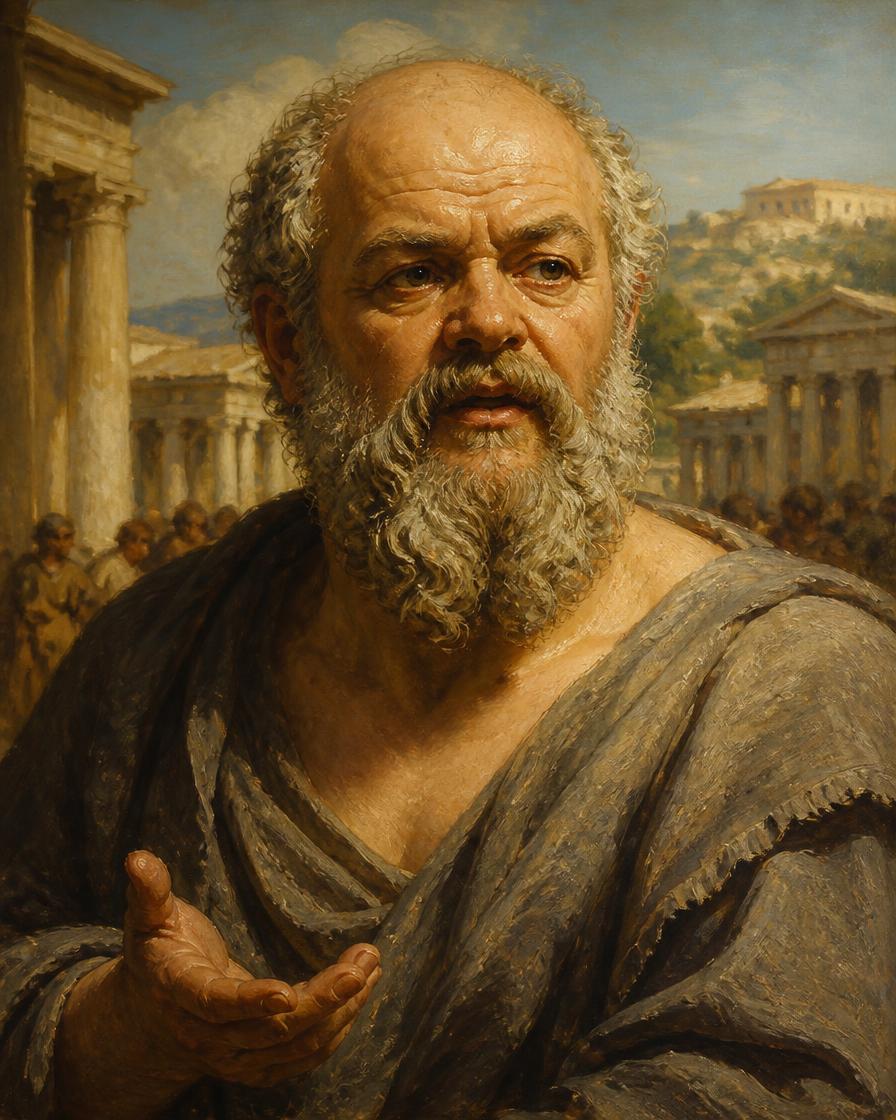
Quick Facts
- Years
- 470 BC – 399 BC
- Category
- Philosophers & Thinkers
- Subcategory
- Ancient Greek Philosophy
- Nationality
- Greek
- Occupation
- Philosopher
Socrates
470 BC – 399 BC · Greek · Philosopher
Audiobook

Life Lessons from Socrates
Marcus Alden · 43 min
Socrates was an Athenian philosopher whose relentless questioning transformed Greek thought and helped lay the foundations of Western ethics and philosophy. Born around 470 BCE and executed in 399 BCE, he wrote no philosophical books. Nearly everything known about him comes from other ancient authors, especially his students Plato and Xenophon, the comic dramatist Aristophanes, and later Aristotle. Because these witnesses differed in purpose and outlook, reconstructing the historical Socrates remains difficult—a problem scholars call the “Socratic problem.”
Socrates’ greatest achievement was not a formal doctrine but a way of examining beliefs. In public conversations, he asked people to define concepts such as justice, courage, piety, and virtue, then tested their answers for contradictions. He argued that care of the soul and moral integrity mattered more than wealth, status, or even survival. His association with controversial Athenians, criticism of complacent authority, and unconventional religious reputation contributed to his prosecution for impiety and corrupting the young.
Condemned by an Athenian jury, Socrates refused to abandon his philosophical mission or escape illegally. His death by hemlock became an enduring symbol of fidelity to conscience. Through Plato, his influence shaped philosophy, education, political theory, Christian intellectual traditions, and modern critical inquiry. He remains studied because his central challenge—how should a person live?—has lost none of its urgency.
Quick Facts
| Field | Information |
|---|---|
| Full Name | Socrates (Greek: Sōkratēs) |
| Common Name(s) | Socrates |
| Born | c. 470 or 469 BCE |
| Died | 399 BCE |
| Age at Death | About 70 |
| Birthplace | Alopece, a deme of Athens, Attica |
| Nationality | Athenian Greek |
| Occupation | Philosopher; citizen-soldier; possibly associated with stoneworking |
| Historical Era | Classical Greece, especially fifth-century BCE Athens |
| Famous For | Socratic questioning, ethical inquiry, trial and execution |
| Political Affiliation if applicable | None recorded; critical of aspects of democracy and oligarchy alike |
| Religion if significant | Participated in Athenian religion but claimed a divine sign and pursued an unconventional religious mission |
| Education | Not recorded; likely received the standard education of an Athenian male citizen |
| Parents | Sophroniscus and Phaenarete |
| Spouse(s) | Xanthippe; a later tradition also names Myrto, but this is disputed |
| Children | Lamprocles, Sophroniscus, and Menexenus |
| Major Works | None written; ideas survive in works by others |
| Major Achievements | Redirected philosophy toward ethical examination; developed influential conversational methods; inspired Plato and later philosophical traditions; became a model of principled dissent |
Early Life
Socrates was born around 470 or 469 BCE in Alopece, a community within the territory of Athens. Plato’s Theaetetus identifies his father as Sophroniscus and his mother as Phaenarete, whom Socrates describes as a midwife. Ancient reports call Sophroniscus a stonemason or sculptor, although the evidence for Socrates himself practicing that trade is uncertain. A later claim linked him to statues of the Graces on the Athenian Acropolis, but historians cannot verify it.
Details of his childhood are not recorded. As a male citizen, he probably received instruction in literacy, music, poetry, physical training, and civic traditions. His conversations reveal familiarity with Homer, drama, mathematics, craftsmanship, law, natural philosophy, and contemporary rhetoric. Ancient accounts connect him intellectually with figures such as Anaxagoras, Archelaus, and Diotima of Mantinea, but the nature or historicity of these relationships is debated. Plato presents Diotima as Socrates’ teacher in matters of love; she may have been historical, literary, or both.
Socrates grew up as Athens became a wealthy maritime empire and cultural center. Democratic institutions encouraged public speech, while traveling teachers known as sophists offered training in argument and political success. Philosophers investigated nature, language, knowledge, and morality. Socrates shared the sophists’ interest in argument but rejected the idea that he possessed wisdom to sell. He normally accepted no fee and repeatedly denied being a conventional teacher.
War shaped his adulthood. During the Peloponnesian War between Athens and Sparta, Socrates served as a hoplite, a heavily armed infantryman. Plato and Xenophon credit him with endurance and courage at Potidaea, Delium, and Amphipolis. These reports helped establish an image of a physically tough philosopher whose commitment to discipline extended beyond conversation.
Rise to Prominence
Socrates appears to have lived modestly and spent much of his time speaking with fellow citizens in workshops, gymnasia, streets, and public spaces. Instead of lecturing, he asked questions. He often began by professing ignorance, invited someone to define a moral quality, and then examined whether the definition survived counterexamples. This practice attracted young men from prominent families, including Plato, Alcibiades, Critias, and Xenophon.
A turning point in his public self-understanding involved the oracle at Delphi. In Plato’s Apology, Socrates says that his friend Chaerephon asked whether anyone was wiser than Socrates; the Pythian priestess reportedly answered that no one was. Socrates interpreted this not as proof of superior knowledge but as a puzzle. After questioning politicians, poets, and craftsmen, he concluded that many claimed knowledge they did not possess, whereas he recognized his own ignorance. He came to regard philosophical examination as a divine duty.
His fame brought hostility. Aristophanes’ comedy Clouds, first produced in 423 BCE, portrayed a fictionalized Socrates suspended in a basket, investigating the heavens and teaching deceptive argument. This blended him with natural philosophers and sophists, despite important differences. Plato later suggested that such caricatures created lasting prejudice.
Political upheaval intensified the danger. Athens suffered military defeat, oligarchic coups, and the brutal rule of the Thirty Tyrants. Some men associated with Socrates—most notably Critias and Alcibiades—became notorious. Although Socrates neither controlled their actions nor consistently supported their politics, these relationships damaged his reputation.
Major Achievements
Making Ethical Examination Central to Philosophy
Earlier Greek thinkers often concentrated on nature and the structure of the cosmos. Socrates did not wholly ignore such subjects, but the strongest ancient testimony associates him with questions about virtue, justice, courage, friendship, and the good life. Aristotle credited him with pursuing universal definitions and inductive arguments.
This shift mattered because morality became a field of reasoned investigation rather than merely inherited custom. Plato, Aristotle, the Cynics, and the Stoics developed different systems from questions Socrates made unavoidable. Modern ethics still asks whether virtue is knowledge, whether wrongdoing comes from ignorance, and whether integrity outweighs advantage.
Establishing the Socratic Style of Inquiry
Socrates tested claims through disciplined dialogue. He sought definitions, drew out implications, introduced counterexamples, and exposed contradictions. The Greek term elenchus—testing or refutation—is often used for this practice. Socratic irony, his characteristic posture of not knowing, encouraged others to reveal their assumptions.
The method mattered because it treated reasoning as cooperative scrutiny rather than passive instruction. Its descendants appear in philosophy seminars, legal education, psychotherapy, scientific questioning, and classroom discussion. The historical Socrates did not provide a standardized teaching formula, so modern “Socratic methods” are adaptations rather than exact replicas.
Embodying Intellectual Humility
Socrates’ famous wisdom consisted partly in recognizing the limits of his knowledge. He did not simply celebrate uncertainty; he used acknowledged ignorance as the beginning of inquiry. This challenged experts and citizens who confused confidence, reputation, or technical skill with moral understanding.
The long-term impact is visible in traditions of skepticism, critical thinking, and scientific fallibilism. Socratic humility does not mean that all opinions are equal. It means beliefs should remain answerable to reasons and examination.
Defending Moral Conscience in Public Life
Plato records two occasions when Socrates resisted political pressure. In 406 BCE, while serving on the Council, he opposed an illegal collective trial of generals after the Battle of Arginusae. Under the Thirty Tyrants, he refused an order to help arrest Leon of Salamis for execution.
The exact constitutional details of the first episode remain debated, but both stories present a consistent principle: legality and justice should not be sacrificed to fear or popular anger. Socrates’ conduct became a model for conscientious resistance to both democratic majorities and authoritarian rulers.
Accepting Death Rather Than Abandoning Philosophy
At his trial in 399 BCE, Socrates refused to win acquittal through flattery, emotional spectacle, or a promise to stop philosophizing. After conviction, he rejected escape in Plato’s Crito, reasoning that one should not answer injustice with injustice or violate lawful obligations for personal benefit.
His execution made his life inseparable from his teaching. For later readers, the death scene in Plato’s Phaedo represented courage, reasoned conviction, and hope concerning the soul. Yet the event also remains a warning about the capacity of political communities to punish dissent.
Leadership and Work
Socrates held no lasting political command, founded no formal school, and left no written curriculum. His leadership was personal and dialogical. He influenced others by questioning their priorities, modeling self-discipline, and demanding consistency between values and conduct.
His decision-making emphasized moral principle over expediency. At trial he insisted that fear of death should not override a duty to pursue truth and virtue. His wartime service and resistance to unlawful orders reinforced this image. He valued courage, moderation, justice, friendship, and care of the soul.
Relationships were central to his work. He conversed with politicians, poets, craftsmen, soldiers, aristocratic youths, sophists, and foreigners. Plato’s dialogues show him adapting questions to each participant. He could be humorous, patient, and intellectually generous, but also relentless and embarrassing. People who discovered that they could not defend their confident opinions sometimes became resentful.
His strengths included intellectual courage, personal endurance, logical persistence, and freedom from conventional ambition. Potential weaknesses followed from the same traits. His public refutations could humiliate others; his ironic manner could seem evasive; and his refusal to offer straightforward positive doctrines frustrated listeners. Because he wrote nothing, his philosophy depended on interpreters who reshaped it for their own purposes.
Personal Life
Socrates married Xanthippe, with whom he had three sons: Lamprocles, Sophroniscus, and Menexenus. Plato’s Phaedo places Xanthippe and a young child with Socrates in prison shortly before his death. Ancient anecdotes often portray her as quarrelsome, but many were composed long afterward and reflect comic stereotypes about marriage. They should not be treated as reliable biography.
A later tradition says that Socrates also married or lived with Myrto, reportedly a descendant of the statesman Aristides. Ancient writers themselves disagreed about this story, and modern historians generally regard it as uncertain.
Socrates’ circle included Plato, Xenophon, Crito, Chaerephon, Phaedo, Antisthenes, Aristippus, and many others. Alcibiades’ speech in Plato’s Symposium portrays Socrates as indifferent to physical temptation and unusually resilient. Although literary, the portrait agrees with other accounts of his self-control.
He was famously plain in appearance and lifestyle. Sources describe him as snub-nosed, broad-faced, often barefoot, and dressed simply. He tolerated hunger, cold, and alcohol remarkably well. These features became part of his philosophical image: external beauty and luxury mattered less than character.
No secure medical diagnosis can be made from ancient descriptions. Reports that he stood motionless in prolonged concentration may reflect meditation, literary symbolism, or an unusual habit rather than illness.
Philosophy and Beliefs
Socrates’ ethical outlook centered on the soul—not necessarily in the later theological sense alone, but as the seat of moral character and rational responsibility. He urged people to care more for becoming good than for acquiring money, power, or reputation. In Plato’s Apology, he says that wealth does not produce virtue; rather, virtue makes wealth and other goods beneficial.
Several ideas are commonly called Socratic, although separating Socrates from Plato is difficult:
- Virtue is closely connected with knowledge.
- Wrongdoing results from ignorance or mistaken judgment about the good.
- No one willingly chooses what they truly understand to be bad for them.
- Suffering injustice is less harmful than committing it.
- A good life requires continual examination.
- Moral excellence is more important than external success.
His politics were complicated. Plato depicts him criticizing selection of officials by lot and questioning whether popular opinion amounts to expertise. Yet he served Athens, obeyed its laws in ordinary circumstances, and resisted the Thirty Tyrants. He was neither a simple champion of democracy nor an oligarchic ideologue. His deepest allegiance was to justice as reasoned moral obligation.
Religiously, Socrates referred to gods, divine commands, dreams, oracles, and a personal daimonion—a divine sign that warned him against certain actions. Prosecutors interpreted his religious conduct as impious or innovative. Plato’s Socrates denied atheism and framed his philosophical activity as service to Apollo. Scholars debate how literally to understand these claims, but ancient evidence does not support describing him simply as an atheist.
Challenges and Controversies
The greatest historical difficulty is the Socratic problem. Plato’s dialogues vary in style and doctrine; Xenophon presents a practical moral teacher; Aristophanes offers hostile comedy; Aristotle wrote later. No source is a neutral transcript. Scholars therefore distinguish cautiously between the historical person and “Socrates” as a literary character.
His relationships with Alcibiades and Critias were politically damaging. Alcibiades repeatedly changed allegiance during the Peloponnesian War, while Critias became a violent leader of the Thirty. Critics could view Socrates as a corrupting influence on elite youths. Defenders reply that he opposed Critias’ regime and that students remained responsible for their own choices.
In 399 BCE, Meletus, Anytus, and Lycon prosecuted him. The formal accusations were that he did not acknowledge the gods recognized by the city, introduced new divine beings, and corrupted the young. Behind these charges may have stood resentment created by his questioning, memories of political disaster, religious concern, and personal hostility. An amnesty restricted prosecutions for earlier political acts, possibly encouraging opponents to frame grievances in religious and educational terms. This explanation is plausible but not certain.
The jury convicted him by a relatively narrow margin, according to Plato’s account. During sentencing, Socrates first proposed that he deserved maintenance in the Prytaneum, an honor granted to public benefactors, before eventually supporting a fine guaranteed by friends. His provocative defense may have increased the vote for death.
Was Socrates a martyr for free speech? The description captures part of his later significance but can be anachronistic. Athens lacked a modern doctrine of individual speech rights, and the charge included religion and education. Conversely, reducing the trial to ordinary law overlooks its political atmosphere and the unusual punishment of a citizen for his public intellectual activity.
Legacy
Socrates’ immediate legacy flowed through competing students. Plato made him the central figure of many dialogues and founded the Academy. Xenophon wrote memoirs defending his character. Antisthenes influenced Cynicism; Aristippus became associated with Cyrenaic philosophy; Euclid of Megara founded the Megarian school. These divergent successors demonstrate that Socrates inspired inquiry more than a single orthodoxy.
Through Plato and Aristotle, Socratic questions entered medieval Islamic, Jewish, and Christian philosophy, Renaissance humanism, Enlightenment criticism, and modern existentialism. Stoics admired his self-command. Early Christian authors sometimes compared his death and moral witness with religious martyrdom, while preserving theological differences. Kierkegaard studied Socratic irony; Nietzsche admired and attacked Socratic rationalism; contemporary philosophers continue to debate his ethics and politics.
Modern education uses Socratic seminars to develop close reading and reasoned discussion. Law schools employ structured questioning to test legal principles. Cognitive therapy also uses “Socratic questioning” to examine assumptions, though this is a modern technique rather than direct historical continuity.
Athens preserves the settings associated with his life, including the Ancient Agora and the archaeological remains of the classical city. A statue of Socrates stands outside the Academy of Athens alongside Plato. Museums such as the Acropolis Museum and National Archaeological Museum illuminate the society in which he lived, though no authenticated personal object or contemporary portrait of Socrates survives.
His most enduring memorial is intellectual. Every disciplined challenge to an unexamined assumption participates, however indirectly, in the tradition attached to his name.
Interesting Facts
- Socrates wrote no known philosophical works.
- His birth year is uncertain, usually placed in 470 or 469 BCE.
- He belonged to the Athenian deme of Alopece.
- His mother, Phaenarete, was described as a midwife.
- He served as an Athenian hoplite in the Peloponnesian War.
- Ancient sources associate him with the campaigns at Potidaea, Delium, and Amphipolis.
- Aristophanes caricatured him in Clouds in 423 BCE.
- He usually did not charge fees for conversation.
- He compared his work to that of a gadfly awakening a sluggish horse.
- His divine sign reportedly warned him against actions rather than prescribing them.
- He opposed an unlawful procedure against Athenian generals in 406 BCE.
- He refused the Thirty Tyrants’ order to arrest Leon of Salamis.
- Three citizens—Meletus, Anytus, and Lycon—brought his prosecution.
- Athens executed him by requiring him to drink hemlock poison.
- His friends were reportedly prepared to help him escape.
- Plato was probably absent from Socrates’ death because of illness, according to Phaedo.
- Socrates had three recorded sons.
- No securely contemporary portrait can be identified as an exact likeness.
- “Socratic method” is a modern umbrella term for several questioning practices.
- The precise historical content of many teachings attributed to him remains debated.
Famous Quotes
Because Socrates wrote nothing, every quotation comes through another author and translation wording varies.
- “The unexamined life is not worth living for a human being.” — Plato, Apology 38a. Spoken during sentencing, it expresses his conviction that moral inquiry gives human life its proper value.
- “I know that I know nothing.” — Popular paraphrase, not a verbatim ancient quotation. It summarizes Plato’s Apology 21d: Socrates is wiser insofar as he does not think he knows what he does not know.
- “I shall obey the god rather than you.” — Plato, Apology 29d. Socrates says he will continue philosophizing even if acquittal requires silence.
- “It is not living that should be valued most, but living well.” — Plato, Crito 48b. He argues that survival cannot justify unjust action.
- “One must never do wrong.” — Plato, Crito 49b. This principle supports his refusal to retaliate against an unjust verdict by escaping unlawfully.
- “The only thing I know is the art of love.” — Plato, Symposium 177d, depending on translation. The line introduces an inquiry into desire, beauty, and wisdom; its literary setting complicates attribution to the historical Socrates.
- “No evil can happen to a good man, either in life or after death.” — Plato, Apology 41d. Socrates expresses trust that moral goodness cannot be destroyed by external misfortune.
- “I was attached to this city by the god…as upon a great and noble horse…a kind of gadfly.” — Plato, Apology 30e. He presents questioning as an irritating but beneficial civic service.
- “Wonder is the feeling of a philosopher, and philosophy begins in wonder.” — Plato, Theaetetus 155d, spoken by Socrates. It links inquiry to astonishment, though it remains a Platonic literary attribution.
- “To fear death…is nothing other than to think oneself wise when one is not.” — Plato, Apology 29a. Since death is unknown, confidently calling it the greatest evil is false knowledge.
- “There is only one good, knowledge, and one evil, ignorance.” — Commonly attributed but not securely documented in this exact form. It should be treated as a modern summary of Socratic intellectualism, not a verified quotation.
Timeline
- c. 470/469 BCE — Socrates is born in Alopece, Athens, to Sophroniscus and Phaenarete.
- c. 450s–440s BCE — Receives an ordinary Athenian citizen’s education; details are unknown.
- 432–429 BCE — Serves in the campaign at Potidaea; later sources praise his endurance and bravery.
- 424 BCE — Fights at the Battle of Delium during the Peloponnesian War.
- 423 BCE — Aristophanes’ Clouds publicly caricatures him.
- 422 BCE — Ancient testimony associates him with the campaign at Amphipolis.
- c. 420s–410s BCE — Becomes increasingly prominent through public philosophical conversations.
- 415–404 BCE — Alcibiades’ controversial career and Athens’ wartime crises affect perceptions of Socrates’ circle.
- 406 BCE — As a member of the Council, resists an unlawful collective procedure against the Arginusae generals.
- 404–403 BCE — Under the Thirty Tyrants, refuses to participate in the arrest of Leon of Salamis.
- 403 BCE — Democracy is restored in Athens.
- 399 BCE — Meletus, supported by Anytus and Lycon, prosecutes Socrates for impiety and corrupting the young.
- 399 BCE — A jury convicts him and sentences him to death.
- 399 BCE — Socrates rejects escape and dies after drinking hemlock.
- After 399 BCE — Followers including Plato and Xenophon compose works preserving rival portraits of him.
Frequently Asked Questions
Who was Socrates?
Socrates was a classical Athenian philosopher active during the fifth century BCE. He became known for examining moral and political beliefs through conversation rather than teaching a fixed body of doctrine. He asked people to define ideas such as justice, courage, and piety, then tested their answers for inconsistency. Although he wrote nothing, portrayals by Plato, Xenophon, Aristophanes, and Aristotle made him one of history’s most influential thinkers.
When and where was Socrates born?
He was born around 470 or 469 BCE in Alopece, a deme within Athenian territory. Ancient evidence does not preserve his exact birthday or a fully documented childhood. Athens at the time was becoming a major democratic, military, and cultural power. This environment exposed him to public debate, drama, warfare, religious practice, craftsmanship, and new intellectual movements.
Why did Socrates write no books?
No surviving source gives a definitive explanation. Plato’s dialogues suggest that Socrates regarded live questioning as especially valuable because conversation could respond to a person’s answers and expose misunderstandings. In Plato’s Phaedrus, Socrates also criticizes writing’s inability to answer questions, though the passage belongs to Plato’s literary presentation. It is safest to say that Socrates practiced philosophy orally and left interpretation to his associates.
How do historians know about Socrates?
The principal witnesses are Plato and Xenophon, both admirers; Aristophanes, who caricatured him in comedy; and Aristotle, who wrote a generation later. Other students and later authors preserve fragments and anecdotes. These accounts differ significantly. Historians compare them, examine chronology and genre, and avoid assuming that every dialogue records an actual conversation. The resulting uncertainty is known as the Socratic problem.
What is the Socratic method?
The term generally describes learning through carefully organized questions. In ancient dialogues, Socrates asks for definitions, tests consequences, introduces counterexamples, and reveals contradictions. This process often ends in aporia, a state of productive puzzlement. Modern schools and law faculties use related methods, but there was no single ancient manual. Contemporary “Socratic method” therefore refers to a family of practices inspired primarily by Plato’s portrayal.
What did Socrates mean by knowing nothing?
The familiar line “I know that I know nothing” is a paraphrase. In Plato’s Apology, Socrates concludes that he has an advantage over supposedly wise people because he does not believe he knows what he does not know. He was not claiming total ignorance: he defended strong moral principles and displayed broad knowledge. His point concerns intellectual humility—the recognition that unsupported confidence is not genuine wisdom.
Was Socrates a sophist?
His contemporaries could associate him with sophists because he debated, influenced young men, and challenged traditional assumptions. Aristophanes deliberately blurred the distinction. Yet Plato and Xenophon emphasize differences: Socrates normally charged no fee, denied possessing teachable wisdom, and sought moral truth rather than rhetorical victory. The category “sophist” was itself broad and polemical, so a simple label can obscure both similarities and differences.
Did Socrates believe in the Greek gods?
The evidence indicates religious belief, though expressed unconventionally. Socrates referred to gods, Apollo’s oracle, dreams, sacrifices, and a divine sign. At trial he denied atheism. The prosecution alleged that he failed to recognize the city’s gods and introduced new divine beings, perhaps referring to his daimonion. Scholars debate whether his theology departed substantially from civic religion, but calling him straightforwardly atheist is unsupported.
What was Socrates’ divine sign?
Socrates described a daimonion, often translated as a divine or spiritual sign. In Plato’s accounts, it intervened from childhood and typically warned him not to take a proposed action. It did not supply a complete ethical system or ordinary practical advice. Ancient audiences could understand such experiences within Greek religious culture, yet opponents might regard the private sign as evidence of religious innovation.
Was Socrates opposed to democracy?
He criticized democratic practices, especially the assumption that political judgment required no expertise. Some associates became oligarchs, deepening suspicion. Nevertheless, he served democratic Athens as a soldier and official, obeyed its institutions, and opposed the oligarchic Thirty when they issued an unjust command. His position is best described as morally critical of all regimes rather than neatly democratic or oligarchic.
Why was Socrates put on trial?
The formal charges were impiety and corruption of the young. Broader causes probably included resentment from public refutations, anxiety about religious innovation, and memories of political figures connected with him. Athens had recently endured war, defeat, and dictatorship. Scholars disagree about how much weight to assign each factor. The trial was legally real, but its social and political background cannot be separated from the charges.
Who accused Socrates?
Meletus formally brought the indictment, while Anytus and Lycon supported the prosecution. Plato associates Meletus with poets, Anytus with politicians and craftsmen, and Lycon with orators, although this classification serves his argument. Anytus was a prominent democratic politician and may have viewed Socrates’ influence on young elites as dangerous. The prosecutors’ exact speeches have not survived.
Did Socrates corrupt the youth?
The jury found him guilty, but surviving evidence does not demonstrate that he instructed young people to commit crimes. Some associates, especially Critias and Alcibiades, behaved destructively. Critics could argue that his questioning weakened respect for civic authority. Defenders answer that Socrates taught self-control and justice, opposed Critias, and could not control independent adults. The charge reflects a real dispute about education and responsibility, not a securely established fact.
Why did Socrates refuse to escape?
In Plato’s Crito, friends offer an escape plan, but Socrates argues that injustice does not justify retaliatory injustice. Having lived under Athenian laws and accepted their benefits, he believes he cannot simply violate the judgment when it harms him. Scholars debate whether the dialogue gives the historical conversation or Plato’s philosophical reconstruction. Either way, the refusal became central to Socrates’ reputation for consistency.
How did Socrates die?
Athens sentenced him to death in 399 BCE. Plato’s Phaedo describes him drinking a preparation of hemlock and gradually losing sensation as paralysis moved upward through his body. The scene is literary and philosophically shaped, but hemlock execution is historically credible. His death was delayed while a sacred Athenian mission to Delos was underway, during which executions were prohibited.
What were Socrates’ final words?
In Plato’s Phaedo, his final recorded words are: “Crito, we owe a cock to Asclepius; pay the debt and do not neglect it.” Asclepius was a god of healing. Interpretations vary: death may be pictured as a cure, the words may concern an ordinary vow, or Plato may intend layered symbolism. No interpretation can be proven, and the wording comes through Plato rather than a transcript.
What did Socrates teach about virtue?
He treated virtue as inseparable from knowledge and moral understanding. If a person genuinely understands what is good, Socratic reasoning suggests, that person will choose it; wrongdoing results from ignorance about true benefit. This “Socratic intellectualism” raises objections because people often appear to act against their better judgment. Plato and Aristotle later developed more complex accounts of desire, habit, and weakness of will.
How did Socrates influence Plato?
Socrates was Plato’s teacher or formative intellectual associate and became the leading speaker in most Platonic dialogues. Plato used Socratic questioning to explore ethics, knowledge, politics, love, and metaphysics. Scholars often regard earlier dialogues as closer to Socratic concerns and later ones as more distinctly Platonic, but there is no universally accepted dividing line. Through Plato, Socrates’ influence reached almost every later period of Western philosophy.
Lessons We Can Learn
- Admit uncertainty. Socrates’ interpretation of the Delphic oracle made awareness of ignorance the beginning of wisdom. Today, acknowledging limits improves research, leadership, and decision-making.
- Define important terms. He asked what justice or courage actually meant before debating examples. Clear definitions reduce confusion in public policy, workplaces, and personal disputes.
- Test beliefs for contradictions. Socratic refutation exposed claims that could not coexist. Checking consistency remains essential in science, law, journalism, and everyday reasoning.
- Value character over status. Socrates prioritized the soul above wealth and reputation. His example warns against treating achievement as a substitute for integrity.
- Question authority without rejecting reason. He challenged politicians, experts, and crowds through argument rather than mere defiance. Responsible criticism should offer evidence and accept examination in return.
- Resist unlawful pressure. His refusal to arrest Leon showed courage under dictatorship. Ethical responsibility does not disappear when an order comes from powerful institutions.
- Avoid retaliatory injustice. In Crito, he refuses to answer wrong with wrong. The principle encourages proportion, legality, and moral restraint during conflict.
- Accept the social cost of honest inquiry. Socrates’ questioning generated resentment as well as admiration. Constructive dissent often requires patience, tact, and courage.
- Align conduct with principles. His military service, civic resistance, trial defense, and death formed a consistent public image. Credibility grows when values survive difficult circumstances.
- Keep examining how to live. Socrates treated philosophy as a daily practice rather than an academic possession. Reflection helps individuals reassess priorities, habits, and obligations throughout life.
Related Historical Figures
- Plato — Socrates’ most influential student and literary interpreter; his dialogues provide the richest surviving portrait.
- Xenophon — Soldier, historian, and associate who defended Socrates in the Memorabilia and Apology.
- Aristophanes — Comic playwright whose Clouds caricatured Socrates and shaped public perceptions.
- Alcibiades — Charismatic Athenian politician and general associated with Socrates; his betrayals damaged the philosopher’s reputation.
- Critias — Associate of Socrates and leading member of the violent Thirty Tyrants.
- Chaerephon — Friend whose question to the Delphic oracle inspired Socrates’ investigation of wisdom.
- Crito of Alopece — Loyal friend portrayed urging Socrates to escape from prison.
- Antisthenes — Follower whose austere ethical emphasis contributed to the development of Cynicism.
- Aristotle — Plato’s student who offered important later testimony about Socrates’ pursuit of definitions and inductive reasoning.
- Anytus — Influential democratic politician and one of the principal supporters of Socrates’ prosecution.
Watch and Learn
PHILOSOPHY - The Good Life: Socrates · Wireless Philosophy
Related Historical Figures