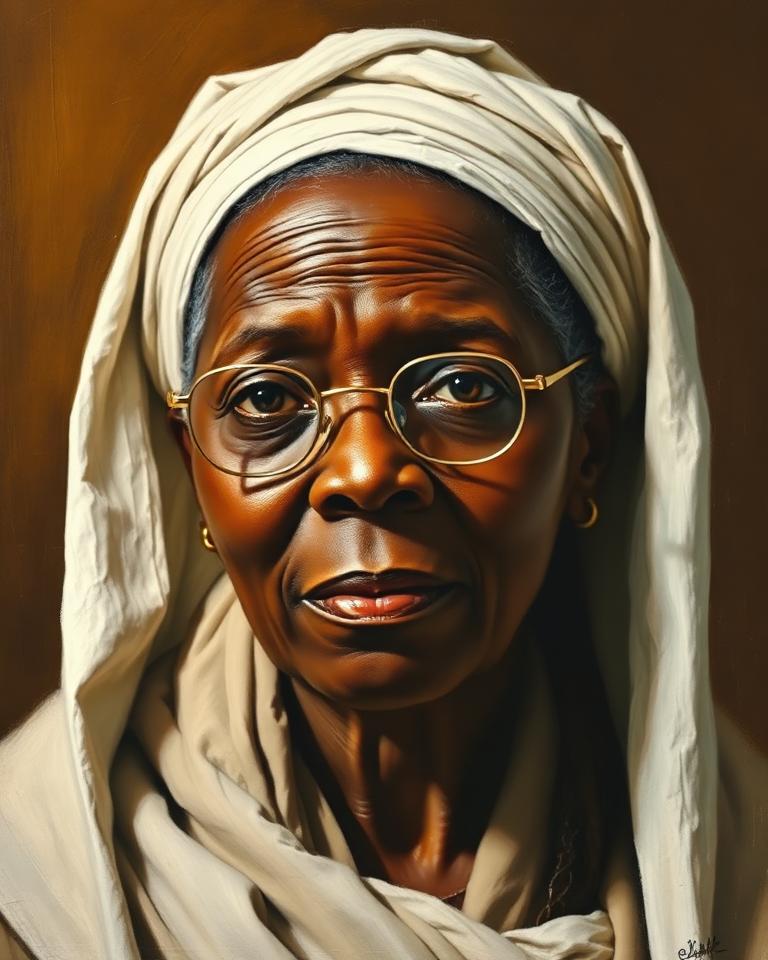
Quick Facts
- Years
- 1797 – 1883
- Category
- Social Reformers & Humanitarians
- Subcategory
- Human Rights
- Nationality
- American
- Occupation
- Abolitionist and Women's Rights Activist
Sojourner Truth
1797 – 1883 · American · Abolitionist and Women's Rights Activist
Audiobook

Life Lessons from Sojourner Truth
Marcus Alden · 48 min
Sojourner Truth was an American abolitionist, women’s rights advocate, religious speaker, and reformer whose life connected the struggle against slavery with campaigns for women’s equality. Born Isabella Baumfree into slavery in New York around 1797, she endured forced labor, family separation, and physical abuse. After escaping with an infant daughter in 1826, she successfully used the courts to recover a son who had been illegally sold south—an extraordinary victory for a Black woman in the early nineteenth century.
In 1843 she adopted the name Sojourner Truth and began traveling as an itinerant preacher. Her commanding voice, biblical arguments, personal testimony, humor, and skill at answering hostile audiences made her one of the era’s best-known reform lecturers. At the 1851 Ohio Women’s Rights Convention, she delivered the speech later popularly called “Ain’t I a Woman?” Although its most famous wording was published twelve years afterward and does not closely reflect the earliest report, the address remains a powerful statement about race, gender, labor, and citizenship.
Truth also recruited Black soldiers during the Civil War, met President Abraham Lincoln, assisted freedpeople, challenged racial discrimination on Washington streetcars, and campaigned for land for formerly enslaved families. She is still studied because her career illuminates slavery in the North, Black women’s political activism, religious reform, and the difficult alliances that shaped nineteenth-century movements for freedom.
Quick Facts
| Field | Information |
|---|---|
| Full Name | Isabella Baumfree at birth; later Sojourner Truth |
| Common Name(s) | Sojourner Truth; Isabella Van Wagenen during part of the 1820s–1840s |
| Born | About 1797; exact date not recorded |
| Died | November 26, 1883 |
| Age at Death | Approximately 86 |
| Birthplace | Swartekill, near present-day Rifton, Ulster County, New York, United States |
| Nationality | American |
| Occupation | Abolitionist, women’s rights activist, lecturer, preacher, reformer |
| Historical Era | Antebellum period, American Civil War, Reconstruction |
| Famous For | Abolitionist advocacy; women’s rights activism; the speech commonly called “Ain’t I a Woman?” |
| Political Affiliation | No consistent formal party affiliation recorded; associated with abolitionist, suffrage, and reform movements |
| Religion | Protestant Christianity; associated at different times with Methodism, perfectionism, Millerism, and Spiritualism |
| Education | No formal schooling; unable to read or write, but developed extensive biblical and political knowledge through listening and discussion |
| Parents | James Baumfree and Elizabeth, called Betsey or Mau-Mau Bett |
| Spouse(s) | Thomas, an enslaved man; their union was not recognized as a legal civil marriage under slavery |
| Children | Five generally identified: Diana, Peter, Elizabeth, Sophia, and an infant who died; some details remain uncertain |
| Major Works | Narrative of Sojourner Truth (dictated to Olive Gilbert, 1850; later editions expanded); The Book of Life materials appended to later editions |
| Major Achievements | Won the return of her illegally sold son; became a nationally known abolitionist and women’s rights speaker; recruited soldiers and aided freedpeople; challenged segregated transit; advocated land reform |
Early Life
Isabella Baumfree was born around 1797 on the estate of Johannes Hardenbergh in the Dutch-speaking Hudson Valley. New York was a northern state, but slavery remained legal there. Her parents, James and Elizabeth Baumfree, had both been enslaved. Isabella grew up speaking Dutch and learned English only after being sold away from her family.
Her childhood was marked by instability. After the Hardenbergh estate changed hands, she was auctioned in 1806 at about nine years old. Her first purchaser, John Neely, reportedly beat her severely, in part because she did not understand English. She was sold several more times before becoming the property of John Dumont in Ulster County.
Isabella received no formal education and remained unable to read or write. Illiteracy did not prevent intellectual development: she memorized scripture, listened closely to public debate, and became an accomplished oral interpreter of biblical stories. Her parents’ religious teachings, especially her mother’s insistence that God saw and heard everything, helped shape her enduring faith.
Around 1815, Isabella formed a relationship with Robert, an enslaved man on a neighboring property. Robert’s enslaver opposed the relationship and violently separated them. She later had a daughter, Diana, whose paternity is generally attributed to Robert. Dumont then compelled or arranged her union with Thomas, an older enslaved man. They had several children.
New York adopted gradual emancipation rather than immediately abolishing slavery. A state law promised freedom to remaining enslaved adults on July 4, 1827, but Dumont reneged on an earlier promise to free Isabella ahead of that date. The gap between legal reform and lived freedom became one of the defining lessons of her early life.
Rise to Prominence
In late 1826, Isabella left Dumont’s farm with her infant daughter Sophia. She later emphasized that she had not fled secretly; she “walked off,” believing she had fulfilled the labor Dumont claimed she owed. Isaac and Maria Van Wagenen, a nearby couple, sheltered her and paid Dumont for the remainder of her legally required service. Isabella adopted their surname for a time.
Soon afterward, she learned that her young son Peter had been sold illegally to Alabama. New York law prohibited such a sale. With assistance from the Van Wagenens and local Quakers, she pursued the case through the courts. Peter was returned in 1828. The episode is often summarized as her becoming one of the first Black women to win such a case against a white man, although precise “first” claims are difficult to prove. What is certain is that she achieved a remarkable legal victory.
Isabella moved to New York City in 1828 and worked as a domestic servant. She joined religious communities and became associated with the controversial preacher Robert Matthews, known as Matthias. When their communal household collapsed amid allegations of fraud, abuse, and murder, Isabella was accused in the press of wrongdoing. Matthews was acquitted of murder but convicted of assault. Isabella successfully pursued a slander action connected to accusations against her, helping restore her reputation.
On June 1, 1843, she announced that God had called her to travel and testify. She took the name Sojourner Truth: “Sojourner” expressed her itinerant mission, and “Truth” the divine message she believed she carried. She joined abolitionist circles, lived for a period at the Northampton Association of Education and Industry in Massachusetts, and met reformers including William Lloyd Garrison, Frederick Douglass, and David Ruggles.
Her dictated autobiography, Narrative of Sojourner Truth, appeared in 1850. Sales helped support her work. That year she purchased a home in Northampton, strengthening her independence as a public lecturer.
Major Achievements
Recovering Her Son Through the Courts
After Peter was illegally sold out of New York, Truth—then Isabella Van Wagenen—helped initiate legal proceedings for his return. Peter came home badly abused and traumatized.
The victory mattered because enslaved and newly freed Black women faced enormous barriers to legal standing, money, evidence, and sympathetic officials. She used the law strategically despite those inequalities. The episode foreshadowed her lifelong insistence that rights must be enforced, not merely announced.
Building a National Abolitionist Career
During the 1840s and 1850s, Truth traveled through the Northeast and Midwest, speaking against slavery. She relied on personal experience, Christian ethics, wit, song, and direct exchanges with audiences rather than written manuscripts.
Her testimony challenged northern listeners who imagined slavery solely as a southern institution. By describing sale, whipping, coerced labor, and family separation in New York, she exposed slavery’s national reach. Her autobiography carried that testimony to readers unable to hear her speak.
Advancing Women’s Rights
Truth attended the Ohio Women’s Rights Convention in Akron in 1851. Her brief address answered claims that women were physically weak, intellectually dependent, or excluded by scripture from equality. She invoked her own hard labor and motherhood while arguing that Christ came from God and a woman, not from a man.
The speech linked racism and sexism through lived experience. It became one of the most famous addresses in American reform history, although the familiar refrain “Ain’t I a Woman?” derives from Frances Dana Gage’s 1863 version, not Marius Robinson’s more immediate 1851 report.
Civil War Service and Aid to Freedpeople
During the Civil War, Truth supported the Union and encouraged Black men to enlist, including her grandson James Caldwell. She collected food and supplies for Black regiments. In 1864 she went to Washington, D.C., where she worked with the National Freedmen’s Relief Association and assisted people emerging from slavery.
Her service reflected a broad definition of freedom: military victory had to be followed by employment, housing, education, legal protection, and family security. She also met President Abraham Lincoln at the White House on October 29, 1864.
Challenging Segregated Transportation
In Washington, Truth resisted discriminatory treatment on streetcars. After a conductor attempted to exclude or mistreat her, she pursued official action. Accounts of the incidents vary in detail, but contemporary evidence confirms that she challenged segregation and helped establish her right to ride.
This activism anticipated later civil rights campaigns against unequal public transportation. Truth treated everyday mobility as a matter of citizenship rather than personal convenience.
Campaigning for Land and Economic Independence
After the war, Truth argued that formerly enslaved people needed land and material support. She promoted a petition asking the federal government to provide western lands to freed families and reportedly gathered many signatures, though Congress did not enact her proposal.
The campaign was important because she recognized that emancipation without resources could leave people vulnerable to exploitation. Modern debates over reparations, land redistribution, and the economic meaning of freedom echo questions she raised during Reconstruction.
Leadership and Work
Truth exercised leadership without holding a formal office. She traveled, spoke, raised funds, sold photographs and books, organized petitions, and worked through networks of abolitionists, suffragists, religious reformers, and freedpeople’s aid societies.
Her speaking style was improvisational and audience-centered. She often answered hecklers immediately, used biblical analogies accessible to ordinary listeners, and alternated moral seriousness with humor. Because she could not read prepared texts, she depended on memory, observation, and rhetorical adaptability.
Her central values were freedom, spiritual accountability, practical self-reliance, and equal human dignity. She could cooperate with people whose views differed from hers, including Garrisonian abolitionists, political antislavery activists, suffragists, Spiritualists, and federal officials.
Her strengths included courage, emotional intelligence, memorable storytelling, and the ability to connect private suffering with public policy. She also understood self-presentation. She sold photographic cartes de visite bearing the slogan, “I sell the shadow to support the substance,” using her image to finance activism and shape how the public saw a Black woman reformer.
Her approach had limitations. Oral speeches were easily misreported, and dependence on white editors, hosts, and reform organizations could distort her words. Her religious certainty sometimes drew her toward unstable leaders or movements. She was also part of coalitions fractured by racism, class prejudice, and disagreements over whether Black male suffrage or universal suffrage should receive priority.
Personal Life
Truth’s family life bore the lasting damage of slavery. Her parents were elderly when she was sold away, and she was separated from siblings whose fates were often unknown. Her relationship with Robert ended through violence imposed by his enslaver. Her later union with Thomas was formed under slavery, where neither partner possessed full legal freedom.
She was deeply attached to her children but could not fully protect them. Recovering Peter was a triumph, yet their later relationship was painful. As a teenager, Peter worked on a whaling ship and disappeared after sailing in 1839. Truth received letters written on his behalf but never learned his final fate with certainty.
Truth formed close relationships with reform-minded families and collaborators. Olive Gilbert transcribed her autobiography. Amy Post, Marius Robinson, Frances Titus, and members of abolitionist and women’s rights networks supported her work in different periods. Some white allies also reshaped her public image, making those relationships both productive and historically complicated.
She was physically tall and strong, with a powerful voice that witnesses frequently remembered. Her humor and quick replies were central to her personality. She enjoyed singing religious and antislavery songs during lectures.
In 1857 she moved to Harmonia, a progressive community near Battle Creek, Michigan. She later lived in Battle Creek itself. Chronic leg ulcers and other illnesses increasingly restricted her travel in old age. She died at home on November 26, 1883, and was buried in Oak Hill Cemetery.
Philosophy and Beliefs
Truth understood freedom through Christianity. She believed God spoke directly to conscience and demanded action against oppression. Biblical narratives supplied much of her political vocabulary, but she rejected interpretations used to justify women’s subordination or slavery.
Her theology emphasized spiritual equality and divine judgment. She maintained that human institutions could not override God-given dignity. At Akron, she reportedly answered theological arguments against women by pointing to Jesus’s birth from God and Mary. Elsewhere, she used the Exodus and the final judgment to condemn enslavers.
Her religious affiliations were fluid. She participated in Methodist revival culture, briefly followed Robert Matthews, showed interest in Millerite expectations of Christ’s return, and later moved among Spiritualist and reform communities in Michigan. This mixture was not unusual in the experimental religious culture of nineteenth-century America, although her association with Matthews exposed her to danger and scandal.
Politically, she favored abolition, equal civil rights, women’s suffrage, temperance, and economic opportunity for freedpeople. Her position during postwar suffrage disputes could be pragmatic: she defended Black male voting rights when Black men faced deadly racial violence, yet she continued demanding votes for women. She did not reduce justice to a single issue.
Challenges and Controversies
Truth faced slavery, poverty, illiteracy, racism, sexism, violence, hostile crowds, and the repeated loss of family members. Her accomplishments emerged despite these constraints, but not every effort succeeded. Her federal land proposal failed, racial equality remained unfulfilled after emancipation, and she did not live to see women gain nationwide voting rights.
Her association with Robert Matthews remains one of the most troubling episodes of her life. Matthews exercised authoritarian control over followers and was accused of serious abuses. Truth defended him at points and remained in his household until the community collapsed. Historians generally view her as a vulnerable participant rather than an architect of the abuse, but the episode shows that her religious trust could be exploited.
The wording of the Akron speech is a major historiographical dispute. Marius Robinson’s report, published within weeks, does not contain “Ain’t I a Woman?” and represents Truth in relatively standard English. Frances Dana Gage’s 1863 recollection repeats the phrase and gives Truth a southern-style dialect, despite her Dutch-speaking New York upbringing. Gage may have preserved themes or rhetorical effects, but most scholars consider Robinson’s account closer to the original wording.
Truth also entered the divisive politics of Reconstruction suffrage. Some white suffragists used racist arguments against enfranchising Black men before white women. Truth’s own comments emphasized both racial and gender justice, though particular statements can appear to prioritize one urgent need over another. Scholars therefore caution against forcing her into modern ideological categories.
Even her meeting with Lincoln has prompted debate. Truth’s own account was admiring, while later histories sometimes present the encounter as unambiguously egalitarian. Lincoln received her respectfully, but the meeting occurred within a broader political context in which federal policy toward Black equality remained limited and contested.
Legacy
Sojourner Truth became an enduring symbol of resistance to slavery and of Black women’s leadership. Her insistence that race, gender, labor, religion, and economic power must be considered together anticipated approaches now often described as intersectional, although that modern term did not exist in her lifetime.
Her name appears on schools, community organizations, scholarships, parks, and public buildings. The Sojourner Truth Memorial in Florence, Massachusetts, commemorates her Northampton years. Battle Creek preserves sites and monuments connected with her later life, and her grave remains an important place of remembrance.
In 2009, a bust by Artis Lane was installed in the U.S. Capitol; it was the first sculpture in the Capitol to honor an individual African American woman. In 2020, the Women’s Rights Pioneers Monument by Meredith Bergmann was unveiled in New York City’s Central Park, depicting Truth with Elizabeth Cady Stanton and Susan B. Anthony.
New York State Parks maintains the Sojourner Truth State Park near Kingston, close to the region of her birth and enslavement. In 2022, NASA named the Mars rover Perseverance’s robotic arm “Sojourner Truth,” linking her legacy with exploration and persistence.
Her most important memorial, however, is the continuing study of her words and actions. Historians use her life to correct assumptions that northern slavery was mild, that women played only secondary roles in abolition, or that emancipation alone resolved the consequences of bondage.
Interesting Facts
- Her first language was Dutch, not English.
- Her original name was Isabella Baumfree.
- Her exact birth date was not recorded; 1797 is an estimate.
- She was sold at auction as a child for $100 along with sheep.
- She escaped slavery with her infant daughter Sophia in 1826.
- She won the return of her son Peter after his illegal sale to Alabama.
- She adopted the name Sojourner Truth in 1843.
- She never learned to read or write.
- She dictated rather than wrote her autobiography.
- She lived at the Northampton Association, an interracial reform community.
- She attended the 1851 women’s rights convention in Akron, Ohio.
- The phrase “Ain’t I a Woman?” is absent from the earliest surviving report of her Akron speech.
- She sold photographs of herself to help finance her activism.
- She used the slogan “I sell the shadow to support the substance.”
- She recruited Black soldiers during the Civil War.
- She met Abraham Lincoln in 1864.
- She challenged discrimination on Washington, D.C., streetcars.
- She campaigned for federal land for formerly enslaved people.
- She spent her later decades in Battle Creek, Michigan.
- Her Capitol bust was the first there honoring an individual African American woman.
Famous Quotes
“I have ploughed and planted, and gathered into barns, and no man could head me!”
From Marius Robinson’s 1851 report of the Akron speech. Truth used her agricultural labor to refute claims that women were naturally too delicate for equal rights.
“I am a woman’s rights.”
Reported at the 1851 Worcester women’s rights convention. The compact declaration made her own body and experience evidence for women’s entitlement to rights.
“I sell the shadow to support the substance.”
Printed on photographs she sold. The “shadow” was her photographic image; the “substance” was Truth herself and the reform work the sales financed.
“If the first woman God ever made was strong enough to turn the world upside down all alone, these women together ought to be able to turn it back.”
From Robinson’s report of the Akron speech. Truth reinterpreted the story of Eve as evidence of women’s power rather than inferiority.
“The little I had in slavery I got by the strength of my arm, and nothing else.”
Recorded in her dictated Narrative. The statement emphasizes both forced labor and the material independence she built through work.
“I feel safe in the midst of my enemies, for the truth is all powerful and will prevail.”
Attributed to Truth in accounts of her public speaking and later biographical materials. It reflects her confidence in religiously grounded testimony, though wording varies across editions.
“There is a great stir about colored men getting their rights, but not a word about the colored women.”
Reported from an 1867 address to the American Equal Rights Association. She warned that Black women could remain subordinated even as Black men gained political rights.
“I am above eighty years old; it is time for me to be going.”
From her 1881 testimony before the Michigan legislature in support of women’s suffrage. She paired awareness of age with urgency about unfinished reform.
“Ain’t I a woman?”
Famous but textually disputed as Truth’s exact refrain. Frances Dana Gage published it in 1863, twelve years after Akron; the earliest report does not include it, and Gage’s dialect is historically implausible for Truth.
“Truth is powerful and it prevails.”
Widely attributed to Truth in several forms. The sentiment accords with her chosen name and message, but researchers should not treat this exact wording as securely tied to one documented speech.
Timeline
- c. 1797 — Isabella Baumfree is born enslaved in Swartekill, New York.
- 1806 — She is auctioned after the death of Charles Hardenbergh and sold to John Neely.
- 1808–1810 — She is sold more than once, eventually becoming enslaved by John Dumont.
- c. 1815 — Her relationship with Robert is violently broken up.
- c. 1815–1826 — She bears children including Diana, Peter, Elizabeth, and Sophia; an infant also dies.
- 1826 — She leaves Dumont with Sophia and finds refuge with the Van Wagenens.
- 1827 — New York’s final gradual-emancipation date takes effect on July 4.
- 1827–1828 — She pursues legal action after Peter is illegally sold to Alabama.
- 1828 — Peter is returned; Isabella moves to New York City.
- 1830s — She works as a domestic servant and participates in urban religious movements.
- 1834–1835 — The Robert Matthews community collapses; Isabella defends herself against accusations and pursues slander litigation.
- 1839 — Peter departs on a whaling voyage and later disappears from the historical record.
- 1843 — She takes the name Sojourner Truth and begins itinerant preaching.
- 1844 — She joins the Northampton Association of Education and Industry.
- 1850 — Narrative of Sojourner Truth is published; she purchases a Northampton home.
- 1851 — She speaks at the Ohio Women’s Rights Convention in Akron and at Worcester.
- 1857 — She moves to Harmonia near Battle Creek, Michigan.
- 1861–1865 — She supports the Union war effort and recruits Black soldiers.
- 1864 — She works in Washington, D.C., and meets Abraham Lincoln.
- 1865 — She challenges discriminatory treatment on Washington streetcars.
- 1867 — She speaks to the American Equal Rights Association.
- 1867–1870s — She campaigns for land grants and economic support for freedpeople.
- 1872 — She attempts to vote in the presidential election but is turned away.
- 1881 — She addresses the Michigan legislature for women’s suffrage.
- 1883 — She dies in Battle Creek on November 26.
- 2009 — Her bust is unveiled in the U.S. Capitol.
- 2020 — She is represented in Central Park’s Women’s Rights Pioneers Monument.
Frequently Asked Questions
When and where was Sojourner Truth born?
She was born around 1797 at Swartekill in Ulster County, New York, near present-day Rifton. No birth certificate recording an exact date is known. She was born enslaved on property connected to the Hardenbergh family. Her first language was Dutch because many Hudson Valley households retained Dutch speech and culture long after the region became part of British, and then American, territory.
What was Sojourner Truth’s birth name?
Her birth name was Isabella Baumfree, with variant historical spellings of the surname. After obtaining freedom, she used Isabella Van Wagenen, taking the surname of the family that sheltered her. In 1843 she adopted Sojourner Truth after concluding that God had called her to travel and preach. The new name described both her mission and her message.
Was Sojourner Truth born into slavery?
Yes. Although New York is usually associated with the free North, slavery was legal there when she was born. She was bought and sold several times, compelled to labor, beaten, and denied control over family relationships. New York used gradual emancipation, meaning slavery persisted for decades after the American Revolution and ended through a phased legal process rather than immediate abolition.
How did Sojourner Truth escape slavery?
In late 1826, after John Dumont failed to honor a promise of early freedom, Isabella left his property with her infant Sophia. She found refuge with Isaac and Maria Van Wagenen, who paid Dumont for the remainder of her legally required service. She later distinguished her action from secret flight, saying in substance that she did not run away but walked away after completing what she regarded as her obligation.
How did she recover her son Peter?
Dumont’s relative had illegally sold Peter out of New York and into slavery in Alabama. Isabella obtained help from the Van Wagenens, Quakers, and local legal authorities. Proceedings forced Peter’s return in 1828. The case demonstrates her resolve and ability to use legal institutions that were deeply unequal yet occasionally offered a route to enforce New York’s antislavery laws.
Could Sojourner Truth read and write?
No evidence indicates that she learned to read or write. She dictated letters and her autobiography and relied on others to read documents aloud. Nevertheless, she possessed considerable intellectual and rhetorical skill. She absorbed scripture, political arguments, and news through oral culture, then used memory, analogy, humor, song, and audience interaction to become an effective national lecturer.
Did she really say “Ain’t I a Woman?”
She delivered the speech associated with that title, but whether she repeated those exact words is doubtful. Marius Robinson’s report, published soon after the 1851 convention, contains neither the phrase nor a southern dialect. Frances Dana Gage introduced the famous refrain in an 1863 recollection. Historians generally regard Robinson’s text as closer to Truth’s actual language while recognizing that no verbatim transcript survives.
What was the main message of the Akron speech?
Truth challenged arguments that women were too weak, dependent, or biblically subordinate to possess equal rights. She cited her own hard labor, strength, hunger, and experience as a mother. She also reinterpreted Christian stories used against women. The speech’s larger message was that conventional ideas of femininity excluded Black women while denying the strength and humanity visible in their lives.
What religion did Sojourner Truth follow?
Truth was a Christian whose beliefs developed through Methodist revivalism and other nineteenth-century religious movements. She believed God communicated directly with individuals and required them to oppose injustice. At various times she encountered perfectionism, the apocalyptic Millerite movement, and Spiritualism. Her affiliations shifted, but her confidence in divine truth, judgment, and human spiritual equality remained central.
Did Sojourner Truth know Frederick Douglass?
Yes. Both moved through abolitionist networks, and they appeared at some of the same reform gatherings. They shared opposition to slavery but did not always emphasize identical strategies. A famous later story has Truth asking Douglass, “Frederick, is God dead?” during a pessimistic speech; the anecdote has nineteenth-century roots, but historians debate its precise setting and wording.
Did she meet Abraham Lincoln?
Yes. Truth met President Abraham Lincoln at the White House on October 29, 1864. She later described the meeting positively and received a signed image or book associated with him. The encounter symbolized her national prominence, but it should not be romanticized as resolving disagreements over race, emancipation, or federal policy during the war.
What did she do during the Civil War?
Truth raised supplies, promoted the Union cause, and encouraged Black men to enlist. Her grandson James Caldwell served in the 54th Massachusetts Infantry. In Washington she assisted formerly enslaved people through relief work, visited camps and hospitals, and pressed officials over discriminatory treatment. Her wartime activism connected military emancipation to the practical needs of freedom.
Why did she campaign for land after slavery?
Truth believed freedom required an economic foundation. Many freed families had little property, capital, or protection and faced exploitative labor arrangements. She proposed that the federal government provide land in the West and promoted a petition to Congress. The plan failed, but it showed her understanding that legal emancipation alone could not overcome generations of forced labor and dispossession.
Was Sojourner Truth a suffragist?
Yes. She spoke repeatedly for women’s voting rights and attempted to vote in Battle Creek in 1872. She also addressed the Michigan legislature in 1881. During Reconstruction she defended the urgent enfranchisement of Black men while continuing to demand rights for Black women. Her position arose from confronting both racial terror and gender inequality rather than treating them as unrelated causes.
Did she write her autobiography?
Truth was the source and central voice of her autobiography, but because she could not write, she dictated it to Olive Gilbert. William Lloyd Garrison printed the first edition in 1850. Later editions, assisted especially by Frances Titus, added letters, newspaper reports, and a “Book of Life.” Readers must therefore distinguish Truth’s testimony from editorial framing by her collaborators.
How many children did Sojourner Truth have?
Most biographies identify five children: Diana, Peter, Elizabeth, Sophia, and an infant who died. Records created under slavery are incomplete, and details such as dates and paternity are not always certain. Her experiences of coerced partnership, separation, illegal sale, and the disappearance of Peter profoundly shaped her public condemnation of slavery’s attack on family life.
Where did Sojourner Truth die and where is she buried?
She died at her home in Battle Creek, Michigan, on November 26, 1883, after years of declining health. She was approximately 86 years old. She is buried in Oak Hill Cemetery in Battle Creek. The city remains a major center for preserving and interpreting her later life and reform career.
Why is Sojourner Truth important today?
Truth demonstrated that struggles over race, gender, labor, faith, and economic justice overlap. She made national politics answerable to the experiences of an enslaved Black woman and insisted that emancipation must produce practical citizenship. Her life also teaches source criticism: comparing the competing versions of her famous speech reveals how editors can preserve, transform, or stereotype a historical voice.
Lessons We Can Learn
- Rights must be enforced. Truth used the courts to recover Peter, showing that legal promises mean little without determined action and institutional accountability.
- Personal testimony can expose systems. She transformed experiences of sale, labor, and family separation into evidence against slavery rather than presenting them only as private suffering.
- Education takes many forms. Though denied literacy, she mastered oral argument, scripture, and public debate. Formal credentials are valuable, but they are not the sole measure of intellect.
- Build coalitions without surrendering principle. Truth worked with diverse religious and political reformers while maintaining an independent message.
- Humor can disarm hostility. Her quick responses helped her regain control of tense meetings and communicate difficult truths.
- Economic justice belongs within civil rights. Her land campaign recognized that legal freedom without resources leaves inequality intact.
- Challenge exclusion within reform movements. She reminded abolitionists and suffragists that Black women could be overlooked by both causes.
- Control your public image when possible. By selling photographs, she funded her work and presented herself as dignified, self-directed, and politically authoritative.
- Verify famous stories. The competing Akron texts show why modern readers should compare early sources rather than repeat a memorable version uncritically.
- Persist beyond partial victories. Emancipation did not end Truth’s activism; she continued pursuing transportation access, land, suffrage, and dignified work.
Related Historical Figures
- Frederick Douglass — Fellow formerly enslaved abolitionist and lecturer; they shared platforms but sometimes differed over tactics and political priorities.
- William Lloyd Garrison — Leading abolitionist whose press published Truth’s 1850 Narrative.
- Harriet Tubman — Contemporary freedom fighter whose work against slavery complements Truth’s legal, speaking, and wartime activism.
- Frances E. W. Harper — Black abolitionist, poet, and suffragist who likewise connected racial and gender justice.
- Elizabeth Cady Stanton — Major women’s rights organizer; connected to Truth through the suffrage movement, despite racial tensions within that movement.
- Susan B. Anthony — Suffrage leader who interacted with overlapping reform networks and is commemorated with Truth and Stanton in Central Park.
- Olive Gilbert — Abolitionist who transcribed Truth’s dictated autobiography and helped bring her life story to print.
- Frances Dana Gage — Convention president who published the famous but disputed 1863 version of the Akron speech.
- Marius Robinson — Abolitionist editor whose 1851 newspaper report is the earliest substantial account of Truth’s Akron address.
- Abraham Lincoln — President during emancipation and the Civil War; Truth met him while working in Washington in 1864.
Related Historical Figures